Jump to content
Twins Daily
  • Create Account
  • Twins News & Analysis

    Pitching Pipeline: What's Next?


    Nick Nelson

    It's not exactly a secret that the Twins need better pitching. They have allowed the most runs in the American League by a huge margin, hanging an above-average offense out to try.

    Now that Jose Berrios has joined the rotation (hopefully for good), what else is on the way?

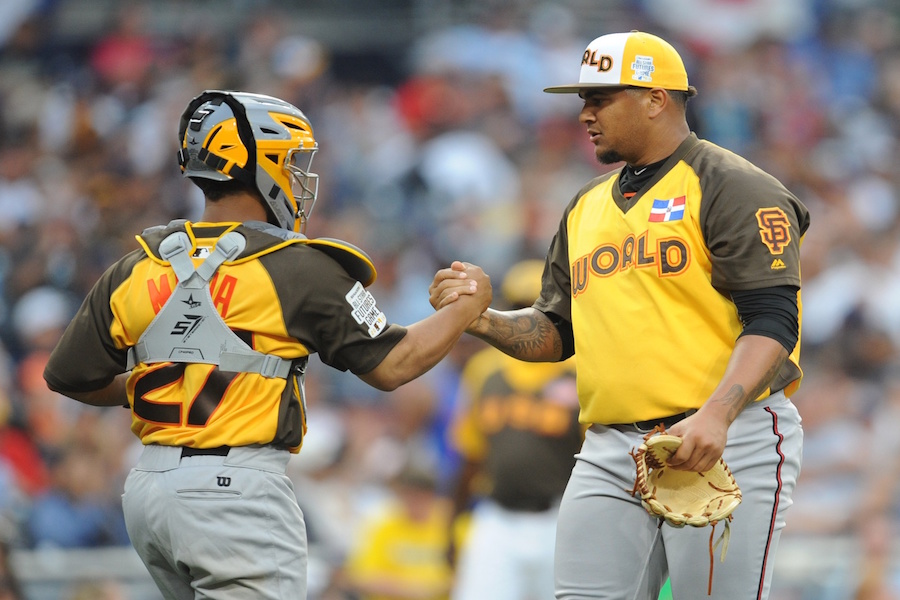
    Image courtesy of Gary A. Vasquez, USA Today

    Twins Video

    Berrios has been uneven, at best, in his initial exposure to the majors. Hopefully he'll find his way. Regardless of what happens with the electric youngster, the Twins are going to need much more quality pitching in order be considered a credible contender within the coming year or two.

    Here's an in-depth look at five prospects that could be considered the next wave, when combining closeness and caliber. At the end, we'll review some conclusions that can be drawn from where things stand with the foremost incoming arms.

    Adalberto Mejia, LHP (23) - Class-AAA Rochester

    Mejia, who came over in the Eduardo Nunez trade, was a particularly important addition because he slots into a Rochester rotation that is otherwise devoid of potential impact talent. Jason Wheeler, Pat Dean and Logan Darnell may get some looks but they are marginal big-leaguers. Mejia could really be something.

    He's a big, sturdy, durable left-hander with good breaking stuff and an improving strikeout rate. He has made 10 starts at at Triple-A and has mostly looked up to the task, commanding the zone and inducing plenty of swings and misses. He is closest to the majors among Minnesota's higher-tier pitching prospects. Most believe he'll end up being a mid-rotation type if he pans out, though.

    Stephen Gonsalves, LHP (22) - Class-AA Chattanooga

    While Mejia is closest to the big leagues, he is not Minnesota's top pitching prospect. That honor, almost indisputably, goes to Gonsalves at this point. The southpaw ranked sixth on our preseason Twins top prospect rankings and has done nothing but enhance his luster this summer. He made short work of the Florida State League in his second stint with the Miracle (2.33 ERA, 0.96 WHIP in 11 starts) before moving up to Chattanooga and not missing a beat (2.01 ERA, 1.19 WHIP in nine starts).

    The jump from Single-A to Double-A is considered perhaps the toughest for prospects, especially for a pitcher like Gonsalves who is said to lack a quality breaking ball. The lefty is simply dominating from his 6'5" frame and has been on an insane run lately with a 4-0 record and 0.80 ERA over his past seven starts.

    In total this year, he has held opponents to a .187 average with three homers in 119 innings.

    The fast-rising 22-year-old is prone to command issues that will likely become more pronounced as he starts regularly facing more patient hitters (by his own admission he got some help in his last outing – a complete game victory – because opponents "kept swinging at anything close to the zone") but that's not unusual for someone his age with his body type.

    Gonsalves is the kind of guy that scouts would describe early on as "projectable," meaning that he had big room for improvement with his tall lanky build and improving feel for pitching. He is now turning into exactly the pitcher that evaluators optimistically projected. His ceiling exceeds any other starter in the system and it wouldn't be a huge shock if he got a look this September.

    Tyler Jay, LHP (22) - Class-AA Chattanooga

    Jay was a gamble. With the sixth pick in last June's draft, the Twins took the Illinois closer just ahead of Andrew Benintendi, who is currently batting .350 for the Red Sox, and Carson Fulmer, who mowed through the minors and has been on the White Sox roster for a month.

    Rather than go after the dynamic offensive talent or the established collegiate starter, the Twins decided to pick Jay with hopes he could successfully transition into a rotation piece. The results, thus far, have not been great.

    After signing, Jay went to rookie ball and finished out his season in his familiar relief role. This year the switch to starting got underway, and right now there is no indication that it will stick. Jay pitched well, albeit not amazingly, for 13 starts in Fort Myers before moving up to Chattanooga. There, he made two starts and a few relief appearances before being shut down amidst some pain. He was diagnosed only with nerve irritation in his neck, which is mostly good news but still not entirely encouraging.

    In 15 starts between Single-A and Double-A this year, Jay pitched past the fifth only five times. He never exceeded 100 pitches. And at the end of July, with 83 total innings thrown, he came down with neck and shoulder problems. At the very least, this looks like it is going to be an extended project. Meanwhile, the players that Minnesota passed up to select Jay have rocketed to the big leagues and are already auditioning for prominent roles in 2017.

    Not ideal.

    Kohl Stewart, RHP (21) - Class-AA Chattanooga

    When the Twins made Stewart the top high school player selected in the 2012 draft, no one really balked at the decision. He was widely viewed as the best prep arm in the nation. He lived up to his billing with a nice debut in rookie ball, and with a little projection, one could envision the athletic teenager growing into a frontline starting stalwart.

    But he really hasn't developed. Sequencing, approach and fastball movement have enabled Stewart to continually achieve good results while climbing the minor-league ladder, but his peripherals have lagged behind. Strikeout-to-walk ratio isn't everything but it says a great deal about the sustainability of good performance and Stewart's 1.90 career mark is flat-out unimpressive, even when you ignore the expectations and pedigree. A 14.9 percent overall strikeout rate in full-season baseball just doesn't equate to a premium prospect, and that's mostly why Stewart has fallen off every list.

    He's still young – one of the younger starting pitchers in the Southern League at 21, in fact – so there is time for Stewart to improve and find a way to overpower pro hitters. The innate ability is there, I think. But he's not really one to count on at this point.

    Felix Jorge, RHP (22) - Class-AAA Chattanooga

    A skinny hurler who also has never missed many bats, Jorge is not any analyst's idea of a premier prospect talent, but he deserves mention because of his consistent penchant for getting outs. Like the three above him on this list, Jorge has reached the Double-A level by age 22, a noteworthy feat. He was fantastic earlier in Fort Myers, posting a 1.55 ERA in 14 starts, and has performed well enough with the Lookouts following a rocky debut.

    In the past, Terry Ryan has compared Jorge to current Twins starter Ervin Santana, noting similiarities in their build and fluid mechanics. Given his youth and sterling results – he has a 2.68 ERA in 278 innings dating back to the start of 2015 – Jorge demands some attention, but he has tallied a lackluster 213 strikeouts during that span. In order to become a real factor in the rotation conversation over the next couple of years, he's got to find a way to start missing some bats.

    SUMMARY

    Berrios was the clear prize of the Twins pitching prospect pool. The jury is still very much out on him based on his stunningly poor early results in the majors, but of course there is plenty of time left.

    His troubling transition increases the urgency of finding potential rotation-fronting talent. The Twins will head into 2017 with few reliable commodities. While the organization could certainly be worse off with their top upcoming pitching talent than the five names listed above, especially after graduating the top arm, none of them realistically boast No. 1 or No. 2 starter upside, other than maybe Gonsalves.

    The free agent market for starting pitching this winter is lacking at the high end, especially with Stephen Strasburg inking an extension in Washington. Options will be limited for finding true impact arms. This is why I feel that the Twins need to consider a major shakeup via trade – such as trading Brian Dozier this offseason – in order to infuse more pitching promise into the system.

    Follow Twins Daily For Minnesota Twins News & Analysis

    Recent Twins Articles

    Recent Twins Videos

    Twins Top Prospects

    Riley Quick

    Fort Myers Mighty Mussels - A, RHP
    Start #3 for the 21-year-old went well again. He tossed three scoreless innings with no walks. He gave up one hit and had three strikeouts. In 8 IP through 3 starts, he's given up 0 runs, 1 hit, 3 walks, and 13 strikeouts.

    User Feedback

    Recommended Comments


    Featured Comments


    The same could have more or less been said about B.J. Hermsen, until his lack of ability to miss bats caught up with him. I'd honestly be curious to know how many pitchers that had a <16% K-rate or a sub-2 K/BB ratio in the minors have made a meaningful impact as big-leaguers in the past decade. I don't have time to do the research but I'm guessing the percentage is very small.


    Few, if any. I'm not sure of any objective reason why Stewart is even a top 20 Twins prospect at this point.


    He mentions it a couple times on the front-end of his podcast here:  http://www.1500espn.com/the-scoop-2/2016/08/the-scoop-twins-gm-update-plus-rob-antony-and-cole-aldrich-join-ep-33/


    Both before and after the Antony interview. 

    Podcast? I don't have time to listen to that, so I'll just take your word for it. lol

    Tyler Jay is looking a lot better DIllon Tate. Tucker at #5 is not ripping it up either.


    Tate has a 4.39 ERA and has not reached AA. Only 7.5 k per 9 and 3.7 BB's.


    Tucker has a .711 OPS and is in A ball. Stealing a lot of bases.


    And Jay's numbers have been better than Fullmer's by a pretty wide margin.

    Edited by tobi0040

    Another note about Tate: He has already been part of a trade. His value has already been maximized by the team that drafted him. For better or worse it's hard to picture the Twins trading a Jay, Stewart, or Gordon or whoever while they are still raw and fairly unknown quantities. 


    I believe he got sent back down this morning too. Not sure what the White Sox were thinking with him, or what they're thinking with Zach Burdi either. 

    Well, Sale, Quintana, and Rodon all came up quickly too, and it's hard to argue with their results too much.  The White Sox like to develop guys at the MLB level.  Even if they fail, it's not necessarily a bad decision -- they may have failed later anyway, and there is value to the White Sox to know that sooner rather than later.  I definitely disagreed on Fulmer, but I've got to respect the White Sox commitment to this particular plan/method of theirs.

    Failing early is one of the great secrets to successful companies, they limit their time and resources spent on bad ideas then. I'm not certain it totally applies to prospects, but it is why I'd rush them thru low A and high A, and have them spend more time in AA and AAA.


    Failing early is one of the great secrets to successful companies, they limit their time and resources spent on bad ideas then. I'm not certain it totally applies to prospects, but it is why I'd rush them thru low A and high A, and have them spend more time in AA and AAA.


    I think it depends. I'm definitely more of a case by case basis on a lot of this as everyone has extenuating circumstances which makes these decisions difficult. The goal isn't to minimize time spent on mistakes but to maximize development for everyone. The biggest issue with a global type approach to this is that there are always going to be examples of where a specific policy fails a specific prospect. That's why I think it really depends on the prospect.  I think your approach will work better with most college guys, but for high school guys, that doesn't make as much sense (and of course there are exceptions with both groups). 


    Keep in mind that for every guy that gets pushed up, someone else gets pushed out. That's what really makes it difficult, even more so at deeper positions.

    Another note about Tate: He has already been part of a trade. His value has already been maximized by the team that drafted him. For better or worse it's hard to picture the Twins trading a Jay, Stewart, or Gordon or whoever while they are still raw and fairly unknown quantities.

    I don't agree a trade means they maximized his value. His struggles were reflected in the return.

    Gonsalves helped prove your point tonight, Nick!  Fairly solid 6 inning, no hit, 2BB, 9K performance. Too bad his pitch count got up there!


    While Mejia is closest to the big leagues, he is not Minnesota's top pitching prospect. That honor, almost indisputably, goes to Gonsalves at this point.

    Gonsalves is in a similar spot as Berrios in 2014 splitting the season between A and AA. It still may a lengthy path towards major league success.

    And oddly enough Gonsalves looks far better in AA than Berrios did initially. In 2014 for New Britian Berrios went 3-4 in 8 starts with a 3.54 ERA and only 28 strike outs in 40 innings. I honestly expected Gonsalves to "struggle" like that, but instead he has gone from an A+ call up to the ace of the staff in Chattanooga in 10 starts. He HAS to be better than what his scouting report said at the beginning of this year. Of course he still has to work on his control. But if that is really all that is keeping him from the majors he defiantly might be even better than we imagined even going into this season.

    I guess I'm not seeing this. It strikes me more as a statement of hype. The two are the same age, and Gonsalves is sitting in AA instead of A ball (yes, I know an injury was there). Results are a mixed bag. Both limit homeruns (with Romero slightly better). Gonsalves gets more Ks. Romero has less walks. WHIPs thus far are nearly identical. Not that Romero isn't a bad prospect, but I'm really not sure just how much higher said ceiling is.

    As a general rule of thumb, the farther away from the majors a player is, the better a player he'll be, and thus should be moved through the system faster.

    That's why when people ask or feel bad why Terry Ryan lost his job this is the reason you named only 2 players out of how ever many that were better than Tyler Jay that's terrible. The way I see it and been preaching for quite some time is that our cupboard is bare when it comes to pitching and wonder why we keep signing people or trading for the likes of Santiago who is awful by the way but this is scarry I agree it's time to trade dozier and get some pitching Cuz we can't win if we can't have a starter pitch more than 5 innings and name a pitcher besides Brad Radke that Terry Ryan drafted who was mediocre also you can't. We haven't had anybody I hope it changes.


    Again, the point here was more relating to workload progression and timelines than picking apart small-sample minor-league stats. 


    Maybe both of these guys are bound for the bullpen. If so, then the Twins still passed up Benintendi, who has clearly developed into one of the game's better OF prospects. The pick just doesn't look very good right now. 

    I think the Twins messed up drafting Buxton when they could have had Seager, Giolito or Russell. Shoulda coulda woulda's aren't cool. We drafted Gibson over Mike Trout.


    I think he's harsh on Tyler Jay like others here - he was going to take some time to make the transition. Also, some teams promote more aggressively, as the White Sox have demonstrated.


    But it's also a big concern that two players drafted immediately afterward are already in the majors. 


    Indeed, many of the players drafted during the team's run of awfulness have yet to make the majors, or even AAA, or be effective once they get there (Berrios and Buxton). Meanwhile, teams like the Texas Rangers, the New York Mets and others are thriving with recent draftees.


    We can't get a new GM and regime fast enough ...


    Every team that drafts the #6 prospect each year has fans that complain about the couple of guys drafted a few picks later that have better careers than their guy. It may be that Benintendi has the best career of any player in that draft. So fans will call for the heads of GM's across the continent I guess. And it's not a race about who gets here first. Jay is progressing at a normal clip. Berrios and Buxton are terrific picks, looking retrospectively or otherwise. The Twins have not had an awful draft now for a decade now. Well, maybe one. Practically every team in baseball had an awful draft the year Levi Michael was drafted. The Rangers, Mets, and ohers have also had an awful draft during this period. It happens.

    Every team that drafts the #6 prospect each year has fans that complain about the couple of guys drafted a few picks later that have better careers than their guy. It may be that Benintendi has the best career of any player in that draft. So fans will call for the heads of GM's across the continent I guess. And it's not a race about who gets here first. Jay is progressing at a normal clip. Berrios and Buxton are terrific picks, looking retrospectively or otherwise. The Twins have not had an awful draft now for a decade now. Well, maybe one. Practically every team in baseball had an awful draft the year Levi Michael was drafted. The Rangers, Mets, and ohers have also had an awful draft during this period. It happens.

    Some high picks, like Buxton, are pretty obvious at the time. Those, I agree are unfair to rip in hindsight.


    I think a pick like Jay is a bit different though. That was a questionable and risky pick at the time, so I think it's perfectly fair to continue to question the pick if it doesn't work out.


    Typically, if your top ten pick turns out to only be a reliever, it's usually a bust. 


    Historically, three of your top ten picks never see a day in the majors, and couple of the top ten pitchers always end up as relievers, so while it would be a disappointment to end up with Jay being more Perkins-like, that's just part of the whole shootin' match. Caveat: anecdotally, it seems like the predictability of these top picks is improving recently, at least when it comes to the college guys from elite programs.


    Some high picks, like Buxton, are pretty obvious at the time. Those, I agree are unfair to rip in hindsight.

    I think a pick like Jay is a bit different though. That was a questionable and risky pick at the time, so I think it's perfectly fair to continue to question the pick if it doesn't work out.


    Yes, I'd agree with that take. Without an ounce of knowledge and armed with a few paragraphs of information, I had an uneasiness about Jay that I don't think I would have had with Fulmer or Benintendi as the pick. It'll be interesting to see if we get some hints about what the new guy thinks of Deron Johnson and his top scouts, and whatever we learn about changes they make in the process are going to be fun to discuss.


    The Twins have not had an awful draft now for a decade now. 


    That's a real low bar you're setting there. 


    The Twins have been bad for several years now. When they get these high draft picks, they have to hit on them. 


    Only two players in the team's draft from those four straight 90-loss seasons, Buxton and Berrios, have made the majors. Neither has done particularly well.


    Meanwhile, EACH of the Chicago Cubs' top draft picks from 2011 through 2014 are currently in the majors, contributing strongly to the big league club. 


    Want to know the difference between the Twins and the Cubs? It's not how much money the teams are spending. Its their respective abilities to hit on draft picks and young players. 


    I understand it's way too early to call either Berrios or Buxton a bust. And I'm certainly not writing off Tyler Jay. But this team cannot afford to have mediocre draft results when it has high draft choices. That is not going to fly. You have to hit on those guys. Period.


    You don't see how I can draw the conclusion that the Thins have drafted terribly? I didn't think that was a secret.


    We see this statement around here all the time. Frankly, I think it shows a level of myopia, and here's why:


    For starters, terrible compared to whom?


    Kiriloff

    Jay

    Gordon

    Stewart

    Berrios

    Buxton

    Michael

    Wimmers

    Gibson

    Hicks


    Ten year's worth of picks. Surely, there's lots to quibble about, for example Fulmer instead of Jay. But to say that they've made terrible decisions? At the time of almost all of these picks, I believe you would find more commentary from the draft experts applauding the decision than you'd find criticizing the choice.


    The last four, Michael, Wimmers, Gibson, and Hicks, have been constantly touted around here for years as the poster children for how crappy our GM is (because he obviously single-handedly selects these guys, we all know that). No consideration seems to EVER be even begrudgingly offered by critics for EITHER the draft order OR the quality of the draft that year. And it's almost ALWAYS a criticism that doesn't allow for comparison. But that doesn't stop many critics from continuing with the narrative that the Twins are exceptionally bad at it, and the main retort to my pushback is the current record, as if no other factors could even possibly be the main source of the problem. No, bad draft decisions simply HAVE to be a big contributing factor to the teams struggles, they say.


    And so, I keep asking people to go back and review those four drafts, 07'-'10, and make a list of the 5 players taken after Michael, Wimmers, Gibson, and Hicks. Now, if the Twins were all that bad, wouldn't you think that a majority of those 20 selections would be productive players? Certainly, half of them at least? I have yet to get a response. Not once. 


    My theory is that, by Taildragger's definition, almost ALL teams are terrible drafters over this ten-year period of time. Because, maybe their Gibson and their Hicks were not all that impressive and it goes unnoticed that, if looked at fairly, that was pretty much the best they could do in that particular draft given their particular order in that particular draft.


    So, c'mon guys, go ahead. Go out to the '08 draft and tell us who which two prospects they should have considered within a few slots after Gibson if they had any brains in their heads. And if you mention some Cy Young winner selected in the 37th round, you deserve to be banished for life. :)


    yeah i thought about him as well.  Last i heard his rehab was not going super well.  Progress very slowly.


    Well, not going well but not for the obvious reasons. He got mono so they shut him down for a month. Too much making out for the Aussie sensation I guess.


    Hughes, Duffey, May, and Gibson are still under contract in 2019 and Santana has a option... 


    Not to rain on your parade of dreams, but... 


    1.) Santana has a team option of $14 million. That is no barrier and presents only opportunity for the Twins. I imagine most of doubt the Twins will be picking up that option as Santana will be 36.


    2.) Hughes seems to have a decent chance of ending up in the bullpen by the end of his deal. Might not be the worst thing as he has had success there.


    3.) To be honest, Duffey also profiles like a guy who might be excellent in the pen and not as good in the rotation (shaky third pitch). There have been rumblings from scouts ever since he was drafted. He'll get his chances to start in the next 2.5 years but I don't see him as a real hard barrier to any promising young guy if he keeps pitching like he does.


    4.) Gibson will be a prime trade candidate over the next few years. He's got team control but if the Twins start getting young guys who are cheaper and ready, he could very easily be dealt. And if he's the pitcher he's been over the past few years (#4 starter?), I don't see him being a huge barrier.


    I guess overall I'd just say that if any of these guys block the young guys (assuming they succeed of course) it will be because the vets are pitching well. That's a nice problem to have.


    Historically, three of your top ten picks never see a day in the majors, and couple of the top ten pitchers always end up as relievers, so while it would be a disappointment to end up with Jay being more Perkins-like, that's just part of the whole shootin' match. Caveat: anecdotally, it seems like the predictability of these top picks is improving recently, at least when it comes to the college guys from elite programs.


    I think you vastly underestimate how often top picks reach the majors and make contributions. From 2002-2009 all first round picks (including the first round supplemental picks) reached the majors 64-82% of the time. Going earlier than 2002, most first rounders reached the majors at about 55-65%. Nearly every top ten pick at least gets a cup of coffee. Heck, since nearly every first round has 40+ picks when including the supp round, if the 20th pick doesn't reach the majors that's a bad pick. 73% of all #6 picks have reached the majors (78% if you remove the three most recent #6's.) and average 14 career WAR per major league player. There is a reason why Andrew Miller was seen as a draft bust. 


    That's a real low bar you're setting there. 


    The Twins have been bad for several years now. When they get these high draft picks, they have to hit on them. 


    Only two players in the team's draft from those four straight 90-loss seasons, Buxton and Berrios, have made the majors. Neither has done particularly well.


    Meanwhile, EACH of the Chicago Cubs' top draft picks from 2011 through 2014 are currently in the majors, contributing strongly to the big league club. 


    Want to know the difference between the Twins and the Cubs? It's not how much money the teams are spending. Its their respective abilities to hit on draft picks and young players. 

    You’re comparing apples and oranges here and I’m also not sure that your conclusions are as clear as you try to make them. To whit:


    The Cubs took the following: 2011 HS hitter, 2012 HS hitter, 2013 Coll hitter, 2014 Coll hitter
    The twins took the following: 2011 Coll hitter, 2012 HS Hitter, 2013 HS pitcher, 2014 HS hitter


    1.) In 2011 the Cubs picked 9th and the Twins picked 30th. Kind of hard to compare a top 10 pick with a dregs of the 1st round pick. If you look 1987 to 2013 (ignore the past few years because guys are too young and before 1987 because draft rules changed) guys picked #30 make the pros 55% of the time and of those who do, they produce an average of 6.2 WAR. Guys picked #9 make the pros 75% of the time and those who do produce an average of 10.6 WAR. So it’s hard to blame a team for having a worse pick at #30 than the team that drafted #9. Not sure why you’d even include 2011 in your decidedly arbitrary sample.


    2.) As for 2012, I’m pretty sure that if the Cubs called up the Twins today and offered to trade 2012 1st round picks, the Twins wouldn’t have time to laugh before hanging up the phone. Albert Amora is a nice enough player but his minor league numbers are nowhere near Buxton’s – he profiles as a 4th OF or defensive CF (OPS in low .700s in upper minors, no track record of stealing bases, limited power). And I’m not sure he’s a good example for your point either – he has fewer MLB at-bats than Buxton and his OPS+ of 89 is below average (and without the minor league success that makes Buxton intriguing). So the Twins got their guy to the pros first and he seems more likely to be a long-term core piece.


    3.) As for 2013 and 2014, college hitters make it to the pros the fastest of any draft picks so comparing the current status of two college hitters vs a HS pitcher and a HS hitter is pretty disingenuous. Stewart and Gordon both look poised to be in AA or AAA next year, right about on track for players drafted out of HS. Schwarber and Bryant are great picks (important to note that the Cubs picked before the Twins both years so the Twins had no shot at either guy and perhaps would have taken them if they were available) but you can’t say that Stewart and Gordon might not be better in five years. Comparing HS and college prospects in the short-term is bogus.


    4.) Well okay, even if Gordon is an all-star, Stewart isn’t going to be as good as Bryant. But that’s the other part. The Twins aren’t the Cubs and can’t take all hitters and then just buy elite pitching – they’re in different markets. The Twins have consistently had to use high picks on pitching, the most unpredictable of gambits while the Cubs have the luxury to focus on elite position players, a much more predictable resource. Kohl Stewart looks like the biggest bust of the 8 (Levi Michael was a 30th overall pick, hard for me to include him as a bust since it’s a coin toss guys drafted where he is are MLB regulars) but that’s not surprising since he’s a HS pitcher. It's a gamble the Twins have to take if they're going to build a playoff rotation.


    Overall, I think this is a bogus way to look at the draft. You are grading very different types of fruit (where picked, age etc.) on a single scale because it gives you the result you’re looking for.


    Edited by ThejacKmp


    Create an account or sign in to comment

    You need to be a member in order to leave a comment

    Create an account

    Sign up for a new account in our community. It's easy!

    Register a new account

    Sign in

    Already have an account? Sign in here.

    Sign In Now

×
×
  • Create New...