Jump to content
Twins Daily
  • Create Account
  • Twins News & Analysis

    On The Twins' Cheapness And Showing Your Work


    William Parker

    I want to talk about the Twins and payroll, and how we talk about the Twins’ payroll.

    It’s been about a month since Jack Moore wrote the excellent and scathing The Minnesota Small-Market Con over at Baseball Prospectus Milwaukee. The points it makes are numerous and wide-ranging -- the most important, I think, is “if the billionaire Pohlads had been willing to take a short-term loss, they could have made their way out of the Metrodome years earlier without taking the public for such a ride" -- but being published as it was in the latter part of an offseason in which fans have watched the team take very few substantial visible steps toward getting better, most seemed to take it as a chance to complain about the team's unwillingness in recent years to spend on free agents.

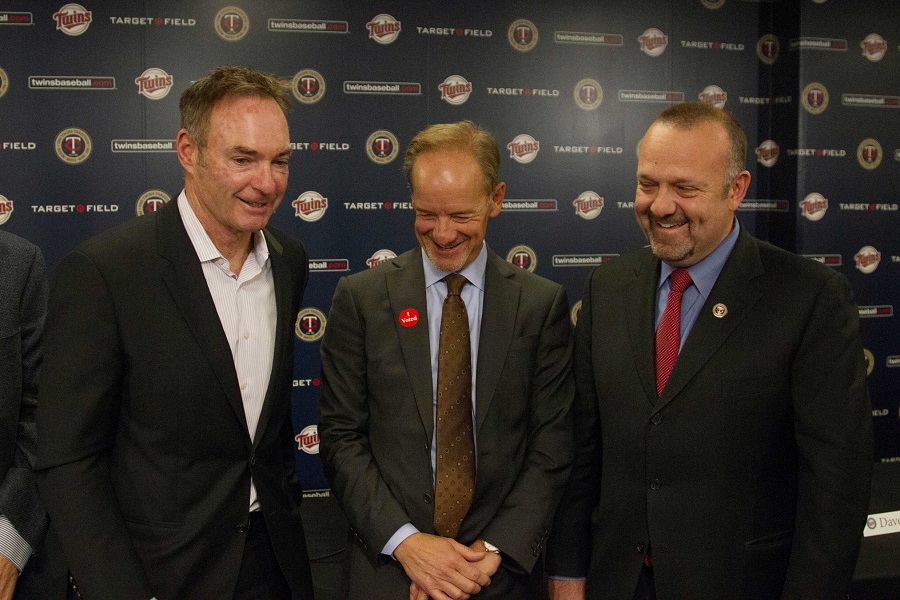
    Image courtesy of Brad Rempel, USA Today

    Twins Video

    And I get it. Having taken the public for said ride and secured a stadium that is maybe the most appealing in baseball, the Twins (per Cot’s Contracts) ended their first two seasons in Target Field with top-ten payrolls, but then fell back to 13th in 2012, and haven’t been out of the 20s since. While attendance predictably declined from 2011 to 2015, it seems a safe bet that they could generally have spent more money than they did in those years and still turned a nice profit.

    The problem I’ve always had, though, is that this (at the most) is generally where the fan’s analysis stops. They could have spent more money, but they didn’t, and they should have. The obvious next questions that gets left on the table, though, are “on what?” and “why?”: what could that money have gotten them, and what makes it a good idea? The 2011 Twins had a $115 million payroll and were coming off a 94-win, first-place year, but with injuries to almost literally everyone -- only Danny Valencia and Michael Cuddyer would play as many as 120 games for the Twins in 2011 -- they lost 99, finishing a whopping 28 games out of a wildcard spot, and it was pretty clear their window had slammed shut. They lost 96 in both 2012 and 2013 (22 and 26 games out of the playoffs, respectively), and 92 (18 out) in 2014. Their season-ending payroll declined, meanwhile, from 9th in 2011, to 13th, to 24th.

    But, again, what could and should they have spent more money on, and what could we have expected it to bring them? In a league in which the very best player might be worth about nine wins and four is a typical All-Star, the Twins would’ve had to add the equivalent of four or five All-Stars, two Mike Trouts, or some combination thereof (assuming each of them takes the place of true replacement-level players, to boot) in order to have had any chance at a postseason berth in any of those years. That’s not the kind of thing that’s ever happened via free agency--teams have tried, typically with disastrous consequences (check out the turn-of-the-century Devil Rays sometime).

    But what if the postseason isn’t the goal? What about just putting a marginally more entertaining product on the field? I question whether that’s a thing, personally--it’s the competing that draws the crowds, the Timberwolves are as entertaining as a bad basketball team can get right now and not drawing substantially more than their terribly depressing squads of the last couple years did--but I get that, too. It’s not as though a team puts those savings in an interest-bearing account and adds them to the pot for next year. They would, in a perfect world, but they don’t; those savings go to the owners, and the next year’s budget is its own thing. So to the extent you’re concerned only about this season, yes, you as a fan should want the team to spend as much money as they can possibly get away with, because that money’s gone for your purposes after the season either way.

    The problem with that is that the one-year deal for a good (or even just “entertaining”) player exists in baseball only when that player comes with huge risks. Most free agents worth signing as anything more than filler in this game demand commitments of three years, or four or five or more. Most free agents are also in their 30s, which means almost without exception that they’re likely to get worse over those three to five years, not better. What that means is that most of the free agents the Twins could’ve signed to make them marginally better or more fun in 2013 or 2014 would still be getting paid as Twins in 2016, and would be less good or fun now than they were then (but probably making at least as much money). When you don’t expect to win, you probably shouldn’t (and can’t, to field a team that avoids challenging the ‘62 Mets) stop spending entirely. But your focus in spending, way ahead of getting better for the now, has to be to avoid hamstringing the team in future seasons, when -- if your prospects pan out and you’re not too bogged down by aging players’ contracts -- you might be positioned to spend to fill more immediate needs and make a run at it.

    In that light, I tended to think the Twins’ spending from 2012 through 2014 was just about perfect--a weird thing for me to say, as I’ve never been one to go easy on the front office (Tony Batista and Ruben Sierra? Seriously?). In 2012, there was just a long, black-dark road ahead, and nothing to do but fill a couple of the gaps to try to be interesting and wait it out. And that’s exactly what they did, bringing in Josh Willingham (who worked) and Ryan Doumit (who didn’t) to fill in for the departing Michael Cuddyer and Jason Kubel, and otherwise just stayed put and take their lumps. Heading into 2014, with Byron Buxton, Miguel Sano and others now on their way, it made sense to take a look at some relatively low-risk, 30-or-younger free agents who could reasonably be expected to be contributing at about the same level a couple years down the line, and they did that, bringing in Phil Hughes (who I’d argue worked) and Ricky Nolasco (who thus far clearly hasn’t), along with more stopgaps like Mike Pelfrey and Kurt Suzuki. For whatever else the Twins have done right or wrong, this is exactly how a non-contending team should spend its money. Should they have spent more of it? Perhaps--but it’s on the one arguing they should to identify where they should’ve spent it and why. Whining that they’re cheap and run by billionaires just doesn’t cut it; they’re losing ninety-plus either way. Show your work.

    I’ve left out 2015 so far, of course, and that’s a tough one because we know how it ends: the Twins win 83 games, surprising everyone, and miss the wildcard play-in game by just three wins. They entered the last week with a real shot, and as it turns out, even one modest upgrade in the offseason could have gotten them there. That’s cheating, though: the Twins didn’t know how it would end, and I really think they were looking at 2016 or 2017 as their next legitimate chance, and so they stayed the course, bringing in 32-year-old Ervin Santana to add to their stable of average starters who seem likely to still be about average by the next time they thought they’d be competitive. Were there moves that not only could have put them over the top as things turned out, but that they should have made in December or January 2014-15, knowing and believing what they reasonably did then? Maybe! But I’d like to know what those specifically were. (Note also that a first half from Santana might itself ultimately have put them in the playoffs.)

    So that gets us to today. I’ve been as frustrated as anyone with the lack of activity: Byung-Ho Park is certainly interesting, but hardly fills a glaring need, and there’s not much else that’s even worth mentioning. It feels much like a team with two third basemen and three or four 1B/DH types, which seems to suggest moves to be made, and I would’ve loved to see them land, say, Darren O’Day, an elite reliever who signed a four-year deal to stay with the Orioles similar to the ones the Twins gave Santana and Nolasco. But: O’Day is 32 years old, and at his very best -- at any modern reliever’s best -- is worth about three wins. The Twins had a lot of luck last year, and while I’m looking forward to seeing what they can do in 2016, there’s good reason to believe they’re not quite there yet, with or without the upgraded bullpen. If, as Baseball Prospectus’ PECOTA expects, they go 79-83 and miss the playoffs by seven games, O’Day probably wouldn’t have made a difference, and neither would most anyone else. And then what about in 2018, when Buxton and Sano are MVP candidates, but O’Day is 35 and ineffective, while his $9 million salary helps prevent you from signing that year’s Darren O’Day, who could be the difference between an LDS loss and a world championship?

    I have no answers. I thought they should have done more this offseason, and I sure hope that they do well enough that there’s a worry it might come back to bite them. But too often, we collectively seem to want the team to spend more money without considering a.) the limits of what that spending can actually do, or b.) the risks down the road of imprudently committing money now. Fans can complain that the team is cheap all they want -- and why not, it’s just baseball, it’s all in fun, you do you -- but without an idea of how they should spend that extra money, why they should and what might happen if it goes bad, all it is is whining for whining’s sake. Seems to me it’s more fun, more instructive, and, at least in this case, harder to argue with the plan, if you show your work.

    Follow Twins Daily For Minnesota Twins News & Analysis

    Recent Twins Articles

    Recent Twins Videos

    Twins Top Prospects

    Marek Houston

    Cedar Rapids Kernels - A+, SS
    The 22-year-old went 2-for-5 on Friday night, his fourth straight multi-hit game. Heading into the week, he was hitting .246/.328/.404 (.732). Four games later, he is hitting .303/.361/.447 (.808).

    User Feedback

    Recommended Comments


    Featured Comments

    I think most of the guys listed below, that have been signed in the last couple of years, would have helped.  I know this list is kind of cherry picked for guys that have worked out, but most of them were at the top of their free agent class where the twins are unwilling to spend.


    David Price

    Brian McCann

    Andrew Miller

    Russell Martin

    Jose Abreau

    David Robertson

    Justin Upton

    Hisashi Iwakuma

    Joaquin Benoit

    Adrian Beltre

    Yu Darvish

    Yoenis Cespedes

    Jon Lester

    Jhonny Peralta

    Zack Greinke

    Scott Kazmir

    James Shields

    Hunter Pence


    So you spend $400 million on Price and Greinke; lock them up for eight years; and what would have happened? You go from a 70 win team to a 85 win team? Still might not be in the playoffs. And you've financially put yourself in a major bind when their skills are rapidly dimishing and Sano, Buxton, Perkins, etc are looking at new contracts. Bad, bad idea. Skip the spending when you aren't winning and possess a great farm system. If Sano and Buxton hadn't both missed 2014, this might have been year 1 of a long reign. Instead, start planning for 2017 and the free agent class of 2018.


    so I won't read "there wasn't anyone good to sign, it was a terrible class" all off season next year?


    You can probable read anything you want to and we all look forward to the responses.


    But I do think it is possible they won't really have such a need that would make overpaying for a free agent a good use of resources. Much more likely we see money being applied to signing the young guys to extensions.


    But they don't know where the holes are. Everyone wanted the bullpen upgraded even though there are at least a half dozen young arms who might excel in that role. Or they might not. We don't know yet, I'm OK waiting to find out.

    You're not wrong. What I was saying is that they signed some starting pitchers when they shouldn't of. I think this often, but try not to say it. To much hindsight. To easy to say now. I did not think those teams could of been competitive either, so that colors my views as well. If you run the Twins you can't really say you're punting this year, but still want people to buy season tickets. 

    I take it back. We should really just discuss what the Twins should do from this point forward.


    You look back to 2011 or 2012 and think, if we were bad to the point of:


    -No money should be spent to upgrade the roster because we were that bad


    -We had next to nothing on the way from the farm to help


    That means a 3-5 year spell of being awful. There is literally no way around it.  We really, really should have traded 28-29 year old Joe Mauer.  Now I get that this looks brilliant in hindsight.  But We had to know that a 33-34 year old Joe was not going to be the same player and likely not catching anymore, so it should have been explored.  I get the PR issue.  But I am not sure fans would be too irate nowadays.


    I am not a toe in the water type of guy.  You are either in or you are out.

    Yeah, but the Twins needed someone to put fans in the seats. Joe "MVP batting title" Mauer put fans in the seats. A team of forgettable cheap FA's does not. Also, what happens when you actually get to the point of needing to sign FA's and you've a reputation of signing people who are nothing more than MLB filler? 


    Heck, the Twins may have already paid the price for having that reputation.


    Ordinary MN Twins fans are not as knowledgeable as the fans on Twins Daily. Admit it, we're all baseball junkies to a certain extent. We all understand the need to dump players and start the rebuild.


    Management, however, still needs the casual fan to attend games.*


    *My $.25. Even with inflation, we all know what it's worth.


    You've been asking for bullpen upgrades all off season, how were Stauffer's 2013-14 numbers really much different than the guys you wanted this year?


    Stauffer wasn't any good last year, that happens all the time with free agent relievers, more so than any other position.

    I think I just posted somewhere today how Stauffer's 2013-2014 was very different from the guys we wanted this winter.  He was a mop-up man (and spot starter) in San Diego.


    I see this said a lot but I can't really agree with it.


    If you're a team looking for mid-season help, how much more are you willing to give up for a Liriano, Morneau, or Willingham if the other team tacks on $3-4m? In my eyes, it's not much. Instead of getting the 14th best prospect, they offer up their 12th best prospect.


    On the other hand, the Twins just handed away $3-4m for a prospect who might be worth a handful of dollars more than the prospect they'd receive without giving up a dime. Sure, it's not my money and all that but that's a pretty bad deal for the Twins. They're handing away millions to get thousands in return.


    Now, this might work on occasion when a team is searching the couch cushions for mid-season cash but I suspect that situation arises infrequently. If it comes down to $2-3m and a late-season run, what owner isn't going to spring for that cash? It's likely they'll make it right back in fan attendance in August and September as everyone comes to watch a competitive team make a run at the postseason (never mind the increased ticket sales and revenue that bleed into the following season).


    This argument seems like a good idea in theory but I don't think it's quite that cut-and-dry in reality.

    I agree that this is all dependent on the right situation, and from the outside we don't have a good handle on how frequently those situations show up. But as a pseudo-rebuttal, I would point out that:


    a) Tacking on $3-4M probably isn't going to net a huge increase in prospect value, but it might allow you to significantly increase upside potential. So instead of having to choose from a list of unexciting mid-20s AAA players, you could choose from rookie-ball teenagers with some upside. Overall expected value might not be very different, but much high potential payout.

    B) It isn't just improving the quality of the return, but also increasing the total number of prospects thrown in. Essentially this allows them to buy additional talent.

    c) Yes, owners may bump up spending a little bit to make some deadline moves, but many teams (Pit, KC, TB, Cle, et al) do have fairly firm limits. So the extra $3-4M that the Twins could cover would be the difference between those teams making, for example, three moves instead of just two at the deadline. It at least maximizes the teams in the conversation, and it allows the opposing GM to make the determination of what is more important to them in the moment: money or future prospects.


    Unfortunately, I believe Terry Ryan is on record of explicitly rejecting the possibility of paying players to play for other teams.


    Unless the Twins operate their finances different than I currently understand, the money they save during these trades provides ZERO benefit for future teams. Marginal improvements in quantity or quality, even at costs that in other circumstances would seem ridiculous, are better than nothing.


    Yeah, but the Twins needed someone to put fans in the seats.

    The Twins didn't put a whole lot of fans in the seats the past few years... and what ones that came were there for the Target Field, warehouse district experience more than seeing Mauer or the Hunter reunion...

    Your typical team has space for one (maybe two) franchise players. Mauer has one of the spots.


    The Twins are willing to spend 55% of revenue on payroll,which is a joke. What do you do with the other 45%...and how much of ANY profit the Twins made the apst few years went to buy down their investment in the stadium (which more than doubled their worth) and whose pocket did it go into (do owners make as much, say, as commissioners in their paychecks?).


    You can invest in free agents. The Twins did the last couple of seasons. Wisely? Who knows. But I doubt that any of the top-flight names were busting down the door to get a Twins offer, which has long been a problem. Even with the worthwhile signing of Josh WIllingham, in the past, Michael Cuddyer managed to still get a much higher paycheck in what had become a diminishing market for outfield talent. Go figure.


    You have to take chances on Payroll. You have to invest wisely. That is hard when a player gets suspended or injured (look at the rotation). In the past, how could you compete against a team like, say, The Yankees, who are willing to have $30-40 million sitting on the disabled list or in lost contracts each year. The Twins seem to go into major turmoil when they lose one guy, be it Mauer, Nathan, Santana or what.


    It is tough running a major league team. You don't know how the prospects will pan out. You can be Oakland and flip your roster 40-50% each season, running a revolving door between vets and promise.


    You can argue the actually need to do a longterm expensive contract (Mauer) and cringe when you hear what a Trout or others may be offered in the future (was St. Louis wise to let Pujols walk). At what point to you overpay a Sano and hope he stays reasonable, or you let him become someone else's worry.


    We just don't really know how to follow the money in this sport. What really goes where (draft picks, international signings, minor league operations) and what ownership takes for their pockets or reinvestment in stadium bricks. Players make the most of it and demand whatever they can get for their services, and everytime someone gets a big contract, it makes it harder to sign certain levels of players, and leaves many others out in the cold as "not worth it."


    The Twins always seemed happy to put a competitive team on the field, to hopefully draw the fans and aim towards the playoffs. Is a competitive team one that plays slightly above .500 (like last year's team) or comes in close to a spot in the post season (also last year's team). The assumption is that EVERY team does WANT to be competitive. (We might see it in the Central in 2016 where f-8 games MIGHT separate the first team from the last).


    Fantasy baseball began when us common folks wanted to see what kind of team we could put together given x-amount of dollars. We all know how that game works...especially when each year you get to spend for the now, not the hereafter.


    So you spend $400 million on Price and Greinke; lock them up for eight years; and what would have happened? You go from a 70 win team to a 85 win team? Still might not be in the playoffs. And you've financially put yourself in a major bind when their skills are rapidly dimishing and Sano, Buxton, Perkins, etc are looking at new contracts. Bad, bad idea. Skip the spending when you aren't winning and possess a great farm system. If Sano and Buxton hadn't both missed 2014, this might have been year 1 of a long reign. Instead, start planning for 2017 and the free agent class of 2018.


    so, never sign FAs, is that your argument? I just want to understand.....Are you saying it is better to sign massive deals, that will NOT expire by the time you have to pay Sano and Buxton, that's better, more likely?


    If they extend Perkins, I'll be shocked, btw.


    I agree that this is all dependent on the right situation, and from the outside we don't have a good handle on how frequently those situations show up. But as a pseudo-rebuttal, I would point out that:


    a) Tacking on $3-4M probably isn't going to net a huge increase in prospect value, but it might allow you to significantly increase upside potential. So instead of having to choose from a list of unexciting mid-20s AAA players, you could choose from rookie-ball teenagers with some upside. Overall expected value might not be very different, but much high potential payout.

    :cool: It isn't just improving the quality of the return, but also increasing the total number of prospects thrown in. Essentially this allows them to buy additional talent.

    c) Yes, owners may bump up spending a little bit to make some deadline moves, but many teams (Pit, KC, TB, Cle, et al) do have fairly firm limits. So the extra $3-4M that the Twins could cover would be the difference between those teams making, for example, three moves instead of just two at the deadline. It at least maximizes the teams in the conversation, and it allows the opposing GM to make the determination of what is more important to them in the moment: money or future prospects.


    Unfortunately, I believe Terry Ryan is on record of explicitly rejecting the possibility of paying players to play for other teams.


    Unless the Twins operate their finances different than I currently understand, the money they save during these trades provides ZERO benefit for future teams. Marginal improvements in quantity or quality, even at costs that in other circumstances would seem ridiculous, are better than nothing.

    Good points that I had not considered.


    It does seem that once August rolled around, the conversations in Pittsburgh and KC were simply whether ownership would approve adding payroll for Morneau and Willingham.  It does stand to reason that we could have kept the upper hand in negotiations by removing that question from the equation.  Without having to convince ownership of anything, maybe we get the trade done July 31st for a lower level lotto ticket?  Or at least younger fringe 40-man guys like we netted for Liriano's ace potential in 2012?


    Not a huge deal, but agreed it was an avenue worth exploring that we did not do.


    A key point that year was that it was the worst pitching fa class of the last decade or so, so it is not as easy as just saying insert player x there.


    I would like to have seen more aggression on one hand, but on the other, that was a bad year to do it for reasons outside the Twins control.


    Scott Feldman, Shaun Marcum, Chris Young, and others all represented better upside moves for the Twins.  I included Marcum as an example that it doesn't always work, but Feldman paid off nicely for the Cubs.  


    I think I just posted somewhere today how Stauffer's 2013-2014 was very different from the guys we wanted this winter.  He was a mop-up man (and spot starter) in San Diego.


    Who? Aside from Mark Lowe who we've already discussed as a guy who was underrated, I don't see free agent pitchers in 2015-16 that had markedly better numbers than Stauffer last year.


    Stauffer had three starts in 2014, other than that he was largely one-inning relief pitcher. His peripherals in 2013-14 were better than Tyler Clippard and Joakim Soria in 2015 and were inline with Ryan Madson.


    Scott Feldman, Shaun Marcum, Chris Young, and others all represented better upside moves for the Twins.  I included Marcum as an example that it doesn't always work, but Feldman paid off nicely for the Cubs.  

    Thank you. Marcum was the name I was trying to remember earlier in the thread.


    Who? Aside from Mark Lowe who we've already discussed as a guy who was underrated, I don't see free agent pitchers in 2015-16 that had markedly better numbers than Stauffer last year.


    Stauffer had three starts in 2015, other than that he was largely one-inning relief pitcher. His peripherals in 2013-14 were better than Tyler Clippard and Joakim Soria in 2015 and were inline with Ryan Madson.

    Stauffer was a mop-up man in San Diego.  His three relief seasons in San Diego had the following leverage indexes: 0.77, 0.85, and 0.68 (and even those were broken up by an attempted return to starting).  You might as well compare his numbers to 2013 Swarzak for all it mattered to his market value (and at least Swarzak was averaging multiple innings per appearance, which is probably more desirable in a mop-up man than one-inning stints).  Heck, Stauffer himself was seeking the chance to start again in 2015, from what I understand.


    Clippard has a career leverage index of 1.44, Soria 1.67, Madson 1.33, Benoit 1.33, etc.  They each have years of experience as top-flight, trusted setup men (if not closers).  They've all previously reaped big FA contracts or strong trade returns. They are not comparable acquisitions to Tim Stauffer circa last winter.  Why the heck would San Diego have held on to him in that role if he had anything close to the value of those top setup men?


    Stauffer's actual usage in Minnesota, where he was in full epic meltdown / injury mode, resulted in a 0.62 leverage index, not that much different than his usage in San Diego during his "good" years.  He was not seen as a good pitcher by San Diego or arguably by anyone, given the deal he signed and the role he had in Minnesota.

    Edited by spycake

    I criticize the Twins for many reasons. On payroll, though, I would only knock them if they used it as an excuse to not improve the team.


    If Ryan was to be quoted tomorrow as saying "sure, we'd love to bring in a major league reliever, but we've got Mauer and we're up against the payroll," I would let loose with the criticism.

    Find it hard to believe anybody who has been a Twins fan would actually believe spending money on free agents was the key to success. This organization has always lived and died by the quality of its homegrown talent.


    Looking at the system, it looks like the Twins are on the upswing. 


    When they spend money, it is quite often a fail. Development, and a nice trade thrown in, that has been the Twins way.


    The difference with Target Field was supposed to be keeping our stars, not poaching other those of other teams.


    I criticize the Twins for many reasons. On payroll, though, I would only knock them if they used it as an excuse to not improve the team.

    If Ryan was to be quoted tomorrow as saying "sure, we'd love to bring in a major league reliever, but we've got Mauer and we're up against the payroll," I would let loose with the criticism.


    So he has to say he has a payroll limitation?  I go off actions. 


    It is 100% obvious the Pohlad's and Terry Ryan have had the discussion.  Keep repeating that we are supporting and that you can add to make the team better.


    Find it hard to believe anybody who has been a Twins fan would actually believe spending money on free agents was the key to success. This organization has always lived and died by the quality of its homegrown talent.


    Looking at the system, it looks like the Twins are on the upswing. 


    When they spend money, it is quite often a fail. Development, and a nice trade thrown in, that has been the Twins way.


    The difference with Target Field was supposed to be keeping our stars, not poaching other those of other teams.


    My favorite straw man in the budget discussions. No one is saying FA is more important than drafting and developing well. 


    Find it hard to believe anybody who has been a Twins fan would actually believe spending money on free agents was the key to success. This organization has always lived and died by the quality of its homegrown talent.


    Looking at the system, it looks like the Twins are on the upswing. 


    When they spend money, it is quite often a fail. Development, and a nice trade thrown in, that has been the Twins way.


    The difference with Target Field was supposed to be keeping our stars, not poaching other those of other teams.


    In three years on this site, I have never heard anyone say that the best way to build a team is through free agency. 


    Scott Feldman, Shaun Marcum, Chris Young, and others all represented better upside moves for the Twins.  I included Marcum as an example that it doesn't always work, but Feldman paid off nicely for the Cubs.  

    Of the 13 or so pitchers that signed one year contracts with new teams after 2012 Lirano and Feldman  were really worked out.


    Scott Feldman, Shaun Marcum, Chris Young, and others all represented better upside moves for the Twins.  I included Marcum as an example that it doesn't always work, but Feldman paid off nicely for the Cubs.  


    Feldman was the one guy who (really) worked out. Young didn't pitch in the majors and Marcum blew out in a couple of months, as I'm sure the Twins realized he would. I remember the big debate over Marcum and it was all silly because of the medicals.


    So yes, Twins did not sign the one upside guy that would have been a good signing - though I'm skeptical they would have turned him into Arrieta either.


    Find it hard to believe anybody who has been a Twins fan would actually believe spending money on free agents was the key to success. This organization has always lived and died by the quality of its homegrown talent.


    Looking at the system, it looks like the Twins are on the upswing. 


    When they spend money, it is quite often a fail. Development, and a nice trade thrown in, that has been the Twins way.


    The difference with Target Field was supposed to be keeping our stars, not poaching other those of other teams.


    Success? If that is the tried and true method, maybe it is time to change things up.  Seeing as they have not won a playoff game in 11 years, and have won 1 playoff series in 25 years.  


    In three years on this site, I have never heard anyone say that the best way to build a team is through free agency. 

    Neither did Monkeypaws.

    The 2012-2014 Twins could have spent 20 million a year on free agents more than they did and the end product would still be a losing team. You would have to cherry pick the names.  In than game of if, rather than Correa they had signed Blanton, they would have been worse off.  Hindsight would make it easy to find the right signings. Russel Martin was a steal for Pittsburgh.  If  you have a hole or two, you can fill in with free agency. to build upon the success you have. Near the bottom, you are not going to build success through free agency


    Feldman was the one guy who (really) worked out. Young didn't pitch in the majors and Marcum blew out in a couple of months, as I'm sure the Twins realized he would. I remember the big debate over Marcum and it was all silly because of the medicals.


    So yes, Twins did not sign the one upside guy that would have been a good signing - though I'm skeptical they would have turned him into Arrieta either.


    My only point to make was that there was a pitcher to get that year that had more upside.  The problem the Twins have isn't necessarily the "who" but the "why".  


    They are content to go for virtually no upside as long as they think the floor is high enough, but in 2012 that was a really bad way of approaching it.  

    Feldman was the one guy who (really) worked out. Young didn't pitch in the majors and Marcum blew out in a couple of months, as I'm sure the Twins realized he would. I remember the big debate over Marcum and it was all silly because of the medicals.


    So yes, Twins did not sign the one upside guy that would have been a good signing - though I'm skeptical they would have turned him into Arrieta either.

    Kazmir?


    Turning a couple months of Feldman into just Pedro Strop wouldn't have been bad either. :)


    Create an account or sign in to comment

    You need to be a member in order to leave a comment

    Create an account

    Sign up for a new account in our community. It's easy!

    Register a new account

    Sign in

    Already have an account? Sign in here.

    Sign In Now

×
×
  • Create New...