


Twins Video
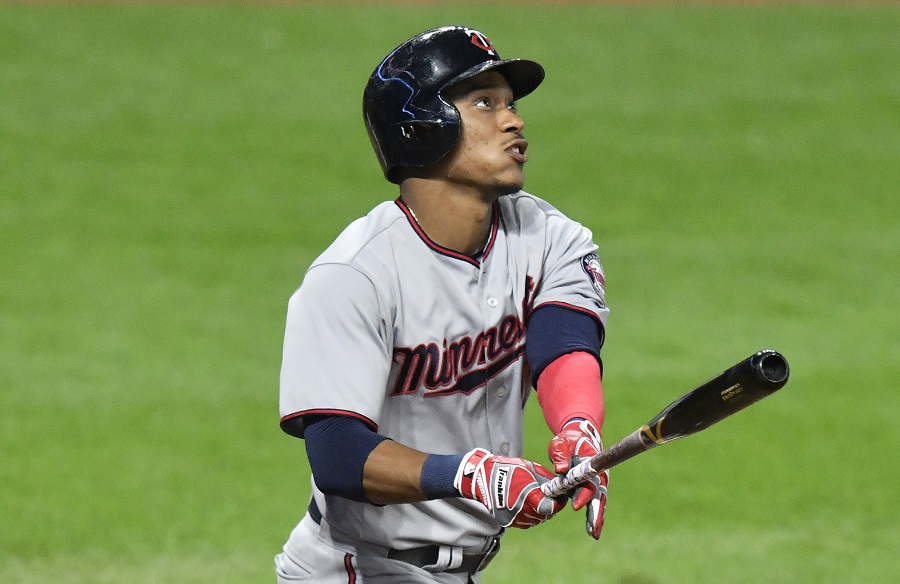
In 2016, the Twins deserved some criticism for their handling of the up-the-middle defender. Despite having not played a single inning at shortstop in affiliated baseball since 2015 at Triple-A, he was thrust into the starting role with the Twins and logged just over 400 innings. For a guy who already had questions regarding his arm strength, range and reactions would play heavily into how well he handled the position. No matter how you look at it, the results suggest that the first season of shortstop at the big league level didn’t go well.
In those 400-plus innings, Polanco earned a -8 DRS to go with a -10.9 UZR, -5.5 RngR, and a -32.3 UZR/150. Among the 34 MLB shortstops to play at least 400 innings, those numbers ranked 28th, 29th, 27th, and 34th respectively. To put it bluntly, he looked anything but capable of handling the position at the highest level. For a guy whose bat was always expected to play, it was scary just how much of a liability the glove had become.
Fast forward to spring training 2017, and Polanco was ready to work. Having witnessed the ethic and resolve in person, it was apparent the youngster wasn’t about to let a disappointing debut beat him. From fielding the position in Grapefruit League games, to putting in hours of extended sessions on the small field adjacent to Hammond Stadium, the effort was more than present.
From a top-down view following the 2017 season’s conclusion, it sure appears to have paid off. Among 20 qualified shortstops, Polanco finished 14th in DRS (-1), 19th in UZR (-4.3), 9th in RngR (2.0), and 18th in UZR/150 (-5.4). While still not an above average defender, he made drastic strides year-over-year, and found his way into the serviceable category as opposed to being a liability.
It wasn’t just in the field that Polanco put in work a season ago however. Despite being carried by his bat through the entirety of the system, it had begun to fail him for the first time. Ceding playing time and forcing Paul Molitor to look elsewhere, Polanco bottomed out at a .213/.265/.308 slash line on August 2nd. Through his first 79 games, he’d totaled just 20 extra-base hits (three HRs), and was putting over 40% of his balls in play on the ground.
There’s been a growing movement to elevate the baseball, increase launch angles, and use exit velocity to drive hits to all fields. The outdated view that hard hit grounders will get misplayed by big league fielders has become laughable, and the reality is that the only place a ball isn’t being caught is when it’s out of reach. From August 4th through the end of the year, a period of 54 games, Polanco seems to have bought into that principle as well.

Down the stretch, the Twins shortstop slashed an incredible .317/.379/.554 with 26 extra-base hits (10 HRs). It’s no coincidence that was coupled with a 6% decrease (down to 34.7%) in ground balls. Polanco slightly bumped his fly ball rate (44.3% from 41.7%), and also jumped up the line drive rate (21% from 18.2%). Taking a quick look at his launch angles from the beginning of the year, a comparison to those generated down the stretch shows he added lift to the ball. In relation to that lift, Polanco’s radial chart also highlights the quality of contact being significantly boosted as well. For a guy who checks in 12th among qualified hitters in regard to swinging strike rates, Polanco was always putting the ball in play, but was now doing so with higher odds for success.

Getting the ball off the ground allowed Polanco to not only see his power numbers increase (the 13 homers in 2017 was a career high), but also enabled him to right a sinking ship. His bat again was again a legitimate weapon, and he re-established himself as a fixture in Paul Molitor’s lineup.
Looking ahead to 2018, Polanco will need to replicate how he ended last year. Continuing to watch the ball rise off the bat will be a focus at the plate, while putting in the work to compensate for arm strength in the field is a must. There’s no imminent danger of the shortstop position being taken over, and the more he can entrench himself with value in the role, the better off the Twins will be. It’s more than OK for Minnesota to have a bat-first player at short, but they’ll obviously be looking to avoid deficiencies on both ends as they’ve seen with Polanco at his worst.
There shouldn’t ever be an expectation that Polanco will turn heads defensively. Jermaine Palacios, Royce Lewis, and Wander Javier all give the Twins a greater hope with the leather. That being said, no matter where he plays in the infield, Polanco’s added effort in all aspects of his game should continue to make him a very valuable piece to the organization for years to come.





Recommended Comments
Create an account or sign in to comment
You need to be a member in order to leave a comment
Create an account
Sign up for a new account in our community. It's easy!
Register a new accountSign in
Already have an account? Sign in here.
Sign In Now