


Twins Video
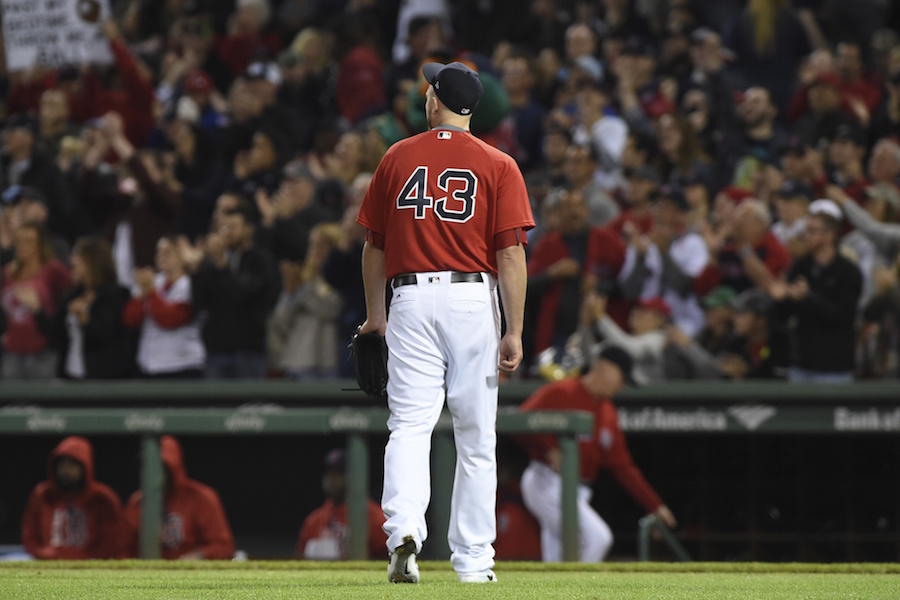
Well, for one thing, Reed was undeniably an excellent value. Maybe it begins and ends with that. You see an opportunity like this, and you don't pass it up.
When it comes to strengths that teams seek out in a relief pitcher, Reed checks off pretty much every box. He's relatively young by free agent standards, having turned 29 less than a month ago. He has worked frequently in high leverage, and brings plenty of closing experience. He's been extremely durable; Reed leads baseball with 157 appearances since the start of 2016, and has made at least 55 every year since 2012.
And of course, there's the performance. Over the past two seasons, in addition to being baseball's most oft-used reliever, Reed has also been one of its best.
Paul Molitor hasn't gotten Yu Darvish (not yet, anyway), but Reed gives him perhaps the most valuable tactical weapon he's ever had on a staff.
ACE IN THE HOLE
Cleveland's Andrew Miller. New York's Dellin Betances. Houston's Chris Devenski. All around the American League we see the emergence of premier relievers serving in non-closer roles and delivering massive value. Being able to deploy a dominating arm against an opposing team's best hitters, situationally, is at least on the same level of importance as a reliable ninth-inning man. I'd argue more so.
The Twins are committed to Fernando Rodney at closer to start the season, and in many ways he is the perfect embodiment of the role's (relative) fungibility. Over the course of his lengthy career Rodney has been an unspectacular relief pitcher by any measure. Yet, he ranks third on the all-time active saves list, and has converted 82% of his career chances, including 88% the last two years.
Plugging in Rodney as an inexpensive, yet experienced, short-term closer while making a much larger investment in Reed as the all-purpose late-inning fireman is – in many ways – a decidedly new-age move.
GAME CHANGER
According to Win Probability Added, which "attempts to measure a player's contribution to a win by figuring the factor by which each specific play made by that player has altered the outcome of a game," Reed has been the fifth most impactful reliever in the majors over the past two seasons. And look at his company in the Top 10:
1. Andrew Miller, NYY/CLE: 8.81
2. Zach Britton, BAL: 8.03
3. Kenley Jansen, LAD: 7.69
4. Brad Hand, SD: 6.14
5. Addison Reed, NYM/BOS: 5.85
6. Craig Kimbrel, BOS: 5.49
7. Wade Davis, KC/CHC: 5.48
8. Raisel Iglesias, CIN: 5.05
9. Shane Greene, DET: 4.47
10. David Robertson, CWS/NYY: 4.36
Now, it should be noted that WPA isn't necessarily a predictive stat. It only tells a story of what's happened. But in this case, it paints a picture of Reed as a pitcher who has consistently delivered with games on the line, drastically altering his teams' fortunes for the better.
That's not a Darvish-caliber impact, but over the course of the season, its influence on the W/L ledger should not be downplayed.
Of course, Reed continuing to succeed in big spots is reliant on his performance sustaining as it has, and that's no given at the game's most notoriously volatile position. We're also talking about a guy who, prior to 2016, had a 4.01 ERA in 250 major-league innings.
But the righty's strengths seemingly make him a good bet to stay on track.
TAKING CONTROL
During our on-stage Q&A with him at the Winter Meltdown on Saturday, I asked the greatest relief pitcher in Twins history for his impressions of the biggest free agent relief signing in Twins history.
Joe Nathan, like many others, went straight to Reed's calling card: control.
"I love how aggressive he is in the zone. That's the biggest thing with the bullpen guys, if you're not throwing strikes you don't belong in the bullpen," opined Nathan, whose own success with the Twins was fueled in part by an excellent 7.3% BB rate.
Reed has walked only 104 (6.2%) of the 1,669 batters he has faced in his MLB career. Twenty of those were intentional. He has hit six batsmen, and uncorked only 13 total wild pitches. (Last year alone, Trevor Hildenberger drilled four hitters and Ryan Pressly was charged with five wild pitches.)
As Parker Hageman noted around the time of the signing, Reed has been in the strike zone more over the last two seasons than any pitcher other than Jansen, who has a strong case for being the best reliever in baseball right now.
Reed doesn't have Kenley-type stuff, but it's good enough that he still managed a 2017 swinging strike rate of 13.7%, which would've led all Twins relievers. The ability to make people miss at that frequency, without needing them to chase, is one that inspires a lot of confidence.
Conventional thinking says Reed is now next in line for closer duties, should Rodney falter. After all, his pay is commensurate with the role, and he has racked up 125 saves in the majors.
But I wonder if the right mindset is to peg Hildenberger as Rodney's fallback in the ninth, and keep Reed as your flexible, strategic bullpen ace for as long as you can.





Recommended Comments
Create an account or sign in to comment
You need to be a member in order to leave a comment
Create an account
Sign up for a new account in our community. It's easy!
Register a new accountSign in
Already have an account? Sign in here.
Sign In Now