Dan Engebretson
-
Posts
31 -
Joined
-
Last visited
Content Type
Profiles
News
Minnesota Twins Videos
2026 Minnesota Twins Top Prospects Ranking
2022 Minnesota Twins Draft Picks
Minnesota Twins Free Agent & Trade Rumors, Notes, & Tidbits
Guides & Resources
2023 Minnesota Twins Draft Picks
The Minnesota Twins Players Project
2024 Minnesota Twins Draft Picks
2025 Minnesota Twins Draft Pick Tracker
2026 Minnesota Twins Draft Tracker: Picks & Bonuses
Forums
Blogs
Events
Store
Downloads
Gallery
Everything posted by Dan Engebretson
-
If Jackson makes it through waivers and Jeffers accepts a QO (if made), the Twins could trade Caratini and roll with Jeffers/Jackson in 2027. This would effectively reduce Jeffers’ contract by $7M (I think this is what Caratini is owed next year). That may be more palatable.
-
If I recall correctly, the ESPN folks give the Orioles about a 50% chance of making the postseason. That tells me the Orioles are a good team. The Twins lost to a good team at home 2-1. While you never want to lose, losses happen and this was not a terrible loss, the wheels did not fall off any stage of the game. Ryan pitched wonderfully, and it would have been great if Funderburk and Topa had pitched as well, but they did not. It is entirely unreasonable to demand pitchers be perfect. They did ok. More (most?) troubling to me is the 1-12 RISP. The upside, of course, is the 12 opportunities, the downside, is they failed in all of them. If my memory is correct, the one hit was with a runner on second base and the hit was a dribbler that could not advance the runner. As already mentioned, this is a trend carrying over for several years. What I saw as an upside and definitely different from the beginning of last year, but carrying over from where last year finished is better base-stealing. Martin’s aggressive theft of second, prevented a double-play that almost certainly would have resulted when Buxton dribbled an easy double-play. I am looking forward to more baseball, and frankly hope that the Twins continue to play like they did yesterday (though, I suspect they will not).
- 80 replies
-
- 1
-

-
- joe ryan
- byron buxton
- (and 8 more)
-
Vazquez’ fWAR has always been above zero and the last two years have been 0.8 and 0.9. He is consistently above replacement level (and if he were “full time” catcher, his fWAR would likely be higher because it is a counting stat). This is in contrast with catchers like Sandy Leon, who rarely had fWAR above zero. While I agree (and the stats support) that Vazquez is a bit overpaid for his output, he is not a scrap-heap catcher. He brings real value that cannot be easily replaced and I don’t believe the Twins should just throw him by the wayside for nothing. (Though I would not have a problem with a rational trade that improved the team for next year).
- 91 replies
-
- 10
-
-

-
- christian vazquez
- ryan jeffers
- (and 2 more)
-
Kepler got a ball 4 gift.
-
Haven’t said this for years. Good baserunning Twins!
-
Game Thread: Twins @ Orioles, 4/16/24 @ 5:35 CT
Dan Engebretson replied to wsnydes's topic in Archived Game Threads
Silver lining — the Twins have not missed any opportunities with runners in scoring position. -
It looks like Martin might be the only one whose batting average exceeds their weight, and this is only because Martin is a pretty small guy.
-
You're Wrong to Not Like Max Kepler
Dan Engebretson replied to Greggory Masterson's topic in Twins Daily Front Page News
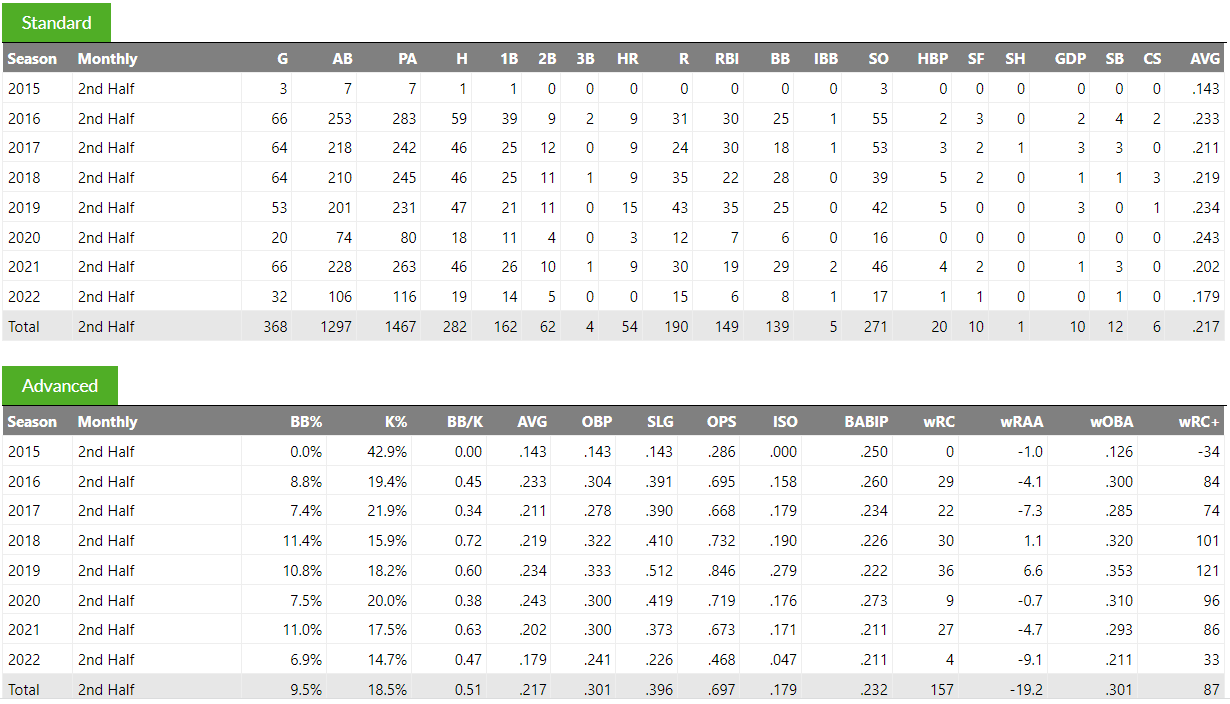
Here are some Fangraphs data I posted earlier this year comparing Kepler's first halves versus second halve throughout his career. With the exception of 2018, Kepler has been an above average hitter (by Fangraph's wRC+ stat), whereas he has been below average in the second half with the exceptions of 2018 and 2019. On his career, he has had more first-half plate appearances and is an 11% above average hitter. In my original post from January (I cannot figure out how to include it here), I speculated that Kepler may be worn down or injured in the second half (we know this was the case last year, but my memory fails me for earlier years) and I hoped that the new training staff will help either maintain his strength or better recover from injury. Both may be helped by the Twins depth of corner outfielders allowing Kepler more time to recover while there is an adequate replacement. Last year, with injuries to Larnach and Kirilof and a pretty bare cupboard, Kepler played when frankly, he should have been on the IL (at least in my opinion) recovering from a broken toe. While I don't think Kepler will ever achieve the lofty goals set by his 2019 performance, I wholeheartedly agree that his performance is worthy of "regular starter" status. Given the shear number of young, inexpensive corner outfield options the Twins have, I do expect them to shop Kepler at the trade deadline, and I expect they will get good value (assuming he continues to produce), because a 2 fWAR player at $10M is a good deal. Similarly, I will not be at all disappointed if the Twins keep Kepler, because his contract is still a good value for a very good player.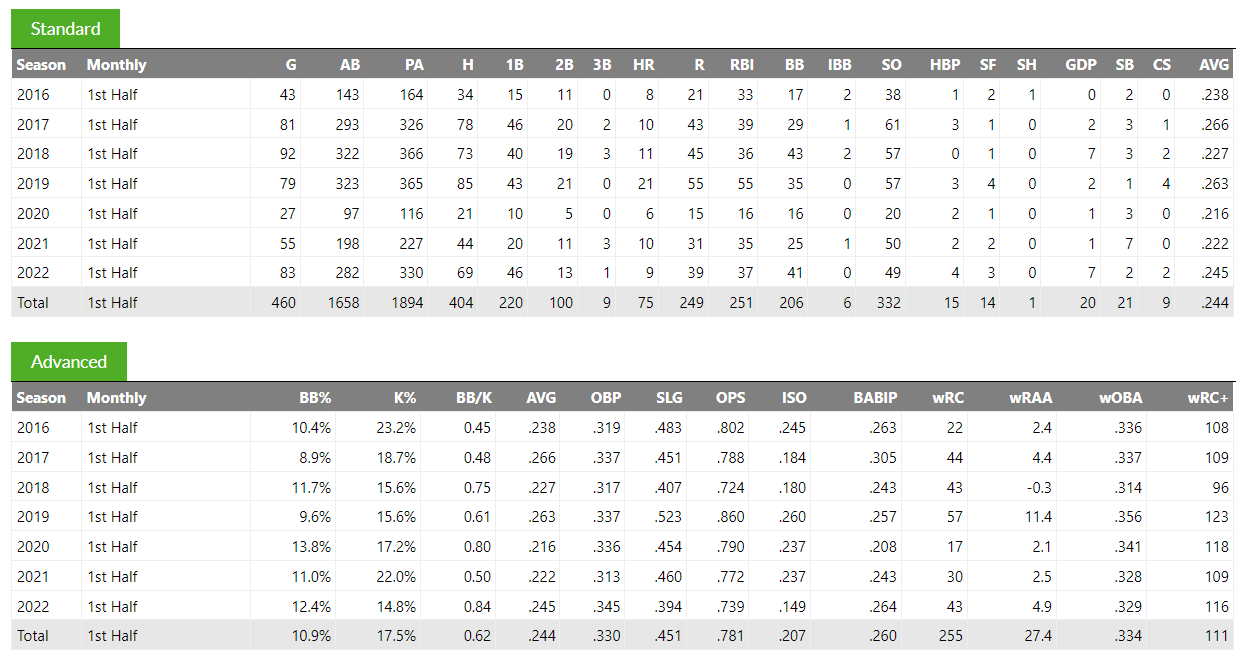
-
Data from Fangraphs (below) shows that Kepler's first half numbers are solid, but routinely (and sometimes catastrophically) fall off in the second half. I know last year he broke a toe in June and struggled after that. I wonder if Kepler wears down or plays through/with injury and it hurts his offensive productivity. Perhaps changes in the training staff will help. First Half numbers: Second Half:
-
Identifying the Twins’ Top 3 Weaknesses
Dan Engebretson replied to Cody Christie's topic in Twins Daily Front Page News
I would add "player development" as a weakness. Examples of poor player development that are too frequently seen include poor baserunning. Grabbing a recent example, in Sunday's 10th inning loss, Kepler should have stayed near the bag on the Miranda's ball hit to the center field so Kepler could tag and advance to third. Rather, he went half-way on contact and had to retreat to second and lost the chance to advance to third. Gordon's groundout could have scored a smart baserunning Kepler from third, instead the poor baserunning Kepler could only get to third. In an earlier post in this thread, tarheeltwinsfan nicely articulated differences between "good clutch hitters" and "poor clutch hitters." The last few weeks not withstanding, most of the Twins hitters are really quite good; focusing on pre-All Star numbers, the Twins had the fifth highest OPS in MLB and 3rd highest in the AL. That's a team that knows how to hit a baseball (they have the talent). However, those numbers tank with RISP and particularly RISP with two out. I think well-developed hitters are aware of the situtation and rather than swinging for the fences in those situations, htey focus on advancing the runner, not getting out, and particularly not striking out (particularly with two out).- 43 replies
-
- 2
-
-
- carlos correa
- tyler duffey
- (and 2 more)
-
It Takes a Team to Blow a Game
Dan Engebretson replied to Matt Braun's topic in Twins Daily Front Page News
To build on Old Twins Cap a bit, I think we look too much at the shortcomings of the Twins pitching staff and not enough at the shortcomings of the Twins offense and mistake-prone play. To grab a recent example -- June 29th's 10th inning loss. At the end of 9 innings the Twins were 1-8 w/RISP and had left six on base. The Twins ranks near the bottom of MLB of OPS w/RISP *(particularly with 2-outs); you cannot expect to consistently win games when you routinely leave baserunners on the bags. Additionally, the Twins seem to make lots mistakes -- not necessarily errors -- think wild pitches, passed balls, dropped fly balls in foul territory, poor baserunning, etc. Specific examples from game #2 of the doubleheader include Jeffers sloppy early-home-run-that-wan't trot that resulted in an out at second, which was immediately followed by the Celestino/Miranda confusion of suicide vs. safety squeeze that eliminated a runner a third. Granted, the Twins won 6-0 so the lost runs are moot, but sloppy play is sloppy play. Also in that game, the Twins were 1-9 w/RISP (so you can win with poor performances w/RISP). In terms of problems, I think the pitching problems are more solvable than the clutch hitting and mistake-prone play. You can buy your way out of the pitching problems (I don't know the Twins appetite for spending more or trading assets), but poor clutch hitting and mistake-prone play seems like a development problem that likely starts early in the minors and will take years to fix. To summarize, I agree that Twins have pitching problems, but I think the bigger, and more difficult to solve problems are poor clutch hitting and generally sloppy play. I think these problems have plagued the Twins for years and are at the heart of the 0-`18 playoff streak. Until these problems are resolved, I don't think the Twins can be an elite team.- 11 replies
-
- 4
-
-
- jharel cotton
- tyler thornburg
- (and 3 more)
-
Game Recap: Twins 8, Cleveland 2
Dan Engebretson replied to Matthew Lenz's topic in Twins Daily Front Page News
To clarify, if the Twins do take 4 from the Sox the Twins would be 6.5 games behind the Sox, not necessarily 6.5 games out of first. If Cleveland has a synchronous 4 game win streak with the Twins, then the Twins would be 9 games behind Cleveland (9 games is the current deficit between Cleveland and the Twins) and Cleveland would be the division leader (nobody could overtake them). But, your point is spot on; to have any chance the Twins must win the games they play. How many games you must win gets murky when there are multiple teams between you and first place. -
Game Recap: Royals 14, Twins 5
Dan Engebretson replied to Jamie Cameron's topic in Twins Daily Front Page News
The silver lining: No inherited runners scored and Sano only struck out once! -
I think the Twins should add a quality defensive short stop via free agency. Jose Iglesias is available as a free agent and has consistently put up good defensive numbers. His offense is not god-awful (OBP is alright and not much power), but I believe the Twins can sacrifice some offense in exchange for what I believe will be significant overall improvement in defense. Putting a good defender next to Sano will make Sano appear better so he can stay put at 3B. I would also add a good glove at 1B (perhaps one of the Twins minor leaguers could fit in here, I don't know much about their defensive prowess); a good 1B receiver will also help Sano's defense. I would prefer to keep Polanco and slide him to 2B. Polanco would be flanked by good defenders at SS and 1B and also helped by a good glove at 1B. I really like Arraez, but with this plan, he will likely get traded or stashed in the minors.
-
I looked at the fielding stats over at Fangraphs. On the year, the Twins had 10 position players (not inlcuding catchers) that played 300+ innings at a position in the field. Only three had positive UZR/150 -- Max Kepler 20.6 in RF, Byron Buxton 15.7 in CF, and Max Kepler 9.5 in CF (yes, Max was two of the Twins 3 players with positive UZR/150). Marwin Gonzalez only played 291.2 innings at 3B, but had an 18.9 UZR/150. Contrast that with the Yankees; they have 8 players with positive UZR/150 (including Brett Gardner counted twice like Max Kepler) and 5 that are negative. The Astros (whom I believe are the most complete team in baseball) have 8 players with positive UZR/150 (Springer counted twice) and 4 that are negative. The Twins have demonstrated that they are a true offensive force, however, they've also demonstrated that they are incredbily weak defensively. While it is probably difficult to determine how much the weak defense negatively impacts pitching, it certainly makes our pitchers work harder each game. I think the Twins gain nothing by rearranging the deck chairs (moving Sano to first....), they must make meaningful personnel changes (particularly in the infield, where every one of our starters with more than 300 defense innings played, has a negative UZR/150) to improve the defense. That might start with keeping Marwin at 3B, but Sano is not a good answer at 1B (223 career innings and negative 5.3 UZR/150), and at least for this upcoming year, there is no way (barring injury to Cruz) that Sano gets many ABs at DH. I think the Twins need to get a great glove/good bat 1B (could very well be one of the minor leaguers stepping up). Work hard to acquire Jose Iglesias (free agent) for SS. Move Polanco to 2B. Keep Sano at 3B (his defense improves by having a better SS next to him and a better receiver at 1B). Trade Arraez; an alternative would be to keep Arraez at 2B and trade Polanco. I suspect that with Polanco's excellent bat and good contract that many teams would give a solid return.
-
One error on what should have been a double play (two outs), and one additional error (one out) means that the Twins gave the Brewers an extra inning of offense. It's really tough to win when the other team gets to play an additional inning.
- 64 replies
-
- 3
-
-
- kyle gibson
- jorge polanco
- (and 3 more)
-
Article: Everything Old Is New Again
Dan Engebretson replied to Steven Buhr's topic in Twins Daily Front Page News
Cal Ripken weighed 220 pounds when most other SS weighed 175 soaking wet (I think Ozzie Guillen was listed at 150!). Ripken ushered in a new era of large shortstops (A-Rod, Jeter, etc.) that could play their positions very well in spite of their large size and did not seem overly prone to injury because of their size (particularly true in Ripken's case). Mike Trout (235 pounds) and Jason Heyward (245 pounds) are both exemplars of modern-day large outfielders that play their positions very well and don't have reputations as being injury prone. Based on these and other examples I don't believe that simply due to his size that Sano cannot become an absolutely adequate defensive outfielder. In terms of experience, we don't have to look past Danny Santana in 2014. Prior to 2014 he had only played a handful of minor league games in the outfield, but when given the opportunity to play CF he was not an embarrassment in the field and his fWAR was 3+ (largely because of his offensive success that year). While Sano certainly doesn't have Santana's range, he does have a strong, accurate arm that should dissuade baserunners from taking extra bases and if he works hard with the coaching staff he should be able to develop enough outfield skills to at least make the routine plays and keep the balls in front of him. If he does not work hard (and I have no reason to believe he won't) he will not be very good; but, this is true even if he plays 3B or DH -- if he isn't willing to work hard, keep his weight in check so his athleticism can shine though, and refine his skills, he will quickly become an overweight has-been that wasted an opportunity to be a once-in-a-lifetime type player.