IndianaTwin
-
Posts
6,627 -
Joined
-
Last visited
-
Days Won
28
Content Type
Profiles
Minnesota Twins News, Rumors & Analysis
Minnesota Twins Videos
2026 Minnesota Twins Top Prospect Rankings
2022 Minnesota Twins Draft Picks & Signing Bonuses
Minnesota Twins Trade & Free Agent Rumors
Minnesota Twins Fan Guides & Resources
2023 Minnesota Twins Draft Picks & Signing Bonuses
2024 Minnesota Twins Draft Picks & Signing Bonuses
2025 Minnesota Twins Draft Picks & Signing Bonuses
2026 Minnesota Twins Draft Picks & Signing Bonuses
Forums
Blogs
Events
Store
Downloads
Gallery
Everything posted by IndianaTwin
-
If so, I'm sure Chief is amped up about it.
-
I assume he's now conducting himself properly?
-
Fun article. Also, any article that has opportunity to reference Juan Berenguer deserves a “like.”
-
Lost in today's wins, don't forget about Tonkin. When he was signed this week, there were a decent number of people complaining, while others of us were naming that he was likely just a placeholder for a few days. Well, last night, he held that place and threw two innings after they were down 5-0. In doing so, he allowed them to have a fresh bullpen today, which was huge. Sure, Bowman could have conceivably thrown those two innings Friday night, but then he wouldn't have been available today (when he wasn't needed, but was an available body) or tomorrow (when he'll be the only completely fresh arm). It's almost like the front office knew what it was doing in signing Tonkin.
- 37 replies
-
- 6
-

-
- willi castro
- simeon woods richardson
- (and 2 more)
-
Beautiful job by SWR. With it and with the efficient bullpen work, no relievers enters tomorrow’s game having thrown more than 32 pitches in the past two days. Guys will need to go back to back, but everyone besides Funderburk, Jackson (both through yesterday and today) and Sands (28 pitches today) is probably available for at least a batter or two. Since I put in a request earlier for SWR to go six innings, I’ll go ahead and request that for Ober for tomorrow.
-
Gotta like having seconds on chicken!
-
I think it may be sorta both. Brock is correct that they have to be sent down. BUT, because he doesn’t have to stay down the normal 10 or 15 days, they can immediately bring him back up in exchange for someone else, which effectively does what Lecroy is describing. In the case of a starting pitcher, it doesn’t make sense to do that, however. Go ahead and send SWR back down, but you can still bring him back up for next Friday or Saturday if you want, but you still have several days’ access to the guy you would send down in his place.
-
Though as I understand it, he doesn’t have to deal with the being down x number of days, since he was up in the 27th-man situation.
-
I’m usually a “I’ve got no problem with Rocco pulling the starter” kind of guy, but given the doubleheader situation, the three-run lead and being at 80 pitches, I’d let him roll. No more than two base runners and have someone ready, but if he can sneak the seventh, that would be spiffy heading into tomorrow. (But I also have no problem with being satisfied with six.)
-
English is a weird language. For example, in most settings, “I’m sorry” and “I apologize” mean more or less the same thing. Except at a funeral.
-
Wow. One guy over .235. Two guys over .209.
-
Obviously the ideal is six innings from SWR, followed by two from Sands and one from Bowman in a blowout, but I could see going to Jax (11 pitches in game 1) and Okert (13), and perhaps even Stewart (19). It helps that none of those three pitched either Friday or Thursday. They may also be more likely to go to one of those mid-inning than they usually are. The real sticking point could be tomorrow’s game, particularly if Ober struggles. I’m not sure who, but I’m guessing that Gardenhire has a couple guys that he’s under strict orders not to use tonight for the possibility of a roster move tomorrow.
-
Let’s go ahead and score another four and go to Willi Castro to close this thing out.
-
I’m sure things are festive on Tigers Daily, with 17 strikeouts by their hitters so far, Torkelson going to third on the sac bunt with Buxton running and then a three-run error.
-
The majority of grounders that lead to a force are also going to be regular groundouts. There’s a smidge of an advantage to having the force, but I don’t think it comes close to the handedness and Manfred Man advantage that pitching to Torkelson provided.
-
With a right hander on the mound, why walk the .584 OPS right-handed hitter to get to the left-handed .855 hitter, particularly when it means getting Torkelson out makes for a much slower Manfred Man in the 11th than Carpenter would be?
-
If Miranda gets thrown out on a strike ‘em out, throw ‘em out, Castro starts the next inning as the Manfred Man and Buxton is still available as a pinch hitter. If Miranda is safe, go ahead and pinch run Buxton, who’s much more likely to score from second on a single, and then leave him in on defense. I’m sure there’s even more to the thought process than that, but it doesn’t seem out of line.
-
In terms of the TWINS’ center field legacy, Bostock had already been traded to the Angels and played nearly a full season for them before he was killed. The article seems to imply that he was still with the Twins.
- 12 replies
-
- 2
-
-
- kirby puckett
- torii hunter
- (and 5 more)
-
Do Right Handed Hitters have Less Severe Platoon Splits?
IndianaTwin replied to stringer bell's topic in Minnesota Twins Talk
I'll give you a "like" for the final sentence alone. I hate it when people subtract (i.e., comparing 78 percentage points to 45 percentage points and calling the first 33 percent larger), rather than doing the (y-x)/x. If their math is off on that, it makes me wonder where else their math is wrong.- 49 replies
-
- 2
-
-
- ops disparity
- top lefties
- (and 1 more)
-
Also, please do not share this "brief and ineffective" phrase with my boss. I'm planning to cut out early tomorrow, and I'm afraid he'll use it in my performance review.
-
In addition to Rule 9.17(c), which you've quoted, there is also this comment from the rule book: Rule 9.17(c) Comment: The Official Scorer generally should, but is not required to, consider the appearance of a relief pitcher to be ineffective and brief if such relief pitcher pitches less than one inning and allows two or more earned runs to score (even if such runs are charged to a previous pitcher). My understanding is that the "should" generally outweighs the "is not required to." In addition, I think that MLB scorers have additional guidance on when to use "brief and ineffective," such as if a pitcher pitches a full inning and gives up at least four earned runs. MLB scorers gather regularly and have some pretty specific training so there is uniformity on how situations are scored across the league. As I understand it, they have generally been given firmer and more complete direction on when to use the "ineffective and brief" situation. There are some wrinkles, however. When a reliever is ineffective and brief, the win has to go a subsequent pitcher (who has to have been more effective). Thus, if a guy is ineffective and brief in the top of the ninth and blows the lead, but the home team rallies and wins, that guy will still get the win, because there was no subsequent reliever. Another wrinkle is that this rule can deprive a guy of a save. Last year in a Saints game, there was a situation where an opposing reliever was ineffective and brief in the bottom of the eighth and blew the lead. The opponent rallied in the top of the ninth and then their closer did his job in the bottom of the ninth. The guy in the eighth SHOULD have gotten the win, EXCEPT he was ineffective and brief. The guy who followed him in the ninth therefore got the win, even if he may have preferred to get a save for his stat line. However, declaring the winning pitcher takes precedence over awarding a save. Because the standard is so tight, "ineffective and brief" is rarely used. Scorers don't really have discretion on it. There is a place where scorers do have discretion, and that's where the starter doesn't go five, but leaves with the lead that is never relinquished. In that case, the scorer does have the ability to pick which reliever is deemed "most effective" and award the win to that person. If there are two that are equal in their effectiveness, it should go to the one who pitched first.
-
Do Right Handed Hitters have Less Severe Platoon Splits?
IndianaTwin replied to stringer bell's topic in Minnesota Twins Talk
Here's one season's worth (2023). I don't know whether these differences are statistically significant, but righties batting against righties did .017 better than lefties against lefties. And the platoon advantage is real -- righties against lefties and lefties against righties each did better than people batting against their same handedness. Intuitively, your hypothesis makes some sense. Righties have more opportunities against righties in their developmental years than lefties do against lefties.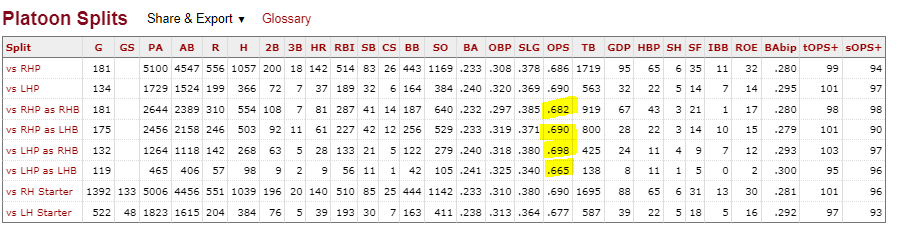
- 49 replies
-
- 5
-
-
- ops disparity
- top lefties
- (and 1 more)
-
Twins Game Scheduled for Today (4/11) is Postponed
IndianaTwin replied to stringer bell's topic in Minnesota Twins Talk
I'll be taking a bit off of my change up. I don't want to hurt his hand just before the game, you know. -
Twins Game Scheduled for Today (4/11) is Postponed
IndianaTwin replied to stringer bell's topic in Minnesota Twins Talk
Thanks. It was pretty cool when he texted the invite. He's a good guy. Three-sport athlete who set his school's career scoring record in basketball and has signed to play at an NAIA school. Good head on his shoulders. And not to be too vain, but I admit to stepping it off in the driveway and throwing a few pitches to Mrs. IT the other evening. I hope I can at least get it in the neighborhood, but it's been 20 years since I threw batting practice to my son. 😃 -
Twins Game Scheduled for Today (4/11) is Postponed
IndianaTwin replied to stringer bell's topic in Minnesota Twins Talk
Well then, since Rocco always pulls his starter early (/s), how about if we sign him up for three perfect innings and then go to the pen?