Major League Ready
-
Posts
7,875 -
Joined
-
Last visited
-
Days Won
26
Content Type
Profiles
News
Minnesota Twins Videos
2026 Minnesota Twins Top Prospects Ranking
2022 Minnesota Twins Draft Picks
Minnesota Twins Free Agent & Trade Rumors, Notes, & Tidbits
Guides & Resources
2023 Minnesota Twins Draft Picks
The Minnesota Twins Players Project
2024 Minnesota Twins Draft Picks
2025 Minnesota Twins Draft Pick Tracker
2026 Minnesota Twins Draft Tracker: Picks & Bonuses
Forums
Blogs
Events
Store
Downloads
Gallery
Everything posted by Major League Ready
-
The Twins Have Failed Josh Donaldson
Major League Ready replied to Matt Braun's topic in Twins Daily Front Page News
I have always admired Donaldson as a player so I was cautiously optimistic when they signed him. However, investing $22M in a free agent for 2.2 WAR is not exactly a problem but he is not a solution either. 2.2 WAR for $22M is underperforming and you are certainly hoping for more in the first 2 years when you sign a 34 y/o to a 4 year deal with a 5th year option that costs $16M or an $8M buyout. I seriously doubt he will be worth $16M in 2024 so you really need to consider that cost as well. Many here predicted this deal would bite us in the ass. I fear they will be right if we hold on to him. So, I am hoping he has a great first half and is dealt at the deadline even if it costs some retained salary. -
The Twins Have Failed Josh Donaldson
Major League Ready replied to Matt Braun's topic in Twins Daily Front Page News
I understand where you are going with this and you make a good point. It appeared to me they definitely would have preferred to sign Wheeler but getting him away from the east coast was a very tall task. So, I think they agreed with you too. Bumgarner also had a definite destination in mind and that probably would have been a disaster anyway. Ryu would have been good but I think most of us were really weary of his durability. Here is the good news. My belief is that they recognize that filling 4 or more spots in the rotation with homegrown players sets up a much better shot at sustained success. If they were to accomplish this goal, they could afford any top of the rotation SP in the league. They still need to convince them to come to Minnesota but it's financially feasible. Even if they spent $35M on a SP, they would still have room to extend a couple players or sign a SS if that does not work out. I believe that's what they see in the future that many here do not. Obviously there is no guarantee our SP prospect fill two more holes in 2022. However, if they do 2023 looks something like this ....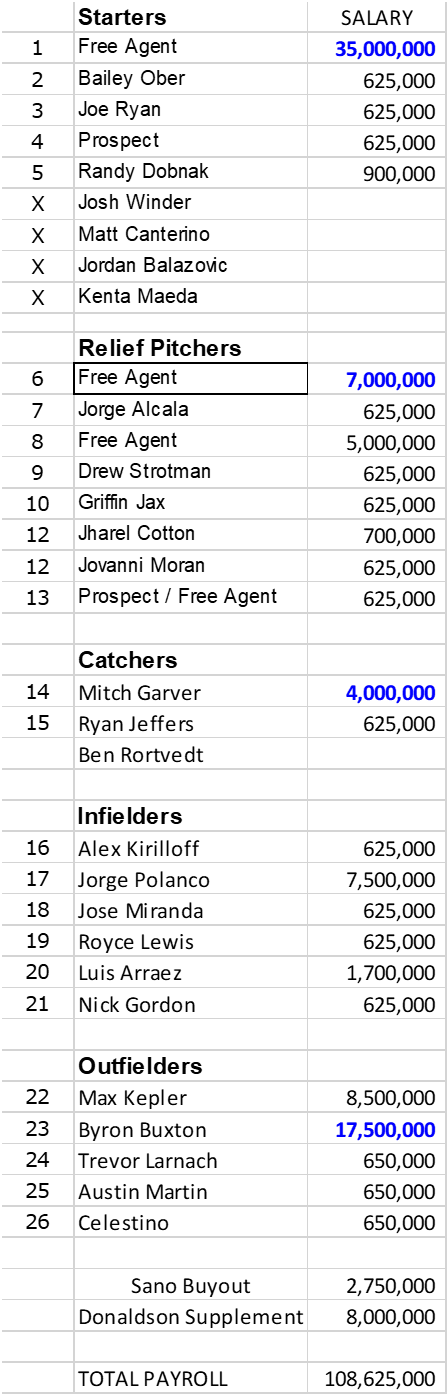
-
The Twins Have Failed Josh Donaldson
Major League Ready replied to Matt Braun's topic in Twins Daily Front Page News
Would/should winning one playoff game change how we interpret the results of the last 3 years? -
I accepted your challenge and starting going through them one by one. The premise that owners are stupid is floated here so frequently I wanted to have an informed opinion on this assertion. Plus, I thought others might be interested in the credentials of ownership. I got as far as Kansas City before calling it day because the facts tell a consistent story that did not require I look at every team. The net is that you sound like a 30 handicap calling Tiger Woods a hack. I pasted these descriptions from Baseball Reference and Wikipedia. I am glad you provided an opportunity to point out just how ridiculous fans can be. Most of these individuals have extremely impressive credentials individually. Given the many minority owners and corporations involved, collectively you are talking about dozens of exceptionally accomplished individuals. There are a few lawyers among them too and lawyers know how to negotiate. To sit here and call the collective buffoons makes a statement all right but it’s not about the competence of owners. Arizona – Ken Kendrick founded Datatel, a software company, in 1968. In 1989, he became the principal investor in Woodforest National Bank Atlanta Braves – Liberty Media Is a $9B entity that owns a variety of businesses. This company generates almost as much revenue as the 30 MLB teams combined. Obviously Liberty media contributes an impressive array of business acumen to the owners group. Baltimore – Peter Angelos. the son of Greek immigrants, he was a self-made man, rising up from a gritty working class neighborhood to run his own law firm in Baltimore. He made his fortune pleading in favor of workers incapacitated by exposure to asbestos and winning enormous settlements. Boston – John Henry & Tom Werner. Henry grew up on a farm in southern Illinois and made his fortune by investing on commodities option. He is known in the options industry for his reliance on analytical methods as opposed to playing hunches. Werner made his fortune as a television producer. A commodities trader and a TV producer. Does not sound like a guy with meager analytical or negotiating skills. Chicago Cubs - Ricketts grew up in Omaha, NE, the son of the founder of Ameritrade Corporation, a brokerage firm. He obtained an undergraduate degree and an MBA from the University of Chicago. Yes, he grew up entitled but the MBA suggests he is far from a “Baffon”. The average GMAT score for applicants at U of C is 732 so it probably takes at least 700 to get in which is the 88th percentile of all applicants. He is not dumb. Chicago White Sox – Jerry Reinsdorf - Reinsdorf earned a bachelor's degree from George Washington University in Washington, D.C.where he became a member of Alpha Epsilon Pi. He subsequently moved to Chicago in 1957.[9] Reinsdorf became a CPA and lawyer as well as a registered mortgage underwriter and a certified review appraiser. He leveraged a full scholarship offer from the University of Chicago Law School into a scholarship from the Northwestern University School of Law. Yep, areal moron witrh no credentials to suggest he could negotiate his direct tv bill. Cincinnati Reds - Robert Castellini – Education: Georgetown and an MBA from the Wharton School of Business. Once he had graduated, Castellini went home to work at his family’s business, which is called Castellini Co. At the time, Castellini Co. was not doing as well as it is now, which speaks well of Castellini’s contributions to the family business over the course of his multi-decade career. Cleveland - Larry Dolan - Education: Notre Dame. Upon leaving Notre Dame, Dolan served in the United States Marine Corps for two years, where he attained the rank of first lieutenant. Upon leaving the Marine Corps in 1958, Dolan worked as assistant prosecutor in Geauga County, Ohio before going into private practice. He eventually became president and managing partner of Thrasher, Dinsmore, & Dolan in Chardon, Ohio. Colorado Rockies - Dick Monfort graduated from the University of Northern Colorado, Greeley with a bachelor's degree in Business Management. He joined Monfort of Colorado in 1974 as a cattle buyer. He then served as vice president federal cattle procurement from 1979–81, group vice president of cattle products 1983-1984 and executive vice president 1984-1987. When ConAgra bought Monfort of Colorado in 1987, Dick became president of ConAgra Red Meats. At the University of Northern Colorado, Dick serves on the board of trustees along with the board of directors at University of Colorado Hospital, Denver Zoo, and the Colorado Economic Development Board. Dick now resides in Denver, Colorado with his wife Karen. Charlie Monfort graduated from the University of Utah with a bachelor's degree in Marketing and Business Management. Charlie started working for the family business Monfort of Colorado, Inc. also in 1988 as president of International Sales until 1996. In 1996, Charlie became president of ConAgra Foods International; later leaving in 1998 to concentrate on his previous commitment to the Rockies. Charlie also serves on the Board of Trustees at Colorado Mesa Universit. He is also a board member of the Kempe Foundation, the Special Olympics, and the Monfort Family Foundation. Detroit Tigers – Chris Ilitch did in fact inherit his position. As president and CEO, Ilitch leads and provides oversight to the Ilitch companies, including Little Caesars Pizza, Blue Line Distribution, the Detroit Red Wings, Olympia Entertainment, the Detroit Tigers, Olympia Development of Michigan (real estate), Little Caesars Pizza Kit Fundraising Program, and Champion Foods (food manufacturing). That’s a pretty big job. Inherited or not, that’s a pretty good business education by default. I have no idea just how competent he is in this role but assuming he is stupid because he inherited a role is a big stretch. Houston Astros - Jim Crane - After graduating from college, Crane went into the insurance business. Crane borrowed $10,000 from his sister and founded Eagle USA Airfreight, an air-freight logistics business. Crane took his profits from EGL and formed Crane Capital Group. He also became a director and shareholder in Western Gas Holdings, LLC. an energy company operating in the southeastern Rocky Mountain region and southern Mid-Continent area. Western Gas Holdings and Western Gas Partners were acquired by Anadarko Petroleum. Crane is also the majority shareholder in Crane Worldwide Logistics LLC, chairman of the board for CargoJet, and director of both Nabors Industries and natural gas company Western Midstream. Kansas City Royals - John Sherman - Sherman graduated from Ottawa University. He later founded LPG Services Group, which later merged with Dynegy. In 1996, Sherman founded Inergy. It merged with Crestwood Holdings in 2013. Sherman bought a minority share of the Cleveland Indians in 2016, and became their vice chairman There is one other ownership group that is unique and should not be ignored because I stopped at KC. The Mariners are owner by First Avenue Entertainment and 17 minority owners. They are led by John W. Stanton. He is the Chairman of Trilogy International Partners, Inc., which operates wireless systems internationally, Trilogy Equity Partners, which invests in wireless-related companies. Stanton founded and served as Chairman and Chief Executive Officer of Western Wireless Corporation, a wireless telecommunications company, from 1992 until shortly after its acquisition by ALLTEL Corporation in 2005. He was Chairman and a director of T-Mobile USA, formerly VoiceStream Wireless Corporation, a mobile telecommunications company, from 1994 to 2004, and was Chief Executive Officer from 1998 to 2003. Mr. Stanton was a director of Clearwire Corp. from 2008 to 2013, Chairman between 2011 and 2013, and interim Chief Executive Officer during 2011. The whole ownership is stupid thing really needs a deeper level of consideration. The definition of random might require a little looking into as well.
-
How would you be balancing revenue if you don't give it to the teams with less revenue. That would not promote parity. Now, if we are talking about the penalties, there may be an opportunity to distribute that differently. Currently, the first $13 million will be used to defray clubs' funding obligations under the MLB Players Benefits Agreements. Of the remaining sum, 50% of the remaining proceeds collected for each Contract Year, with accrued interest, will be used to fund player compensation as described in the MLB Players Benefits Plan Agreements and the other 50% shall be distributed to clubs that did not exceed the Base Tax Threshold in that Contract Year.[6] The 50% distributed to clubs that did not exceed the Base Tax Threshold means wealthy clubs that are just under the cap still get revenue. That money could be distributed in a manner that better served parity. The 50% going to player benefits could be distributed among prearb players or the bottom 25% or some other manner that does not include the highest paid players. Increasing penalties and distributing differently would serve competitive parity as well provide additional compensation to lower paid players. However, the players are very would likely stringently resist increasing penalties for exceeding the CBT threshold.
-
I disagree counselor. The starting point by which to determine who is asking for concessions is not the new ask, it’s where they left off. If Party 1 has a contract for services expire at $X and party 2 asks for 1.5X, in a new contract, and we arrive at 1.25X, the person conceding something is party 1 as I see it. They owners have not asked for a salary cap like other sports have. They have not asked for a maximum annual amount like some sports. They have not asked for the number of years to be limited and they have not asked for non-guaranteed contracts. The owners are asking for one thing, expanded playoffs. Given 85-90% of that money will go to player salaries, I would not call that asking for a concession. All of the concessions necessary to get a new CBA will be on the part of ownership.
-
Twins Time to Cash in On Ryan Pressly Trade
Major League Ready replied to Ted Schwerzler 's topic in Twins Daily Front Page News
If we are going to make a case on pure assumption like we would have extended Pressly, it would be equally fair to say the money that would have gone to Pressly would have resulted in not signing Cruz who produced 4.3 WAR compared to Pressly's 1.6 WAR. I am not saying either form of speculation is sold critical thinking but they are on the same plane. -
What if These Twins Worked Out?
Major League Ready replied to Ted Schwerzler 's topic in Twins Daily Front Page News
How about Mark Appel. Drafted 1/1 and never pitched in MLB.- 25 replies
-
- 1
-

-
- byungho park
- oswaldo arcia
- (and 2 more)
-
You make an undeniable point which I fully understood long before these threads about this CBA illustrated your point. However, it does depend on the environment. I spent a dozen years doing corporate reorgs which is why I so obnoxiously don't except these refusals to address the facts. In that environment the facts get thoroughly researched and vetted and the assumptions fully validated. Holding on to positions that are not supported by the facts is simply not accepted. You either get on board or get run over. I don't have a problem when the issue is people are unaware of the issues / facts. In this case, the facts are about as clear as it gets. They are in the form of specific demands. The implications / conclusions always have room to be debated but obviously not a single person here would try to suggest the terms were not detrimental to parity. This sort of refusal to address the facts never leads to harmony so pardon me for being a prick about it. Putting your shoulder to the wall is not a good way to earn respect or resolve any issues in any any context / environment.
-
I have no objection to anything you have said. This all stems from a long series of posts in different threads where people insist a given approach is necessary to reach the playoffs. Ok, show me examples where this approach has succeeded. More importantly, they insist the FO is incompetent because they won't follow the approach they prescribe. I have done the research and I am not guessing in terms of how these teams were built which is why I ask people to give examples of success if they are going to insist the FO is incompetent. Show me where big free agent acquisitions, especially more than 1 have led to playoff success for a below ave revenue team. The fact is that success among this subset of teams has been by far most influenced by players that were drafted follow by players acquired as prospects (generally meaning they traded established players to get them) followed by modest priced free agents. High-end free agents and trades for well-establish players are a very small part in comparison. So, when someone insists what we need to do is follow practices that have proven to be ineffective and the FO is incompetent, I think it's reasonable to ask for some empirical proof of concept.
-
2022 Prospect Previews: Steven Hajjar
Major League Ready replied to Jamie Cameron's topic in Twins Minor League Talk
Wouldn't a 97mph FB with decent control rate 60? Just asking.- 14 replies
-
- 1
-
-
- steven hajjar
- chase petty
- (and 2 more)
-
That's a pertinent question. However, I have always framed this discussion in the context of playoff teams simply because that's the first goal. Of course sustained success is ambiguous and basically impossible if the standard for sustained is relative to the Yankees and Dodgers. Among below average revenue teams Oakland / Cleveland and Tampa have collectively produced (27) 90 wins seasons since 2000. The Rockies / Marlins / Padres / Orioles / Pirates and Royals have (8) 90 win seasons collectively. Does sustained be consecutive seasons or relative success over several years. I don't know about you but semantics aside I would opt for the 3 teams that produced (27) 90 win seasons over the (6) that produced 8.
-
Oh. I get it. You have figured out something no team / no general manger / no front office in the history of baseball has ever been able to figure out. Do you realize how absurd this statement is? No below average revenue team has produced what you feel is sufficient to call sustained success so we should ignore the how the most successful teams are built. If you had identified a more efficient / effective approach like Tampa has utilized this could potentially make sense. However, your plan is to utilize the most inefficient practice of all for player acquisition. The only teams that could claim sustained success are the Yankees and Dodgers who operate in an entirely different realm given their massive revenue advantage. Even their history has clearly illustrated the value of building from within. Among below average revenue teams Oakland / Cleveland and Tampa have collectively produced (27) 90 wins seasons. The Rockies / Marlins / Padres / Orioles / Pirates and Royals have (8) 90 win seasons collectively. I don't know about you but I would seek to learn something from how Oakland / Cleveland and Tampa built their teams. Players don't hit 600 and teams can't win 90 every season. Expecting perfection or something close is not even remotely reasonable in this scenario. Outperforming all mid and small market teams is a reasonable goal. The acquisition practices that have led to success are an excellent indicator of best practice. I made it even more direct by comparing the acquistion practices that produced playoff teams. What makes sense is to study what practices have been utilized by the most successful teams. You are suggesting we ignore the facts because they don't support your position.
- 37 replies
-
- 1
-

-
- thad levine
- derek falvey
- (and 1 more)
-
For starters, what happened 2 or 3 or 4 years ago is a different topic. I have no problem with what they did for the 2019 and 2020 seasons. Anyone and I mean anyone could trade away the future for the present. Even the top revenue teams have become very reluctant to trade their top talent. The Dodgers would not be where they are today if they would have traded away any number of players 3-6 years ago to "go for it". Sustaining success is much harder. Most fans put far more weight on the immediate and that's the reason fans hate management. I have gone to a fair amount of effort to summarize how the top WAR players were acquired for playoff teams. I broke them down to drafted / Traded for as prospects or unestablished MLB players / Traded for as established MLB players and free agents. I have posted those summaries here. I have also posted summaries of several teams. In other words, I have posted a great deal of evidence. That information is largely ignored. Of course, I would not expect evidence to sway fanaticism. That would be naive on my part. I have asked many times for people to give even a single example of below average revenue teams that sustained any success (reached the playoffs) that produced a significant portion of their WAR via free agency or specifically established / expensive free agents. Modest or low priced free agents that over achieved have actually played a role. History shows that drafting and development + trading for prospects is by far the most influential form of acquisition for teams outside the top 10 in revenue. Over performing free agents next. High price free agents and high profile trades have a very modest impact so there are many examples if you are willing to look without bias. I am not going to post the information again. It would just be ignored again. I will however mention one more time that for all the bitching about the going for it approach, not a single person has ever been willing to challenge the assertions I have made about talent acquisition with examples. There has to be a couple that at least have some validity. If the methods so often insisted upon here were viable there would be all kinds of examples and posters VERY eager to prove I am full of $h!( and the front office is incompetent. Instead, everyone just refuses to actually take a look at how playoff teams have been constructed in a methodical way. In other words, take the top players in terms of WAR and list how they were acquired.
- 37 replies
-
- 3
-
-
- thad levine
- derek falvey
- (and 1 more)
-
Absolutely not. This singular focus would make for prolonged mediocrity. That's why Chicago traded away Sale and Eaton. It's why Oakland traded away Samardzija for Semien and Bassit. It's why Seattle traded away Cano / Diaz and on and on. Contending shouldn't even be a consideration for really bad teams. Of course, the Twins have a reasonably good offense and that makes this question debatable. If you want a good indication of what strategy they should be following wouldn't it make sense to study how contenders outside the top 10 in revenue have been built. Shouldn't we want the FO to follow strategies that have been proven effective. The Twins have enough revenue to extend players like they have with Buxton, Polanco, and Kepler. They can also fill a hole or two but trying to rebuild to the extent needed here through Free agency is a very low probability play. Can you give an examples of contenders among teams with similar or less revenue over the past couple decades. Is this how Cleveland or Oakland or Tampa or Pittsburgh or Kansas City or Milwaukee built playoff teams?
- 37 replies
-
- 4
-
-

-
- thad levine
- derek falvey
- (and 1 more)
-
I was curious how the IP would work out with less tradition roles. Using these assumptions for the roster spot not necessarily a given pitcher. 3 tradition SPs averaging 4.33 IP and 4 what I will call Hybrid pitchers averaging 3IP plus 3 Two Inning RPs and 3 One IP RPs The innings total looks like this …. AVE AVE # OF TOTAL # IP REST Games IP IP 3 Traditional Starters 4.66 5.6 33 153.95 461.84 4 Hybrid 3.33 4.33 43 142.27 569.10 3 2 IP Specialist 1.66 2.66 70 115.45 346.35 3 1 IP Specialist 0.9 2.2 84 75.68 227.05 13 1604.34
- 10 replies
-
- 2
-
-
- jhoan duran
- simeon woods richardson
- (and 1 more)
-
They are going to add a SS so that gets you to 22 and 17? They have Kepler and Celestino to cover center id needed. They have Celestino / Cave / Larnach and Gordon for corner ofers. 3 deep at catcher. Several options for 1st 2nd and 3rd. SS is the one lean position. Obviously, they could use Gordon as a back-up. I guess if they lose whoever the sign and Gordon they would have to go to Palacios or use Polanco at SS.
-
2022 Prospect Previews: Steven Hajjar
Major League Ready replied to Jamie Cameron's topic in Twins Minor League Talk
It's hard to believe they added velocity just like that. Could be a big jump in hos ceiling, especially given his best pitch is a change-up. He would have Johan like velocity difference between the two. I am going to be watch a lot of Milb games this year.- 14 replies
-
- 2
-
-
- steven hajjar
- chase petty
- (and 2 more)
-
Twins Time to Cash in On Ryan Pressly Trade
Major League Ready replied to Ted Schwerzler 's topic in Twins Daily Front Page News
It has happened often to varying degrees. Charlie Morton signed with the Rays and then Atlanta to be near home. Madison Bumgarner wanted to have a horse ranch and so on. It was reported that Bumgarner had higher offers and I would guess Morton could have dome better elsewhere too. Maybe they just knew his preference was not Minnesota and determined he was unlikely to sign an extension. For all we know, they approached him with an extension before trading him. -
Twins Time to Cash in On Ryan Pressly Trade
Major League Ready replied to Ted Schwerzler 's topic in Twins Daily Front Page News
They were so desperate that they won 101 games that year. Placing this much weight on the immediate term is a sure fire way to insure failure in the long-term. The net gain of having Pressly in 2019 most likely would have been they win 102 or103 instead 101. His presence would have meant nothing in the post season given how that turned out. Trading 4 years of Alcala and 6 of Celestino for an extra game or two in 2019 would be horrendous asset management. -
The first part is obvious. You can't claim to want better competitive balance when you ask for a big increase in the CBT and less revenue sharing. It's insulting they try to tell us they are concerned about competitive integrity. If the owners wanted to "pay the least amount they can", what would stop them from spending less under the old agreement or the terms being demanded by players?
-
The Lockout Diaries: Week 7
Major League Ready replied to Nick Nelson's topic in Twins Daily Front Page News
Obviously, they don’t all work out. The question is not do they all work out. The question is would insisting these teams keep these players and maintain a higher payroll profile help or hinder them in building a contender? These teams are mediocre with no chance of ever contending unless they get an influx of talent and rebuild. The Marlins were simply poorly run. Let’s not forget they traded Realmuto for Sixto Sanchez and Intl bonus money. I guess the jury is out but the point is that was a better plan than keeping Realmuto and still being under 500. Oakland got Semien and Bassit for Samardzija. Mariners got Kelenic in the Cano / Diaz trade. Cleveland Traded Cliff Lee for Carlos Carrasco Cleveland also got Kluber for Westbrook. They also got Bauer for Sipp. Sipp was not great but he was a 4yr establish player. Atlanta got Max Fried for Justin Upton. They are not stars but contributors. Of course, they got Ynoa from us for Garcia. Let’s not forget the Padres got Tatis for Sheilds. Would teams in the Padres position be better of if the Padres had kept Shields to meet a payroll floor? Would their fans be better off. What did fans here want when the Twins season was lost? Most of us wanted players that could be part of the solution to get playing time so why do we want to force a different approach? There are many others examples throughout history. It’s clear moving veterans has helped teams rebuild. Their alternative was most likely to remain a poor team. So, would we really be improving the level of competition by enforcing a floor? Honest question because it appears to me a salary floor would make really bad teams a little less terrible but hinder them in building an actual contender. -
That's probably the real reason it to 43 days.
-
You are changing the starting point. They had an agreement. That’s the starting point by which to gauge which party was unwilling. Let's not change topics. You asserted the lockout demonstrated unwillingness on the owner's part. I don't believe the lockout has absolutely nothing to do with why the parties have not agreed. They have not agreed because the players have held very firm on three demands that would make the current problem with parity worse. Would you really argue that shorter control, less revenue sharing and a substantial increase in the CBT won’t contribute to even greater competitive imbalance? It would be just great if someone other than me was actually willing to discuss this issue because it is the real issue here. We simply can’t blame anything else unless you can reasonably refute these demands would not further disparity. More importantly, why would the fans of any team outside the top 5 or 6 in revenue want the owners to accept these demands? Explain to me how these demands would not be bad for two-thirds of league, including the MN Twins?
-
I can see why you might come to this conclusion. However, which party is unwilling? The league has made an offer which demonstrates willingness in a very certain and specific way. It is the players who are unwilling. They rejected that offer which demonstrates clearly that they are the unwilling party. Are you really suggesting the players would be more willing if they were not locked out?