



Major League Ready
-
Posts
7,875 -
Joined
-
Last visited
-
Days Won
26
Content Type
Profiles
News
Minnesota Twins Videos
2026 Minnesota Twins Top Prospects Ranking
2022 Minnesota Twins Draft Picks
Minnesota Twins Free Agent & Trade Rumors, Notes, & Tidbits
Guides & Resources
2023 Minnesota Twins Draft Picks
The Minnesota Twins Players Project
2024 Minnesota Twins Draft Picks
2025 Minnesota Twins Draft Pick Tracker
2026 Minnesota Twins Draft Tracker: Picks & Bonuses
Forums
Blogs
Events
Store
Downloads
Gallery
Everything posted by Major League Ready
-
The Lockout Diaries: Week 12
Major League Ready replied to Nick Nelson's topic in Twins Daily Front Page News
The players showed in 2020 they would stick to their guns no matter what. The owners took the covid year losses and went on business as usual. If they all decide to recoup these losses, they could adjust their free agent spending over the next 2-3 years. 115 players made more than $10M last year. IDK exactly how many were past their arbitration years but it was probably 90%. Those players were paid a collective $2.13B. It would take a couple years for the owners to adjust but it is completely within their power to recoup these losses. A 200K increase in minimum salary won't prohibit a deal. That's roughly $80M but that's not the ask for prearb increases. They also are demanding another $115M in bonus pool + arbitration for 80% of 3rd year players which is another roughly $80M. I would be the owners would go for the $200K or 36% but the ask is well over 100% for prearb players. How it's divided up does not change the collective amount. My guess is that the two biggest holdups are the 80% arbitration and the increase in the CBT threshold is the biggest holdup. All of the teams outside to top 20 revenue markets have to be pretty tired of the advantage held by the top revenue markets. Those owners are not going to allow that gap to be increased. The arbitration demand completely changes the compensation framework not just for 3rd year players but all players. That alone would be an enormous ask. Combine it with all the other demands and we have a stalemate. -
Wouldn't you say the issues that diminished ratings and the issues creating an impasse on a new CBA are mostly different issues? The universal DH will help a little and expanded playoffs would definitely keep more fans engaged. However, the changes in the game and the game itself not appealing to younger fans seem to be the problem and they are not part of this impasse. Of course, one could argue a prolonged work stoppage will drive fans away but history suggests they will return.
-
Should the Twins Draft Kumar Rocker?
Major League Ready replied to Jeremy Nygaard's topic in Twins Minor League Talk
We have blown enough 1st round picks. He would have to demonstrate he is not at risk. Plus, the fact that he has Boras as an agent is just one more reason to avoid him. We would have never signed Buxton or Polanco if Boras was their agent. -
What has that got to do with the adverse effect of raising the CBT threshold? What do you care more about, preventing teams from making a profit or preventing the further erosion of parity? It's one or the other in this case. I would add that I have provided an alternative distribution of revenue sharing that would provide greater opportunity for small market teams that are spending by redistributing those funds based on payroll spending. Fans of any team outside the top 5-7 teams promoting an increased CBT or taking away revenue sharing from low revenue teams makes absolutely no sense.
-
As a Twins fan or even a fan of the game, why would you advocate furthering the gap in parity. You seem to suggest that the top markets being able to spend more is somehow good for the fans. There would be two groups of winners if they significantly raise the CBT threshold. The top 5-6 teams in terms of revenue could sign an additional top free agent without penalty. Therefore, those few teams and their fans as would benefit as would a handful of players. The bottom 20 teams that will never spend at that level and their fans will be further disadvantaged. Why should we want to be more disadvantaged from a competitive standpoint so that some free agent gets $200M instead of $180M?
-
There are firms or teams within consulting firms that specialize in economic analysis of business models. This is a deep well that would require several pages to outline and explain all of the problems associated with comparing compensation between the leagues in the context of revenue split. Nobody wants to read 10 pages so here is what is believe it or not a brief summary. 1) The percentage that goes to players is not the same as player salaries which is the number often used to calculate the percentage going to players. MLB pays out roughly 9% of revenue for player benefits and signing bonuses. How does that compare to other leagues? The NBA has virtually no signing bonuses. 2) There are a myriad of differences in Operating Costs. a. Facilities costs – How much do MLB teams spend on construction costs compared to NBA and NFL teams. b. Facilities maintenance – I would assume it costs a lot more to maintain target field for 82 games as compared to 41 games for the Wolves or 8 games for the Vikings. c. Milb costs – The Vikings have a practice squad and the Wolves have a G-league team. MLB teams have substantially more cost in their Milb operations? d. Travel and Hotel – 82 games on the road vs 41 for NBA and 8 for NFL e. Non-plater employees – how do #of employees compare between leagues. The bottom line is that the normal practice in any business relationship is to find a metric that adjusts compensation fairly as variables change. Revenue is a terrible starting point because the amount available to pay players is not determined solely determined by revenue. It’s determined by Revenue less Operating Expense. If for example average operating costs for MLB is 38% and the NBA is 33% and the NFL is 30%, a 50% revenue split is much more favorable to the other league. Now, I don’t know what those percentages are and neither does the person who wrote this article. As a matter of fact, it does not appear the author understands these principals at all. A set percentage of revenue was a smart play for NBA and NFL teams when they made those deals. If you believe revenue will continue to make significant gains and operation costs will be relatively stable, operating expense as a percentage of revenue will decrease over time. Of course, that means net income as a percentage of revenue will increase. Right now I would not bet on MLB revenue increasing. We also are facing significant inflation. If Russia invades the Ukraine we could have 10% inflation. Hat combination would be very bad for owners. Quite a few of those owners have degrees from Wharton and MBAs from Harvard. Believe me when I say this has not escaped them. Another thing that is much maligned is that the percentage has gone down the last few years. There is a factor that seems to be completely ignored by those who write about this trend. That would be that teams have taken a small part of the available budget (Revenue – Operating Cost) and invested in Analytics Teams / Equipment / Specialized Coaches / etc. This is very common in every industry. Good companies find better ways to perform. They add certain skill sets and pay for them by reducing others. They invest in equipment that displaces others. MLB teams don’t reduce the number of people. They change where they are investing. It’s become well understood that these investments in baseball are yielding great results in identifying and developing people, Assuming you accept the industries conclusion these investments will yield better results than continuing to invest 100% of their available budget on players, would you prefer they take 3-5% of the available funds and invest in other areas or would you prefer they continue to invest 100% in player salary and not hire these other staff of buy the specialized equipment? Finally, we would have to assume players would accept some combination of NBA / NFL / NBA contract terms. I just don’t believe that is remotely true. IMO they have the best terms. No maximum length of contract is huge. The negotiations in free agency often come down to number of years. The players goal is to get paid as much as possible for as long as possible after they are no longer producing at a level equal to their compensation. Just think about what percentage of the big free agent deals are underwater the last couple years or even several years. Those other leagues have some terms the MLBPA would never go for. They have much more restriction in terms of years or even maximum amounts. MLB players would also never give up contracts being 100% guaranteed. I just don’t believe the combination of terms that exist is these other leagues would be accepted by the MLBPA. The one fact in this article that is the most telling is that team values are higher for NFL and NBA teams. The most influential determinant of company value is profitability. Perceived risk and the forecasted revenue growth also play a role in evaluation. However, it’s a pretty fair assumption that the revenue split in these other leagues is more favorable to ownership which might explain their willingness to make such an agreement.
-
Do you think the players would accept non-guaranteed contracts or 5 year maximum length or a cap or a set contract max amount? Don't see the players accepting these terms. Getting paid beyond their production in the final years of their contracts is a huge priority. They also seem very focused on the top 5-10% of players. If MLB asked for these terms, we would never get back to playing IMO. How about opt-outs. Does the NBA or NFL have opt-outs?. I just don't see NBA/NFL terms as something the MLBPA would accept.
-
How many players would typically qualify for the pre arb bonus pool as currently proposed? Seems like it would be about a dozen players. Am I interpreting this wrong?
-
Twins Daily 2022 Top Prospects: #10 Josh Winder
Major League Ready replied to Matt Braun's topic in Twins Minor League Talk
You removed all the context which was they have a ton of depth. The question remains can they produce a couple of front of the rotation guys from this group of prospects. This whole line of thought is presuming the need for two front of the rotation guys. Trading for 2 or even 1 true top of the rotation guy would be extremely costly. There is no way around mortgaging the future. It would be a whole lot more advantages if they developed them from within. Also, if they develop 4 solid starters or even 5 where a couple are stacked, they would be positioned to afford a true top of the rotation free agent. -
Twins Daily 2022 Top Prospects: #10 Josh Winder
Major League Ready replied to Matt Braun's topic in Twins Minor League Talk
I see him as a higher floor lower ceiling when compared to Balazovic / Duran / Canterino / SWR / Raya and Petty. Ryan / Winder / Sands and Enlow are all guys with a good chance to be solid contributors with Ryan / Winder maybe having a little more upside. Strotman and Valimont seem like they are the biggest wildcards. A couple of those 1st 5 guys reaching their potential would be huge for this team's chances of eventually contending. Povich / Haijar / SGL and Varland are so new it will take a while to figure out their future role but the takeaway is the system is so deep that the odds are pretty good they develop enough guys to full a rotation and add some BP arms from failed SPs. Now can they come up with some legit front of the rotation guys? -
Of course, you are right. People get bent out of shape because they think these comparisons are meaningful when they provide no value at all. Allow me to add a couple of thoughts. The Twins bonus pools allotments are almost $14M which is 4.5-5% of revenue. Also, MLB benefits are $16M a team according to spotrac. Is this being considered in these comparisons or are they simply salary comparisons? IDK what the number is for NBA teams but I would assume considerably less given the smaller roster size. How about maintenance cost. I would guess it costs a whole lot more to maintain Target field. What about travel. Twice as many people to transport staying twice as many nights. Even the small things like meals / bats and balls add up over an entire season. Too many people getting upset and taking a stand when they simply don't have enough information to warrant taking a position at all.
-
Most of us watch MLB to see great talent. The vast majority of pitchers are markedly worse than the worst position players. Players flailing away is not a net positive when the game is suffering from a lack of action already. Plus, injury concerns for pitchers make this an absolute no-brainer. We can't complain about the state of the game while resisting change.
-
Are the fans being completely ignored? We don't know the exact motivation of owners. However, generally speaking business owners are inherently very concerned about their product and their customers. At least the successful ones are very mindful and this subset of entrepreneurs have been the most successful in America. Anyone here a business owner or know one? Do you or they care about you customers? Even if the motivation is purely financial, there financial interests align with fan interests. This is not even remotely true for players which is why we have demands that would be bad for the game and ownership not bending to those specific demands. I think we can look at the universal DH as a cost they were willing to bare for the good of the game. The draft lottery is a small thing but good for the game. The international draft they proposed seemed to me that it would be good for the game. Expanded playoffs are good for Owners and Players but they are also very good for the game IMO. There were several different markets in 2020 that were energized by expanded playoffs. Maintaining a modest increase in the CBT threshold and maintaining revenue sharing are without question beneficial to the game. Some big market fans might argue for shorter control but this would definitely promote a wide gap in parity. I guess we could presume owners only did this for financial reasons but that seems pretty cynical. What's good for the game is good for them financially. This is a pretty easy premise to embrace yet fans want to believe the owners are against them. They are not the side demanding change that would further the gap in parity. If this latest proposal really does drop draft pick compensation, and add the DH, expanded playoffs, and a draft lottery, as well as a reasonable increase in league minimum, I don't know how we can conclude they have not done enough.
-
Also, were capital contributions considered? In other words, when improvements like the ones done at Target field are made, do owners borrow that money or do they contribute the capital? IDK, but it would change the calculation.
-
What Happens if the MLB Season Gets Delayed?
Major League Ready replied to Nick Nelson's topic in Twins Daily Front Page News
Because I have learned that it is pointless to argue the facts with many people here because some of you will ignore whatever facts you don't want to acknowledge. For example, when I kept asking the people who insisted this was all about owner greed if certain specific demands were bad for the game, they flat out refused to acknowledge the facts. They got downright combative about me asking for an answer. In this case, the attached memo clearly showed there was an understanding that MLB and the MLBPA had acknowledge the need for an alternative agreement if fans were not present. The MLBPA proceeded as if this was not the case and then intentionally mislead the fans. Even the national baseball media acknowledged the MLBPA claims that MLB had agreed to prorated salaries without fans present was fiction. The prorated salaries was the core premise and starting point. When it became clear fans would not be presented they literally ignored the basis of that agreement was that fans be present. They proceeded as if that discussion never took place and flat out misrepresented the understanding to fans. They literally went to the media telling them those terrible owners agreed and are not reneging on their agreement when they knew there initial agreement was based on fans being present. It's rather impossible to negotiate when one party is proceeding as if that understanding did not exist. Of course, the fact that they would not budge from 100% is well-documented. This timeline failed to mention the MLBPA agreed to negotiate different terms if fans were not present and it fails to mention the part where they mislead the public. I especially like the May 29th headline "MLBPA waiting for evidence of 'dubious' financial claims". It's widely acknowledged that roughly 40% of revenue comes from fans in attendance. Yet, the MLBPA concluded this was not problematic. That is so absurd it defies words. Of course, we know teams lost a pile of money so this assertion was so void of any financial acumen it's stunning. Also, anyone who has ever done economic analysis on this scale knows that it would be impossible to pull together that much data, consolidate it in a form that could validated and then validate it in a manner that would satisfy players. I have 8-9 figure contracts for nearly 30 years, and I have never in my entire career run across a more absurd statement or position. When one party thinks losing 40 of revenue does not create a need for adjustment you have an impossible position.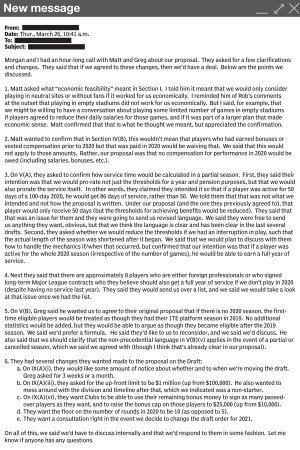
-
What Happens if the MLB Season Gets Delayed?
Major League Ready replied to Nick Nelson's topic in Twins Daily Front Page News
The 10 year pacts can produce situations that are unfair to players who are producing who could be getting that money. However, these 6+ year deals that go bad nullify some of the spending advantage of big teams. In other words, they actually help parity so I have no problem with these deals. The question is would a 5 year max help average revenue teams sign some of these top players. I am guessing not. The big revenue teams would offer an AAV that modest revenue teams could not afford. A floor does absolutely nothing / zero to help low revenue teams put a contender on the field. It's only benefit is to get really bad teams to hire veterans. Really great for the players but would anyone here be satisfied if our 61 win team in 2019 would have had 65 wins. Also , by definition the goal would be to take playing time away from prospects which is not what any of us would want. As I have said, there is a MUCH better way to use revenue sharing to help low revenue teams. Players care much more about how much they make over their career than what they earn the first couple years. They want more pay early only because they believe it will result in them making more in total. They are working towards hopefully generational wealth but even a bench player is going to make enough to retire at 35 and live very comfortably without ever working another day. That's there focus. The reality is the owners could very easily manage their payrolls via how they pay free agents to pay out the exact same amount regardless of what they pay in the first 3 or 4 years. I would like to see a significant raise in years 1-3 but really ... why do we care if they get paid more early. What is the benefit to fans? I particularly dislike the $100M pool because it will pay 3-4% (guess) of players more than all of then other prearb players will make combined even if they get a 35% raise. Those are the same players that will likely get huge contracts at some point. Once again it wreaks of Boras. -
Twins Players Most Hurt by a Lockout
Major League Ready replied to Ted Schwerzler 's topic in Twins Daily Front Page News
You are absolutely right but why should we care about anything other than the good of the game as fans. He still made triple what the average doctor does in 30 years practicing medicine. Granted, the owners are the wealthiest people on the planet but why should we care if a player "only makes $30M" and retires at age 32-33? Sign me up for that gig!- 13 replies
-
- 1
-

-
- royce lewis
- jordan balazovic
- (and 3 more)
-
Twins Players Most Hurt by a Lockout
Major League Ready replied to Ted Schwerzler 's topic in Twins Daily Front Page News
What's the "but". Would it have been good for the Twins, their fans or the game if they would have given him a 3 year $40M deal? -
What Happens if the MLB Season Gets Delayed?
Major League Ready replied to Nick Nelson's topic in Twins Daily Front Page News
How the players handled 2020 changed things for me too. They went public complaining the owners had agreed to pay pro-rated salaries and now refuse to live up to the agreement. I was shocked they agreed to this but was still dismayed they were not living up to their word. Of course, the leaked memo very clearly showed they agreed to pay prorated salaries IF FANS WERE IN ATTENDANCE. They flat out lied to us and refused to compromise in any manner. So, to paint the owners as the party that dug their heels in is absurd. The players said don’t tell me about a national pandemic we are not working for a penny less than 100%. We could have had another 20-25 games had they been willing to compromise. than playing 60 games. It’s not as if the owners were making less they were losing money for every game played. They went public and in the most intentional manner mislead us. They also did not do much to foster a working relationship when they agreed to work something out of fans were not present and then literally not move 1% while at the same time misleading the public. -
This many legit pitching prospects outside the top 20 is pretty exciting. Raya is the guy IMO that could really move up the rankings this year. The other guys all have enough raw stuff to move up too. It's going to be an interesting season.
- 18 replies
-
- 4
-
-
- aaron sabato
- drew strotman
- (and 3 more)
-
It's not nearly as simple as revenue grew and player salary has not from a given point. Part of it is that teams had been ineffective in how they invested in free agents. They adjusted. That's how it works in business. Second, teams added a significant number of non-player personnel. Why? Because they felt that investment would have a greater return than spending on free agents. Businesses reallocate financial resource all the time. This time that did not favor players but would you prefer your team allocate those funds to players or spend those dollars on analysts, equipment and specialty coaches that will enhance player development and provide greater performance across all of your players? Then, there is the whole concept that an employee is entitled to more money because revenue grew. Obviously, there are employees who get bonuses based on revenue. However, compensation for employees is not driven by revenue. It just does not work that way in any industry. If your company's revenue went up, would you be successful in demanding a raise based on the company revenue? The other side of this premise was demonstrated quite clearly during 2020 when the players refused to work for a penny less than 100% of their normal rate. They very clearly demonstrated they were not interested in compensation being driven by revenue when revenue was down. They are employees not partners.
-
What Happens if the MLB Season Gets Delayed?
Major League Ready replied to Nick Nelson's topic in Twins Daily Front Page News
The most interesting part of this to me is that I don’t see how any of the demands would change what have much impact on how much the players make over their career if the owners are anywhere near as greedy as fans think. If teams are paying players $3M more over the first 3 years or $7M more over the first 5, they could easily adjust what they are spend on free agents. If everyone is convinced it’s pure greed on their part, why would they not just make this adjustment and go on paying out the exact same amount in salary and making exactly the same amount of profit? There were 116 players that made $10M or more and there cumulative income was $2.2B. The top 200 made 2.8B. Obviously, not all of them were on free agent contracts but even at the 37% raised proposed by player’s amounts to about $60M. Add the 100M bonus pool and you have $160M. It would be extremely easy to adjust spending on free agents to nullify that expenditure. Still think the owners are fighting it because of the financial impact? You think the owners with MBAs from Harvard have not figured this out? -
What Happens if the MLB Season Gets Delayed?
Major League Ready replied to Nick Nelson's topic in Twins Daily Front Page News
I think you are right and I would not take that bet. -
What Happens if the MLB Season Gets Delayed?
Major League Ready replied to Nick Nelson's topic in Twins Daily Front Page News
This is all reasonable. There is no perfect system where everyone gets treated fairly. Players don’t get paid big money the first 3 years. Chris Davis / Jason Heyward and many many others get paid an absolute fortune to underperform or even perform at or near replacement level. Look at Pujlos and Cabrera. They are going to get paid huge for 5 or 6 years at near replacement level. Many others are overpaid for 2-3 years. Ironically, the frequency of these bad contracts helps mitigate the spending advantage the top revenue teams have over the bottom revenue teams given those bottom revenue teams so rarely sign these deals. Maybe they should enact a clause allowing teams to cancel these deals but 1/2 of the money goes into a fund to be distributed among all prearb players. I am being facetious but it would be more fair than players getting paid $150M to perform at replacement level and prearb players making $600K. The system that is in place basically has an internship and then players get paid big. The good ones make generational wealth in 10 years and retire at 35. ? Does it really matter if they make $600K for the 1st 3 years? It’s not like they are suffering making twice what the average doctor makes. More importantly, this compensation system is crucial to below average revenue teams every having a shot to build a contender. Is it worth further eroding parity so that these guys can get paid earlier? Granted, there will be some players that suffer career ending injuries before they get to the big money. There are also plenty of Mark Appels who never even earn a roster spot but get a bonus that is 3 times more than the average guy makes in a lifetime. Is every player who ever makes it to MLB level entitled to earnings such that they can retire whenever they are done playing? As it is, any player that can maintain a roster spot even as a bench player will make enough to retire. An “Ehire Adrianza” bench type player will make $12-15M over their career. Let’s call it $7M after taxes. If they buy a $1M home and spend $1M on living expenses over their career they have $5M to invest. Let’s just say they buy an apartment building. If they hire a property management firm so they don’t need to be bothered with anything, they can return about 6% OR $300K/year. An average everyday player is going to make enough to retire at 35, live like a king and leave a trust fund that would all their kids to live like a king never working a day in their lives. How is it a problem they have to work a couple years at a reduced rate? One of the best parallels is MDs and their internship. They spend 8-10 years in school and come out with a half-million in student loads and then work insane hours for little pay for a couple hours. When they are done with that program the average doctor makes 1/2 of what the MLB minimum will be in the next CBA. IMO, we should be far more worried about how any changes impact parity than if players need to wait a couple years before they can afford a private jet. -
You are right but these debates tend to lose focus on the actual point of the discussion. If you look back at the discussion, my point was that both sides are extremely fortunate. However, only one side refuses to go on without getting more from the other. A lot of people want to ignore which side won't go on without getting more. The owners want 3 things. A universal DH. It's good for the game and will replace some low paying jobs with high paying jobs so it's good for the players. It will cost the owners whatever the difference in salary is between the bench player they replace X 15. Expanded playoffs created a lot more fan interest in 2020. It's good for fans. The additional revenue created is good for players and owners. Obviously, the revenue goes to owners but given they spend 85-90 of the revenue it's good for the players too. They certainly are not asking for something from the players. An international draft. I will let you decide if that system could use an overhaul and if that would be good for the game because that's a whole other discussion. The league has not asked for anything this is not of benefit to the players and the game. The same can't be said of the player's demands. We are where we are because the players want more. That's why we won't have a normal season or perhaps any season at all. It's pretty tough to swallow they need more when looking at the contracts given out before the lockout. If your company had several years of success could you demand a raise because they are making money? Of course not. Your compensation is based on market economics. Would your salary / job be guaranteed no matter how you perform?
