



Nick Nelson
-
Posts
8,326 -
Joined
-
Last visited
-
Days Won
56
Content Type
Profiles
News
Minnesota Twins Videos
2026 Minnesota Twins Top Prospects Ranking
2022 Minnesota Twins Draft Picks
Minnesota Twins Free Agent & Trade Rumors, Notes, & Tidbits
Guides & Resources
2023 Minnesota Twins Draft Picks
The Minnesota Twins Players Project
2024 Minnesota Twins Draft Picks
2025 Minnesota Twins Draft Pick Tracker
2026 Minnesota Twins Draft Tracker: Picks & Bonuses
Forums
Blogs
Events
Store
Downloads
Gallery
Everything posted by Nick Nelson
-
Twins Daily 2023 Top 20 Prospects: Recap & Analysis
Nick Nelson replied to Nick Nelson's topic in Twins Minor League Talk
I figured I had to up the stakes this time 😎- 28 replies
-
- 7
-

-

-
- brooks lee
- royce lewis
- (and 3 more)
-
We've spent the past few weeks revealing our choices for the top prospects in the Twins organization. Now, let's take a step back and assess the state of the system. Image courtesy of Thiéres Rabelo, Twins Daily The purpose of these rankings is to take stock of the Twins farm system leading up to the start of the season. This year we asked 10 different Twins Daily writers, all of whom follow the minors closely, to share their choices for the current top 30 Twins prospects. Then we aggregated them into the list that's been gradually rolled out here over the past few weeks. This is a snapshot in time. Prospect rankings are never static, and in order to better follow the movement that occurs over time, last year we launched the Twins Daily Prospect Tracker. It's updated monthly throughout the season with new stats, insights, and re-rankings. I recommend bookmarking that page and checking back often if you love to follow the next generation of Twins talent. For today, we're going to dive deep on that next generation and how it's shaping the future of the franchise. First, here's a rundown of this year's top 20 rankings – you can click on each player's name to find a profile on him from one of our writers. Minnesota Twins 2023 Top 20 Prospects 20. Misael Urbina, OF: Has come along slowly since signing as a top int'l talent out of DR in 2018, but still 20 with big tools. 19. Jose Rodriguez, OF: Opened eyes with a spectacular and rare power display in the Dominican Summer League. 18. Tanner Schobel, 2B: 2022 second-round pick saw his college power spike evaporate in pro debut, fading his hype. 17. Ronny Henriquez, RHP: Slider-slinging 22-year-old seems destined to break through in full-time relief role. 16. Jordan Balazovic, RHP: Stellar track record keeps him on the radar following a disastrous year at Triple-A. 15. Matt Canterino, RHP: Maybe the best raw stuff in the organization, but TJ surgery will sideline him again this year. 14. Noah Miller, SS: Outstanding fielder needs to find some semblance of offensive game other than drawing walks. 13. David Festa, RHP: Former 13th-rounder's domination of Single-A sparks hope for another deep-draft pitching find. 12. Yasser Mercedes, OF: Club's biggest int'l signing last summer flashed all five tools in highly impressive rookie-ball debut. 11. Matt Wallner, OF: His off-the-charts raw power will play in the bigs if he can stay relatively disciplined at plate. 10. Austin Martin, SS: Huge dropoff after topping this list a year ago, but the speedy OBP specialist can rebound. 9. Louie Varland, RHP: Continues to outperform his stuff, but also, the stuff continues to get better for hard-working SP. 8. Jose Salas, INF: Twins picked up a dynamic young athlete via Arraez trade in this versatile switch-hitting infielder. 7. Connor Prielipp, LHP: Slid to Twins in second round of latest draft coming off elbow surgery, but has frontline SP traits. 6. Simeon Woods Richardson, RHP: Reached majors at age 22 following lights-out campaign between AA/AAA. 5. Edouard Julien, 2B: He has raked in the minors with an ultra-patient approach, and is knocking on MLB door. 4. Marco Raya, RHP: Word is out on the best-kept secret in Twins system, who dazzled in pro debut at Fort Myers. 3. Emmanuel Rodriguez, OF: Flashed superstar talent and production during full-season debut cut short by knee injury. 2. Royce Lewis, SS: Cemented legitimacy during a convincing return to action before being struck by another torn ACL. 1. Brooks Lee, SS: Drafted eighth overall with a bat that pretty much looked MLB-ready as soon as he reached the pro field. A True Deadlock at the Top The most fascinating dynamic of this year's rankings was the choice between Lee and Lewis for number one. I cannot possibly overstate how accurate the word "deadlock" is in describing the lack of separation between these high-end talents in our ranking process. The results from tabulating our panel of 10 voters placed the two in an exact tie: five voters picked Lewis, five picked Lee. In order to try and swing things one way or the other, we reached out for off-the-record opinions on the matter from a variety of trusted sources: scouting contacts, prospect analysts, baseball people inside the Twins organization and out. You know what came back? Pretty much a 50/50 split exactly. Almost everyone expressed a variation of the same sentiment: It's really hard to compare the two directly, because it all comes down to the upside & risk versus safety & floor equation. "If I had to choose, I guess I'd go with X." We all want to dream on the lofty upside Lewis still possesses: the potential for an electric power/speed combo from shortstop or center field, combined with character and charisma on the Jeter Scale. But no one can ignore the realities of a career that's been sabotaged by injuries, the latest of which undeniably clouds his future outlook. How do you properly account for this in projecting him as a major-league player? And how do you compare him to someone like Lee, who probably has a lower overall ceiling but also has one of the highest floors you could ask for in a prospect? Lee looked so polished and adept during his pro debut after signing last year that he found his way to Wichita for the Double-A playoffs and was up to the task. Lee makes it look really easy, and that's the highest compliment you can pay a 21-year-old barely out of college and facing experienced pro competition. Ultimately, we went with Lee as our choice for as the top Twins prospect of 2023, because the feedback we received seemed to tilt ever-so-slightly in that direction and because the majority of publications we chart our rankings against – MLB.com, Baseball Prospectus, The Athletic (both Keith Law and Aaron Gleeman) – have Lee in front of Lewis. But if there's a strong consensus to be found around these two it's this: the Twins are very lucky to have them both. Restocking the Low Minors with Upside Lee and Lewis both contribute to a robust top end of the pipeline, joining the likes of Julien, Woods Richardson, Varland, Martin, and Wallner as quality prospects who could essentially be ready to make an MLB impact at any time. But a number of breakthroughs from recent draft classes and recent high-profile international signings have populated the lower levels with promising young talent. This was missing last year, when essentially all 10 of our top prospects were in the high minors and approaching MLB-readiness, save for Chase Petty who got traded shortly after we published. The emergences of teenaged players like Emmanuel Rodriguez, Raya, and Mercedes – bolstered by the acquisition of Salas in the Luis Arraez trade – have done wonders for the lower levels of this system, and the franchise's long-term talent landscape. Still Lacking Catcher Talent The lack of standout catching prospects in Minnesota's system is something I noted last year, even before Mitch Garver and Ben Rortvedt were traded away. It's now even more conspicuous. The Twins have sought to backfill at the MLB level with veterans like Gary Sánchez and now Christian Vázquez, but the future of this position continues to hinge on Ryan Jeffers, who has proven little at age 25. Not only were there zero catching prospects in our top 20, but if you zoom out to the top 30, none are found in the 21-through-30 range either. The highest I've seen a catcher ranked by anyone is Noah Cardenas, who was 25th on Gleeman's top 40 list, but Cardenas was profiled there as a "future backup with some starter upside." Another tough year for Jeffers, with Vázquez under control through 2025 but turning 33 in August, would leave the organization's outlook pretty flimsy behind the plate unless new names emerge. Rebound Scenarios Present X-factors Aside from some of the big risers, the most stark movements from last year's rankings were the dramatic downfalls of Martin (#1 last year, #10 this year) and Balazovic (#4 last year, #16 this year). Those are tough blows for the system and help explain why it's generally viewed as middling compared to the league. (Law ranked them 19th out of 30 organizations at The Athletic earlier this month.) The flip side is this: it's only one season, and these players are not far removed from being viewed as viable (and imminent) difference-makers with convincing track records. Martin and Balazovic are legit talents, and both will be 24 this year with ample experience in the high minors. A turnaround for either could quickly thrust them into the big-league picture. Who's Your Pick to Click in 2023? I asked this at the conclusion of last year's recap article, so I'll send it your way again. Who is your pick to click and make a huge jump in the rankings in 2023? Last year I the name I submitted was Marco Raya, and he went from Honorable Mentions to #4 on our list, so that went well. This year I will go with Keoni Cavaco, who was merely an Honorable Mention this year having fallen off the radar in three unproductive seasons since being drafted 13th overall in 2019. Cavaco wasn't good last year, but he did seem to take a step forward and he remains an athletic and toolsy infielder. I like him to escape the pitcher-friendly Florida State League and put together a strong age-21 season that vaults him back into the top 20. How about you? Past Rankings Twins Daily 2022 Top Prospects Twins Daily 2021 Top Prospects Twins Daily 2020 Top Prospects Twins Daily 2019 Top Prospects Twins Daily 2018 Top Prospects Twins Daily 2017 Top Prospects Twins Daily 2016 Top Prospects Twins Daily 2015 Top Prospects Twins Daily Links: Misael Urbina, OF, Jose Rodriguez, OF, Tanner Schobel, 2B, Ronny Henriquez, RHP, Jordan Balazovic, RHP, Matt Canterino, RHP, Noah Miller, SS, David Festa, RHP, Yasser Mercedes, OF, Matt Wallner, OF, Austin Martin, SS, Louie Varland, RHP. Jose Salas, INF, Connor Prielipp, LHP, Simeon Woods Richardson, RHP, Edouard Julien, 2B, Marco Raya, RHP, Emmanuel Rodriguez, OF, Royce Lewis, SS, Brooks Lee, SS. Baseball-Reference Links: Misael Urbina, OF, Jose Rodriguez, OF, Tanner Schobel, 2B, Ronny Henriquez, RHP, Jordan Balazovic, RHP, Matt Canterino, RHP, Noah Miller, SS, David Festa, RHP, Yasser Mercedes, OF, Matt Wallner, OF, Austin Martin, SS, Louie Varland, RHP. Jose Salas, INF, Connor Prielipp, LHP, Simeon Woods Richardson, RHP, Edouard Julien, 2B, Marco Raya, RHP, Emmanuel Rodriguez, OF, Royce Lewis, SS, Brooks Lee, SS. View full article
-
 The purpose of these rankings is to take stock of the Twins farm system leading up to the start of the season. This year we asked 10 different Twins Daily writers, all of whom follow the minors closely, to share their choices for the current top 30 Twins prospects. Then we aggregated them into the list that's been gradually rolled out here over the past few weeks. This is a snapshot in time. Prospect rankings are never static, and in order to better follow the movement that occurs over time, last year we launched the Twins Daily Prospect Tracker. It's updated monthly throughout the season with new stats, insights, and re-rankings. I recommend bookmarking that page and checking back often if you love to follow the next generation of Twins talent. For today, we're going to dive deep on that next generation and how it's shaping the future of the franchise. First, here's a rundown of this year's top 20 rankings – you can click on each player's name to find a profile on him from one of our writers. Minnesota Twins 2023 Top 20 Prospects 20. Misael Urbina, OF: Has come along slowly since signing as a top int'l talent out of DR in 2018, but still 20 with big tools. 19. Jose Rodriguez, OF: Opened eyes with a spectacular and rare power display in the Dominican Summer League. 18. Tanner Schobel, 2B: 2022 second-round pick saw his college power spike evaporate in pro debut, fading his hype. 17. Ronny Henriquez, RHP: Slider-slinging 22-year-old seems destined to break through in full-time relief role. 16. Jordan Balazovic, RHP: Stellar track record keeps him on the radar following a disastrous year at Triple-A. 15. Matt Canterino, RHP: Maybe the best raw stuff in the organization, but TJ surgery will sideline him again this year. 14. Noah Miller, SS: Outstanding fielder needs to find some semblance of offensive game other than drawing walks. 13. David Festa, RHP: Former 13th-rounder's domination of Single-A sparks hope for another deep-draft pitching find. 12. Yasser Mercedes, OF: Club's biggest int'l signing last summer flashed all five tools in highly impressive rookie-ball debut. 11. Matt Wallner, OF: His off-the-charts raw power will play in the bigs if he can stay relatively disciplined at plate. 10. Austin Martin, SS: Huge dropoff after topping this list a year ago, but the speedy OBP specialist can rebound. 9. Louie Varland, RHP: Continues to outperform his stuff, but also, the stuff continues to get better for hard-working SP. 8. Jose Salas, INF: Twins picked up a dynamic young athlete via Arraez trade in this versatile switch-hitting infielder. 7. Connor Prielipp, LHP: Slid to Twins in second round of latest draft coming off elbow surgery, but has frontline SP traits. 6. Simeon Woods Richardson, RHP: Reached majors at age 22 following lights-out campaign between AA/AAA. 5. Edouard Julien, 2B: He has raked in the minors with an ultra-patient approach, and is knocking on MLB door. 4. Marco Raya, RHP: Word is out on the best-kept secret in Twins system, who dazzled in pro debut at Fort Myers. 3. Emmanuel Rodriguez, OF: Flashed superstar talent and production during full-season debut cut short by knee injury. 2. Royce Lewis, SS: Cemented legitimacy during a convincing return to action before being struck by another torn ACL. 1. Brooks Lee, SS: Drafted eighth overall with a bat that pretty much looked MLB-ready as soon as he reached the pro field. A True Deadlock at the Top The most fascinating dynamic of this year's rankings was the choice between Lee and Lewis for number one. I cannot possibly overstate how accurate the word "deadlock" is in describing the lack of separation between these high-end talents in our ranking process. The results from tabulating our panel of 10 voters placed the two in an exact tie: five voters picked Lewis, five picked Lee. In order to try and swing things one way or the other, we reached out for off-the-record opinions on the matter from a variety of trusted sources: scouting contacts, prospect analysts, baseball people inside the Twins organization and out. You know what came back? Pretty much a 50/50 split exactly. Almost everyone expressed a variation of the same sentiment: It's really hard to compare the two directly, because it all comes down to the upside & risk versus safety & floor equation. "If I had to choose, I guess I'd go with X." We all want to dream on the lofty upside Lewis still possesses: the potential for an electric power/speed combo from shortstop or center field, combined with character and charisma on the Jeter Scale. But no one can ignore the realities of a career that's been sabotaged by injuries, the latest of which undeniably clouds his future outlook. How do you properly account for this in projecting him as a major-league player? And how do you compare him to someone like Lee, who probably has a lower overall ceiling but also has one of the highest floors you could ask for in a prospect? Lee looked so polished and adept during his pro debut after signing last year that he found his way to Wichita for the Double-A playoffs and was up to the task. Lee makes it look really easy, and that's the highest compliment you can pay a 21-year-old barely out of college and facing experienced pro competition. Ultimately, we went with Lee as our choice for as the top Twins prospect of 2023, because the feedback we received seemed to tilt ever-so-slightly in that direction and because the majority of publications we chart our rankings against – MLB.com, Baseball Prospectus, The Athletic (both Keith Law and Aaron Gleeman) – have Lee in front of Lewis. But if there's a strong consensus to be found around these two it's this: the Twins are very lucky to have them both. Restocking the Low Minors with Upside Lee and Lewis both contribute to a robust top end of the pipeline, joining the likes of Julien, Woods Richardson, Varland, Martin, and Wallner as quality prospects who could essentially be ready to make an MLB impact at any time. But a number of breakthroughs from recent draft classes and recent high-profile international signings have populated the lower levels with promising young talent. This was missing last year, when essentially all 10 of our top prospects were in the high minors and approaching MLB-readiness, save for Chase Petty who got traded shortly after we published. The emergences of teenaged players like Emmanuel Rodriguez, Raya, and Mercedes – bolstered by the acquisition of Salas in the Luis Arraez trade – have done wonders for the lower levels of this system, and the franchise's long-term talent landscape. Still Lacking Catcher Talent The lack of standout catching prospects in Minnesota's system is something I noted last year, even before Mitch Garver and Ben Rortvedt were traded away. It's now even more conspicuous. The Twins have sought to backfill at the MLB level with veterans like Gary Sánchez and now Christian Vázquez, but the future of this position continues to hinge on Ryan Jeffers, who has proven little at age 25. Not only were there zero catching prospects in our top 20, but if you zoom out to the top 30, none are found in the 21-through-30 range either. The highest I've seen a catcher ranked by anyone is Noah Cardenas, who was 25th on Gleeman's top 40 list, but Cardenas was profiled there as a "future backup with some starter upside." Another tough year for Jeffers, with Vázquez under control through 2025 but turning 33 in August, would leave the organization's outlook pretty flimsy behind the plate unless new names emerge. Rebound Scenarios Present X-factors Aside from some of the big risers, the most stark movements from last year's rankings were the dramatic downfalls of Martin (#1 last year, #10 this year) and Balazovic (#4 last year, #16 this year). Those are tough blows for the system and help explain why it's generally viewed as middling compared to the league. (Law ranked them 19th out of 30 organizations at The Athletic earlier this month.) The flip side is this: it's only one season, and these players are not far removed from being viewed as viable (and imminent) difference-makers with convincing track records. Martin and Balazovic are legit talents, and both will be 24 this year with ample experience in the high minors. A turnaround for either could quickly thrust them into the big-league picture. Who's Your Pick to Click in 2023? I asked this at the conclusion of last year's recap article, so I'll send it your way again. Who is your pick to click and make a huge jump in the rankings in 2023? Last year I the name I submitted was Marco Raya, and he went from Honorable Mentions to #4 on our list, so that went well. This year I will go with Keoni Cavaco, who was merely an Honorable Mention this year having fallen off the radar in three unproductive seasons since being drafted 13th overall in 2019. Cavaco wasn't good last year, but he did seem to take a step forward and he remains an athletic and toolsy infielder. I like him to escape the pitcher-friendly Florida State League and put together a strong age-21 season that vaults him back into the top 20. How about you? Past Rankings Twins Daily 2022 Top Prospects Twins Daily 2021 Top Prospects Twins Daily 2020 Top Prospects Twins Daily 2019 Top Prospects Twins Daily 2018 Top Prospects Twins Daily 2017 Top Prospects Twins Daily 2016 Top Prospects Twins Daily 2015 Top Prospects Twins Daily Links: Misael Urbina, OF, Jose Rodriguez, OF, Tanner Schobel, 2B, Ronny Henriquez, RHP, Jordan Balazovic, RHP, Matt Canterino, RHP, Noah Miller, SS, David Festa, RHP, Yasser Mercedes, OF, Matt Wallner, OF, Austin Martin, SS, Louie Varland, RHP. Jose Salas, INF, Connor Prielipp, LHP, Simeon Woods Richardson, RHP, Edouard Julien, 2B, Marco Raya, RHP, Emmanuel Rodriguez, OF, Royce Lewis, SS, Brooks Lee, SS. Baseball-Reference Links: Misael Urbina, OF, Jose Rodriguez, OF, Tanner Schobel, 2B, Ronny Henriquez, RHP, Jordan Balazovic, RHP, Matt Canterino, RHP, Noah Miller, SS, David Festa, RHP, Yasser Mercedes, OF, Matt Wallner, OF, Austin Martin, SS, Louie Varland, RHP. Jose Salas, INF, Connor Prielipp, LHP, Simeon Woods Richardson, RHP, Edouard Julien, 2B, Marco Raya, RHP, Emmanuel Rodriguez, OF, Royce Lewis, SS, Brooks Lee, SS.
- 28 comments
-
- 7
-
-
- brooks lee
- royce lewis
- (and 3 more)
-
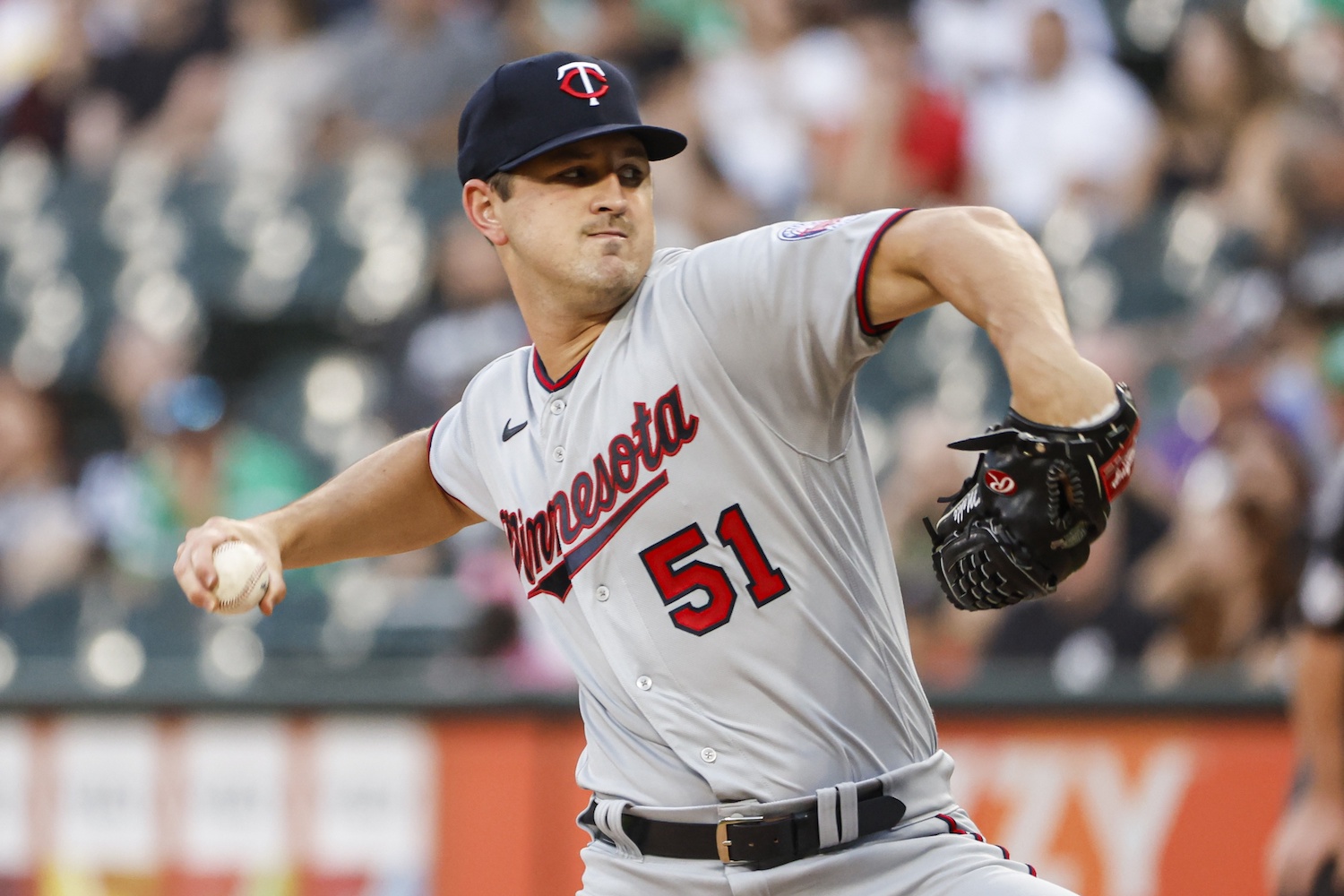 I'll be honest, it sucks to write articles like these. When analyzing the impact players are likely to have, I much prefer to talk about guys with something to prove performance-wise, because it feels more actionable and controllable. Alas, it's impossible to talk about this year's team without addressing all of the cascading injury concerns that carry over from a 2022 campaign besieged by heath issues. One of the reasons we've all been so adamantly looking forward to the start of spring training is because we actually get some insight into these players' statuses, as opposed to endless speculating and hoping. Granted, the insights we're gaining at this very early stage of camp, with players still arriving and settling in, are very limited in their significance. But they're something. And for what it's worth, there's been a considerable amount of reporting and updates around these topics because – like we said – everyone understands the magnitude of importance. Here's what we we've learned so far about several pivotal players with injury concerns. Alex Kirilloff Situation: Kirilloff's rookie season in 2021 was cut short by a wrist injury that required surgery, and his 2022 season was again cut short by issues in the same wrist, requiring a more invasive and serious surgery. We start with Kirilloff because he is, in my opinion, the single most impactful health question mark for the Twins this year. The variance of outcomes here is wild: Either the second surgery doesn't take and Kirilloff is forever doomed to be a mere figment of his true potential, or he finally gains comfort at the plate and blossoms into the MVP-caliber hitter we've all envisioned. We're not going to be able to draw any kind of substantive conclusions until Kirilloff actually starts getting some game action and taking competitive swings – even then, we might not know a ton, since he seemed to feel OK around this time last year – but for now, the news is positive. Rocco Baldelli told reporters there was "no setback, no concern" attached to the 25-year-old at this point and he's "probably in as good of a spot as they've seen him coming into camp." Even if things are going smoothly, I would expect the Twins to take things very slowly with Kirilloff, holding him out of exhibition contests until there's full confidence he's in a good place. It wouldn't shock me if he was held back from the MLB roster at the start of the season, even without setbacks, to be totally honest. The club seems committed to a very cautious approach in these situations, as we'll see. Trevor Larnach Situation: Larnach's second season in the majors showed the similar promise he showed in his first season, but also ended in injury like his first season. A core muscle strain suffered in late-June required surgery, recovery was slower than anticipated, and then a rehab assignment led to a cascading core injury that ended his season. Larnach is also looking to establish himself, and also penciled into a big role for the Twins this year. He spent the offseason rehabbing a core injury with input from several doctors and trainers, and reports that he is at 100%, and hasn't even needed to see the trainer this year so far. In addition, the Twins also report him entering camp without any limitations. Tyler Mahle Situation: Mahle was plagued by ambiguous shoulder issues throughout the 2022 campaign – described at various junctures as soreness, weakness, and fatigue – and they shut him down shortly after he was acquired by Minnesota at the deadline. The unexplained nature of Mahle's 2022 shoulder malady is what makes it so hard to feel confident in a clean rebound. Each time the righty took the mound with diminished velocity and results, he expressed minimal concern. And yet, he threw only two innings after exiting his third Twins start early on August 17th, ending the season on IL. So far this spring, the vibe around Mahle is very similar: no problems, all systems go. Dan Hayes of The Athletic reports that the 28-year-old felt good enough at season's end to put in work at Driveline, an esteemed performance training center for pitchers. Much like with Kirilloff, the proof will very much be in the pudding for Mahle. Can he get out on the mound and throw in the mid-90s? Can he sustain that over increasingly long starts this spring? We'll see. But for now, all signs are positive, and customarily chill. Kenta Maeda Situation: Maeda missed the entire 2022 season after undergoing Tommy John surgery in August of 2021, and is now coming back from all the missed time at age 35, with a baseline of only 175 total innings thrown since 2019. Maeda's inability to make it back onto the mound late last season was largely treated as a formality – the team faded from contention, why bother – but his early comments in camp suggest that he still wasn't feeling ready, one year removed from the surgery. The 2020 Cy Young runner-up reportedly threw 40 pitches in the bullpen on Thursday, and indicated that he already felt much better compared to where he was last September. Topping out at 89 MPH is not a bad sign for Maeda, especially this early in the process. He's less reliant on velocity than Mahle, and in this case the real questions are around stamina and command. We'll have to see how the spring progresses to get a good read on those factors. Royce Lewis Situation: Lewis missed the entire 2021 season after suffering an offseason ACL tear, then made a brief but electric return to the field last year before re-tearing the same ACL in an outfield wall collision. It was a beautiful sight. Eight months removed from undergoing his second reconstructive right knee surgery (with a twist), reporters caught video of Lewis opening up with a relatively high-intensity sprint on the grassy side fields of Lee County Sports Complex. Lewis still has a long way to go before he's in game shape, and his spring training activity will likely be limited to these kinds of on-the-side rehab drills, but the fact that's running comfortably at this stage is very encouraging. The estimated timeline for Lewis to return to the majors is "late June or July," but we'll see if a productive spring revises it on the shorter side. Chris Paddack Situation: He looked good in a handful of starts after being acquired from San Diego just before the 2022 season, but tore his UCL and underwent Tommy John surgery for the second time in mid-May. Paddack raised some eyebrows when he told reporters late last season his goal was to return to the mound in August of this year, establishing a notably longer rehab window than the 9-12 months now considered customary for TJ. Of course, undergoing the operation for a second time already at age 26 casts recovery in a very different light, and in Paddack's case there seems to a special emphasis on taking things slow and steady. "Because this is his second elbow surgery, Paddack is taking a conservative approach and performing each step in his rehab three months later than normal at the advice of Dr. Keith Meister," wrote Hayes for The Athletic. Indeed, Paddack shared with the beat reporters that with a second surgery, the timetable is generally moved back three months from the first Tommy John surgery. In the article, Paddack's quotes gave the impression that making it back at all this year is a stretch goal more than anything. “We made that clear at the beginning of this whole thing is like, ‘Hey, don’t tell me I’m not pitching,’ because I want to have some drive,” he said. “I want to have something to look forward to and then if September rolls around and we’re not ready to go, then we can address that situation when it comes.” You wonder if the Twins players, coaches, and trainers have basically committed to setting unambitious expectations after a year where every timeline seemed to drag past initial estimates, leading to criticisms being leveled at all parties involved. Wouldn't be refreshing to have a few players actually beat their estimated return timelines for a change? Jorge Alcalá Situation: The hard-throwing righty made two April appearances for the Twins last year before being shut down due to elbow discomfort. The issue was initially deemed minor, but setbacks in recovery led to arthroscopic debridement surgery in August. He's been billed as fully healthy coming into spring training and was seen throwing early bullpens with no apparent inhibitions. I'll be curious to see those in-game velocity readings. However, Falvey put Alcala into the category of "starting camp with limitations" meaning they'll be careful in bringing him along slowly. Randy Dobnak Situation: Dobnak's Cinderella Story was disrupted by multiple pulley ligament tears in his middle right finger, preventing him from throwing effectively or without pain over the past two seasons. Since signing a five-year contract extension ahead of 2021, he's thrown 50 MLB innings with a 7.64 ERA, and is now off the 40-man roster. Once viewed as a heartwarming success story, Dobnak has fallen off the radar due to his relentless struggles with a recurring finger injury that wreaks havoc on his ability to execute the trademark slider/sinker combo. He's no more than an afterthought in the Twins pitching plans at this point, but one that's easy to root for. Phil MIller had a great profile on Dobnak in the Star Tribune, relaying that "his finger, though not as flexible or strong as it once was, has been pain-free all winter." The caveat there looms large, given that Dobnak was a fringy overachieving talent to begin with, but he's proven doubters wrong plenty of times before. "I think we're way over the hump now," Dobnak said. "I've been slinging it fine." Jorge Polanco Situation: Polanco went on the injured list in late August, and – despite repeated indications that his knee issue was not severe and his return was near – he never made it back before the end of the season. Rocco Baldelli was conspicuously reserved when asked to share where things stand with the second baseman. "He'll be on a slightly different schedule," Baldelli said. "We'll slowly work him back into all facets of the game ... I think he's going to end up getting a lot at-bats on the back field. I think we're going to keep it controlled for a little while until we cut him loose in these games." On the other hand, Polanco met with reporters Saturday and said that there is no pain any more in his knee. However, he also admitted that the rehab work this offseason was extensive, that the recovery took more time than he hoped, and that he still needs to be conscious of it both on and off the field to make sure he takes care of it. It's likely that the next big step for him will be getting into a spring training game. That will indicate that they trust it enough for him to be full go for defensively. Byron Buxton Situation: Buxton was once again plagued by multiple injuries in 2022, costing him almost half the season, and the most significant was a persistent knee issue that required surgery after the season. He's the central storyline heading into this season and will be a primary player to follow in coming weeks. Unfortunately, we have the least information so far on Buxton, who arrived in camp on Friday and is just beginning to ramp up this weekend. Falvey address Buxton's condition, saying "There's nothing he's coming in with that's an issue" but also saying it will be a slow ramp up, similar to Polanco. It will be interesting to see how he's feeling and how he's moving around as the action picks up. Additionally, how will he be managed? The Twins walk a fine line between ensuring he's fully game-ready by Opening Day, while also limiting his exposure enough to minimize early wear and injury risk. John Bonnes is in Fort Myers following closely (and I'll be making the trek down there in a week to join him) so stay tuned as we track all of these crucial spring storylines.
- 16 comments
-
- 12
-

-
-
- tyler mahle
- alex kirilloff
- (and 2 more)
-
Injuries are unfortunately the number one storyline for the 2023 Twins coming off a promising campaign that was sabotaged by health woes. Now that spring training is underway and players are reporting, to camp here's where things stand with key players on the roster whose uncertainties weigh most heavily on the team's outlook this season. Image courtesy of Kamil Krzaczynski-USA TODAY Sports I'll be honest, it sucks to write articles like these. When analyzing the impact players are likely to have, I much prefer to talk about guys with something to prove performance-wise, because it feels more actionable and controllable. Alas, it's impossible to talk about this year's team without addressing all of the cascading injury concerns that carry over from a 2022 campaign besieged by heath issues. One of the reasons we've all been so adamantly looking forward to the start of spring training is because we actually get some insight into these players' statuses, as opposed to endless speculating and hoping. Granted, the insights we're gaining at this very early stage of camp, with players still arriving and settling in, are very limited in their significance. But they're something. And for what it's worth, there's been a considerable amount of reporting and updates around these topics because – like we said – everyone understands the magnitude of importance. Here's what we we've learned so far about several pivotal players with injury concerns. Alex Kirilloff Situation: Kirilloff's rookie season in 2021 was cut short by a wrist injury that required surgery, and his 2022 season was again cut short by issues in the same wrist, requiring a more invasive and serious surgery. We start with Kirilloff because he is, in my opinion, the single most impactful health question mark for the Twins this year. The variance of outcomes here is wild: Either the second surgery doesn't take and Kirilloff is forever doomed to be a mere figment of his true potential, or he finally gains comfort at the plate and blossoms into the MVP-caliber hitter we've all envisioned. We're not going to be able to draw any kind of substantive conclusions until Kirilloff actually starts getting some game action and taking competitive swings – even then, we might not know a ton, since he seemed to feel OK around this time last year – but for now, the news is positive. Rocco Baldelli told reporters there was "no setback, no concern" attached to the 25-year-old at this point and he's "probably in as good of a spot as they've seen him coming into camp." Even if things are going smoothly, I would expect the Twins to take things very slowly with Kirilloff, holding him out of exhibition contests until there's full confidence he's in a good place. It wouldn't shock me if he was held back from the MLB roster at the start of the season, even without setbacks, to be totally honest. The club seems committed to a very cautious approach in these situations, as we'll see. Trevor Larnach Situation: Larnach's second season in the majors showed the similar promise he showed in his first season, but also ended in injury like his first season. A core muscle strain suffered in late-June required surgery, recovery was slower than anticipated, and then a rehab assignment led to a cascading core injury that ended his season. Larnach is also looking to establish himself, and also penciled into a big role for the Twins this year. He spent the offseason rehabbing a core injury with input from several doctors and trainers, and reports that he is at 100%, and hasn't even needed to see the trainer this year so far. In addition, the Twins also report him entering camp without any limitations. Tyler Mahle Situation: Mahle was plagued by ambiguous shoulder issues throughout the 2022 campaign – described at various junctures as soreness, weakness, and fatigue – and they shut him down shortly after he was acquired by Minnesota at the deadline. The unexplained nature of Mahle's 2022 shoulder malady is what makes it so hard to feel confident in a clean rebound. Each time the righty took the mound with diminished velocity and results, he expressed minimal concern. And yet, he threw only two innings after exiting his third Twins start early on August 17th, ending the season on IL. So far this spring, the vibe around Mahle is very similar: no problems, all systems go. Dan Hayes of The Athletic reports that the 28-year-old felt good enough at season's end to put in work at Driveline, an esteemed performance training center for pitchers. Much like with Kirilloff, the proof will very much be in the pudding for Mahle. Can he get out on the mound and throw in the mid-90s? Can he sustain that over increasingly long starts this spring? We'll see. But for now, all signs are positive, and customarily chill. Kenta Maeda Situation: Maeda missed the entire 2022 season after undergoing Tommy John surgery in August of 2021, and is now coming back from all the missed time at age 35, with a baseline of only 175 total innings thrown since 2019. Maeda's inability to make it back onto the mound late last season was largely treated as a formality – the team faded from contention, why bother – but his early comments in camp suggest that he still wasn't feeling ready, one year removed from the surgery. The 2020 Cy Young runner-up reportedly threw 40 pitches in the bullpen on Thursday, and indicated that he already felt much better compared to where he was last September. Topping out at 89 MPH is not a bad sign for Maeda, especially this early in the process. He's less reliant on velocity than Mahle, and in this case the real questions are around stamina and command. We'll have to see how the spring progresses to get a good read on those factors. Royce Lewis Situation: Lewis missed the entire 2021 season after suffering an offseason ACL tear, then made a brief but electric return to the field last year before re-tearing the same ACL in an outfield wall collision. It was a beautiful sight. Eight months removed from undergoing his second reconstructive right knee surgery (with a twist), reporters caught video of Lewis opening up with a relatively high-intensity sprint on the grassy side fields of Lee County Sports Complex. Lewis still has a long way to go before he's in game shape, and his spring training activity will likely be limited to these kinds of on-the-side rehab drills, but the fact that's running comfortably at this stage is very encouraging. The estimated timeline for Lewis to return to the majors is "late June or July," but we'll see if a productive spring revises it on the shorter side. Chris Paddack Situation: He looked good in a handful of starts after being acquired from San Diego just before the 2022 season, but tore his UCL and underwent Tommy John surgery for the second time in mid-May. Paddack raised some eyebrows when he told reporters late last season his goal was to return to the mound in August of this year, establishing a notably longer rehab window than the 9-12 months now considered customary for TJ. Of course, undergoing the operation for a second time already at age 26 casts recovery in a very different light, and in Paddack's case there seems to a special emphasis on taking things slow and steady. "Because this is his second elbow surgery, Paddack is taking a conservative approach and performing each step in his rehab three months later than normal at the advice of Dr. Keith Meister," wrote Hayes for The Athletic. Indeed, Paddack shared with the beat reporters that with a second surgery, the timetable is generally moved back three months from the first Tommy John surgery. In the article, Paddack's quotes gave the impression that making it back at all this year is a stretch goal more than anything. “We made that clear at the beginning of this whole thing is like, ‘Hey, don’t tell me I’m not pitching,’ because I want to have some drive,” he said. “I want to have something to look forward to and then if September rolls around and we’re not ready to go, then we can address that situation when it comes.” You wonder if the Twins players, coaches, and trainers have basically committed to setting unambitious expectations after a year where every timeline seemed to drag past initial estimates, leading to criticisms being leveled at all parties involved. Wouldn't be refreshing to have a few players actually beat their estimated return timelines for a change? Jorge Alcalá Situation: The hard-throwing righty made two April appearances for the Twins last year before being shut down due to elbow discomfort. The issue was initially deemed minor, but setbacks in recovery led to arthroscopic debridement surgery in August. He's been billed as fully healthy coming into spring training and was seen throwing early bullpens with no apparent inhibitions. I'll be curious to see those in-game velocity readings. However, Falvey put Alcala into the category of "starting camp with limitations" meaning they'll be careful in bringing him along slowly. Randy Dobnak Situation: Dobnak's Cinderella Story was disrupted by multiple pulley ligament tears in his middle right finger, preventing him from throwing effectively or without pain over the past two seasons. Since signing a five-year contract extension ahead of 2021, he's thrown 50 MLB innings with a 7.64 ERA, and is now off the 40-man roster. Once viewed as a heartwarming success story, Dobnak has fallen off the radar due to his relentless struggles with a recurring finger injury that wreaks havoc on his ability to execute the trademark slider/sinker combo. He's no more than an afterthought in the Twins pitching plans at this point, but one that's easy to root for. Phil MIller had a great profile on Dobnak in the Star Tribune, relaying that "his finger, though not as flexible or strong as it once was, has been pain-free all winter." The caveat there looms large, given that Dobnak was a fringy overachieving talent to begin with, but he's proven doubters wrong plenty of times before. "I think we're way over the hump now," Dobnak said. "I've been slinging it fine." Jorge Polanco Situation: Polanco went on the injured list in late August, and – despite repeated indications that his knee issue was not severe and his return was near – he never made it back before the end of the season. Rocco Baldelli was conspicuously reserved when asked to share where things stand with the second baseman. "He'll be on a slightly different schedule," Baldelli said. "We'll slowly work him back into all facets of the game ... I think he's going to end up getting a lot at-bats on the back field. I think we're going to keep it controlled for a little while until we cut him loose in these games." On the other hand, Polanco met with reporters Saturday and said that there is no pain any more in his knee. However, he also admitted that the rehab work this offseason was extensive, that the recovery took more time than he hoped, and that he still needs to be conscious of it both on and off the field to make sure he takes care of it. It's likely that the next big step for him will be getting into a spring training game. That will indicate that they trust it enough for him to be full go for defensively. Byron Buxton Situation: Buxton was once again plagued by multiple injuries in 2022, costing him almost half the season, and the most significant was a persistent knee issue that required surgery after the season. He's the central storyline heading into this season and will be a primary player to follow in coming weeks. Unfortunately, we have the least information so far on Buxton, who arrived in camp on Friday and is just beginning to ramp up this weekend. Falvey address Buxton's condition, saying "There's nothing he's coming in with that's an issue" but also saying it will be a slow ramp up, similar to Polanco. It will be interesting to see how he's feeling and how he's moving around as the action picks up. Additionally, how will he be managed? The Twins walk a fine line between ensuring he's fully game-ready by Opening Day, while also limiting his exposure enough to minimize early wear and injury risk. John Bonnes is in Fort Myers following closely (and I'll be making the trek down there in a week to join him) so stay tuned as we track all of these crucial spring storylines. View full article
-
Twins Daily 2023 Top Prospects: #3 Emmanuel Rodriguez, OF
Nick Nelson posted an article in Minor Leagues
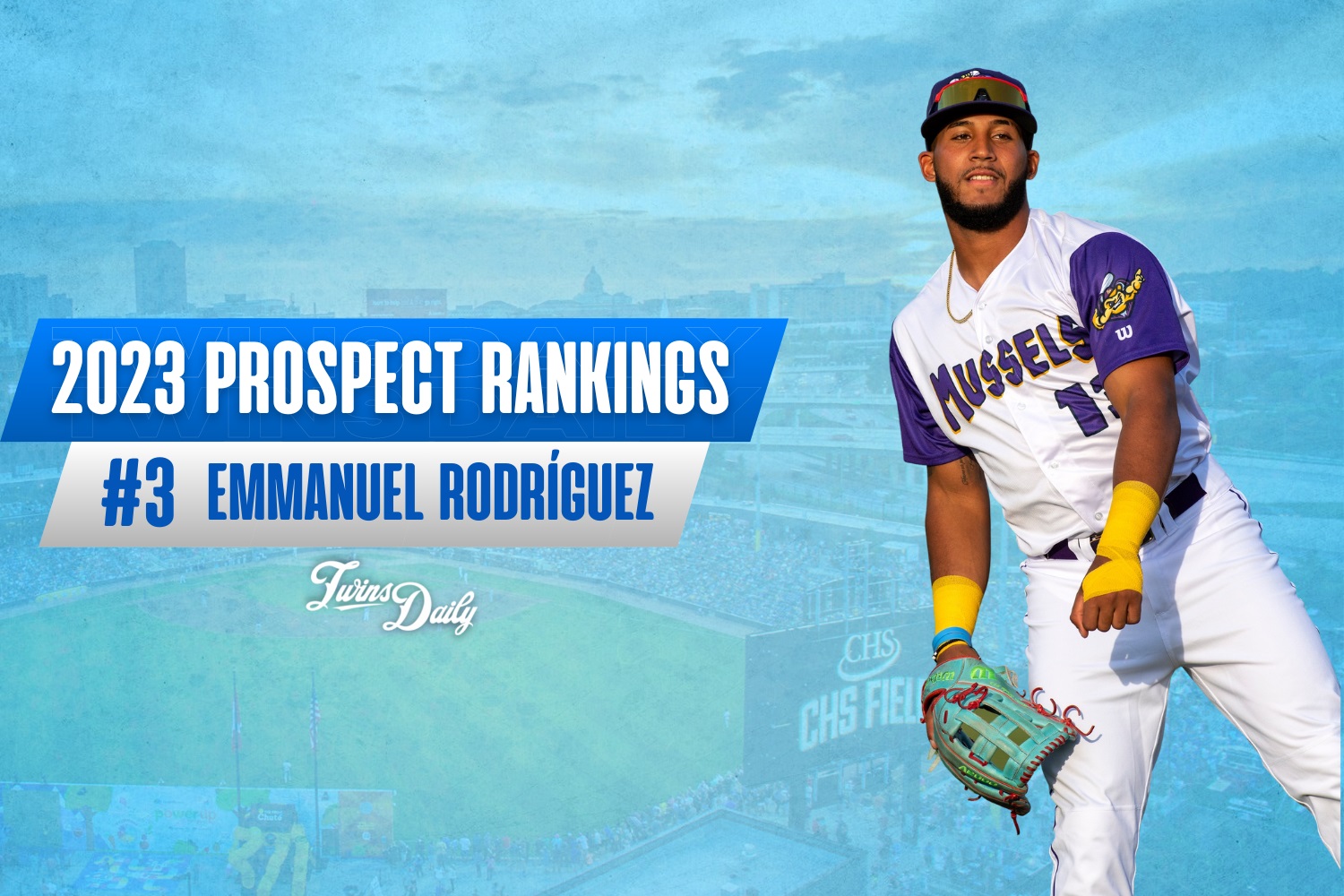 Age: 19 (DOB: 2/28/2003) 2022 Stats: (A): 199 PA, .272/.493/.552, 9 HR, 25 RBI ETA: 2025 2022 Ranking: 16 National Top 100 Rankings BA: 46 | MLB: 88 | ATH: 48 | BP: 42 What's To Like It's hard to properly explain just how special and stunning Emmanuel Rodriguez's performance was last year in the Florida State League. First, I'll try to set the stage a little bit. Rodriguez had just turned 19 before the start of the season, and had played a total of 37 professional games, all in 2021 at the rookie-level Florida Complex League. He had played pretty well there, showing a lot of power (.524 SLG) along with a lot of swing-and-miss (36% K-rate, .214 AVG). He was embarking upon his first full-season campaign in the Florida State League, always known for its pitcher-friendly conditions. (In 2022, FSL hitters posted a .687 OPS overall.) E-Rod was younger than the league's average by two years. He was facing more experienced, more advanced competition. Here's what he did, while playing a very solid center field: In 199 plate appearances, he hit five doubles, three triples, and nine homers with 11 steals, 52 strikeouts, and 57 walks. That last part is worth repeating: 52 K, 57 BB. He cut his problematic K-rate down to an acceptable range while also drawing walks at a truly staggering frequency. Fifty-seven walks (just one "intentional") in 199 plate appearances equates to a 28.6% BB rate. It's a figure so astronomically high it almost defies belief. Juan Soto led the majors at 20.3% last year. The freakish rate of free passes indicates that Rodriguez has quickly developed both an incredibly keen eye, and a reputation among pitchers as a feared slugger to avoid. He lived up to the latter billing when he got something to hit, slugging .552, and rode all those walks to a .493 on-base percentage. The lefty swinger had a .522 OBP against left-handed pitchers. Among players with 100+ PA in the FSL, no one was within 80 points of OPS to the teenaged CF Rodriguez, other than a 24-year-old 1B/DH named Jacob Gonzalez. Rodriguez's breakout season was cut dramatically short by a knee meniscus injury suffered in June, but evaluators have seen enough in the small sample to elevate him into the elite tier of prospects. All four nationals outlets above have the outfielder in their top 100, and three have him in their top 50. Baseball America called him "one of the strongest up-arrow candidates" on their list. "He might be a top-10 prospect in baseball by midseason if what we saw last spring holds up," observed The Athletic's Keith Law. It's not hard to see where the hype is coming from. And while you couldn't exactly say he came out of nowhere -- the Dominican scored a $2.75 million bonus at age 16 as one of the top talents in the 2019 international class -- he's definitely going somewhere. What's Left to Work On There is not a single thing you can quibble with in Rodriguez's brief flash of brilliance last year. Complete all-around dominance. But, that's all it was: a brief flash. Turning 20 later this month, he's got a very sparse track record – just 84 pro games – and a long road ahead to the major leagues. There are many possible paths forward for the high-upside, high-variance talent. The direction he'll try to steer clear of goes something like this: As he moves up and faces better pitchers (who can better command the strike zone), Rodriguez's patience gives way to passiveness and his K-rate climbs, while the walk rate drops precipitously. Meanwhile, he loses a step after the surgery and keeps adding bulk as he ages into his 20s, forcing a move to a corner outfield spot and raising the bar for his offensive impact. Even in this scenario, Rodriguez can still pan out as a pretty valuable player, because his power tool is outstanding and there's nothing wrong with a classic slugging right fielder who can run and throw. But if Rodriguez can come back healthy at High-A and keep remotely intact the robust skill set we saw on display over two spectacular months in Fort Myers ... he'll likely be viewed among the top prospects in all of baseball by this time next year, following the trajectory of a future MLB superstar. What's Next Prospect rankings tend to be all over the place, but there's a stark level of consensus surrounding Rodriguez and his current estimation from the evaluation community. While there was tremendous dissent regarding the top two spots on the list this year (as we'll soon explore), there was none about who should rank #3: all 10 people who voted on Twins Daily's list had Rodriguez here. Even as you zoom out to the national 100 prospect rankings, the level of consensus is pretty stunning for a player who was on none of these lists a year ago. Baseball America, Baseball Prospectus and The Athletic all have E-Rod ranked between 42nd and 48th overall. We're all seeing the same thing: a highly touted international talent who showed everything you could possibly want to see during an all-too-brief breakthrough in 2022. Now he needs to rebound from the injury, and put together a full season of work. From there, the sky is the limit. He might not necessarily be the best prospect in the Twins system, but Rodriguez is almost certainly the most exciting, with a ceiling that rivals any promising young player who's ever graced these rankings. Feel free to discuss E-Rod as a prospect and ask as many questions as you like in the COMMENTS below. Previous Installments Honorable Mention Prospects 21-30 Prospects 16-20 Prospects 11-15 Prospect #10: Austin Martin, SS Prospect #9: Louie Varland, RHP Prospect #8: Jose Salas, INF Prospect #7: Connor Prielipp, LHP Prospect #6: Simeon Woods Richardson, RHP Prospect #5: Edouard Julien, 2B Prospect #4: Marco Raya, RHP Prospect #3: Emmanuel Rodriguez, OF Prospect #2: Coming tomorrow!
 -
You can make a case that Emmanuel Rodriguez was THE single most meteoric player in all of the minors last year. He shined bright and burnt out quickly, succumbing to a knee injury. Now, he's back and ready to light the minors aflame once again. Age: 19 (DOB: 2/28/2003) 2022 Stats: (A): 199 PA, .272/.493/.552, 9 HR, 25 RBI ETA: 2025 2022 Ranking: 16 National Top 100 Rankings BA: 46 | MLB: 88 | ATH: 48 | BP: 42 What's To Like It's hard to properly explain just how special and stunning Emmanuel Rodriguez's performance was last year in the Florida State League. First, I'll try to set the stage a little bit. Rodriguez had just turned 19 before the start of the season, and had played a total of 37 professional games, all in 2021 at the rookie-level Florida Complex League. He had played pretty well there, showing a lot of power (.524 SLG) along with a lot of swing-and-miss (36% K-rate, .214 AVG). He was embarking upon his first full-season campaign in the Florida State League, always known for its pitcher-friendly conditions. (In 2022, FSL hitters posted a .687 OPS overall.) E-Rod was younger than the league's average by two years. He was facing more experienced, more advanced competition. Here's what he did, while playing a very solid center field: In 199 plate appearances, he hit five doubles, three triples, and nine homers with 11 steals, 52 strikeouts, and 57 walks. That last part is worth repeating: 52 K, 57 BB. He cut his problematic K-rate down to an acceptable range while also drawing walks at a truly staggering frequency. Fifty-seven walks (just one "intentional") in 199 plate appearances equates to a 28.6% BB rate. It's a figure so astronomically high it almost defies belief. Juan Soto led the majors at 20.3% last year. The freakish rate of free passes indicates that Rodriguez has quickly developed both an incredibly keen eye, and a reputation among pitchers as a feared slugger to avoid. He lived up to the latter billing when he got something to hit, slugging .552, and rode all those walks to a .493 on-base percentage. The lefty swinger had a .522 OBP against left-handed pitchers. Among players with 100+ PA in the FSL, no one was within 80 points of OPS to the teenaged CF Rodriguez, other than a 24-year-old 1B/DH named Jacob Gonzalez. Rodriguez's breakout season was cut dramatically short by a knee meniscus injury suffered in June, but evaluators have seen enough in the small sample to elevate him into the elite tier of prospects. All four nationals outlets above have the outfielder in their top 100, and three have him in their top 50. Baseball America called him "one of the strongest up-arrow candidates" on their list. "He might be a top-10 prospect in baseball by midseason if what we saw last spring holds up," observed The Athletic's Keith Law. It's not hard to see where the hype is coming from. And while you couldn't exactly say he came out of nowhere -- the Dominican scored a $2.75 million bonus at age 16 as one of the top talents in the 2019 international class -- he's definitely going somewhere. What's Left to Work On There is not a single thing you can quibble with in Rodriguez's brief flash of brilliance last year. Complete all-around dominance. But, that's all it was: a brief flash. Turning 20 later this month, he's got a very sparse track record – just 84 pro games – and a long road ahead to the major leagues. There are many possible paths forward for the high-upside, high-variance talent. The direction he'll try to steer clear of goes something like this: As he moves up and faces better pitchers (who can better command the strike zone), Rodriguez's patience gives way to passiveness and his K-rate climbs, while the walk rate drops precipitously. Meanwhile, he loses a step after the surgery and keeps adding bulk as he ages into his 20s, forcing a move to a corner outfield spot and raising the bar for his offensive impact. Even in this scenario, Rodriguez can still pan out as a pretty valuable player, because his power tool is outstanding and there's nothing wrong with a classic slugging right fielder who can run and throw. But if Rodriguez can come back healthy at High-A and keep remotely intact the robust skill set we saw on display over two spectacular months in Fort Myers ... he'll likely be viewed among the top prospects in all of baseball by this time next year, following the trajectory of a future MLB superstar. What's Next Prospect rankings tend to be all over the place, but there's a stark level of consensus surrounding Rodriguez and his current estimation from the evaluation community. While there was tremendous dissent regarding the top two spots on the list this year (as we'll soon explore), there was none about who should rank #3: all 10 people who voted on Twins Daily's list had Rodriguez here. Even as you zoom out to the national 100 prospect rankings, the level of consensus is pretty stunning for a player who was on none of these lists a year ago. Baseball America, Baseball Prospectus and The Athletic all have E-Rod ranked between 42nd and 48th overall. We're all seeing the same thing: a highly touted international talent who showed everything you could possibly want to see during an all-too-brief breakthrough in 2022. Now he needs to rebound from the injury, and put together a full season of work. From there, the sky is the limit. He might not necessarily be the best prospect in the Twins system, but Rodriguez is almost certainly the most exciting, with a ceiling that rivals any promising young player who's ever graced these rankings. Feel free to discuss E-Rod as a prospect and ask as many questions as you like in the COMMENTS below. Previous Installments Honorable Mention Prospects 21-30 Prospects 16-20 Prospects 11-15 Prospect #10: Austin Martin, SS Prospect #9: Louie Varland, RHP Prospect #8: Jose Salas, INF Prospect #7: Connor Prielipp, LHP Prospect #6: Simeon Woods Richardson, RHP Prospect #5: Edouard Julien, 2B Prospect #4: Marco Raya, RHP Prospect #3: Emmanuel Rodriguez, OF Prospect #2: Coming tomorrow! View full article
-
Relief pitchers have a quantitatively small job – pitch one or two innings a couple times per week – but they have an outsized impact on a team's fortunes, as we've seen. Is the front office playing with fire in its passive approach to the bullpen this offseason? Image courtesy of Jeffrey Becker-USA TODAY Sports The impact of the bullpen on a team's fate can often be overstated by fans, which is understandable. Not to get into specifics, but ... a certain reliever melting down several times in close games against a division rival lingers in memory more starkly than, say, the offense that couldn't build a sufficient lead, or the starter who couldn't go deep enough to prevent that scenario. Many fans will tell you the bullpen was the primary downfall of the 2022 Twins. Is that true? Not really. Their bullpen ranked 20th among MLB teams in fWAR, 16th in ERA, 14th in FIP, compared to a rotation that ranked 21st, 20th, and 18th respectively. The offense, which was supposed to be the engine driving a competitive team, ranked 17th in the majors in runs scored. Notably, the Twins bullpen ranked 29th in fWAR in the first half last year, but improved to FOURTH in the second half, once they'd parted ways with the likes of Tyler Duffey and Joe Smith. They weren't just improved in the latter portion of the campaign, after ironing out an uninspiring opening group – they were elite. All of which is to say they're not working from as lousy of an existing base as many seem to perceive or assume. The front office's decision to bypass any significant offseason RP additions – which now seems all but affirmed, with Michael Fulmer and Andrew Chafin both coming off the market in the past few days – is justifiable on merit. That said, failing to properly build a deep and resilient bullpen can be a costly misstep that fans won't be eager to forgive. Even if it's sometimes exaggerated, there's no question that the bullpen plays a vital role in any team's success, and is often a key differentiator between the good and the great. Is this group up to snuff? The team is placing it's chips on a series of outcomes shaking out mostly the right way, in order to fulfill the vision of a bullpen suited to a World Series contender: The Twins are betting on Jhoan Durán holding up. He's one of the best relievers in baseball, so Durán would serve as a linchpin in almost any bullpen makeup. But the Twins are set to once again lean hard on him for the late innings, because there is so much uncertainty surrounding him (as we'll discuss). The big right-hander was remarkably healthy and durable last year, but he was limited to 16 total innings in 2021 by an elbow strain. He throws about as hard as any pitcher in history, so the injury concerns are self-evident and unignorable. The Twins can't do much about that other than manage and protect his arm to their best ability, but if they wanted some peace of mind, they might've shelled out or traded for a big-name reliever to serve as co-ace of the bullpen. The Rafael Montero to their Ryan Pressly, if you will. Alas, it's possible – maybe even probable – that the front office feels it already accomplished this at the deadline last year: The Twins are betting on Jorge López getting back on track. If López and Durán are both pitching at a level approximating their work in the first half last year, they provide Minnesota with one of the most dominant 1-2 punches at the back end of any bullpen. This no doubt played a major role in the front office's strategy during a 2022 deadline that seemed as much oriented toward strengthening the '23 club as boosting their chances for the stretch run. The plan can still work, and the Twins are counting on it. López's results dropped off big-time after the trade last year, but it was only 23 innings and the stuff was still there. If his drop-off didn't coincide directly with switching teams, it probably would've been less noticeable, and we'd have been more inclined to judge his overall body of work – 71 IP, 2.54 ERA, 3.42 FIP, 4 HR allowed – as a tremendously encouraging first go as a full-time reliever. Merely replicating that overall level of performance for the full season would make López a worthy setup man or closer. But if getting comfortable while making adjustments brings him back closer to the level of his All-Star first half, the Twins have two powerhouses lurking at the back of the bullpen. They'll be the envy of almost every team in the league. The Twins are betting on Emilio Pagán proving doubters wrong. The doubters are many, and they have ample evidence to support their stance. Pagán authored from the mound some of this team's lowest moments in 2022. His propensity for hanging meatballs that got launched 450 feet at dire moments was legendary ... and it's a rep that's now been following him around for a while. And yet. The Twins believe in the quality of his stuff and they are not alone. Perhaps they feel it started to shine through in the second half and down the stretch, with help from a new breaking ball swapped in for the cutter. After posting a 5.23 ERA in the first half, Pagán lowered that figure to 3.56 in the second half – including 2.16 ERA in his final 16 ⅔ innings, during which he held opponents to a .170/.279/.288 with only one home run allowed. The overpowering arsenal is undeniable, and in the latter stage of the season – under tutelage from a rearranged coaching staff featuring Pete Maki and Colby Suggs – Pagán finally started to unlock it. Or so the Twins are betting. The Twins are betting on unproven middle relief options coming through. Griffin Jax looked very good last year in his transition to relief, but posted a 6.37 ERA the prior season as a rookie. Caleb Thielbar was phenomenal following a rocky start, but he's 36 and was out of pro baseball a few years ago. Jorge Alcalá undoubtedly has the stuff to dominate righties, but missed nearly all of last season with an elbow injury. Add in the likes of Trevor Megill and Jovani Moran, and you've got a great deal of high-end potential within the middle tier of his bullpen mix – including some very viable setup candidates – but also substantial question marks relating to age, injury, track record, or otherwise. The argument for adding another veteran reliever is that you can mitigate some of this uncertainty with more of a proven commodity. The argument against it is that you might be limiting well-earned opportunities for some of the guys lower on the list. Moran for example posted a 2.21 ERA while averaging 12.0 K/9 and allowing zero homers in 41 innings for the Twins last year, and he's about to turn 26. Does he really deserve to be buried back in Triple-A with another vet of questionable superiority stacked above him on the depth chart? The Twins are betting on manufacturing relief arms over the course of the season. Even if the Twins are mostly right about the pitchers mentioned above, they'll need to rely on an influx of talent throughout the course of the season, because that's always the case. The underlying premise seems to be one guiding this front office philosophically from a bullpen standpoint: we can find them. Maybe that means extracting good performances out of minor-league signings and waiver claims, such as Danny Coulombe and Oliver Ortega. They've been okay at that, on the fringes. But really, it comes down to identifying pitchers from a wide-ranging pool of flawed starters who can elevate into true relief weapons. We saw this last year with Durán and Jax, and I suspect the Twins feel they're only scratching the surface. Keep a close eye on names like Josh Winder, Ronny Henriquez, Jordan Balazovic, Blayne Enlow, and Brent Headrick as candidates to shift to relief and make a major big-league impact. This philosophy that basically boils down to, "Capable relievers are everywhere, but volatile, why pay a premium?" is not exactly unique to the Twins, but it's one they're embracing with all their might. And it might ultimately play a huge role in defining their success this season. Let's hope they're right on that bet, and the others inherent to a status quo offseason for the Minnesota bullpen. View full article
-
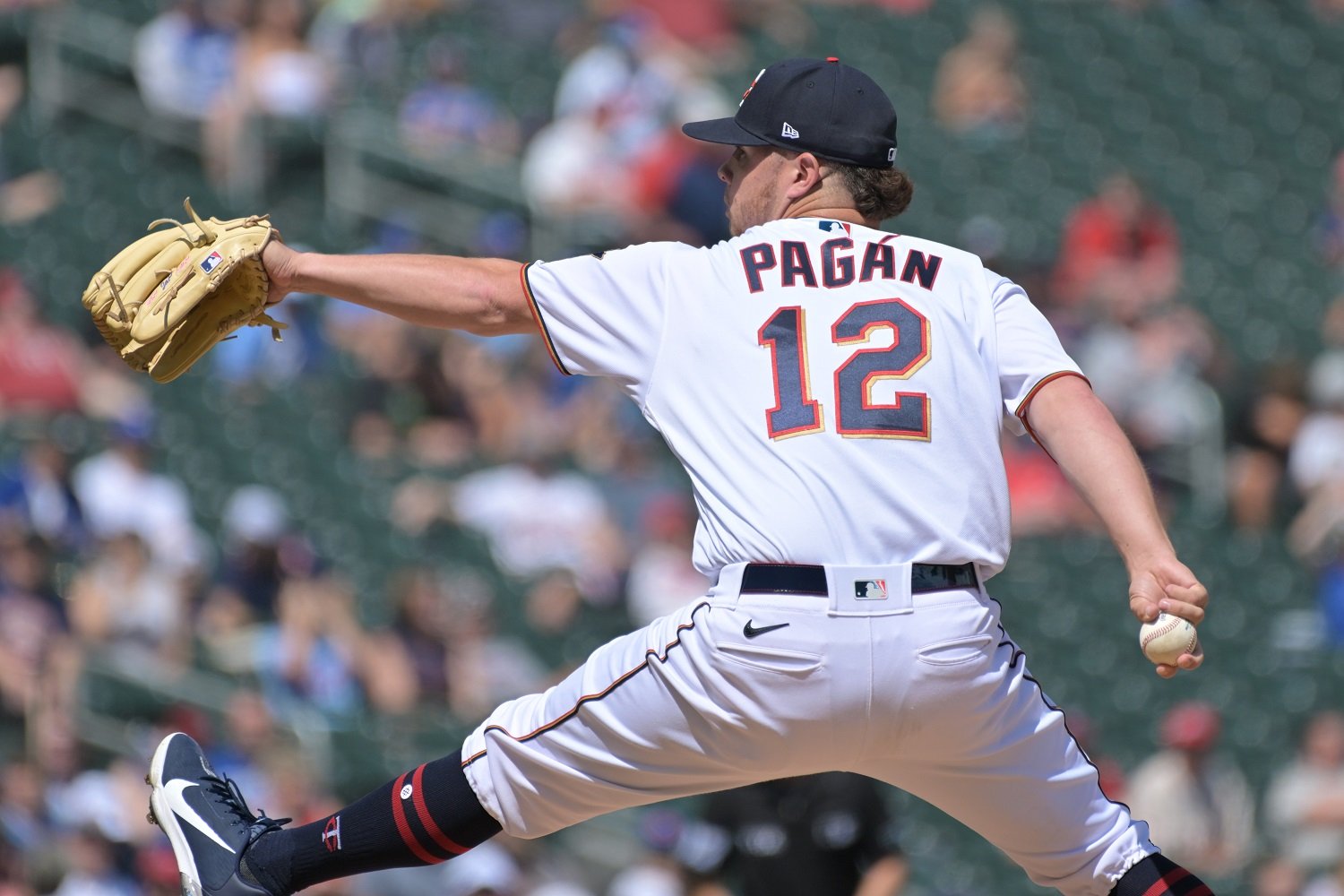 The impact of the bullpen on a team's fate can often be overstated by fans, which is understandable. Not to get into specifics, but ... a certain reliever melting down several times in close games against a division rival lingers in memory more starkly than, say, the offense that couldn't build a sufficient lead, or the starter who couldn't go deep enough to prevent that scenario. Many fans will tell you the bullpen was the primary downfall of the 2022 Twins. Is that true? Not really. Their bullpen ranked 20th among MLB teams in fWAR, 16th in ERA, 14th in FIP, compared to a rotation that ranked 21st, 20th, and 18th respectively. The offense, which was supposed to be the engine driving a competitive team, ranked 17th in the majors in runs scored. Notably, the Twins bullpen ranked 29th in fWAR in the first half last year, but improved to FOURTH in the second half, once they'd parted ways with the likes of Tyler Duffey and Joe Smith. They weren't just improved in the latter portion of the campaign, after ironing out an uninspiring opening group – they were elite. All of which is to say they're not working from as lousy of an existing base as many seem to perceive or assume. The front office's decision to bypass any significant offseason RP additions – which now seems all but affirmed, with Michael Fulmer and Andrew Chafin both coming off the market in the past few days – is justifiable on merit. That said, failing to properly build a deep and resilient bullpen can be a costly misstep that fans won't be eager to forgive. Even if it's sometimes exaggerated, there's no question that the bullpen plays a vital role in any team's success, and is often a key differentiator between the good and the great. Is this group up to snuff? The team is placing it's chips on a series of outcomes shaking out mostly the right way, in order to fulfill the vision of a bullpen suited to a World Series contender: The Twins are betting on Jhoan Durán holding up. He's one of the best relievers in baseball, so Durán would serve as a linchpin in almost any bullpen makeup. But the Twins are set to once again lean hard on him for the late innings, because there is so much uncertainty surrounding him (as we'll discuss). The big right-hander was remarkably healthy and durable last year, but he was limited to 16 total innings in 2021 by an elbow strain. He throws about as hard as any pitcher in history, so the injury concerns are self-evident and unignorable. The Twins can't do much about that other than manage and protect his arm to their best ability, but if they wanted some peace of mind, they might've shelled out or traded for a big-name reliever to serve as co-ace of the bullpen. The Rafael Montero to their Ryan Pressly, if you will. Alas, it's possible – maybe even probable – that the front office feels it already accomplished this at the deadline last year: The Twins are betting on Jorge López getting back on track. If López and Durán are both pitching at a level approximating their work in the first half last year, they provide Minnesota with one of the most dominant 1-2 punches at the back end of any bullpen. This no doubt played a major role in the front office's strategy during a 2022 deadline that seemed as much oriented toward strengthening the '23 club as boosting their chances for the stretch run. The plan can still work, and the Twins are counting on it. López's results dropped off big-time after the trade last year, but it was only 23 innings and the stuff was still there. If his drop-off didn't coincide directly with switching teams, it probably would've been less noticeable, and we'd have been more inclined to judge his overall body of work – 71 IP, 2.54 ERA, 3.42 FIP, 4 HR allowed – as a tremendously encouraging first go as a full-time reliever. Merely replicating that overall level of performance for the full season would make López a worthy setup man or closer. But if getting comfortable while making adjustments brings him back closer to the level of his All-Star first half, the Twins have two powerhouses lurking at the back of the bullpen. They'll be the envy of almost every team in the league. The Twins are betting on Emilio Pagán proving doubters wrong. The doubters are many, and they have ample evidence to support their stance. Pagán authored from the mound some of this team's lowest moments in 2022. His propensity for hanging meatballs that got launched 450 feet at dire moments was legendary ... and it's a rep that's now been following him around for a while. And yet. The Twins believe in the quality of his stuff and they are not alone. Perhaps they feel it started to shine through in the second half and down the stretch, with help from a new breaking ball swapped in for the cutter. After posting a 5.23 ERA in the first half, Pagán lowered that figure to 3.56 in the second half – including 2.16 ERA in his final 16 ⅔ innings, during which he held opponents to a .170/.279/.288 with only one home run allowed. The overpowering arsenal is undeniable, and in the latter stage of the season – under tutelage from a rearranged coaching staff featuring Pete Maki and Colby Suggs – Pagán finally started to unlock it. Or so the Twins are betting. The Twins are betting on unproven middle relief options coming through. Griffin Jax looked very good last year in his transition to relief, but posted a 6.37 ERA the prior season as a rookie. Caleb Thielbar was phenomenal following a rocky start, but he's 36 and was out of pro baseball a few years ago. Jorge Alcalá undoubtedly has the stuff to dominate righties, but missed nearly all of last season with an elbow injury. Add in the likes of Trevor Megill and Jovani Moran, and you've got a great deal of high-end potential within the middle tier of his bullpen mix – including some very viable setup candidates – but also substantial question marks relating to age, injury, track record, or otherwise. The argument for adding another veteran reliever is that you can mitigate some of this uncertainty with more of a proven commodity. The argument against it is that you might be limiting well-earned opportunities for some of the guys lower on the list. Moran for example posted a 2.21 ERA while averaging 12.0 K/9 and allowing zero homers in 41 innings for the Twins last year, and he's about to turn 26. Does he really deserve to be buried back in Triple-A with another vet of questionable superiority stacked above him on the depth chart? The Twins are betting on manufacturing relief arms over the course of the season. Even if the Twins are mostly right about the pitchers mentioned above, they'll need to rely on an influx of talent throughout the course of the season, because that's always the case. The underlying premise seems to be one guiding this front office philosophically from a bullpen standpoint: we can find them. Maybe that means extracting good performances out of minor-league signings and waiver claims, such as Danny Coulombe and Oliver Ortega. They've been okay at that, on the fringes. But really, it comes down to identifying pitchers from a wide-ranging pool of flawed starters who can elevate into true relief weapons. We saw this last year with Durán and Jax, and I suspect the Twins feel they're only scratching the surface. Keep a close eye on names like Josh Winder, Ronny Henriquez, Jordan Balazovic, Blayne Enlow, and Brent Headrick as candidates to shift to relief and make a major big-league impact. This philosophy that basically boils down to, "Capable relievers are everywhere, but volatile, why pay a premium?" is not exactly unique to the Twins, but it's one they're embracing with all their might. And it might ultimately play a huge role in defining their success this season. Let's hope they're right on that bet, and the others inherent to a status quo offseason for the Minnesota bullpen.
- 37 comments
-
- 6
-
-
- jhoan duran
- emilio pagan
- (and 1 more)
-
The prized pitching prospect who came over in the José Berríos trade has reached the majors and will now aim to establish himself there. As something more than a mid-rotation starter? That is the question. Image courtesy of Rob Thompson, St. Paul Saints Age: 22 (DOB: 9/27/2000) 2022 Stats: (AA/AAA): 107.1 IP, 2.77 ERA, 1.05 WHIP, 9.6 K/9, 3.0 BB/9 ETA: 2023 2022 Ranking: 8 National Top 100 Rankings BA: NR | MLB: NR | ATH: NR | BP: NR What's To Like The 2021 season was a slog for Simeon Woods Richardson. Pushed aggressively to Double-A at age 20 coming off the lost COVID season, he struggled to find his rhythm, finishing with a 5.91 ERA in 53 1/3 sporadic innings. Spending several weeks abroad with Team USA for the Olympics (where he didn't actually pitch) and getting traded at mid-season for the second time in two years surely didn't help. The young right-hander took it in stride. He committed to a smoother ride in 2022 and made it happen. After giving up six earned runs in eight innings spread across four appearances at Wichita following the trade in '21, Woods Richardson got off to a much better start in his second tour, going four full turns on the mound before allowing his first earned run of the season. He turned the hot opening into a strong run with the Wind Surge before a bout with COVID in June knocked him out of action for six weeks. This time, he wouldn't let the time off derail him. Woods Richardson returned in late July and was lights out. He made five more starts for Wichita, striking out 10 over five innings in the last one before a promotion to Triple-A, where he was consistently excellent through the end of September. By the time Woods Richardson got the call to start at Detroit in one of the last games of the Twins season, he had posted a 2.15 ERA while holding opponents to a .188/.255/.266 line in 54 ⅓ innings over his past dozen outings between Double-A and Triple-A. Not much more you can do to earn the opportunity. He made the most of that opportunity, holding the Tigers to two runs on three hits over five innings. Granted, it was a meaningless game between two eliminated teams eager to close up shop, but still it was a big and impressive moment for Woods Richardson, who was the youngest pitcher to throw in the majors last season. He showed all the polish and poise that got him there. There are some limitations to SWR's game, as we'll discuss, but his youth gives you the ability to dream on further evolution of his talent. He's still only 22 with room for growth yet. (For comparison, he's about two months older than our #7 prospect Connor Prielipp, who was drafted out of the University of Alabama last summer and hasn't yet thrown a professional pitch.) What's Left to Work On Woods Richardson saw a big velocity spike during his senior year of high school in Sugar Land, TX, prompting the Mets to draft him 48th overall and sign him to a $1.85 million bonus. His advanced stuff played well in the low levels of the minors and Woods Richardson moved fast, reaching High-A by the age of 18. But the trouble is, his stuff sort of stagnated over the next few years. SWR's fastball velo hasn't picked up any added oomph and is now solidly below average in the low 90s range. He hasn't developed a true putaway pitch, although the changeup has emerged as star of the show and helped him decimate lefties last year with an extreme reverse platoon split. To his great credit, Woods Richardson got the job done everywhere he went in 2022, averaging more than a strikeout per inning, but he wasn't overpowering hitters based on the raw caliber of his pitches. Part of what helps him succeed is a funky over-the-top delivery with good extension that routinely keeps hitters from jumping on his pitches. (He allowed only six home runs in 107 innings last year, and has a 0.6 HR/9 overall in the minors.) But Woods Richardson's quirky mechanics can also become a source of inconsistency, leading to occasion command issues that never seemed to surface in the low minors. This was an especially big problem during the 2021 campaign, but he was able to tighten things up last year. If the lanky 6-foot-3 hurler can further refine and orchestrate all the moving parts in his delivery and find a way to juice up his fastball, he still has the potential to reach another level as a starting pitcher. If not, the Twins will need to decide if they want to keep pushing toward a future in the lower part of the rotation, or potentially bigger things in the bullpen. What's Next Woods Richardson reached the majors alongside Louie Varland at the end of last year, so these two stand as the most readily available depth in the prospect pool should a need arise. However, Varland is three years older and seems like more of a finished product, so he's firmly ahead in line. The Twins will be inclined to show patience with Woods Richardson, giving him ample time and seasoning in Triple-A before they feel ready to promote him for good. They should hopefully have that luxury with at seven starters lined up ahead of him on the depth chart. Feel free to discuss SWR as a prospect and ask as many questions as you like in the COMMENTS below. Previous Installments Honorable Mention Prospects 21-30 Prospects 16-20 Prospects 11-15 Prospect #10: Austin Martin, SS Prospect #9: Louie Varland, RHP Prospect #8: Jose Salas, INF Prospect #7: Connor Prielipp, LHP Prospect #6: Simeon Woods Richardson, RHP Prospect #5: Coming Monday! View full article
-
Twins Daily 2023 Top Prospects: #6 Simeon Woods Richardson, RHP
Nick Nelson posted an article in Twins
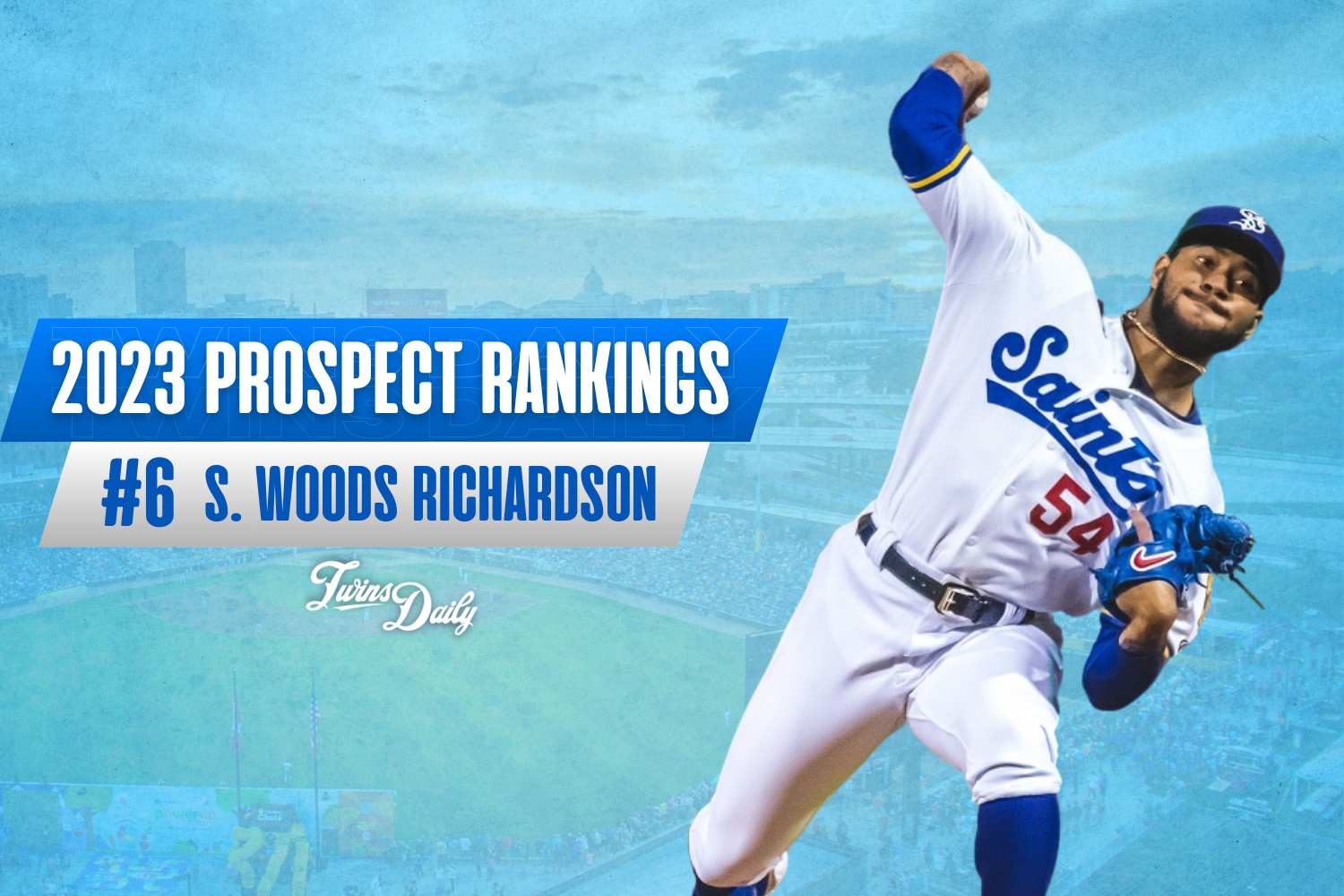 Age: 22 (DOB: 9/27/2000) 2022 Stats: (AA/AAA): 107.1 IP, 2.77 ERA, 1.05 WHIP, 9.6 K/9, 3.0 BB/9 ETA: 2023 2022 Ranking: 8 National Top 100 Rankings BA: NR | MLB: NR | ATH: NR | BP: NR What's To Like The 2021 season was a slog for Simeon Woods Richardson. Pushed aggressively to Double-A at age 20 coming off the lost COVID season, he struggled to find his rhythm, finishing with a 5.91 ERA in 53 1/3 sporadic innings. Spending several weeks abroad with Team USA for the Olympics (where he didn't actually pitch) and getting traded at mid-season for the second time in two years surely didn't help. The young right-hander took it in stride. He committed to a smoother ride in 2022 and made it happen. After giving up six earned runs in eight innings spread across four appearances at Wichita following the trade in '21, Woods Richardson got off to a much better start in his second tour, going four full turns on the mound before allowing his first earned run of the season. He turned the hot opening into a strong run with the Wind Surge before a bout with COVID in June knocked him out of action for six weeks. This time, he wouldn't let the time off derail him. Woods Richardson returned in late July and was lights out. He made five more starts for Wichita, striking out 10 over five innings in the last one before a promotion to Triple-A, where he was consistently excellent through the end of September. By the time Woods Richardson got the call to start at Detroit in one of the last games of the Twins season, he had posted a 2.15 ERA while holding opponents to a .188/.255/.266 line in 54 ⅓ innings over his past dozen outings between Double-A and Triple-A. Not much more you can do to earn the opportunity. He made the most of that opportunity, holding the Tigers to two runs on three hits over five innings. Granted, it was a meaningless game between two eliminated teams eager to close up shop, but still it was a big and impressive moment for Woods Richardson, who was the youngest pitcher to throw in the majors last season. He showed all the polish and poise that got him there. There are some limitations to SWR's game, as we'll discuss, but his youth gives you the ability to dream on further evolution of his talent. He's still only 22 with room for growth yet. (For comparison, he's about two months older than our #7 prospect Connor Prielipp, who was drafted out of the University of Alabama last summer and hasn't yet thrown a professional pitch.) What's Left to Work On Woods Richardson saw a big velocity spike during his senior year of high school in Sugar Land, TX, prompting the Mets to draft him 48th overall and sign him to a $1.85 million bonus. His advanced stuff played well in the low levels of the minors and Woods Richardson moved fast, reaching High-A by the age of 18. But the trouble is, his stuff sort of stagnated over the next few years. SWR's fastball velo hasn't picked up any added oomph and is now solidly below average in the low 90s range. He hasn't developed a true putaway pitch, although the changeup has emerged as star of the show and helped him decimate lefties last year with an extreme reverse platoon split. To his great credit, Woods Richardson got the job done everywhere he went in 2022, averaging more than a strikeout per inning, but he wasn't overpowering hitters based on the raw caliber of his pitches. Part of what helps him succeed is a funky over-the-top delivery with good extension that routinely keeps hitters from jumping on his pitches. (He allowed only six home runs in 107 innings last year, and has a 0.6 HR/9 overall in the minors.) But Woods Richardson's quirky mechanics can also become a source of inconsistency, leading to occasion command issues that never seemed to surface in the low minors. This was an especially big problem during the 2021 campaign, but he was able to tighten things up last year. If the lanky 6-foot-3 hurler can further refine and orchestrate all the moving parts in his delivery and find a way to juice up his fastball, he still has the potential to reach another level as a starting pitcher. If not, the Twins will need to decide if they want to keep pushing toward a future in the lower part of the rotation, or potentially bigger things in the bullpen. What's Next Woods Richardson reached the majors alongside Louie Varland at the end of last year, so these two stand as the most readily available depth in the prospect pool should a need arise. However, Varland is three years older and seems like more of a finished product, so he's firmly ahead in line. The Twins will be inclined to show patience with Woods Richardson, giving him ample time and seasoning in Triple-A before they feel ready to promote him for good. They should hopefully have that luxury with at seven starters lined up ahead of him on the depth chart. Feel free to discuss SWR as a prospect and ask as many questions as you like in the COMMENTS below. Previous Installments Honorable Mention Prospects 21-30 Prospects 16-20 Prospects 11-15 Prospect #10: Austin Martin, SS Prospect #9: Louie Varland, RHP Prospect #8: Jose Salas, INF Prospect #7: Connor Prielipp, LHP Prospect #6: Simeon Woods Richardson, RHP Prospect #5: Coming Monday!
 -
Twins Daily 2023 Top Prospects: #9 Louie Varland, RHP
Nick Nelson replied to Nick Nelson's topic in Twins Minor League Talk
Lots of good discussion here of velocity for pitching prospects and how much weight we give it. (Too much? Maybe.) If you want a super duper optimistic comp, here's one: Shane Bieber. He also was not super highly drafted (albeit 4th round not 15th). He also didn't show up on any global top prospects lists, despite putting up ridiculous numbers in the minors. He was #5 in the Cleveland system, per BP, ahead of his rookie season. Two years later he was in MVP contention. Last year Bieber put up a 2.88 ERA with a fastball that averaged like 91 MPH. Obviously it helps to have the Guardians pitching development juggernaut but, so far so good with the Twins and Varland, whose "coachability" is a standout trait that gets talked about all the time. -
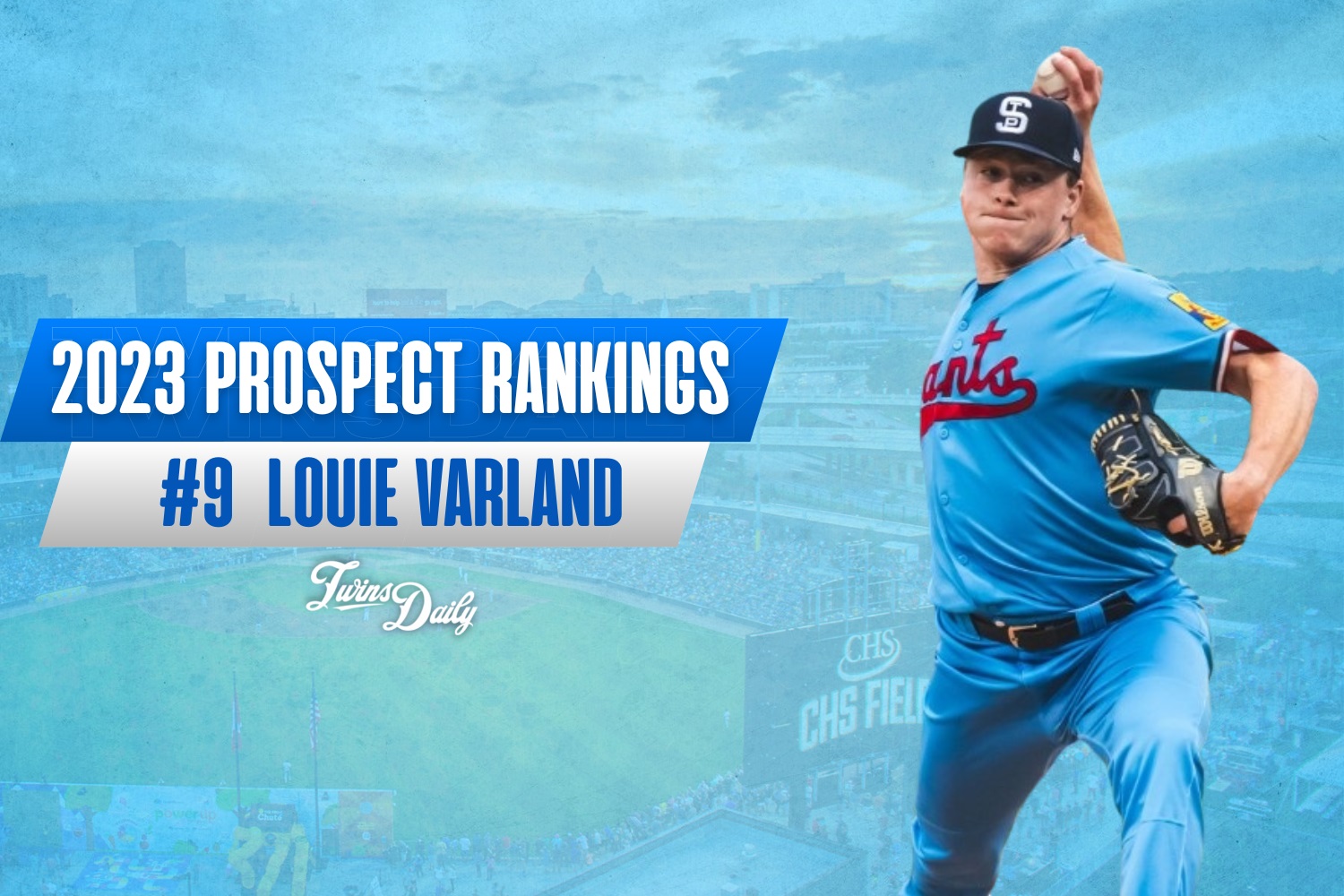 Age: 25 (DOB: 12/9/1997) 2022 Stats: (AA/AAA): 126.1 IP, 3.06 ERA, 1.26 WHIP, 10.4 K/9, 3.0 BB/9 ETA: 2023 2022 Ranking: 15 National Top 100 Rankings BA: NR | MLB: NR | ATH: NR | BP: NR Varland's big-league debut on September 7th was emblematic of his journey as a prospect, which earned him back-to-back Twins Minor League Player of the Year awards: he met a new challenge with poise and confidence, and he handled it brilliantly. You could hardly ask for more stressful introductory circumstances than stepping into Yankee Stadium to face MVP Aaron Judge and the Bronx Bombers on behalf of a team desperately clinging onto postseason hopes. Varland took it in stride. In his first match-up against Judge, he got a swinging strikeout with a beautifully executed righty-on-righty changeup. Varland went to pitch into the sixth inning, finishing with a final line (5.1 IP, 2 ER, 7 K, 1 BB) that reflected his body of work in a five-start September stint with the Twins: 26 IP, 3.81 ERA, 21 K, 6 BB. Add in his outstanding work at Double-A and Triple-A prior to the promotion, and you've got a statement season that lends further legitimacy to the former 15th-round pick's pro credentials. As much as he's improved his stuff from where it was when he was drafted, Varland still lacks the pure velocity or secondary quality of other pitchers in the Twins' current rotation mix, and others on this top prospects list. But there's something to be said for having the confidence and pace to execute as consistently as he does on the mound, including pressure-packed situations. Another thing working for Varland, particularly in the context of Minnesota's current situation, is his dependability and durability. He's one of the few on this list (or currently in the majors) who's been able to reliably take the mound each fifth day without issue. Last year between the majors and minors he threw 150 innings, which is more than any Twins pitcher has totaled since 2019. This, as a 24-year-old with one pro season under his belt. Clearly there's a lot to like from this hometown hurler who has proven so much. So why isn't he higher than ninth on our list? That comes down to Varland's final proving point ahead. What's Left to Work On Varland's overachieving accomplishments have earned him organizational awards and an early arrival in the majors. But they haven't shifted the broader view of his future upside, which helps explain why he still doesn't appear on any global top prospect lists and – despite moving up six spots this year – remains behind eight players (including several pitchers) in our rankings. It comes down to the substance behind his performance. Varland's fastball plays up due to his extension and deceptive release point, and he's added a ton since his college days, but it still averages under 94 MPH, placing it on the lower side of today's MLB spectrum. None of his secondary pitches – the slider, cutter and change – have shown to be particularly outstanding offerings. The righty manages to make the most of his arsenal thanks to a good approach and situational fortitude – for example, he held opponents to a .643 OPS with runners on last year compared to .726 with the bases empty – but decades of evaluation have taught us there's a limit to how far you can go with this kind of raw stuff. Generally speaking, that's about a third or fourth starter. And that's what Varland has mostly looked like thus far, which is hardly an insult. There's plenty of value in a player with his consistency and reliability providing several cost-controlled seasons of roughly average performance from an MLB rotation. What's Next I don't think anyone in the organization would deny that Varland looks like a major-league pitcher. He could credibly be written into the back end of the Twins rotation on Opening Day, if needed, but the Twins have wisely stacked veteran depth to allow the 25-year-old righty to open up at Triple-A (where he's made four starts) so he can serve as a quality rotation reinforcement with a chance to lock down his spot as soon as the opportunity comes. Reaching the next level of MLB starting pitcher status would require fundamentally improving some of his pitches to overpower batters with more than a polished approach, but we're talking about a guy whose legendary work ethic led to adding nearly 10 MPH in fastball velocity and vastly upgrading his secondary repertoire since being drafted as a little-known 15th-rounder out of Concordia University. If anyone can do it, it'd be Louie Varland. Feel free to discuss these prospects and ask as many questions as you like in the COMMENTS below. For more Twins Daily content on Louie Varland, click here. Previous Installments Honorable Mention Prospects 21-30 Prospects 16-20 Prospects 11-15 Prospect #10: Austin Martin, SS Prospect #9: Louie Varland, RHP Prospect #8: Coming Wednesday!
 -
The overachiever from St. Paul has proven doubters wrong at every stage of his professional journey thus far. The only remaining step is the most important one. Image courtesy of Rob Thompson, St. Paul Saints Age: 25 (DOB: 12/9/1997) 2022 Stats: (AA/AAA): 126.1 IP, 3.06 ERA, 1.26 WHIP, 10.4 K/9, 3.0 BB/9 ETA: 2023 2022 Ranking: 15 National Top 100 Rankings BA: NR | MLB: NR | ATH: NR | BP: NR Varland's big-league debut on September 7th was emblematic of his journey as a prospect, which earned him back-to-back Twins Minor League Player of the Year awards: he met a new challenge with poise and confidence, and he handled it brilliantly. You could hardly ask for more stressful introductory circumstances than stepping into Yankee Stadium to face MVP Aaron Judge and the Bronx Bombers on behalf of a team desperately clinging onto postseason hopes. Varland took it in stride. In his first match-up against Judge, he got a swinging strikeout with a beautifully executed righty-on-righty changeup. Varland went to pitch into the sixth inning, finishing with a final line (5.1 IP, 2 ER, 7 K, 1 BB) that reflected his body of work in a five-start September stint with the Twins: 26 IP, 3.81 ERA, 21 K, 6 BB. Add in his outstanding work at Double-A and Triple-A prior to the promotion, and you've got a statement season that lends further legitimacy to the former 15th-round pick's pro credentials. As much as he's improved his stuff from where it was when he was drafted, Varland still lacks the pure velocity or secondary quality of other pitchers in the Twins' current rotation mix, and others on this top prospects list. But there's something to be said for having the confidence and pace to execute as consistently as he does on the mound, including pressure-packed situations. Another thing working for Varland, particularly in the context of Minnesota's current situation, is his dependability and durability. He's one of the few on this list (or currently in the majors) who's been able to reliably take the mound each fifth day without issue. Last year between the majors and minors he threw 150 innings, which is more than any Twins pitcher has totaled since 2019. This, as a 24-year-old with one pro season under his belt. Clearly there's a lot to like from this hometown hurler who has proven so much. So why isn't he higher than ninth on our list? That comes down to Varland's final proving point ahead. What's Left to Work On Varland's overachieving accomplishments have earned him organizational awards and an early arrival in the majors. But they haven't shifted the broader view of his future upside, which helps explain why he still doesn't appear on any global top prospect lists and – despite moving up six spots this year – remains behind eight players (including several pitchers) in our rankings. It comes down to the substance behind his performance. Varland's fastball plays up due to his extension and deceptive release point, and he's added a ton since his college days, but it still averages under 94 MPH, placing it on the lower side of today's MLB spectrum. None of his secondary pitches – the slider, cutter and change – have shown to be particularly outstanding offerings. The righty manages to make the most of his arsenal thanks to a good approach and situational fortitude – for example, he held opponents to a .643 OPS with runners on last year compared to .726 with the bases empty – but decades of evaluation have taught us there's a limit to how far you can go with this kind of raw stuff. Generally speaking, that's about a third or fourth starter. And that's what Varland has mostly looked like thus far, which is hardly an insult. There's plenty of value in a player with his consistency and reliability providing several cost-controlled seasons of roughly average performance from an MLB rotation. What's Next I don't think anyone in the organization would deny that Varland looks like a major-league pitcher. He could credibly be written into the back end of the Twins rotation on Opening Day, if needed, but the Twins have wisely stacked veteran depth to allow the 25-year-old righty to open up at Triple-A (where he's made four starts) so he can serve as a quality rotation reinforcement with a chance to lock down his spot as soon as the opportunity comes. Reaching the next level of MLB starting pitcher status would require fundamentally improving some of his pitches to overpower batters with more than a polished approach, but we're talking about a guy whose legendary work ethic led to adding nearly 10 MPH in fastball velocity and vastly upgrading his secondary repertoire since being drafted as a little-known 15th-rounder out of Concordia University. If anyone can do it, it'd be Louie Varland. Feel free to discuss these prospects and ask as many questions as you like in the COMMENTS below. For more Twins Daily content on Louie Varland, click here. Previous Installments Honorable Mention Prospects 21-30 Prospects 16-20 Prospects 11-15 Prospect #10: Austin Martin, SS Prospect #9: Louie Varland, RHP Prospect #8: Coming Wednesday! View full article
-
Twins Daily 2023 Top Prospects: #16-20
Nick Nelson replied to Nick Nelson's topic in Twins Minor League Talk
Noting here that my originally published list was slightly off, as it had Canterino at #16. He is in fact #15 (spoiler alert) and will be covered in Theo's story tomorrow. I've added in the proper prospect at #20, Misael Urbina, and moved everyone else down a spot. Just in case anyone sees the above Canterino comments above and is confused. Sorry folks. It's been a long week. I'm cohabitating two feisty cats, I hope you understand.- 35 replies
-
- 5
-
-
-
- jose rodriguez
- jordan balazovic
- (and 2 more)
-
As we kick off our annual top 20 countdown with a renewed order based on voting from the Twins writer community, we already have some (former and future?) big-name prospects showing up at the back end of the list. Image courtesy of Thiéres Rabelo, Twins Daily Earlier this week, Seth Stohs took a dive into the deeper end of the Minnesota Twins system, highlighting players who finished in the 21-30 range of our voting tabulation, and honorable mentions who fell just outside that threshold. (For what it's worth, note that Luis Arraez was once found in these very same outside ranks of our lists and others. And he's only one fresh-in-mind example.) With that said, the odds of an MLB future start to increase as we break into the top 20 of our list. In this group of five, representing Twins Daily's choices for the organizations 16th-through-20th best prospects of 2023, we find an intriguing mix of untapped promise and fading high-end upside. 20. Misael Urbina, OF Age: 20 2022 Stats: 263 PA, .247/.323/.407, 5 HR, 27 RBI He was the Twins' big-money signing out of the Dominican Republic in 2018, scoring a $2.75 million bonus, but four years later he hasn't played a game above Low-A. That's how it can go for players that sign as extremely raw talents at age 16 (especially with a lost COVID season mixed in). Through it all he still won't reach legal drinking age until this April. Urbina's outstanding tools remain intact but he needs to start backing them up with production in order to keep his prospect status from fading. Thus far he has a .228/.326/.359 slash line as a pro. 19. Jose Rodriguez, OF Age: 17 2022 Stats (Rookie): 219 PA, .290/.361/.605 , 13 HR, 49 RBI Typically speaking, when teenage players sign from another country and head to the States to play pro ball, it takes a little while to acclimate and warm up. You'll often see meager results in short-season debuts for players who go on to accomplish a great deal. Rodriguez broke the mold after he signed last summer and joined the Twins' affiliate in the Dominican Summer League. He wasn't the most high-profile player acquired in Minnesota's 2022 international signing class, which helped make his spectacular showing on the field so jarring. Rodriguez posted a jaw-dropping .966 OPS and led the short-season league with 13 homers in 55 games. He was an absolute slugging machine and it's scary to think how that might evolve as he ages. The stellar showing earned him Twins Daily's nod as short-season hitter of the year. "Rodriguez’s exit velocities may have been even more impressive than his homer total," wrote Aaron Gleeman, who is higher than most on the prospect, ranking him 13th on his list. "He destroyed the ball, in an environment where that isn’t supposed to take place." So far, so very good. And the strikeout/walk rates are promising for future development. But Rodriguez has a long way to go, as a player from a mold that has high burnout rates. He's a candidate to fly up these rankings with a reinforcing 2023 campaign. 18. Tanner Schobel, 2B Age: 21 2022 Stats (Rookie/A): 136 PA, .242/.367/.303, 1 HR, 11 RBI The Twins snagged Schobel in the second round of last year's draft out of Virginia Tech, where he emerged as a slugging shortstop to boost his appeal. After signing him to a $1 million bonus the Twins him to get his feet wet in Low-A. There, Schobel's power evaporated. Following a 19-homer outburst in the college season, Schobel managed just one home run in 120 plate appearances at Fort Myers, producing a mere .303 slugging percentage. He did, however, show good plate discipline with a 23-to-18 K/BB ratio while swiping seven bags. The power drop-off and move from short to second keep Schobel's helium in check, leading to a lower ranking than you'd normally see from such a highly-drafted prospect in the latest class. But there are some Brian Dozier parallels here, and he's the poster child for late-blooming middle infield power. 17. Ronny Henriquez, RHP Age: 22 2022 Stats (AAA): 95.1 IP, 5.66 ERA, 10.0 K/9, 3.1 BB/9 The Twins were excited to get Ronny Henriquez as an addition to Isiah Kiner-Falefa in last offseason's Mitch Garver trade. They viewed him as underrated addition to their pitching pipeline, capable of racking up strikeouts and moving quickly to the majors. They were correct on those two counts. Henriquez tallied 106 strikeouts in 95 innings at Triple-A, and reached the majors in September at age 22, posting a 2.31 ERA in three appearances. data:image/gif;base64,R0lGODlhAQABAPABAP///wAAACH5BAEKAAAALAAAAAABAAEAAAICRAEAOw== With the goods news out of the way, he also allowed a 5.66 ERA at St. Paul, coughing up 19 homers and 33 walks in those 95 innings. Some changes in pitch usage could help Henriquez take the final step to fulfill his potential, and that'll probably start with moving him to full-time relief duty. The righty made 14 starts for the Saints last year among 24 appearances. Don't sleep on him as a significant factor in Minnesota's bullpen this year. 16. Jordan Balazovic, RHP Age: 24 2022 Stats (AAA): 70.2 IP, 7.39 ERA, 9.7 K/9, 4.5 BB/9 What was supposed to be Balazovic's breakthrough year turned into a total breakdown. From start to finish it was an abject disaster. He was all over the place, utterly hittable when in the zone, and incredibly home run prone. Virtually every start unraveled on the big right-hander, at least up until a decent final month softened his landing at season's end. There were reports of a bothersome knee issue, but Balazovic was healthy enough to avoid the injured list following his late start, so this seems more an issue of mechanics and execution. The reason he remains as high as he does in our ranks is because Balazovic had elevated himself to such a level prior to this lost season. Bad as it was, it's only one season, and the 24-year-old still has time to get (at least somewhat) back on track to recapture the form that made him arguably the system's best pitching prospect prior. Over the past three years he's ranked fourth, sixth, and fifth on this list. Feel free to discuss these prospects and ask as many questions as you like in the COMMENTS below. I will try to get to as any of them as I can. For more Twins Daily content on these ten Twins prospects, click on the link with their name here: Jordan Balazovic, Ronny Henriquez, Tanner Schobel, Jose Rodriguez, Misael Urbina. Previous Installments Honorable Mention Prospects 21-30 Prospects 16-20 Prospects 11-15 - Coming Soon! View full article
-
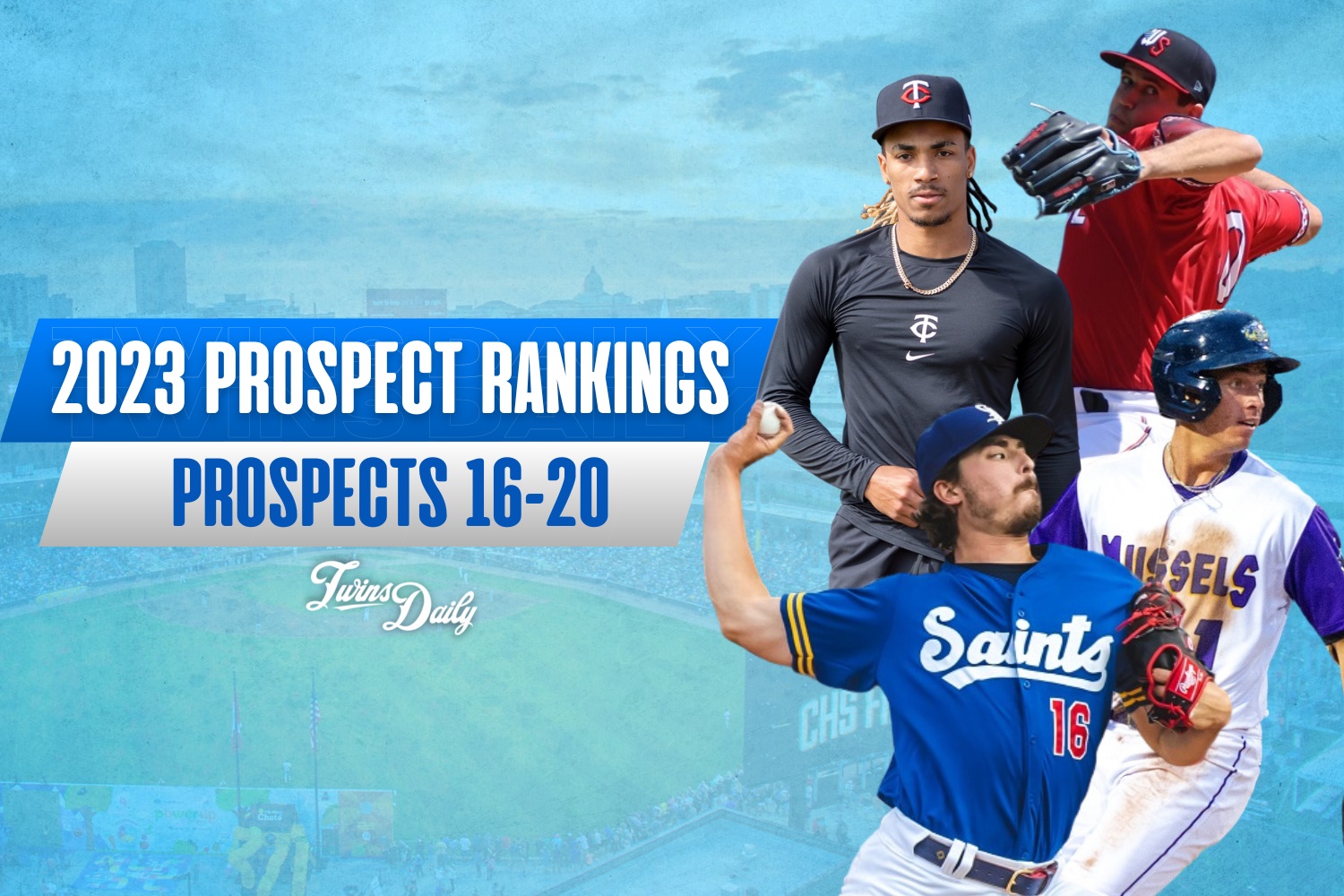 Earlier this week, Seth Stohs took a dive into the deeper end of the Minnesota Twins system, highlighting players who finished in the 21-30 range of our voting tabulation, and honorable mentions who fell just outside that threshold. (For what it's worth, note that Luis Arraez was once found in these very same outside ranks of our lists and others. And he's only one fresh-in-mind example.) With that said, the odds of an MLB future start to increase as we break into the top 20 of our list. In this group of five, representing Twins Daily's choices for the organizations 16th-through-20th best prospects of 2023, we find an intriguing mix of untapped promise and fading high-end upside. 20. Misael Urbina, OF Age: 20 2022 Stats: 263 PA, .247/.323/.407, 5 HR, 27 RBI He was the Twins' big-money signing out of the Dominican Republic in 2018, scoring a $2.75 million bonus, but four years later he hasn't played a game above Low-A. That's how it can go for players that sign as extremely raw talents at age 16 (especially with a lost COVID season mixed in). Through it all he still won't reach legal drinking age until this April. Urbina's outstanding tools remain intact but he needs to start backing them up with production in order to keep his prospect status from fading. Thus far he has a .228/.326/.359 slash line as a pro. 19. Jose Rodriguez, OF Age: 17 2022 Stats (Rookie): 219 PA, .290/.361/.605 , 13 HR, 49 RBI Typically speaking, when teenage players sign from another country and head to the States to play pro ball, it takes a little while to acclimate and warm up. You'll often see meager results in short-season debuts for players who go on to accomplish a great deal. Rodriguez broke the mold after he signed last summer and joined the Twins' affiliate in the Dominican Summer League. He wasn't the most high-profile player acquired in Minnesota's 2022 international signing class, which helped make his spectacular showing on the field so jarring. Rodriguez posted a jaw-dropping .966 OPS and led the short-season league with 13 homers in 55 games. He was an absolute slugging machine and it's scary to think how that might evolve as he ages. The stellar showing earned him Twins Daily's nod as short-season hitter of the year. "Rodriguez’s exit velocities may have been even more impressive than his homer total," wrote Aaron Gleeman, who is higher than most on the prospect, ranking him 13th on his list. "He destroyed the ball, in an environment where that isn’t supposed to take place." So far, so very good. And the strikeout/walk rates are promising for future development. But Rodriguez has a long way to go, as a player from a mold that has high burnout rates. He's a candidate to fly up these rankings with a reinforcing 2023 campaign. 18. Tanner Schobel, 2B Age: 21 2022 Stats (Rookie/A): 136 PA, .242/.367/.303, 1 HR, 11 RBI The Twins snagged Schobel in the second round of last year's draft out of Virginia Tech, where he emerged as a slugging shortstop to boost his appeal. After signing him to a $1 million bonus the Twins him to get his feet wet in Low-A. There, Schobel's power evaporated. Following a 19-homer outburst in the college season, Schobel managed just one home run in 120 plate appearances at Fort Myers, producing a mere .303 slugging percentage. He did, however, show good plate discipline with a 23-to-18 K/BB ratio while swiping seven bags. The power drop-off and move from short to second keep Schobel's helium in check, leading to a lower ranking than you'd normally see from such a highly-drafted prospect in the latest class. But there are some Brian Dozier parallels here, and he's the poster child for late-blooming middle infield power. 17. Ronny Henriquez, RHP Age: 22 2022 Stats (AAA): 95.1 IP, 5.66 ERA, 10.0 K/9, 3.1 BB/9 The Twins were excited to get Ronny Henriquez as an addition to Isiah Kiner-Falefa in last offseason's Mitch Garver trade. They viewed him as underrated addition to their pitching pipeline, capable of racking up strikeouts and moving quickly to the majors. They were correct on those two counts. Henriquez tallied 106 strikeouts in 95 innings at Triple-A, and reached the majors in September at age 22, posting a 2.31 ERA in three appearances. data:image/gif;base64,R0lGODlhAQABAPABAP///wAAACH5BAEKAAAALAAAAAABAAEAAAICRAEAOw== With the goods news out of the way, he also allowed a 5.66 ERA at St. Paul, coughing up 19 homers and 33 walks in those 95 innings. Some changes in pitch usage could help Henriquez take the final step to fulfill his potential, and that'll probably start with moving him to full-time relief duty. The righty made 14 starts for the Saints last year among 24 appearances. Don't sleep on him as a significant factor in Minnesota's bullpen this year. 16. Jordan Balazovic, RHP Age: 24 2022 Stats (AAA): 70.2 IP, 7.39 ERA, 9.7 K/9, 4.5 BB/9 What was supposed to be Balazovic's breakthrough year turned into a total breakdown. From start to finish it was an abject disaster. He was all over the place, utterly hittable when in the zone, and incredibly home run prone. Virtually every start unraveled on the big right-hander, at least up until a decent final month softened his landing at season's end. There were reports of a bothersome knee issue, but Balazovic was healthy enough to avoid the injured list following his late start, so this seems more an issue of mechanics and execution. The reason he remains as high as he does in our ranks is because Balazovic had elevated himself to such a level prior to this lost season. Bad as it was, it's only one season, and the 24-year-old still has time to get (at least somewhat) back on track to recapture the form that made him arguably the system's best pitching prospect prior. Over the past three years he's ranked fourth, sixth, and fifth on this list. Feel free to discuss these prospects and ask as many questions as you like in the COMMENTS below. I will try to get to as any of them as I can. For more Twins Daily content on these ten Twins prospects, click on the link with their name here: Jordan Balazovic, Ronny Henriquez, Tanner Schobel, Jose Rodriguez, Misael Urbina. Previous Installments Honorable Mention Prospects 21-30 Prospects 16-20 Prospects 11-15 - Coming Soon!
- 35 comments
-
- 7
-
-
- jose rodriguez
- jordan balazovic
- (and 2 more)
-
I'm curious to see if the Twins are open to Gordon occasionally playing 3B. It'd be very helpful to have a LH option there in addition to Miranda/Farmer, and would be a clear path to more tread for Gordon. Thing is, I don't know that we really have any evidence to suggest he's "passable" there. He has made zero career starts in the majors and two in the minors. To my eye, he doesn't really have the skill set to be an asset or even an average defender there.
- 53 replies
-
- 3
-
-
- joe ryan
- jorge polanco
- (and 3 more)
-
I was wondering about that too. Seems to be in reference to this, I wouldn't really treat it as a sign of much that he has soreness following a surgery like that:
- 53 replies
-
- 2
-
-
- joe ryan
- jorge polanco
- (and 3 more)
-
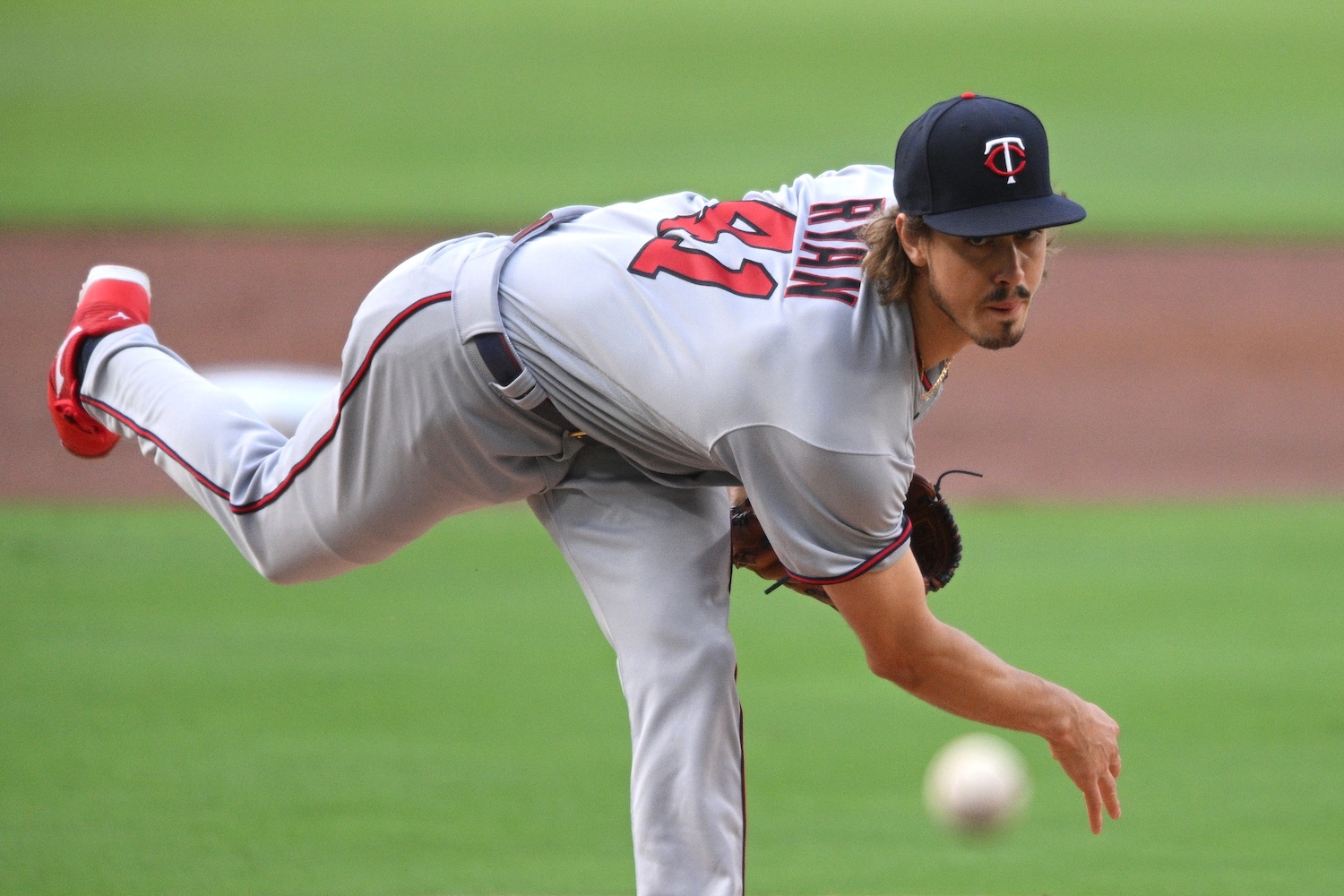 Yes, we all know that health uncertainty is the banner headline for the 2023 Twins. "If they're healthy" is the rallying cry for even the most optimistic fan. As pivotal as they are, these situations just aren't very fun to analyze or talk about, because they feel so beyond anyone's control. Much of the team's outlook hinges on whether Tyler Mahle can pitch without shoulder weakness, and Alex Kirilloff can swing without pain. These things either will happen or they won't, and if they don't, it's not necessarily anyone's fault. The human body is fickle. Today I'm going to look at five critical points of uncertainty for the Twins that have nothing to do with injuries. (Well, almost nothing.) Instead, it's about these players proving they can deliver in areas where the club really needs them if they're to achieve their goals. 1. Can Joe Ryan excel against good teams? Hidden in Ryan's very good overall numbers last year (13-8, 3.55 ERA in 147 innings over 27 starts) is the fact that his success was largely buoyed by beating up on horrible AL Central opponents. In eight starts against the Royals and Tigers, the two teams he faced more than any other, Ryan went 8-0 with a 0.94 ERA. He won every start, allowing just five earned runs on 26 hits (one homer) in 48 innings. Look: that's an absurd level of dominance against any major-league lineup. Ryan certainly deserves a ton of credit for being absolutely automatic in those match-ups. But the flip side is that against all other opponents, he went 5-8 with a 4.80 ERA. The 26-year-old has already established himself as a solid mid-rotation starter who can take care of business against lesser lineups. But with so many question marks elsewhere in the rotation, the Twins are really leaning on him to be more. Showing he can up his game against better offenses than Detroit and KC will be key, both because he'll face less of each in the rebalanced schedule, and because the Twins will (hopefully) need starters they can count on in the postseason. 2. Can Jorge Polanco fill Luis Arraez's OBP void? There's no question that Arraez's ability to get on base will be deeply missed, and his departure raises questions about how a power-driven lineup will fare without his penchant for creating opportunities. There's reason to hope Polanco can make up for some of what the top of the order just lost. You might look at Polanco's career .334 OBP and say, eh, nothing special. Even his .346 mark last year was quite ordinary. But here's the thing: he posted it while batting a career-low .235, thanks to DOUBLING his walk rate from 2021. Polanco's 14.4% BB rate last year would've ranked fifth-best in baseball if his at-bats qualified. If the newfound patience sticks and Polanco is able to sustain a similar walk rate while his batting average rebounds to somewhere in the range of his .270 career benchmark, you've got the recipe for an Arraez-like OBP, or better. To wit: if Polanco walked at same rate in 2021 – when he batted .269 with a .323 OBP – as he did in 2022, he would've had 92 walks and a .395 on-base percentage. 3. Can Nick Gordon make himself essential? Gordon is coming off a breakthrough season that earned him Most Improved Twin honors and saw him accrue nearly 450 plate appearances. In many cases, a campaign like that for a former first-round draft pick would open the door for a big opportunity, if not a starting role. But the circumstances of the offseason leave him in a spot where he'll be scrapping for playing time from the start, and potentially buried on the depth chart. He's not their top backup center fielder (that's Michael A. Taylor). He's not their best lefty-swinging backup corner OF or DH option (that's Trevor Larnach). He's not their top backup anywhere in the infield, and in fact, I'd be somewhat surprised if the Twins view him as anything more than an emergency option on the dirt. Injuries can of course change the equation here, but as things stand, Gordon will have a hard time finding his way off the bench with any regularity. That is, unless he can force the issue. At times last year the former light-hitting shortstop looked like a game-changing offensive force, like in August when he slashed .321/.360/.531 with three steals and 17 RBIs in 26 games. Gordon was electric. Bring more of that to the table, and Rocco Baldelli will find a way to get Gordon into the lineup as much as he can. 4. Can José Miranda play third base effectively? The viability of Miranda's bat is not in question after a convincing rookie campaign that saw him handle everything MLB pitchers could throw at him, thanks to high-contact swing that generated power to all fields. Now he needs to define his defensive future. If he's able to hold on as a capable third baseman, at least for a few years, as opposed to switching to 1B/DH duty, it'd be a boon for the team's planning and lineup-building. An early slide down the defensive spectrum diminished Arraez's value in the front office's eyes, but Miranda can still avoid that route. Thus far, I would say the signs are less than encouraging. His defense at third base checked out pretty poorly last year, by almost any measure or metric, and scouting reports were hardly glowing in the minors. But plenty of third basemen who looked rough as rookies went on to establish themselves at the hot corner (calling Corey Koskie), and Miranda's still only 24. His offseason efforts to slim down have also notably resulted in a body that, per Carlos Correa, "looks sexy." We'll see if the defense can follow suit. 5. Can Jorge Alcalá get lefties out? Coming off a season where he made only two appearances due to an elbow injury that ultimately required debridement surgery, Alcalá is obviously a health question mark. Can his arm hold up, much less get back to pumping the upper-90s heat that led to big results in 2020/21? The Twins seem to be counting on it, because they have yet to make any significant additions to their bullpen this offseason. Unless that changes, they're banking largely on Alcalá's return to provide depth in the mid-to-late innings, setting the table for Jhoan Durán and Jorge López at the back end. Even assuming he's healthy, Alcalá needs to turn one more corner to be the kind of weapon the Twins need him to be. He needs to overcome his susceptibility against left-handed pitchers, who have pummeled him to the tune of .275/.358/.508 in his MLB career. That .866 OPS is 354 points higher than his mark against righties. Baldelli will have the ability to strategically deploy Alcalá in favorable match-ups to an extent, but if the righty wants to truly be relied upon as a key late-inning weapon, he'll need to show he can handle the lefty sluggers and pinch-hitters that come his way.
- 53 comments
-
- 11
-
-
- joe ryan
- jorge polanco
- (and 3 more)
-
These five players have key questions to answer in the season ahead. I promise none of them have to do with injuries. Image courtesy of Orlando Ramirez-USA TODAY Sports Yes, we all know that health uncertainty is the banner headline for the 2023 Twins. "If they're healthy" is the rallying cry for even the most optimistic fan. As pivotal as they are, these situations just aren't very fun to analyze or talk about, because they feel so beyond anyone's control. Much of the team's outlook hinges on whether Tyler Mahle can pitch without shoulder weakness, and Alex Kirilloff can swing without pain. These things either will happen or they won't, and if they don't, it's not necessarily anyone's fault. The human body is fickle. Today I'm going to look at five critical points of uncertainty for the Twins that have nothing to do with injuries. (Well, almost nothing.) Instead, it's about these players proving they can deliver in areas where the club really needs them if they're to achieve their goals. 1. Can Joe Ryan excel against good teams? Hidden in Ryan's very good overall numbers last year (13-8, 3.55 ERA in 147 innings over 27 starts) is the fact that his success was largely buoyed by beating up on horrible AL Central opponents. In eight starts against the Royals and Tigers, the two teams he faced more than any other, Ryan went 8-0 with a 0.94 ERA. He won every start, allowing just five earned runs on 26 hits (one homer) in 48 innings. Look: that's an absurd level of dominance against any major-league lineup. Ryan certainly deserves a ton of credit for being absolutely automatic in those match-ups. But the flip side is that against all other opponents, he went 5-8 with a 4.80 ERA. The 26-year-old has already established himself as a solid mid-rotation starter who can take care of business against lesser lineups. But with so many question marks elsewhere in the rotation, the Twins are really leaning on him to be more. Showing he can up his game against better offenses than Detroit and KC will be key, both because he'll face less of each in the rebalanced schedule, and because the Twins will (hopefully) need starters they can count on in the postseason. 2. Can Jorge Polanco fill Luis Arraez's OBP void? There's no question that Arraez's ability to get on base will be deeply missed, and his departure raises questions about how a power-driven lineup will fare without his penchant for creating opportunities. There's reason to hope Polanco can make up for some of what the top of the order just lost. You might look at Polanco's career .334 OBP and say, eh, nothing special. Even his .346 mark last year was quite ordinary. But here's the thing: he posted it while batting a career-low .235, thanks to DOUBLING his walk rate from 2021. Polanco's 14.4% BB rate last year would've ranked fifth-best in baseball if his at-bats qualified. If the newfound patience sticks and Polanco is able to sustain a similar walk rate while his batting average rebounds to somewhere in the range of his .270 career benchmark, you've got the recipe for an Arraez-like OBP, or better. To wit: if Polanco walked at same rate in 2021 – when he batted .269 with a .323 OBP – as he did in 2022, he would've had 92 walks and a .395 on-base percentage. 3. Can Nick Gordon make himself essential? Gordon is coming off a breakthrough season that earned him Most Improved Twin honors and saw him accrue nearly 450 plate appearances. In many cases, a campaign like that for a former first-round draft pick would open the door for a big opportunity, if not a starting role. But the circumstances of the offseason leave him in a spot where he'll be scrapping for playing time from the start, and potentially buried on the depth chart. He's not their top backup center fielder (that's Michael A. Taylor). He's not their best lefty-swinging backup corner OF or DH option (that's Trevor Larnach). He's not their top backup anywhere in the infield, and in fact, I'd be somewhat surprised if the Twins view him as anything more than an emergency option on the dirt. Injuries can of course change the equation here, but as things stand, Gordon will have a hard time finding his way off the bench with any regularity. That is, unless he can force the issue. At times last year the former light-hitting shortstop looked like a game-changing offensive force, like in August when he slashed .321/.360/.531 with three steals and 17 RBIs in 26 games. Gordon was electric. Bring more of that to the table, and Rocco Baldelli will find a way to get Gordon into the lineup as much as he can. 4. Can José Miranda play third base effectively? The viability of Miranda's bat is not in question after a convincing rookie campaign that saw him handle everything MLB pitchers could throw at him, thanks to high-contact swing that generated power to all fields. Now he needs to define his defensive future. If he's able to hold on as a capable third baseman, at least for a few years, as opposed to switching to 1B/DH duty, it'd be a boon for the team's planning and lineup-building. An early slide down the defensive spectrum diminished Arraez's value in the front office's eyes, but Miranda can still avoid that route. Thus far, I would say the signs are less than encouraging. His defense at third base checked out pretty poorly last year, by almost any measure or metric, and scouting reports were hardly glowing in the minors. But plenty of third basemen who looked rough as rookies went on to establish themselves at the hot corner (calling Corey Koskie), and Miranda's still only 24. His offseason efforts to slim down have also notably resulted in a body that, per Carlos Correa, "looks sexy." We'll see if the defense can follow suit. 5. Can Jorge Alcalá get lefties out? Coming off a season where he made only two appearances due to an elbow injury that ultimately required debridement surgery, Alcalá is obviously a health question mark. Can his arm hold up, much less get back to pumping the upper-90s heat that led to big results in 2020/21? The Twins seem to be counting on it, because they have yet to make any significant additions to their bullpen this offseason. Unless that changes, they're banking largely on Alcalá's return to provide depth in the mid-to-late innings, setting the table for Jhoan Durán and Jorge López at the back end. Even assuming he's healthy, Alcalá needs to turn one more corner to be the kind of weapon the Twins need him to be. He needs to overcome his susceptibility against left-handed pitchers, who have pummeled him to the tune of .275/.358/.508 in his MLB career. That .866 OPS is 354 points higher than his mark against righties. Baldelli will have the ability to strategically deploy Alcalá in favorable match-ups to an extent, but if the righty wants to truly be relied upon as a key late-inning weapon, he'll need to show he can handle the lefty sluggers and pinch-hitters that come his way. View full article
-
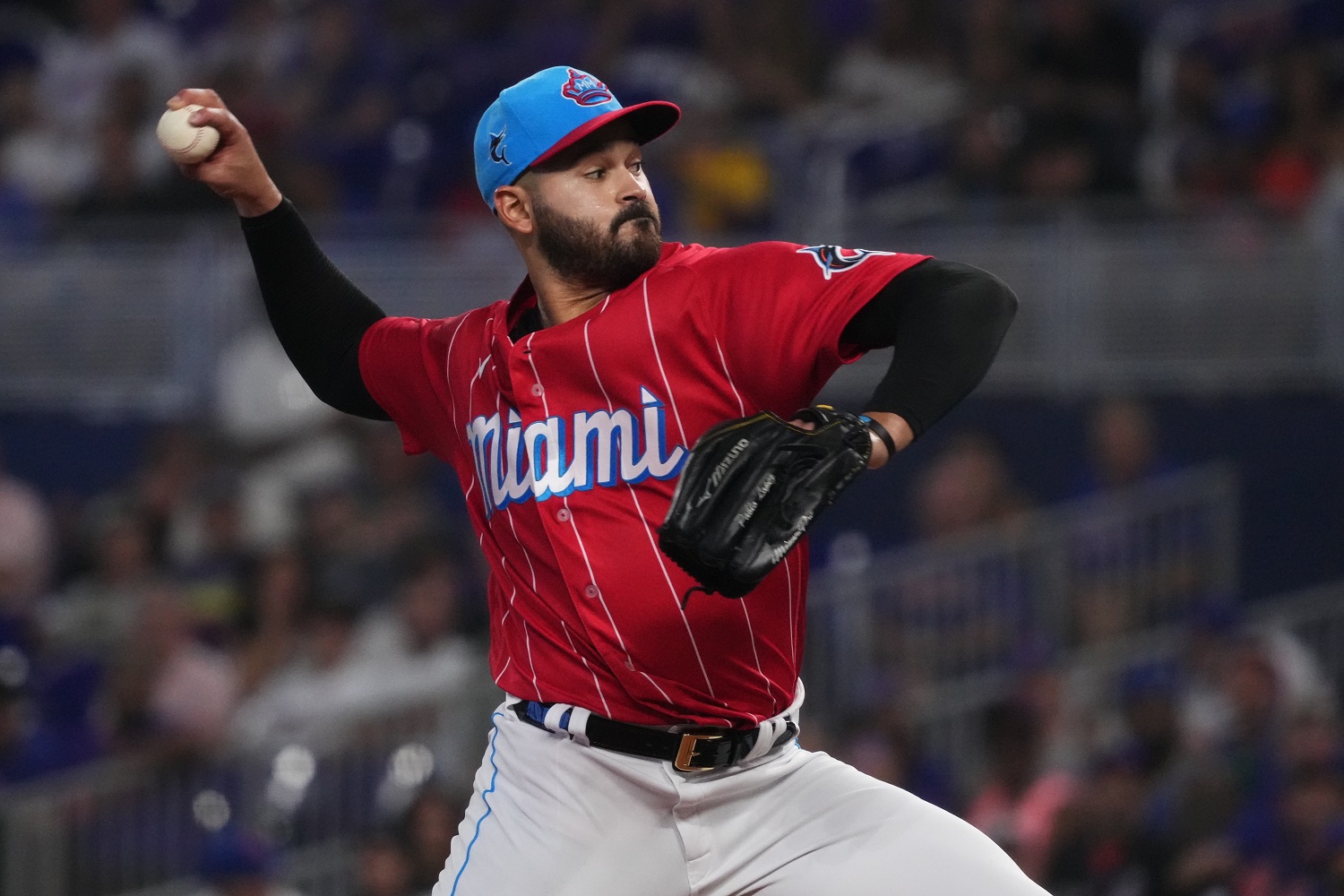 Just after the New Year, we were lamenting the failed pursuit of Carlos Correa and puzzling over Michael Wacha rumors amidst what felt like a very unfulfilling offseason for the Twins. Less than a month later, we can safely call this the splashiest winter in franchise history. The highlight of January was the stunning and record-shattering Correa signing. But in the weeks since, there's been more significant activity to round out the roster. The front office followed up its biggest move with perhaps its most controversial. Twins Trade Arraez to Acquire López from Marlins It's extremely rare for a team to trade away the reigning batting champion – hasn't happened since 1978 – but the Twins did just that (again) when they agreed to send Luis Arraez to Miami in exchange for starting pitcher Pablo López and two prospects. Arraez was coming off a career year that saw him make the All-Star team in addition to winning the AL batting title and taking home a Silver Slugger award. He was the only Twins player to receive MVP votes. Needless to say, his value was at a high point, which made him appealing to the bat-needy Marlins. Undeniably a tough price to pay, but that's what it takes to get controllable, young, high-end pitching, and there's a good argument to be made that the Twins were wise to sell high on Arraez. López adds crucial veteran depth to a rotation besieged by question marks, significantly raising both the unit's floor and ceiling. He doesn't quite clear the Sonny Gray Threshold but he reaches it, and that makes him a worthy addition to the Twins rotation mix. Crucially, the 26-year-old right-hander is under control for an additional year, in 2024, which gives the Twins some much-needed ongoing pitching stability with Gray, along with Tyler Mahle and Kenta Maeda, due for free agency next offseason. Of course, López's two years of team control equates to one fewer than Arraez, so the pressure is on for the hurler to deliver big returns in order to keep this deal from looming as an unforgivable misstep in the eyes of many fans. The Twins were able to offset their risk a bit by acquiring a pair of teenaged prospects, Jose Salas and Byron Chourio, with considerable upside. Michael A. Becomes Plan B in Center Field The Twins can and will hope for the best with Byron Buxton this year, but they can't plan for it. And they know that. It's what compelled them to swing yet another trade shortly after completing the Marlins deal, when they acquired outfielder Michael A. Taylor from the Royals in exchange for a pair of unexceptional pitching prospects, lefty Evan Sisk and righty Steven Cruz. It's a modest but meaningful price to pay for a modest but meaningful addition to the Twins roster. While hardly a star, Taylor is an elite defensive outfielder and has been a regular for Kansas City over the past two seasons, posting 3.4 fWAR over 266 games. For reference, Arraez was worth 4.8 fWAR over 265 games in the same span, albeit in the exact opposite fashion: all offensive value, no defense. In Taylor's case, fielding prowess is the selling point and it's an appealing one. He won a Gold Glove in 2021 and has consistently rated out brilliantly by defensive metrics. His Statcast sliders from last year pretty much tell the whole story: elite range, reactions, and arm that enable him to cover all three outfield positions extremely well. With Taylor around, the Twins have a veteran starting center fielder lined up right behind Buxton -- a sizable upgrade from a year ago when Nick Gordon and Gilberto Celestino made do in a pinch. Rocco Baldelli can feel much more comfortable writing in Buck as DH frequently knowing that there will be no defensive downgrade in center from doing so. Taylor's righty bat lines up nicely for spelling the lefty-swinging corner outfielders as well, but glovework is the highlight here and I can't wait to watch him work. More Moves Left to Come? Are the Twins done? Pitchers and catchers report in two weeks. Their roster is in pretty good shape after the January flurry, but there are a few areas that could still stand to be addressed. The first is their logjam of lefty-swinging corner outfielders, which was worsened instead of relieved by adding Joey Gallo while Max Kepler (for now) stays put. All offseason we heard that Kepler had more trade value than people perceived, but as things wind down the front office seems to content holding him instead of dealing for an unsatisfactory return. (Maybe his trade value isn't really THAT much higher than perceived.) Kepler remains a quality player on a reasonable contract, so keeping him isn't the worst thing in the world, but it sure feels like his roster spots could be better used by, say, a righty-swinging DH/1B type. (The Twins have been connected to Yuli Gurriel, who remains available.) The bullpen is one other area that could still benefit from one more addition. Finding one more semi-stable option for the middle innings would be akin to supplementing the rotation with López. (And I don't mean Jorge López, who lends to this unit's volatility factor.) Michael Fulmer is still sitting out there, oddly unsigned... Roster & Payroll Projection v. 7 Unless the Twins make one of the above moves, or another that falls outside of expectations, this might be our last offseason status update and roster projection until we get to spring training and can start mapping things out with increasing confidence. As it stands, what you see below is roughly the group they'll be planning to roll with this year. Team payroll is above $150 million, which would set a new franchise record. Meanwhile, the rest of the division has barely done a thing all winter. You can't win anything in the offseason, and the Twins are coming from a tough position off a third place finish with all their injury concerns. But there's not much more they could have done to address the weaknesses that pulled them down in 2022.
- 24 comments
-
- 8
-
-
- pablo lopez
- michael a taylor
- (and 1 more)
-
A big month of January has redefined the Twins' offseason, generating a sense of excitement that was palpable at TwinsFest and the Winter Meltdown. As spring training fast approaches, let's get up to speed on the action and chart what moves (if any) might still be left on the table. Image courtesy of Jasen Vinlove-USA TODAY Sports Just after the New Year, we were lamenting the failed pursuit of Carlos Correa and puzzling over Michael Wacha rumors amidst what felt like a very unfulfilling offseason for the Twins. Less than a month later, we can safely call this the splashiest winter in franchise history. The highlight of January was the stunning and record-shattering Correa signing. But in the weeks since, there's been more significant activity to round out the roster. The front office followed up its biggest move with perhaps its most controversial. Twins Trade Arraez to Acquire López from Marlins It's extremely rare for a team to trade away the reigning batting champion – hasn't happened since 1978 – but the Twins did just that (again) when they agreed to send Luis Arraez to Miami in exchange for starting pitcher Pablo López and two prospects. Arraez was coming off a career year that saw him make the All-Star team in addition to winning the AL batting title and taking home a Silver Slugger award. He was the only Twins player to receive MVP votes. Needless to say, his value was at a high point, which made him appealing to the bat-needy Marlins. Undeniably a tough price to pay, but that's what it takes to get controllable, young, high-end pitching, and there's a good argument to be made that the Twins were wise to sell high on Arraez. López adds crucial veteran depth to a rotation besieged by question marks, significantly raising both the unit's floor and ceiling. He doesn't quite clear the Sonny Gray Threshold but he reaches it, and that makes him a worthy addition to the Twins rotation mix. Crucially, the 26-year-old right-hander is under control for an additional year, in 2024, which gives the Twins some much-needed ongoing pitching stability with Gray, along with Tyler Mahle and Kenta Maeda, due for free agency next offseason. Of course, López's two years of team control equates to one fewer than Arraez, so the pressure is on for the hurler to deliver big returns in order to keep this deal from looming as an unforgivable misstep in the eyes of many fans. The Twins were able to offset their risk a bit by acquiring a pair of teenaged prospects, Jose Salas and Byron Chourio, with considerable upside. Michael A. Becomes Plan B in Center Field The Twins can and will hope for the best with Byron Buxton this year, but they can't plan for it. And they know that. It's what compelled them to swing yet another trade shortly after completing the Marlins deal, when they acquired outfielder Michael A. Taylor from the Royals in exchange for a pair of unexceptional pitching prospects, lefty Evan Sisk and righty Steven Cruz. It's a modest but meaningful price to pay for a modest but meaningful addition to the Twins roster. While hardly a star, Taylor is an elite defensive outfielder and has been a regular for Kansas City over the past two seasons, posting 3.4 fWAR over 266 games. For reference, Arraez was worth 4.8 fWAR over 265 games in the same span, albeit in the exact opposite fashion: all offensive value, no defense. In Taylor's case, fielding prowess is the selling point and it's an appealing one. He won a Gold Glove in 2021 and has consistently rated out brilliantly by defensive metrics. His Statcast sliders from last year pretty much tell the whole story: elite range, reactions, and arm that enable him to cover all three outfield positions extremely well. With Taylor around, the Twins have a veteran starting center fielder lined up right behind Buxton -- a sizable upgrade from a year ago when Nick Gordon and Gilberto Celestino made do in a pinch. Rocco Baldelli can feel much more comfortable writing in Buck as DH frequently knowing that there will be no defensive downgrade in center from doing so. Taylor's righty bat lines up nicely for spelling the lefty-swinging corner outfielders as well, but glovework is the highlight here and I can't wait to watch him work. More Moves Left to Come? Are the Twins done? Pitchers and catchers report in two weeks. Their roster is in pretty good shape after the January flurry, but there are a few areas that could still stand to be addressed. The first is their logjam of lefty-swinging corner outfielders, which was worsened instead of relieved by adding Joey Gallo while Max Kepler (for now) stays put. All offseason we heard that Kepler had more trade value than people perceived, but as things wind down the front office seems to content holding him instead of dealing for an unsatisfactory return. (Maybe his trade value isn't really THAT much higher than perceived.) Kepler remains a quality player on a reasonable contract, so keeping him isn't the worst thing in the world, but it sure feels like his roster spots could be better used by, say, a righty-swinging DH/1B type. (The Twins have been connected to Yuli Gurriel, who remains available.) The bullpen is one other area that could still benefit from one more addition. Finding one more semi-stable option for the middle innings would be akin to supplementing the rotation with López. (And I don't mean Jorge López, who lends to this unit's volatility factor.) Michael Fulmer is still sitting out there, oddly unsigned... Roster & Payroll Projection v. 7 Unless the Twins make one of the above moves, or another that falls outside of expectations, this might be our last offseason status update and roster projection until we get to spring training and can start mapping things out with increasing confidence. As it stands, what you see below is roughly the group they'll be planning to roll with this year. Team payroll is above $150 million, which would set a new franchise record. Meanwhile, the rest of the division has barely done a thing all winter. You can't win anything in the offseason, and the Twins are coming from a tough position off a third place finish with all their injury concerns. But there's not much more they could have done to address the weaknesses that pulled them down in 2022. View full article
- 24 replies
-
- 1
-
-
- pablo lopez
- michael a taylor
- (and 1 more)
-
I would say these have been addressed, mostly. Pagan was basically the de facto closer on Opening Day last year, this year he'll be like 5th in the pecking order. Last year Buxton had no credible backup in CF, this year he has an elite defensive veteran. Switching pitching coaches at midseason is going to have an adverse effect on any team, but now Maki will have a full offseason and spring to run his own plan and approach. He'll also have considerably more talent/depth to work with, which should benefit both him and Baldelli from a game management standpoint. The reality is that there was no avoiding a scenario where they were going to be dependent on likely-to-be-injured stars. They can't trade Buxton and they really can't trade guys like Kirilloff or Mahle or Maeda because of their situations. All they can do is try to provide them with the best training support possible and buoy them with plenty of depth, which they did.
- 39 replies
-
- 8
-
-
- michael a taylor
- pablo lopez
- (and 1 more)
-
The Twins hired a new hitting coach just last year (David Popkins) and he's quite highly regarded so I wouldn't expect another change anytime soon.
- 39 replies
-
- 8
-
-
- michael a taylor
- pablo lopez
- (and 1 more)

