Jump to content
Twins Daily
  • Create Account
  • Twins Minor League Coverage

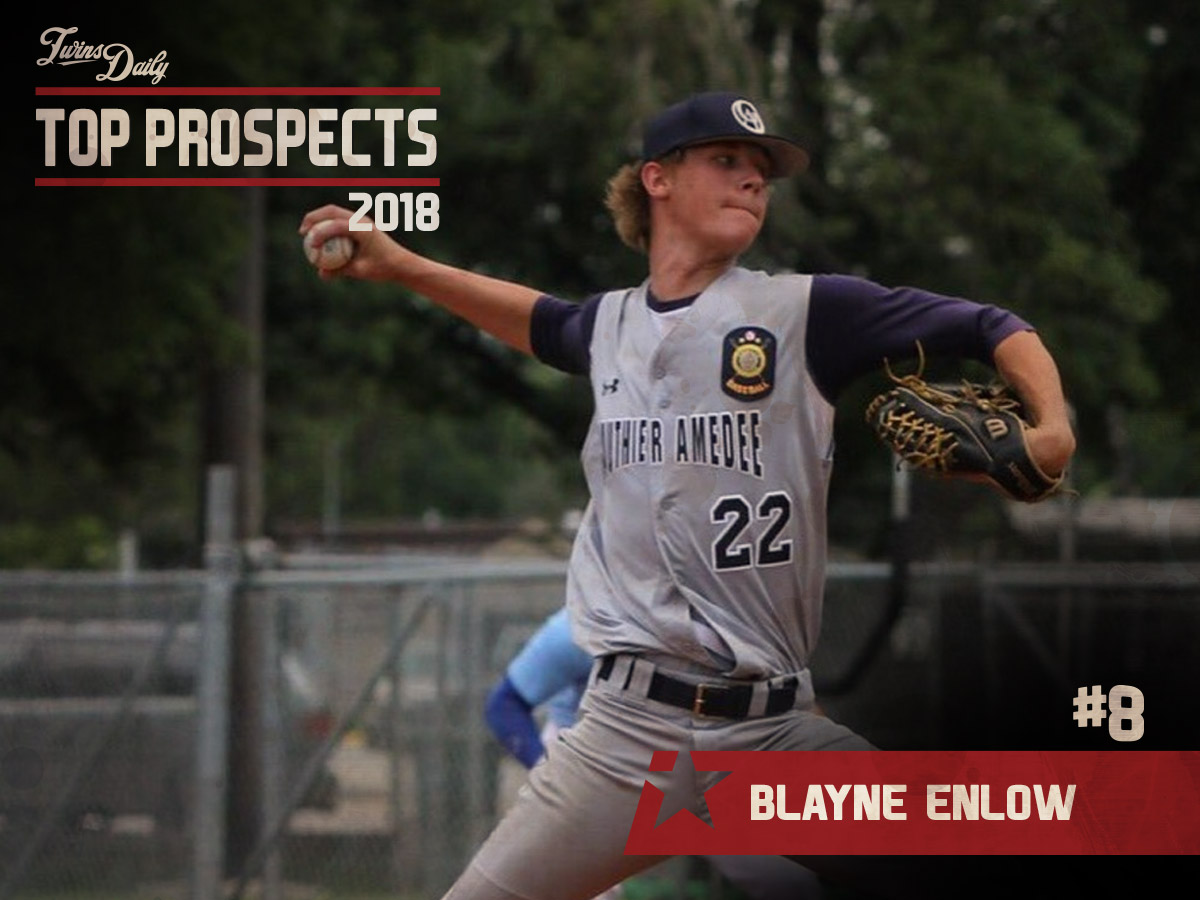
    Twins Daily 2018 Top Prospects: #8 Blayne Enlow


    Nick Nelson

    Trouble with the curve: An old baseball phrase as trite and cliché as the Clint Eastwood movie titled after it. But as the game has evolved, that cliché has never lost its relevance. The curveball remains a mystical entity, difficult for pitchers to master and even more so for hitters to solve.

    Blayne Enlow, still just 18 years old, has no trouble with the curve. His special ability to spin the baseball helps him hook a spot among our Top 10 Twins prospects fresh off his pro debut.

    Twins Video

    Age: 18 (DOB: 3/21/99)

    2017 Stats (Rookie): 20.1 IP, 1.33 ERA, 19/4 K/BB, 0.69 WHIP

    ETA: 2021

    2017 Ranking: NR

    National Top 100 Rankings

    BA: NR | MLB: NR | ESPN: NR | BP: NR

    What's To Like

    "He can spin the ball, which is hard to teach."

    Those were the words of Twins scouting director Sean Johnson when first

    in the 2017 draft. And it's very true. Last summer, Tom Verducci penned a big feature for Sports Illustrated on the resurgence of the curveball as a premier pitch in MLB. "Organizations have learned," he wrote, "that if someone does not show an aptitude to spin the baseball as an amateur, it’s foolish to expect him to acquire the skill."

    Enlow is ahead of all peers in this regard. Prior to last June's draft, MLB.com's Jim Callis dubbed his curveball the best in the entire class, which included plenty of vaunted college arms. The Twins followed the Louisiana prep closely all spring, and basically framed their entire draft strategy around landing him. (Maybe they wanted Royce Lewis no matter what, but signing him below-slot at No. 1 gave them the flexibility to lure Enlow away from an LSU commitment with a gaudy $2 million bonus.)

    It is, of course, still very early, but so far Minnesota's scouting department looks to have hit the bullseye and added one hell of a pitcher.

    Enlow made only six appearances in the Gulf Coast League after signing, totaling just 20 1/3 innings, but his performance was almost spotless. The projectible 6-foot-4, 180 lb right-hander turned in a 1.33 ERA with 19 strikeouts and four walks, allowing just 10 hits and one home run with a 55% grounder rate. As a high school senior at St. Amant, he had fanned 101 over 76 frames with a 0.92 ERA.

    His signature curve is already making waves in the pros. Baseball America recently ranked it as the best in the Twins system. GCL hitters were overmatched and couldn't do much with it. The pitch breaks so hard that some see it as more of a slurve, and TD community member Bob Sacamento went so far as to say in September that "[Enlow] showed me the grip and it's a slider."

    Regardless of what you want to call it, it's a phenomenal pitch, and Enlow's ability to combine it with a power fastball with stellar command at the age of 18 is beyond promising.

    What's Left to Work On

    You might be asking yourself: If this kid's so good, why did he slip to the third round of the draft? Well, that's a little misleading, because he signed for late-first-round money. It is quite likely that other teams were aware of his arrangement with Minnesota.

    But there were legitimate concerns cropping up around Enlow that caused his draft stock to drop a bit. Namely: a dip in fastball velocity, from 94 MPH during his junior year to the upper-80s early in his senior season. That can be a very troubling sign, but the velo rebounded as the draft approached (likely alleviating any reservations for the Twins), and he was reportedly back to touching 94 in the GCL.

    Of course, the problem with dominating so thoroughly on the strength of two pitches is that he's never had much need to work on a third. Enlow's changeup lags behind his heater and breaking ball, but that's not rare for a pitcher at this stage, and most believe he can develop his third offering into something at least usable.

    That question mark, and all others that generally apply to a teenage pitcher who hasn't yet played above rookie ball, keep Enlow's prospect standing in check... for now.

    What's Next

    The temporary decline in arm strength late in his prep career might help explain why the Twins took it quite easy on Enlow during his first foray into the pro ranks, using him almost exclusively in relief and always with big breaks in between outings. They'll probably continue to exercise caution in the next couple of years, but as he fills out, there's little reason to doubt his ability to stay healthy and maintain velo.

    Turning 19 next month, Enlow will likely start the season at the next step of rookie ball in Elizabethton, but it would surprise no one if he surfaced quickly in Cedar Rapids. Any level of success there, as a teenager, would put him on track to beat out our (fairly aggressive) estimate of an MLB arrival in 2021.

    Catch Up on the Rest of Twins Daily's Top Prospect Countdown:

    TD Top Prospects: 16-20

    TD Top Prospects: 11-15

    TD Top Prospect: #10 Akil Baddoo, OF

    TD Top Prospects: #9 Brusdar Graterol, RHP

    TD Top Prospects: #8 Blayne Enlow, RHP

    TD Top Prospects: #7 - Coming Tuesday!


    Interested in learning more about the Minnesota Twins' top prospects? Check out our comprehensive top prospects list that includes up-to-date stats, articles and videos about every prospect, scouting reports, and more!

    View Twins Top Prospects

    Follow Twins Daily For Minnesota Twins News & Analysis

    Recent Twins Articles

    Recent Twins Videos

    Twins Top Prospects

    Marek Houston

    Cedar Rapids Kernels - A+, SS
    The 22-year-old went 2-for-5 on Friday night, his fourth straight multi-hit game. Heading into the week, he was hitting .246/.328/.404 (.732). Four games later, he is hitting .303/.361/.447 (.808).

    User Feedback

    Recommended Comments


    Featured Comments

    I'm impressed but he almost reminds me of Duffey.Guy has a fantastic curve but that's about it.


    Prefacing this by saying super loud that THERE'S NO SUCH THING AS A PITCHING PROSPECT. Especially at 18 years old. Enlow has two plus pitches but ultimately needs a third and some seasoning before you can say he's got it. 


    It might seem easy to take a right-handed curveball specialist and say he's a Tyler Duffey type but that's doing a disservice to where Enlow's curveball is at right now. In his senior year, his curveball's spin rate was the highest in the draft class, measuring over 2700 RPMs on average. That puts him in some elite territory immediately. MLB's average curveball spin is 2490 in 2017. By comparison, Tyler Duffey's curveball spins at a 2475 rate. It's not as sharp, it's not a late-breaking. It's a good pitch, to be sure, but we're talking two different types of curveballs. 


    Again -- TNSTAAPP -- but we're talking an 18-year-old with two plus tools. 


    I'm impressed but he almost reminds me of Duffey. Guy has a fantastic curve but that's about it.

    From what the scouting report says Enlow’s velocity came back between 90-94 while he pitched for the GCL Twins so that’s better than Duffey’s upper 80’s fastball, plus Enlow is younger...I have more confidence now that Enlow can develop a change rather than Duffey IMO.


    Prefacing this by saying super loud that THERE'S NO SUCH THING AS A PITCHING PROSPECT. Especially at 18 years old. Enlow has two plus pitches but ultimately needs a third and some seasoning before you can say he's got it. 


    It might seem easy to take a right-handed curveball specialist and say he's a Tyler Duffey type but that's doing a disservice to where Enlow's curveball is at right now. In his senior year, his curveball's spin rate was the highest in the draft class, measuring over 2700 RPMs on average. That puts him in some elite territory immediately. MLB's average curveball spin is 2490 in 2017. By comparison, Tyler Duffey's curveball spins at a 2475 rate. It's not as sharp, it's not a late-breaking. It's a good pitch, to be sure, but we're talking two different types of curveballs. 


    Again -- TNSTAAPP -- but we're talking an 18-year-old with two plus tools. 


    I'm impressed at what he can do at 18 no doubt.  My only concern is that once he reaches the upper minors and majors he will essentially be a one trick pony like Duffey.  Bert dominated for many years because he could vary the spin on his curve keeping it in strike territory or drop out of the zone keeping hitters off balance.

    It's kinda like adjusting the spin on your bowling ball to control the amount of hook depending on oil lane conditions.  Not every pitcher has that finesse control of their out pitch. Duffey is a perfect example and that's why he's failed as a starter IMO (besides his average fastball).  Hopefully Enlow can develop a third pitch changeup.

    Edited by laloesch


    I'm impressed at what he can do at 18 no doubt.  My only concern is that once he reaches the upper minors and majors he will essentially be a one trick pony like Duffey.  Bert dominated for many years because he could vary the spin on his curve keeping it in strike territory or drop out of the zone keeping hitters off balance.

    It's kinda like adjusting the spin on your bowling ball to control the amount of hook depending on oil lane conditions.  Not every pitcher has that finesse control of their out pitch. Duffey is a perfect example and that's why he's failed as a starter IMO (besides his average fastball).  Hopefully Enlow can develop a third pitch changeup.

    So you are saying you can be a one trick pony like Bert if you do it well?  Might not be what you meant but I agree with it anyway.   Duffey did quite well as a starter when he had good command of both his fastball and curveball in 2015.   He mixed big breaking sweepers with sharp biting 12-6 pitches.     He had command of neither in 2016 quite possibly because of trying to develop a third pitch which I don't think he needed.   There are a lot of variations in arm angle, speed and break with curve balls that essentially give you enough different looks from that same pitch.    Heck, a slow curve ball IS a change up.   Then even a mediocre fast ball placed well can be very effective.    Duffey lost the well placed part, a little downward plane and a little bite from what he had in 2015.  .    It looks to me that Enlow has enough stuff right now to do well.   If he can get the pin point control down I think his future is very bright.

    Definitely one of the more interesting prospects in the system, however, I don't believe there was a master plan to land him specifically.  They could have taken him at #35 or #37 and signed him for right around slot.  Any other team could have taken him in that range as well.  To not take him at #37 and rather take Leach tells me while high on him, they couldn't have had him that high otherwise they don't risk losing him.  I'm hoping they push him to Cedar Rapids for at least a good chunk of the season.  

    Definitely one of the more interesting prospects in the system, however, I don't believe there was a master plan to land him specifically. They could have taken him at #35 or #37 and signed him for right around slot. Any other team could have taken him in that range as well. To not take him at #37 and rather take Leach tells me while high on him, they couldn't have had him that high otherwise they don't risk losing him. I'm hoping they push him to Cedar Rapids for at least a good chunk of the season.

    I dunno. From what I heard other teams knew not to pick him or he'd have gone to LSU. Twins were basically the only team that could offer him enough money by undersigning on Lewis.


    I love Enlow. I'd have him as my number 1 pitching prospect in the org. I think he needs to be fast tracked before that spin rate causes his arm to detach at the Enlow.. I mean elbow.

    Edited by Jham


    He's going to cost a lot of minor league batters their jobs. "Can't hit the good curve."


    Whether that translates into a job in the majors where batters can hit (or lay off of) the good curve, is of course what will decide things for him.

    Don't know if this is true, didn't  I hear Cuellers for the Astros threw 24 consecutive curve balls to the Yankees in game 7 and they did nothing with them. 


    I love this and I hope the Twins are really aggressive with him, Rooker, and Lewis.  Remember the Kid?  Griffey at 19 in mlb.  I love it.  move fast, get the talent to the bigs and soar with it. 


    You mean Ken Griffey Jr.? One of the most phenomenal players in the history of the game? I don't think there is a current prospect in all of baseball with Ken Griffey Jr. upside. Lets let them develop at an appropriate curve and time frame. 

    Don't know if this is true, didn't  I hear Cuellers for the Astros threw 24 consecutive curve balls to the Yankees in game 7 and they did nothing with them. 

    Since my comment garnered two dissents, I guess I should walk it back a little because I wasn't trying to say curveballs aren't good. It really was meant as almost a nothing-conclusion - I might have said, "looks deadly at this point, which is great to see. Time will tell." Which is not much different than any good prospect.

    Since my comment garnered two dissents, I guess I should walk it back a little because I wasn't trying to say curveballs aren't good. It really was meant as almost a nothing-conclusion - I might have said, "looks deadly at this point, which is great to see. Time will tell." Which is not much different than any good prospect.

    I got your point and I agree with you. I watched McCullers throw those 24 again and posted the YouTube link above. The Yankees couldn't do squat with it. ZERO solid contact and at least 5 or 6 K's in 3 innings (I think). He completely shut them down with 1 pitch for multiple innings. If a pitch is that good (Mariano Rivera anyone?) it can serve to shut down some of the best hitters and lineups in the game. I think your point is well taken and most of us are very optimistic about Enlow's development and rise through the Twins' system.


    No one can argue that. IMO I would turn a few of those coin flips into players that can help us now, before those coin flips come up tails.


    Enlow and other prospects like him are usually worth much more to the Twins than anything they would be offered for them. Any buyer will demand an exaggerated discount to cover perceived risks that the Twins see as overstated. I know that people think we overvalue prospects, but it works both ways, and when the mistake is made by the seller of the prospect, it can create a problem that won't go away for years. Wilson Ramos and Matt Garza come to mind.


    What makes those prospect for MLB'ers even more dangerous is that you give up multiple prospects, which increases the odds that one of them hits their ceiling while the single MLB player received in return faces his own odds of injury and early decline.


    Call me crazy, but I value the combination of Enlow, Badoo, and Graterol more than Archer, for example.


    I dunno. From what I heard other teams knew not to pick him or he'd have gone to LSU. Twins were basically the only team that could offer him enough money by undersigning on Lewis.

    Five players (including 3 other high school pitchers) received as large or larger bonuses than Enlow's $2 million despite being drafted between the Twins pick of Leach at #37 and the Enlow pick at #76. It is certainly possible that Enlow really was dead-set on the Twins and scared away other teams with outrageous fake bonus demands, but I think he would have taken their $2.5 million at the #54 pick had the Yankees picked him there (and offered 25% more than what he signed for with the Twins). Instead, I think the Yankees just liked Matt Sauer better. The Rays probably just like Michael Mercado at #40 better, and the Mariners liked Sam Carlson at #55 better.

    Yeah, I'm pretty sure the Twins had a list of guys that they were going to offer overslot money to at the start of Day 2. Enlow was a good one to nab, and I'm glad we have him, but I doubt the Twins planned to have that specific player there as opposed to knowing they'd have a handful of solid draft prospects available.


    *And maybe Enlow was #1 on their wish list of those guys.

    Edited by gunnarthor

    I dunno. From what I heard other teams knew not to pick him or he'd have gone to LSU. Twins were basically the only team that could offer him enough money by undersigning on Lewis.


    I love Enlow. I'd have him as my number 1 pitching prospect in the org. I think he needs to be fast tracked before that spin rate causes his arm to detach at the Enlow.. I mean elbow.

    yeah, I think he will be an upper end of the rotation type. Im not sure there is another starting pitching prospect in our minor league system that I have higher expectations of.


    All 24 in all their glory: https://youtu.be/QjngPW6XVvI

    Says he threw 24 straight curve balls.   They didn't look straight.   Ok bad joke.   They actually didn't look like they were great curve balls either.   His best and his average for those curve balls did not look as nasty as the best and average of the clip of Enlow.    Just more evidence that a guy with a curve ball and fast ball can do just fine without a third pitch if the two pitches are good enough and used in different ways.    I think I could have watched a game pitched by Duffey in 2015 and one in 2016 and concluded that it wasn't the batters adjusting to the fact Duffey had only two pitches but simply that Duffey did not throw those two pitches as well.   


    Yeah, I'm pretty sure the Twins had a list of guys that they were going to offer overslot money to at the start of Day 2. Enlow was a good one to nab, and I'm glad we have him, but I doubt the Twins planned to have that specific player there as opposed to knowing they'd have a handful of solid draft prospects available.


    *And maybe Enlow was #1 on their wish list of those guys.

    Yep. I completely agree.


    Additionally, my own pet theory is that they had hoped that at least one other top player would have dropped to their 4th round pick at #106. They had enough money to offer another $2M bonus if someone was available. I think that partially explains the needlessly complicated maneuver to take Leach way underslot at #37 (unless, of course, they just really, really liked Leach!). I have yet to read a good explanation on what benefit they would have lost by taking Enlow (or whomever else they liked) at #37, especially a benefit greater than the risk that none of the high-end prospects would be available at #76.


    With due respect and appreciation for your knowledge, I think you are greatly overstating the legitimacy of an old study that looks at data from 1994 to 2006. There have been so many transformative improvements in virtually every aspect of the process and at every stage of the process since then. Technology that takes much of the judgment away from the trained eyes of scouts who see prospects a handful of times who are now supported by myriads of eyes studying video. Fitness and health upgrades, perhaps most dramatically affecting IFA prospects, knowledge about biomechanics, kinesiology, psychology, better coaching tools and knowledge. I don't have numbers to support it, but my intuition tells me that players who make the top 120 or so today probably enjoy odds that have improved enough so that the odds for Graterol, Badoo, and Enslow are closer to 50% than 25%, that even despite the much worse odds for pitching prospects because of the much higher injury risks.

    Sorry for the delayed response on this, but it has occupied my thoughts for a while now. I certainly share the intuition that you articulated - namely, the player development process and prospect evaluation has revolutionized over the past decade-plus. But at the moment I just haven't seen data to back it up that these prospect rankings are significantly better than they were before. Even a chart compiled this offseason doesn't show any major improvement in the overall performance of, at least, BA's prospect lists over the past twenty years: 


    It certainly feels like the rankings should be better in this day and age, with so much more information and more people/organizations taking prospect ranking seriously. But at the same time, a lot of the public prospect analysts (and presumably the best) have been hired away by specific clubs. So maybe while teams are getting better and better, there are countervailing forces that are keeping the public content more or less the same. Also, the game itself is changing extremely quickly - the flyball revolution, juiced balls, increased velocity, different balls between majors and minors. It's possible that at some level, the skills (or lack there of) that mattered even five years ago just don't matter in the same way right now. Finally, maybe is just a lag in the data - HS players from the draft class of 2013 are just starting to reach the majors, so we won't really "know" how good the 2014 ranking will be until 2023(?) or so. 


    Maybe part of our disagreement is that we are just talking about different things. When I'm talking about a "contributor", I'm talking about a player that is at least a consistent 4th-outfielder, backup catcher, utility infielder, platoon bat, 4th starter or middle reliever. Someone who can provide consistent above-replacement-level performance over a decent time frame. Ben Revere was a contributor. Joe Benson was not. You get the idea. If you are talking about the odds that they will at least get a cup of coffee, then obviously our odds are going to be very different.


    Anyway, thanks for your comment. It has certainly given me a lot to ponder about over the last couple days.


    From what the scouting report says Enlow’s velocity came back between 90-94 while he pitched for the GCL Twins so that’s better than Duffey’s upper 80’s fastball, plus Enlow is younger...I have more confidence now that Enlow can develop a change rather than Duffey IMO.

    What I wrote on my adopted prospect:


    18 year old Blayne Enlow was considered a tough sign away from his college commitment to LSU as he's a Louisana boy and a huge fan of the university's athletic program.Even with that said the Twins were able to wriggle him away from college with a 2 million signing bonus in the third round.To put it in perspective, Enlow's76th overall slot was valued at 775K while the 2 million he signed for was valued at 33rd overall slot.


    The tall lanky righty who appears to be all arms and legs on the mound signed on the 22nd of June yet didn't appear in a professional game until the 19th of July as he was rebuilding arm strength due to the layoff he had from his high school season.


    He had a very impressive 2017 regular season line yet never threw more than 70 pitches and 4 1/3 innings in an outing.


    3-0 , 6 G/1GS, 20 1/3 IP, 10 H, 3 ER, 1 HR, 4 BB, 19 K, 1.33 ERA, 0.69 WHIP, .141 BAA, 1.77 BB/9, 8.41 K/9


    He was impressive to the point where he was entrusted with the GCL Twins playoff game vs the GCL Nationals.The Cajun Heat was splendid through 5 innings giving up 2 hits, 1 run, 1 walk, and striking out 6 before being trotted back out there to start the 6th inning.Enlow subsequently gave up a bunt single, balked, a run scoring triple and then a run scoring double before being removed.


    During the GCL season, Blayne's fastball showed to be a plus pitch sitting 94-95 mph regularly with great life that runs in on the hands of right handed hitters.When he wants he can rearback and get a few more ticks on his fastball as I've seen him max at 97 mph. Still his already above average control over his heater was what really sets him apart.


    In addition to his fastball, Blayne features a wicked 84-86 mph slider with hard sharp bite getting as much break vertically as it does horizontally.Characteristically it looks very similar to a hard curveball aka a slurve but he showed me the grip and it's a slider.His other secondary pitch is a changeup but it's still in it's infantile state as he didn't need much of it as a prep pitcher.Nevertheless, Enlow shows a great ability to let the ball tumble out of his hand and releases the 88-89 mph pitch out of the same arm slot as his fastball creating even more deception.

    After the GCL season, Enlow was slated to throw in Instuctional ball but it was canceled. Look for Enlow to add some pounds this offseason with further conditioning and muscle building.Depending how aggressive the front office is he'll have an outside chance to start the 2018 season in Cedar Rapids.


    Bob's Grades for Blayne Enlow

    Fastball50/65
    Slider45/65
    Changeup40/50
    Command45/60

    Overall 45/60


    Video shot with camera phone, not my best work:

    https://www.youtube.com/watch?v=ta0KUNyIjZ0

    What I wrote on my adopted prospect:


    18 year old Blayne Enlow was considered a tough sign away from his college commitment to LSU as he's a Louisana boy and a huge fan of the university's athletic program.Even with that said the Twins were able to wriggle him away from college with a 2 million signing bonus in the third round.To put it in perspective, Enlow's76th overall slot was valued at 775K while the 2 million he signed for was valued at 33rd overall slot.


    The tall lanky righty who appears to be all arms and legs on the mound signed on the 22nd of June yet didn't appear in a professional game until the 19th of July as he was rebuilding arm strength due to the layoff he had from his high school season.


    He had a very impressive 2017 regular season line yet never threw more than 70 pitches and 4 1/3 innings in an outing.


    3-0 , 6 G/1GS, 20 1/3 IP, 10 H, 3 ER, 1 HR, 4 BB, 19 K, 1.33 ERA, 0.69 WHIP, .141 BAA, 1.77 BB/9, 8.41 K/9


    He was impressive to the point where he was entrusted with the GCL Twins playoff game vs the GCL Nationals.The Cajun Heat was splendid through 5 innings giving up 2 hits, 1 run, 1 walk, and striking out 6 before being trotted back out there to start the 6th inning.Enlow subsequently gave up a bunt single, balked, a run scoring triple and then a run scoring double before being removed.


    During the GCL season, Blayne's fastball showed to be a plus pitch sitting 94-95 mph regularly with great life that runs in on the hands of right handed hitters.When he wants he can rearback and get a few more ticks on his fastball as I've seen him max at 97 mph. Still his already above average control over his heater was what really sets him apart.


    In addition to his fastball, Blayne features a wicked 84-86 mph slider with hard sharp bite getting as much break vertically as it does horizontally.Characteristically it looks very similar to a hard curveball aka a slurve but he showed me the grip and it's a slider.His other secondary pitch is a changeup but it's still in it's infantile state as he didn't need much of it as a prep pitcher.Nevertheless, Enlow shows a great ability to let the ball tumble out of his hand and releases the 88-89 mph pitch out of the same arm slot as his fastball creating even more deception.

    After the GCL season, Enlow was slated to throw in Instuctional ball but it was canceled. Look for Enlow to add some pounds this offseason with further conditioning and muscle building.Depending how aggressive the front office is he'll have an outside chance to start the 2018 season in Cedar Rapids.


    Bob's Grades for Blayne Enlow

    Fastball50/65

    Slider45/65

    Changeup40/50

    Command45/60

    Overall 45/60


    Video shot with camera phone, not my best work:

    https://www.youtube.com/watch?v=ta0KUNyIjZ0

    Is okay to be even more excited about him now?? If it wasn’t for Enlow’s dip in his fastball velocity he sounded like a sure fire 1st rounder. I’m excited to see how he progresses. Thanks for the report Bob!!


    Sorry for the delayed response on this, but it has occupied my thoughts for a while now. I certainly share the intuition that you articulated - namely, the player development process and prospect evaluation has revolutionized over the past decade-plus. But at the moment I just haven't seen data to back it up that these prospect rankings are significantly better than they were before. Even a chart compiled this offseason doesn't show any major improvement in the overall performance of, at least, BA's prospect lists over the past twenty years: 


    It certainly feels like the rankings should be better in this day and age, with so much more information and more people/organizations taking prospect ranking seriously. But at the same time, a lot of the public prospect analysts (and presumably the best) have been hired away by specific clubs. So maybe while teams are getting better and better, there are countervailing forces that are keeping the public content more or less the same. Also, the game itself is changing extremely quickly - the flyball revolution, juiced balls, increased velocity, different balls between majors and minors. It's possible that at some level, the skills (or lack there of) that mattered even five years ago just don't matter in the same way right now. Finally, maybe is just a lag in the data - HS players from the draft class of 2013 are just starting to reach the majors, so we won't really "know" how good the 2014 ranking will be until 2023(?) or so. 


    Maybe part of our disagreement is that we are just talking about different things. When I'm talking about a "contributor", I'm talking about a player that is at least a consistent 4th-outfielder, backup catcher, utility infielder, platoon bat, 4th starter or middle reliever. Someone who can provide consistent above-replacement-level performance over a decent time frame. Ben Revere was a contributor. Joe Benson was not. You get the idea. If you are talking about the odds that they will at least get a cup of coffee, then obviously our odds are going to be very different.


    Anyway, thanks for your comment. It has certainly given me a lot to ponder about over the last couple days.


    I can say that we were working with decidedly different definitions because I was in fact counting all players who made a MLB roster. So yes, under that criteria, I think I side with your estimates. It will be interesting to see what the results looks like when the data catches up a bit more.

    Edited by birdwatcher


    What if the Twins told the Rays “We’d like to offer you, in exchange for Archer, a package of Kepler and your choice of 3 of these 4 players: Graterol, Badoo, Enlow and Rooker.”

    Would you do that?

    I wouldn't but I'm the low man on Archer.


    Create an account or sign in to comment

    You need to be a member in order to leave a comment

    Create an account

    Sign up for a new account in our community. It's easy!

    Register a new account

    Sign in

    Already have an account? Sign in here.

    Sign In Now

×
×
  • Create New...