


Twins Video
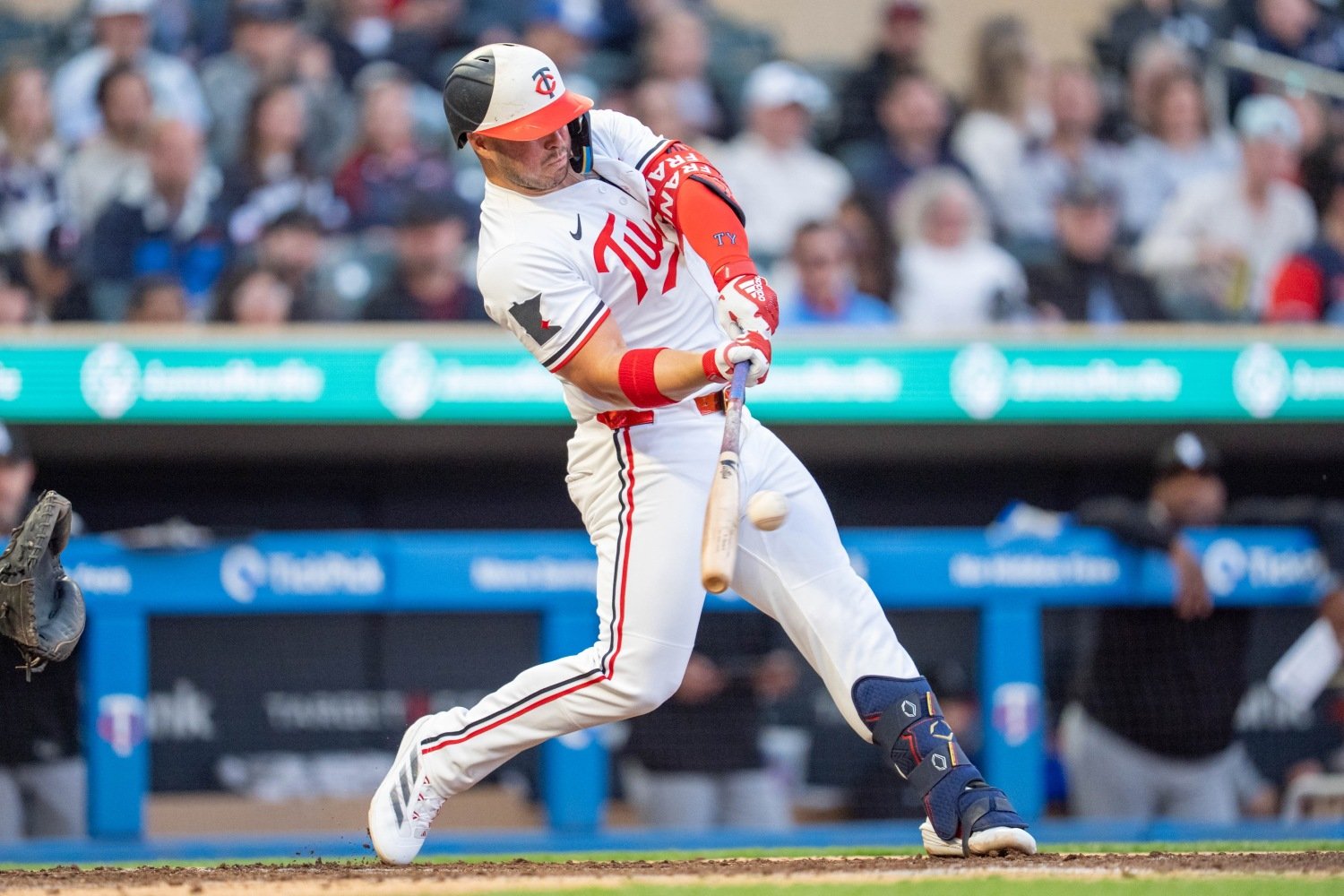
If he wants it (or, perhaps, if he simply doesn't get as filthy-rich as this game still has a chance to make him), Ty France has a future in sales. He's got the flair for it. When the topic of his new torpedo bat is broached, he immediately effuses—and mostly, what he wants to tell you is that there's nothing to tell.
"Yeah, I used it last night for the first time. Feels just like my other bat," France said Thursday morning, sounding much more excited than one normally would about something not feeling remotely different. But as he's quick to demonstrate, there's a reason for his excitement.
"Actually, here, I'll do a test with you," he said. "Close your eyes."
In turns, France handed me two of his 'gamers'—one an original model, with the traditional barrel, and one with the torpedo shape that moves slightly more of the batweight toward the handle and narrows the end of the shaft. He encouraged me to take a batter's stance, move each around a bit, and feel their balance. Then he asked me to identify which was which.
I failed—which is the expected result, for a person a bit older than France but with perhaps 20 years less dirt between their cleats than he has. But the point, of course, is that even some pro hitters also feel no difference, as France himself doesn't.
"That's what we want. We don't want something that feels drastically different," he said, simply. He's excited about the possibility of adapting the new tool of the trade, because it won't change how he feels in the box but might change how much wood is behind the ball when he meets it, at times.
The magnitude of the help torpedo bats can provide has been vastly overstated, based on a fluky first series at Yankee Stadium between the Bronx Bombers and the Milwaukee Brewers and a broadcast segment that was just meant to inform—not to dramatize. There are also plenty of hitters who aren't good candidates for the change. France, however, is a superb one.
"For me, personally, more of my misses are closer to the handle, so it makes sense for me," France said. "But the biggest thing was making sure it felt like my original bat."
While a subtle shift in weight toward the hands can improve bat control and allow a hitter to either generate more swing speed or better manipulate a swing at the same clip, hitters themselves don't want to feel that. Rightfully, many of them worry that such a change could mess with their mechanics, leaving them in danger of whiffing on formerly friendly pitches or even hurting themselves. While they're less common than torn ligaments in pitching elbows, broken hamates haunt the nightmares of some hitters, because it can be so easy to do that on a swing that felt routine until the last moment—and the result can vary from just a few weeks' missed time to a few months', plus months more of not quite having your swing back.
France is among those who feel comfortable because they don't feel a major change in the swing weight, but he's also a good fit for the new technology because of where and how he tends to hit the ball. He mentioned that most of his misses are slightly toward the handle. One way we can view that (while we all anxiously await further bat-tracking data from Statcast, perhaps as soon as next month, that might give us more direct info on it) is by looking at a hitter's contact point. France is a guy who contacts the ball deep in his hitting zone—behind the front edge of home plate, quite often, and about 27 inches in front of his center of mass.

Compare that to, for instance, teammate Trevor Larnach, whose average contact point is a few inches in front of home plate and about 32 inches in front of his center of mass.

I placed the blue diagonal lines here to help you see how Larnach's bat is more likely to have come around fully and be square to the path of the incoming pitch, or wrapping slightly around it. That's why Larnach is the more dangerous of the two, in terms of pull power. It's why he struggles against offspeed stuff; he has to fight to stay back enough to meet the ball squarely.
France, meanwhile, is more likely to have his mishits happen deep in the hitting zone, which might mean that the bat isn't fully square to the incoming pitch yet. When that happens, the ball connects with the bat just a bit up the handle. We don't have to rely on hypotheticals to say this. Of 294 qualifying hitters, last year, France ranked 97th in the differential between his hard-hit balls and non-hard-hit balls, in terms of contact point. On the same list, Larnach was 182nd, where a lower ranking means your hard-hit balls have deeper contact points. In short, the lower you are on this list, the more likely that your mishits tend to come off the end of the bat. The higher you are, the more likely that your mishits come off the handle.
Thus, Larnach would be a very poor candidate for a torpedo bat. So would Royce Lewis, one of the hitters at the extreme end of the spectrum; his mishits nearly all come off the end of the bat. France, however, is a great fit for it. That doesn't mean he'll get red-hot and start hitting like the game's elite first basemen, once he gets the torpedo bat working. It does, however, mean he's right to feel that excitement, even if it's about the absence of a feeling of difference.







Recommended Comments
Create an account or sign in to comment
You need to be a member in order to leave a comment
Create an account
Sign up for a new account in our community. It's easy!
Register a new accountSign in
Already have an account? Sign in here.
Sign In Now