Jump to content
Twins Daily
  • Create Account
  • Twins News & Analysis

    Whiff Of Success: Gibson Making Bats Miss


    Nick Nelson
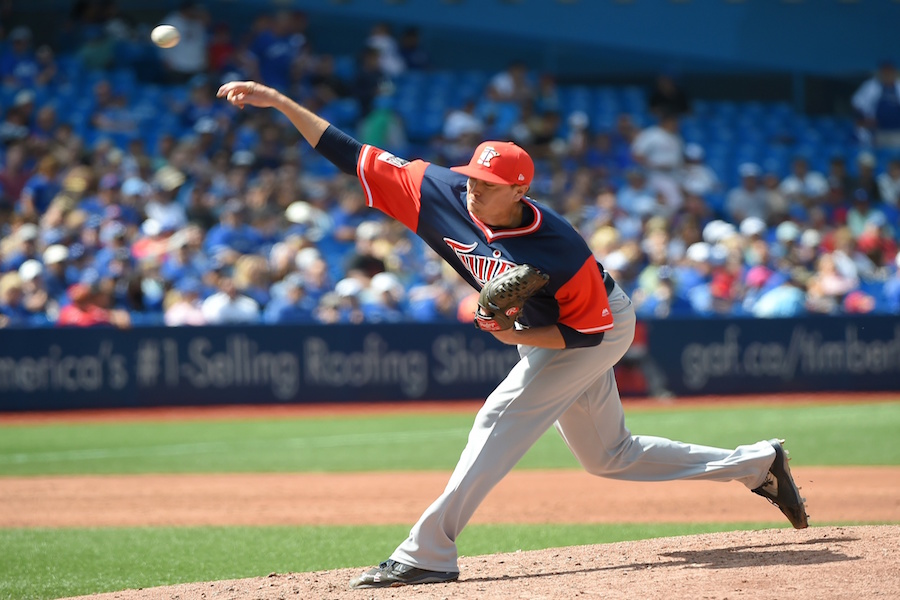
    Image courtesy of Dan Hamilton, USA Today

    Twins Video

    WHIFF.

    Ahh, that sweet onomatopoeia: the sound of a pitch whooshing past a bat untouched. Music to a hurler's ears.

    It's a song Kyle Gibson hasn't heard as often as one would hope, or expect. Until lately.

    In 2005, the Twins used their first-round pick to draft Matt Garza, a pitcher who has gone on to throw 1,700 major-league innings in an altogether successful career (albeit one spent mostly outside of Minnesota).

    Since then, the organization has used 10 first-round selections (including supplemental picks) on arms, with a woefully low hit rate. The list is a collection of washouts, disappointments and case studies in the perils of prospecting young pitchers – with two exceptions.

    Jose Berrios and Kyle Gibson. The former has entrenched himself as an ongoing rotation staple. The latter had seemingly erased himself from that conversation during the past two seasons.

    But now, when the team needs him most, Gibson is making a late case by – at long last – getting the most out of his stuff.

    I've always counted myself as a Gibson fan. I remember on draft day in 2009, when the Twins landed him with the 22nd overall pick, thinking what a steal he was. Following an outstanding career at the University of Missouri, he slid to the late first round due to concerns about a forearm issue, enabling Minnesota to snag a talent worthy of going in the Top 15. He was the prototype of a quality pitcher: tall and lanky, with a hard sinker that careened downhill from his big frame.

    He made the Twins look smart with a phenomenal first year in the pros, rising all the way to Triple-A in 2010. He was on track for a fast MLB debut before Tommy John surgery in 2011 stalled his momentum, but came back strong and joined the big-league ranks in 2013.

    Gibson followed the same progressive path that many young players do. He struggled mightily in his first exposure to the majors, then showed moderate improvement in Year 2, and finally seemed to come into his own the following season (Byron Buxton, anyone?).

    That third year – 2015 – signaled that the right-hander was putting together all the pieces: he ranked among the top 10 grounder rates in the majors, posted the best strikeout rate of his career, and averaged more than six innings over 32 starts.

    At age 28, he appeared poised to keep growing in 2016, but much like the team as a whole, it was Total System Failure for Gibson. All of his promising trends turned the wrong way as he struggled through a tumultuous campaign, finishing with a 5.07 ERA and 1.56 WHIP.

    Afterward, he acknowledged he'd been dealing with back and shoulder discomfort for much of the summer, even outside of his five-week trip to the disabled list. He battled through 25 starts, frequently relying on anti-inflammatory meds.

    Searching for answers, Gibson went through an offseason program that involved completely overhauling his routine and mechanics. As Star Tribune's Phil Miller put it, the revamp was "an entirely new way of delivering the baseball, about as fundamental a change as a pitcher can make."

    Sounds like something that could take a while to coalesce, but during spring training it looked as though Gibson's efforts were paying immediate dividends. In Grapefruit League play, he was as good as ever, dominating opposing lineups while flashing electric stuff and, by his account, feeling great.

    Once the season started, however, things went totally off the rails for Gibson. He didn't record a quality start for the Twins until June 8th, spending much of May in Triple-A. By late July, when he and his 6.08 ERA were sent back to Rochester in order to make room for newly acquired Jaime Garcia, it appeared Gibson had essentially played his way out of the team's plans.

    But in August, the embattled starter came back with a vengeance. With an excellent outing in Toronto on Sunday, Gibson wrapped up the best month he's had in a long time. Suddenly, he had resolved the issues that plagued him for the better part of two years. He was throwing in the zone (seven walks in five starts). He was keeping the ball down (only three homers).

    And most notably, Gibson was finally missing bats. His 12.8% swinging strike rate towered over his career norm, and is in line with the season rates for top-tier strikeout artists like Stephen Strasburg and Zack Greinke.

    In his August 22nd start against the White Sox, when he tossed seven innings of one-run ball, Gibson induced 17 swings and misses. Only two Twins have produced more whiffs in a start this year: Ervin Santana (26 in a complete game win against the Padres on 8/2) and Berrios (19 in his 11 K game against Colorado).

    With his hard sinker and sharp slider, Gibson always seemed like a guy who should get more hitters to miss. This month, it's been happening in fairly consistent fashion, and the results are beginning to reflect a pitcher with renewed confidence and legit comfort on the mound.

    Is it possible his alterations and adjustments just took a few months to fully reach fruition? It is still too early to draw such conclusions, but lately Gibson is truly looking as good as he has in years. And he's doing it at a time where the Twins, in the thick of the postseason race, desperately need it.

    Whiffs, grounders and wins. Music to their ears.

    Want more Twins in your Google results? Add us as a preferred source.

    Follow Twins Daily For Minnesota Twins News & Analysis

    Recent Twins Articles

    Recent Twins Videos

    Twins Top Prospects

    Yasser Mercedes

    Cedar Rapids Kernels - A+, OF
    On Thursday in the Fall League, Mercedes went 2-for-4 with his first double and his first homer run of the AFL season.

    User Feedback

    Recommended Comments


    Featured Comments


    50 pitches in 3 innings. He has a 9-0 lead and he may not get past 6.

    At least it isn't likely that the "A Team" relievers will need to work tonight.

    and 74 pitches to get through 6. could have easily gone 7+. Retired the last 10 in a row.  your point was?


    50 pitches in 3 innings. He has a 9-0 lead and he may not get past 6.

    At least it isn't likely that the "A Team" relievers will need to work tonight.

    So he ended up with 74 in 6 with no runs.

    I am not arguing Gibson is something more than he is, I am just saying since his May 28th start he has been a fairly reliable number 4 or 5 starter and has lowered his ERA almost 3 runs. Yes those first 7 starts count and he was terrible in those. But since then he has been giving the team a chance to win, hence the 12 - 7 record in his start. (and yes I realize when your teams scores 20, 17, and 16 runs that helps)


    Another difference is that Vargas isn't among the worst hitters in Twins history. Prior to the last 4 starts, I believe Gibson was the worst pitcher in Twins history with over 400 IP.

    Berrios had the worst rookie debut of any starting pitcher in the history of the franchise.


    I get the sense that Gibson could pitch a perfect game against Cleveland, perform the Heimlich maneuver on Chief after the game when he chokes on the after game chicken winnah drumstick, and donate half his 2017 salary towards covering adoption fees around the country so that there is space in shelters for displaced dogs from Harvey and Irma (something Max Scherzer and his wife Erica did in DC)....and your response would be, "Meh, Cleveland's due for a clunker, what about the kittens, and only half?"


    Gibson has an ERA of 4.97. Last year he had an ERA of 5.07. Out of 87 starters with 250+ IP in the past 2 years, Gibson ranks 77 out of 87 in ERA-. I just do not understand what more he can possibly do to prove that he isn't good. I guess he would need to be 87 out of 87, but maybe even that wouldn't matter to some on here.

    Is it too much to believe that Gibson made some adjustments that improved his game? He's had dramatically different results in each half.


    k/9    bb/9    hr/9   FIP    xFIP     gb/fb   iffb%    soft%     hard%

    5.64  4.20    1.77   5.93   5.05    1.88      2.6      13.7        38.6

    7.50   2.25    0.45  3.03   3.58     2.30     12.5     17.2       30.6


    FWIW, he's the 15th most valuable starter in the second half according to Fangraphs.


    Pitchers frequently have significant splits within a particular year. He's faced weaker opposition, for one thing . . . random variation with respect to balls in play is another likely factor. 


    If he was blown out every single start he wouldn't still be in the rotation - even a well below-average MLB starter can string together some solid performances. That's nothing new, it happens all the time. 


    If you want to look at his performance by half-season, OK, since the beginning of 2015 he will have 6 half seasons, and he was bad in 4 out of the 6. 


    So for any given half-season, there's a 1/3 chance he will be pretty good and a 2/3 chance he will be bad. Maybe that's a good ratio to you, in which case we just have an honest disagreement over SP expectations.


    Gibson has an ERA of 4.97. Last year he had an ERA of 5.07. Out of 87 starters with 250+ IP in the past 2 years, Gibson ranks 77 out of 87 in ERA-. I just do not understand what more he can possibly do to prove that he isn't good. I guess he would need to be 87 out of 87, but maybe even that wouldn't matter to some on here.


    77th best pitcher in mlb doesn't strike me as a *bad* thing.


    I don't think he is especially good, but it is not always easy to replace that many starts. Especially not in this free agent market.


    Pitchers frequently have significant splits within a particular year. He's faced weaker opposition, for one thing . . . random variation with respect to balls in play is another likely factor. 


    If he was blown out every single start he wouldn't still be in the rotation - even a well below-average MLB starter can string together some solid performances. That's nothing new, it happens all the time. 


    If you want to look at his performance by half-season, OK, since the beginning of 2015 he will have 6 half seasons, and he was bad in 4 out of the 6. 


    So for any given half-season, there's a 1/3 chance he will be pretty good and a 2/3 chance he will be bad. Maybe that's a good ratio to you, in which case we just have an honest disagreement over SP expectations.


    Don't disagree with you in principle, but we need to look at stabilization rates for particular statistics. For example, a pitcher's BIP doesn't really stabilize until about 2000 balls in play. That's why I included the range of statistics I did.


    For reference, Kyle faced 376 batters in the first half, 248 in the second half. I can't find splits for balls in play, but this year he's had a total of 461 balls in play.


    Stabilization rates are as follows:

    K rate: 70 batters faced

    BB rate: 170 BF

    GB rate: 70 balls in play

    FB rate: 70 balls in play


    So, while we'd expect to see streaks in ERA, wins, and even HR rate (1320 batters faced), a significant change in strikeouts, walks, ground balls and fly balls become predictive much more quickly.

    77th best pitcher in mlb doesn't strike me as a *bad* thing.


    I don't think he is especially good, but it is not always easy to replace that many starts. Especially not in this free agent market.

    It's not 77th best in baseball though.

    It's 77th out of only 87 that meet the qualifier.

    That's the bottom 11%.


    So he ended up with 74 in 6 with no runs.

    I am not arguing Gibson is something more than he is, I am just saying since his May 28th start he has been a fairly reliable number 4 or 5 starter and has lowered his ERA almost 3 runs. Yes those first 7 starts count and he was terrible in those. But since then he has been giving the team a chance to win, hence the 12 - 7 record in his start. (and yes I realize when your teams scores 20, 17, and 16 runs that helps)


    I just don't see the line of improvement at that point.  Some, sure.  He went from historically bad to merely bad from June through the first couple weeks of August.  This is Gibson's combined line (if I did the math correctly) from June 1 through August 17:  72 IP, 87 H, 45 ER, 11 HR, 29 BB, 50 K.  ERA=5.63, WHIP=1.61


    I'm sorry.  I still don't consider that acceptable from a number 4 or a number 5.  I'd certainly be looking to upgrade that if I was at all able to do so.


    Since then, yes, the results are undeniably good.  Fantastic, even.  But it still doesn't erase the previous 4 months or frankly his entire career.

    Edited by yarnivek1972


    Actually qualifying is a pretty significant achievement. It's quite telling that only 77 pitchers are on pace.

    87 would be about 3 per team.  Between injuries, skipping the worst starter a few times and shuffling pitchers from AAA to get better production from the bottom of the rotation, that seems about right.

    Actually qualifying is a pretty significant achievement. It's quite telling that only 77 pitchers are on pace.

    Kyle Gibson didn't qualify last year, and likely won't this year either.


    When I said qualifier, I meant drv's criteria of 250ip the last 2 years.


    I just don't see the line of improvement at that point.  Some, sure.  He went from historically bad to merely bad from June through the first couple weeks of August.  This is Gibson's combined line (if I did the math correctly) from June 1 through August 17:  72 IP, 87 H, 45 ER, 11 HR, 29 BB, 50 K.  ERA=5.63, WHIP=1.61


    I'm sorry.  I still don't consider that acceptable from a number 4 or a number 5.  I'd certainly be looking to upgrade that if I was at all able to do so.


    Since then, yes, the results are undeniably good.  Fantastic, even.  But it still doesn't erase the previous 4 months or frankly his entire career.


    well, when I filter by date on fangraphs splits........Gibson has a 3.96 ERA since June 1....which is 62nd in baseball of those with at least 50 innings pitched since then, so not sure where you get your numbers.


    edit: see below for my error!

    Edited by Mike Sixel


    Don't disagree with you in principle, but we need to look at stabilization rates for particular statistics. For example, a pitcher's BIP doesn't really stabilize until about 2000 balls in play. That's why I included the range of statistics I did.


    For reference, Kyle faced 376 batters in the first half, 248 in the second half. I can't find splits for balls in play, but this year he's had a total of 461 balls in play.


    Stabilization rates are as follows:

    K rate: 70 batters faced

    BB rate: 170 BF

    GB rate: 70 balls in play

    FB rate: 70 balls in play


    So, while we'd expect to see streaks in ERA, wins, and even HR rate (1320 batters faced), a significant change in strikeouts, walks, ground balls and fly balls become predictive much more quickly.


    You're using stabilization rate to draw conclusions that aren't supported by the underlying methodology. Stabilization rate generally refers to the point at which R = .5 for the stat in question, meaning that half of the subsequent results are explained by the current results.


    Taking your numbers: after 70 batters faced, a pitcher's K rate would be expected to explain 50% of his rate against the next set of 70 batters. 


    So while it's a useful concept to get a general profile of a player, it's predictive value is limited. You're also assuming that Gibson is no more inconsistent than the average player, which is not an assumption I would want to make. 


    His 2nd half stats look particularly good compared to the first half largely because, in the first half, he was batting practice. But compared to his career numbers, nothing he is doing now indicates some kind of real change.

    well, when I filter by date on fangraphs splits........Gibson has a 3.96 ERA since June 1....which is 62nd in baseball of those with at least 50 innings pitched since then, so not sure where you get your numbers.

    Yarn cited 6/1 through 8/17, not through current.


    The reason being, and I agree with him, is that people are trying to say that since his COMBINED numbers are good from June 1, that means he's turned it around from June 1 onward.

    In actuality, he was still pretty bad from June 1 to mid August, and THEN has been really good since.

    well, when I filter by date on fangraphs splits........Gibson has a 3.96 ERA since June 1....which is 62nd in baseball of those with at least 50 innings pitched since then, so not sure where you get your numbers.

    That's because your end date is the current date, not August 17.


    What I am saying is that his very good numbers since then skew the subpar numbers he had in the previous 2 1/2 months.


    It's the clearest definition of a SSS skewing a larger sample.

    Yarn cited 6/1 through 8/17, not through current.


    The reason being, and I agree with him, is that people are trying to say that since his COMBINED numbers are good from June 1, that means he's turned it around from June 1 onward.

    In actuality, he was still pretty bad from June 1 to mid August, and THEN has been really good since.

    Yes


    Yarn cited 6/1 through 8/17, not through current.

    The reason being, and I agree with him, is that people are trying to say that since his COMBINED numbers are good from June 1, that means he's turned it around from June 1 onward.
    In actuality, he was still pretty bad from June 1 to mid August, and THEN has been really good since.


    Ah, I missed that, sorry.....


    And, I have no skin in the game, other than I generally find that hot streaks are just that.....now, it's certainly possible Gibson made some change, but most stories we read about change are post hoc analysis and narrative, and suddenly disappear and no one writes about that.....

    and this isn't the first time the narrative has been written about how Gibson has changed and has now figured it all out.

    I think if there was an easy replacement for Gibson you would do it. But Twins will need to add at least one starter, possibly two, even if they keep Gibson. It is just not that easy to get good replacements, especially not at ~5mil for 1 year that he'll get. That is a contract worth tendering in my mind. I'm not especially interested in trading from a position player and creating a different hole.


    You're using stabilization rate to draw conclusions that aren't supported by the underlying methodology. Stabilization rate generally refers to the point at which R = .5 for the stat in question, meaning that half of the subsequent results are explained by the current results.


    Taking your numbers: after 70 batters faced, a pitcher's K rate would be expected to explain 50% of his rate against the next set of 70 batters. 


    So while it's a useful concept to get a general profile of a player, it's predictive value is limited. You're also assuming that Gibson is no more inconsistent than the average player, which is not an assumption I would want to make. 


    His 2nd half stats look particularly good compared to the first half largely because, in the first half, he was batting practice. But compared to his career numbers, nothing he is doing now indicates some kind of real change.


    I didn't know this until you posted it, so I had to look it up. According to This BP Article, stabilization rates are the point at which R > .70. So that's the point at which "the signal to noise crosses the halfway point." The farther you get beyond the stabilization point, the more it becomes an indicator of true talent level over that time frame.


    Yes, past results don't imply future success. And yes, this stretch was during a time where Gibson faced worse teams. But the stark difference in k rate, bb rate, gb rate and fb rate indicate to me that he changed something.


    Will he sustain it? Who knows. But those statistics are ones pitchers have more control over and ones that stabilize quickly. So I think he's actually been a better pitcher, not just one facing worse teams.


    I am not sure if there is a pitcher in baseball that won't look good if you start omitting enough results using some arbitrary split.

    Gibson's nice little run that he is having is why I disagreed those with pitchforks that were ready to cut him despite no viable replacement being on the MLB or AAA roster. There is some level of competence and he is showing that he can be successful against awful offenses but I don't really believe in any significant change from his previous 700+ innings of mediocrity. 

    This was posted elsewhere, but figures it should go here too, an article in Baseball Prospectus on Gibson's tweaks this year:


    http://www.baseballprospectus.com/article.php?articleid=32777&utm_content=buffer3430f&utm_medium=social&utm_source=twitter.com&utm_campaign=buffer


    I'll also note that in his September starts, Gibson has

    1. Followed a loss with a win

    2. Followed three losses and win (but 3-inning start) with a great start that resulted in a late-game win

    3. Followed two losses with a win.


    And 4. Pitches today after two losses.


    Part of this is simply being slotted behind the fifth spot in the rotation, but Gibson has come up in big situations for this playoff run, and come up big in those situations. Hopefully he can do it again today!

    Today may be the most important start (to date) of Gibson's career.

    And he laid an absolute egg. He has a lead right now and may even get a win. But this is the Gibson we have seen for the majority of his career. Not very good. Doesn't command his pitches well enough.


    Create an account or sign in to comment

    You need to be a member in order to leave a comment

    Create an account

    Sign up for a new account in our community. It's easy!

    Register a new account

    Sign in

    Already have an account? Sign in here.

    Sign In Now

×
×
  • Create New...