


Twins Video
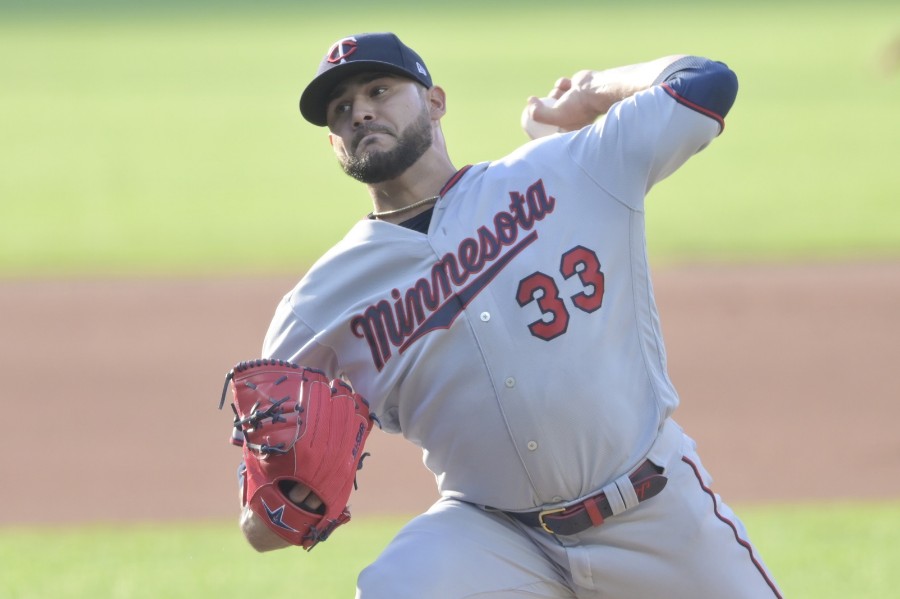
When examining the performance of individual players, it’s important that context is factored in. What was their 2018 season like? What developments has the organization catalyzed in helping to maximize their production? Martin Perez should be viewed with such a contextual lens. The Twins signed Perez for $3.5 million with a team option year for 2020 (which they should pick up if he maintains his current level of performance). To put that another way, contract-wise, Perez was a lottery ticket reclamation project, who the Twins impressively turned around. He’s already been worth around $13 million to them based on his 2019 fWAR.
Before we dig into Perez’s ups and downs, let’s set some historical precedent. Despite being a top prospect, it’s easy to overlook just how bad Perez has been throughout his career as a starting pitcher. In 2018, Perez put up a 6.22 ERA, his wOBA was .390 (bottom 1% of the league), xSLG was .471 (bottom 7% of the league) and his K% was 13% (bottom 1% of the league). Perez was, at best, a replacement level pitcher who gave up a ton of hard contact often. The addition of Perez’s cutter has completely transformed his outcomes as a pitcher. In 68.2 IP as a starter (he has 8.1 horrible innings in relief at the beginning of the season), he’s managed a 3.67 ERA, a .292 wOBA, and a K% of 22. Perez is in the top 5% of the league in Exit Velocity and Hard Hit%. To put it simply, he’s gone from giving up lots of hard contact, to less contact which is mostly soft.
Perez really started to put things together in May. From the end of April to the end of May, he racked up 37.2 IP in six starts and gave up just 7 ER. Mechanical similarities and same-handedness had Twins fans ready to anoint the second coming of Johan Santana, then June happened.
There’s been a ton of great work already published on Perez’s cutter. If you’re looking for a deeper dive on the pitch specifically, I’d suggest a great piece from Dan Hayes of the Athletic, or Twins Daily’s own Codie Christie, or a Baseball Prospectus piece from Aaron Gleeman. For me, pictures speak a thousand words, so I’ll just leave this beauty here (courtesy of Mike Petriello). One of the keys to Perez’s cutter has been his ability to locate the pitch, specifically down and in to right-handed hitters (more on that later).
https://twitter.com/mike_petriello/status/1121942309573144577
Perez has struggled more in recent outings, giving up 16 ER in his last 4 starts, so has he fallen off a cliff? What can we expect moving forward? Looking at Perez’s peripheral numbers is a good starting point when looking at small sample sizes, as they tell their own story.

Perez had one clunker at the end of May in which he gave up 6 ER in 2.2 IP. Outside of this start, his May and June have been similar process, with slightly different results. There are however, a couple of notable differences about Perez’s setup over the last month. Perez’s vertical release point has dropped slightly.. Additionally, his horizontal release point has shifted towards the first base side of the rubber. It’s natural for pitchers release points to vary significantly throughout the course of the season, but in Perez’s case, it’s been accompanied by less pinpoint command.


Perez is throwing a similar percentage of strikes from May to June. (63% in May VS 64% in June). What’s been significantly different between the two months is his LOB% (79% in May VS 44% in June - his career average is 68%).
The side by side pitch heat maps show the location of Perez’s cutter and fastball. The left hand image in each pair shows Perez’s incredible stretch from late April to late May, the right hand image shows late May to mid-June. What’s noticeable about each pair is the consistency of Perez’s command when he’s in a groove. Perez consistently buried his cutter down and in to right handed hitter in May and has struggled to find the plate with it with consistency in June. Perez’s fastball tells a similar story. In May, the clustering is middle-in to right handed hitters. In June, his consistency is gone and he is leaving more fastballs middle up and inside to left-handed hitters. It’s not certain that Perez’s move across the rubber and a drop in his vertical release are causing these less consistent offerings, but his consistency in managing the plate has diminished significantly in his last 5-6 starts.


It’s time we view Perez for what he is. He’s not consistently going to be the pitcher who threw eight shutout innings against the Astros on May 1st. Conversely, he’s not going to be the pitcher who gave up six earned in 2.2 IP against Tampa Bay on May 30th. In Perez, the Twins have created a viable mid-rotation starter whose performance has already paid for his 2019 salary four times over. If Perez continues his level of performance throughout the 2019 season, he’s a no-brainer to return to the Twins in 2020 and to a rotation with very little certainty surrounding it.





Recommended Comments
Create an account or sign in to comment
You need to be a member in order to leave a comment
Create an account
Sign up for a new account in our community. It's easy!
Register a new accountSign in
Already have an account? Sign in here.
Sign In Now