


Twins Video
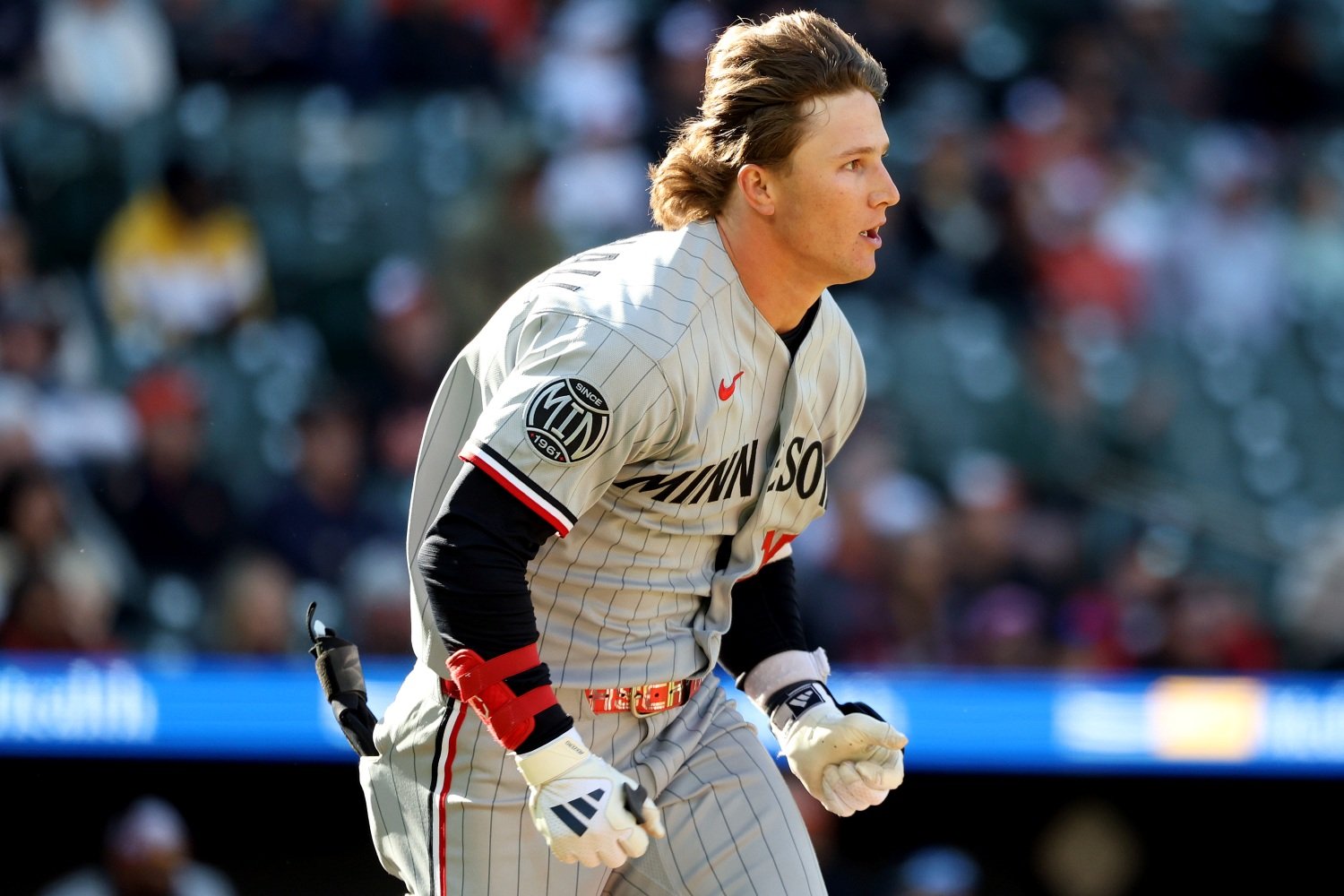
Power is not going to be the calling card for Luke Keaschall, no matter what. However, it doesn't look like defense will be, either, so the speedy and contact-savvy Twins second baseman might have to tap into a bit more pop in order to be as dynamic a player as the team needs him to be. Unfortunately, last season, he showed some of the lowest bat speed in baseball—which puts a frighteningly low ceiling on a player's power production.
In his brief active stint (207 plate appearances, before and between a broken forearm and a thumb issue), Keaschall still slugged .529 on contact (SLGCON); the median hitter only had a .548 SLGCON last year. Some of that was good batted-ball luck, though, and some came from Keaschall's speed, as he had more than one hustle double. Though the hustle double is arguably the game's most delightful play, it's also one good defensive positioning often takes away—especially once the book on a given hitter gets out.
Thus, coming into this season, the dearest hope for Keaschall boosters was that we would see an uptick in bat speed. That was certainly a reasonable thing for which to hope, too. Last spring, he was still technically recovering from Tommy John surgery he'd undergone in August 2024. He then broke his forearm when he was hit by a pitch, so even the longer stretch he got in the majors in August and September was marred (and his bat speed perhaps diminished) by a lingering issue in a body part essential to the swing.
We only have one three-game series of data so far, but it looks like Keaschall has, indeed, found more bat speed this spring. He hasn't materially changed his stance, his bat path or his contact point, but he's swinging much faster. His average bat speed was just 66.9 MPH last year; it's up to 70.2 so far. Just as importantly, he's showing the ability to swing at a very high speed (north of, say, 74, MPH) that was missing last year. He only had 14 such swings in the big leagues in 2025; he had three this weekend in Baltimore.
Now, not all swing speeds are created equal. A hitter can sometimes generate a whole lot of extra bat speed, but get no value from it, simply by cutting it loose for its own sake and disregarding making contact. We've all seen players swing from their heels and look theoretically dangerous, but not come especially near the baseball. In fact, Keaschall did do that once this weekend.
That was the first pitch he saw all season, and he seemed to think, "Wouldn't it be cool if I homered on the first pitch I saw?" It would have been, but he didn't come anywhere near doing it, and he exercised greater restraint the rest of the series.
Still, he's also demonstrating higher functional bat speed, if you will. Consider his at-bat against Orioles closer Ryan Helsley Sunday afternoon. Keaschall was leading off the top of the ninth in a two-run game, so the goal was to get on base. With Helsley's intense stuff, though, that's no easy project—and no job for the weak or the meek.
Keaschall took the first two pitches, to get ahead 2-0. Then, with Helelsy taking a bit off (the pitch was only 97 MPH), he fouled off the next offering. Here's what that looked like.
That swing was 74.9 MPH. Now, it also led to a foul ball to the right side, because Keaschall was late, so perhaps you're wondering why the bat speed matters. Wasn't he still beaten on the pitch? Yes, but in a greater sense, no.
Raw bat speed is not how you hit high-velocity pitching. It matters, but (as the Statcast measurements confirm), the other guy can throw the little sphere in his hand faster than you can swing your big wooden club—especially because you have to react to him. Bat speed is often better applied in a situation like this, where a hitter anticipates a fastball, but doesn't want to start too early and end up chasing a pitch that wasn't really worth swinging at. Here, Keaschall wanted a heater, and geared up to hit one. But as the data and the result tell us, he wasn't getting antsy—not with nobody out and the tying run in the on-deck circle. It made much more sense to be patient unless he got a pitch right down the middle. He did, and he didn't do anything with it, but that doesn't make the swing a waste.
This is a good example of how we can learn to use swing speed as a process stat—meaning not only that it's one input in the slow buildup to the actual result of a pitch or plate appearance, but that it tells us something about what the hitter was trying to do. In this spot, for Keaschall to swing fast but be late on a pitch in the lower range of Helsley's fastball velocity range, what we can learn is that he was laser-focused on not chasing. If he'd done everything perfectly, he still would have squared this ball up and driven it on a line somewhere, but he wasn't going to get himself out or freely give Helsley an advantage on this pitch. If he'd been one small click earlier, timing-wise, he would have gotten a hit on this pitch. If Helsley had thrown him a slider, instead of a fastball, but it had still been an in-zone pitch, Keaschall would have hit it over the wall in left field.
That's the real benefit of bat speed, much of the time. It lets you start a hair later than you otherwise might, so if you guess wrong but see the ball well, you might be early in a good way. That's where a lot of extra-base hits come from. A hitter who makes a plan to take their 'A' swing on a pitch like this, or not to swing at all, is very unlikely to make the grievous mistake of (say) grounding out to shortstop on 2-0.
On the next pitch, Keaschall modulated his plan a bit, knowing Helsley was back in the count. Again, though, Keaschall hadn't helped him; Helsley had just made the right pitch and gotten a bit less behind. This swing was only 68.2 MPH, but it worked gorgeously.
The thing not to take away from this is that swing speed isn't important. It is. It's just a complex number, disguised as a simple one. Keaschall got what could have been a rally-sparking hit Sunday on a slow swing, but it was made possible by a faster swing on the pitch before. Seeing Keaschall late on the 2-0 pitch, Helsley humped it up to 98.4 and came in on him on the next one, and Keaschall did have to shorten up to get the barrel to it. He did so, though, and he's very good at doing so. The lesson pitcher and catcher took from the previous offering was that they could beat Keaschall with velocity, but they were wrong. Keaschall had known what to look for and how hard to swing on the previous pitch, and he knew what to look for and how hard to swing on this one. The answer changed in between, but Keaschall was moving with it.
Showing the ability to swing fast—especially early in counts or when ahead—is important. It forces pitchers to work differently to you. It gives you chances to unload on mistakes, even if power isn't the primary element of your game. Keaschall didn't really have that club in his bag last year, but in 2026, he looks more able to let it eat when the occasion calls for it. That will pay off, as long as he remains as adaptable and smart in the box as he's looked throughout his career to date.
Are you optimistic about the Twins right now?

Follow Twins Daily For Minnesota Twins News & Analysis



- arby58, DocBauer and thelanges5
-
 3
3



Recommended Comments
Create an account or sign in to comment
You need to be a member in order to leave a comment
Create an account
Sign up for a new account in our community. It's easy!
Register a new accountSign in
Already have an account? Sign in here.
Sign In Now