Jump to content
Twins Daily
  • Create Account
  • Twins News & Analysis

    Chasing An Ace


    Nick Nelson

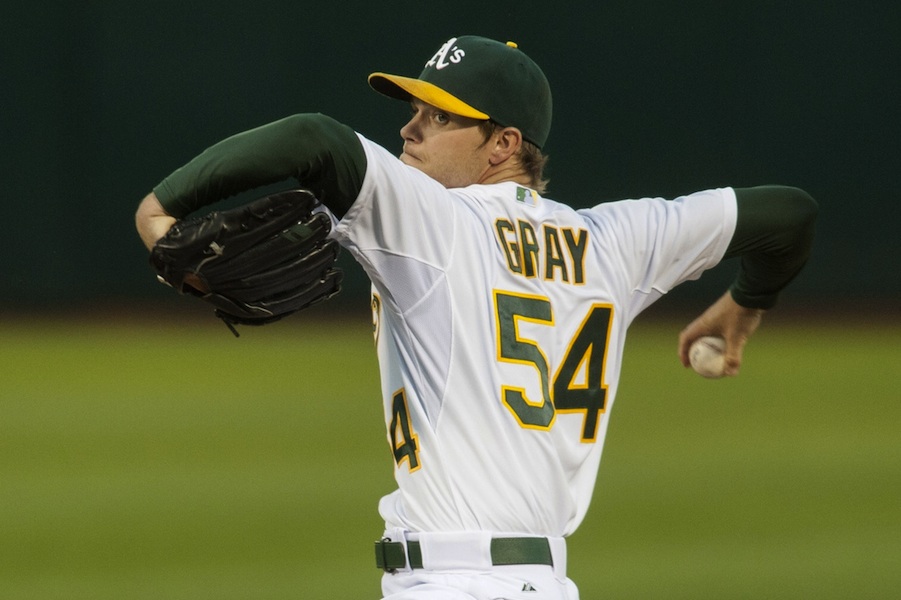
    Last week, on Twitter and in the Twins Daily forum, I posed a hypothetical question: If you were the Twins GM, and you had the chance to trade Jose Berrios and Max Kepler for Oakland's Sonny Gray, would you do it?

    The responses varied widely – everywhere from "Yes, in a split-second" to "Not in a million years." But the uncomfortable proposition of parting with both the organization's reigning minor-league pitcher and hitter of the year highlights a dreary and relevant reality: Acquiring an "ace" pitcher is really, really difficult.

    Image courtesy of Ed Szczepansk, USA Today

    Twins Video

    Outlook for the 2016 Rotation

    The Twins had plenty of solid depth in their starting corps this season, with five different starters making 15-plus starts and posting an ERA that was close to or slightly above average.

    What was lacking, however, was a true standout No. 1. Kyle Gibson earned that billing by default, as he led the way in innings and ERA, but his ERA ranked 48th among big-league starters and his K-rate ranked 60th. A match-up between Gibson and someone like David Price, Cole Hamels or Dallas Keuchel in a Game 1 postseason tilt would have been tragically lopsided.

    So as the Twins try to solidify themselves as true contenders this offseason, the search for that top-tier arm to lead the rotation is a primary consideration, and one that we cover extensively in the upcoming Offseason Handbook (now available for preorder!).

    Before we dig into the topic here, let's ask ourselves a question:

    Does An Ace Really Matter That Much?

    It seems inherently obvious. Many teams have ridden their horse to October glory, with last year's Giants and Madison Bumgarner serving as a prime example.

    But having that premier starter at the front of your rotation doesn't come close to guaranteeing anything. This year, we saw the Royals ship out some great young talent to acquire Johnny Cueto from the Reds at the deadline, only to watch the righty post a 5.27 ERA in 16 starts between the regular season and postseason.

    Cueto was pretty much the definition of an ace starter when Kansas City acquired him. He'd been Cincinnati's No. 1 for years, had pitched in big postseason games, and had the second-lowest ERA among all MLB starters since 2011, trailing only the inimitable Clayton Kershaw. Yet, as the Royals learned, and as the Twins have learned on a smaller scale with Ervin Santana and Ricky Nolasco, you don't always know what you're getting.

    Even when a top starter does pitch up to his ability, it's not some magical elixir that assures postseason success. The Twins went to the playoffs four times from 2002 through 2006, and the only time they won a series was when Johan Santana was NOT in the rotation.

    Paying The Price

    In any case, clearly, having a high-end starter fronting the rotation makes a team better, both in the regular season and playoffs. So what would it cost for the Twins to reel in an elite pitching talent?

    The top name on the free agent market is David Price, who could land a record-setting deal coming off a Cy Young caliber season in which he had an enormous impact for the Blue Jays following a deadline trade. It seems safe to assume that the Twins won't go north of $200 million on any contract.

    Next in line are names like Zack Greinke, Cueto and Jordan Zimmermann, but each is likely to ink a nine-figure contract. That's probably too steep. In fact, almost any lucrative long-term deal for a starter is difficult to fathom when the Twins have committed a total of $170 to Santana, Nolasco and Phil Hughes over the past two offseasons.

    Those big commitments to middling veterans are really limiting the Twins' flexibility to make a meaningful plunge into the pitching market. It'd be nice if they could take all those deals back and put that combined sum toward one elite arm, but alas.

    Outside of free agency, the avenue for acquiring a big-name starter would be a trade. As the Berrios/Kepler-for-Gray scenario illustrates, going this route would require a painful exodus of high-caliber young talent. Still, it might be worth it. Gray has established himself at a level Berrios can only hope to reach, and will be controlled at a reasonable price for many years. He's only one example, but he's certainly the type of player that Terry Ryan should be targeting if he's willing to pony up with some of his top prospects.

    Searching Within

    The alternative to all this, of course, is to stand pat and hope that someone emerges from within to provide the Twins with a legitimate No. 1 starter. I see three paths to this outcome that aren't completely unrealistic:

    1) Ervin Santana pitches like he did in September for most the season.

    When the Twins signed Santana to a franchise-record free agent deal last winter, they were hoping he could become that No. 1 guy for them. He certainly looked the part at times. In his first four starts and last seven starts, he combined to go 7-1 with a 1.97 ERA and 1.00 WHIP. That's ace type stuff, for sure. Of course, the problem was that in between those stretches he endured a miserable slump. That's always been the story for Santana: flashes of brilliance amidst consistent inconsistency. There's a reason he has only twice posted an ERA+ higher than 111. It's tough to believe he'll pull it together for a full year, especially as he ages into his mid-30s and surpasses 2,000 innings in career workload.

    2) Phil Hughes reverts to 2014 form.

    It gets overlooked a bit since the Twins lost 92 games, but Hughes really was an ace-caliber starter in his first season with Minnesota. He set an MLB record for K/BB ratio, his 2.65 FIP was sixth-best in baseball, and he was "quality" in 20 of his 32 starts. This year, Hughes' HR-rate spiked while his strikeouts plummeted, but decreased fastball velocity (attributable to back problems?) appeared to be the main culprit. He did maintain his elite control, proving that 2014 was no fluke in that regard, so if he can regain the zip on his heater and start missing more bats he has a chance to get back to that level. Hughes doesn't turn 30 until next June.

    3) Jose Berrios fulfills his promise.

    Since he lacks the prototypical frame of a front-end workhorse starter, Berrios' ability to develop into the pitcher that his spectacular minor-league numbers foretell has always been in question. Yet, the kid just continues to dominate older and more experienced competition at every stop. And he's the one pitcher in the mix for the Twins who, in terms of pure stuff, can match up to the top dogs on contending clubs.

    Personally, I think the chances of at least one of the three possibilities mentioned above coming to fruition are good enough that I'd forego taking the drastic steps necessary to acquire an established No. 1 starter externally.

    How about you?

    Follow Twins Daily For Minnesota Twins News & Analysis

    Recent Twins Articles

    Recent Twins Videos

    Twins Top Prospects

    Kendry Rojas

    St. Paul Saints - AAA, LHP
    Reports indicate that Kendry Rojas will be called up to the Twins on Tuesday. The 23-year-old has pitched twice for the Saints this year.

    User Feedback

    Recommended Comments


    Featured Comments


    Sano? teams would pay more like $75-100MM for him right now. Look at what they are paying international free agents.

    As for your point, it misses a point that people seem to ignore a lot. Only 25 guys are on a roster at a time. Only 8 SP pitch in many years. Only 1 at most infield positions in a year. IMO, it's not as simple as saying "you can't give up 2 WAR from these 5 people, for a guy that only gives you 5 WAR back", since those 5 might not be able to play at the same time (and might be replaceable themselves with 3 WAR guys). Generally, the analysis works, but specifically, not always.


    We are not comparing apples to apples here.  The 62M for an international free agent for example also pays the player for six years.  In my hypothetical, the team that pays 40-50M for Sano also has to pay him for the next 6-7 years to play there.  3 ARB years is going to be another 40-50M


    My broad point is that younger players have an inherent value because they make nothing.


    Edited by tobi0040

    Make your own ace is the ideal option since their cost is minimal and years are controlled. There's very little evidence of that happening during the TR era other than Johan. Berrios is the next best chance, who has zero MLB experience. I don't think he's going to come up to the MLB and have a 2006 Liriano campaign next season, or even in 2017. So how are the Twins supposed to take this next step to being a 90+ win baseball club next season? Or are we back to building for 2 years from now? 

    We are not comparing apples to apples here.  The 62M for an international free agent for example also pays the player for six years.  In my hypothetical, the team that pays 40-50M for Sano also has to pay him for the next 6-7 years to play there.  3 ARB years is going to be another 40-50M


    My broad point is that younger players have an inherent value because they make nothing.

    Very true on that point.


    I honestly think that Berrios is their "ace." Call it blind faith, but I think he'll pan out. I also think that the Twins need to pour their resources into building an elite bullpen. Easier said than done, but recent years have shown that that's how teams win in the playoffs. Get ahead after 5 or 6 and shut the door.

    I feel he is getting sold short here - the guy has gone out and dominated guys years older than him at every level, and stands at the threshold of the majors at the ripe old age of 21, same as a college junior draftee.


    Trading him at this point would be madness.


    I know people are concerned about his size, but the Royals have a lot of guys 6' or less that are pitching quite effectively: Volquez, Ventura, Cueto, Herrera.


    How's that ace making going over the last 30 years?


    Awful, they've drafted and developed two in the organization's entire run in Minnesota. It still needs to happen though.


    To be clear, I'm not against supplementing the homegrown talent with difference makers from the outside, in 1987 they brought back Blyleven and in 1991 they got Morris.  However the Twins already did this with this club with Nolasco, Hughes and Santana, unfortunately it doesn't look like it was enough.  Can't keep doubling down on these bad contracts, at some point they have to try a different approach.

    I would go after Gray IF he would sign a deal that buys out 1-2 years of FA and they are overwhelmed by quantity, i.e. no Sano, Buxton, or Berrios. 


    The odds of that happening are very slim with these pre-conditions.  


    Just thought I would note that Gray was the 65th rated prospect at his high point. Not to say that every guy in that range has the same first three years as Gray.  But at this point in his career Berrios was thought of higher.

    Edited by tobi0040


    Hmmm... Cards, Pirates, Cubs, Dodgers, Mets....  Royals, Jays, Yankees, Stros, and Rangers...

    The only teams without a true ace Cardinals and Yankees, had borderline aces and were eliminated at their first opportunity.  The Rangers and Jays were out of it before dealing for aces.  The Royals went and got Cueto who was fantastic in Game 5.  If you don't have an ace (or several) you had better have a lights out rotation top to bottom.  


    Arieta, Mets anyone, Price, and Cueto.  That seems to make a pretty solid case for needing an ace to both make the post season, and win in the post season.

    Are you arguing that Cueto was somehow instrumental in getting the Royals to the playoffs? He's been more of a negative than a positive since coming over.


    The Royals made it to the World Series last year without a real "ace." They'll probably do it this year with Cueto struggling. I don't think bringing them up as an example supports the point you're trying to make. 


    Are you arguing that Cueto was somehow instrumental in getting the Royals to the playoffs? He's been more of a negative than a positive since coming over.


    The Royals made it to the World Series last year without a real "ace." They'll probably do it this year with Cueto struggling. I don't think bringing them up as an example supports the point you're trying to make. 


    Also, the Blue Jays only had Price for 74 innings.  Other than that they had four guys with FIP's in the 4.20 to 4.40 range.

    No. I do not think the Twins should chase an "ace." 


    I certainly don't think the Twins should go out and sign a free agent. The Twins' track record on free agent signings is ugly. And they owe a ton of money to too many guys. If there is a lesson to be learned from the past couple of years, it's that the Twins are basically terrible when it comes to signing free agents to multi-year deals.


    And I don't like the Sonny Gray trade idea, either. I'm not above trading prospects. But I think there's enough potential in Berrios that he could be just as good as Gray soon enough. Or at least close.


    The Twins are always better when they develop aces from within. Santana and an improved Phil Hughes could both potentially fill that "ace" role if need be. But I think that "ace" factor is terribly overrated.


    The other element here is that the Twins suddenly have a surplus of starting pitchers to the point it's a problem. We've got Hughes and Santana who aren't going anywhere. Kyle Gibson has earned a spot. Tyler Duffy has earned a spot. Tommy Milone has earned a spot. And Trevor May was probably the best pitcher on the staff last year. That's six pitchers. And then there is Berrios and of course, Ricky Nolasco. By my math that's eight starters. Even if the Twins traded for an ace, they'd still need to deal with this surplus.


    That surplus alone means that May will stay in the bullpen next year. It also means Berrios will be in AAA unless the Twins trade someone like Tommy Milone or Kyle Gibson. Oh, and that's assuming the Twins trade Nolasco. And if they trade Berrios for an ace they would have to trade another pitcher because none of those guys are going to AAA.


    On the bright side, it does mean the Twins have the potential of a decent to good rotation next year, especially if Hughes improves and Santana pitches like he did late in the summer. Tyler Duffy should be able to improve. Maybe Berrios forces the issue and barges his way on the staff. Or one of the other guys steps up. 


    But it means no free agent starters. 


    I think the Twins will be good next year.  World Series good?  I don't think so.  In that case in a perfect world Phil Hughes reverts back to 2014 performance.  Then I would package him with a prospect of need for the other team and trade for young stud. 


    Phil is from Tampa and wouldn't mind playing there is my best guess.  So in the 2016 offseason assuming Phil is stellar in 2015 I would do a Phil Hughes, Gibson and Kepler for Chris Archer.  I doubt Tampa does that, but Tampa isn't afraid to trade and the Twins get to keep Berrios.


    Also, the Blue Jays only had Price for 74 innings.  Other than that they had four guys with FIP's in the 4.20 to 4.40 range.


    And Price is one of many "aces" you'll find out there with horrific post-season success.  


    People seem to forget we had one of the best pitchers in baseball for much of our last run and it guaranteed nothing.  I'd rather have one than not, but I'm not going to fall over myself in FA to get one if my dollar could go farther on, say, Chris Davis or Matt Wieters.


    Is there really a correlation between pitcher height and effectiveness? I ask because it always seems to come up when projecting Berrios.

    I get that JO is like four feet tall in heels, but Johan wasn't real tall. And for every Randy Johnson there's a bunch of Mike Pelfreys.

    I'm not sure what the statistical correlation is, but scouts and analysts tend to feel that shorter pitchers can't get the same downward trajectory on their pitches, making them more susceptible to fly balls and especially home runs. Intuitively it makes sense and we've certainly seen it play out for many diminutive hurlers.


    We just haven't seen that with Berrios, at all. He's not a ground ball guy necessarily but he keeps the ball in the yard. He's given up only 25 homers in 440 innings, including just 12 last year in 27 starts as a 21-year-old in AA and AAA. 


    I'm not sure what the statistical correlation is, but scouts and analysts tend to feel that shorter pitchers can't get the same downward trajectory on their pitches, making them more susceptible to fly balls and especially home runs. Intuitively it makes sense and we've certainly seen it play out for many diminutive hurlers.


    We just haven't seen that with Berrios, at all. He's not a ground ball guy necessarily but he keeps the ball in the yard. He's given up only 25 homers in 440 innings, including just 12 last year in 27 starts as a 21-year-old in AA and AAA. 


    Law was the biggest proponent of this.  He was very low on Berrios but has seemed to reverse course this year.


    Posters threw out Pedro a lot, but he would always fire back and say that you can't comp every guy under 6 feet to one of the most dominant guys ever


    Edited by tobi0040

    Not sure if it is a self fulfilling prophecy or not, but there just aren't many shorter pitchers that are great. We can always name exceptions to the rule, but that doesn't prove much. Maybe just more elite athletes are taller to begin with? Who knows, but I think there is some selection bias here....

    2/3 of the Royals 3-headed monster is under 6.' Ventura is 6' exactly. Pedro, Johan, Oswalt, Hudson, plenty of pitchers in that 6' range who did fine. Stuff's all that matters IMO and Berrios has stuff.

    Edited by Willihammer

    A team doesn't strictly "need" an ace to win the WS but it sure doesn't hurt and personally as a fan its fun to watch a stud pitcher take the ball and go 9 innings and dominate. We had a glimpse of that with Hughes last year but it has really been in short supply since the Santana days.


    I look at Toronto's Marcus Stroman as an example of what a dominating pitcher who lacks height can look like. He's a few inches shorter than Berrios and he's a beast.


    I also look at Rick Vaughn as a comparison. Dude is only 5'10" and threw 97 consistently...... Is that not the same??

    Please - the Twins will not step up to the true aces on the market and lets not encourage Terry Ryan to go out and sign another lower cost vet - we have Nolasco, Hughes, Santana clogging the system now.  Bring up Berrios, work with Duffey, Gibson, Berrios and make a trade with the others.  Get young, not mediocre.

    I also think the "downward plane" need is overblown. 


    If it was so devastatingly important, would anyone throw from the pretty standard 3/4 delivery?  Heck, what about a side-armer.

    Not to mention, what is the actual difference in "downward plane" between a guy 5'10" and a guy 6'10" from 60 ft away? Can't be much.

    Not to mention, what is the actual difference in "downward plane" between a guy 5'10" and a guy 6'10" from 60 ft away? Can't be much.

    Arms are probably shorter too......do either of you have evidence that the scouts who believe this are wrong?


    Remember, it is a rule, not a law. There will be exceptions to rules.


    Create an account or sign in to comment

    You need to be a member in order to leave a comment

    Create an account

    Sign up for a new account in our community. It's easy!

    Register a new account

    Sign in

    Already have an account? Sign in here.

    Sign In Now

×
×
  • Create New...