

Twins Video
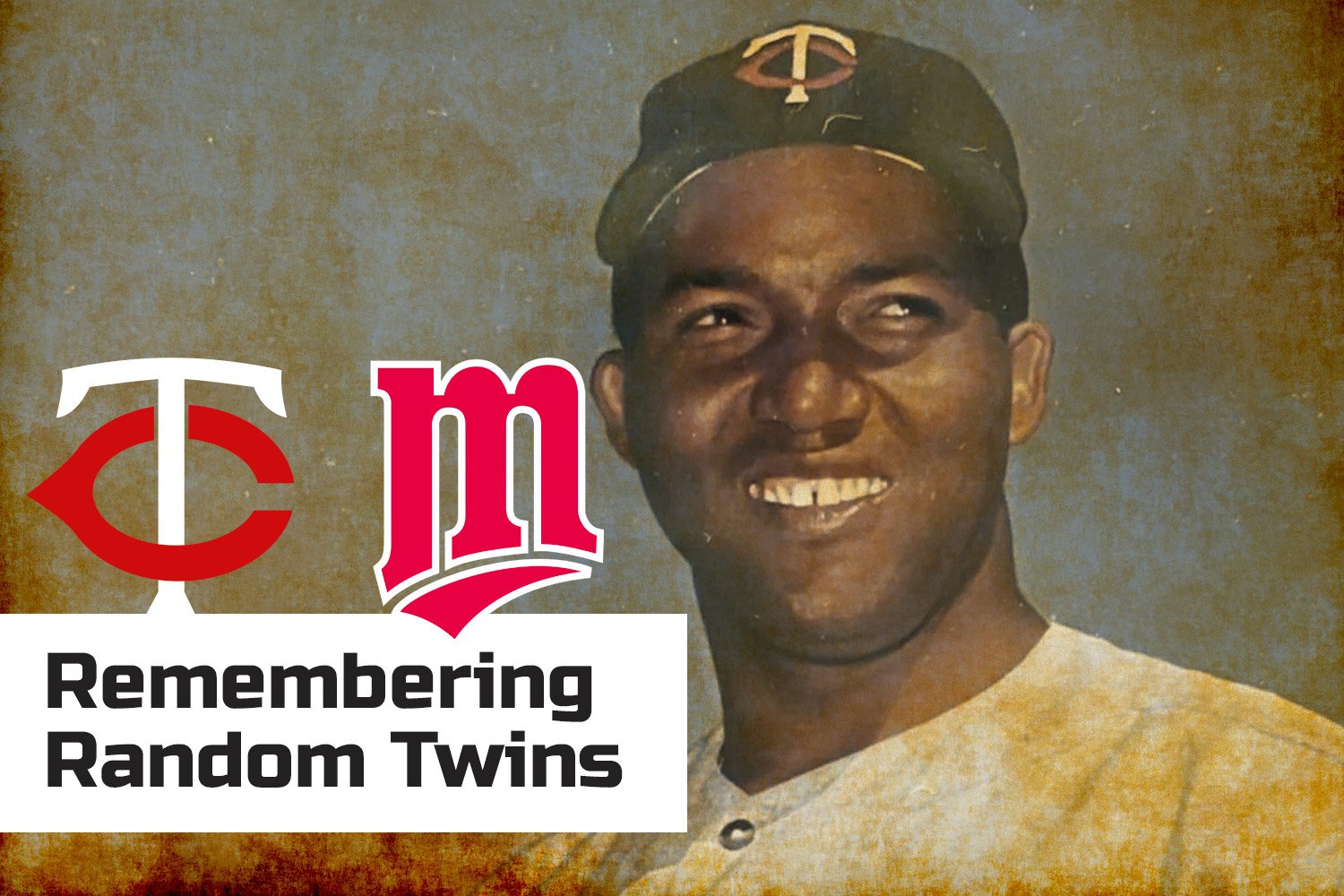
My Twins fandom/memory starts around 1980. Kent Hrbek would soon take the field and set a standard (at least for me) for what a solid defensive first basement should look like. Hrbek was followed by other excellent defenders at first, such as Gold Glove Award winners Doug Mientkiewicz and Carlos Santana, plus Joe Mauer and Justin Morneau. Further back in Twins history, I have heard or read that Rich Reese and Don Mincher were also exceptional fielders at first base. Still, Vic Power was the original, perhaps the premier, defensive first baseman in Minnesota Twins history.
Victor Felipe Pellot Pové (Power) was born November 1, 1927, in Arecibo, Puerto Rico. When Vic’s mother was in first grade, the teacher changed her last name to Pové, believing it was too hard for the apparently illiterate student to spell. The teacher changed the “v” to a “w” and added an “r,” so Pové became Power. Young Vic loved to play baseball as a child, but his father was against it and would punish the youngster for playing. Vic’s father passed when Vic was just 13; it was a heartbreaking way to allow young Power to play ball. Power graduated high school and was soon playing ball in the Puerto Rican league and, soon after, on to the independent Provincial League in Drummondville, Quebec, Canada. At this time, Power was still using his father’s name, Pellot, but to francophones in Quebec, it was mistaken for or sounded like a sexual term. To silence the giggling in the crowd, Victor changed his name to his mother’s modified name of Power, and that would be how he was known throughout his North American baseball career. He would retain and use Pellot when playing winter ball in his native Puerto Rico or other Latin American countries.
A New York Yankees scout had seen Power play in Puerto Rico and checked on him again in Drummondville. In 1949, the Yankees signed the six-foot, 186-pound Power. The right-handed hitting and fielding Power rose through the Yankees farm system quickly. During this time, a funny tale occurred. Power, seeking a table at a Syracuse, NY, restaurant, was purportedly told, “I'm sorry, we don't serve colored people here." Power was said to have replied, "That's OK, I don't eat colored people. I just want rice and beans.”
While Power was in the minor leagues, Moose Skowron was a first baseman in the Yankees minor leagues and would be their first baseman of the future. Power played many positions in the infield and outfield to make himself more versatile and more likely to be promoted. The Yankees were under pressure to add a Black player as baseball had been integrated in 1947. However, Vic Power would not be the first Black player for the Yankees. He was soon traded to the Philadelphia Athletics. One reason New York traded him was that he dated white women. Despite the outside pressure, I guess Yankee management wasn’t ready for a Black player.
But for Power, the trade to Philadelphia was his opportunity. He debuted on April 13, 1954, and was one of the first Puerto Ricans in Major League Baseball. (I found one source putting him as the second player from Puerto Rico; another claimed he was the sixth.) That first season, he played all over the diamond, got into 127 games, and had 462 at-bats. His offense was limited, but he showed promise. When the Athletics moved to Kansas City in 1955, Power’s bat got going. In 1955 and 1956, Power played in his first two All-Star Games, and he garnered MVP votes. He earned four straight Gold Glove Awards from 1958-1961 with KC and Cleveland. Before the 1962 season, the Twins acquired Power by trade from Cleveland along with Dick Stigman for Pedro Ramos.
Power would play for the Twins in 1962, 1963, and part of 1964. He won three more Gold Gloves in those seasons, making it seven years in a row. His defense was called brilliant, flashy, and flamboyant. Legendary Hall of Fame manager Casey Stengel said Power was the best right-handed first baseman he ever saw. Power often caught the ball one-handed, considered showboating in those days but is standard in today’s game. Power would play extremely deep at first base and tell teammates to throw the ball to first, even if he wasn’t there yet. This led to some apprehension on the part of the throwers, but they eventually learned Power would get there.
During the Twins portion of Power’s career, the defense was still there, but the bat was less than ideal. With the Twins, Power hit .278/.305/.398. His OBP was never good; he rarely walked. His career walk rate was 4.3 percent, roughly half the MLB average of 8.7. Vic’s OPS+ in his time with Minnesota was a substandard 89.
In 1962 and 1963, the Twins had a young Cuban who was coming. It was apparent that they would need to make room for Tony Oliva. Thus, in early 1964, fan-favorite Power was traded with Lenny Green to the Angels in a three-team trade, which included Cleveland. The Twins received Jerry Kindall and Frank Kostro. Moving Power allowed the Twins to shift Harmon Killebrew from the outfield to first base, opening an outfield spot for Oliva. It’s hard to argue with this logic. Tony Oliva would go on to a Hall of Fame career, and Power was out of baseball after 1965.
In his 12-season major league career, Vic Power played for five teams. He appeared in six All-Star Games. He hit .284/.315/.411 with 126 home runs and 658 runs batted in. He led the American League with 10 triples in 1957. His career OPS+ was 97, and he achieved a WAR of 15.2. Most notably, he won seven Gold Glove Awards, with the first coming in 1958, the fifth season of his career and the second season of the award. Would he have won additional Gold Gloves had the award existed prior to 1957? We’ll never know. Regardless, his seven awards are the fourth most by a first baseman in the history of the Gold Glove Award.
Power remained engaged in baseball after his playing career. He managed the Puerto Rican national team to a Silver Medal in the 1973 FIBA Amateur World Series. He scouted for the California Angels in Puerto Rico. According to Wikipedia, “During the summers, he helped youngsters develop their baseball skills in Puerto Rico and San Pedro de Macorís in the Dominican Republic. According to historian Bill James, [Power] was probably a main reason San Pedro de Macorís became ‘the world's richest source of baseball talent’”. Vic Power passed away on November 29, 2005, in Puerto Rico from cancer.
Vic Power came to the US to play baseball when it was rare for a Puerto Rican to do so. He had a long, notable career and was especially memorable for his glove work. As a fan of flashy defense, I wish I could have seen him play.
Did you see Vic Power play? How good was his defense? Please share any memories or thoughts in the comments below.
If you like looking back at the Twins past, check out my previous articles at Twins Daily History.
Sources include Baseball Reference, Twenty-Five Seasons by Dave Mona and Dave Jarzyna, Cool of the Evening by Jim Thielman, Society for American Baseball Research, and Wikipedia.
Do you approve of the job Derek Shelton is doing as Twins manager?

Are you interested in Twins history? Then check out the Minnesota Twins Players Project, a community-driven project to discover and collect great information on every player to wear a Twins uniform!
View The Players ProjectFollow Twins Daily For Minnesota Twins News & Analysis



- nclahammer and C_frommn
-
 1
1
-
 1
1


Recommended Comments
Create an account or sign in to comment
You need to be a member in order to leave a comment
Create an account
Sign up for a new account in our community. It's easy!
Register a new accountSign in
Already have an account? Sign in here.
Sign In Now