


Twins Video
The Twins' 2022 draft class is quickly shaping up to be an exciting one. Brooks Lee is on the doorstep of MLB. Tanner Schobel had an exceptional first half for Cedar Rapids before struggling with the adjustment to Double A. One draft tendency that’s well established with the Sean Johnson-run Twins draft room is success in drafting unpolished pitching gems in the middle and late rounds, with the fruits of those labors finally impacting the big-league rotation in Bailey Ober and Louie Varland.
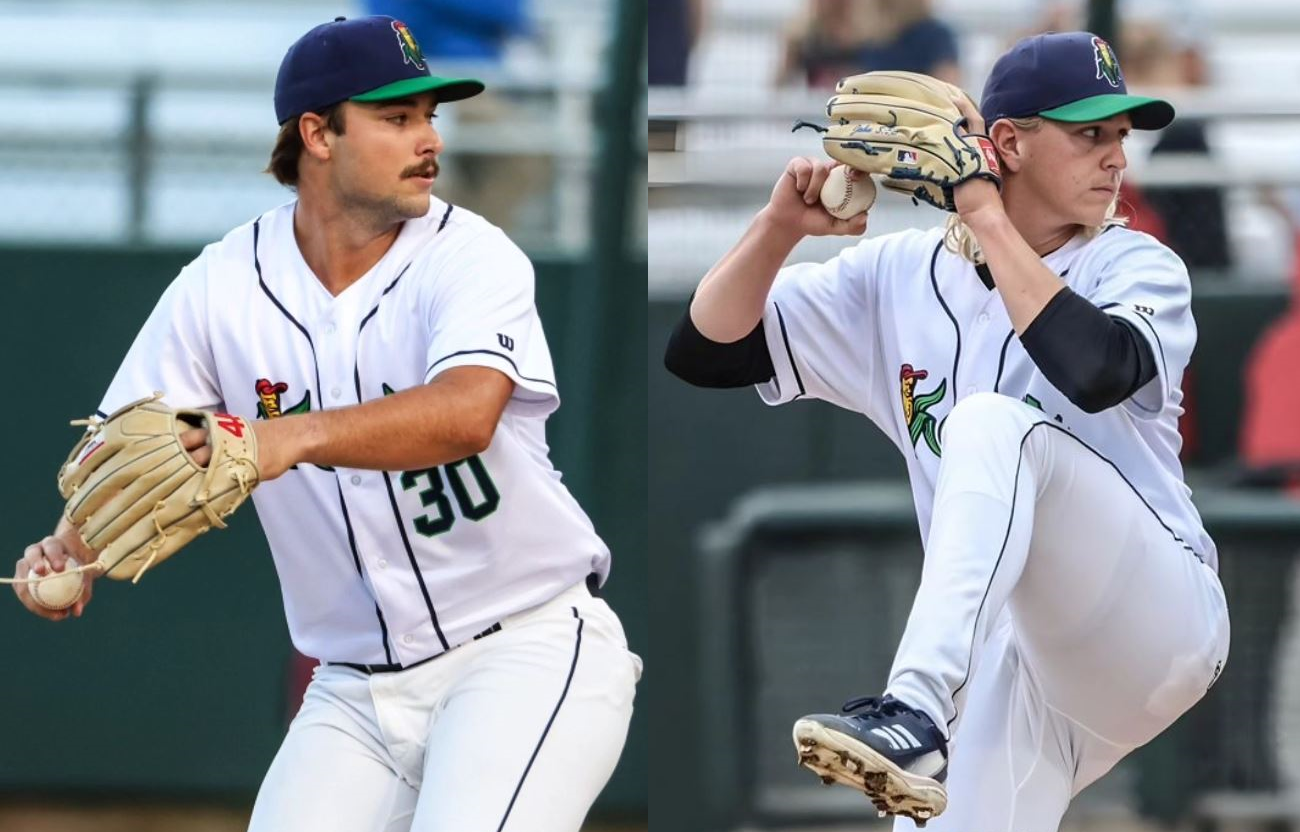
Cory Lewis, C.J. Culpepper, Andrew Morris, and Zebby Matthews are a cluster of starting pitching prospects who have moved from Fort Myers to Cedar Rapids, and who comprised the Kernels rotation for the majority of 2023. But, what makes them unique? I dug into some numbers to highlight some of the unique traits and skill sets that have drawn so much attention to this group.
Cory Lewis
Lewis was pre-famous when he was drafted by the Twins in the ninth round in 2023 out of UC Santa Barbara, as he boasted a knuckleball as part of his repertoire, and not merely as a gimmick. It’s worth highlighting a feature that makes Lewis’ knuckleball unique: velocity.
If, like me, you remember watching Tim Wakefield and R.A. Dickey pitch, they are likely a large part of your schema for what the pitch looks like. Wakefield’s velocity was typically in the high 60s and low 70s. Dickey threw a slower version in the low to mid 70s, and a fast version that reached 83 mph. Lewis routinely throws his knuckleball in the 82-84 mph range and cranked it as high as 87 mph in 2023! There’s an argument to be made that the latter figure might be too hard. The majority of pitches where Lewis achieved minimal spin on the pitch (the desired outcome to maximize variance), were in the 82-84 mph range.
The graphic below plots spin and tilt for all of Lewis’ offerings. The blue cluster in the center is his knuckleball, with a minimum spin of 120 rpm (compared to a typical fastball, around 2,150 rpm). But how effective was it? He threw 66 that we have tracking data for in 2023. He gave up two hits, and allowed a FIP of -2.14 on the pitch. Hitters are whiffing on the pitch, or hitting it into the ground.

For Lewis, his knuckleball and breaking or offspeed pitches are set up by a fastball with the characteristics to succeed. While Lewis's fastball velocity typically sits 90-92 mph, it can be a weapon. He gets good extension (max 6.71 feet in 2023; the MLB average is around 6.5 feet). Couple this with an induced vertical break that was as high as 24.8 inches (averaging 20.6 inches), and you have a pitch that can perform extremely well at the top of the strike zone. If Lewis can continue to refine his fastball command, it’ll help him mitigate the challenge of moving up to Double A in 2024.
C.J. Culpepper
C.J. Culpepper has risen in the estimation of evaluators, such that he’s joined the group of David Festa, Marco Raya, and Lewis as one of Minnesota’s best pitching prospects and should be considered a borderline top-10 prospect in the system. After strong performances as a reliever at California Baptist and an effective stint in the Cape Cod league, Culpepper went to the Twins in the 13th round. He threw 86 innings in 2023, posting a 2.87 FIP despite wearing down a little at the end of the season at Cedar Rapids.
What stands out about Culpepper is the scope of his pitch mix. He throws two fastballs: a traditional four-seamer with a 90th-percentile velocity of 96 mph; and a two-seamer with a 90th-percentile velocity of 95.8 mph with up to 19 inches of run (averaging 13.4 inches). Culpepper also throws a curveball, slider, changeup, and cutter. Both iterations of Culpepper’s fastball were effective in 2023. While his four-seamer doesn’t get a ton of chase, his two-seamer is a real worm killer, generating a 78% ground ball rate.
The graphic below plots Culpepper’s pitch mix by vertical and horizontal break. His arsenal allows him diversity of movement (both horizontal, and vertical) that keeps hitters off balance.

All of Culpepper's breaking and offspeed pitches showed promising results in 2023, with his slider being the most commonly thrown. In 2024, Culpepper will have to refine the command of his slider in particular, as its sweeping action makes it leak out of the strike zone too often. If his command of his newer offerings improves in 2024, he has the velocity and diversity of arsenal to be another in the line of Twins rotation contributors from the mid-late rounds of the draft.

What are your thoughts on the promising group of pitcher at Cedar Rapids? What are your expectations for 2024? Join the conversation with a comment below.
Research assistance provided by TruMedia
Which team do you dislike the most in the AL Central?
Check out our 2026 MLB Draft tracker, with scouting reports, player information, total pool allotments, and much more!
View The 2026 Draft Tracker






Recommended Comments
Create an account or sign in to comment
You need to be a member in order to leave a comment
Create an account
Sign up for a new account in our community. It's easy!
Register a new accountSign in
Already have an account? Sign in here.
Sign In Now