



jorgenswest
-
Posts
8,284 -
Joined
-
Last visited
-
Days Won
9
Content Type
Profiles
News
Minnesota Twins Videos
2026 Minnesota Twins Top Prospects Ranking
2022 Minnesota Twins Draft Picks
Minnesota Twins Free Agent & Trade Rumors, Notes, & Tidbits
Guides & Resources
2023 Minnesota Twins Draft Picks
The Minnesota Twins Players Project
2024 Minnesota Twins Draft Picks
2025 Minnesota Twins Draft Pick Tracker
2026 Minnesota Twins Draft Tracker: Picks & Bonuses
Forums
Blogs
Events
Store
Downloads
Gallery
Everything posted by jorgenswest
-
Article: Who Says No? Brian Dozier Edition
jorgenswest replied to Seth Stohs's topic in Twins Daily Front Page News
Walker is projected for a better season next year. Projections need to be based on 3-5 years and Walker has been consistently strong longer. His projection from steamer of 3.4 compared to 2.9 for Dozier is pretty close so the comp is a good one. I don't think any arbiter would accept the clearly inferior argument, but the number aspect makes sense. -
Article: Who Says No? Brian Dozier Edition
jorgenswest replied to Seth Stohs's topic in Twins Daily Front Page News
He is projected for a 2.9 WAR (steamer) next year which is between his last two seasons. If he were to continue to be a 3 WAR player through his arbitration seasons, what would he earn in arbitration? I am not sure, but I think the answer to yes or no can be found by studying that progression. The Twins say no unless they get a significant savings in the above deal compared to arbitration. If I am the Twins, I do say no to buying that first year of free agency at age 33. Instead, they still have the option of tendering. The 5/33 contract is much easier to trade. It is going to be difficult to trade a contract where half of its value is in the age 32-33 seasons. -
Article: The Case for Tony O
jorgenswest replied to Seth Stohs's topic in Twins Daily Front Page News
Both were signed at 22 and played in the minors from 22-24. Both played baseball prior to signing. Minoso played in Cuba and then for the New York Cubans in the Negro Leagues for parts of three seasons. Oliva played in the Cuban League, but had he been in Minoso's era he would certainly have joined him in the Negro Leagues. I don't see any difference or how the 250 at bats in the Negro League might distinguish Minoso over Oliva. http://sabr.org/bioproj/person/244de7d2 -
Article: The Case for Tony O
jorgenswest replied to Seth Stohs's topic in Twins Daily Front Page News
Kiner is another interesting comparison. His first 8 seasons combined for a 155 OPS+. That is Hall of Fame worthy. -
Article: The Case for Tony O
jorgenswest replied to Seth Stohs's topic in Twins Daily Front Page News
The are similar. Like Oliva, Minoso had a cup of coffee at age 23 and became a regular at 25. In his first 8 seasons, he nearly matches Oliva's OPS+ of 140 at 137. Minoso remained healthy and put up two more above average seasons for his position. I think they are very comparable candidates. Minoso has 2 extra seasons that Tony lost to health. Minoso was a LF so Tony has a defensive edge. They also compare similarly to Rusty Staub. -
Article: The Case for Tony O
jorgenswest replied to Seth Stohs's topic in Twins Daily Front Page News
Brian Dozier doesn't belong in the same conversation as Tony Oliva. Hundreds of players have had good late career starts. Most also have earlier declines. The conversation should be about where he fit in with his contemporaries. Looking at only his first 8 years which would shed the best possible light in his Hall if Fame hopes he stands 5th in OPS+ of 9 right fielders in that time span. 165 Frank Robinson 161 Henry Aaron 152 Roberto Clemente 143 Al Kaline 140 Tony Oliva 136 Rusty Staub 121 Tony Conigliaro 114 Johnny Callison 85 Jesus Alou For him, it depends on where the line is drawn. The 4 above all are clear Hall of Famers. They bested him at his best and had much longer careers. He played in an era of elite right fielders. When running the same search and using the previous 8 seasons no RF matches Tony. The best is Jose Bautista at 136. That is encouraging. Checking a few other stretches since Tony O and I find that Canseco, Tartabull, Strawberry, Singleton and Reggie Smith put up similar stretches. All that leaves me a little disappointed. He has been in my Hall of Fame since the first time I saw him at the Met. -
Allen has no ties to the organization. The only thing that could have set him apart is the Twins perception of his skill in coaching pitchers. Encouraging.
-
Rosario only has value at 2B and CF if he can play adequate defense at those spots. Simply playing him there doesn't give him value. When the Rafters lost Buxton, they didn't move Eddie to CF. He continued to play LF and DH for them. I hope the Twins would have been smart enough to keep him in CF early in his career if they felt he could be an average defender at the spot. Good CFs are more valuable than good 2Bs. I realize they had Span, Revere and Hunter in front of him and they had a major league need at 2B. They must have realized that Rookie Ball is a long way from the majors. Lots of things can happen to a position in between. You don't make that position shift based on a perceived major league need 4-5 years down the road. You make it based on assessment of the young player's skills. The assessment at the time appears correct. He probably didn't show the glove potential to be a regular CF. He would need a pretty good bat to be a regular LF. His bat could play at 2B. It was worth a shot in the A Ball. It didn't work out and now he needs to bring the bat to LF to be a regular.
-
I have wondered what "ready" means. No one can truly get ready to hit major league pitching by hitting minor league pitching. Struggle and adjustment are the norm for almost every player in their first few full years. Perhaps it means ready to take on the next challenge. In this sense, Arcia was ready to take on the next challenge as he came up. Rosario really needs to meet the challenge of AA or AAA first. The success in the AFL was a good start. Match that with similar performance over 50 games in AAA and he should be ready to struggle with the challenge major league pitching. I would give Buxton or Sano the same opportunity if they dominate the first few months in AAA or AAA next year.
- 38 replies
-
- 3
-

-
- eddie rosario
- mike radcliff
- (and 1 more)
-
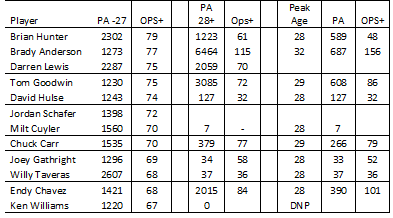
Jordan Schafer is at his 4th stop having moved from Atlanta to Houston to Atlanta prior to being claimed by Minnesota. He enters next season as a 28 year old with a significant 1398 plate appearances. Is there a chance that the once highly rated prospect can turn it around at age 28? Has it happened before?I used Baseball Reference's play index seeking an answer. I wanted a group of outfielders that had a similar number of plate appearances and performances through age 27. A group where Schafer sits somewhere near the middle according to career OPS+ and plate appearances. It turns out pretty rare for an outfielder to be given around 1400 plate appearances at Schafer's level of production. I had to go back to 1987 to find 11 comps. Several of the players listed above have characteristics in speed and ability that allowed them to play all three outfield spots. All had played for multiple teams. Their careers through age 27 were very similar to Schafer. What about after age 27 and their peak values? Brady Anderson!5 of the 11 had careers with at least 1000 more plate appearances.2 of the 11 performed better after age 27.I wondered if there was another Brady Anderson if I searched back further. I went back 50 years. We can add Boots Day, Tony Scott, Herm Winningham, Luis Melendez, Rick Bosetti, Marvell Wynne, Hector Cruz and George Wright. Not a Brady Anderson among them. It appears that almost all outfielders by age 28 and 1200+ plate appearances have established their skill level. What do the Twins do with Schafer? Should they tender him a contract and go to arbitration? Do they plan for him to be on the 25 roster next year, or do they look elsewhere? Click here to view the article
-
 I used Baseball Reference's play index seeking an answer. I wanted a group of outfielders that had a similar number of plate appearances and performances through age 27. A group where Schafer sits somewhere near the middle according to career OPS+ and plate appearances. It turns out pretty rare for an outfielder to be given around 1400 plate appearances at Schafer's level of production. I had to go back to 1987 to find 11 comps. Several of the players listed above have characteristics in speed and ability that allowed them to play all three outfield spots. All had played for multiple teams. Their careers through age 27 were very similar to Schafer. What about after age 27 and their peak values? Brady Anderson! 5 of the 11 had careers with at least 1000 more plate appearances. 2 of the 11 performed better after age 27. I wondered if there was another Brady Anderson if I searched back further. I went back 50 years. We can add Boots Day, Tony Scott, Herm Winningham, Luis Melendez, Rick Bosetti, Marvell Wynne, Hector Cruz and George Wright. Not a Brady Anderson among them. It appears that almost all outfielders by age 28 and 1200+ plate appearances have established their skill level. What do the Twins do with Schafer? Should they tender him a contract and go to arbitration? Do they plan for him to be on the 25 roster next year, or do they look elsewhere?
 -
Article: On Twins Pitching and Philosophy
jorgenswest replied to Parker Hageman's topic in Twins Daily Front Page News
If the Twins want to continue their focus on keeping the ball down in the strike zone, they might consider acquiring catchers skilled in getting low pitches in the strike zone called strikes. Martin is one of the best.- 34 replies
-
- 3
-
-
- rick anderson
- tom brunansky
- (and 1 more)
-
Alex Meyer was the better rated prospect by both MLB.com and Baseball America at the time the Twins acquired him. The Royals gave Duffy a combined 15 starts in AA and AAA before he hit the majors. Jake Odorizzi followed the same route as Ventura. Low A, Hi A/AA, AA/AAA/September call up. In mid June last year, Meyer had 14 starts for AAA. He had good numbers certainly comparable with Ventura in as many AAA starts. He had many more AA/AAA starts than Duffy. The Twins were looking for a replacement for Deduno. The Twins went with Yohan Pino. I think the Royals make a different decision.
-
Article: Who's The Next Phil Hughes?
jorgenswest replied to Nick Nelson's topic in Twins Daily Front Page News
May and Meyer need to get significant starts in the majors this year. The Twins need to start Nolasco and try to see if he can return to form. Gibson will take a step forward and Hughes is solid. Berrios needs to get starts at the end of the season. I wouldn't argue with signing or trading for an ace to front that group. Signing a question mark on a short term deal doesn't help long term and slows the development of May, Meyer and Berrios. At the end of this season, the Twins need to know whether they should count on May or Meyer. Anything short of 150 innings won't begin to answer that question. Did the Royals worry about performance in AAA and consistency when they put Ventura in the rotation this year? -
The Twins have been notoriously slow at moving pitchers through the system while they wait for consistency. I thought it might be interesting to see how some of other young pitchers moved through their systems. How about Yordano Ventura? Yordano Ventura and Alex Meyer both pitched in the Carolina League in 2012. Meyer started in low-A and arrived about the time Ventura was leaving. What was the Royals plan for Ventura? Did they wait for consistency? 2010- He started the year in the Dominican summer league. He pitched 52 innings in the Arizona rookie league mixing 6 starts in 14 games. What would the Twins do? Elizabethton or Low A? 2011- The Royals moved him to Low-A. This was Ventura's first full year in the United States. At 20 years old, he started 19 games and threw 84 innings for a 4.27 ERA. He averaged a little over 4 innings a start. He also was injured midseason. What would the Twins do? Would they begin him at the same level at 21 and hope that he found some success and confidence or would they move him up in spite of only 84 shaky innings and the injury? 2012- The Royals moved him up.He started the next year in high A. He started 16 games for Wilmington. On July 15 he moved up to AA. He pitched well in high A with a 3.30 ERA and lots of strikeouts and a good number of walks, but what about consistency? His start prior to the call up lasted 2.2 innings and he gave up 7 hits and 6 runs. His 5 starts prior consisted of outings of 1.2, 5, 7, 5 and 2.2. He was not the winning pitcher in any of those starts. In those 21 innings he did strike out 31 but he walked 9. What would the Twins do? Move him up? 2012 AA- The Royals moved him up. He was challenged. He struggled mightily in his first start at AA that summer (4 IP, 9H, 7R). Then he was injured and missed much of August. He returned at the end of August to start two more games. This must have shaken his confidence. How did he respond? 2013- He started in AA. He pitched really well in April and May. Through June 1, he had a 2.34 ERA and the only blemish was 20 walks in 57 innings. Was he consistent? His start on May 22 went 4.1 innings giving up 9 hits and 7 runs while walking 3. What would the Twins do? On June 1, the Royals moved him up. 2013 AAA- He started 14 games in AAA. He struggled with an ERA of 3.74 and a WHIP of 1.458. In his last three AAA starts, he gave up 22 hits and 10 runs in 16.1 innings. What would the Twins do? The Royals called him up. They didn't wait until 2014 to put him in the rotation. They called him up in September of 2013 in spite of his AAA performance. The Royals had a plan for Ventura's arm. His innings at each level are remarkably consistent. From Low A to AAA, He pitched 84, 76, 87 and 77 innings spanning 66 starts between low A and AAA. He did not show consistency. He was out twice with injuries. He struggled with walks. The Royals saw the arm and the strike outs. They didn't wait until he mastered a level. They didn't worry about shaking his confidence. They continued to challenge him. If Alex Meyer had been a Royal, would we have seen him in the postseason? Has Berrios been following a path similar to Ventura? He has 44 starts from low A through AAA at this point. Do the Twins have a plan for him to hit the majors later this year? Will he need to show consistency in AAA before we see him? Lewis Thorpe has 16 starts in over 70 low A innings. Where will the Twins start him next year? What would the Royals do?
-
Jordan Schafer: Breakout or Bust
jorgenswest commented on jorgenswest's blog entry in Blog jorgenswest
Seems reasonable hope as comp to Tyner. He also played 212 games in AAA in his first two years as a a Twin. Schafer would need to be DFA'd (for the third time) to give the Twins that flexibility. -
Jordan Schafer: Breakout or Bust
jorgenswest commented on jorgenswest's blog entry in Blog jorgenswest
I am not as confident in his defense. The anecdotal evidence when he arrived was that he took poor jumps and poor routes to the ball. In a different forum discussion, I had shown quotes from the local papers and blogs describing his defensive shortcomings. I should dig it up again but to summarize... The Braves were quoted saying that Bonifacio would be an upgrade in the OF. Bonifacio is at best average in the OF. Brave blogger Biggentleben wrote on Twins Daily about his defensive shortcomings in August. The Crawfishboxes wrote of how his tools didn't match the reality of his defensive performance while he was with the Astros. This time the metrics back up the eyes of the reporters. Both his DRS and UZR are significantly negative in CF with over 2000 innings. In LF they are negative but near enough to 0. I am sure a discussion of lack of trust in metrics will follow. That would be fine if they were in conflict with the reports of his performance with the Astros and Braves. For a fourth OF, his defense would be passable if combined with the bat of a corner OF. That isn't the case. He brings a small hope of a significantly improved bat to go with the certainty of his base stealing and a possibly adequate glove. Coming up through the minors he showed all of the tools. His tools have yet to materialize in the performance of his bat or glove. -
Jordan Schafer: Breakout or Bust
jorgenswest commented on jorgenswest's blog entry in Blog jorgenswest
I think I would give him two months and be ready to turn to Rosario or Buxton. -
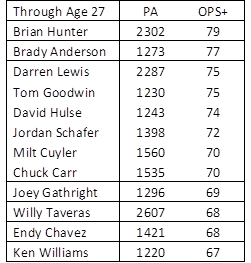
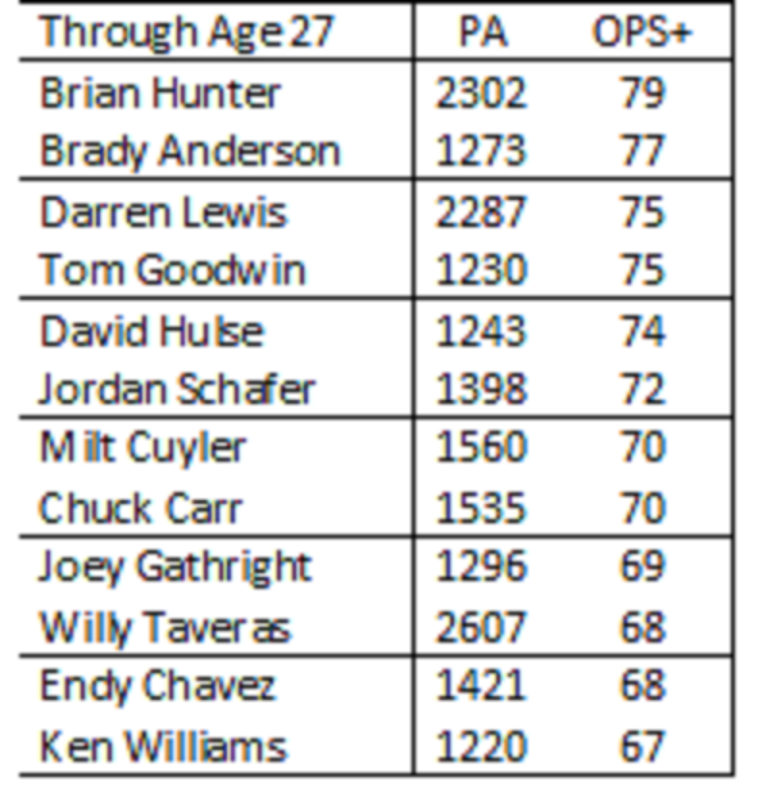
Jordan Schafer is at his 4th stop having moved from Atlanta to Houston to Atlanta prior to being claimed by Minnesota. He enters next season as a 28 year old with a significant 1398 plate appearances. Is there a chance that the once highly rated prospect can turn it around at age 28? Has it happened before? I used Baseball Reference's play index seeking an answer. I wanted a group of outfielders that had a similar number of plate appearances and performance through age 27. A group where Schafer sits somewhere near the middle according to career OPS+ and plate appearances. It turns out pretty rare for an outfielder to be given around 1400 plate appearances at Schafer's level of production. I had to go back to 1987 to find 11 comps. Several of the players listed above have similar characteristics in speed and ability to play all three outfield spots. All had played for multiple teams. Their careers through age 27 were very similar to Schafer. What about after age 27 and their peak values? Brady Anderson! 5 of the 11 had careers with at least 1000 more plate appearances. 2 of the 11 performed better after age 27. I wondered if there was another Brady Anderson if I searched back further. I went back 50 years. We can add Boots Day, Tony Scott, Herm Winningham, Luis Melendez, Rick Bosetti, Marvell Wynne, Hector Cruz and George Wright. Not a Brady Anderson among them. It appears that almost all outfielders by age 28 and 1200+ plate appearances have established their skill level. What do the Twins do about Schafer? Should they tender him a contract and go to arbitration? Do they plan for him to be on the 25 next year or do they look elsewhere?
-
From the album: Images
-
From the album: Images
-
From the album: Images
-
Article: Twins Daily Primer: The Blogs
jorgenswest replied to Brock Beauchamp's topic in Twins Daily Front Page News
I need help with tables. I have a table in excel (or word) but it looks awful in the preview. Thanks -
Article: What to do: Eduardo Escobar
jorgenswest replied to Seth Stohs's topic in Twins Daily Front Page News
At the time if the trade, Escobar projected to a Nick Punto type career. If Santana's glove is not solid at SS, he could have a Bonifacio type career. Great to have both players on the roster. -
Article: Finding a New Pitching Coach
jorgenswest replied to Nick Nelson's topic in Twins Daily Front Page News
I am not sure they can get Ray Searage in a lateral move. Is he under contract? I do think they should consider the Pirates bullpen coach Euclides Rojas.
