



Jamie Cameron
-
Posts
1,349 -
Joined
-
Last visited
-
Days Won
4
Content Type
Profiles
News
Minnesota Twins Videos
2026 Minnesota Twins Top Prospects Ranking
2022 Minnesota Twins Draft Picks
Minnesota Twins Free Agent & Trade Rumors, Notes, & Tidbits
Guides & Resources
2023 Minnesota Twins Draft Picks
The Minnesota Twins Players Project
2024 Minnesota Twins Draft Picks
2025 Minnesota Twins Draft Pick Tracker
2026 Minnesota Twins Draft Tracker: Picks & Bonuses
Forums
Blogs
Events
Store
Downloads
Gallery
Everything posted by Jamie Cameron
-
Up until May 20, Brooks Lee and Walker Jenkins had combined for one at-bat in all of Minor League Baseball, but they began a rehab assignment together with the FCL Twins last week putting them on track to still play for the majority of this season. Jamie and Jeremy evaluate their situations and whats to come for them following their activations.
-
Up until May 20, Brooks Lee and Walker Jenkins had combined for one at-bat in all of Minor League Baseball, but they began a rehab assignment together with the FCL Twins last week putting them on track to still play for the majority of this season. Jamie and Jeremy evaluate their situations and whats to come for them following their activations. View full video
-
MLB Draft Consensus Boards are a huge topic of interest for fans like us who follow the draft heavily months in advance. But do they hold any weight for team scouting departments that do make the decisions on which team draft and when? Ezra Wise answers that question here on what the Twins do.
-
MLB Draft Consensus Boards are a huge topic of interest for fans like us who follow the draft heavily months in advance. But do they hold any weight for team scouting departments that do make the decisions on which team draft and when? Ezra Wise answers that question here on what the Twins do. View full video
-
2024 MLB draft coverage is kicking off with positional previews. We continue with third base. Image courtesy of Brock Beauchamp 2024 MLB draft coverage is kicking off with positional previews. We continue with third base. We’re excited to ratchet up 2024 MLB Draft content in the coming weeks. We’ll start with a series of articles detailing each positional demographic. These pieces aren’t meant to be an exhaustive list, rather, an overview of the caliber of talent at the position. For each player, we'll run down some basic information, in addition to some strengths and weaknesses. You’ll also find their current position on the Consensus MLB Draft Board in parentheses next to their name. The third base class in 2023 was strong, with 5 profiles in the top 25 in an extremely talented overall class. 2024 is a thinner crop and the demographic will be influenced by tweener shortstop types. Let’s dig in. Cameron Smith R/R, Florida State (13) After appearing as a top-100 prospect on draft lists ahead of the 2022 draft, Smith made it to campus in Tallahassee. After a freshman campaign that saw evaluators question his hit tool, he's been making strides since a summer stint on the Cape to answer those questions and put himself in a strong position as a draft eligible sophomore in 2024. Smith has an athletic profile built for good power, with a flatter bat path indicative that more home run power could be on the way, if Smith can lift the ball with more consistency. Advances in the hit tool have raised his stock over the summer. Smith has begun chasing less and improved his contact rate significantly enabling him to get off to a scorching 2024 season. Smith is a good runner and mover for someone his size but that's a fringe average grade overall. Defensively, he has a plus arm and moves well, making third base a viable long term home as a professional, one that he should be above average at defensively. Smith is definitely an up arrow prospect thus far in 2024 with an increasingly well-balanced offensive profile at the hot corner. Tommy White R/R, LSU (23) Tommy White became instantly famous as a freshman at NC State, earning the 'Tommy Tanks' moniker after a ridiculous 27 home run first college season (and 3 in his first ever college game). He transferred to LSU in 2023 and helped the Tigers to a national championship, protecting Dylan Crews in the middle of a stacked lineup, mashing another 24 home runs and slugging .725 in the process. At the plate, White has a crouched stance and a very wide base. He has excellent bat speed, consistently finding the barrel of the bat for great power to all parts of the field. White's bat to ball skills have improved throughout his collegiate career although he has a high chase rate that could be exposed as a professional. It's a legit hit and power combo though, with not many holes in his offensive approach. White isn't a great athlete, and doesn't offer a ton of additional avenues to accrue value. He's played third base defensively but isn't a great fielder. He has an average arm but as a way below average runner, limiting his impact to the offensive side of the ball. White is a polarizing prospect for me. The bat is explosive, but there's not much else on offer. He'll have to hit a ton to be worth it, which he has the skill set to do, but it's a narrower path to success than other first round prospects. Billy Amick R/R, Tennessee (33) Amick is an up arrow player this spring. After receiving limited playing time at Clemson in 2023, he transferred to Tennessee after a strong summer on the Cape and has started the 2024 season hot. Possessing a simple, quietly loaded right-handed swing, Amick has serious strength and has started to put up some impressive exit velocities to go along with solid bat to ball skills. Amick does chase a bit too much and his aggressive approach might limit his ability to get to his power in game unless he can dial it back, but this is a potentially average hit, above average power profile with an increasing track record of performance to back it up. The one question for Amick remains swing and miss, with a contact rate of under 70% a flag for me. Amick has taken a step forward value-wise defensively in 2024. The stocky prospect has manned third base with surprising athleticism. While it's fringe average defense at the moment, an above-average arm helps ameliorate some of the rawness and there's increasing confidence he can at least start his pro career at third base. Not blessed with great speed, Amick will need to keep hitting to force his way up draft boards, the offensive profile is well rounded and impactful, though. Carson DeMartini L/R, Virginia Tech (48) DeMartini is the latest in a line of college bats to come out of Virginia Tech, following first rounder Gavin Cross and second rounder Tanner Schobel in 2022. DeMartini is a third baseman who primarily played at DH in 2023 due to a shoulder injury and had a procedure to repair his labrum that impacted his preparation for the 2024 season. When it's all said and done, DeMartini is a power over hit profile that projects as a slugging corner infielder or outfielder. In the box, it's a quiet operation with good bat speed and a swing designed to lift the ball. DeMartini has some chase in his game (although not as much as you might think) and improved his bat to ball skills significantly in 2023, dropping his whiff% by 12%. He strikes out more than you'd like to see, but takes plenty of walks to add to the on-base skill set. Defensively, he has at least an average arm and a solid average glove. He doesn't have much in the way of foot speed but he projects to stick at third base as a professional. There's definitely areas of refinement in the profile, but there's a productive corner infield slugger in DeMartini's future if he continues to develop and improve. Colby Shelton L/R, Florida (66) After an outstanding freshman season playing third base for Alabama, Colby Shelton transferred to Florida with an opportunity to play shortstop after Josh Rivera was drafted in July of 2023. Shelton is a stockily-built infield prospect with a left-handed power profile that will likely appeal to teams come July. In the box, it's a very quiet approach. Shelton has little to no pre-swing movement. Good bat speed and a strong lower half help him generate plenty of loft and power in his swing. Shelton walks at a decent clip (13% in 2023) but strikes out more than you'd like to see (24% in 2023). He's been particularly susceptible to velocity and has some swing and miss to his game against secondaries too. While Shelton doesn't have premium athleticism, he's handled the move to shortstop well and, while it doesn't always look picture perfect, has made plenty of plays. I think his home will be somewhere else on the infield when it's all said and done. An average arm and glove should support a transition to second or third base as a professional. The hit tool will be what to watch for Shelton, he leveled out a previously steep swing this spring. If he can hit enough, he is going to end up having an appealing all round offensive profile. Honorable Mentions: Kale Fountain (90), Gage Miller (93), Chase Harlan (108) Who excites you from the third base class in 2024? Who are you higher on than other prospects? Jump into the draft conversation in the comments below. View full article
-
 We’re excited to ratchet up 2024 MLB Draft content in the coming weeks. We’ll start with a series of articles detailing each positional demographic. These pieces aren’t meant to be an exhaustive list, rather, an overview of the caliber of talent at the position. For each player, we'll run down some basic information, in addition to some strengths and weaknesses. You’ll also find their current position on the Consensus MLB Draft Board in parentheses next to their name. The third base class in 2023 was strong, with 5 profiles in the top 25 in an extremely talented overall class. 2024 is a thinner crop and the demographic will be influenced by tweener shortstop types. Let’s dig in. Cameron Smith R/R, Florida State (13) After appearing as a top-100 prospect on draft lists ahead of the 2022 draft, Smith made it to campus in Tallahassee. After a freshman campaign that saw evaluators question his hit tool, he's been making strides since a summer stint on the Cape to answer those questions and put himself in a strong position as a draft eligible sophomore in 2024. Smith has an athletic profile built for good power, with a flatter bat path indicative that more home run power could be on the way, if Smith can lift the ball with more consistency. Advances in the hit tool have raised his stock over the summer. Smith has begun chasing less and improved his contact rate significantly enabling him to get off to a scorching 2024 season. Smith is a good runner and mover for someone his size but that's a fringe average grade overall. Defensively, he has a plus arm and moves well, making third base a viable long term home as a professional, one that he should be above average at defensively. Smith is definitely an up arrow prospect thus far in 2024 with an increasingly well-balanced offensive profile at the hot corner. Tommy White R/R, LSU (23) Tommy White became instantly famous as a freshman at NC State, earning the 'Tommy Tanks' moniker after a ridiculous 27 home run first college season (and 3 in his first ever college game). He transferred to LSU in 2023 and helped the Tigers to a national championship, protecting Dylan Crews in the middle of a stacked lineup, mashing another 24 home runs and slugging .725 in the process. At the plate, White has a crouched stance and a very wide base. He has excellent bat speed, consistently finding the barrel of the bat for great power to all parts of the field. White's bat to ball skills have improved throughout his collegiate career although he has a high chase rate that could be exposed as a professional. It's a legit hit and power combo though, with not many holes in his offensive approach. White isn't a great athlete, and doesn't offer a ton of additional avenues to accrue value. He's played third base defensively but isn't a great fielder. He has an average arm but as a way below average runner, limiting his impact to the offensive side of the ball. White is a polarizing prospect for me. The bat is explosive, but there's not much else on offer. He'll have to hit a ton to be worth it, which he has the skill set to do, but it's a narrower path to success than other first round prospects. Billy Amick R/R, Tennessee (33) Amick is an up arrow player this spring. After receiving limited playing time at Clemson in 2023, he transferred to Tennessee after a strong summer on the Cape and has started the 2024 season hot. Possessing a simple, quietly loaded right-handed swing, Amick has serious strength and has started to put up some impressive exit velocities to go along with solid bat to ball skills. Amick does chase a bit too much and his aggressive approach might limit his ability to get to his power in game unless he can dial it back, but this is a potentially average hit, above average power profile with an increasing track record of performance to back it up. The one question for Amick remains swing and miss, with a contact rate of under 70% a flag for me. Amick has taken a step forward value-wise defensively in 2024. The stocky prospect has manned third base with surprising athleticism. While it's fringe average defense at the moment, an above-average arm helps ameliorate some of the rawness and there's increasing confidence he can at least start his pro career at third base. Not blessed with great speed, Amick will need to keep hitting to force his way up draft boards, the offensive profile is well rounded and impactful, though. Carson DeMartini L/R, Virginia Tech (48) DeMartini is the latest in a line of college bats to come out of Virginia Tech, following first rounder Gavin Cross and second rounder Tanner Schobel in 2022. DeMartini is a third baseman who primarily played at DH in 2023 due to a shoulder injury and had a procedure to repair his labrum that impacted his preparation for the 2024 season. When it's all said and done, DeMartini is a power over hit profile that projects as a slugging corner infielder or outfielder. In the box, it's a quiet operation with good bat speed and a swing designed to lift the ball. DeMartini has some chase in his game (although not as much as you might think) and improved his bat to ball skills significantly in 2023, dropping his whiff% by 12%. He strikes out more than you'd like to see, but takes plenty of walks to add to the on-base skill set. Defensively, he has at least an average arm and a solid average glove. He doesn't have much in the way of foot speed but he projects to stick at third base as a professional. There's definitely areas of refinement in the profile, but there's a productive corner infield slugger in DeMartini's future if he continues to develop and improve. Colby Shelton L/R, Florida (66) After an outstanding freshman season playing third base for Alabama, Colby Shelton transferred to Florida with an opportunity to play shortstop after Josh Rivera was drafted in July of 2023. Shelton is a stockily-built infield prospect with a left-handed power profile that will likely appeal to teams come July. In the box, it's a very quiet approach. Shelton has little to no pre-swing movement. Good bat speed and a strong lower half help him generate plenty of loft and power in his swing. Shelton walks at a decent clip (13% in 2023) but strikes out more than you'd like to see (24% in 2023). He's been particularly susceptible to velocity and has some swing and miss to his game against secondaries too. While Shelton doesn't have premium athleticism, he's handled the move to shortstop well and, while it doesn't always look picture perfect, has made plenty of plays. I think his home will be somewhere else on the infield when it's all said and done. An average arm and glove should support a transition to second or third base as a professional. The hit tool will be what to watch for Shelton, he leveled out a previously steep swing this spring. If he can hit enough, he is going to end up having an appealing all round offensive profile. Honorable Mentions: Kale Fountain (90), Gage Miller (93), Chase Harlan (108) Who excites you from the third base class in 2024? Who are you higher on than other prospects? Jump into the draft conversation in the comments below.
- 2 comments
-
- 3
-

-
- cameron smith
- tommy white
- (and 3 more)
-
Funny you mention him. I cut the honorable mention list at top 150 guys (at the moment) on my board. He's 155!
-
 We’re excited to ratchet up 2024 MLB Draft content in the coming weeks. We’ll start with a series of articles detailing each positional demographic. These pieces aren’t meant to be an exhaustive list. Rather, each will be an overview of the caliber of talent at the position. For each player, we'll run down some basic information, and break down some strengths and weaknesses. You’ll also find their current position on the Consensus MLB Draft Board in parentheses next to their name. The shortstop class in 2023 was loaded, with 12 profiles in the top 50 of an extremely talented class. This year's is a thinner crop, particularly at the college level. Several prep names have emerged this spring, particularly in the 25-50 range on the consensus board. Bryce Rainer L/R, Harvard Westlake (11) Rainer is a legitimate two-way prospect who is looking to join the likes of Pete Crow-Armstrong and Max Fried in becoming a first-round selection out of California prep powerhouse Harvard-Westlake. On the mound, it's a pretty effortless 95-mph fastball with good life, an average curveball with good downward bite, and a slider and changeup that are each fringy, emerging pitches. While it's far from a finished product on the mound, his looseness and projectability point toward a fastball that might flirt with triple digits when it's all said and done. Offensively, there's good bat speed, lightning-quick hands, and plenty of raw power to tap into. His swing can get long leading to some swing-and-miss in his profile. Defensively, he's an efficient mover, with good quickness, who has posted above-average run times to go with a plus arm. Even if he moves off shortstop eventually, his profile should play well at third base. It's difficult to know, at the time of writing, where orgs would prefer Rainer (pitcher or hitter). That will sort itself out eventually. Either way, it's a ton of tools and projectability in an easy-to-dream-on profile. Kaelen Culpepper R/R, Kansas State (25) Kaelen Culpepper is an exceptional athlete who has shifted defensively from 2B/3B to SS in his junior season at Kansas State. With a strong offensive performance in 2024, he could provide a jolt to a weak draft demographic that's usually coveted (college SS). At the plate, Culpepper has a strong overall skill set. He generates good bat speed, although a flatter bat path hasn't produced much loft to date. Additionally, he has good contact skills, solid plate discipline, although he does expand the zone a little too much at times. Culpepper is having a solid 2024 season in which he’s walking more and has amassed 24 extra base hits in 50 games, in addition to 15 stolen bases. Defensively, it's a plus arm, with good defensive actions and athleticism. Regardless of whether Culpepper ends up sticking at SS as a pro, or slides over to 2B or 3B, it should be an above-average defensive profile. Wyatt Sanford L/R, Independence HS, TX (28) Sanford is a projectable Texas prep shortstop with a strong toolset and no real weakness in his game. Starting from a crouched, back foot weight stance, a small toe tap gets Sanford going into a pretty left-handed swing. Good bat speed and quick hands give Sanford outstanding bat-to-ball skills. He maintains strong contact rates, particularly on fastballs in the zone. Sanford rarely expands the zone and doesn't chase often. While there's not been a ton of power in the profile, Sanford has shown more pop this spring and might get to average power as he continues to grow, add weight, and loft to his swing. Defensively, it's a really solid profile. Sanford has good actions, moves efficiently, and has an above average arm. He should have a good chance to stick at shortstop as a professional. Caleb Bonemer R/R, Okemos HS, MI (31) Bonemer was one of the biggest board risers on the prep side this winter after a great summer in 2023 with one of the better athletic profiles and potentially one of the most exciting power/speed combinations in the 2024 class. A quiet, efficient, short swing produces good bat speed and Bonemer is already showing above average in-game power (typically to the pull side) that may eventually become plus power. Defensively, he's a solid mover with an above average arm at shortstop who can make all the throws. He may eventually grow off shortstop to third base, but it'd be potentially plus defense there with the offensive profile to make it not matter. Bonemer has also posted plus run times, making him a threat on the base paths and in the run game. One area of opportunity is refining his approach some at the plate, as there's some swing and miss and a bit too much chase in the profile currently. If he can work through those needs and get the hit tool to average, it's going to be a strong overall profile and one of the first prep names to go in July. Carter Johnson L/R, Oxford HS, MS (32) Carter Johnson is one of the most intriguing prep profiles in the 2024 class thanks to a well-rounded skill set in which everything grades out as average or better. At 6'2, 180 pounds, there's plenty of projectability left in an already strong athletic profile. At the plate Johnson has a clean, smooth, left-handed swing. Everything looks good; quick hands, consistent bat path, an ability to recognize pitches well, a hitter who uses the entire field. At the moment, the hit tool is more advanced than the power tool but there's plenty of time to add strength and in-game power in what is more of a gap to gap approach at present. Johnson has average speed. Growth and increased strength may eventually move him off shortstop, even though he has the arm, defensive actions, and hands to stay there. While the defensive profile is average to above-average, the bat is exciting and Johnson is one of the most well rounded offensive profiles of any prep in the class. Theo Gillen L/R, Westlake HS, TX (36) Gillen is rising quickly up draft boards after a loud start to the 2024 season in which his offensive impact is beginning to match his enormous potential and athleticism. After returning from shoulder surgery in 2022, he's grown a ton, now standing 6'3, 200 pounds in a frame that has plenty of projection. At the plate, Gillen starts in an upright stance with a bat tip straight behind his left shoulder. A small stride gets him moving forward into his compact left-handed swing. Gillen's offensive profile is underpinned by excellent bat to ball skills. While his profile used to feature more line drive power, he's begun to develop more home run juice, particularly to the pull side, with a frame that suggests that more in the tank. Defensively, Gillen is a good mover with a quick first step and good defensive actions. He might move off shortstop as he continues to grow. Additionally, much will depend on his throwing arm, which has been the subject of some of his injuries. Gillen has shown plus speed so there are plenty of defensive homes available (second base, or even centerfield). All of this likely won't matter too much, as Gillen has an impactful and well rounded offensive profile that should put him in the day one conversation. Kellon Lindsey R/R, Hardee HS, FL (38) Lindsey is THE 'where did you come from?' prospect of the 2024 draft class, prep edition. A two-sport star who is committed to Florida to play football and baseball, the SS/OF profile is underpinned by some of the most impressive athleticism in the entire class. There's a ton of projection left in Lindsey's frame. He's already posted 80-grade run times that should translate to him being a plus defender, whether he sticks at SS or CF, in addition to being a menace on the base paths. Linsey has also received rave reviews for his offensive improvements thus far in 2023. Quick hands, excellent bat to ball skills, good barrel control, and an emerging ability to backspin the baseball make Lindsey a serious helium prospect and someone who could have significant impact as a first round pick come July. Honorable Mentions: Tyson Lewis (44), Griff O’Ferrall (48), Anthony Silva (66), Tyler Bell (67), Charlie Bates (74), Kyle DeBarge (76), Sawyer Farr (78) 2024 MLB Draft Preview: Catcher Who excites you from the shortstop class in 2024? Who are you higher on than other prospects? Jump into the draft conversation in the comments below.
 -
Our 2024 MLB draft coverage is kicking off with positional previews. We continue today with shortstops. Image courtesy of Brock Beauchamp Our 2024 MLB draft coverage is kicking off with positional previews. We continue today with shortstops. We’re excited to ratchet up 2024 MLB Draft content in the coming weeks. We’ll start with a series of articles detailing each positional demographic. These pieces aren’t meant to be an exhaustive list. Rather, each will be an overview of the caliber of talent at the position. For each player, we'll run down some basic information, and break down some strengths and weaknesses. You’ll also find their current position on the Consensus MLB Draft Board in parentheses next to their name. The shortstop class in 2023 was loaded, with 12 profiles in the top 50 of an extremely talented class. This year's is a thinner crop, particularly at the college level. Several prep names have emerged this spring, particularly in the 25-50 range on the consensus board. Bryce Rainer L/R, Harvard Westlake (11) Rainer is a legitimate two-way prospect who is looking to join the likes of Pete Crow-Armstrong and Max Fried in becoming a first-round selection out of California prep powerhouse Harvard-Westlake. On the mound, it's a pretty effortless 95-mph fastball with good life, an average curveball with good downward bite, and a slider and changeup that are each fringy, emerging pitches. While it's far from a finished product on the mound, his looseness and projectability point toward a fastball that might flirt with triple digits when it's all said and done. Offensively, there's good bat speed, lightning-quick hands, and plenty of raw power to tap into. His swing can get long leading to some swing-and-miss in his profile. Defensively, he's an efficient mover, with good quickness, who has posted above-average run times to go with a plus arm. Even if he moves off shortstop eventually, his profile should play well at third base. It's difficult to know, at the time of writing, where orgs would prefer Rainer (pitcher or hitter). That will sort itself out eventually. Either way, it's a ton of tools and projectability in an easy-to-dream-on profile. Kaelen Culpepper R/R, Kansas State (25) Kaelen Culpepper is an exceptional athlete who has shifted defensively from 2B/3B to SS in his junior season at Kansas State. With a strong offensive performance in 2024, he could provide a jolt to a weak draft demographic that's usually coveted (college SS). At the plate, Culpepper has a strong overall skill set. He generates good bat speed, although a flatter bat path hasn't produced much loft to date. Additionally, he has good contact skills, solid plate discipline, although he does expand the zone a little too much at times. Culpepper is having a solid 2024 season in which he’s walking more and has amassed 24 extra base hits in 50 games, in addition to 15 stolen bases. Defensively, it's a plus arm, with good defensive actions and athleticism. Regardless of whether Culpepper ends up sticking at SS as a pro, or slides over to 2B or 3B, it should be an above-average defensive profile. Wyatt Sanford L/R, Independence HS, TX (28) Sanford is a projectable Texas prep shortstop with a strong toolset and no real weakness in his game. Starting from a crouched, back foot weight stance, a small toe tap gets Sanford going into a pretty left-handed swing. Good bat speed and quick hands give Sanford outstanding bat-to-ball skills. He maintains strong contact rates, particularly on fastballs in the zone. Sanford rarely expands the zone and doesn't chase often. While there's not been a ton of power in the profile, Sanford has shown more pop this spring and might get to average power as he continues to grow, add weight, and loft to his swing. Defensively, it's a really solid profile. Sanford has good actions, moves efficiently, and has an above average arm. He should have a good chance to stick at shortstop as a professional. Caleb Bonemer R/R, Okemos HS, MI (31) Bonemer was one of the biggest board risers on the prep side this winter after a great summer in 2023 with one of the better athletic profiles and potentially one of the most exciting power/speed combinations in the 2024 class. A quiet, efficient, short swing produces good bat speed and Bonemer is already showing above average in-game power (typically to the pull side) that may eventually become plus power. Defensively, he's a solid mover with an above average arm at shortstop who can make all the throws. He may eventually grow off shortstop to third base, but it'd be potentially plus defense there with the offensive profile to make it not matter. Bonemer has also posted plus run times, making him a threat on the base paths and in the run game. One area of opportunity is refining his approach some at the plate, as there's some swing and miss and a bit too much chase in the profile currently. If he can work through those needs and get the hit tool to average, it's going to be a strong overall profile and one of the first prep names to go in July. Carter Johnson L/R, Oxford HS, MS (32) Carter Johnson is one of the most intriguing prep profiles in the 2024 class thanks to a well-rounded skill set in which everything grades out as average or better. At 6'2, 180 pounds, there's plenty of projectability left in an already strong athletic profile. At the plate Johnson has a clean, smooth, left-handed swing. Everything looks good; quick hands, consistent bat path, an ability to recognize pitches well, a hitter who uses the entire field. At the moment, the hit tool is more advanced than the power tool but there's plenty of time to add strength and in-game power in what is more of a gap to gap approach at present. Johnson has average speed. Growth and increased strength may eventually move him off shortstop, even though he has the arm, defensive actions, and hands to stay there. While the defensive profile is average to above-average, the bat is exciting and Johnson is one of the most well rounded offensive profiles of any prep in the class. Theo Gillen L/R, Westlake HS, TX (36) Gillen is rising quickly up draft boards after a loud start to the 2024 season in which his offensive impact is beginning to match his enormous potential and athleticism. After returning from shoulder surgery in 2022, he's grown a ton, now standing 6'3, 200 pounds in a frame that has plenty of projection. At the plate, Gillen starts in an upright stance with a bat tip straight behind his left shoulder. A small stride gets him moving forward into his compact left-handed swing. Gillen's offensive profile is underpinned by excellent bat to ball skills. While his profile used to feature more line drive power, he's begun to develop more home run juice, particularly to the pull side, with a frame that suggests that more in the tank. Defensively, Gillen is a good mover with a quick first step and good defensive actions. He might move off shortstop as he continues to grow. Additionally, much will depend on his throwing arm, which has been the subject of some of his injuries. Gillen has shown plus speed so there are plenty of defensive homes available (second base, or even centerfield). All of this likely won't matter too much, as Gillen has an impactful and well rounded offensive profile that should put him in the day one conversation. Kellon Lindsey R/R, Hardee HS, FL (38) Lindsey is THE 'where did you come from?' prospect of the 2024 draft class, prep edition. A two-sport star who is committed to Florida to play football and baseball, the SS/OF profile is underpinned by some of the most impressive athleticism in the entire class. There's a ton of projection left in Lindsey's frame. He's already posted 80-grade run times that should translate to him being a plus defender, whether he sticks at SS or CF, in addition to being a menace on the base paths. Linsey has also received rave reviews for his offensive improvements thus far in 2023. Quick hands, excellent bat to ball skills, good barrel control, and an emerging ability to backspin the baseball make Lindsey a serious helium prospect and someone who could have significant impact as a first round pick come July. Honorable Mentions: Tyson Lewis (44), Griff O’Ferrall (48), Anthony Silva (66), Tyler Bell (67), Charlie Bates (74), Kyle DeBarge (76), Sawyer Farr (78) 2024 MLB Draft Preview: Catcher Who excites you from the shortstop class in 2024? Who are you higher on than other prospects? Jump into the draft conversation in the comments below. View full article
-
I like that one-two punch idea in general, whether that college pick is a catcher or someone like Kaelen Culpepper. For preps, I think the arms are interesting (more on those in a couple weeks). I'd also add that there's an emerging group of prep SS that I think are interesting. Wyatt Sanford, Theo Gillen, Kellon Lindsey, Carter Johnson. All those guys are in the 20-40 range and they all have very interesting profiles. The SS preview piece will be out Monday or Tuesday next week, so we'll have all the details coming y'all's way, A better demo (on the prep side) than was initially suggested, imo.
-
 In Episode 36 of Destination: The Show, Jeremy and Jamie chat with Ezra Wise, Manager of Scouting Research for the Minnesota Twins. Ezra shares about his pathway through the baseball industry and talks through the roles he has held with the Twins. The guys talk through how data and analytics informs the draft process including what a draft model is, how the Twins draft team evaluates their drafts and performance and some impressions of this year's class. They also get to debunking some Twins draft myths. You can support the show by downloading it from wherever you get your podcasts, including iTunes and Spotify. If you enjoy the content, consider leaving us a five-star rating and review in addition to sharing or retweeting DTS-related content. You can follow us on Twitter @DTS_POD1, @Jeremynygaard, @J_D_Cameron, and @TheodoreTollef1. You can also find full episodes and clips of our shows on our YouTube page @DestinationTheShow.
 -
Draft tandem Jeremy Nygaard and JD Cameron team up for a podcast to discuss prospects on their way to the big leagues and the MLB draft, produced by Theo Tollefson. Image courtesy of Thieres Rabelo Draft tandem Jeremy Nygaard and JD Cameron team up for a podcast to discuss prospects on their way to the big leagues and the MLB draft, produced by Theo Tollefson. In Episode 36 of Destination: The Show, Jeremy and Jamie chat with Ezra Wise, Manager of Scouting Research for the Minnesota Twins. Ezra shares about his pathway through the baseball industry and talks through the roles he has held with the Twins. The guys talk through how data and analytics informs the draft process including what a draft model is, how the Twins draft team evaluates their drafts and performance and some impressions of this year's class. They also get to debunking some Twins draft myths. You can support the show by downloading it from wherever you get your podcasts, including iTunes and Spotify. If you enjoy the content, consider leaving us a five-star rating and review in addition to sharing or retweeting DTS-related content. You can follow us on Twitter @DTS_POD1, @Jeremynygaard, @J_D_Cameron, and @TheodoreTollef1. You can also find full episodes and clips of our shows on our YouTube page @DestinationTheShow. View full article
-
This is going to be an interesting year for the C position. I have this theory (probably wrong) that the Twins, similarly to college pitching in mid to late rounds, can find value in catching later, but there's a ton of profiles around the spot they pick. Camden Janik is a guy I'd look out for later. He plays for Illinois, really good hitter. Thanks for reading, and commenting, as always!
-
Thanks Cory! I think Moore might be the Twins first option. He has really good bat to ball skills and is controlling the strike zone more this season, despite the batted ball luck. Stanford is also known for emphasizing contact for hitters (Braden Montgomery has flourished more since leaving), so I think there's more in the tank for Moore (where the power is already good). Additionally, young for the class (as was Soto in 2023), not that important, but maybe a tiebreaker.
-
Thanks so much for reading. Mabeus is really interesting. Played really well at NHSI recently in NC from what I heard. Around 200th by consensus atm.
-
2024 MLB draft coverage is kicking off with positional previews. We start with an intriguing crop of catchers. Image courtesy of Brock Beauchamp 2024 MLB draft coverage is kicking off with positional previews. We start with an intriguing crop of catchers. We’re excited to ratchet up 2024 MLB Draft content in the coming weeks. We’ll start with a series of articles detailing each positional demographic. These pieces aren’t meant to be an exhaustive list, but rather, an overview of the caliber of talent at the position. For each player, we'll run down some basic information, in addition to some strengths and weaknesses. You’ll also find their current position on the Consensus MLB Draft Board in parentheses next to their name. The catching class in 2023 was extremely thin and top-heavy. Beyond Blake Mitchell (8th to the Royals) and Kyle Teel (14th to the Red Sox), Michael Carico (149th to the Cubs) was the only other true catcher who finished the cycle with a top 100 consensus ranking. This year's class is carried mostly by the college crop. Who are the names to know, and what are their strengths and (ahem) opportunities? Let’s dig in. Caleb Lomavita R/R, Cal (21) Caleb Lomavita is one of a handful of names from a collegiate catching crop that will likely be Day One selections in July. The native of Hawaii has improved his offensive game steadily over three seasons at Cal. Lomavita has an unusual setup at the plate, crouched in an open stance before starting a leg drift to a more closed approach as the pitcher starts their motion. Nonetheless, it works. Lomavita has a launch-oriented swing that provides a nice balance between above-average hit and power tools, finding the barrel of the bat often enough to balance his good contact rate with plenty of hard-hit balls. While he doesn't walk much (10 in 49 games), there's a ton of impact here: Lomavita has launched 14 home runs and 12 doubles in 2024. He's an excellent athlete and has at least average speed, even acting as an opportunistic base stealer. While there's refinement needed on the defensive side of his game (receiving, framing, etc.), he has the foundation to stick at the position with good lateral quickness and an above-average to plus arm. If he doesn't stick behind the plate, there's a first-base or corner-outfield profile there with his athleticism. Lomavita could be the first collegiate backstop off the board in July. Malcolm Moore L/R, Stanford (24) Moore was one of the better prep bats in the 2022 class and one of the highest-ranked players not to sign. Moore made it to campus at Stamford and will be extremely young for the class (20) as a draft-eligible sophomore in 2024. Moore had an extremely unusual setup at the plate that he has simplified this season. However strange his operation was, it was effective in his freshman season in Palo Alto, to the tune of 15 home runs and 20 doubles. Moore’s approach and swing decisions have improved in 2024, as he has walked more this season. He has excellent bat-to-ball skills but seems to have suffered some bad batted-ball luck. Moore is a question mark behind the plate. A solid arm is offset by the need to refine his blocking, receiving, and footwork. Moore has the offensive profile to stick in the first round regardless of defensive position, but if he can develop his catching skills, he has a chance to provide really good value. Jacob Cozart L/R, NC State (33) Cozart's floor is laid by the fact that he's one of the best defensive catching prospects in the class. Although tall for the position, good hands, lateral movement, defensive actions and pitch framing set an excellent foundation for (at the bare minimum) an average defensive catcher at the big-league level. Cozart has plenty to offer on the offensive side of the ball, too, and took solid steps forward in his sophomore season. In 2023, he managed a .301/392/.536 line, with 10 home runs and 14 doubles. Most of his present power comes to the pull side, with more line-drive power to center field and the opposite field. Cozart has typically struggled against spin, but there's plenty to like about his offensive profile. His plate discipline is very good, he doesn't strike out a ton, and he has good bat-to-ball skills. If (as has proven the case so far) Cozart can continue his steady improvement to his offensive game in 2024, he’ll be one of the first few backstops off the board. Walker Janek R/R, Sam Houston St (34) After back-to-back solid seasons for Sam Houston State, Walker Janek looks to have broken out in a major way in 2024. Simply put, Janek has a solid all-around profile in both his offensive and defensive game. At the plate, he has good bat speed and finds the barrel often. There's present pull-side power and good bat-to-ball skills. Although Janek does have a tendency to chase, especially against secondaries, there's a good shot that it's an above-average hit and average power tool when he's done developing, which would play well at catcher. Defensively, he has one of the better arms in the catcher demographic, turning back a solid number of would-be base stealers with good pop and release times behind the plate. All the other prerequisites needed to be at least average defensively are present. Janek moves laterally and blocks well, has solid ability to frame, and while his intangible presence behind home needs some work, there's plenty to work with. All in all, this is one of the most well-rounded catching profiles in the 2024 class. Janek is having an excellent 2024 season. An up-arrow prospect for me. Kevin Bazzell R/R, Texas Tech (53) Bazzell transferred to Texas Tech after spending his freshman season at DBU and immediately hit the ground running (after sitting out the 2022 season) to become one of the better bats in his conference. At the plate, Bazzell has a quiet operation. It's a simple, smooth load, punctuated by a small leg kick to get the bat moving through the zone. His offensive profile is definitely hit over power, for now. It's a flatter bat path that's more geared toward gap power, although he did show some pop (10 HR) in his first season at TTU. As an overall offensive package, however, there's plenty to like. Bazzell doesn't chase much, walks plenty, and has strong bat-to-ball skills (92% zone contact rate in 2023). While Bazzell has only fringy speed, he's an excellent athlete. An above-average arm, good defensive actions and lateral movement give him a chance to stick behind the plate. If that doesn't work out, he's played at third base for the Red Raiders and has enough athleticism to handle left field. The bat is the calling card for Bazzell, if orgs like his chances to stick behind the plate, it'll increase his stock significantly. Cade Arrambide R/R, Tomball HS, TX (96) The 2024 catching class is much more interesting than the 2023 class. Though mostly buoyed by the college demographic, Arrambide is one of the best prep catchers in the class. Arrambide has the potential to be an excellent defensive catcher. It's a plus (or better) arm that's recorded throws at over 100mph from the outfield, combined with good lateral movement and great pop times. There are other aspects of catching (such as blocking and framing) that will require refinement, but Arrambide has the potential to be an above-average to plus defender, with a right-field profile if it doesn't work behind the plate. Offensively, there's plenty to be excited about, too. He has great bat speed and plenty of raw power, which has already shown itself in games. The big question marks with his offensive profile are bat-to-ball skills and chase rate, both of which could be exposed as a professional. If he can shore up at least one of those two areas, he has a good chance to accrue plenty of offensive and defensive value as a pro. Honorable Mentions: Hunter Carns (101), Anderson French (124), Cole Messina (139) Who excites you from the catching class in 2024? Who are you higher on than other prospects? Jump into the draft conversation in the comments below. View full article
-
 We’re excited to ratchet up 2024 MLB Draft content in the coming weeks. We’ll start with a series of articles detailing each positional demographic. These pieces aren’t meant to be an exhaustive list, but rather, an overview of the caliber of talent at the position. For each player, we'll run down some basic information, in addition to some strengths and weaknesses. You’ll also find their current position on the Consensus MLB Draft Board in parentheses next to their name. The catching class in 2023 was extremely thin and top-heavy. Beyond Blake Mitchell (8th to the Royals) and Kyle Teel (14th to the Red Sox), Michael Carico (149th to the Cubs) was the only other true catcher who finished the cycle with a top 100 consensus ranking. This year's class is carried mostly by the college crop. Who are the names to know, and what are their strengths and (ahem) opportunities? Let’s dig in. Caleb Lomavita R/R, Cal (21) Caleb Lomavita is one of a handful of names from a collegiate catching crop that will likely be Day One selections in July. The native of Hawaii has improved his offensive game steadily over three seasons at Cal. Lomavita has an unusual setup at the plate, crouched in an open stance before starting a leg drift to a more closed approach as the pitcher starts their motion. Nonetheless, it works. Lomavita has a launch-oriented swing that provides a nice balance between above-average hit and power tools, finding the barrel of the bat often enough to balance his good contact rate with plenty of hard-hit balls. While he doesn't walk much (10 in 49 games), there's a ton of impact here: Lomavita has launched 14 home runs and 12 doubles in 2024. He's an excellent athlete and has at least average speed, even acting as an opportunistic base stealer. While there's refinement needed on the defensive side of his game (receiving, framing, etc.), he has the foundation to stick at the position with good lateral quickness and an above-average to plus arm. If he doesn't stick behind the plate, there's a first-base or corner-outfield profile there with his athleticism. Lomavita could be the first collegiate backstop off the board in July. Malcolm Moore L/R, Stanford (24) Moore was one of the better prep bats in the 2022 class and one of the highest-ranked players not to sign. Moore made it to campus at Stamford and will be extremely young for the class (20) as a draft-eligible sophomore in 2024. Moore had an extremely unusual setup at the plate that he has simplified this season. However strange his operation was, it was effective in his freshman season in Palo Alto, to the tune of 15 home runs and 20 doubles. Moore’s approach and swing decisions have improved in 2024, as he has walked more this season. He has excellent bat-to-ball skills but seems to have suffered some bad batted-ball luck. Moore is a question mark behind the plate. A solid arm is offset by the need to refine his blocking, receiving, and footwork. Moore has the offensive profile to stick in the first round regardless of defensive position, but if he can develop his catching skills, he has a chance to provide really good value. Jacob Cozart L/R, NC State (33) Cozart's floor is laid by the fact that he's one of the best defensive catching prospects in the class. Although tall for the position, good hands, lateral movement, defensive actions and pitch framing set an excellent foundation for (at the bare minimum) an average defensive catcher at the big-league level. Cozart has plenty to offer on the offensive side of the ball, too, and took solid steps forward in his sophomore season. In 2023, he managed a .301/392/.536 line, with 10 home runs and 14 doubles. Most of his present power comes to the pull side, with more line-drive power to center field and the opposite field. Cozart has typically struggled against spin, but there's plenty to like about his offensive profile. His plate discipline is very good, he doesn't strike out a ton, and he has good bat-to-ball skills. If (as has proven the case so far) Cozart can continue his steady improvement to his offensive game in 2024, he’ll be one of the first few backstops off the board. Walker Janek R/R, Sam Houston St (34) After back-to-back solid seasons for Sam Houston State, Walker Janek looks to have broken out in a major way in 2024. Simply put, Janek has a solid all-around profile in both his offensive and defensive game. At the plate, he has good bat speed and finds the barrel often. There's present pull-side power and good bat-to-ball skills. Although Janek does have a tendency to chase, especially against secondaries, there's a good shot that it's an above-average hit and average power tool when he's done developing, which would play well at catcher. Defensively, he has one of the better arms in the catcher demographic, turning back a solid number of would-be base stealers with good pop and release times behind the plate. All the other prerequisites needed to be at least average defensively are present. Janek moves laterally and blocks well, has solid ability to frame, and while his intangible presence behind home needs some work, there's plenty to work with. All in all, this is one of the most well-rounded catching profiles in the 2024 class. Janek is having an excellent 2024 season. An up-arrow prospect for me. Kevin Bazzell R/R, Texas Tech (53) Bazzell transferred to Texas Tech after spending his freshman season at DBU and immediately hit the ground running (after sitting out the 2022 season) to become one of the better bats in his conference. At the plate, Bazzell has a quiet operation. It's a simple, smooth load, punctuated by a small leg kick to get the bat moving through the zone. His offensive profile is definitely hit over power, for now. It's a flatter bat path that's more geared toward gap power, although he did show some pop (10 HR) in his first season at TTU. As an overall offensive package, however, there's plenty to like. Bazzell doesn't chase much, walks plenty, and has strong bat-to-ball skills (92% zone contact rate in 2023). While Bazzell has only fringy speed, he's an excellent athlete. An above-average arm, good defensive actions and lateral movement give him a chance to stick behind the plate. If that doesn't work out, he's played at third base for the Red Raiders and has enough athleticism to handle left field. The bat is the calling card for Bazzell, if orgs like his chances to stick behind the plate, it'll increase his stock significantly. Cade Arrambide R/R, Tomball HS, TX (96) The 2024 catching class is much more interesting than the 2023 class. Though mostly buoyed by the college demographic, Arrambide is one of the best prep catchers in the class. Arrambide has the potential to be an excellent defensive catcher. It's a plus (or better) arm that's recorded throws at over 100mph from the outfield, combined with good lateral movement and great pop times. There are other aspects of catching (such as blocking and framing) that will require refinement, but Arrambide has the potential to be an above-average to plus defender, with a right-field profile if it doesn't work behind the plate. Offensively, there's plenty to be excited about, too. He has great bat speed and plenty of raw power, which has already shown itself in games. The big question marks with his offensive profile are bat-to-ball skills and chase rate, both of which could be exposed as a professional. If he can shore up at least one of those two areas, he has a good chance to accrue plenty of offensive and defensive value as a pro. Honorable Mentions: Hunter Carns (101), Anderson French (124), Cole Messina (139) Who excites you from the catching class in 2024? Who are you higher on than other prospects? Jump into the draft conversation in the comments below.
 -
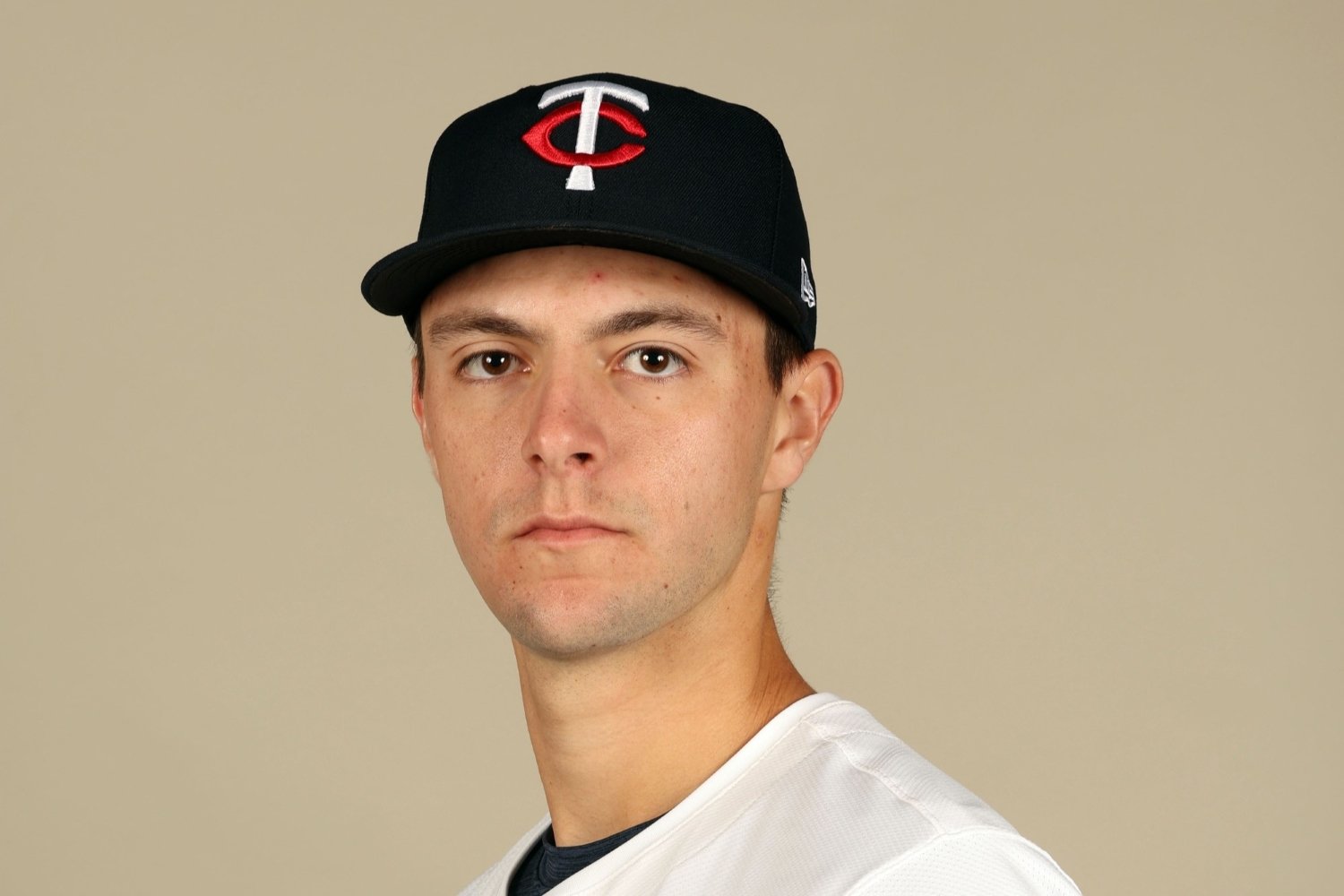 David Festa is striking hitters out at a higher rate than any other Triple-A starting pitcher--37.2%, to be exact, 3.3% more than the next-best starting pitcher (Cade Povich), and 16.3% above the average for the level. The 2021 13th-rounder has a 3.59 FIP and a 3.11 xFIP. He's generating an 18.3% swinging-strike rate, far above average for the level. In short, Festa is dominating hitters, and is looking close to MLB-ready. So, what’s new for Festa in 2024? There are a few trends to mine here, starting with his fastball. Festa is getting more induced vertical break (IVB) on his fastball in 2024 (19.3 inches on average) versus 2023 (17.1). Festa has a decently high release (about 77 inches), but this increase will still help Festa’s fastball do well at the top of the strike zone. Additionally, Festa is generating more release extension in 2024 (6.9 feet), giving his fastball an average effective velocity of 96.3 mph. The outcomes of the fastball improvements? A pitch that generates a 34.1% miss rate. The average in Triple-A is 23.7%. Let’s ground ourselves in the pitch mix, through about 30 innings. He mostly uses a fastball-slider combination against right-handed hitters, and a fastball-changeup-slider blend against left-handed hitters. 4Seam% Slider% Change% Curve% versus LHH 33.8% 22.8% 38.4% 5% versus RHH 36.1% 48.7% 15.2% 0% I’d argue that Festa’s command of his slider and changeup are the most important developments from 2023 to 2024. Here’s a look at his slider location from 2023 to 2024, and his changeup location from 2023 to 2024. In both cases, the command has improved significantly. He’s consistently burying his slider down and away from right-handers and his changeup down and away from left-handers. The results, for Festa’s slider in particular, speak for themselves. Strike% Contact% Chase% SwStrk% K% Slider 2023 56.5% 66.7% 20% 14.1% 23.5% Slider 2024 65.2% 55.1% 33.9% 21.6% 44.9% Much has been made of Festa’s strike-throwing. He did struggle with free passes at the beginning of the season. Since then, however, Festa has tightened up his control significantly. Control has not been one of Festa’s strengths thus far in his professional career. I’d argue that he has enough stuff to overcome that limitation, though, and his recent improvements in strike throwing and walk rate will set him up well for MLB success, so let's retire the narrative that he doesn't throw enough strikes. So, where might Festa feature for the Twins? What might his role be? When might we see him in 2024? I think the answer is ‘sooner than you might think’. While Simeon Woods Richardson has been solid for the Twins since Louie Varland was demoted to Triple-A, the Twins have begun to stretch Festa out. His last six appearances for St. Paul have featured an ‘A/B’ pattern. In start A, Festa gets stretched a little further. In start B, he gets a shorter burst of around three innings. In his last three ‘A’ starts, Festa has pitched four, five, and six innings, respectively. In his last start, he threw 86 pitches. Festa was selected with the 399th pick in the 2021 draft. It’s a testament to his work ethic and the Twins' player development team that he’s now the most dominant strikeout pitcher in Triple-A, on the doorstep of contributing at the major-league level. How far he can continue to climb and the extent of the impact he might have remains to be seen. Make no mistake, though, David Festa has the tools to thrive. Research assistance provided by TruMedia Sports.
- 27 comments
-
- 11
-
-
David Festa is an MLB-Ready Top 100 Prospect
Jamie Cameron posted a topic in Twins Minor League Talk
David Festa is off to an exciting start in 2024. What's driving his success? How has he performed? How might he feature in the Twins' plans this season? Let's dig in. Image courtesy of © Kim Klement Neitzel-USA TODAY Sports David Festa is off to an exciting start in 2024. What's driving his success? How has he performed? How might he feature in the Twins' plans this season? Let's dig in. David Festa is striking hitters out at a higher rate than any other Triple-A starting pitcher--37.2%, to be exact, 3.3% more than the next-best starting pitcher (Cade Povich), and 16.3% above the average for the level. The 2021 13th-rounder has a 3.59 FIP and a 3.11 xFIP. He's generating an 18.3% swinging-strike rate, far above average for the level. In short, Festa is dominating hitters, and is looking close to MLB-ready. So, what’s new for Festa in 2024? There are a few trends to mine here, starting with his fastball. Festa is getting more induced vertical break (IVB) on his fastball in 2024 (19.3 inches on average) versus 2023 (17.1). Festa has a decently high release (about 77 inches), but this increase will still help Festa’s fastball do well at the top of the strike zone. Additionally, Festa is generating more release extension in 2024 (6.9 feet), giving his fastball an average effective velocity of 96.3 mph. The outcomes of the fastball improvements? A pitch that generates a 34.1% miss rate. The average in Triple-A is 23.7%. Let’s ground ourselves in the pitch mix, through about 30 innings. He mostly uses a fastball-slider combination against right-handed hitters, and a fastball-changeup-slider blend against left-handed hitters. 4Seam% Slider% Change% Curve% versus LHH 33.8% 22.8% 38.4% 5% versus RHH 36.1% 48.7% 15.2% 0% I’d argue that Festa’s command of his slider and changeup are the most important developments from 2023 to 2024. Here’s a look at his slider location from 2023 to 2024, and his changeup location from 2023 to 2024. In both cases, the command has improved significantly. He’s consistently burying his slider down and away from right-handers and his changeup down and away from left-handers. The results, for Festa’s slider in particular, speak for themselves. Strike% Contact% Chase% SwStrk% K% Slider 2023 56.5% 66.7% 20% 14.1% 23.5% Slider 2024 65.2% 55.1% 33.9% 21.6% 44.9% Much has been made of Festa’s strike-throwing. He did struggle with free passes at the beginning of the season. Since then, however, Festa has tightened up his control significantly. Control has not been one of Festa’s strengths thus far in his professional career. I’d argue that he has enough stuff to overcome that limitation, though, and his recent improvements in strike throwing and walk rate will set him up well for MLB success, so let's retire the narrative that he doesn't throw enough strikes. So, where might Festa feature for the Twins? What might his role be? When might we see him in 2024? I think the answer is ‘sooner than you might think’. While Simeon Woods Richardson has been solid for the Twins since Louie Varland was demoted to Triple-A, the Twins have begun to stretch Festa out. His last six appearances for St. Paul have featured an ‘A/B’ pattern. In start A, Festa gets stretched a little further. In start B, he gets a shorter burst of around three innings. In his last three ‘A’ starts, Festa has pitched four, five, and six innings, respectively. In his last start, he threw 86 pitches. Festa was selected with the 399th pick in the 2021 draft. It’s a testament to his work ethic and the Twins' player development team that he’s now the most dominant strikeout pitcher in Triple-A, on the doorstep of contributing at the major-league level. How far he can continue to climb and the extent of the impact he might have remains to be seen. Make no mistake, though, David Festa has the tools to thrive. Research assistance provided by TruMedia Sports. View full article -
Good looking out, fixed this, thanks.
-
Zebby Matthews put together a dominant AA debut on Thursday night in Wichita. What stands out about his performance so far in 2024? Just how good can he be? Let's dig into some numbers. Image courtesy of Ed Bailey, Wichita Wind Surge Zebby Matthews put together a dominant AA debut on Thursday night in Wichita. What stands out about his performance so far in 2024? Just how good can he be? Let's dig into some numbers. Stepping onto the mound for his AA debut for Wichita, 2022 draftee Zebby Matthews was staring down at a formidable group of hitters. The Arkansas Travelers boast a lineup that includes Cole Young and Harry Ford (34th and 35th in the MLB Pipeline top 100 prospects list). Tyler Locklear, a data darling and on base machine from the same draft as Matthews, also featured. Matthews put together an impressive debut for the Wind Surge, going 6.2 innings, giving up three hits, two unearned runs (scored on a throwing error) and striking out nine. It was a performance that has cemented him as a Twins MiLB arm who has taken a significant leap in 2024. Matthews was drafted under slot in the eighth round of the 2022 draft out of Western Carolina (signed for $125,000). With a prototypical starting pitcher’s frame (6’5, 220 pounds), the scouting report on Matthews coming out of college was that he was an elite strike thrower with good fastball characteristics without overpowering velocity or secondary pitches. That’s a useful draft tendency to hold onto. We know that the Twins tend to take a run of college pitchers in the mid to late rounds of the draft as they believe they can develop good value in that range, and so it has proved with pitchers like Bailey Ober and Louie Varland . College pitching in the middle rounds is typically rooted in one or two intriguing traits, the rest is up to the player development team and player to develop and work on. Matthews relied on an extensive pitch mix in 2023 (four seam, sinker, changeup, curveball, sweeper, cutter). The indicators from Twins PD staff were that developing consistent shapes on his secondary pitches was his biggest developmental need, having already added velocity to a good fastball. Thus far in 2024, the results have been outstanding. Matthews’ fastball touched 97 mph in his first AA start. Through 29.1 innings pitched this season, he’s maintaining a 1.18 FIP (1.72 xFIP), 34.6 K%, and hasn’t walked a single batter. Opposing hitters are currently hitting .187/.187/.243 (.430) off Matthews. All of this while leveraging his elite strike throwing (69.3 Strike%). To put Matthews’ control and command into context, his current strike percentage would rank sixth in MLB, behind Jared Jones, George Kirby, Zack Littell, Chris Sale, and Tarik Skubal. Matthews was always in the zone, now he’s beating hitters with increasingly nasty stuff in the zone. It’s always hard to balance excitement about prospects with pragmatism. Matthews will undoubtedly run into bumps and challenges as he adjusts at AA (and hitters adjust to him). He’s yet another example, though, of the Twins doing what they do best: identifying pitching that can be maximized by their player development team. Matthews deserves a ton of praise for the progress he’s made since turning pro. He’s certainly showing the type of improvement and development you want to see in a future big-league arm. Research assistance provided by TruMedia View full article
-
Heads Up: The Twins have a Pitching Prospect Making The Leap
Jamie Cameron posted an article in Minor Leagues
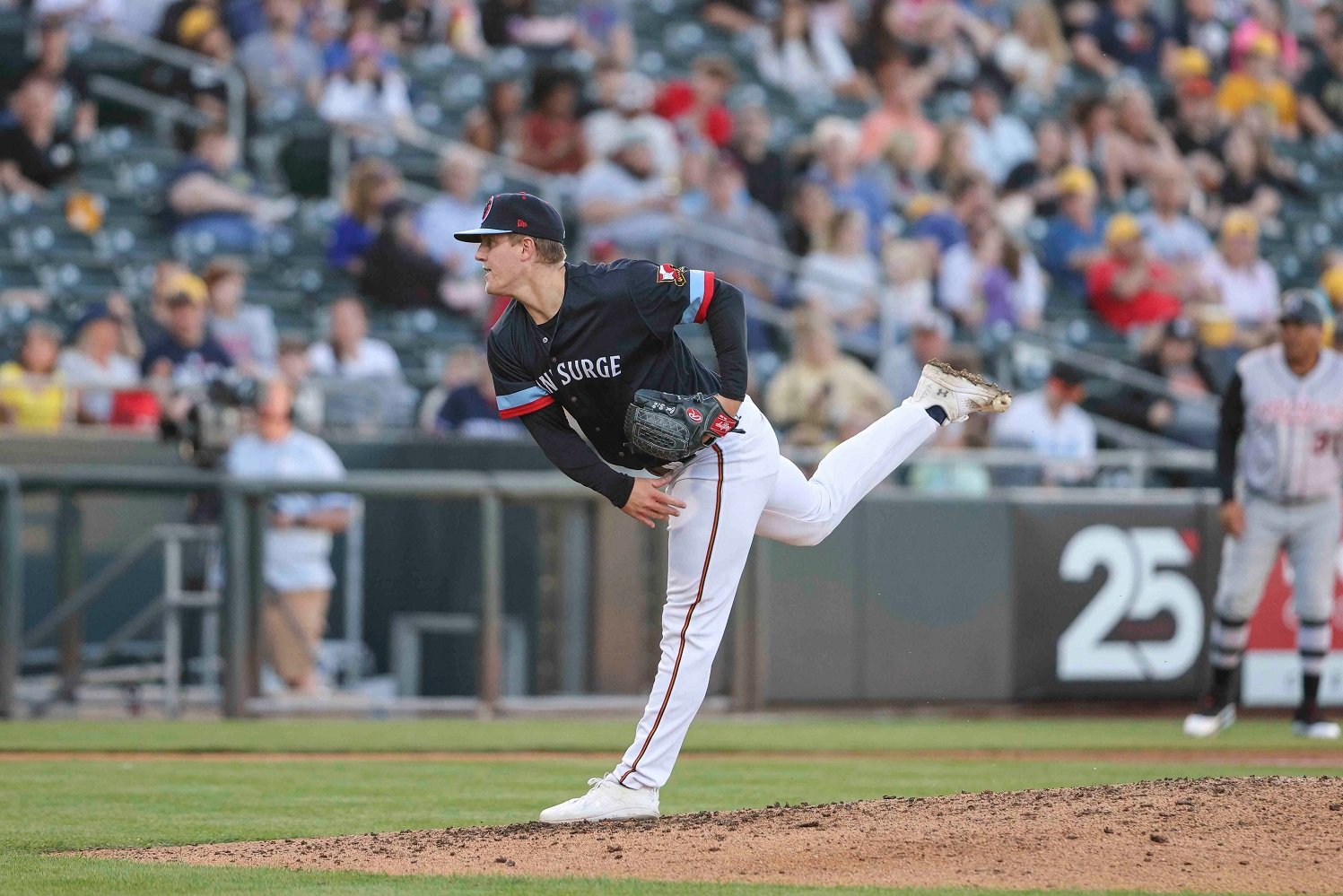 Stepping onto the mound for his AA debut for Wichita, 2022 draftee Zebby Matthews was staring down at a formidable group of hitters. The Arkansas Travelers boast a lineup that includes Cole Young and Harry Ford (34th and 35th in the MLB Pipeline top 100 prospects list). Tyler Locklear, a data darling and on base machine from the same draft as Matthews, also featured. Matthews put together an impressive debut for the Wind Surge, going 6.2 innings, giving up three hits, two unearned runs (scored on a throwing error) and striking out nine. It was a performance that has cemented him as a Twins MiLB arm who has taken a significant leap in 2024. Matthews was drafted under slot in the eighth round of the 2022 draft out of Western Carolina (signed for $125,000). With a prototypical starting pitcher’s frame (6’5, 220 pounds), the scouting report on Matthews coming out of college was that he was an elite strike thrower with good fastball characteristics without overpowering velocity or secondary pitches. That’s a useful draft tendency to hold onto. We know that the Twins tend to take a run of college pitchers in the mid to late rounds of the draft as they believe they can develop good value in that range, and so it has proved with pitchers like Bailey Ober and Louie Varland . College pitching in the middle rounds is typically rooted in one or two intriguing traits, the rest is up to the player development team and player to develop and work on. Matthews relied on an extensive pitch mix in 2023 (four seam, sinker, changeup, curveball, sweeper, cutter). The indicators from Twins PD staff were that developing consistent shapes on his secondary pitches was his biggest developmental need, having already added velocity to a good fastball. Thus far in 2024, the results have been outstanding. Matthews’ fastball touched 97 mph in his first AA start. Through 29.1 innings pitched this season, he’s maintaining a 1.18 FIP (1.72 xFIP), 34.6 K%, and hasn’t walked a single batter. Opposing hitters are currently hitting .187/.187/.243 (.430) off Matthews. All of this while leveraging his elite strike throwing (69.3 Strike%). To put Matthews’ control and command into context, his current strike percentage would rank sixth in MLB, behind Jared Jones, George Kirby, Zack Littell, Chris Sale, and Tarik Skubal. Matthews was always in the zone, now he’s beating hitters with increasingly nasty stuff in the zone. It’s always hard to balance excitement about prospects with pragmatism. Matthews will undoubtedly run into bumps and challenges as he adjusts at AA (and hitters adjust to him). He’s yet another example, though, of the Twins doing what they do best: identifying pitching that can be maximized by their player development team. Matthews deserves a ton of praise for the progress he’s made since turning pro. He’s certainly showing the type of improvement and development you want to see in a future big-league arm. Research assistance provided by TruMedia
 -
Jamie and Jeremy put Future Star Series Senior Analyst on the spot asking him who he believes is the best draft prospect to fall into the Twins' first pick for the 2024 MLB this upcoming July. Watch his answer and analysis of his choice of player here.
-
Jamie and Jeremy put Future Star Series Senior Analyst on the spot asking him who he believes is the best draft prospect to fall into the Twins' first pick for the 2024 MLB this upcoming July. Watch his answer and analysis of his choice of player here. View full video
-
Draft tandem Jeremy Nygaard and JD Cameron team up for a podcast to discuss prospects on their way to the big leagues and the MLB draft, produced by Theo Tollefson. Image courtesy of Thieres Rabelo Draft tandem Jeremy Nygaard and JD Cameron team up for a podcast to discuss prospects on their way to the big leagues and the MLB draft, produced by Theo Tollefson. In episode 34 of Destination: The Show, Jeremy and Jamie sit down with Joe Doyle, Senior Analyst at FSS and host of Over Slot, an MLB Draft Podcast. The guys talk through the top of the 2024 draft class, including asking Joe who he’d take at 1:1 before talking about some specific demographics and how they stack up compared to 2023. The guys then talk about some options for the Cubs, Brewers, and Twins with their first round picks in what looks like a chaotic draft board after the top group of prospects. They talk through the college catching class and some options for prep pitching and the challenges of the demographic. 1:20 Joe Doyle Intro 3:45 Comparing the top of this year's class vs last year's class 9:00 College bats are strong... but is there anything else aside from the top 8 picks? 18:27 A little chat about college catching. 20:25 Options for the Cubs at #14 24:45 Who would you consider for the Brewers at #17? 28:00 How about the Twins at #21? 32:15 Prep pitching 37:27 Some prep pitching highlights 43:00 Joe's take on the lottery and trading draft picks 48:30 Joe's chance to plug his stuff You can support the show by downloading it from wherever you get your podcasts, including iTunes and Spotify. If you enjoy the content, consider leaving us a five-star rating and review in addition to sharing or retweeting DTS-related content. You can follow us on Twitter @DTS_POD1, @Jeremynygaard, @J_D_Cameron, and @TheodoreTollef1. You can also find full episodes and clips of our shows on our YouTube page @DestinationTheShow. View full article

