



Jamie Cameron
-
Posts
1,349 -
Joined
-
Last visited
-
Days Won
4
Content Type
Profiles
News
Minnesota Twins Videos
2026 Minnesota Twins Top Prospects Ranking
2022 Minnesota Twins Draft Picks
Minnesota Twins Free Agent & Trade Rumors, Notes, & Tidbits
Guides & Resources
2023 Minnesota Twins Draft Picks
The Minnesota Twins Players Project
2024 Minnesota Twins Draft Picks
2025 Minnesota Twins Draft Pick Tracker
2026 Minnesota Twins Draft Tracker: Picks & Bonuses
Forums
Blogs
Events
Store
Downloads
Gallery
Everything posted by Jamie Cameron
-
Danny De Andrade hasn't played since May 15 as he went down in a game for High-A Cedar Rapids with a shin injury. The Arizona Fall League will provide him opportunities to make up for some, but not all of his lost playing time, so how can one of the best defensive infielders in the Twins organization take advantage of the short AFL season to prove himself great for 2025. View full video
-
Draft tandem Jeremy Nygaard and JD Cameron team up for a podcast to discuss prospects on their way to the big leagues and the MLB draft, produced by Theo Tollefson. Image courtesy of Thieres Rabelo Draft tandem Jeremy Nygaard and JD Cameron team up for a podcast to discuss prospects on their way to the big leagues and the MLB draft, produced by Theo Tollefson. In episode 53 of Destination: The Show, Jeremy and Jamie start by breaking down their rooting interests in the playoffs, and ask if the end of season is even more frustrating for Twins fans with two AL Central teams making an October run. Next they dig into some discussion on coaching staff turnover and how much it really matters and impacts the on field product. The guys then break down AFL rosters for the Brewers, Cubs and Twins. Jeremy talks through how the AFL has changed and highlights how teams leverage roster spots different from previous years. They spend time breaking down Brock Wilken, Luis Lara, Ryan Birchard, Moises Ballesteros, Benjamin Cowles, Jonathon Long, Kala’i Rosario, Danny De Andrade, and Kade Bragg, before answering questions on Matt Canterino and Connor Prielipp. 0:00 Intro 14:05 Arizona Fall League 19:50 Brewers 29:18 Cubs 39:00 Twins You can support the show by downloading it from wherever you get your podcasts, including iTunes and Spotify. If you enjoy the content, consider leaving us a five-star rating and review in addition to sharing or retweeting DTS-related content. You can follow us on Twitter @DTS_POD1, @Jeremynygaard, @J_D_Cameron, and @TheodoreTollef1. You can also find full episodes and clips of our shows on our YouTube page @DestinationTheShow. View full article
-
Destination: The Show. Episode 53. AFL Rosters are Here!
Jamie Cameron posted an article in Podcasts
 In episode 53 of Destination: The Show, Jeremy and Jamie start by breaking down their rooting interests in the playoffs, and ask if the end of season is even more frustrating for Twins fans with two AL Central teams making an October run. Next they dig into some discussion on coaching staff turnover and how much it really matters and impacts the on field product. The guys then break down AFL rosters for the Brewers, Cubs and Twins. Jeremy talks through how the AFL has changed and highlights how teams leverage roster spots different from previous years. They spend time breaking down Brock Wilken, Luis Lara, Ryan Birchard, Moises Ballesteros, Benjamin Cowles, Jonathon Long, Kala’i Rosario, Danny De Andrade, and Kade Bragg, before answering questions on Matt Canterino and Connor Prielipp. 0:00 Intro 14:05 Arizona Fall League 19:50 Brewers 29:18 Cubs 39:00 Twins You can support the show by downloading it from wherever you get your podcasts, including iTunes and Spotify. If you enjoy the content, consider leaving us a five-star rating and review in addition to sharing or retweeting DTS-related content. You can follow us on Twitter @DTS_POD1, @Jeremynygaard, @J_D_Cameron, and @TheodoreTollef1. You can also find full episodes and clips of our shows on our YouTube page @DestinationTheShow.
 -
Cory Lewis and Marco Raya made their Triple-A debuts in St. Paul in the final week of the Saints' season. Let’s dig into what they threw, how it looked, and the prognosis for each in 2025 and beyond. Image courtesy of Rob Thompson, St. Paul Saints Cory Lewis and Marco Raya made their Triple-A debuts in St. Paul in the final week of the Saints' season. Let’s dig into what they threw, how it looked, and the prognosis for each in 2025 and beyond. Cory Lewis It’s hard to imagine a more pleasing combination of outcomes than the ‘college four’ the Twins drafted in 2022, composed of Andrew Morris, Zebby Matthews, Cory Lewis, and C.J. Culpepper. Each has had ample success early in their professional careers. Taken as a foursome, what they’ve accomplished is remarkable; we shouldn’t take it for granted. Heading into 2024, Lewis was the most famous of the four. Shoulder fatigue delayed his start to the season, and the twin ascensions (one to each of the Twin Cities) of Zebby Matthews and Andrew Morris diminished Lewis’s starshine ever so slightly. After a strong second half of the season at Double-A Wichita, Lewis was rewarded with a Triple-A debut, so let’s dig into what he showed. Lewis pitched five innings, giving up seven hits, two earned runs, walking three and striking out two. Unlike Matthews and Morris, Lewis isn’t an elite strike thrower. He managed a Strike% of just 58.8% in his first Triple-A start (compared to 62.9% on the season in Double A, and an MLB league average of 65%). Lewis threw his four-seam fastball 30.6% of the time in his first start for the Saints. He averaged 19.1 inches of induced vertical break on the pitch, albeit from a higher release point. What was noticeable about Lewis’s fastball, was his velocity was down. It averaged just 89.9 mph. Even with a solid shape, that will need to tick back up a few mph to maximize it’s effectiveness. I’m putting that down to the grind of a long season. Lewis threw his knuckleball plenty (which also seems to be mischaracterized as a slider at times). It’s going to be an incredibly fun pitch to track. On the occasions it was correctly classified, it averaged just 243 RPM in spin rate, with a few thrown at 135 RPM. That’s diabolical. The pitch warrants further discussion, as it’s so unique. While Lewis kills spin at a similar level to Matt Waldron’s knuckleball and gets less play vertically, its velocity is unique. Lewis threw his hardest knuckleball in his start for the Saints at 86 miles per hour, and the pitch averaged over 83 MPH. (For reference, Waldron’s knucklers average 77.) It’s a deception of velocity, just as much as the unpredictable action of the baseball. It’s hard to pull the threads of Lewis’ profile together, for me. There are exciting assets in the fastball shape, the knuckleball, and the solid secondary offerings; and there are some challenges with a lack of elite velocity and shaky strike-throwing. He’ll continue to be a fascinating pitcher to track in 2025, and should get an extended run in St. Paul to open the season. Marco Raya Along with Kala’i Rosario, Raya is the remaining Twins holdout from the abbreviated 2020 COVID Draft, in which there were just five rounds. Then a 17-year-old, Raya’s scouting reports coming out of Texas emphasized the cleanness of his mechanics and repeatability of his delivery. Finally, four years later, we can pull back the hood on the stuff a little more tangibly. Raya is the Twins prospect I hear complained about the most, through no fault of his own. He’s been on strict pitch counts even in his last two seasons. It’s debatable whether the Twins should have gotten him more exposure to seeing a lineup for a third time, especially as he's ascended to the upper minors. An undeniable positive is that he’s now on the doorstep of the majors, and is still healthy. All things considered, keeping his health front and center is logical to me. In his debut, Raya threw 65 pitches. His four-seam fastball, although with an unremarkable shape, topped out at 96.2 mph. Raya also threw a pair of two-seam fastballs, averaging 12 inches of horizontal break. The other obvious thing about Raya is that he can really spin a baseball. His arsenal is rounded out by a cutter, slider and curveball. The two breaking pitches averaged close to 2,800 RPM, and the curveball got to 3,000, with around a foot of downward induced vertical break. It looks extremely tough on hitters. My hope for Raya is a lengthy, healthy runway at Triple-A in 2025. He’s undersized (listed at 6’0", 170 pounds), but has a legitimately diverse pitch mix and will eventually need to get reps surpassing 75 pitches if he’ll continue to be a starter as he gets closer to making an MLB debut. Saints Boast Impressive Pitching Depth for 2025 Taking a more global snapshot of the Twins organizational pitching depth, one can’t help but be encouraged. ‘Where is the pitching pipeline?’, the pithy refrain so blithely thrown around Twins Twitter as a subject of mockery in the earlier years of the Falvey regime, now has a cheeky but not mockable answer: right here. The team's dedication to scouting and development excellence, especially on the pitching side, is now bearing fruit. Not only that, its product is diverse, intriguing, and fun. Let’s travel down the 2025 rabbit hole for just a moment. In this future iteration of the Twins, Chris Paddack and Louie Varland are both full-time relievers. The Opening Day rotation of the big-league team is Pablo López, Bailey Ober, Joe Ryan, Simeon Woods Richardson, and David Festa. That’s a solid five. Let’s examine the immediate depth behind them at St. Paul. Without being able to predict offseason veteran signings, the Saints are likely to have Zebby Matthews, Andrew Morris, Cory Lewis, Marco Raya, and Randy Dobnak as starters, with Travis Adams as an extra option. Behind them at Wichita, there’s Pierson Ohl, Christian MacLeod, and C.J. Culpepper. This list goes on. Of course, that’s not to say all these pitchers will remain starters, remain effective starters, stay healthy, or even remain with the organization. Let’s make no mistake, though, the Minnesota Twins are a pitching development organization. That’s what they do well. If they want to trade assets to improve their offense prior to 2025, it’s likely to be from that deep corps of potential starters. In a season for the organization that seems to have ended in uniquely jarring disappointment, the saving grace is the feeling that the future remains bright. View full article
-
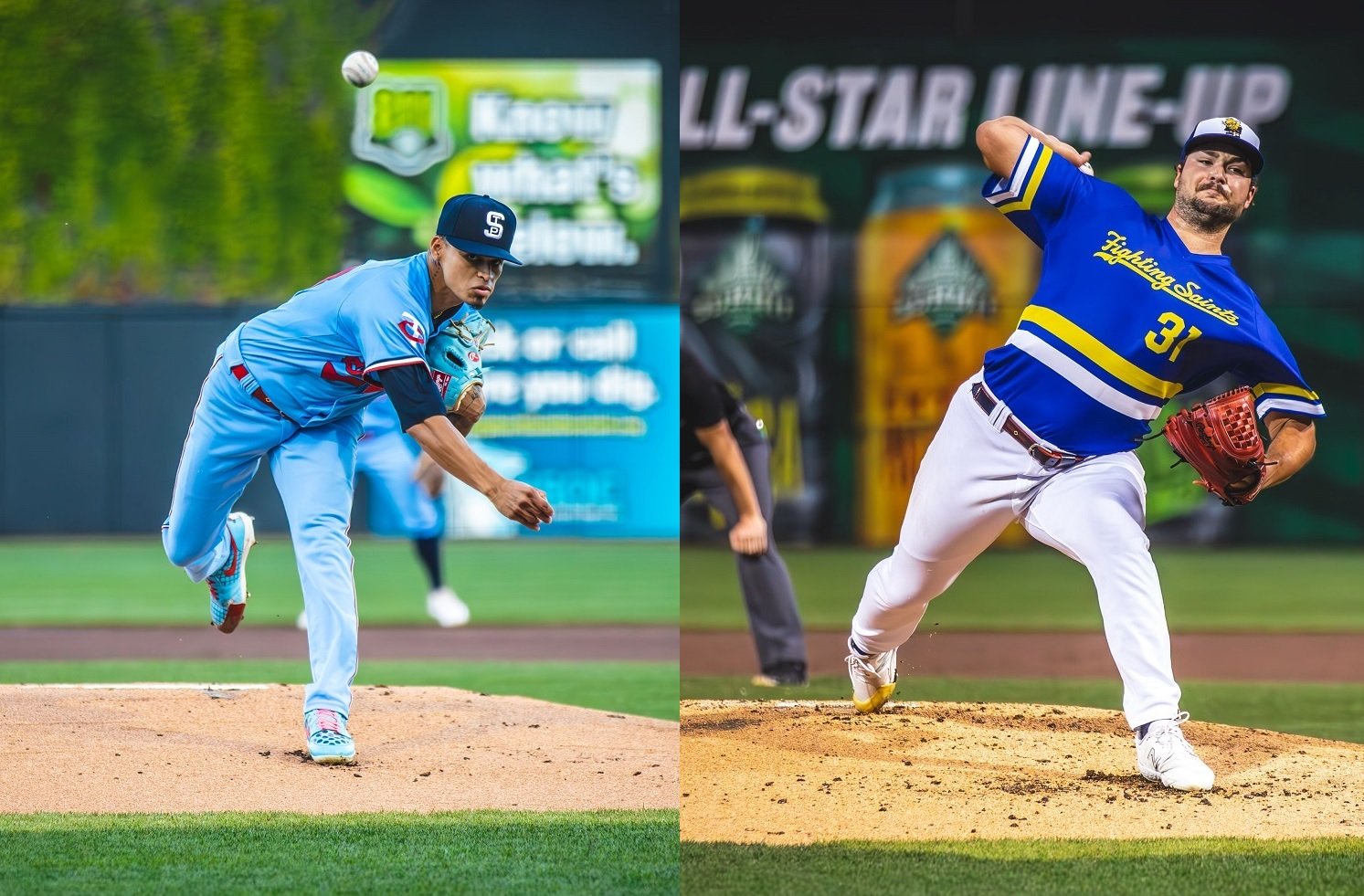 Cory Lewis It’s hard to imagine a more pleasing combination of outcomes than the ‘college four’ the Twins drafted in 2022, composed of Andrew Morris, Zebby Matthews, Cory Lewis, and C.J. Culpepper. Each has had ample success early in their professional careers. Taken as a foursome, what they’ve accomplished is remarkable; we shouldn’t take it for granted. Heading into 2024, Lewis was the most famous of the four. Shoulder fatigue delayed his start to the season, and the twin ascensions (one to each of the Twin Cities) of Zebby Matthews and Andrew Morris diminished Lewis’s starshine ever so slightly. After a strong second half of the season at Double-A Wichita, Lewis was rewarded with a Triple-A debut, so let’s dig into what he showed. Lewis pitched five innings, giving up seven hits, two earned runs, walking three and striking out two. Unlike Matthews and Morris, Lewis isn’t an elite strike thrower. He managed a Strike% of just 58.8% in his first Triple-A start (compared to 62.9% on the season in Double A, and an MLB league average of 65%). Lewis threw his four-seam fastball 30.6% of the time in his first start for the Saints. He averaged 19.1 inches of induced vertical break on the pitch, albeit from a higher release point. What was noticeable about Lewis’s fastball, was his velocity was down. It averaged just 89.9 mph. Even with a solid shape, that will need to tick back up a few mph to maximize it’s effectiveness. I’m putting that down to the grind of a long season. Lewis threw his knuckleball plenty (which also seems to be mischaracterized as a slider at times). It’s going to be an incredibly fun pitch to track. On the occasions it was correctly classified, it averaged just 243 RPM in spin rate, with a few thrown at 135 RPM. That’s diabolical. The pitch warrants further discussion, as it’s so unique. While Lewis kills spin at a similar level to Matt Waldron’s knuckleball and gets less play vertically, its velocity is unique. Lewis threw his hardest knuckleball in his start for the Saints at 86 miles per hour, and the pitch averaged over 83 MPH. (For reference, Waldron’s knucklers average 77.) It’s a deception of velocity, just as much as the unpredictable action of the baseball. It’s hard to pull the threads of Lewis’ profile together, for me. There are exciting assets in the fastball shape, the knuckleball, and the solid secondary offerings; and there are some challenges with a lack of elite velocity and shaky strike-throwing. He’ll continue to be a fascinating pitcher to track in 2025, and should get an extended run in St. Paul to open the season. Marco Raya Along with Kala’i Rosario, Raya is the remaining Twins holdout from the abbreviated 2020 COVID Draft, in which there were just five rounds. Then a 17-year-old, Raya’s scouting reports coming out of Texas emphasized the cleanness of his mechanics and repeatability of his delivery. Finally, four years later, we can pull back the hood on the stuff a little more tangibly. Raya is the Twins prospect I hear complained about the most, through no fault of his own. He’s been on strict pitch counts even in his last two seasons. It’s debatable whether the Twins should have gotten him more exposure to seeing a lineup for a third time, especially as he's ascended to the upper minors. An undeniable positive is that he’s now on the doorstep of the majors, and is still healthy. All things considered, keeping his health front and center is logical to me. In his debut, Raya threw 65 pitches. His four-seam fastball, although with an unremarkable shape, topped out at 96.2 mph. Raya also threw a pair of two-seam fastballs, averaging 12 inches of horizontal break. The other obvious thing about Raya is that he can really spin a baseball. His arsenal is rounded out by a cutter, slider and curveball. The two breaking pitches averaged close to 2,800 RPM, and the curveball got to 3,000, with around a foot of downward induced vertical break. It looks extremely tough on hitters. My hope for Raya is a lengthy, healthy runway at Triple-A in 2025. He’s undersized (listed at 6’0", 170 pounds), but has a legitimately diverse pitch mix and will eventually need to get reps surpassing 75 pitches if he’ll continue to be a starter as he gets closer to making an MLB debut. Saints Boast Impressive Pitching Depth for 2025 Taking a more global snapshot of the Twins organizational pitching depth, one can’t help but be encouraged. ‘Where is the pitching pipeline?’, the pithy refrain so blithely thrown around Twins Twitter as a subject of mockery in the earlier years of the Falvey regime, now has a cheeky but not mockable answer: right here. The team's dedication to scouting and development excellence, especially on the pitching side, is now bearing fruit. Not only that, its product is diverse, intriguing, and fun. Let’s travel down the 2025 rabbit hole for just a moment. In this future iteration of the Twins, Chris Paddack and Louie Varland are both full-time relievers. The Opening Day rotation of the big-league team is Pablo López, Bailey Ober, Joe Ryan, Simeon Woods Richardson, and David Festa. That’s a solid five. Let’s examine the immediate depth behind them at St. Paul. Without being able to predict offseason veteran signings, the Saints are likely to have Zebby Matthews, Andrew Morris, Cory Lewis, Marco Raya, and Randy Dobnak as starters, with Travis Adams as an extra option. Behind them at Wichita, there’s Pierson Ohl, Christian MacLeod, and C.J. Culpepper. This list goes on. Of course, that’s not to say all these pitchers will remain starters, remain effective starters, stay healthy, or even remain with the organization. Let’s make no mistake, though, the Minnesota Twins are a pitching development organization. That’s what they do well. If they want to trade assets to improve their offense prior to 2025, it’s likely to be from that deep corps of potential starters. In a season for the organization that seems to have ended in uniquely jarring disappointment, the saving grace is the feeling that the future remains bright.
 -
Prep Baseball has become the powerhouse in scouting high school athletes and the talent they possess to possibly go pro someday. Shooter Hunt, former Twins prospect hand and VP of Prep Baseball breaks down how they go about scouting athletes at such a young age and the realistic approach to their talent while their bodies are still growing.
-
Prep Baseball has become the powerhouse in scouting high school athletes and the talent they possess to possibly go pro someday. Shooter Hunt, former Twins prospect hand and VP of Prep Baseball breaks down how they go about scouting athletes at such a young age and the realistic approach to their talent while their bodies are still growing. View full video
-
 In episode 52 of Destination: The Show, Jeremy and Jamie bemoan a lifeless 6 week period of play from the MLB squad. They talk through if the team can and will make the playoffs, and where to direct criticism should they miss the postseason. The guys are joined by producer Theo to talk through Cory Lewis and Marco Raya, who were recently promoted to AAA. They ask how Morris will impact the MLB roster with so much competing depth, and if Raya’s long term future is as a starter or reliever. Finally, the guys dig into some prospects lower in the system, talking through the respective seasons of Charlee Soto, Brandon Winokur, and Kaelen Culpepper and their outlooks for 2025. 5:00 What Happens if the Twins miss the playoffs? 12:35 Who to criticize? 20:20 Andrew Morris 33:00 Marco Raya 43:00 Charlee Soto 52:11 Brandon Winokur 58:24 Kaelen Culpepper You can support the show by downloading it from wherever you get your podcasts, including iTunes and Spotify. If you enjoy the content, consider leaving us a five-star rating and review in addition to sharing or retweeting DTS-related content. You can follow us on Twitter @DTS_POD1, @Jeremynygaard, @J_D_Cameron, and @TheodoreTollef1. You can also find full episodes and clips of our shows on our YouTube page @DestinationTheShow.
 -
Draft tandem Jeremy Nygaard and JD Cameron team up for a podcast to discuss prospects on their way to the big leagues and the MLB draft, produced by Theo Tollefson. Image courtesy of Thieres Rabelo Draft tandem Jeremy Nygaard and JD Cameron team up for a podcast to discuss prospects on their way to the big leagues and the MLB draft, produced by Theo Tollefson. In episode 52 of Destination: The Show, Jeremy and Jamie bemoan a lifeless 6 week period of play from the MLB squad. They talk through if the team can and will make the playoffs, and where to direct criticism should they miss the postseason. The guys are joined by producer Theo to talk through Cory Lewis and Marco Raya, who were recently promoted to AAA. They ask how Morris will impact the MLB roster with so much competing depth, and if Raya’s long term future is as a starter or reliever. Finally, the guys dig into some prospects lower in the system, talking through the respective seasons of Charlee Soto, Brandon Winokur, and Kaelen Culpepper and their outlooks for 2025. 5:00 What Happens if the Twins miss the playoffs? 12:35 Who to criticize? 20:20 Andrew Morris 33:00 Marco Raya 43:00 Charlee Soto 52:11 Brandon Winokur 58:24 Kaelen Culpepper You can support the show by downloading it from wherever you get your podcasts, including iTunes and Spotify. If you enjoy the content, consider leaving us a five-star rating and review in addition to sharing or retweeting DTS-related content. You can follow us on Twitter @DTS_POD1, @Jeremynygaard, @J_D_Cameron, and @TheodoreTollef1. You can also find full episodes and clips of our shows on our YouTube page @DestinationTheShow. View full article
-
Destination: The Show. Episode 51, Shooter Hunt Interview
Jamie Cameron posted an article in Podcasts
 In episode 51 of Destination: The Show, Jeremy and Jamie are joined by Prep Baseball’s Vice President of Scouting and former Twins first round pick, Shooter Hunt. They discuss how scouting and player evaluation have changed with the explosion of publicly available data on prospects before digging into a discussion of player evaluation of prep prospects, in particular, prep pitchers. The guys dig into Shooter’s thoughts on the 2024 draft class and how it stacks up against the 2025 class before getting some insights on some of Shooter’s favorite hitting and pitching prospects for next summer’s draft cycle. Jeremy and Jamie talk through the Twins releasing Derek Bender after Fort Myers elimination from playoff contention. The guys are joined by Theo and finish with some thoughts on Cory Lewis and Marco Raya being promoted to St. Paul. 0:00 Intro 1:17 Shooter Hunt 3:20 Background 5:32 Approach to Evaluation 12:30 Prep Players 19:45 2024 Draft 24:35 2025 Draft 33:59 Names to Watch 36:20 Where to find Shooter 37:53 Derek Bender & Pitching You can support the show by downloading it from wherever you get your podcasts, including iTunes and Spotify. If you enjoy the content, consider leaving us a five-star rating and review in addition to sharing or retweeting DTS-related content. You can follow us on Twitter @DTS_POD1, @Jeremynygaard, @J_D_Cameron, and @TheodoreTollef1. You can also find full episodes and clips of our shows on our YouTube page @DestinationTheShow.
 -
Draft tandem Jeremy Nygaard and JD Cameron team up for a podcast to discuss prospects on their way to the big leagues and the MLB draft, produced by Theo Tollefson. Image courtesy of Thieres Rabelo Draft tandem Jeremy Nygaard and JD Cameron team up for a podcast to discuss prospects on their way to the big leagues and the MLB draft, produced by Theo Tollefson. In episode 51 of Destination: The Show, Jeremy and Jamie are joined by Prep Baseball’s Vice President of Scouting and former Twins first round pick, Shooter Hunt. They discuss how scouting and player evaluation have changed with the explosion of publicly available data on prospects before digging into a discussion of player evaluation of prep prospects, in particular, prep pitchers. The guys dig into Shooter’s thoughts on the 2024 draft class and how it stacks up against the 2025 class before getting some insights on some of Shooter’s favorite hitting and pitching prospects for next summer’s draft cycle. Jeremy and Jamie talk through the Twins releasing Derek Bender after Fort Myers elimination from playoff contention. The guys are joined by Theo and finish with some thoughts on Cory Lewis and Marco Raya being promoted to St. Paul. 0:00 Intro 1:17 Shooter Hunt 3:20 Background 5:32 Approach to Evaluation 12:30 Prep Players 19:45 2024 Draft 24:35 2025 Draft 33:59 Names to Watch 36:20 Where to find Shooter 37:53 Derek Bender & Pitching You can support the show by downloading it from wherever you get your podcasts, including iTunes and Spotify. If you enjoy the content, consider leaving us a five-star rating and review in addition to sharing or retweeting DTS-related content. You can follow us on Twitter @DTS_POD1, @Jeremynygaard, @J_D_Cameron, and @TheodoreTollef1. You can also find full episodes and clips of our shows on our YouTube page @DestinationTheShow. View full article
-
Carson McCusker is another hidden gem unearthed by the Twins putting up production in 2024 that's hard to ignore. What are his strengths, opportunities, and has he made his way into the Twins roster plans for 2025 and beyond? View full video
-
Carson McCusker is another hidden gem unearthed by the Twins putting up production in 2024 that's hard to ignore. What are his strengths, opportunities, and has he made his way into the Twins roster plans for 2025 and beyond?
-
Since his call-up to the Majors, Brooks Lee has seen many more times of struggles over success, but is this just a sign of how hard the Major Leagues are, especially when debuting with an injury? Jamie and Jeremy break down if this is a rookie slump or a long-term concern. View full video
-
Since his call-up to the Majors, Brooks Lee has seen many more times of struggles over success, but is this just a sign of how hard the Major Leagues are, especially when debuting with an injury? Jamie and Jeremy break down if this is a rookie slump or a long-term concern.
-
Draft tandem Jeremy Nygaard and JD Cameron team up for a podcast to discuss prospects on their way to the big leagues and the MLB draft, produced by Theo Tollefson. Image courtesy of Thieres Rabelo Draft tandem Jeremy Nygaard and JD Cameron team up for a podcast to discuss prospects on their way to the big leagues and the MLB draft, produced by Theo Tollefson. In episode 50 of Destination: The Show, Jeremy and Jamie start a marathon review of what's been a great year for the Twins farm system. They focus on six players at the top of the system (Walker Jenkins, Emmanuel Rodriguez, Brooks Lee, Luke Keaschall, Zebby Matthews and David Festa) and walk through an overview of their respective seasons. Jeremy and Jamie dig into some of their data and ask if it's 'stock up, stock down, or stock neutral' for each prospect. The guys dig into how to parse injury/end of season wear and tear with performance and try and put the ups and downs of rookie starting pitchers into big picture perspective. There's also some great listener questions, banter about the fancy seats at Target Field, and a preview of an exciting guest joining the show next week. 0:00 Intro 3:51 Jamie's New Gig 6:05 How to support the show 8:30 Walker Jenkins 16:18 E-Rod 30:19 Brooks Lee 38:14 Luke Keaschall 45:23 Zebby Matthews 51:05 David Festa You can support the show by downloading it from wherever you get your podcasts, including iTunes and Spotify. If you enjoy the content, consider leaving us a five-star rating and review in addition to sharing or retweeting DTS-related content. You can follow us on Twitter @DTS_POD1, @Jeremynygaard, @J_D_Cameron, and @TheodoreTollef1. You can also find full episodes and clips of our shows on our YouTube page @DestinationTheShow. View full article
-
Destination: The Show. Episode 50. Twins Farm System Review, Part 1.
Jamie Cameron posted an article in Podcasts
 In episode 50 of Destination: The Show, Jeremy and Jamie start a marathon review of what's been a great year for the Twins farm system. They focus on six players at the top of the system (Walker Jenkins, Emmanuel Rodriguez, Brooks Lee, Luke Keaschall, Zebby Matthews and David Festa) and walk through an overview of their respective seasons. Jeremy and Jamie dig into some of their data and ask if it's 'stock up, stock down, or stock neutral' for each prospect. The guys dig into how to parse injury/end of season wear and tear with performance and try and put the ups and downs of rookie starting pitchers into big picture perspective. There's also some great listener questions, banter about the fancy seats at Target Field, and a preview of an exciting guest joining the show next week. 0:00 Intro 3:51 Jamie's New Gig 6:05 How to support the show 8:30 Walker Jenkins 16:18 E-Rod 30:19 Brooks Lee 38:14 Luke Keaschall 45:23 Zebby Matthews 51:05 David Festa You can support the show by downloading it from wherever you get your podcasts, including iTunes and Spotify. If you enjoy the content, consider leaving us a five-star rating and review in addition to sharing or retweeting DTS-related content. You can follow us on Twitter @DTS_POD1, @Jeremynygaard, @J_D_Cameron, and @TheodoreTollef1. You can also find full episodes and clips of our shows on our YouTube page @DestinationTheShow.
 -
Entering the 2024 season, Brooks Lee was a consensus global top-35 prospect. He's been poor offensively in his limited playing time in the big leagues, though. What's at the heart of his struggles at the plate? Image courtesy of Jesse Johnson-USA TODAY Sports (photo of Brooks Lee) Entering the 2024 season, Brooks Lee was a consensus global top-35 prospect. He's been poor offensively in his limited playing time in the big leagues, though. What's at the heart of his struggles at the plate? It hasn’t been a smooth rookie season for Brooks Lee. A highly-ranked prospect entering 2024, Lee caught the eye in Spring Training, to the tune of a .963 OPS. Shortly after being assigned to minor-league camp, though, Lee was shut down in late March with what was described as back spasms. Those turned out to be a herniated disc that required two months of rehab, with Lee eventually starting a Complex League rehab assignment in late May. Lee debuted with the Twins on Jul. 4, before cranking a two-run home run against the Astros on Jul. 6. In early August, The Athletic reported Lee was dealing with shoulder soreness that ultimately resulted in an IL stint starting on Aug. 9, due to bicep tendonitis. Lee completed a brief rehab stint in St Paul, before returning to MLB action in early September. Lee has largely struggled during his inaugural big-league campaign. Through Wednesday, he’s hitting .222/.267/.319, with 7 extra-base hits in 37 MLB games. Why include such a tedious overview of Lee’s health challenges to open this piece? Because I don’t want to preclude the possibility that Lee is playing hurt, is incredibly worn down, or both. Any conjecture on his current physical condition on my part would be irresponsible speculation, so let’s focus on the data behind some of Lee’s 2024 struggles. What is going on under the hood here? Coming into 2024, it was clear Lee had challenges with his right-handed swing. Indeed, it was reported widely earlier this season that Lee had worked feverishly throughout the offseason to correct his poor output as a right-handed hitter in MiLB in 2023. So what has been the fruit of his labor? He’s crushed as a right-handed hitter in Triple-A in 2024. At the major-league level, it’s all been a struggle, with a slightly better performance from the right side. The dark humor shouldn’t be lost here. Lee worked extensively on his swing against left-handed pitching, which he’s seen in 48 MLB plate appearances, and now looks destitute against right-handed pitching (98 plate appearances). Can you go back to what you were doing in 2023, Brooks? What about those swings, though? Are they tangibly different in how they are impacting the baseball? Thanks to Baseball Savant’s impeccable timing, we can now answer that question. A quick primer on Statcast’s relatively new swing metrics: This season, Baseball Savant made swing data public. Here’s some important nuggets before we discuss Brooks Lee. A ‘fast swing’ is defined as a swing at 75 mph or greater. In the first month of the 2024 season, ~25% of swings were classified as ‘fast’. In very general terms, players who swing ‘fast’ more frequently outproduce those who don’t. Swing length is another metric we’ll use here. Simply, this measures in feet, the distance from the start of the swing to the point the bat impacts the baseball. Again, generally, longer swings produce more power, and often more miss. An average MLB swing is 7.3 feet. So, how do Brooks Lee’s swings plug into all this new fancy mumbo jumbo? Well, it might not surprise you to learn that Brooks Lee’s swings are shortish (6.9 feet on average) and slow (69.1 mph average). What might surprise you more is how different they are from each other. Lee’s left-handed swing (the one lauded throughout his career) is the slower of the two (68.7 mph vs 69.9 mph on average). Only 2.7% of Lee’s left-handed swings meet the ‘fast swing’ threshold of 75 mph+, compared to 8.6% of his right-handed swings. Lee’s left-handed swing is also a little shorter (6.8 feet vs 7.0 feet). It came as a surprise to me that Lee’s erstwhile stronger side per scouting reports (left-handed) is the slower, shorter swing currently. My question is whether there’s a mechanical issue with his swing from the left-side currently, whether technical or injury-related. It’s also worth noting that Lee’s bat speed is significantly below average. That’s not a death knell by any means, but it’s a challenge he has to navigate with a strong approach at the plate. So, what are some of Lee’s outputs that might be impacted by his swings? It’s worth noting here that Lee hasn’t been particularly good from the left or the right side in his limited MLB playing time, but the right-handed swing is the one currently set up to produce consistently better outcomes. Avg Swing Speed Avg Swing Length 90th Percentile EV LA Hit95+% OPS As LHH 68.7 mph 6.8 feet 99.8 mph 11.8 23% .562 As RHH 69.9 mph 7.0 feet 102.4 mph 14.2 30.6% .618 Any player’s swing metrics are an important piece of the puzzle, but not the only one. It’s important to dig into other data, as our notion of what Lee is as a hitter (currently) is belied by some other intriguing numbers. What of Lee’s approach, though? Lee talked prior to Wednesday’s series finale against the Angles about how his approach had been ‘in the dumps’. How is this reflection born out, or not, in his data? Well, he’s right. Lee chases, and I mean a ton. He’s currently chasing at a 34.3% clip, that’s ~15th percentile in MLB and way higher than average (28.3%). Lee chases, and it’s important to note how and where he chases. It’s everywhere. As you can see from the figure below, Lee chases to all compass points, giving pitchers a significant margin for error in devising a plan of attack to induce non-competitive swings. Additionally, Lee has become a more aggressive swinger, in general. He swung at 47.2% of pitches in July, 54.5% in August, and is up to 57.1% thus far in September. His in-zone swing percentage has fluctuated around its average for the season and he hasn’t seen improved outcomes from swinging more, making me question whether it’s part of a proactive approach, or he’s pressing at the plate. It’s tough to tie all of this in a bow. Lee has battled through a long season, he’s had two injuries that have impacted and interrupted his playing time. There’s certainly a strong enough minor-league track record to not be overly concerned, long-term. If Lee is going to become a consistent, high-quality MLB regular, he’ll need to improve his swing decisions to raise the lower ceilings his swings currently offer. View full article
-
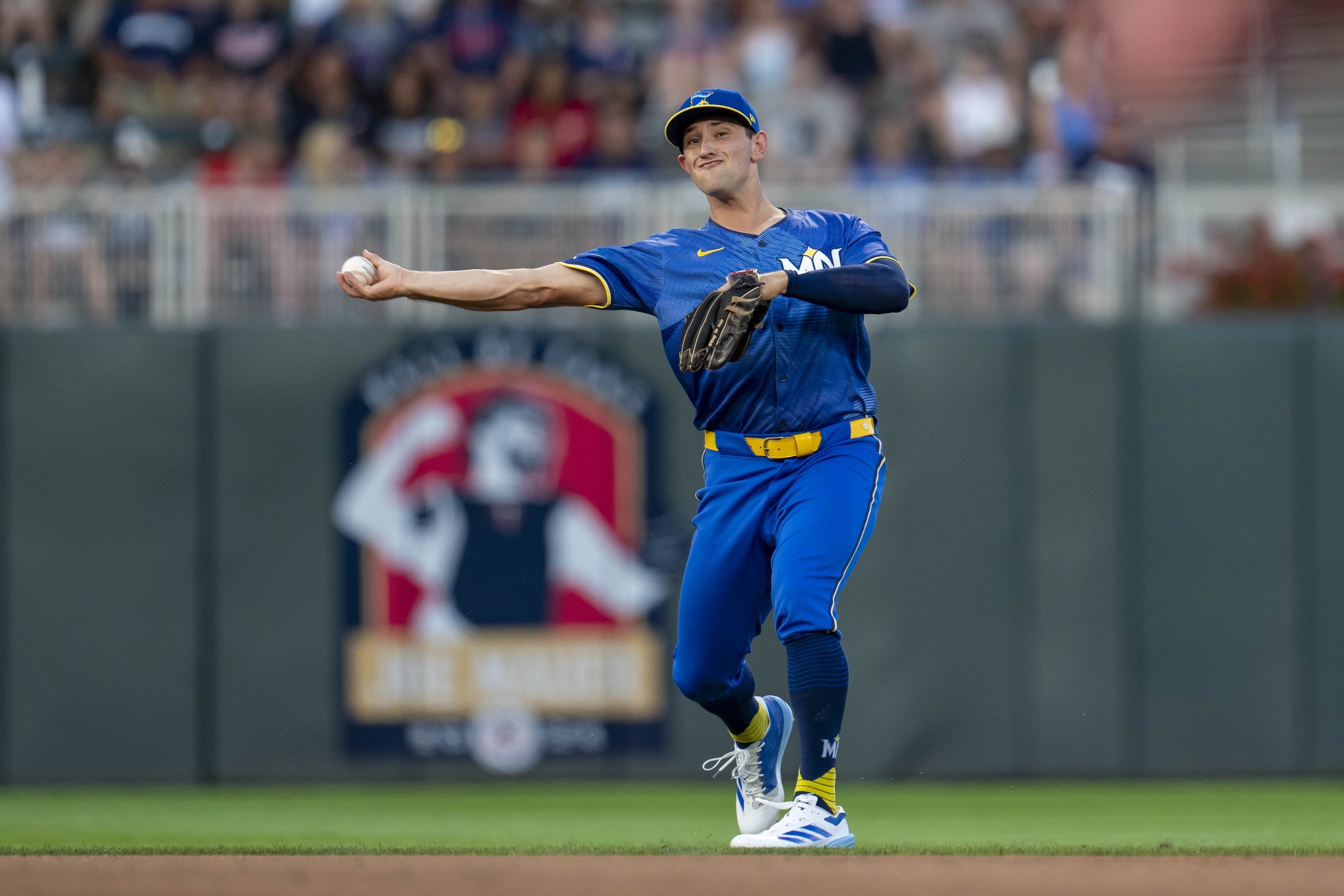 It hasn’t been a smooth rookie season for Brooks Lee. A highly-ranked prospect entering 2024, Lee caught the eye in Spring Training, to the tune of a .963 OPS. Shortly after being assigned to minor-league camp, though, Lee was shut down in late March with what was described as back spasms. Those turned out to be a herniated disc that required two months of rehab, with Lee eventually starting a Complex League rehab assignment in late May. Lee debuted with the Twins on Jul. 4, before cranking a two-run home run against the Astros on Jul. 6. In early August, The Athletic reported Lee was dealing with shoulder soreness that ultimately resulted in an IL stint starting on Aug. 9, due to bicep tendonitis. Lee completed a brief rehab stint in St Paul, before returning to MLB action in early September. Lee has largely struggled during his inaugural big-league campaign. Through Wednesday, he’s hitting .222/.267/.319, with 7 extra-base hits in 37 MLB games. Why include such a tedious overview of Lee’s health challenges to open this piece? Because I don’t want to preclude the possibility that Lee is playing hurt, is incredibly worn down, or both. Any conjecture on his current physical condition on my part would be irresponsible speculation, so let’s focus on the data behind some of Lee’s 2024 struggles. What is going on under the hood here? Coming into 2024, it was clear Lee had challenges with his right-handed swing. Indeed, it was reported widely earlier this season that Lee had worked feverishly throughout the offseason to correct his poor output as a right-handed hitter in MiLB in 2023. So what has been the fruit of his labor? He’s crushed as a right-handed hitter in Triple-A in 2024. At the major-league level, it’s all been a struggle, with a slightly better performance from the right side. The dark humor shouldn’t be lost here. Lee worked extensively on his swing against left-handed pitching, which he’s seen in 48 MLB plate appearances, and now looks destitute against right-handed pitching (98 plate appearances). Can you go back to what you were doing in 2023, Brooks? What about those swings, though? Are they tangibly different in how they are impacting the baseball? Thanks to Baseball Savant’s impeccable timing, we can now answer that question. A quick primer on Statcast’s relatively new swing metrics: This season, Baseball Savant made swing data public. Here’s some important nuggets before we discuss Brooks Lee. A ‘fast swing’ is defined as a swing at 75 mph or greater. In the first month of the 2024 season, ~25% of swings were classified as ‘fast’. In very general terms, players who swing ‘fast’ more frequently outproduce those who don’t. Swing length is another metric we’ll use here. Simply, this measures in feet, the distance from the start of the swing to the point the bat impacts the baseball. Again, generally, longer swings produce more power, and often more miss. An average MLB swing is 7.3 feet. So, how do Brooks Lee’s swings plug into all this new fancy mumbo jumbo? Well, it might not surprise you to learn that Brooks Lee’s swings are shortish (6.9 feet on average) and slow (69.1 mph average). What might surprise you more is how different they are from each other. Lee’s left-handed swing (the one lauded throughout his career) is the slower of the two (68.7 mph vs 69.9 mph on average). Only 2.7% of Lee’s left-handed swings meet the ‘fast swing’ threshold of 75 mph+, compared to 8.6% of his right-handed swings. Lee’s left-handed swing is also a little shorter (6.8 feet vs 7.0 feet). It came as a surprise to me that Lee’s erstwhile stronger side per scouting reports (left-handed) is the slower, shorter swing currently. My question is whether there’s a mechanical issue with his swing from the left-side currently, whether technical or injury-related. It’s also worth noting that Lee’s bat speed is significantly below average. That’s not a death knell by any means, but it’s a challenge he has to navigate with a strong approach at the plate. So, what are some of Lee’s outputs that might be impacted by his swings? It’s worth noting here that Lee hasn’t been particularly good from the left or the right side in his limited MLB playing time, but the right-handed swing is the one currently set up to produce consistently better outcomes. Avg Swing Speed Avg Swing Length 90th Percentile EV LA Hit95+% OPS As LHH 68.7 mph 6.8 feet 99.8 mph 11.8 23% .562 As RHH 69.9 mph 7.0 feet 102.4 mph 14.2 30.6% .618 Any player’s swing metrics are an important piece of the puzzle, but not the only one. It’s important to dig into other data, as our notion of what Lee is as a hitter (currently) is belied by some other intriguing numbers. What of Lee’s approach, though? Lee talked prior to Wednesday’s series finale against the Angles about how his approach had been ‘in the dumps’. How is this reflection born out, or not, in his data? Well, he’s right. Lee chases, and I mean a ton. He’s currently chasing at a 34.3% clip, that’s ~15th percentile in MLB and way higher than average (28.3%). Lee chases, and it’s important to note how and where he chases. It’s everywhere. As you can see from the figure below, Lee chases to all compass points, giving pitchers a significant margin for error in devising a plan of attack to induce non-competitive swings. Additionally, Lee has become a more aggressive swinger, in general. He swung at 47.2% of pitches in July, 54.5% in August, and is up to 57.1% thus far in September. His in-zone swing percentage has fluctuated around its average for the season and he hasn’t seen improved outcomes from swinging more, making me question whether it’s part of a proactive approach, or he’s pressing at the plate. It’s tough to tie all of this in a bow. Lee has battled through a long season, he’s had two injuries that have impacted and interrupted his playing time. There’s certainly a strong enough minor-league track record to not be overly concerned, long-term. If Lee is going to become a consistent, high-quality MLB regular, he’ll need to improve his swing decisions to raise the lower ceilings his swings currently offer.
 -
View full video
-
The Twins leaned into a strong crop of college hitters in the 2024 MLB Draft, selecting Kaelen Culpepper, Kyle DeBarge, and Billy Amick with their first three picks. How have they started off in their professional careers? Let's dig into their data from A-ball. Image courtesy of © Kevin Jairaj-Imagn Images The Twins leaned into a strong crop of college hitters in the 2024 MLB Draft, selecting Kaelen Culpepper, Kyle DeBarge, and Billy Amick with their first three picks. How have they started off in their professional careers? Let's dig into their data from A-ball. It’s hard to believe, but we’re already two months down the road from the 2024 MLB Draft. With the minor-league season in its final stretch, it’s time to take a look at how the Twins' top 2024 draftees are doing. Immediately after the draft, Sean Johnson intimated that the Twins were surprised by how many hitters held up on their draft board. Thankfully for us, the vast majority of them are at Fort Myers, where we have access to robust data on their first few weeks of professional baseball. For the purposes of this article, I’ve pulled some key metrics for each prospect to allow for some apples-to-apples comparison, and provided a little analysis for each to place their performance in context. It’s worth remembering that these are all still small sample sizes, so take them with a large grain of salt. Numbers were pulled prior to games on Sept. 3. NOTE: Kaelen Culpepper’s contact, in-zone whiff, chase, and exit velocity only take into account his time at Fort Myers. The rest of his numbers are cumulative across both levels he’s played at in 2024. Kaelen Culpepper, 1st Round, 21st Overall Selection Slash line: .241/.326/.405 (.731) 12.4 K%, 9 BB% 82.1% Contact% 0% InZoneWhiff% 33% Chase% 102.6 mph 90th percentile EV The first-round pick got off to as good a start as you could hope for, making short work of Low A in a nine-game sample. Of particular note were his 82% contact rate, and the fact that he didn’t swing and miss at a pitch in the strike zone once while at Fort Myers. Since moving to Cedar Rapids, Culpepper has slowed down, to the tune of just a .578 OPS in his first 12 games. He hit his first home run at High A on Aug. 31, though, so he might be starting to find his groove. Kyle DeBarge, Comp A, 33rd Overall Selection Slash line: .195/.311/.293 (.584) 25.6 K%, 13.3 BB% 79.1% Contact% 15.2% InZoneWhiff% 21.2% Chase% 102.7 mph 90th percentile EV 57.4% Ground% 1.8 LaunchAng For me, Kyle DeBarge will always be known as "the Sonny Gray pick". The 33rd overall selection was conferred upon the Twins as compensation, after Gray turned down the qualifying offer and signed with the Cardinals. The scouting reports on DeBarge coming out of college were of a hitter who controls the strike zone incredibly well, and had some of the best bat-to-ball skills of any college hitter in the class. DeBarge has posted some impressive numbers relating to his approach at Fort Myers. Through 20 games, he’s walking 13.3% of the time, sporting a contact rate around 80%, and a 15.2% InZoneWhiff%. DeBarge’s average and 90th percentile exit velocity are right around average for the level, too. So why has his raw production (.584) been so poor? DeBarge has run into a major ground-ball problem thus far as a pro. He’s running a 57% ground-ball rate, and an average launch angle of just 1.8 degrees. As soon as he’s able to generate more consistent loft, his production will quickly improve. Nothing to worry about here, yet. Billy Amick, Round 2, 60th Overall Pick Slash line: .222/.351/.413 (.763) 19.5 K%, 15.6 BB% 70.1% Contact% 18% InZoneWhiff% 25% Chase% 104 mph 90th percentile EV 55% Ground% Amick was a player connected with the Twins at 21st overall, which was a little rich for me. They were surely delighted he was still on the board at 60, though. The Twins don’t shy away from high chase rates when drafting (or trading for) hitters. Amick came with the added challenge of a slightly concerning contact rate in college. After a slow start, he turned it around in late August, getting on base plenty thanks to a 15.6 BB%. While the bat-to-ball skills and the chase rate are worth monitoring, Amick’s numbers have improved significantly in the last few weeks. Around 43% of Amick’s batted-balls have been hit 95 mph or harder, close to 10% above average for A ball. The easy power is certainly present. What are your thoughts on the Twins 2024 draft class thus far? Who has stood out to you? Research assistance provided by TruMedia Sports View full article
- 12 replies
-
- 2
-

-
- kaelen culpepper
- kyle debarge
- (and 1 more)
-
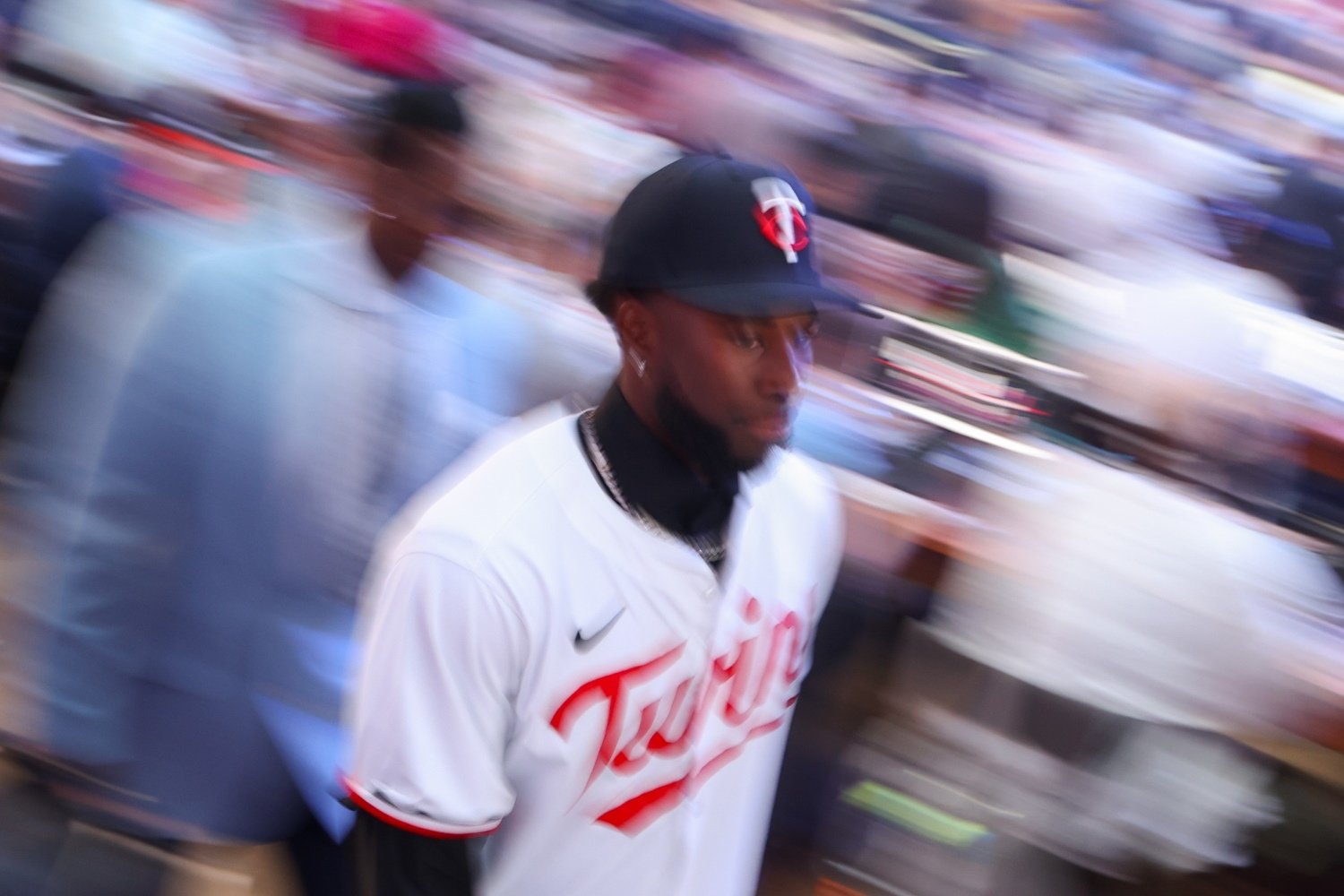 It’s hard to believe, but we’re already two months down the road from the 2024 MLB Draft. With the minor-league season in its final stretch, it’s time to take a look at how the Twins' top 2024 draftees are doing. Immediately after the draft, Sean Johnson intimated that the Twins were surprised by how many hitters held up on their draft board. Thankfully for us, the vast majority of them are at Fort Myers, where we have access to robust data on their first few weeks of professional baseball. For the purposes of this article, I’ve pulled some key metrics for each prospect to allow for some apples-to-apples comparison, and provided a little analysis for each to place their performance in context. It’s worth remembering that these are all still small sample sizes, so take them with a large grain of salt. Numbers were pulled prior to games on Sept. 3. NOTE: Kaelen Culpepper’s contact, in-zone whiff, chase, and exit velocity only take into account his time at Fort Myers. The rest of his numbers are cumulative across both levels he’s played at in 2024. Kaelen Culpepper, 1st Round, 21st Overall Selection Slash line: .241/.326/.405 (.731) 12.4 K%, 9 BB% 82.1% Contact% 0% InZoneWhiff% 33% Chase% 102.6 mph 90th percentile EV The first-round pick got off to as good a start as you could hope for, making short work of Low A in a nine-game sample. Of particular note were his 82% contact rate, and the fact that he didn’t swing and miss at a pitch in the strike zone once while at Fort Myers. Since moving to Cedar Rapids, Culpepper has slowed down, to the tune of just a .578 OPS in his first 12 games. He hit his first home run at High A on Aug. 31, though, so he might be starting to find his groove. Kyle DeBarge, Comp A, 33rd Overall Selection Slash line: .195/.311/.293 (.584) 25.6 K%, 13.3 BB% 79.1% Contact% 15.2% InZoneWhiff% 21.2% Chase% 102.7 mph 90th percentile EV 57.4% Ground% 1.8 LaunchAng For me, Kyle DeBarge will always be known as "the Sonny Gray pick". The 33rd overall selection was conferred upon the Twins as compensation, after Gray turned down the qualifying offer and signed with the Cardinals. The scouting reports on DeBarge coming out of college were of a hitter who controls the strike zone incredibly well, and had some of the best bat-to-ball skills of any college hitter in the class. DeBarge has posted some impressive numbers relating to his approach at Fort Myers. Through 20 games, he’s walking 13.3% of the time, sporting a contact rate around 80%, and a 15.2% InZoneWhiff%. DeBarge’s average and 90th percentile exit velocity are right around average for the level, too. So why has his raw production (.584) been so poor? DeBarge has run into a major ground-ball problem thus far as a pro. He’s running a 57% ground-ball rate, and an average launch angle of just 1.8 degrees. As soon as he’s able to generate more consistent loft, his production will quickly improve. Nothing to worry about here, yet. Billy Amick, Round 2, 60th Overall Pick Slash line: .222/.351/.413 (.763) 19.5 K%, 15.6 BB% 70.1% Contact% 18% InZoneWhiff% 25% Chase% 104 mph 90th percentile EV 55% Ground% Amick was a player connected with the Twins at 21st overall, which was a little rich for me. They were surely delighted he was still on the board at 60, though. The Twins don’t shy away from high chase rates when drafting (or trading for) hitters. Amick came with the added challenge of a slightly concerning contact rate in college. After a slow start, he turned it around in late August, getting on base plenty thanks to a 15.6 BB%. While the bat-to-ball skills and the chase rate are worth monitoring, Amick’s numbers have improved significantly in the last few weeks. Around 43% of Amick’s batted-balls have been hit 95 mph or harder, close to 10% above average for A ball. The easy power is certainly present. What are your thoughts on the Twins 2024 draft class thus far? Who has stood out to you? Research assistance provided by TruMedia Sports
- 12 comments
-
- 7
-

-
-

-
- kaelen culpepper
- kyle debarge
- (and 1 more)
-
Connor Prielipp's early career was derailed by injuries. Now pitching at A+, he's showing nasty stuff and dominating hitters. We dig into some of the data from his return to action.
-
Connor Prielipp's early career was derailed by injuries. Now pitching at A+, he's showing nasty stuff and dominating hitters. We dig into some of the data from his return to action. View full video
