Major League Ready
-
Posts
7,875 -
Joined
-
Last visited
-
Days Won
26
Content Type
Profiles
News
Minnesota Twins Videos
2026 Minnesota Twins Top Prospects Ranking
2022 Minnesota Twins Draft Picks
Minnesota Twins Free Agent & Trade Rumors, Notes, & Tidbits
Guides & Resources
2023 Minnesota Twins Draft Picks
The Minnesota Twins Players Project
2024 Minnesota Twins Draft Picks
2025 Minnesota Twins Draft Pick Tracker
2026 Minnesota Twins Draft Tracker: Picks & Bonuses
Forums
Blogs
Events
Store
Downloads
Gallery
Everything posted by Major League Ready
-
Really good point regarding Castro’s value in covering some many positions. In terms of him needing to be a completely different player at STP, I am not so sure. He was pretty respectable in AA and AAA when he was with Texas. His AA OPS was .808 and his AAA OPS was .829. In comparison, Brooks Lee had an OPS of .750 his first year of AA and .841 his 2nd year and .731 in AAA. I think there is a decent chance they keep him on the 40 man and hope to get a Castro like improvement. He only has 241 ABs at the big league level. Nice low risk play with a guy that still has upside.
-
Are the Tigers Really Coming?
Major League Ready replied to Ted Schwerzler 's topic in Twins Daily Front Page News
Their best position players last year were very young players just like the Twins. Our experienced players are better and deeper. Their big free agent (Baez) was absolutely brutal. I like the odds of Correa bouncing back better than Baez. The potential big difference maker is we have Buxton. He might produce nothing but he could have a huge impact. We also have Kepler assuming he is not traded.- 31 replies
-
- 4
-

-
- spencer torkelson
- aj hinch
- (and 5 more)
-
Do you believe elevating the luxury tax threshold is influencing spending? Obviously, that is not on Boris but the players union was pushing very hard to expand the gap. They also actually wanted to reduce revenue sharing. We needed changes in the last CBA to diminish the disparity. Boris and the union would have never accepted this type of change and the owners of the top revenue teams were not going to just give their competitors more of their revenue.
-
Detroit is still at $17M less in payroll. Seattle is about $7M more than the Twins and they traded away a very good SP to shed salary. Colorado is about $20M above. They will have at least $50M more revenue than the twin this year unless they find a much better TV deal than expected. None of these teams lost their TV contract and STL has always produced significantly more revenue than the Twins. The Twins signed the largest free agent contract in their history last year and extended Lopez after extending Buxton the year before. That’s not going to happen every year.
- 45 replies
-
- 8
-
-
- carlos correa
- josh donaldson
- (and 1 more)
-
No shortage of people who don't want to bother to get informed. Yet, plenty of people willing to criticize.
-
It's hard to argue that the Correa signing is going to hurt the team if he continues to perform as he did in 2023. I doubt that happens but there have been many just horrible long-term big money deals that have produced virtually nothing. Where we don't agree is that the Gallo deal is not even remotely close to horrible. It's just not possible to hurt the team all that much with a one year deal. We could recite a very long list of 5-10 year deals that have been complete disasters. Gallo plugged some holes with an average bat for 1 year. Big deal! The problem is already gone at no future cost. We could still be paying for Bumgarner who was highly touted here when he was a FA.
- 45 replies
-
- 4
-
-
- carlos correa
- josh donaldson
- (and 1 more)
-
Would it be fair to characterize the moves for Castro and Stewart as being "around the edges"? I seem to remember similar sentiment towards Castro. While I don't remember the reaction to Stewart I would bet we could find reference to him as "dumpster diving".
-
It's not math, I think the assumptions here limits the potential revenue stream. The first assumption is that would be that fans are only willing to pay $100 for 162 games and 6 months of entertainment. That won't cover the cost of one decent dinner out for a couple. The family spends $266 to attend a single MLB game. IDK the tipping point but $100 seems low. MLB is in trouble if that's all people are willing to pay. There is also an assumption here that the pricing model only includes a monthly option. Streaming allows for a multi-tier pricing model. They could offer 20 or 40 game bundles for the average fan. Obviously, this would be more expensive on a per game basis than a season pass but this would provide a lower price point option. They could also charge separately for playoff games. Perhaps free playoffs could be an incentive to buy a season pass. The most impactful assumption here is the absence of advertising revenue which is more valuable than streaming fees. IDK how many minutes of advertising there are per game + pregame + postgame but multiply that number by 162 and that's far more valuable than the fees charges to viewers. I don't think it's math in this analogy where "math" means economics. They need to find a model and a partner that can maximize the value of the advertising fees.
-
No problem we just disagree on this one. I almost always agree with you but not here. The broadcasting deals a decade ago looked pretty darn good. I would bet the owners and the league pursue strategies based on long-term revenue vs short-term cash flow. It will be apparent with the Twins soon enough. Millionaires don't become billionaires with long-term vision. Do you think Bill Gates made decisions based on immediate term? These guys are the optime of long-term strategists. My firm put together a strategic plan for all of the companies owned by one the NBA owners. Their focus was very much on long-term sustainable growth. In my experience, the vast majority of fortune 500 companies make decisions based on long-term revenue and profitability. They discount future returns but the decisions are almost always based on long-term return and risk mitigation. Granted, we are not talking about owners in this context but this sort of approach is widely the norm.
-
The problem with your logic is that you want a solution that is not possible. Good faith also requires you have a viable alternative. You just can't go replace these guys. The team does not have anywhere near the financial resources to follow the practices you promote. They could trade away their entire future but short of that the fantasy tactics you insist upon are either totally unrealistic or horrible long-term. What is the alternative to relying on Lewis / Kirilloff and Wallner? How do you manage the roster spots. Are you getting rid of them, giving them bench roles or sending them, back to AAA?
-
Who do you think is most likely to look out for the best interest of the game? Players who have an extremely short-window to cash-in or owners who reap enormous financial reward for growing the sport and keeping it healthy. The answer is quite clear when reviewing the position of both sides during the last CBA. I am not suggesting the owners would look out for the long-term interests of the game out of love for the game. Their selfish interests align much better with the long-term interest of the game than the players who wanted to reduce revenue sharing, pushed hard for a very high luxury tax threshold, and opposed an international draft.
-
Streaming offers the opportunity to tailor the service that is completely unbundled. They could offer the ability to purchase a single game pass. Obviously, they would charge a higher rate. It might be $3-4 for a single game but viewers would not have to commit to anything. Per game fees would be billed to a credit card on file. They could sell 20 or 40 or 80 game packages or a season pass. Playoffs could be included in a season pass or even that could be sold on a per game basis.
-
For starters, this have to do with owners who answer to nobody? They are going to do whatever is best for them in the long run. If you think they are so ignorant as to prioritize short-term gains you are badly misinformed. Actually, uninformed would be more accurate.
-
While you are no doubt correct that injury could derail these players seasons. That same risk of injury exists for older/more established players. It's a good thing our big dollar players like Correa and Buxton crushed it for a grand total of less than 2 WAR for $48M and our other two most expensive signings (Vasquez & Gallo) sucked too. By your logic there is no hope no matter what they do.
-
Billionaires as a group have an exponentially better understanding of long-term value than baseball fans in general. If they don't possess that skillset, and even if they do, they hire people exceptionally skilled in this area. They also don't need the money. It is basically certain that they will evaluate the various future state scenarios and pick the option with the best long-term financial outlook.
-
Is Ryan Jeffers Underrated?
Major League Ready replied to Cody Christie's topic in Twins Daily Front Page News
The 1876 reference really brings this home. It's hard to calculate the impact of a blown call on the game because it depends on so many variables. We do however know the impact for a given AB. A blown call with a 1;1 count has a huge impact on an AB. The difference between 2:1 and 1:2 is huge. Obviously, a blown call on a full count decides an AB. -
Is Ryan Jeffers Underrated?
Major League Ready replied to Cody Christie's topic in Twins Daily Front Page News
There are a lot of analogies that come to mind. Why did they invoke replays if calling a runner who is safe out or calling a would be hit foul a hit if this is charming. How an unfair call is charming is beyond me. A blown call absolutely changes the AB and therefore the game. Why would we want the game changed by a bad call. It's not really the umpires fault. The stuff pitchers are throwing up there these days is stretching the limits of human vision. The good news is that it would appear is that a lot of people recognize this is a wart on the game. They did a good job with the latest rule changes and they will eventually get this right. -
Lewis, Wallner, and Kirilloff produced a total of 5.1 WAR. They only played 222 games combined. I don't think you are accounting for the cumulative nature of WAR. With any luck they are going to play 400+ games between them. If that happens, 7.5-10 WAR is not "insanely optimistic" Lewis is quite capable of putting up 5 WAR himself. Buxton and Correa only produced 1.8 WAR combined. Those two playing just near what was expected when they were signed would make this a different team.
- 66 replies
-
- 1
-
-
- carlos correa
- pablo lopez
- (and 2 more)
-
Our reality (Minnesota Twins fans) and teams with similar revenue is that success is absolutely dependent upon the acquisition and development of young players. That means drafting or trading for prospects. Obviously, the more cheap players they produce the more they can spend on free agents but that well is limited when you generate 200-300M less than the top teams. There is no more money. How do you invest money you don't have? We have already invested in the form of Correa, Lopez, and Buxton. Our excess is spent. You can also do some trading of prospects if you produce enough to have an excess but trading six year assets for two year assets is a losing strategy unless you are fortunate enough to only trade away prospects that fail. Pick any team from the last 20 years with 90 wins outside the top dozen in revenue. 80-90% of their top players by WAR were drafted or acquired as prospects. Why should we focus on practices that have not yielded results? BTW ... This includes players acquired in trade before they became established players. Fans generally want it immediately, so they don't want to wait for prospects and assume established players are the answer. They fail too. I can quite clearly recall posters here absolutely going off on the FO because they did not understand that Madison Bumgarner was a no brainer and they should have offered him whatever it took. If the 2022 Mets and Padres don't cure the assumption that established players often fail, I don't know what will. I would love to have an extra couple hundred million in revenue so that our team could buy players an absorb the frequent failure associated with free agents. However, we don't have that luxury. Developing players is a prerequisite to winning for the Minnesota Twins and teams of similar revenue. I am far more worried about the execution of viable practices than what could be had with another $30M in payroll. For example, had they drafted Carroll instead of Cavaco that one decision would very likely made more difference than spending $30M on a free agent, especially during the back half of the contract. I also would like to have CES right now and SGL looked good in his first appearances.
- 66 replies
-
- 1
-
-
- carlos correa
- pablo lopez
- (and 2 more)
-
Farmer / Castro and Martin makes for an incredibly versatile bench.
-
He looked good in his last 150 ABs (starting 7/25). His OPS was .901 with a .300 BA and .428 OBP. I would not be shocked if he broke camp with the ML club. I think any chance of that happening will be a product of trades yet to be seen. More likely is he sees another 150ABs in STP. Hopefully, he is even better and we see him on the big club in June.
-
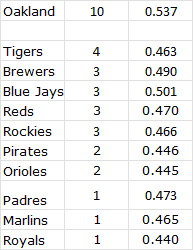
I presume your conclusion is they are only concerned about the bottom line. If they were able to win without revenue sharing, why wouldn't they just pocket the extra money and keep on winning? I don't doubt that every franchise is focus on profitability just as players are focused on maximizing their salary. Winning generates more revenue so why would they not continue to operate as they had in order to maximize profitability? I think it's more likely they were at the end of one of the many cycles this team has gone through which has also been the norm for all of the other teams in the bottom half of revenue. The difference being a lot of the teams in the bottom half have very few winning years ever. I put together the chart below after the 2022 season. This shows overall win percentage and number of 90 win seasons for the bottom 10 teams compared to Oakland.
-
Yes. I would imagine we read the same accounts of revenue during covid. I was not considering national broadcast revenue given they are not impacted by the issue with RSNs and the national money does not change. I thought the context was local TV revenue given the national revenues are not in jeopardy.
- 33 replies
-
- 1
-
-
- jordan montgomery
- blake snell
- (and 1 more)
-
A couple years ago I compiled the win/loss data back to the turn of the century for all of the teams in the bottom half of revenue. The A's had the most 90 win seasons and best overall record. Only the Guardians and Rays were anywhere close. They also had a better win percentage than half of the teams in the top half of revenue.
-
With ticket revenue comes concessions and apparel sales. The MLB average for a family is of 4 is $266 or $66.50/person. I would assume that couples spend more per person. However, if we use $66.50/person, a team drawing 2.5M fans would generate $166M. So, if we view this a TV vs in person attendance, teams like the Red and Twins generate far less revenue from broadcasting rights.