



Nick Nelson
-
Posts
8,326 -
Joined
-
Last visited
-
Days Won
56
Content Type
Profiles
News
Minnesota Twins Videos
2026 Minnesota Twins Top Prospects Ranking
2022 Minnesota Twins Draft Picks
Minnesota Twins Free Agent & Trade Rumors, Notes, & Tidbits
Guides & Resources
2023 Minnesota Twins Draft Picks
The Minnesota Twins Players Project
2024 Minnesota Twins Draft Picks
2025 Minnesota Twins Draft Pick Tracker
2026 Minnesota Twins Draft Tracker: Picks & Bonuses
Forums
Blogs
Events
Store
Downloads
Gallery
Everything posted by Nick Nelson
-
 Last week, the Minnesota Twins announced that they would not be activating the contract option for Glen Perkins, making him a free agent. Matt Belisle will soon join him. At that point, the Twins will have a total of three major-league saves on their entire roster (one apiece for Trevor Hildenberger, Tyler Duffey and Gabriel Moya). If experience is at all a weighty factor for this team, then we have a pretty clear idea of what they'll be looking for on the relief market.The 2017 Twins season was, in some ways, a banner example of the closer label's fungibility. In the past, Minnesota has been guilty of vastly overrating the importance of ninth-inning experience, to its own detriment (*coughMATTCAPPScough*). But this past season, we saw Brandon Kintzler, a veteran with zero career MLB saves prior to overtaking the role midway through 2016, excel as an extremely reliable door-slammer. He converted 28 of 32 saves and made the All-Star team before being traded to Washington. Good reliever = fine closer. After Kintzler went to the Nationals, Belisle took over in the ninth. The 37-year-old had never in his career served as a regular closer. During the final two months, he converted nine of 11 saves. Good reliever = fine closer. These instances seem to confirm something most of us already knew: there's nothing supernatural about pitching in the ninth inning. And with this in mind, the urgency of adding a reliever with such experience during the offseason is lowered. The Twins have at least one player who could plausibly open the 2018 season as closer, with others in line to get a shot in the near future. Download attachment: CTA-Banner.jpg READY NOW? Trevor Hildenberger: Hildenberger was fantastic as a rookie in 2017, with his stellar mix of strikeouts and grounders proving extremely reliable. He rose to the occasion time and time again in big spots. He got both righties and lefties out. And he has plenty of experience closing in the minors. But he's also 26 with only 42 innings logged in the big leagues. This, too, is problematic: pigeonholing him in the ninth stops him from being available to Paul Molitor in those key mid-game high-leverage spots where Hildenberger was a godsend this year. I'm not sure you can make a strong case for anyone else internally being ready to take on the closer job now. But as soon as mid-season in 2018, several others could emerge as legit options. READY SOON? Tyler Duffey: The 2017 season was a frustrating one for Duffey, who flashed overpowering stuff at times and posted solid peripherals (3.72 FIP) but could never get into a prolonged groove in terms of results. It's important to remember, though, that he hadn't previously pitched out of the bullpen since 2013 and was in the Twins rotation mix all the way up until the end of spring camp. If he prepares for 2018 as a reliever, and comes back with an extra tick or two on his fastball to complement his power curve, he's certainly got the makings of a closer. He was a dominant one in college at Rice University. JT Chargois: Duffey's co-closer at Rice has been on the path to a late-inning role in the majors ever since being drafted, and looks to me like a closer in waiting. He has the pedigree and potency, no doubt. But he lost almost his entire 2017 campaign to an elbow injury, so he'll need to come back and prove himself effective before any kind of high-leverage assignment is on the table. Ryan Pressly: It was a weird year for Pressly. You look at so many elements of his game and see the profile of someone who could close. His fastball burns in at 96 with a complementary slider at 90. His 3.2 K/BB ratio, 1.16 WHIP, and 50% grounder rate all signaled a quality bullpen weapon. If he could translate his second-half performance (2.62 ERA, .582 opp OPS) over a full season he'd be a perfectly suitable closer. But he's gotten in his own way too often to be counted on. A sustained run of setup excellence in April and May next year could change the narrative. Gabriel Moya: Acquired for John Ryan Murphy in a late-July trade, Moya had a phenomenal season closing at Double-A, saving 24 games with a 0.77 ERA and 0.77 WHIP, plus a 13.4 K/9 rate. The stuff played in his first taste of the majors, producing a 12.4% swinging strike rate (tied with Pressly for highest in pen) and holding opponents to a .206 average, albeit in a small sample of seven appearances. He performed very well against righties. Moya is definitely a sleeper for the gig but won't be in the mix until midseason. Tyler Jay: The true sleeper in this discussion. Like Chargois, Jay endured a lost season in 2017, but now he's back in the Arizona Fall League and proving he's healthy. After dealing with shoulder and neck issues again this summer, there were rumblings he'd need thoracic outlet surgery, but has repeatedly tested negative for that condition. Like Chargois, he has the stuff and pedigree; it's just a matter of staying healthy and showing what he can do. FINDING A PLUG The six players listed above are realistic candidates to be good relievers, and as our earlier arithmetic suggests: Good reliever = fine closer. But no matter how much you want to downplay it, there is an added element when it comes to pitching in the ninth. There's unique pressure as a hurler faces the reality that small mistakes can turn a win into a loss very quickly. Any team, especially one with an offense like Minnesota's, can bounce back from a bullpen hiccup in the middle innings. When you're at the very end of the game? Not so much. Kintzler and Belisle converting a combined 86% of their save chances is an underrated factor in Minnesota's 2017 success, and the Twins need to try to replicate that efficacy in late lead protection. While neither Kintzler nor Belisle had history as a closer, or even a particularly dominant relief pitcher, they did have this arguably essential attribute: lots of experience in the big leagues. So if the Twins want to hold off on anointing one of the relatively inexperienced relievers as closer, it would make sense to find at least an interim veteran plug. Ideally, they'd do so without paying the premium for closer experience. Who on this year's market could be the next Kintzler? In our upcoming 2018 Offseason Handbook (preorder now!), we lay out the free agent reliever landscape. Wade Davis, of course, sits at the top of the pack, and is really the only bona fide "Proven Closer" in the group. Others like Seung-hwan Oh and Fernando Rodney have the experience but are somewhat shaky bets. These are some names that catch my eye as I survey what's going to be out there: Brandon Kintzler, RHP: If you're looking for a Brandon Kintzler type, you could always sign... Brandon Kintzler. The Twins will have an opportunity to re-sign the 33-year-old right-hander after sending him to Washington for the final two months of the season. He's familiar and well liked in the clubhouse. But they'd also be buying high on a guy coming off his best MLB season – also a season where his 4.9 K/9 rate ranked third-lowest out of 155 qualified relievers. Steve Cishek, RHP: Cishek has a very similar profile to Hildenberger. He's a right-handed sidearmer who gets lots of ground balls and strikeouts. He has been a very consistent performer over the course of his career, with an ERA+ of 109 or above in each of his seven seasons. Though he served exclusively in a setup role for the Mariners and Rays this year, the 31-year-old has plenty of closing experience with 121 saves and an 83% conversion rate in the big leagues. The distinguished track record will make him a pricey commodity. Jake McGee, LHP: There are many things to like about McGee. He's a strikeout pitcher with excellent control (four times as many K's as walks in his career). He's a left-hander who shuts down righties. He has experience in the ninth inning (44 saves), as well as in the playoffs (six postseason appearances). He's been durable and fairly reliable. It'd take a sizable multi-year deal to get him, but the 31-year-old could be a great veteran anchor in a young bullpen going forward. Luke Gregerson, RHP: Over the course of his career – spent with the Padres, A's and Astros – Gregerson has mostly been a fantastic reliever. But he's coming off his worst season, so it's possible he could be had at a relative discount. In the Offseason Handbook, we suggest Gregerson could be viewed as a "rich man's Belisle." He's got tons of experience (623 MLB appearances) and has a rep as a strong clubhouse guy, but he also has been much better all-around, and gets tons of strikeouts with a heavily deployed slider. Koji Uehara, RHP: It's entirely possible that Uehara decides to hang up the cleats. He turns 43 next April, and had the second half of his 2017 season ruined by knee and back issues. But if he wants to give it one more go, he'd be a welcome addition for the Twins on a one-year deal. When healthy, he's as reliable as they come, and was lights-out in the first half this year. He could hold down the closer role until one of the young guys emerges. What's your view of the closer situation as we head into the offseason? Are you comfortable with an internal option? Would you aim high for a name like Wade Davis? Or does one of the other free agents listed (or another) make more sense to you? Click here to view the article
- 56 replies
-
- 1
-

-
- trevor hildenberger
- matt belisle
- (and 1 more)
-
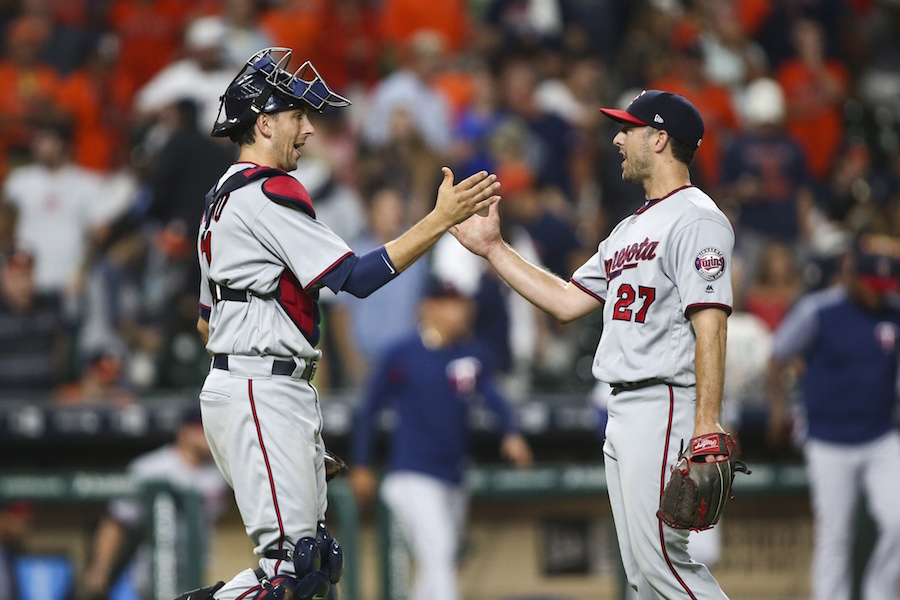 The 2017 Twins season was, in some ways, a banner example of the closer label's fungibility. In the past, Minnesota has been guilty of vastly overrating the importance of ninth-inning experience, to its own detriment (*coughMATTCAPPScough*). But this past season, we saw Brandon Kintzler, a veteran with zero career MLB saves prior to overtaking the role midway through 2016, excel as an extremely reliable door-slammer. He converted 28 of 32 saves and made the All-Star team before being traded to Washington. Good reliever = fine closer. After Kintzler went to the Nationals, Belisle took over in the ninth. The 37-year-old had never in his career served as a regular closer. During the final two months, he converted nine of 11 saves. Good reliever = fine closer. These instances seem to confirm something most of us already knew: there's nothing supernatural about pitching in the ninth inning. And with this in mind, the urgency of adding a reliever with such experience during the offseason is lowered. The Twins have at least one player who could plausibly open the 2018 season as closer, with others in line to get a shot in the near future. READY NOW? Trevor Hildenberger: Hildenberger was fantastic as a rookie in 2017, with his stellar mix of strikeouts and grounders proving extremely reliable. He rose to the occasion time and time again in big spots. He got both righties and lefties out. And he has plenty of experience closing in the minors. But he's also 26 with only 42 innings logged in the big leagues. This, too, is problematic: pigeonholing him in the ninth stops him from being available to Paul Molitor in those key mid-game high-leverage spots where Hildenberger was a godsend this year. I'm not sure you can make a strong case for anyone else internally being ready to take on the closer job now. But as soon as mid-season in 2018, several others could emerge as legit options. READY SOON? Tyler Duffey: The 2017 season was a frustrating one for Duffey, who flashed overpowering stuff at times and posted solid peripherals (3.72 FIP) but could never get into a prolonged groove in terms of results. It's important to remember, though, that he hadn't previously pitched out of the bullpen since 2013 and was in the Twins rotation mix all the way up until the end of spring camp. If he prepares for 2018 as a reliever, and comes back with an extra tick or two on his fastball to complement his power curve, he's certainly got the makings of a closer. He was a dominant one in college at Rice University. JT Chargois: Duffey's co-closer at Rice has been on the path to a late-inning role in the majors ever since being drafted, and looks to me like a closer in waiting. He has the pedigree and potency, no doubt. But he lost almost his entire 2017 campaign to an elbow injury, so he'll need to come back and prove himself effective before any kind of high-leverage assignment is on the table. Ryan Pressly: It was a weird year for Pressly. You look at so many elements of his game and see the profile of someone who could close. His fastball burns in at 96 with a complementary slider at 90. His 3.2 K/BB ratio, 1.16 WHIP, and 50% grounder rate all signaled a quality bullpen weapon. If he could translate his second-half performance (2.62 ERA, .582 opp OPS) over a full season he'd be a perfectly suitable closer. But he's gotten in his own way too often to be counted on. A sustained run of setup excellence in April and May next year could change the narrative. Gabriel Moya: Acquired for John Ryan Murphy in a late-July trade, Moya had a phenomenal season closing at Double-A, saving 24 games with a 0.77 ERA and 0.77 WHIP, plus a 13.4 K/9 rate. The stuff played in his first taste of the majors, producing a 12.4% swinging strike rate (tied with Pressly for highest in pen) and holding opponents to a .206 average, albeit in a small sample of seven appearances. He performed very well against righties. Moya is definitely a sleeper for the gig but won't be in the mix until midseason. Tyler Jay: The true sleeper in this discussion. Like Chargois, Jay endured a lost season in 2017, but now he's back in the Arizona Fall League and proving he's healthy. After dealing with shoulder and neck issues again this summer, there were rumblings he'd need thoracic outlet surgery, but has repeatedly tested negative for that condition. Like Chargois, he has the stuff and pedigree; it's just a matter of staying healthy and showing what he can do. FINDING A PLUG The six players listed above are realistic candidates to be good relievers, and as our earlier arithmetic suggests: Good reliever = fine closer. But no matter how much you want to downplay it, there is an added element when it comes to pitching in the ninth. There's unique pressure as a hurler faces the reality that small mistakes can turn a win into a loss very quickly. Any team, especially one with an offense like Minnesota's, can bounce back from a bullpen hiccup in the middle innings. When you're at the very end of the game? Not so much. Kintzler and Belisle converting a combined 86% of their save chances is an underrated factor in Minnesota's 2017 success, and the Twins need to try to replicate that efficacy in late lead protection. While neither Kintzler nor Belisle had history as a closer, or even a particularly dominant relief pitcher, they did have this arguably essential attribute: lots of experience in the big leagues. So if the Twins want to hold off on anointing one of the relatively inexperienced relievers as closer, it would make sense to find at least an interim veteran plug. Ideally, they'd do so without paying the premium for closer experience. Who on this year's market could be the next Kintzler? In our upcoming 2018 Offseason Handbook (preorder now!), we lay out the free agent reliever landscape. Wade Davis, of course, sits at the top of the pack, and is really the only bona fide "Proven Closer" in the group. Others like Seung-hwan Oh and Fernando Rodney have the experience but are somewhat shaky bets. These are some names that catch my eye as I survey what's going to be out there: Brandon Kintzler, RHP: If you're looking for a Brandon Kintzler type, you could always sign... Brandon Kintzler. The Twins will have an opportunity to re-sign the 33-year-old right-hander after sending him to Washington for the final two months of the season. He's familiar and well liked in the clubhouse. But they'd also be buying high on a guy coming off his best MLB season – also a season where his 4.9 K/9 rate ranked third-lowest out of 155 qualified relievers. Steve Cishek, RHP: Cishek has a very similar profile to Hildenberger. He's a right-handed sidearmer who gets lots of ground balls and strikeouts. He has been a very consistent performer over the course of his career, with an ERA+ of 109 or above in each of his seven seasons. Though he served exclusively in a setup role for the Mariners and Rays this year, the 31-year-old has plenty of closing experience with 121 saves and an 83% conversion rate in the big leagues. The distinguished track record will make him a pricey commodity. Jake McGee, LHP: There are many things to like about McGee. He's a strikeout pitcher with excellent control (four times as many K's as walks in his career). He's a left-hander who shuts down righties. He has experience in the ninth inning (44 saves), as well as in the playoffs (six postseason appearances). He's been durable and fairly reliable. It'd take a sizable multi-year deal to get him, but the 31-year-old could be a great veteran anchor in a young bullpen going forward. Luke Gregerson, RHP: Over the course of his career – spent with the Padres, A's and Astros – Gregerson has mostly been a fantastic reliever. But he's coming off his worst season, so it's possible he could be had at a relative discount. In the Offseason Handbook, we suggest Gregerson could be viewed as a "rich man's Belisle." He's got tons of experience (623 MLB appearances) and has a rep as a strong clubhouse guy, but he also has been much better all-around, and gets tons of strikeouts with a heavily deployed slider. Koji Uehara, RHP: It's entirely possible that Uehara decides to hang up the cleats. He turns 43 next April, and had the second half of his 2017 season ruined by knee and back issues. But if he wants to give it one more go, he'd be a welcome addition for the Twins on a one-year deal. When healthy, he's as reliable as they come, and was lights-out in the first half this year. He could hold down the closer role until one of the young guys emerges. What's your view of the closer situation as we head into the offseason? Are you comfortable with an internal option? Would you aim high for a name like Wade Davis? Or does one of the other free agents listed (or another) make more sense to you?
 -
Article: Order The 2018 Offseason Handbook
Nick Nelson posted a topic in Twins Daily Front Page News
The Twins Daily 2018 Offseason Handbook is now available for order and immediate download. You can claim your copy by clicking here. Name your price and download it right away to dig into its 63 pages of unparalleled offseason coverage. Read below for details about pricing and what's inside.What Is It? For nearly a decade, the TwinsCentric group has been producing the annual Offseason Handbook, an essential guide to the coming Hot Stove season for Minnesota Twins fans. This downloadable PDF features a ton of exclusive content previewing the offseason landscape as it pertains to your favorite team. * Click here to view last year's Offseason Handbook * We put you in the shoes of the Twins GM, providing all of the information you'll need to form your own vision for the offseason (or predict what the real guys in charge will do). Among the topics thoroughly covered inside this beautifully designed ebook: A deep dive on payroll and how much spending flexibility you'll haveFree agents at positions of need, and what they might costTrade targets, and how they could be acquiredArbitration eligible players and projected salariesBreakdowns of organizational depth at each positionFeatures from Twins Daily writersAnd more!Download attachment: CTA-Banner_NOW.jpg How Much Does it Cost? That's up to you. This is a donation-based product, so you can choose how much you'd like to pay. When you go to the order page, you will find an editable field for price. The recommended amount is $5. If you'd like to contribute more as a token of thanks for Twins Daily's year-round coverage, and to help the site sustain and grow, we are beyond grateful. If you're hesitant about paying, go ahead and order a copy with no donation. We don't mind! We'd rather get it into as many people's hands as possible, because we know Twins fans are going to love it. Have any other questions? Issues with your order? Please drop us a line at twinscentric@gmail.com and let us know. Click here to view the article -
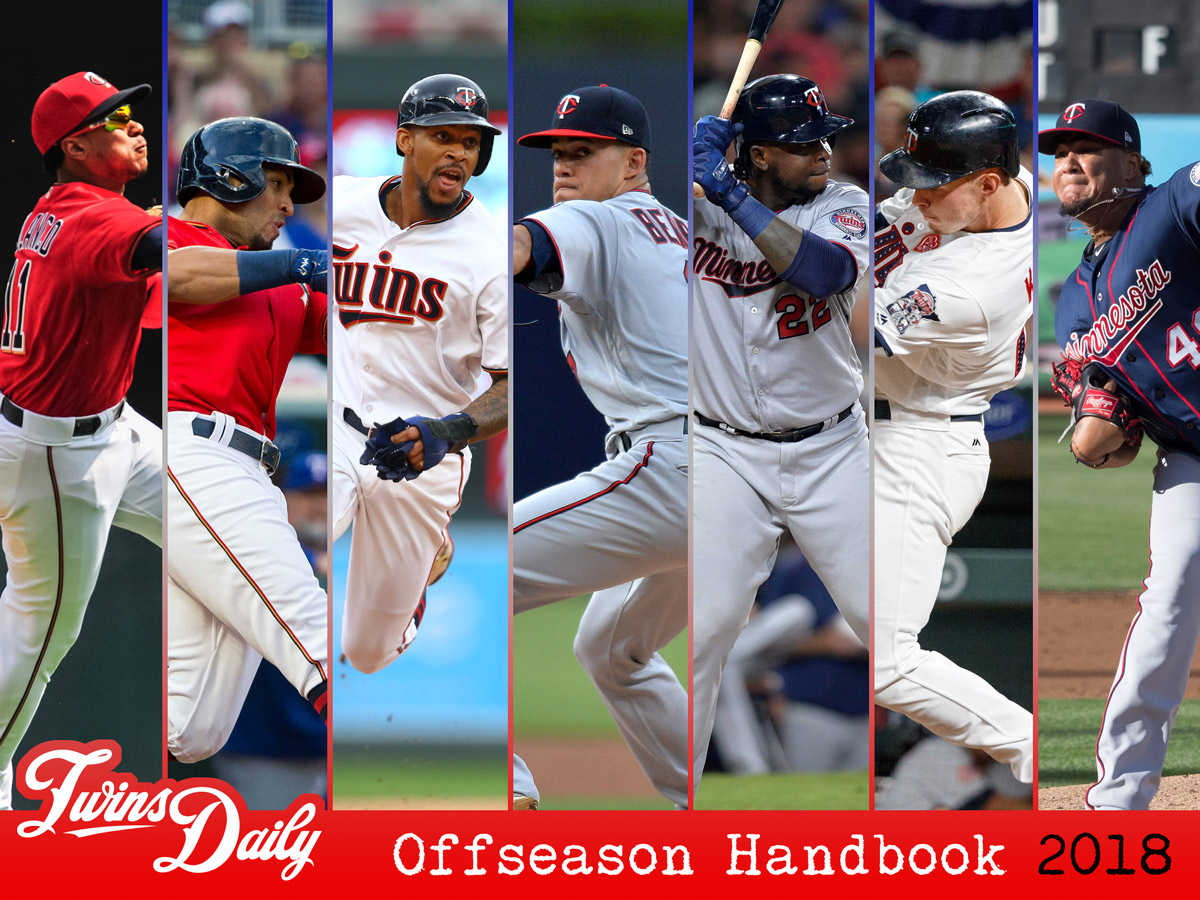 What Is It? For nearly a decade, the TwinsCentric group has been producing the annual Offseason Handbook, an essential guide to the coming Hot Stove season for Minnesota Twins fans. This downloadable PDF features a ton of exclusive content previewing the offseason landscape as it pertains to your favorite team. * Click here to view last year's Offseason Handbook * We put you in the shoes of the Twins GM, providing all of the information you'll need to form your own vision for the offseason (or predict what the real guys in charge will do). Among the topics thoroughly covered inside this beautifully designed ebook: A deep dive on payroll and how much spending flexibility you'll have Free agents at positions of need, and what they might cost Trade targets, and how they could be acquired Arbitration eligible players and projected salaries Breakdowns of organizational depth at each position Features from Twins Daily writers And more! How Much Does it Cost? That's up to you. This is a donation-based product, so you can choose how much you'd like to pay. When you go to the order page, you will find an editable field for price. The recommended amount is $5. If you'd like to contribute more as a token of thanks for Twins Daily's year-round coverage, and to help the site sustain and grow, we are beyond grateful. If you're hesitant about paying, go ahead and order a copy with no donation. We don't mind! We'd rather get it into as many people's hands as possible, because we know Twins fans are going to love it. Have any other questions? Issues with your order? Please drop us a line at twinscentric@gmail.com and let us know.
 -
Article: The Brian Dozier Trade That Almost Was
Nick Nelson replied to Nick Nelson's topic in Twins Daily Front Page News
I didn't say he was a bust. But whatever question marks surrounded him a year ago have only been magnified. De Leon will turn 26 next season, hasn't even thrown 115 innings in a season, hasn't had a shred of success at the major-league level. If the Twins had traded Dozier for him straight-up, or with minimal added pieces (as plenty of people around here felt they should have), and things had played out in a similar fashion with both players, it would look TERRIBLE for the Twins and their new regime right now. They'd be getting skewered. This isn't even debatable. -
Sometimes, the best trades are the ones you don't make. That old sports adage certainly seems to apply with regards to the first big test Derek Falvey and Thad Levine faced as heads of the reconstructed Twins front office. A look back at their savvy stubbornness, and how it paid off:In our blueprint for last year's Offseason Handbook, we suggested trading Brian Dozier to the Dodgers in exchange for young right-hander Jose De Leon and additional prospects. ** You can order the 2018 Offseason Handbook now (name your price) to ensure you get it ahead of its official release at the end of the postseason, with other special perks on the way as well. Preorders are only open for a limited time! ** The Twins, it turned out, were of a similar mind. As soon as the postseason ended, reports quickly arose that they were engaging the Dodgers over Dozier, with De Leon mentioned as a central piece. Based on media coverage, negotiations over the rest of the package turned into an extended saga, with little agreement over what those additional prospects might look like. For Levine, it was a high-stakes game of chicken. The longtime right-hand man of Jon Daniels in Texas, Levine was still arranging his office after landing his first gig as a GM, and here he was, going toe-to-toe with one of the game's most heralded execs in Andrew Friedman. And the player he was discussing giving up? Only the most popular and valuable one on the roster – one of the few marketable commodities on a club that just reached an all-time low. No pressure or anything. It would've been irresponsible not to explore the possibility. Dozier was coming off a likely career year and approaching the end of his contract. The Twins were rebuilding. De Leon was a hot prospect on the rise – the premier strikeout artist in all of the minors, aligning with a drastic need in Minnesota's system. But by all accounts, Levine took a hardline stance, refusing to accept anything less than a major haul in addition to De Leon. The thinking, I imagine, was that pitching prospects (especially those with recent injury history and unproven workload thresholds like JDL) are fickle assets, and you can't really afford to place all your chips on a single one. Good call. The Dodgers ultimately ran out of patience with the Twins and made a pivot, shipping De Leon to Tampa Bay straight-up in exchange for Logan Forsythe. I'm not sure anyone's regretting the deal at this point, but it certainly wasn't a slam dunk for either side. Forsythe took a huge step back from his solid 2016 campaign, hitting 14 fewer home runs with a 100-point drop in OPS. The Dodgers still won 104 games and are still heading to the big show but when you're in go-for-it mode, there's only one ultimate goal. I wonder if they'll wish they had the dangerous Dozier instead of Forsythe in the World Series, and next year. While the Dodgers didn't receive the major impact they initially sought, they're probably satisfied with the price they ended up paying. De Leon, sure enough, saw his first season in Tampa's organization ravaged by injuries, limiting him to 41 total innings and just one appearance for the Rays. It was more or less a lost year, casting further doubt on durability going forward. How would that have looked as the headlining return for Dozier, while he was powering Los Angeles to an incredible season? We'll probably never know what the best package Levine turned down was. But there were rumblings that the Twins were pushing for the likes of Cody Bellinger and Walker Buehler. If so, it demonstrates astute evaluative chops from the GM and his staff. As we now know, Bellinger went on to have one of the great rookie campaigns in MLB history this year, slugging 39 home runs in 130 games, while Buehler returned from his Tommy John layoff in dominant fashion and even made a late-season debut for the Dodgers. Getting one of those prospects would have changed the conversation. But if indeed the offer was never more than De Leon plus scraps, then Minnesota pretty clearly made the right choice. Dozier stuck around and was a driving force in the Twins' reinvigorating turnaround, earning our 2017 team MVP honor. Coming off yet another strong campaign, and still a year from free agency, Dozier still carries significant trade value if the Twins choose to go that route, though that seems unlikely with the sudden flip to contention mode. For Levine and Falvey, stubbornness paid off. I hope they'll exercise the same keen judgment and high standards as the trade talks heat up once again in the coming weeks. Click here to view the article
-
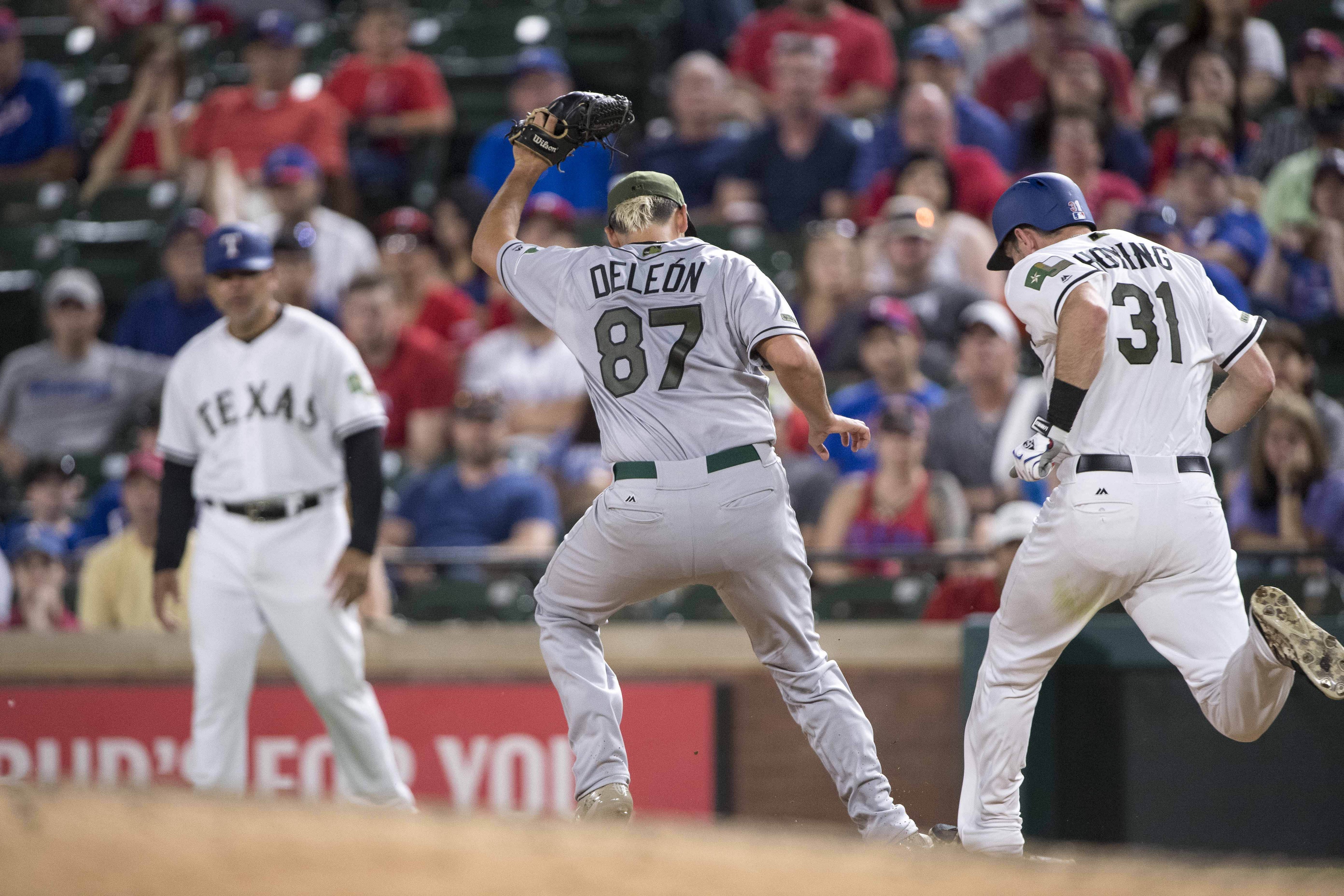 In our blueprint for last year's Offseason Handbook, we suggested trading Brian Dozier to the Dodgers in exchange for young right-hander Jose De Leon and additional prospects. ** You can order the 2018 Offseason Handbook now (name your price) to ensure you get it ahead of its official release at the end of the postseason, with other special perks on the way as well. Preorders are only open for a limited time! ** The Twins, it turned out, were of a similar mind. As soon as the postseason ended, reports quickly arose that they were engaging the Dodgers over Dozier, with De Leon mentioned as a central piece. Based on media coverage, negotiations over the rest of the package turned into an extended saga, with little agreement over what those additional prospects might look like. For Levine, it was a high-stakes game of chicken. The longtime right-hand man of Jon Daniels in Texas, Levine was still arranging his office after landing his first gig as a GM, and here he was, going toe-to-toe with one of the game's most heralded execs in Andrew Friedman. And the player he was discussing giving up? Only the most popular and valuable one on the roster – one of the few marketable commodities on a club that just reached an all-time low. No pressure or anything. It would've been irresponsible not to explore the possibility. Dozier was coming off a likely career year and approaching the end of his contract. The Twins were rebuilding. De Leon was a hot prospect on the rise – the premier strikeout artist in all of the minors, aligning with a drastic need in Minnesota's system. But by all accounts, Levine took a hardline stance, refusing to accept anything less than a major haul in addition to De Leon. The thinking, I imagine, was that pitching prospects (especially those with recent injury history and unproven workload thresholds like JDL) are fickle assets, and you can't really afford to place all your chips on a single one. Good call. The Dodgers ultimately ran out of patience with the Twins and made a pivot, shipping De Leon to Tampa Bay straight-up in exchange for Logan Forsythe. I'm not sure anyone's regretting the deal at this point, but it certainly wasn't a slam dunk for either side. Forsythe took a huge step back from his solid 2016 campaign, hitting 14 fewer home runs with a 100-point drop in OPS. The Dodgers still won 104 games and are still heading to the big show but when you're in go-for-it mode, there's only one ultimate goal. I wonder if they'll wish they had the dangerous Dozier instead of Forsythe in the World Series, and next year. While the Dodgers didn't receive the major impact they initially sought, they're probably satisfied with the price they ended up paying. De Leon, sure enough, saw his first season in Tampa's organization ravaged by injuries, limiting him to 41 total innings and just one appearance for the Rays. It was more or less a lost year, casting further doubt on durability going forward. How would that have looked as the headlining return for Dozier, while he was powering Los Angeles to an incredible season? We'll probably never know what the best package Levine turned down was. But there were rumblings that the Twins were pushing for the likes of Cody Bellinger and Walker Buehler. If so, it demonstrates astute evaluative chops from the GM and his staff. As we now know, Bellinger went on to have one of the great rookie campaigns in MLB history this year, slugging 39 home runs in 130 games, while Buehler returned from his Tommy John layoff in dominant fashion and even made a late-season debut for the Dodgers. Getting one of those prospects would have changed the conversation. But if indeed the offer was never more than De Leon plus scraps, then Minnesota pretty clearly made the right choice. Dozier stuck around and was a driving force in the Twins' reinvigorating turnaround, earning our 2017 team MVP honor. Coming off yet another strong campaign, and still a year from free agency, Dozier still carries significant trade value if the Twins choose to go that route, though that seems unlikely with the sudden flip to contention mode. For Levine and Falvey, stubbornness paid off. I hope they'll exercise the same keen judgment and high standards as the trade talks heat up once again in the coming weeks.
 -
Article: Sizing Up The 2017-18 Offseason
Nick Nelson replied to Nick Nelson's topic in Twins Daily Front Page News
Signing free agents to multi-year contracts, and trading prospects you view as non-essential for long-term upgrades, is very much in line with the objective of building a sustained winner. Treading water and stagnating is a bad idea IMO because during that time you are potentially missing out on excellent, and cheap, years from your blossoming young offensive core. They're here, they're ready. You're also wasting what could be the final years from Mauer, Dozier, Santana. And you're losing out on a significant opportunity with three-fifths of the division basically rebuilding. That won't last forever. The time is now. I do not agree that the strategy should be focused around winning in 2-3 years. -
Article: Sizing Up The 2017-18 Offseason
Nick Nelson replied to Nick Nelson's topic in Twins Daily Front Page News
Interesting. But is it really buy low when he just posted a 2.87 ERA and allowed a .141 average? It'll take a haul to get him. -
Turnarounds like the one we saw from Minnesota this season are rare, but not unprecedented. Derek Falvey knows this as well as anyone. Fresh off his first year as Twins Chief Baseball Officer, Falvey is working in familiar territory. He understands from experience that the hardest part isn't going from irrelevance to contention, but taking the next step.** Before we get started on this overview of the coming offseason, I'll make a quick pitch for your quintessential Hot Stove guide: The 2018 Twins Daily Offseason Handbook is now available for preorder. Click the link to claim your copy, and you'll get it as soon as it's ready, after the postseason concludes. Same deal as last year: name your price. Recommendation is $5, but you can pay as little or as much as you wish. We appreciate any and all support! Plenty more details are on the way in the coming weeks. You can check out last year's edition for an idea of what to expect. ** Midway through Falvey's tenure in Cleveland's front office, the Indians made a leap similar to the one we just saw from the Twins. After finishing in fourth place with 94 losses in 2012, Cleveland improved by 24 wins, earning a Wild Card berth in 2013 but losing to the Rays. In that case, the sudden emergence was followed by two years of treading water. The Indians won 85 and 81 games the next two seasons, finishing third both times, before rising to win the AL Central and pennant in 2016. This year, of course, they won 102 games and took the division again, but were ousted by the Yankees in the ALDS. For Falvey and his general manager Thad Levine, the goal is to unseat the current Central champs by following a similar path, but skipping the stagnation. Given the makeup of this roster as we head into the offseason, that's a reasonable objective. And in fact, while there's been much talk of a measured approach aligning with the big picture, one can argue that the front office should be making a very emphatic championship push in 2018 specifically. END OF AN ERA? Brian Dozier and Joe Mauer are both in line to return next year, and we can only hope they'll be as effective as in 2017. Sustained performance is no given; Mauer turns 35 next April, Dozier 31 in May. Age can become a factor at any time. There's also the matter of their contracts, which both expire after next year. The Twins certainly could bring them back, but it's hardly assured. This may well be the last chance to make a run with both longtime staples as key contributors. MARK YOUR CALENDARS Here are some important dates worth keeping in mind as we survey the offseason landscape. Three Days After End of World Series: Contract Options Due. The Twins only have one and it's a no-brainer: they'll exercise a $700,000 buyout to decline the $6.5 million team option for Glen Perkins. Five Days After End of World Series: Deadline to Make Qualifying Offers to Free Agents. For the five days after the postseason concludes, MLB teams get an exclusive negotiating window with their own free agents. During this time, they can make a qualifying offer, which brings the player back on a one-year (~$18M) contract if accepted, and yields draft pick compensation if they decline and sign elsewhere. None of the Twins' internal free agents – Matt Belisle, Bartolo Colon, Hector Santiago, Dillon Gee – are worthy of a QO, and it's highly unlikely Minnesota will sign any before the market opens up. Six Days After End of World Series: Free Agency Open for Business. We don't know much about how this front office will operate yet, but if their first major move was any indication, they are going to be aggressive in pursuing their top targets. Last offseason, the Twins made their interest in Jason Castro known very quickly, and had him signed before the end of November. Once free agency officially gets underway, we should start hearing rumblings pretty quickly about players that Falvey and Thad Levine are keen on. This is the first offseason where they've had a chance to fully set up a plan going in, so they undoubtedly already have some names in mind. I suspect they'll be shopping for three things in particular: starting pitchers, relief pitchers and right-handed bats. You can get a deep look at what's available in each of those categories with our Free Agency breakdowns in the Offseason Handbook. November 13th-16th: GM Meetings. Today's general managers communicate through many different channels to negotiate trades (much of the action happens on Tinder, Levine has joked) but there's still something to be said for an old-fashioned face-to-face discussion. All 30 GMs will be in the same place during this week, with the annual GM Meetings taking place in Orlando. It'll be an opportunity to lay the groundwork with other execs as well as agents. Falvey and Levine haven't been shy about pulling the trigger on deals thus far, and started up extensive talks with the Dodgers over Dozier last winter around this time. December 10th-14th: Winter Meetings. One month later, the baseball world will converge once again in Orlando for the Winter Meetings – typically the most active period of the entire offseason. What kinds of shakeups might we see from the Twins? EXTENSIONS, EXTENSIONS, EXTENSIONS Some of the biggest storylines of this offseason will surround potential long-term contracts for a number of different players. Last week, John wrote about the merits of locking up Miguel Sano, Byron Buxton and Eddie Rosario ahead of their arbitration years. A day later, Seth pondered what an extension for Dozier might look like as he looks ahead to a walk year. This week, he also took a deeper dive on how a Buxton extension could take shape. Here at Twins Daily, we'll of course have plenty more coverage of Hot Stove season as it gets piping, with all of the speculation, analysis and up-to-the-minute news you expect. But I promise you this: you are going to want a copy of the Offseason Handbook as a handy resource along the way. Please consider preordering yours now to ensure you receive it the moment it becomes available. Click here to view the article
-
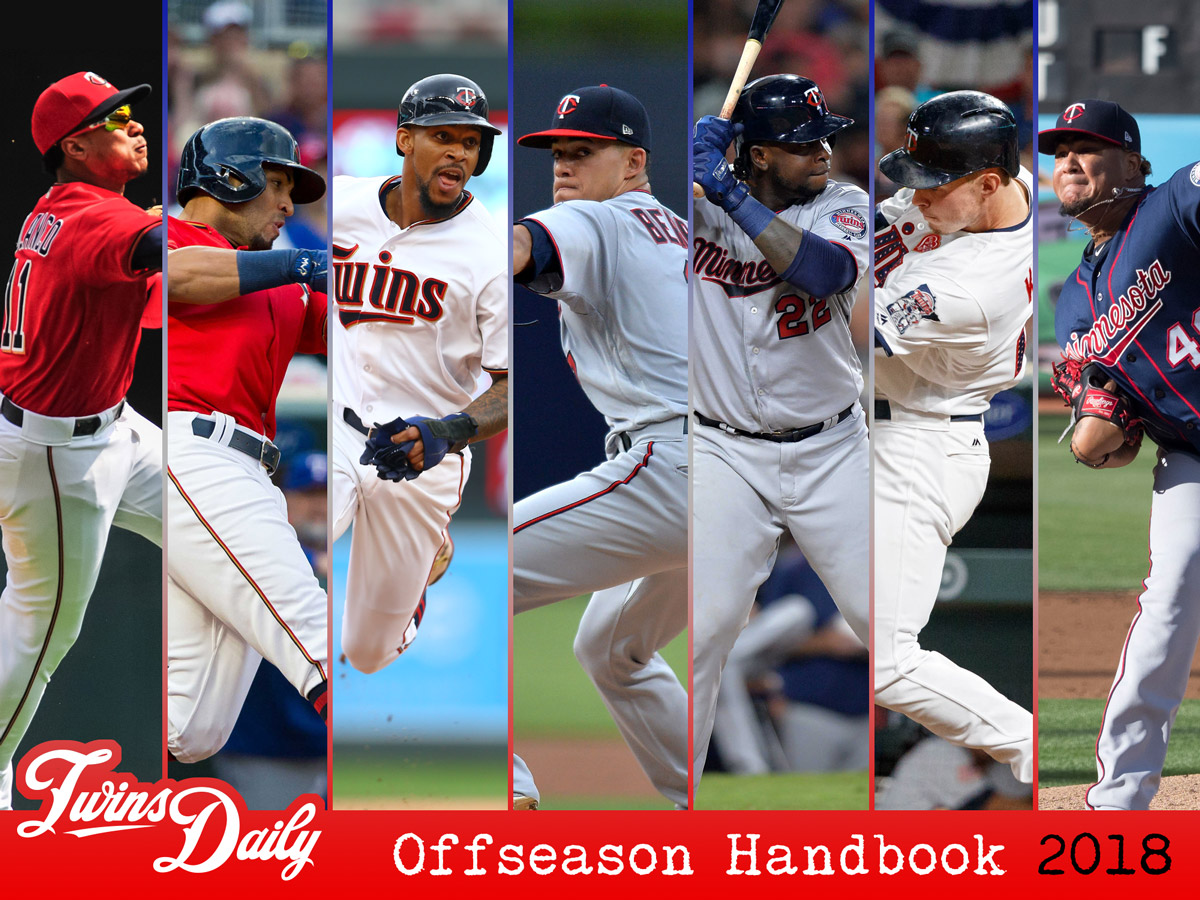 ** Before we get started on this overview of the coming offseason, I'll make a quick pitch for your quintessential Hot Stove guide: The 2018 Twins Daily Offseason Handbook is now available for preorder. Click the link to claim your copy, and you'll get it as soon as it's ready, after the postseason concludes. Same deal as last year: name your price. Recommendation is $5, but you can pay as little or as much as you wish. We appreciate any and all support! Plenty more details are on the way in the coming weeks. You can check out last year's edition for an idea of what to expect. ** Midway through Falvey's tenure in Cleveland's front office, the Indians made a leap similar to the one we just saw from the Twins. After finishing in fourth place with 94 losses in 2012, Cleveland improved by 24 wins, earning a Wild Card berth in 2013 but losing to the Rays. In that case, the sudden emergence was followed by two years of treading water. The Indians won 85 and 81 games the next two seasons, finishing third both times, before rising to win the AL Central and pennant in 2016. This year, of course, they won 102 games and took the division again, but were ousted by the Yankees in the ALDS. For Falvey and his general manager Thad Levine, the goal is to unseat the current Central champs by following a similar path, but skipping the stagnation. Given the makeup of this roster as we head into the offseason, that's a reasonable objective. And in fact, while there's been much talk of a measured approach aligning with the big picture, one can argue that the front office should be making a very emphatic championship push in 2018 specifically. END OF AN ERA? Brian Dozier and Joe Mauer are both in line to return next year, and we can only hope they'll be as effective as in 2017. Sustained performance is no given; Mauer turns 35 next April, Dozier 31 in May. Age can become a factor at any time. There's also the matter of their contracts, which both expire after next year. The Twins certainly could bring them back, but it's hardly assured. This may well be the last chance to make a run with both longtime staples as key contributors. MARK YOUR CALENDARS Here are some important dates worth keeping in mind as we survey the offseason landscape. Three Days After End of World Series: Contract Options Due. The Twins only have one and it's a no-brainer: they'll exercise a $700,000 buyout to decline the $6.5 million team option for Glen Perkins. Five Days After End of World Series: Deadline to Make Qualifying Offers to Free Agents. For the five days after the postseason concludes, MLB teams get an exclusive negotiating window with their own free agents. During this time, they can make a qualifying offer, which brings the player back on a one-year (~$18M) contract if accepted, and yields draft pick compensation if they decline and sign elsewhere. None of the Twins' internal free agents – Matt Belisle, Bartolo Colon, Hector Santiago, Dillon Gee – are worthy of a QO, and it's highly unlikely Minnesota will sign any before the market opens up. Six Days After End of World Series: Free Agency Open for Business. We don't know much about how this front office will operate yet, but if their first major move was any indication, they are going to be aggressive in pursuing their top targets. Last offseason, the Twins made their interest in Jason Castro known very quickly, and had him signed before the end of November. Once free agency officially gets underway, we should start hearing rumblings pretty quickly about players that Falvey and Thad Levine are keen on. This is the first offseason where they've had a chance to fully set up a plan going in, so they undoubtedly already have some names in mind. I suspect they'll be shopping for three things in particular: starting pitchers, relief pitchers and right-handed bats. You can get a deep look at what's available in each of those categories with our Free Agency breakdowns in the Offseason Handbook. November 13th-16th: GM Meetings. Today's general managers communicate through many different channels to negotiate trades (much of the action happens on Tinder, Levine has joked) but there's still something to be said for an old-fashioned face-to-face discussion. All 30 GMs will be in the same place during this week, with the annual GM Meetings taking place in Orlando. It'll be an opportunity to lay the groundwork with other execs as well as agents. Falvey and Levine haven't been shy about pulling the trigger on deals thus far, and started up extensive talks with the Dodgers over Dozier last winter around this time. December 10th-14th: Winter Meetings. One month later, the baseball world will converge once again in Orlando for the Winter Meetings – typically the most active period of the entire offseason. What kinds of shakeups might we see from the Twins? EXTENSIONS, EXTENSIONS, EXTENSIONS Some of the biggest storylines of this offseason will surround potential long-term contracts for a number of different players. Last week, John wrote about the merits of locking up Miguel Sano, Byron Buxton and Eddie Rosario ahead of their arbitration years. A day later, Seth pondered what an extension for Dozier might look like as he looks ahead to a walk year. This week, he also took a deeper dive on how a Buxton extension could take shape. Here at Twins Daily, we'll of course have plenty more coverage of Hot Stove season as it gets piping, with all of the speculation, analysis and up-to-the-minute news you expect. But I promise you this: you are going to want a copy of the Offseason Handbook as a handy resource along the way. Please consider preordering yours now to ensure you receive it the moment it becomes available.
 -
EDITOR'S NOTE: We're re-pinning this article from October today due to the news that Glen Perkins has officially retired from baseball. On the final Sunday of the 2017 regular season, Minnesota Twins fans had the privilege of watching 44-year-old Bartolo Colon put, perhaps, the finishing touch on a lengthy major-league career that will go down as unforgettable. One night earlier, another pitcher likely closed the book on a story that's been far more impactful and personal to us, playing out from start to finish in our own backyards. Glen Perkins won't loom as large as Colon in the game's history, but he will deservedly go down as a Minnesota baseball legend, and if we were to establish a Twins Daily Hall of Fame, he'd certainly be a first-ballot inductee.Why do I say Perk is an easy choice for this hypothetical TD Hall of Fame? The biggest reason is obvious enough: his play. Our site launched in 2012, and during the first several years of its existence, he was easily one of the team's brightest stars. Perkins first took over the closer role midway through that campaign, relieving us all of Matt Capps. From that point through the end of the 2015 season, the left-hander was one of the best relief pitchers in all of baseball, a three-time All Star and a dominant force. His best years coincided directly with the rise of our community. They also coincided directly with one of the darkest chapters in this franchise's modern history, which is a true shame. I do wonder how much differently Perkins might be viewed if more than a handful of his 120 career saves were actually meaningful. But it's not just the performance Perkins delivered at his peak that makes him near-and-dear to this site. He is in so many ways a reflection of everything Twins Daily stands for: a celebration of Minnesota baseball; an embracing of deeper and more thoughtful analysis; a sometimes nerdy level of passion for the game. This piece is my attempt to recognize Perkins for all of these things. Local Product He's the definition of a homegrown talent. Perkins was born in Stillwater, just inside the Minnesota border, in 1983. He grew up and played prep ball there, then attended the University of Minnesota, where he starred for the Gophers. Taken by his hometown MLB team with the 22nd overall pick in 2004, Perkins became the eighth first-round pick out of the U of M, joining – among others – Paul Molitor. How fitting that Molitor would eventually be the manager to send Perk out for his emotional curtain call in the season's second-to-last game. Obviously our central focus here at Twins Daily is covering the Twins (daily) but we also make efforts to extend our lens to Minnesota hardball at large. Readers could find frequent coverage of the Gophers and St. Paul Saints this summer, and around draft time we always shine a light on the locals. Perkins covers the breadth of our scope. When he donned those road jerseys with the "MINNESOTA" lettering across the front, it had quite a bit more meaning for Perkins than most. The Reinvention After joining the pro ranks, Perkins rose quickly through the minors, making his first big-league appearance two years after being drafted. But in time it became apparent that he wasn't cut out as an MLB starter. After working up to 150 innings in 2008, his arm didn't respond well. The following year he battled injuries while his fastball dipped below 90 and his K/9 sank to an untenable nadir. Late in the season, relations between he and the team reached a low point when Perkins filed a grievance against the Twins for optioning him to the minors instead of sending him on a rehab assignment off a DL stint, preventing him qualifying for Super 2 status (and thus, an arbitration raise). It was a logical decision for the Twins, but one could understand the lefty's frustration. His budding career momentum had grinded to a halt before yielding any significant money. The next year he pitched terribly in Triple-A but came back up to the majors in August anyway, in a probable last shot with the organization. Ron Gardenhire and the Twins saw something they liked as Perkins worked as a reliever in September, posting a 3.09 ERA and averaging a strikeout per inning. They brought him to New York for the playoffs. In spring of 2011, he was reportedly close to not making the team before a late-March meeting with Gardenhire in which he told the skipper, “I want to pitch for the Twins. It’s where I grew up. Just give me a chance.” They did, and boy was it a good call. Perkins blossomed as a setup man that year, pumping heat in the mid-90s, then took over the closer role in 2012. He would make three straight All Star teams in that capacity, and four years later he'd overtake Eddie Guardado for third on the franchise leaderboard in saves. It's the kind of turnaround that should inspire every struggling young player in the game. A Studious Mind As you may or may not be aware, Perkins wrote the foreword for this year's edition of the Baseball Prospectus Annual. In it, he recounts the story of discovering BP in 2009, and thusly becoming aware of sabermetrics and modernized analysis. Suddenly, he was noticing the negative harbingers in a 12-win 2008 season – a sub par K-rate, a bloated fly ball ratio, a FIP north of 5.00. A change in mindset, and reevaluating the factors of his game really worth focusing on, may have played a big role in driving his turnaround. By the time he was blooming as an elite relief pitcher in 2013, Perkins was well versed in advanced stats. That May, he participated in a Q&A with David Laurila of FanGraphs where he drilled down into metrics like K/9, Z-Swing%, and HR/FB. His assertion in that interview that FIP (Fielding Independent Pitching) is the most important pitching statistic probably wasn't shared by any of his peers in the majors, but was music to the ears of bloggers and analytical fans. This commonality – a fervent curiosity about baseball, extending beyond its traditions and platitudes – helped many of us fans feel an inherent bond with the hurler, and he strengthened it with an engaging and accessible personality. Perk has always been pretty interactive on Twitter. He and his wife Alisha host an annual 5K supporting mental health. He notoriously bought a round of beers from the bullpen for Twins Daily readers at our first Touch Em All Pub Crawl. He has even gone to bat for the value of baseball writing not driven by access: Perkins has done much to endear himself to Twins fans – and the hardcore sorts that patronize this site especially – so it's safe to say he wasn't the only one dealing with dust in his eyes as he sat in the dugout after that final appearance of the year. One of Us Here in Minnesota, the above term is thrown around often in sarcastic tones, teasing the absurd amount of pride we tend to express over athletes with local ties. But Perkins fulfills that descriptor in every sense. Thanks, Perk, for being One of Us and representing Us so well. Click here to view the article
-
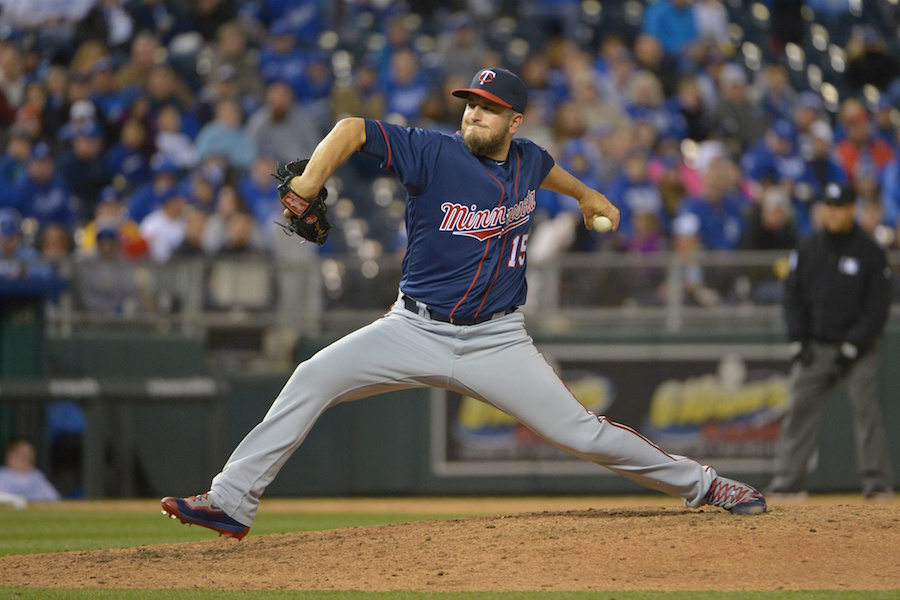 Why do I say Perk is an easy choice for this hypothetical TD Hall of Fame? The biggest reason is obvious enough: his play. Our site launched in 2012, and during the first several years of its existence, he was easily one of the team's brightest stars. Perkins first took over the closer role midway through that campaign, relieving us all of Matt Capps. From that point through the end of the 2015 season, the left-hander was one of the best relief pitchers in all of baseball, a three-time All Star and a dominant force. His best years coincided directly with the rise of our community. They also coincided directly with one of the darkest chapters in this franchise's modern history, which is a true shame. I do wonder how much differently Perkins might be viewed if more than a handful of his 120 career saves were actually meaningful. But it's not just the performance Perkins delivered at his peak that makes him near-and-dear to this site. He is in so many ways a reflection of everything Twins Daily stands for: a celebration of Minnesota baseball; an embracing of deeper and more thoughtful analysis; a sometimes nerdy level of passion for the game. This piece is my attempt to recognize Perkins for all of these things. Local Product He's the definition of a homegrown talent. Perkins was born in Stillwater, just inside the Minnesota border, in 1983. He grew up and played prep ball there, then attended the University of Minnesota, where he starred for the Gophers. Taken by his hometown MLB team with the 22nd overall pick in 2004, Perkins became the eighth first-round pick out of the U of M, joining – among others – Paul Molitor. How fitting that Molitor would eventually be the manager to send Perk out for his emotional curtain call in the season's second-to-last game. Obviously our central focus here at Twins Daily is covering the Twins (daily) but we also make efforts to extend our lens to Minnesota hardball at large. Readers could find frequent coverage of the Gophers and St. Paul Saints this summer, and around draft time we always shine a light on the locals. Perkins covers the breadth of our scope. When he donned those road jerseys with the "MINNESOTA" lettering across the front, it had quite a bit more meaning for Perkins than most. The Reinvention After joining the pro ranks, Perkins rose quickly through the minors, making his first big-league appearance two years after being drafted. But in time it became apparent that he wasn't cut out as an MLB starter. After working up to 150 innings in 2008, his arm didn't respond well. The following year he battled injuries while his fastball dipped below 90 and his K/9 sank to an untenable nadir. Late in the season, relations between he and the team reached a low point when Perkins filed a grievance against the Twins for optioning him to the minors instead of sending him on a rehab assignment off a DL stint, preventing him qualifying for Super 2 status (and thus, an arbitration raise). It was a logical decision for the Twins, but one could understand the lefty's frustration. His budding career momentum had grinded to a halt before yielding any significant money. The next year he pitched terribly in Triple-A but came back up to the majors in August anyway, in a probable last shot with the organization. Ron Gardenhire and the Twins saw something they liked as Perkins worked as a reliever in September, posting a 3.09 ERA and averaging a strikeout per inning. They brought him to New York for the playoffs. In spring of 2011, he was reportedly close to not making the team before a late-March meeting with Gardenhire in which he told the skipper, “I want to pitch for the Twins. It’s where I grew up. Just give me a chance.” They did, and boy was it a good call. Perkins blossomed as a setup man that year, pumping heat in the mid-90s, then took over the closer role in 2012. He would make three straight All Star teams in that capacity, and four years later he'd overtake Eddie Guardado for third on the franchise leaderboard in saves. It's the kind of turnaround that should inspire every struggling young player in the game. A Studious Mind As you may or may not be aware, Perkins wrote the foreword for this year's edition of the Baseball Prospectus Annual. In it, he recounts the story of discovering BP in 2009, and thusly becoming aware of sabermetrics and modernized analysis. Suddenly, he was noticing the negative harbingers in a 12-win 2008 season – a sub par K-rate, a bloated fly ball ratio, a FIP north of 5.00. A change in mindset, and reevaluating the factors of his game really worth focusing on, may have played a big role in driving his turnaround. By the time he was blooming as an elite relief pitcher in 2013, Perkins was well versed in advanced stats. That May, he participated in a Q&A with David Laurila of FanGraphs where he drilled down into metrics like K/9, Z-Swing%, and HR/FB. His assertion in that interview that FIP (Fielding Independent Pitching) is the most important pitching statistic probably wasn't shared by any of his peers in the majors, but was music to the ears of bloggers and analytical fans. This commonality – a fervent curiosity about baseball, extending beyond its traditions and platitudes – helped many of us fans feel an inherent bond with the hurler, and he strengthened it with an engaging and accessible personality. Perk has always been pretty interactive on Twitter. He and his wife Alisha host an annual 5K supporting mental health. He notoriously bought a round of beers from the bullpen for Twins Daily readers at our first Touch Em All Pub Crawl. He has even gone to bat for the value of baseball writing not driven by access: https://twitter.com/glenperkins/status/904755261725925379 Perkins has done much to endear himself to Twins fans – and the hardcore sorts that patronize this site especially – so it's safe to say he wasn't the only one dealing with dust in his eyes as he sat in the dugout after that final appearance of the year. One of Us Here in Minnesota, the above term is thrown around often in sarcastic tones, teasing the absurd amount of pride we tend to express over athletes with local ties. But Perkins fulfills that descriptor in every sense. Thanks, Perk, for being One of Us and representing Us so well.
 -
We had some tough choices to make in our Twins Daily Awards polling for Most Improved and Rookie of the Year. The decision for Best Pitcher was... considerably easier. Ervin Santana unsurprisingly swept the ballots with arguably the best campaign by a Twins starter since that other Santana guy left town.The last time we saw Big Erv take the mound this year, it wasn't pretty. He was an erratic mess at Yankee Stadium in the AL Wild Card Game, instantly coughing up Minnesota's first-inning lead and exiting after two frames. But the Twins never would have reached that unexpected point without Santana's steady work atop the rotation all summer. Not a chance. He was far-and-away the team's most valuable and effective pitcher. Only Jose Berrios came close, and while he earned every second-place vote in our ballots, the much-improved young righty was a very distant second by any measure. Santana's 3.28 ERA was not only the best in the rotation this year, edging Berrios by more than half a run, but the best mark by a qualifying Twins starter since Johan's 2.77 in 2006. On a staff that desperately needed innings from starters to protect an iffy bullpen, Santana threw 211 innings – most since Carl Pavano's 222 in 2011, and 50 more than 2017 runner-up Kyle Gibson. Santana's five complete games and three shutouts both led baseball – in fact, only one team (Cleveland) had more complete games and none had more shutouts. Santana's WHIP (1.13) and BAA (.225) were the lowest of his career, and both ranked fifth among AL starters. He posted his best walk rate since 2008, finishing on a strong note with just four walks over 35 innings in September. It was a masterful age-34 season for Santana, who has proven to be a resoundingly successful free agent signing, perhaps the best in franchise history. Defying the conventional effects of age, Erv has only gotten better as his contract has progressed and he's entered his mid-30s. As long as he can continue to stay healthy while commanding his solid fastball and excellent slider, he should be ready to bring it again next year. Hopefully a young starter like Berrios or Adalberto Mejia – or a newcomer acquired this offseason – will be able to give Santana a run for his money in this category, however. THE BALLOTS Here's a look at the ballots from each of our nine voters. There was zero disagreement over the top two choices, and Twins Daily's Rookie of the Year winner was very well represented despite throwing only 42 innings. Seth Stohs: 1) Ervin Santana, 2) Jose Berrios, 3) Trevor Hildenberger, 4) Taylor Rogers Nick Nelson: 1) Ervin Santana, 2) Jose Berrios, 3) Trevor Hildenberger, 4) Kyle Gibson Parker Hageman: 1) Ervin Santana, 2) Jose Berrios, 3) Bartolo Colon, 4) Brandon Kintzler John Bonnes: 1) Ervin Santana, 2) Jose Berrios, 3) Brandon Kintzler, 4) Trevor Hildenberger Jeremy Nygaard: 1) Ervin Santana, 2) Jose Berrios, 3) Taylor Rogers, 4) Brandon Kintzler Cody Christie: 1) Ervin Santana, 2) Jose Berrios, 3) Brandon Kintzler, 4) Taylor Rogers Steve Lien: 1) Ervin Santana, 2) Jose Berrios, 3) Trevor Hildenberger, 4) Brandon Kintzler Tom Froemming: 1) Ervin Santana, 2) Jose Berrios, 3) Adalberto Mejia, 4) Kyle Gibson Ted Schwerzler: 1) Ervin Santana, 2) Jose Berrios, 3) Trevor Hildenberger, 4) Matt Belisle POINTS Ervin Santana: 36 Jose Berrios: 27 Trevor Hildenberger: 9 Brandon Kintzler: 7 Taylor Rogers: 4 Kyle Gibson: 2 Bartolo Colon: 2 Adalberto Mejia: 2 Matt Belisle: 1 Do you agree with our committee's pick? Who would be your choice for Best Twins Pitcher and why? 2017 TWINS DAILY AWARDS 2017 Most Improved: Byron Buxton 2017 Rookie of the Year: Trevor Hildenberger 2017 Pitcher of the Year: Ervin Santana 2017 Most Valuable Player: Thursday Click here to view the article
-
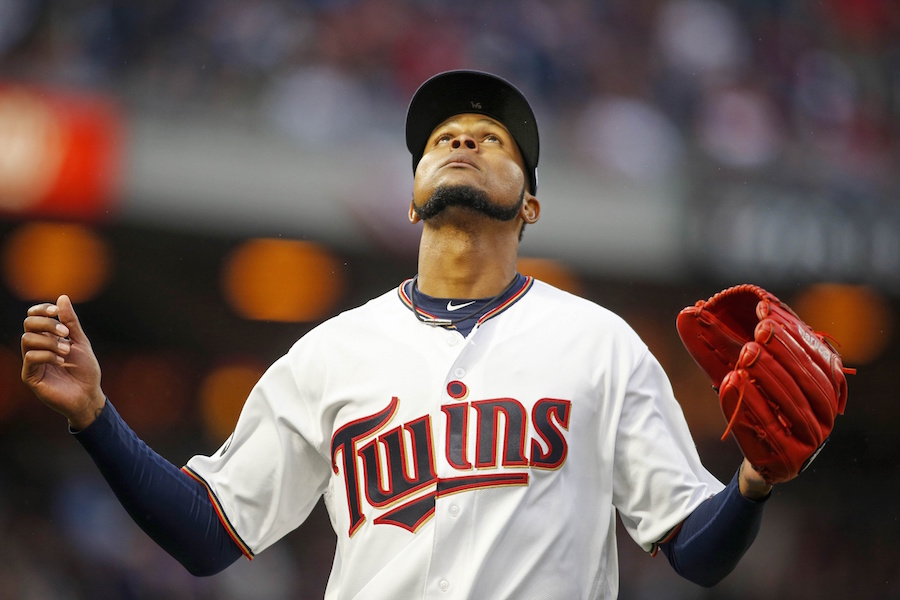 The last time we saw Big Erv take the mound this year, it wasn't pretty. He was an erratic mess at Yankee Stadium in the AL Wild Card Game, instantly coughing up Minnesota's first-inning lead and exiting after two frames. But the Twins never would have reached that unexpected point without Santana's steady work atop the rotation all summer. Not a chance. He was far-and-away the team's most valuable and effective pitcher. Only Jose Berrios came close, and while he earned every second-place vote in our ballots, the much-improved young righty was a very distant second by any measure. Santana's 3.28 ERA was not only the best in the rotation this year, edging Berrios by more than half a run, but the best mark by a qualifying Twins starter since Johan's 2.77 in 2006. On a staff that desperately needed innings from starters to protect an iffy bullpen, Santana threw 211 innings – most since Carl Pavano's 222 in 2011, and 50 more than 2017 runner-up Kyle Gibson. Santana's five complete games and three shutouts both led baseball – in fact, only one team (Cleveland) had more complete games and none had more shutouts. Santana's WHIP (1.13) and BAA (.225) were the lowest of his career, and both ranked fifth among AL starters. He posted his best walk rate since 2008, finishing on a strong note with just four walks over 35 innings in September. It was a masterful age-34 season for Santana, who has proven to be a resoundingly successful free agent signing, perhaps the best in franchise history. Defying the conventional effects of age, Erv has only gotten better as his contract has progressed and he's entered his mid-30s. As long as he can continue to stay healthy while commanding his solid fastball and excellent slider, he should be ready to bring it again next year. Hopefully a young starter like Berrios or Adalberto Mejia – or a newcomer acquired this offseason – will be able to give Santana a run for his money in this category, however. THE BALLOTS Here's a look at the ballots from each of our nine voters. There was zero disagreement over the top two choices, and Twins Daily's Rookie of the Year winner was very well represented despite throwing only 42 innings. Seth Stohs: 1) Ervin Santana, 2) Jose Berrios, 3) Trevor Hildenberger, 4) Taylor Rogers Nick Nelson: 1) Ervin Santana, 2) Jose Berrios, 3) Trevor Hildenberger, 4) Kyle Gibson Parker Hageman: 1) Ervin Santana, 2) Jose Berrios, 3) Bartolo Colon, 4) Brandon Kintzler John Bonnes: 1) Ervin Santana, 2) Jose Berrios, 3) Brandon Kintzler, 4) Trevor Hildenberger Jeremy Nygaard: 1) Ervin Santana, 2) Jose Berrios, 3) Taylor Rogers, 4) Brandon Kintzler Cody Christie: 1) Ervin Santana, 2) Jose Berrios, 3) Brandon Kintzler, 4) Taylor Rogers Steve Lien: 1) Ervin Santana, 2) Jose Berrios, 3) Trevor Hildenberger, 4) Brandon Kintzler Tom Froemming: 1) Ervin Santana, 2) Jose Berrios, 3) Adalberto Mejia, 4) Kyle Gibson Ted Schwerzler: 1) Ervin Santana, 2) Jose Berrios, 3) Trevor Hildenberger, 4) Matt Belisle POINTS Ervin Santana: 36 Jose Berrios: 27 Trevor Hildenberger: 9 Brandon Kintzler: 7 Taylor Rogers: 4 Kyle Gibson: 2 Bartolo Colon: 2 Adalberto Mejia: 2 Matt Belisle: 1 Do you agree with our committee's pick? Who would be your choice for Best Twins Pitcher and why? 2017 TWINS DAILY AWARDS 2017 Most Improved: Byron Buxton 2017 Rookie of the Year: Trevor Hildenberger 2017 Pitcher of the Year: Ervin Santana 2017 Most Valuable Player: Thursday
 -
Improvement was the story of the 2017 Minnesota Twins. From 103 losses to 85 wins; from worst team in baseball to a postseason berth. It was a year-to-year jump like none we've ever seen in this franchise's history. Many different players contributed to this seismic upswing with their own individual progressions, making this first Twins Daily Award a tough one. As you'll see, there was plenty of diversity on the ballots, but in the end, one player stood out as a fairly clear choice.Byron Buxton's massive strides forward were reflective of what we saw from this team as a whole in 2017: young, raw talent finally figuring it out and pulling things together. A quick glance at his offensive numbers may not point to huge improvement – his OPS rose by only 14 points from 2016 to 2017 (.714 to .728), and his OPS+ jumped by only four (90 to 94). But that doesn't tell the whole story by any means. Buxton comprehensively advanced his game, and – while this award intends to recognize positive change from one year to the next – his incredible in-season improvements are what really sealed the deal for him. Let's break it down by three areas in which the 23-year-old budding superstar elevated his performance: His Bat Buxton got his season off to a disastrous start at the plate, going 3-for-37 with a 20-to-1 K/BB ratio in his first 10 games. From there, he gradually started to get on track, but digging such a deep early hole meant it would take awhile for his overall numbers to reach respectability. Buxton's batting average didn't surpass .200 for the first time until the last day of May. His approach at the plate improved, and so did the results, but his first half was filled with fits and stops. At the All-Star break, when he went on the disabled list with a groin injury, the center fielder was sporting an ugly .218/.292/.311 slash line. It was upon his return from that DL stint, on August 1st, that things truly began to click. In the final two months Buxton slashed .298/.342/.541 with 11 homers, seven doubles and five triples. By the end of the year he looked like a totally different player. He was making regular contact, smashing line drives, working counts, bunting for hits, and producing steadily in the middle of the lineup. Whereas the September 2016 outburst that raised his OPS from .561 to .714 didn't carry the indicators of sustainability (he still struck out at a 34% clip while hammering nine balls over the fence), Buck's more gradual 2017 turnaround was quite convincing. His Glove In 2016, Buxton showed the makings of an elite defensive player, with his incredible speed enabling him to track down just about every ball. In 2017, he became THE elite defensive player, maximizing the impact of that speed with superior recognition and routes. Per FanGraphs, his UZR/150 improved from 6.4 to 13.1. His DRS (Defensive Runs Saved) went from three to 24. He led baseball in StatCast's Outs Above Average measure this year at 25; in 2016 he ranked 14th at 10. Buxton hauled in an astonishing 26 four-star catches after nabbing six a year ago. His Baserunning Much like his defense, Buxton's base-running went from promising to preeminent. In 2016 he stole 10 bases on 12 attempts. Not bad. In 2017 he stole 29 on 30 attempts (plus 1-for-1 in the Wild Card game), and not one single catcher was able to beat him with a throw all year – Buxton's only caught stealing came on an overslide. According to Baseball Prospectus' Baserunning Runs (BRR) metric, which accounts for "a player's contributions on the basepaths based on activity during the run of play, on stolen base attempts, from tag-up situations, and other advancement opportunities," Buxton was the third-most valuable runner in the game behind Dee Gordon and Delino Deshields. In 2016 he ranked 14th. The Full Package In the final eight weeks of the season Buxton was probably MLB's single most valuable all-around player, everything considered. With his offense finally catching up to his other-worldly aptitude on the base paths and in center field, he changed games on a nightly basis, playing a pivotal role in lifting the Twins from alsorans to postseason entrants. That earned him our Most Improved award over a number of deserving contenders. THE BALLOTS Here's a look at the ballots from each of our nine voters. Opinions varied greatly on this one. There were five different choices for No. 1, and no player appeared on every list. Seth Stohs: 1) Eddie Rosario, 2) Byron Buxton, 3) Jose Berrios Nick Nelson: 1) Byron Buxton, 2) Eddie Rosario, 3) Jose Berrios Parker Hageman: 1) Byron Buxton, 2) Joe Mauer, 3) Eduardo Escobar John Bonnes: 1) Jose Berrios, 2) Eduardo Escobar, 3) Miguel Sano Jeremy Nygaard: 1) Joe Mauer, 2) Byron Buxton, 3) Eddie Rosario/Jose Berrios Cody Christie: 1) Byron Buxton, 2) Jorge Polanco, 3) Eddie Rosario Steve Lien: 1) Eddie Rosario, 2) Jose Berrios, 3) Byron Buxton Tom Froemming: 1) Jose Berrios, 2) Eddie Rosario, 3) Eduardo Escobar Ted Schwerzler: 1) Byron Buxton, 2) Kyle Gibson, 3) Jorge Polanco POINTS Byron Buxton: 17 Eddie Rosario: 11.5 Jose Berrios: 10.5 Joe Mauer: 5 Eduardo Escobar: 4 Jorge Polanco: 3 Kyle Gibson: 2 Miguel Sano: 1 Do you agree with our committee's pick? Who would be your choice for Most Improved Twin and why? Click here to view the article
-
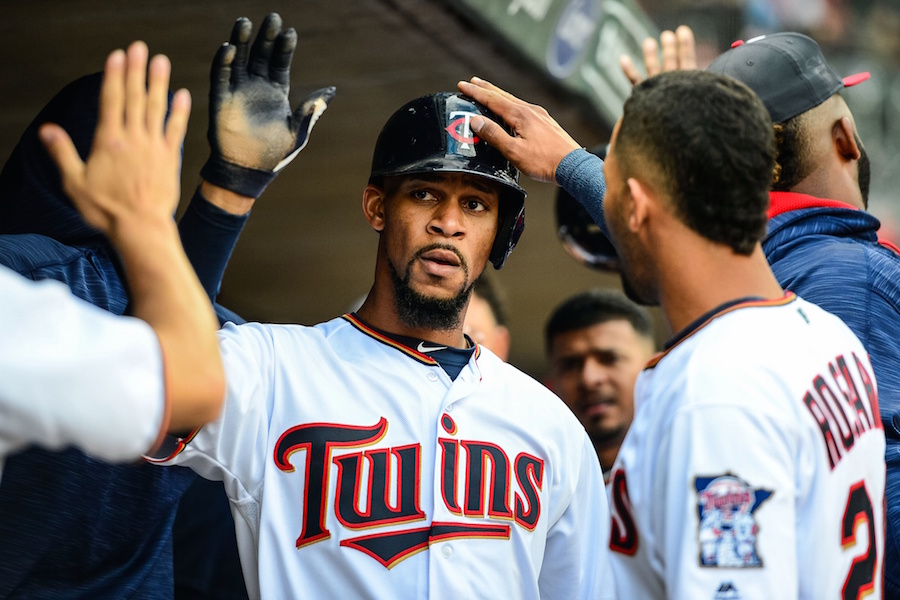 Byron Buxton's massive strides forward were reflective of what we saw from this team as a whole in 2017: young, raw talent finally figuring it out and pulling things together. A quick glance at his offensive numbers may not point to huge improvement – his OPS rose by only 14 points from 2016 to 2017 (.714 to .728), and his OPS+ jumped by only four (90 to 94). But that doesn't tell the whole story by any means. Buxton comprehensively advanced his game, and – while this award intends to recognize positive change from one year to the next – his incredible in-season improvements are what really sealed the deal for him. Let's break it down by three areas in which the 23-year-old budding superstar elevated his performance: His Bat Buxton got his season off to a disastrous start at the plate, going 3-for-37 with a 20-to-1 K/BB ratio in his first 10 games. From there, he gradually started to get on track, but digging such a deep early hole meant it would take awhile for his overall numbers to reach respectability. Buxton's batting average didn't surpass .200 for the first time until the last day of May. His approach at the plate improved, and so did the results, but his first half was filled with fits and stops. At the All-Star break, when he went on the disabled list with a groin injury, the center fielder was sporting an ugly .218/.292/.311 slash line. It was upon his return from that DL stint, on August 1st, that things truly began to click. In the final two months Buxton slashed .298/.342/.541 with 11 homers, seven doubles and five triples. By the end of the year he looked like a totally different player. He was making regular contact, smashing line drives, working counts, bunting for hits, and producing steadily in the middle of the lineup. Whereas the September 2016 outburst that raised his OPS from .561 to .714 didn't carry the indicators of sustainability (he still struck out at a 34% clip while hammering nine balls over the fence), Buck's more gradual 2017 turnaround was quite convincing. His Glove In 2016, Buxton showed the makings of an elite defensive player, with his incredible speed enabling him to track down just about every ball. In 2017, he became THE elite defensive player, maximizing the impact of that speed with superior recognition and routes. Per FanGraphs, his UZR/150 improved from 6.4 to 13.1. His DRS (Defensive Runs Saved) went from three to 24. He led baseball in StatCast's Outs Above Average measure this year at 25; in 2016 he ranked 14th at 10. Buxton hauled in an astonishing 26 four-star catches after nabbing six a year ago. His Baserunning Much like his defense, Buxton's base-running went from promising to preeminent. In 2016 he stole 10 bases on 12 attempts. Not bad. In 2017 he stole 29 on 30 attempts (plus 1-for-1 in the Wild Card game), and not one single catcher was able to beat him with a throw all year – Buxton's only caught stealing came on an overslide. According to Baseball Prospectus' Baserunning Runs (BRR) metric, which accounts for "a player's contributions on the basepaths based on activity during the run of play, on stolen base attempts, from tag-up situations, and other advancement opportunities," Buxton was the third-most valuable runner in the game behind Dee Gordon and Delino Deshields. In 2016 he ranked 14th. The Full Package In the final eight weeks of the season Buxton was probably MLB's single most valuable all-around player, everything considered. With his offense finally catching up to his other-worldly aptitude on the base paths and in center field, he changed games on a nightly basis, playing a pivotal role in lifting the Twins from alsorans to postseason entrants. That earned him our Most Improved award over a number of deserving contenders. THE BALLOTS Here's a look at the ballots from each of our nine voters. Opinions varied greatly on this one. There were five different choices for No. 1, and no player appeared on every list. Seth Stohs: 1) Eddie Rosario, 2) Byron Buxton, 3) Jose Berrios Nick Nelson: 1) Byron Buxton, 2) Eddie Rosario, 3) Jose Berrios Parker Hageman: 1) Byron Buxton, 2) Joe Mauer, 3) Eduardo Escobar John Bonnes: 1) Jose Berrios, 2) Eduardo Escobar, 3) Miguel Sano Jeremy Nygaard: 1) Joe Mauer, 2) Byron Buxton, 3) Eddie Rosario/Jose Berrios Cody Christie: 1) Byron Buxton, 2) Jorge Polanco, 3) Eddie Rosario Steve Lien: 1) Eddie Rosario, 2) Jose Berrios, 3) Byron Buxton Tom Froemming: 1) Jose Berrios, 2) Eddie Rosario, 3) Eduardo Escobar Ted Schwerzler: 1) Byron Buxton, 2) Kyle Gibson, 3) Jorge Polanco POINTS Byron Buxton: 17 Eddie Rosario: 11.5 Jose Berrios: 10.5 Joe Mauer: 5 Eduardo Escobar: 4 Jorge Polanco: 3 Kyle Gibson: 2 Miguel Sano: 1 Do you agree with our committee's pick? Who would be your choice for Most Improved Twin and why?
 -
Article: Small Miracles: How To Beat The Yankees
Nick Nelson replied to Nick Nelson's topic in Twins Daily Front Page News
^^ Phil Cuzzi is working the NLDS so I think we should be safe this time around- 21 replies
-
- 5
-
-
- ervin santana
- miguel sano
- (and 1 more)
-
'Let me start with issuing you a challenge: Be better than you are. Set a goal that seems unattainable, and when you reach that goal, set another one even higher.' - Herb Brooks The Twins have already achieved the seemingly unattainable in becoming the first MLB team ever to go from losing 100 games to making the playoffs – er, playoff. To pluralize that, an even bigger challenge now stands in the way: Going into New York and overcoming those damn Yankees.Winning a single game against any opponent should not be such an intimidating proposition, but we all know the history here. The Twins have lost nine straight postseason games against the Yankees and have a .270 winning percentage against them overall dating back to the start of the Ron Gardenhire era. This year, Minnesota extended a streak of futility by dropping four of six against New York in the regular season. The last time the Twins won a season series against the Yanks was 2001 when they went 4-2. Their winning pitchers in those victories were Brad Radke, Joe Mays, Eric Milton and Eddie Guardado. Now, Guardado is overseeing a bullpen that's been surprisingly effective since subtracting its top performer at the deadline. But even if Brandon Kintzler was still around, Guardado's unit would still be at a staggering disadvantage against this powerful Yankees relief corps. So as we examine potential weaknesses to exploit in a quest to slay the giant, we must first confront its most menacing strength. The Unwinnable Bullpen Battle When these two teams met in NYC two weeks ago, the pivotal moment in the series came in the eighth inning of Game 1, with New York leading 2-1. The Twins had managed to mount a rare threat against this vaunted pen, capitalizing on Dellin Betances' wildness to load the bases with one out. Stepping in: Joe Mauer. On deck: Byron Buxton. Two of the league's better hitters in the second half. So Joe Girardi went to his big gun, calling on Aroldis Chapman for a five-out save. Mauer's ensuing at-bat is one that sticks with me as I think back on that game, and look ahead to Tuesday's. He'd been one of the game's toughest outs over the previous month, batting almost .400 and rarely failing to make contact. Chapman blew him away on three pitches, burning him with a 103 MPH fastball for strike three and then inducing a weak fly on the first pitch against Buxton to escape unscathed. In that game, Girardi utilized a strategy he would love to follow again on Tuesday, pulling his starter in the sixth at the first sign of trouble, and then letting his three-headed bullpen monster take care of the rest. Chapman, Betances and David Robertson got 10 outs without allowing a hit, and that's pretty much the norm; not one of the three has allowed a batting average higher than .202. Ervin Santana pitched well enough that his team was only down one when he exited in the sixth, but that single run looms incredibly large against such a fearsome late-inning trio. It is urgent that the Twins strike early. They'll be attempting to do so against one of the American League's finest starting pitchers. Solving Severino Flaws are not easily detected in Luis Severino, New York's 23-year-old All-Star rotation-fronter. He ranks third in the AL in ERA, trailing only Corey Kluber and Chris Sale who will surely be the top two Cy Young finishers. Severino is a strikeout machine and doesn't issue many walks. He has every attribute of an ace. Oh, and he's red-hot: 2.10 ERA and .423 OPS in his five September starts – each a win for the Yankees. He originally signed out of the Dominican Republic for a relatively modest $235,000 on December 26th, 2011 (a belated Christmas gift, it turns out). A month earlier the Twins had signed fellow countryman Fernando Romero with a $260,000 bonus. Romero was ranked as Twins Daily's No. 1 prospect this spring and he showed signs this year that things are moving in the right direction. We can only hope he someday approaches the brilliance Severino is already displaying. Severino brings gas. There isn't a starter in major league baseball who can match his velocity. He's got a nasty slider and a quality changeup. He is an intimidating force, but he's not infallible. The Twins know this because they're the only team that has gotten to him in the past month. His only unspectacular start in September came against Minnesota, who chased him after three innings by running him up to 71 pitches. Can they repeat it? There are three reasons to think they might: 1. Patience Pays Severino doesn't have the frequent bouts of erraticness you expect from such a hard thrower. He has issued one or zero walks in more than half of his starts, and his 2.4 BB/9 rate would be the best of all Twins starters save for Bartolo Colon. The Twins only walked once against Severino in their lone matchup with him this year, but they grinded out at-bats and made him work hard. Mauer, redeeming himself after the tough result against Chapman two nights earlier, drove in the game's first run with perhaps the best AB by a Twin all year, a 13-pitch marathon ending in an RBI single. We'll need to see a lot more of that – pesky at-bats that ratchet up the pitch count and force another early exit. The Twins rank third in the AL in walks and fourth in pitches per plate appearance. 2. Ambush Approach The beauty of this Twins offense is in its ability to attack with such sudden ferocity that an opposing team hardly knows what hit it. They strike and score in bunches. You might as well call them the Crooked Number Crew. Severino doesn't get flustered often and frequently gets into grooves where he's virtually untouchable. But he is susceptible to the ambush. He was cruising along in that start against the Twins until they jumped all over him in the third, and then he was gone. It's a recurring theme in his less-than-stellar performances this year (not that there have been many) – blips of turbulence that snowballed. 3. Nerves and Wear Going with Severino in this winner-take-all affair is essentially a no-brainer, but the decision isn't without risk. He's a 23-year-old who has never pitched in a game with these kinds of stakes, or anything close really. On top of that, he's at an unprecedented workload, with 193 innings in the books (his previous high was 162). I'm not saying either of these things are necessarily decisive issues. But together, they are worth keeping in mind. The Miggy Factor Just when it was starting to appear Miguel Sano might not make it back this year, he pronounced himself ready to play ahead of this weekend's closing series against Detroit. In his tuneup games, he didn't look close to 100 percent, displaying some rust at the plate and still limping on his injured leg, but Sano is the best and most dangerous hitter on this roster. His absence was felt in the Bronx two weeks ago, when the Twins scored only six runs in a three-game sweep. If Sano is healthy enough to swing a bat, he pretty much needs to be in the lineup, or at the very least available on the bench. Paul Molitor essentially acknowledged this, saying after Saturday's game: "I'm leaning that even just having the threat has enough value to consider it." It seems safe to say that Sano won't be intimidated by the spotlight. He has never played in a game of this magnitude but history tells us he thrives in big spots, and (SMALL SAMPLE SIZE WARNING) his track record against the Yankees is strong: 1.169 OPS with five home runs in nine games, including two homers and four RBI in three contests at their park. Plugging Sano into the starting lineup requires a leap of faith from Molitor, who acknowledged that the slugger's timing and recognition were clearly amiss on Friday and Saturday. But it feels like a leap he needs to take, doesn't it? Playing the Ground Game As you'd expect from a group leading the majors in home runs, the Yankees are a prototypical power-hitting team that loves to elevate the ball. Against fly ball pitchers this year, they've hit .268/.345/.489, compared to .253/.334/.392 against ground ball pitchers. That's a 108-point drop in OPS, whereas MLB as a whole has only a 20-point difference. The bad news here, of course, is that Ervin Santana is no one's idea of a ground-ball pitcher. His grounder rate is 15th-lowest among big-league starters and his fly ball rate is seventh-highest. The long ball has been his most evident weakness in an all-around excellent season; only five pitchers have allowed more than his 31 bombs. The good news is that he hasn't allowed multiple homers in a start since July, and he also has a skill that should play very well against the Yankees: missing bats. Santana ramped up his whiffs in the second half, with a 12% swinging strike rate in 14 starts since the break. That clip would rank just outside MLB's top 10 overall, and actually just a tick behind Severino. Santana might be in trouble if he lets guys like Aaron Judge and Gary Sanchez put the ball in play too often, so the key will be to make them miss. That's a known skill of Jose Berrios, who might be first in line to relieve Santana, but New York's splits could cause Molitor to think twice. His 39% grounder rate is lower even than Ervin's, though he hasn't been as susceptible to homers, allowing zero in his past four appearances. If Santana gets in trouble early, Berrios remains the obvious choice as a bridge to the bullpen, but there shouldn't be an overeagerness to get him in. Molitor should, however, be prepared to go to Trevor Hildenberger whenever things are getting sticky. His 59% ground ball rate is elite. And, yes: the Twins are going to miss having Kintzler available. Stealing on Sanchez? On Sunday afternoon, Byron Buxton stole his 29th base of the season on his 24th consecutive successful attempt. This one came the same way as most before it: really, really easily. The Tigers knew, with certainty, that he'd be attempting to steal. Anibal Sanchez threw over three times before delivering a pitch. As soon as he went home, Buxton was gone, and he coasted into second base without a throw. It feels safe to say he's the best base stealer in the game right now, and he may be on his way to establishing himself as one of the best ever. Yankees catcher Gary Sanchez, for all his flaws as a receiver (his 16 passed balls lead the league), does have a good arm. He threw out 41% of runners last year and is at 38% this year, both well above average. Meanwhile, Severino doesn't get run on often (only six attempts in 31 starts) so this is a tough battery to crack. I'd bet on Buxton, but would be reluctant to send any other members of the lineup. One thing to keep in mind: Ehire Adrianza is 8-for-9 on steals this year and had a 72% success rate in the minors. He'll be available on the bench. Let's Go It feels strange to write so many words in a preview for one single game, but that's where we stand. An entire season comes down to this one contest. We already know that each decision and controversial play on Tuesday night will be overanalyzed and dissected to death, so we might as well get it started early, right? The Yankees are heavily favored in this game, with good reason: They are the better team – right now, anyway. To pull off this unlikely victory and advance, the Twins need to orchestrate an upset. And with that in mind, I keep coming back to that quote from Herb Brooks, who knew a little something about the task. "Be better than you are." For one night at least, the Twins need to do just that. At the risk (okay, certainty) of sounding over-dramatic, it feels wrong not to close with this question: Do you believe in miracles? Click here to view the article
- 21 replies
-
- 1
-
-
- ervin santana
- miguel sano
- (and 1 more)
-
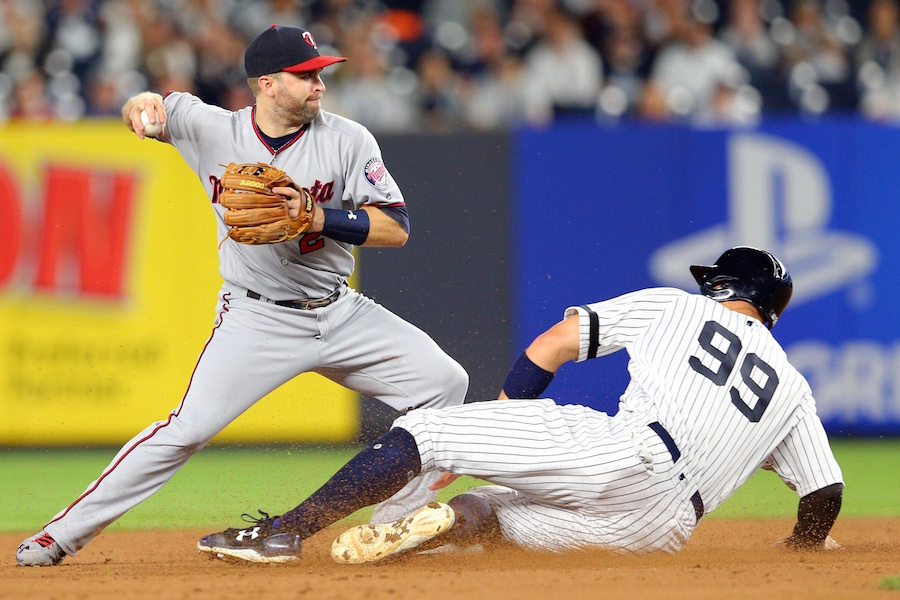 Winning a single game against any opponent should not be such an intimidating proposition, but we all know the history here. The Twins have lost nine straight postseason games against the Yankees and have a .270 winning percentage against them overall dating back to the start of the Ron Gardenhire era. This year, Minnesota extended a streak of futility by dropping four of six against New York in the regular season. The last time the Twins won a season series against the Yanks was 2001 when they went 4-2. Their winning pitchers in those victories were Brad Radke, Joe Mays, Eric Milton and Eddie Guardado. Now, Guardado is overseeing a bullpen that's been surprisingly effective since subtracting its top performer at the deadline. But even if Brandon Kintzler was still around, Guardado's unit would still be at a staggering disadvantage against this powerful Yankees relief corps. So as we examine potential weaknesses to exploit in a quest to slay the giant, we must first confront its most menacing strength. The Unwinnable Bullpen Battle When these two teams met in NYC two weeks ago, the pivotal moment in the series came in the eighth inning of Game 1, with New York leading 2-1. The Twins had managed to mount a rare threat against this vaunted pen, capitalizing on Dellin Betances' wildness to load the bases with one out. Stepping in: Joe Mauer. On deck: Byron Buxton. Two of the league's better hitters in the second half. So Joe Girardi went to his big gun, calling on Aroldis Chapman for a five-out save. Mauer's ensuing at-bat is one that sticks with me as I think back on that game, and look ahead to Tuesday's. He'd been one of the game's toughest outs over the previous month, batting almost .400 and rarely failing to make contact. Chapman blew him away on three pitches, burning him with a 103 MPH fastball for strike three and then inducing a weak fly on the first pitch against Buxton to escape unscathed. In that game, Girardi utilized a strategy he would love to follow again on Tuesday, pulling his starter in the sixth at the first sign of trouble, and then letting his three-headed bullpen monster take care of the rest. Chapman, Betances and David Robertson got 10 outs without allowing a hit, and that's pretty much the norm; not one of the three has allowed a batting average higher than .202. Ervin Santana pitched well enough that his team was only down one when he exited in the sixth, but that single run looms incredibly large against such a fearsome late-inning trio. It is urgent that the Twins strike early. They'll be attempting to do so against one of the American League's finest starting pitchers. Solving Severino Flaws are not easily detected in Luis Severino, New York's 23-year-old All-Star rotation-fronter. He ranks third in the AL in ERA, trailing only Corey Kluber and Chris Sale who will surely be the top two Cy Young finishers. Severino is a strikeout machine and doesn't issue many walks. He has every attribute of an ace. Oh, and he's red-hot: 2.10 ERA and .423 OPS in his five September starts – each a win for the Yankees. He originally signed out of the Dominican Republic for a relatively modest $235,000 on December 26th, 2011 (a belated Christmas gift, it turns out). A month earlier the Twins had signed fellow countryman Fernando Romero with a $260,000 bonus. Romero was ranked as Twins Daily's No. 1 prospect this spring and he showed signs this year that things are moving in the right direction. We can only hope he someday approaches the brilliance Severino is already displaying. Severino brings gas. There isn't a starter in major league baseball who can match his velocity. He's got a nasty slider and a quality changeup. He is an intimidating force, but he's not infallible. The Twins know this because they're the only team that has gotten to him in the past month. His only unspectacular start in September came against Minnesota, who chased him after three innings by running him up to 71 pitches. Can they repeat it? There are three reasons to think they might: 1. Patience Pays Severino doesn't have the frequent bouts of erraticness you expect from such a hard thrower. He has issued one or zero walks in more than half of his starts, and his 2.4 BB/9 rate would be the best of all Twins starters save for Bartolo Colon. The Twins only walked once against Severino in their lone matchup with him this year, but they grinded out at-bats and made him work hard. Mauer, redeeming himself after the tough result against Chapman two nights earlier, drove in the game's first run with perhaps the best AB by a Twin all year, a 13-pitch marathon ending in an RBI single. We'll need to see a lot more of that – pesky at-bats that ratchet up the pitch count and force another early exit. The Twins rank third in the AL in walks and fourth in pitches per plate appearance. 2. Ambush Approach The beauty of this Twins offense is in its ability to attack with such sudden ferocity that an opposing team hardly knows what hit it. They strike and score in bunches. You might as well call them the Crooked Number Crew. Severino doesn't get flustered often and frequently gets into grooves where he's virtually untouchable. But he is susceptible to the ambush. He was cruising along in that start against the Twins until they jumped all over him in the third, and then he was gone. It's a recurring theme in his less-than-stellar performances this year (not that there have been many) – blips of turbulence that snowballed. 3. Nerves and Wear Going with Severino in this winner-take-all affair is essentially a no-brainer, but the decision isn't without risk. He's a 23-year-old who has never pitched in a game with these kinds of stakes, or anything close really. On top of that, he's at an unprecedented workload, with 193 innings in the books (his previous high was 162). I'm not saying either of these things are necessarily decisive issues. But together, they are worth keeping in mind. The Miggy Factor Just when it was starting to appear Miguel Sano might not make it back this year, he pronounced himself ready to play ahead of this weekend's closing series against Detroit. In his tuneup games, he didn't look close to 100 percent, displaying some rust at the plate and still limping on his injured leg, but Sano is the best and most dangerous hitter on this roster. His absence was felt in the Bronx two weeks ago, when the Twins scored only six runs in a three-game sweep. If Sano is healthy enough to swing a bat, he pretty much needs to be in the lineup, or at the very least available on the bench. Paul Molitor essentially acknowledged this, saying after Saturday's game: "I'm leaning that even just having the threat has enough value to consider it." It seems safe to say that Sano won't be intimidated by the spotlight. He has never played in a game of this magnitude but history tells us he thrives in big spots, and (SMALL SAMPLE SIZE WARNING) his track record against the Yankees is strong: 1.169 OPS with five home runs in nine games, including two homers and four RBI in three contests at their park. Plugging Sano into the starting lineup requires a leap of faith from Molitor, who acknowledged that the slugger's timing and recognition were clearly amiss on Friday and Saturday. But it feels like a leap he needs to take, doesn't it? Playing the Ground Game As you'd expect from a group leading the majors in home runs, the Yankees are a prototypical power-hitting team that loves to elevate the ball. Against fly ball pitchers this year, they've hit .268/.345/.489, compared to .253/.334/.392 against ground ball pitchers. That's a 108-point drop in OPS, whereas MLB as a whole has only a 20-point difference. The bad news here, of course, is that Ervin Santana is no one's idea of a ground-ball pitcher. His grounder rate is 15th-lowest among big-league starters and his fly ball rate is seventh-highest. The long ball has been his most evident weakness in an all-around excellent season; only five pitchers have allowed more than his 31 bombs. The good news is that he hasn't allowed multiple homers in a start since July, and he also has a skill that should play very well against the Yankees: missing bats. Santana ramped up his whiffs in the second half, with a 12% swinging strike rate in 14 starts since the break. That clip would rank just outside MLB's top 10 overall, and actually just a tick behind Severino. Santana might be in trouble if he lets guys like Aaron Judge and Gary Sanchez put the ball in play too often, so the key will be to make them miss. That's a known skill of Jose Berrios, who might be first in line to relieve Santana, but New York's splits could cause Molitor to think twice. His 39% grounder rate is lower even than Ervin's, though he hasn't been as susceptible to homers, allowing zero in his past four appearances. If Santana gets in trouble early, Berrios remains the obvious choice as a bridge to the bullpen, but there shouldn't be an overeagerness to get him in. Molitor should, however, be prepared to go to Trevor Hildenberger whenever things are getting sticky. His 59% ground ball rate is elite. And, yes: the Twins are going to miss having Kintzler available. Stealing on Sanchez? On Sunday afternoon, Byron Buxton stole his 29th base of the season on his 24th consecutive successful attempt. This one came the same way as most before it: really, really easily. The Tigers knew, with certainty, that he'd be attempting to steal. Anibal Sanchez threw over three times before delivering a pitch. As soon as he went home, Buxton was gone, and he coasted into second base without a throw. It feels safe to say he's the best base stealer in the game right now, and he may be on his way to establishing himself as one of the best ever. Yankees catcher Gary Sanchez, for all his flaws as a receiver (his 16 passed balls lead the league), does have a good arm. He threw out 41% of runners last year and is at 38% this year, both well above average. Meanwhile, Severino doesn't get run on often (only six attempts in 31 starts) so this is a tough battery to crack. I'd bet on Buxton, but would be reluctant to send any other members of the lineup. One thing to keep in mind: Ehire Adrianza is 8-for-9 on steals this year and had a 72% success rate in the minors. He'll be available on the bench. Let's Go It feels strange to write so many words in a preview for one single game, but that's where we stand. An entire season comes down to this one contest. We already know that each decision and controversial play on Tuesday night will be overanalyzed and dissected to death, so we might as well get it started early, right? The Yankees are heavily favored in this game, with good reason: They are the better team – right now, anyway. To pull off this unlikely victory and advance, the Twins need to orchestrate an upset. And with that in mind, I keep coming back to that quote from Herb Brooks, who knew a little something about the task. "Be better than you are." For one night at least, the Twins need to do just that. At the risk (okay, certainty) of sounding over-dramatic, it feels wrong not to close with this question: Do you believe in miracles?
 -
Article: The Falvey And Levine Machine
Nick Nelson replied to Nick Nelson's topic in Twins Daily Front Page News
These are all flawed teams. The Twins came out on top of a mediocre pack that is clearly a significant step behind the Top 4 and especially the Top 3. Maybe they'll win against the Yankees. Maybe they'll somehow pull off an upset in the ALDS and even the ALCS, though I think we all recognize this is outrageously unlikely because pitching wins in October and the Twins don't have it. They wouldn't have had it if Kintzler was here. Whatever they do next month, it will serve as a springboard going forward, and that should be the real focus. They need to build a championship-caliber staff and while I'm not convinced Littell, or Enns, or Watson will be part of it, they have a chance to help and that's better than nothing for two guys who'd have been here making a minimal difference for a total of 60 innings or so. (In fact, Garcia would've been a net negative, which nobody on the other side of this debate seems to want to address. Trading him will go down as a brilliant move if either prospect they get back has an impact in 2018/19.) Re: Kintzler. I get that he was the team's best-performing reliever, but let's not act like the Twins traded Glen Perkins or Joe Nathan in his prime. This is a closer with a K/9 of 5 and an xFIP of 4.25. I'm not really going to defend the trade because Watson doesn't seem like anything special but conceptually I like the idea of giving up a non-elite relief rental for value when you have a middling shot at a 1-game wild card play-in. -
Article: The Falvey And Levine Machine
Nick Nelson replied to Nick Nelson's topic in Twins Daily Front Page News
I believe that's the Pickler factor -
Article: The Falvey And Levine Machine
Nick Nelson replied to Nick Nelson's topic in Twins Daily Front Page News
It was a team 3 games under .500, with a far worse Pythagorean W/L, coming off a 100-loss season. To make their playoff run, they needed to play .600 ball while EVERY OTHER TEAM in the league (sans the 4 clearly superior playoff squads) to completely folded. If you had faith in the Twins' ability to do this, as a fan, then I commend you. But there was no real reason for a front office to foresee this outcome based on a rational analysis. It's literally one of the first times something like this has ever happened. I hope (and trust) that in the future they'll continue to make decisions on the same basis. If they would've sunk the team's chances I would get this argument, but they didn't, not even close! The Twins still walked away with this thing, and not having Kintzler or Garcia won't be the reason they fail to advance.- 143 replies
-
- 13
-
-
In some corners, Minnesota's new front office leaders will probably be handed too much credit for their roles in one of the most remarkable turnarounds ever by a major-league team. In Year 1 under Derek Falvey and Thad Levine, the Twins will improve by at least 24 wins, going from 100 losses to a probable playoff berth. The narrative is obvious.But the more striking narrative here pertains to the duo's good fortune, rather than their miraculous intervention. Most often, baseball executives getting their first chances to lead a major-league front office are tasked with overhauling a complete mess. From the outside, that's what this looked like: Falvey and Levine inherited the reigning worst team in baseball, one that had lost 90-plus games in five of the last six seasons. They spoke frequently about their big-picture mindset, expressing an intent to eschew shortcuts and quick fixes. But the staggering improvement we've seen this year owes to something we mostly already knew, despite the 2016 debacle: This rebuild was already well underway when the new Chief Baseball Officer and GM arrived. Most of the critical pieces had reached the big-league ranks and others were on the brink. It's just about the most favorable situation one can imagine walking into. For much of that, Falvey and Levine can thank their predecessor Terry Ryan and his colleagues, who assembled a great deal of talent. But while Ryan deserves credit for assembling much of this core, the "Boy Geniuses" (as my pal Clarence Swamptown blithely refers to them -- BeeGees for short) have given us plenty of indications that they're the right ones to bring it forward. The Deadline Dance Recently, I've seen some retrospective debate surrounding the front office's approach at the trade deadline. The critical argument goes like this: Falvey and Levine made a miscalculation by pivoting to seller mode and trading away assets, rather than adding, at the end of July. Regardless of the impact these moves had, the signal was one of resignation, and now it looks bad. This line of thinking doesn't really work for me, for two reasons: 1) It wasn't really a "sell" They didn't trade Brian Dozier, or Ervin Santana. They gave up a starter they'd acquired a week earlier, and a reliever who proved nonessential. Good front office execs are opportunistic, and that's exactly how to describe these moves; the market for Jaime Garcia heated up as the Yankees developed a need, and Brandon Kintzler's value was at its absolute peak. Both are heading for free agency. And in fact, you can argue there's been significant overall benefit from removing them, as it opened the door for Kyle Gibson and Trevor Hildenberger – who will be around next year – to step into bigger roles and flourish. 2) It was a perfectly reasonable strategy even if you want to call it a sell Look, we don't need to delve into playoff odds and percentages, which were dreadfully low as the Twins reached the end of July, trailing several teams in the race and playing uninspiring ball. An honest assessment showed at the time (and still shows) that this isn't a great team, not yet anyway. It would've been impossible to predict that laggards like Gibson and Jorge Polanco would suddenly take off while the rest of the American League completely folded, but the FO didn't do anything to sabotage the Twins' chances in such an event – obviously. In fact, I see Minnesota's deadline approach as a savvy one that avoided the pitfalls of this new postseason format. The addition of a second Wild Card slot means more teams are in the mix, and this compels clubs to make "Buy" moves when they're not necessarily warranted*. The Royals traded prospects to acquire Trevor Cahill and Melky Cabrera. The Angels made deals in August to acquire Justin Upton and Brandon Phillips. All of this got them nowhere. Meanwhile, the Twins – who are at the front end of their winning cycle – added future assets and will still get their shot. Falvey and Levine come away from this looking pretty good. * As a middling club aiming for a WC berth, you're still facing serious uphill odds with a one-game play-in for the chance to face superior teams in the Division and League Championship Series. I like the system but it begs for a merely solid team to sacrifice long-term thinking in order to chase that tiny chance. Given their position, the Twins were wise to steer clear of this trap. Putting Pieces in Place How much did the execs influence the team's success this year? It's tough to measure, but I think we can safely say they had a positive impact. As mentioned before, the Twins' turnaround was largely driven by players brought into the organization by Ryan and even Bill Smith. Meanwhile, the same manager is running the show. But the dramatic improvement in on-field results has likely been facilitated in some ways by the new regime. For one thing, there were free agent signings like Jason Castro and Matt Belisle. Castro has proven a very solid addition, helping the pitching staff with his strong framing work, while Belisle has been brilliant in the ninth, negating the absence of Kintzler. Perhaps more importantly, there were organizational changes and coaching staff additions like James Rowson and Jeff Pickler. I don't think it's coincidence that so many young hitters are suddenly turning corners, or that the Twins have suddenly catapulted to the top tier of MLB defenses, with these two handpicked coaches in the dugout. Moreover, Levine has mostly pulled the right roster strings throughout the summer, showing a refreshing willingness to shuttle players in and out as needed, and to experiment with a multitude of arms to see what works. Through it all, decisions have seemingly been guided by evidence, data, and good intelligence. I'm not confident these guys will always make the right calls – no one does. But I am feeling confident that those calls will be well-informed and guided by the three things mentioned above. My interactions with Falvey and Levine, and everything they've done and said, reinforces the team's decision and leads me to believe this beautiful gift is in very good hands. And make no mistake: it is a beautiful gift. The Twins have one of the best and youngest offenses in the game, with every member of a top-tier lineup locked in for next year. They have a strong farm system, with a pipeline ready to deliver. And they also have significant spending freedom on the horizon, with Joe Mauer's $23 million coming off the books next year and minimal contractual commitments beyond that. Lefty Gomez once said, "I'd rather be lucky than good." Why not both? Click here to view the article
-
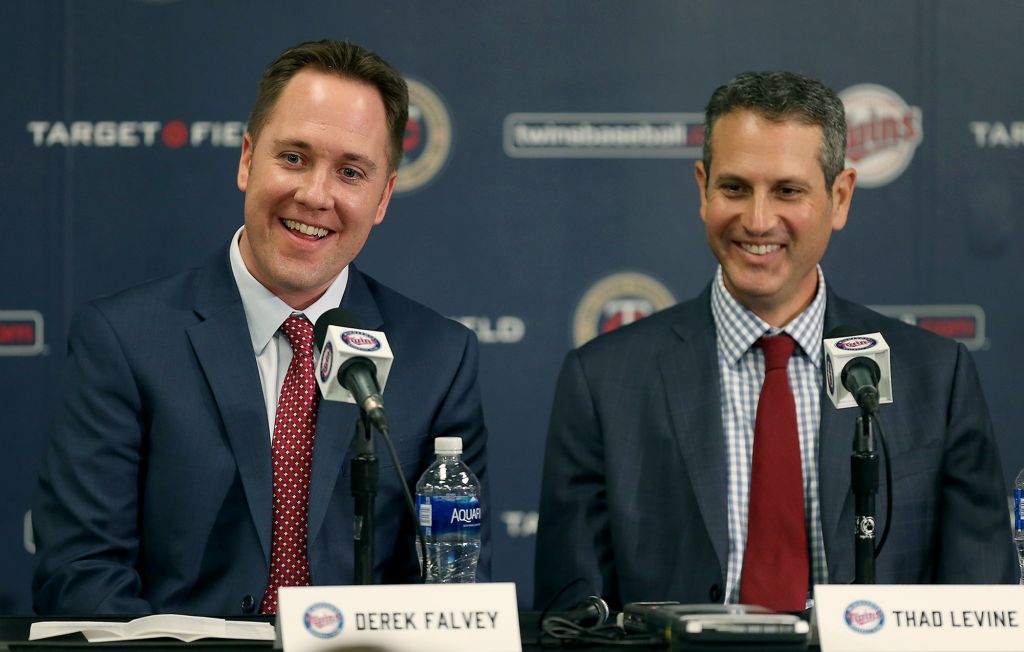 But the more striking narrative here pertains to the duo's good fortune, rather than their miraculous intervention. Most often, baseball executives getting their first chances to lead a major-league front office are tasked with overhauling a complete mess. From the outside, that's what this looked like: Falvey and Levine inherited the reigning worst team in baseball, one that had lost 90-plus games in five of the last six seasons. They spoke frequently about their big-picture mindset, expressing an intent to eschew shortcuts and quick fixes. But the staggering improvement we've seen this year owes to something we mostly already knew, despite the 2016 debacle: This rebuild was already well underway when the new Chief Baseball Officer and GM arrived. Most of the critical pieces had reached the big-league ranks and others were on the brink. It's just about the most favorable situation one can imagine walking into. For much of that, Falvey and Levine can thank their predecessor Terry Ryan and his colleagues, who assembled a great deal of talent. But while Ryan deserves credit for assembling much of this core, the "Boy Geniuses" (as my pal Clarence Swamptown blithely refers to them -- BeeGees for short) have given us plenty of indications that they're the right ones to bring it forward. The Deadline Dance Recently, I've seen some retrospective debate surrounding the front office's approach at the trade deadline. The critical argument goes like this: Falvey and Levine made a miscalculation by pivoting to seller mode and trading away assets, rather than adding, at the end of July. Regardless of the impact these moves had, the signal was one of resignation, and now it looks bad. This line of thinking doesn't really work for me, for two reasons: 1) It wasn't really a "sell" They didn't trade Brian Dozier, or Ervin Santana. They gave up a starter they'd acquired a week earlier, and a reliever who proved nonessential. Good front office execs are opportunistic, and that's exactly how to describe these moves; the market for Jaime Garcia heated up as the Yankees developed a need, and Brandon Kintzler's value was at its absolute peak. Both are heading for free agency. And in fact, you can argue there's been significant overall benefit from removing them, as it opened the door for Kyle Gibson and Trevor Hildenberger – who will be around next year – to step into bigger roles and flourish. 2) It was a perfectly reasonable strategy even if you want to call it a sell Look, we don't need to delve into playoff odds and percentages, which were dreadfully low as the Twins reached the end of July, trailing several teams in the race and playing uninspiring ball. An honest assessment showed at the time (and still shows) that this isn't a great team, not yet anyway. It would've been impossible to predict that laggards like Gibson and Jorge Polanco would suddenly take off while the rest of the American League completely folded, but the FO didn't do anything to sabotage the Twins' chances in such an event – obviously. In fact, I see Minnesota's deadline approach as a savvy one that avoided the pitfalls of this new postseason format. The addition of a second Wild Card slot means more teams are in the mix, and this compels clubs to make "Buy" moves when they're not necessarily warranted*. The Royals traded prospects to acquire Trevor Cahill and Melky Cabrera. The Angels made deals in August to acquire Justin Upton and Brandon Phillips. All of this got them nowhere. Meanwhile, the Twins – who are at the front end of their winning cycle – added future assets and will still get their shot. Falvey and Levine come away from this looking pretty good. * As a middling club aiming for a WC berth, you're still facing serious uphill odds with a one-game play-in for the chance to face superior teams in the Division and League Championship Series. I like the system but it begs for a merely solid team to sacrifice long-term thinking in order to chase that tiny chance. Given their position, the Twins were wise to steer clear of this trap. Putting Pieces in Place How much did the execs influence the team's success this year? It's tough to measure, but I think we can safely say they had a positive impact. As mentioned before, the Twins' turnaround was largely driven by players brought into the organization by Ryan and even Bill Smith. Meanwhile, the same manager is running the show. But the dramatic improvement in on-field results has likely been facilitated in some ways by the new regime. For one thing, there were free agent signings like Jason Castro and Matt Belisle. Castro has proven a very solid addition, helping the pitching staff with his strong framing work, while Belisle has been brilliant in the ninth, negating the absence of Kintzler. Perhaps more importantly, there were organizational changes and coaching staff additions like James Rowson and Jeff Pickler. I don't think it's coincidence that so many young hitters are suddenly turning corners, or that the Twins have suddenly catapulted to the top tier of MLB defenses, with these two handpicked coaches in the dugout. Moreover, Levine has mostly pulled the right roster strings throughout the summer, showing a refreshing willingness to shuttle players in and out as needed, and to experiment with a multitude of arms to see what works. Through it all, decisions have seemingly been guided by evidence, data, and good intelligence. I'm not confident these guys will always make the right calls – no one does. But I am feeling confident that those calls will be well-informed and guided by the three things mentioned above. My interactions with Falvey and Levine, and everything they've done and said, reinforces the team's decision and leads me to believe this beautiful gift is in very good hands. And make no mistake: it is a beautiful gift. The Twins have one of the best and youngest offenses in the game, with every member of a top-tier lineup locked in for next year. They have a strong farm system, with a pipeline ready to deliver. And they also have significant spending freedom on the horizon, with Joe Mauer's $23 million coming off the books next year and minimal contractual commitments beyond that. Lefty Gomez once said, "I'd rather be lucky than good." Why not both?
