



Nick Nelson
-
Posts
8,326 -
Joined
-
Last visited
-
Days Won
56
Content Type
Profiles
News
Minnesota Twins Videos
2026 Minnesota Twins Top Prospects Ranking
2022 Minnesota Twins Draft Picks
Minnesota Twins Free Agent & Trade Rumors, Notes, & Tidbits
Guides & Resources
2023 Minnesota Twins Draft Picks
The Minnesota Twins Players Project
2024 Minnesota Twins Draft Picks
2025 Minnesota Twins Draft Pick Tracker
2026 Minnesota Twins Draft Tracker: Picks & Bonuses
Forums
Blogs
Events
Store
Downloads
Gallery
Everything posted by Nick Nelson
-
 It's one of those things that can be difficult to quantify, but without a doubt, veteran presence matters in an MLB clubhouse. In 2015, anyone who spent time around the team will tell you that 39-year-old Torii Hunter played a larger role in the group's success than his numbers show. And this year, 44-year-old Bartolo Colon's impact after joining the roster in mid-August overshadowed his production on the field. Colon is back on the market and reportedly looking to give it another go next season. It's sadly time for the Twins to move on from Big Sexy, but there are two other well-traveled vets that look like potential fits.John Lackey "intends to pitch in 2018," according to Jon Heyman. He's 39 and has thrown almost 3,000 innings in the major leagues. When we last saw him on the mound, it wasn't pretty; the right-hander was roughed up in three relief appearances during the NLDS. And in general, it was a trying season for him, as he posted his worst ERA in five years while allowing a league-high 36 home runs. But outside of the long ball troubles, Lackey pitched fairly well. His 1.28 WHIP would've ranked third among Twins starters and his 20.4% K-rate would have ranked second. From 2013 through 2016, he posted a 3.35 ERA and 1.18 WHIP with an excellent record of durability while pitching for teams that made the postseason every year (Red Sox, Cardinals, Cubs). He took home rings in 2013 and 2016. Lackey is a capable starter with tons of experience, and he's accustomed to winning. He'll also be surely be available on a one-year deal, leaving the front office with plenty of long-term flexibility if they were to sign him. The other name I'll be tracking is not a pitcher, but a hitter. Jayson Werth, 38, plans to keep playing and might look very nice on the Twins bench next season. Like Lackey, he's coming off an inauspicious campaign, having hit .226/.332/.393 in the final year of a fairly disastrous $126 million contract with the Nationals. He was limited to 70 games this year by a bone bruise in his left foot. Werth hasn't had much success lately in general with a sub par .724 OPS over his past three seasons. As a guy making $21 million and expected to serve as a regular in the outfield, Werth was a major liability. FanGraphs pegged him at -0.3 WAR in 2017. But what if he were making a fraction of that on a one-year deal, being used more sparingly and more to his strengths? Werth posted an .820 OPS and 10/9 K/BB ratio against left-handed pitchers this year, but made less than 20% of his plate appearances against them. In his career, he has hit .293/.393/.538 against southpaws. With the Twins, he could spend much of his time at DH while occasionally spelling Max Kepler or Eddie Rosario in the outfield corners against left-handers (though preferably not often as he'd be a huge step down defensively). As a young team looking to build upon its success and return to the postseason, the Twins will surely have a keen interest in players that fit the veteran leader prototype. As it happens, two of the most experienced players on the free agent market look like pretty solid fits, given their needs. I wouldn't be surprised to soon hear Minnesota connected to one, or both. Have you gotten your copy of the Offseason Handbook yet? You can read about these names and dozens of other Twins targets. Download yours now and dig in: Download attachment: CTA-Banner (2).jpg Click here to view the article
 -
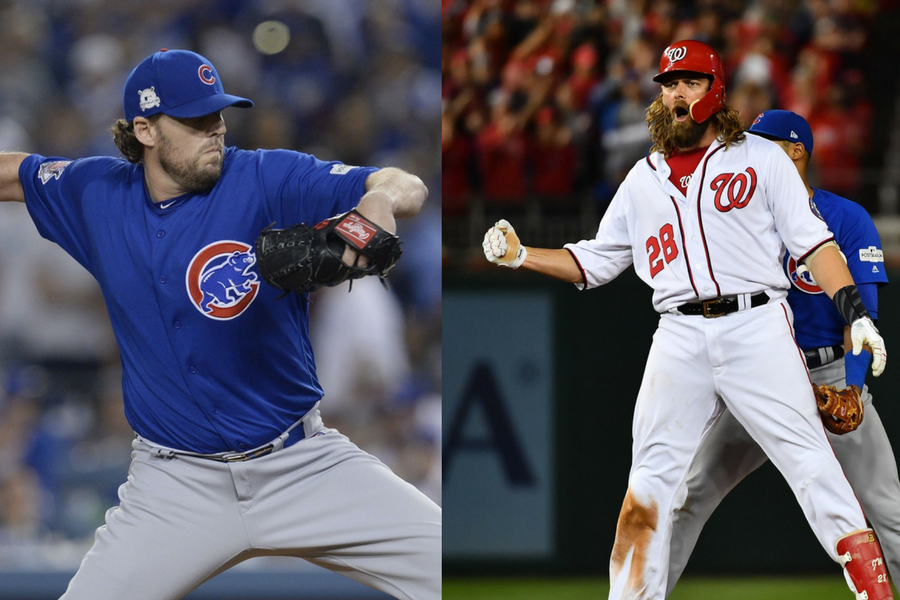 John Lackey "intends to pitch in 2018," according to Jon Heyman. He's 39 and has thrown almost 3,000 innings in the major leagues. When we last saw him on the mound, it wasn't pretty; the right-hander was roughed up in three relief appearances during the NLDS. And in general, it was a trying season for him, as he posted his worst ERA in five years while allowing a league-high 36 home runs. But outside of the long ball troubles, Lackey pitched fairly well. His 1.28 WHIP would've ranked third among Twins starters and his 20.4% K-rate would have ranked second. From 2013 through 2016, he posted a 3.35 ERA and 1.18 WHIP with an excellent record of durability while pitching for teams that made the postseason every year (Red Sox, Cardinals, Cubs). He took home rings in 2013 and 2016. Lackey is a capable starter with tons of experience, and he's accustomed to winning. He'll also be surely be available on a one-year deal, leaving the front office with plenty of long-term flexibility if they were to sign him. The other name I'll be tracking is not a pitcher, but a hitter. Jayson Werth, 38, plans to keep playing and might look very nice on the Twins bench next season. Like Lackey, he's coming off an inauspicious campaign, having hit .226/.332/.393 in the final year of a fairly disastrous $126 million contract with the Nationals. He was limited to 70 games this year by a bone bruise in his left foot. Werth hasn't had much success lately in general with a sub par .724 OPS over his past three seasons. As a guy making $21 million and expected to serve as a regular in the outfield, Werth was a major liability. FanGraphs pegged him at -0.3 WAR in 2017. But what if he were making a fraction of that on a one-year deal, being used more sparingly and more to his strengths? Werth posted an .820 OPS and 10/9 K/BB ratio against left-handed pitchers this year, but made less than 20% of his plate appearances against them. In his career, he has hit .293/.393/.538 against southpaws. With the Twins, he could spend much of his time at DH while occasionally spelling Max Kepler or Eddie Rosario in the outfield corners against left-handers (though preferably not often as he'd be a huge step down defensively). As a young team looking to build upon its success and return to the postseason, the Twins will surely have a keen interest in players that fit the veteran leader prototype. As it happens, two of the most experienced players on the free agent market look like pretty solid fits, given their needs. I wouldn't be surprised to soon hear Minnesota connected to one, or both. Have you gotten your copy of the Offseason Handbook yet? You can read about these names and dozens of other Twins targets. Download yours now and dig in:
 -
Article: The 5 Best Pitching Gambles In Free Agency
Nick Nelson replied to Nick Nelson's topic in Twins Daily Front Page News
By what measure was his 2013 season not "great"? The upside is that you have a chance to capture an above-average starter while committing very little. Wasn't that pretty clearly explained? It's pretty easy to say "These guys are bad, why sign any of them!" but teams sign players like this every year and catch lightning in a bottle. The Twins, IMO, are in very good position to take such gambles for a couple reasons: 1) They offer an attractive environment for pitchers looking for that one-year make-good deal because of their contending status and excellent defense. 2) They have enough pitching depth that if they sign one or two of these kinds of guys and they don't work out, the rotation should still be OK. I'm sure people would've been saying the same type of stuff last year about Charlie Morton if he was listed as a buy-low target. How'd that work out for Houston? All I'm gonna say is that this kind of limiting mindset would cause you to miss out on opportunities. It's important to be objective and open-minded, not blinded by personal experience. -
At 9:00 am on Monday, MLB free agency will officially be open for business. At that point, the Twins front office can embark upon its quest to improve the starting rotation via external additions. Let's take a look at some of the best potential bargains in this year's class.Sure, there are the big names: Jake Arrieta, Yu Darvish, Lance Lynn. All will have very competitive markets, and will likely end up with nine-figure deals. One can argue that the smarter way to spend in free agency is targeting high-ceiling pitchers in buy-low opportunities. If you hit on one of these tickets, you can end up with a top-of-the-rotation starter; if you miss, you're not committed to anything beyond a one-year contract. Brett Anderson's name has become something of a running joke among the Twins Daily writers, because I have reliably mentioned him almost every offseason as a player the Twins should look into. In some ways, he's the prototype for the free agent pitching gambles we're discussing here – talented enough to be a high-caliber starter if healthy, but with enough question marks that no team will give him more than a make-good deal. He's most often a good example of the downside. As it happens, Anderson's out there again this offseason, but even I've lost hope for the oft-injured southpaw, who has thrown 60+ innings just once since 2011. Luckily, there are plenty of others in the same category offering far more realistic upside. These five names – drawn from the Offseason Handbook – are my favorites among this group. Chris Tillman, RHP (29): From 2013 through 2016, Tillman averaged 190 innings with a 3.91 ERA while pitching for Baltimore in the offense-packed AL East. His 2017 season was a total mess, yielding a 1-7 record and 7.84 ERA, so now Tillman will be looking to re-establish some value in search of a long-term deal next winter. He doesn't turn 30 until mid-April. As someone who allows a fair amount of contact, the right-hander could be swayed by the opportunity to pitch in front of an elite defensive unit that will help his numbers. Trevor Cahill, RHP (29): The Royals traded for Cahill ahead of the deadline with hopes he'd help get them over the hump, but the move fizzled horribly as he battled shoulder issues throughout the second half, making only three starts for KC. Prior to the trade, Cahill had been highly impressive as a starter for San Diego, averaging 10.6 K/9 while posting a 3.69 ERA and 3.40 FIP. If they can recapture that form, the Twins would have a nice rotation weapon, or else they could try him as a reliever (he was excellent in that capacity for the Cubs in 2016). Tyson Ross, RHP (30): Much like Matt Harvey and Phil Hughes, Ross's return this year from thoracic outlet syndrome surgery didn't go smoothly. He put up a 7.71 ERA in 12 appearances for Texas before being released in September. But between 2014 and 2015, he made 64 starts with a 3.03 ERA and 9.4 K/9 rate. He's definitely a talent worth betting on, and will likely need to settle for a minor-league contract. Jeremy Hellickson, RHP (30): Coming off a strong 2016 campaign with Philadelphia, Hellickson had a chance to hit free agency for the first time and score a sizable multi-year deal. Instead, he accepted a qualifying offer from the Phillies, taking a $17 million salary and hoping to springboard back into the market this winter. That... didn't happen. The righty endured the worst season of his career (5.43 in 30 starts) and now he'll likely be seeking a one-year deal to rebuild his stock. The Twins can offer a contending environment and a great defense, so the right offer probably gets it done. Ubaldo Jimenez, RHP (33): Gulp. What am I doing here? Jimenez was one of the prime culprits in a horrendous Orioles rotation this year. He led baseball in earned runs allowed. Turning 34 in January, he owns a 6.13 ERA and 1.58 WHIP over the past two seasons. It goes without saying there's major risk. But Jimenez still does have those occasional flashes of brilliance that make you wonder. He struck out 11 in an August start and 10 in a September start. Maybe a change of scenery and new pitching coach enables that dominant side to come out more often? It bears noting that Jimenez's last good year came in 2013 in Cleveland, when he posted a 3.30 ERA over 30 starts for Derek Falvey's Cleveland Indians. Which free agent starter names in the Offseason Handbook stand out to you? If you haven't gotten yours yet, make sure to order and download now so you'll have a handy resource in hand as the free agency frenzy gets underway. Download attachment: CTA-Banner (2).jpg Click here to view the article
-
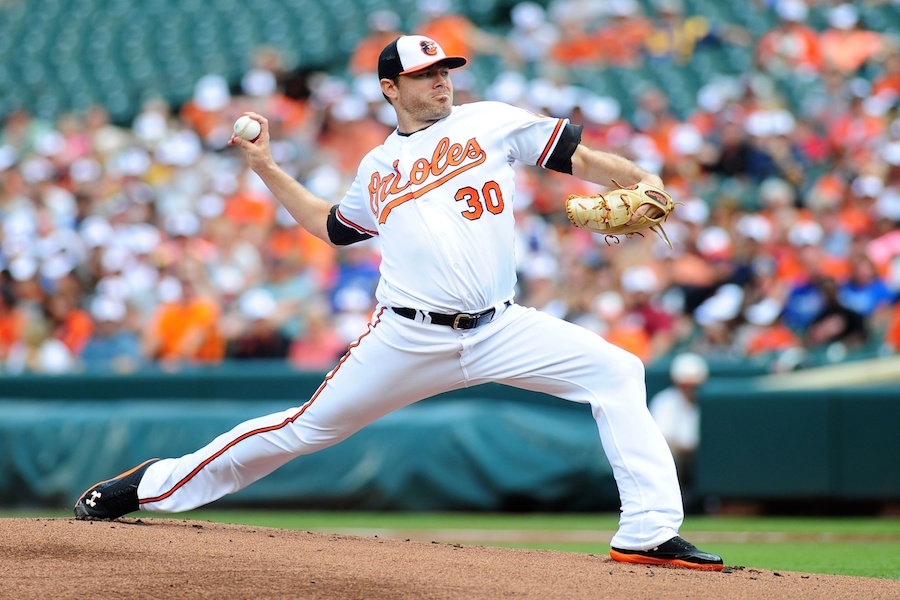 Sure, there are the big names: Jake Arrieta, Yu Darvish, Lance Lynn. All will have very competitive markets, and will likely end up with nine-figure deals. One can argue that the smarter way to spend in free agency is targeting high-ceiling pitchers in buy-low opportunities. If you hit on one of these tickets, you can end up with a top-of-the-rotation starter; if you miss, you're not committed to anything beyond a one-year contract. Brett Anderson's name has become something of a running joke among the Twins Daily writers, because I have reliably mentioned him almost every offseason as a player the Twins should look into. In some ways, he's the prototype for the free agent pitching gambles we're discussing here – talented enough to be a high-caliber starter if healthy, but with enough question marks that no team will give him more than a make-good deal. He's most often a good example of the downside. As it happens, Anderson's out there again this offseason, but even I've lost hope for the oft-injured southpaw, who has thrown 60+ innings just once since 2011. Luckily, there are plenty of others in the same category offering far more realistic upside. These five names – drawn from the Offseason Handbook – are my favorites among this group. Chris Tillman, RHP (29): From 2013 through 2016, Tillman averaged 190 innings with a 3.91 ERA while pitching for Baltimore in the offense-packed AL East. His 2017 season was a total mess, yielding a 1-7 record and 7.84 ERA, so now Tillman will be looking to re-establish some value in search of a long-term deal next winter. He doesn't turn 30 until mid-April. As someone who allows a fair amount of contact, the right-hander could be swayed by the opportunity to pitch in front of an elite defensive unit that will help his numbers. Trevor Cahill, RHP (29): The Royals traded for Cahill ahead of the deadline with hopes he'd help get them over the hump, but the move fizzled horribly as he battled shoulder issues throughout the second half, making only three starts for KC. Prior to the trade, Cahill had been highly impressive as a starter for San Diego, averaging 10.6 K/9 while posting a 3.69 ERA and 3.40 FIP. If they can recapture that form, the Twins would have a nice rotation weapon, or else they could try him as a reliever (he was excellent in that capacity for the Cubs in 2016). Tyson Ross, RHP (30): Much like Matt Harvey and Phil Hughes, Ross's return this year from thoracic outlet syndrome surgery didn't go smoothly. He put up a 7.71 ERA in 12 appearances for Texas before being released in September. But between 2014 and 2015, he made 64 starts with a 3.03 ERA and 9.4 K/9 rate. He's definitely a talent worth betting on, and will likely need to settle for a minor-league contract. Jeremy Hellickson, RHP (30): Coming off a strong 2016 campaign with Philadelphia, Hellickson had a chance to hit free agency for the first time and score a sizable multi-year deal. Instead, he accepted a qualifying offer from the Phillies, taking a $17 million salary and hoping to springboard back into the market this winter. That... didn't happen. The righty endured the worst season of his career (5.43 in 30 starts) and now he'll likely be seeking a one-year deal to rebuild his stock. The Twins can offer a contending environment and a great defense, so the right offer probably gets it done. Ubaldo Jimenez, RHP (33): Gulp. What am I doing here? Jimenez was one of the prime culprits in a horrendous Orioles rotation this year. He led baseball in earned runs allowed. Turning 34 in January, he owns a 6.13 ERA and 1.58 WHIP over the past two seasons. It goes without saying there's major risk. But Jimenez still does have those occasional flashes of brilliance that make you wonder. He struck out 11 in an August start and 10 in a September start. Maybe a change of scenery and new pitching coach enables that dominant side to come out more often? It bears noting that Jimenez's last good year came in 2013 in Cleveland, when he posted a 3.30 ERA over 30 starts for Derek Falvey's Cleveland Indians. Which free agent starter names in the Offseason Handbook stand out to you? If you haven't gotten yours yet, make sure to order and download now so you'll have a handy resource in hand as the free agency frenzy gets underway.
 -
Article: Busting 3 Myths About The Twins Offseason
Nick Nelson replied to Nick Nelson's topic in Twins Daily Front Page News
Sure, and I'd be all for it. I just won't feel like the offseason is a failure if they don't do so. I think they have enough quality numbers. Though I do like the idea of swapping out Santana for a superior longer-term option, as outlined in the Handbook blueprint. -
Article: Busting 3 Myths About The Twins Offseason
Nick Nelson replied to Nick Nelson's topic in Twins Daily Front Page News
Not plus that pen, BECAUSE of that pen. They were 12th in the AL in SP ERA in 2015, when they won the World Series. -
Article: Busting 3 Myths About The Twins Offseason
Nick Nelson replied to Nick Nelson's topic in Twins Daily Front Page News
Did Smith get fired for spending money or for spending money poorly? Speculation aside, he was green-lighted for an all-time record payroll the last time the Twins had legit championship aspirations. That is the pertinent fact here. -
Article: Busting 3 Myths About The Twins Offseason
Nick Nelson replied to Nick Nelson's topic in Twins Daily Front Page News
My point was that someone like May or Romero could be the addition to the top. And keeping the door open for them maintains roster/payroll flexibility. As I mentioned, you can always add during the season when you have a better idea of how things are shaping up. -
Article: Busting 3 Myths About The Twins Offseason
Nick Nelson replied to Nick Nelson's topic in Twins Daily Front Page News
I think some are missing the point of this post a little bit. To be clear, I'm not saying the Twins will spend $120M+, only that we shouldn't treat it as a given they won't. It seems like a lot of people are conditioned to think a certain way, or making assumptions based on how they've operated over the past 5 years while out of contention, or in the pre-Target Field days. The fact that people are pointing back to how the franchise spent in the early 2000s only reinforces why I made the point. And I'm certainly not saying the Twins SHOULDN'T add an impact starter, only that they COULD keep roughly the same staff and still take a meaningful step forward. Do the people saying things to the effect of "If they don't spend on a FA they'll end up with pitchers like Hughes and Nolasco in the rotation" realize the irony of their statements? -
The World Series is over. The offseason is about to rev up. You can explore its many possibilities by ordering and immediately downloading your copy of the Twins Daily Offseason Handbook. As we gear up for many weeks of in-depth Hot Stove coverage here on the site, I thought I'd address three pervasive myths I've seen floating around in Twins Territory. Let's set the record straight on these misleading talkers.On the surface, these suppositions may feel plausible, if not resoundingly true. But each of these three Twins offseason myths is driven by faulty reasoning, and here's why. MYTH #1: The Twins won't significantly increase payroll. It's understandable that this is the default position. The Twins franchise has a long history of spending less on the roster than many fans would hope or expect. Even our own Offseason Handbook fuels the fire on this myth, with John writing that 2018 payroll will likely top out at $110-115 million – he even considered that "optimistic." It's certainly possible this will be the case. But I urge you to keep a few things in mind: A ) There's a new front office in place. Granted, we've been given no reason to think Derek Falvey and Thad Levine are going to be handed a blank check, but the general belief is that Terry Ryan would often spend far less than he was able. Is that still going to be the case? Let's not forget that the first major move from this new leadership was a fairly aggressive free-agent spend (Jason Castro). B ) The Twins have a long way to go before they're even in the middle of the pack for spending. Levine acknowledged in his interview with Baseball Prospectus this summer that when it comes to payroll, the Twins are "not going to be in the top 10, and we're fine with that." But here's the thing: he can add quite a bit and still be nowhere near the top 10. Minnesota's Opening Day payroll this year ($108 million) ranked 22nd in the majors. The 15th-ranked team was Kansas City, at $140 million. Is there really any reason the Twins shouldn't be able to reach that level? Especially when you consider that... C ) They are competitive now. Know what happened the last time the Twins planned for a season with true championship aspirations? They set a franchise record for payroll, under Bill Smith, at $113 million. That was in 2011, when they were coming off their last playoff appearance. When accounting for market inflation, that same $113 million would check in over $120 million today – maybe well over. The Twins ranked ninth in payroll in 2011; this year, the ninth-ranked Nationals spent $167 million. So let's not just assume this team won't see a significant bump in spending, especially with a number of contracts set to come off the books following 2018. MYTH #2: The Twins need to add an impact starting pitcher. Sure, it'd be nice. And now that we've dispelled the first myth, it certainly feels accomplishable. But the Twins don't necessarily NEED to add a top-tier starter via free agency or trade in order to enter the 2018 season as legitimate playoff (and even World Series) contenders. They will likely be bringing back four pitchers who made 20-plus starts in 2017, and there's reason to believe it could be a very capable group. Ervin Santana: Coming off a career-year, has been a steady workhorse in three seasons with MN, posting a 3.47 ERA over 500 innings. Jose Berrios: Former top prospect found his comfort zone in the big leagues and posted a 14-8 record, 3.89 ERA at age 23. Could (should?) take another big step forward. Kyle Gibson: Finally looked in the second half like the version we've all been waiting for. Posted a 3.55 ERA with markedly more whiffs in August and September. Contrary to another popular myth, this wasn't just another typical fluctuation for the notoriously inconsistent hurler; he made several noticeable changes to drive the improvement. Adalberto Mejia: His first season as a major-league starter was a relative success. He has the build and the stuff to succeed. With better control he can become a reliable mid-rotation piece. Young pitchers often improve this facet in their second year, and Mejia has a history of throwing strikes in the minors (2.1 BB/9). I'm feeling somewhat bullish on this group, and the Twins will have numerous options on hand to fill the fifth spot. Their projected season-opening rotation at Rochester includes Stephen Gonsalves, Fernando Romero, Zack Littell, Felix Jorge and Aaron Slegers, who could all be poised to contribute early on if not right away. At least a couple of them have top-of-rotation potential. As a placeholder until one of those prospects is ready, the Twins could roll out Trevor May as the fifth starter, give Tyler Duffey another shot, or a sign a lower-level free agent. And then, once the 2018 season is underway, the opportunity is always there to make in-season additions. MYTH #3: The Twins must add more padding to the outfield walls to protect Byron Buxton. I keep seeing this suggestion again and again, for some reason. It's not going to happen, nor should it. First of all, the Twins already bulked up the padding on Target Field's outfield fences, back in 2014. The "Covermaster" surface now in place is eight inches thick, built to absorb and disperse impact force. It cost "six figures" to install. At a point it becomes impractical to do much else. They're not going to cover the walls in pillows, or anything that significantly affects play (you can't have line drives flying into an ultra-soft surface and then just dropping onto the warning track). Look, we all recognize that Buxton's style of play entails certain hazards, and we were reminded of that in the final game of the season, where he suffered a cracked rib in a collision with the fence in New York. But that's part of the package. He'll never dial down the all-out effort and aggressiveness (we can only hope), so the best hope to avoid injuries is for Buxton to continually improve his situational awareness and not allow that wall (or another outfielder) to blindside him. He did seem to get better about that this year. But at the end of the day, there's just a certain risk you run (so to speak) when hurdling through the outfield with mythical speed. Download attachment: CTA-Banner (2).jpg Click here to view the article
-
 On the surface, these suppositions may feel plausible, if not resoundingly true. But each of these three Twins offseason myths is driven by faulty reasoning, and here's why. MYTH #1: The Twins won't significantly increase payroll. It's understandable that this is the default position. The Twins franchise has a long history of spending less on the roster than many fans would hope or expect. Even our own Offseason Handbook fuels the fire on this myth, with John writing that 2018 payroll will likely top out at $110-115 million – he even considered that "optimistic." It's certainly possible this will be the case. But I urge you to keep a few things in mind: A ) There's a new front office in place. Granted, we've been given no reason to think Derek Falvey and Thad Levine are going to be handed a blank check, but the general belief is that Terry Ryan would often spend far less than he was able. Is that still going to be the case? Let's not forget that the first major move from this new leadership was a fairly aggressive free-agent spend (Jason Castro). B ) The Twins have a long way to go before they're even in the middle of the pack for spending. Levine acknowledged in his interview with Baseball Prospectus this summer that when it comes to payroll, the Twins are "not going to be in the top 10, and we're fine with that." But here's the thing: he can add quite a bit and still be nowhere near the top 10. Minnesota's Opening Day payroll this year ($108 million) ranked 22nd in the majors. The 15th-ranked team was Kansas City, at $140 million. Is there really any reason the Twins shouldn't be able to reach that level? Especially when you consider that... C ) They are competitive now. Know what happened the last time the Twins planned for a season with true championship aspirations? They set a franchise record for payroll, under Bill Smith, at $113 million. That was in 2011, when they were coming off their last playoff appearance. When accounting for market inflation, that same $113 million would check in over $120 million today – maybe well over. The Twins ranked ninth in payroll in 2011; this year, the ninth-ranked Nationals spent $167 million. So let's not just assume this team won't see a significant bump in spending, especially with a number of contracts set to come off the books following 2018. MYTH #2: The Twins need to add an impact starting pitcher. Sure, it'd be nice. And now that we've dispelled the first myth, it certainly feels accomplishable. But the Twins don't necessarily NEED to add a top-tier starter via free agency or trade in order to enter the 2018 season as legitimate playoff (and even World Series) contenders. They will likely be bringing back four pitchers who made 20-plus starts in 2017, and there's reason to believe it could be a very capable group. Ervin Santana: Coming off a career-year, has been a steady workhorse in three seasons with MN, posting a 3.47 ERA over 500 innings. Jose Berrios: Former top prospect found his comfort zone in the big leagues and posted a 14-8 record, 3.89 ERA at age 23. Could (should?) take another big step forward. Kyle Gibson: Finally looked in the second half like the version we've all been waiting for. Posted a 3.55 ERA with markedly more whiffs in August and September. Contrary to another popular myth, this wasn't just another typical fluctuation for the notoriously inconsistent hurler; he made several noticeable changes to drive the improvement. Adalberto Mejia: His first season as a major-league starter was a relative success. He has the build and the stuff to succeed. With better control he can become a reliable mid-rotation piece. Young pitchers often improve this facet in their second year, and Mejia has a history of throwing strikes in the minors (2.1 BB/9). I'm feeling somewhat bullish on this group, and the Twins will have numerous options on hand to fill the fifth spot. Their projected season-opening rotation at Rochester includes Stephen Gonsalves, Fernando Romero, Zack Littell, Felix Jorge and Aaron Slegers, who could all be poised to contribute early on if not right away. At least a couple of them have top-of-rotation potential. As a placeholder until one of those prospects is ready, the Twins could roll out Trevor May as the fifth starter, give Tyler Duffey another shot, or a sign a lower-level free agent. And then, once the 2018 season is underway, the opportunity is always there to make in-season additions. MYTH #3: The Twins must add more padding to the outfield walls to protect Byron Buxton. I keep seeing this suggestion again and again, for some reason. It's not going to happen, nor should it. First of all, the Twins already bulked up the padding on Target Field's outfield fences, back in 2014. The "Covermaster" surface now in place is eight inches thick, built to absorb and disperse impact force. It cost "six figures" to install. At a point it becomes impractical to do much else. They're not going to cover the walls in pillows, or anything that significantly affects play (you can't have line drives flying into an ultra-soft surface and then just dropping onto the warning track). Look, we all recognize that Buxton's style of play entails certain hazards, and we were reminded of that in the final game of the season, where he suffered a cracked rib in a collision with the fence in New York. But that's part of the package. He'll never dial down the all-out effort and aggressiveness (we can only hope), so the best hope to avoid injuries is for Buxton to continually improve his situational awareness and not allow that wall (or another outfielder) to blindside him. He did seem to get better about that this year. But at the end of the day, there's just a certain risk you run (so to speak) when hurdling through the outfield with mythical speed.
 -
You should have received an email last night with a download link. Check spam/promotions tab in your inbox? If it's not there, email us (twinscentric at gmail dot com) and we'll make sure you get it.
-
He does have a 3.71 FIP and 9.5 K/9 rate in 200 MLB innings... May has been quite unlucky with the injuries thus far but when he's been on the field, he has performed.
-
The Twins need to improve their pitching this offseason. That is their top priority, and arguably their only priority. While it's easy enough to say, 'Go sign and trade for a bunch of new arms,' there are roster realities that will make adding multiple guaranteed contracts on the staff a somewhat complicated proposition. Trevor May is one pitcher who will prove difficult to plan around.When I was in Ft. Myers in March for spring training, May was one of the best performers on the mound I had a chance to watch. I wasn't alone in my sentiment. There was significant buzz around the big right-hander, who had worked hard in the lead-up to camp after getting the go-ahead to prepare as a starter. He was in great shape. His pitches were buzzing. He was amped up and ready to go. That May's stuff was among the best in the organization was no secret, and he had it all working in the Grapefruit League. He was electric on the mound in what turned out to be his final appearance of 2017, facing an all-star laden Team USA squad in early March. His sterling performance against premium hitters represented a big step toward locking up a spot in the rotation. And then, just a couple days later, it was all over. Shockingly, May had suffered a torn ACL in the middle of that outing, despite reporting no issues postgame. He underwent Tommy John surgery on March 22nd, and then spent his summer rehabbing. TJ recovery can sometimes take more than a year, but the timetable is growing shorter as methods improve. These days, pitchers frequently return to the mound after 10 or 11 months. There's reason to believe May will be ready to roll around the start of spring training if not shortly thereafter. As he noted at the time, the 28-year-old has never had a remotely serious arm injury in the past. GM Thad Levine pointed out that the UCL tear was "an acute injury" and that the cumulative impact was minimal. In other words, May's elbow was otherwise quite healthy, improving his odds for a quicker recovery. May has been throwing for a while now and reported on Twitter that he was starting to touch the mid-80s already in early October, less than seven months removed from the surgery. If by the end of camp next year he's looking like he did this spring before going down, May could be a high-impact addition, either in the rotation or bullpen. But in either capacity, how do you account for him if you're in charge of constructing the team this winter? The rotation already figures to have four members more or less locked in: Ervin Santana, Jose Berrios, Kyle Gibson and Adalberto Mejia. If you sign or trade for a starter, suddenly May is crowded out of the picture, though he could obviously push someone like Gibson or Mejia for a job, or stand by as the ready reinforcement. Sending May back to the bullpen is a less appealing option, in my mind. He showed upside as a full-time reliever in 2016, striking out 60 in 43 innings, but was altogether inconsistent and deserves a real shot at starting anyway. Besides, the pen has its share of question marks as is – Ryan Pressly, Tyler Duffey, Alan Busenitz, JT Chargois, etc. Adding May would further cloud a situation already lacking much clarity. On the bright side, the Twins do have the luxury of taking their time, in a sense. There's nothing wrong with getting to Ft. Myers next February, allowing May to rev it up on the mound, and assessing from there. He has options left, so they'll even be able to start him in Rochester if they deem it necessary. But the front office's moves to improve the team in the coming months will need to factor in what they already have on hand, and May – more than most – is a difficult one to project with any kind of certainty. If he makes a full recovery and is ready to roll by Opening Day – and currently there's little reason to think this won't be the case – he should be part of the plan. Maybe a big part. Click here to view the article
-
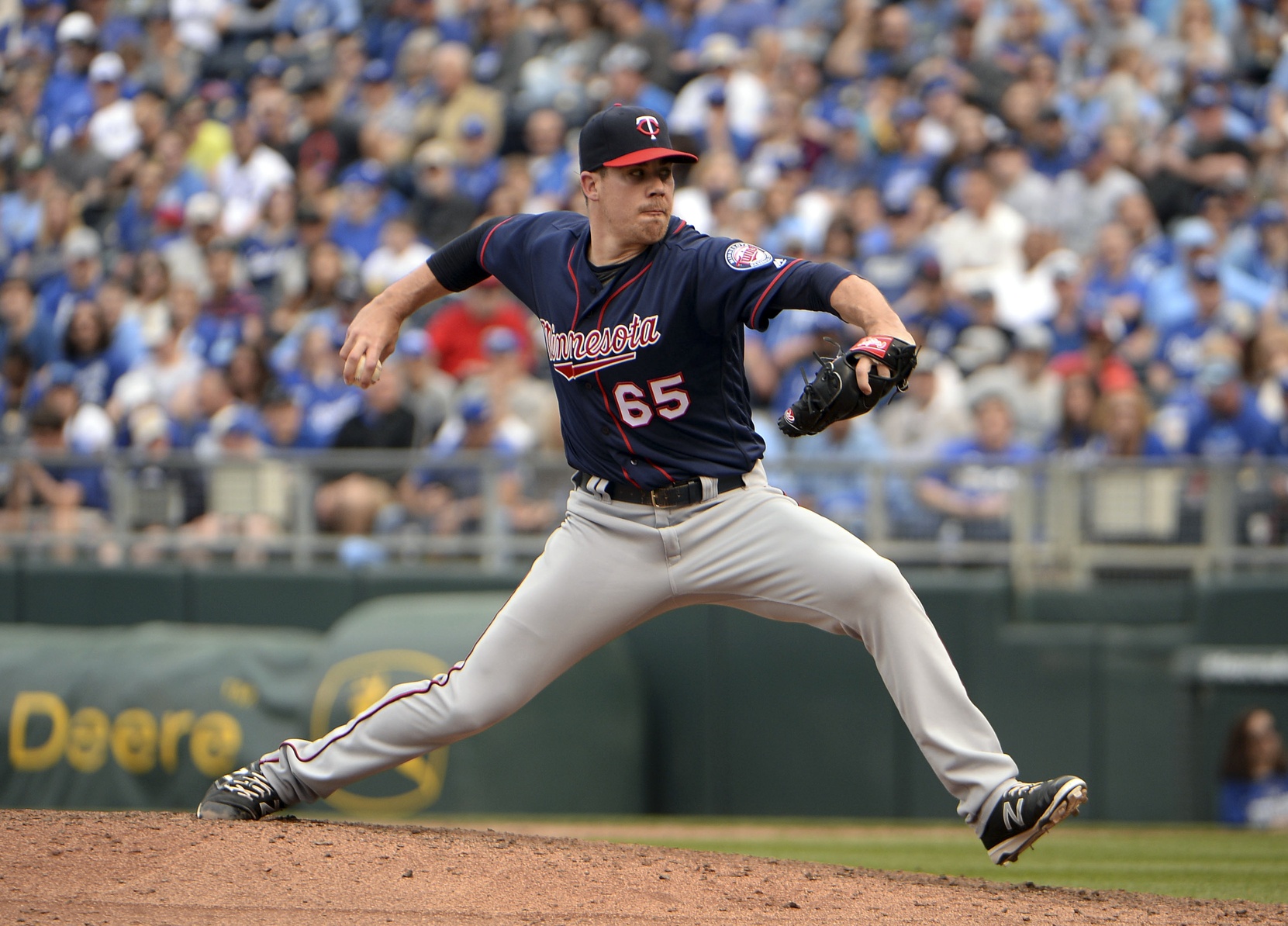 When I was in Ft. Myers in March for spring training, May was one of the best performers on the mound I had a chance to watch. I wasn't alone in my sentiment. There was significant buzz around the big right-hander, who had worked hard in the lead-up to camp after getting the go-ahead to prepare as a starter. He was in great shape. His pitches were buzzing. He was amped up and ready to go. That May's stuff was among the best in the organization was no secret, and he had it all working in the Grapefruit League. He was electric on the mound in what turned out to be his final appearance of 2017, facing an all-star laden Team USA squad in early March. His sterling performance against premium hitters represented a big step toward locking up a spot in the rotation. And then, just a couple days later, it was all over. Shockingly, May had suffered a torn ACL in the middle of that outing, despite reporting no issues postgame. He underwent Tommy John surgery on March 22nd, and then spent his summer rehabbing. TJ recovery can sometimes take more than a year, but the timetable is growing shorter as methods improve. These days, pitchers frequently return to the mound after 10 or 11 months. There's reason to believe May will be ready to roll around the start of spring training if not shortly thereafter. As he noted at the time, the 28-year-old has never had a remotely serious arm injury in the past. GM Thad Levine pointed out that the UCL tear was "an acute injury" and that the cumulative impact was minimal. In other words, May's elbow was otherwise quite healthy, improving his odds for a quicker recovery. May has been throwing for a while now and reported on Twitter that he was starting to touch the mid-80s already in early October, less than seven months removed from the surgery. If by the end of camp next year he's looking like he did this spring before going down, May could be a high-impact addition, either in the rotation or bullpen. But in either capacity, how do you account for him if you're in charge of constructing the team this winter? The rotation already figures to have four members more or less locked in: Ervin Santana, Jose Berrios, Kyle Gibson and Adalberto Mejia. If you sign or trade for a starter, suddenly May is crowded out of the picture, though he could obviously push someone like Gibson or Mejia for a job, or stand by as the ready reinforcement. Sending May back to the bullpen is a less appealing option, in my mind. He showed upside as a full-time reliever in 2016, striking out 60 in 43 innings, but was altogether inconsistent and deserves a real shot at starting anyway. Besides, the pen has its share of question marks as is – Ryan Pressly, Tyler Duffey, Alan Busenitz, JT Chargois, etc. Adding May would further cloud a situation already lacking much clarity. On the bright side, the Twins do have the luxury of taking their time, in a sense. There's nothing wrong with getting to Ft. Myers next February, allowing May to rev it up on the mound, and assessing from there. He has options left, so they'll even be able to start him in Rochester if they deem it necessary. But the front office's moves to improve the team in the coming months will need to factor in what they already have on hand, and May – more than most – is a difficult one to project with any kind of certainty. If he makes a full recovery and is ready to roll by Opening Day – and currently there's little reason to think this won't be the case – he should be part of the plan. Maybe a big part.
 -
MN's ranks in swinging strike %: 2013: 30th 2014: 29th 2015: 29th 2016: 29th 2017: 28th Regardless of what moves they make in the offseason, a majority of this year's staff will surely be returning and I don't think it's realistic to expect them to suddenly vault into the top half of the league.
- 40 replies
-
- 1
-

-
- byron buxton
- robbie grossman
- (and 2 more)
-
Of course. And this clearly is an ongoing objective for the front office based on everything we've heard. But the Twins have a long way to go before their staff is even average at missing bats and it's not going to happen in one year, so for the time being, maintaining and building upon an elite defensive unit is critical.
-
Minnesota's 26-game improvement from 2016 to 2017 was driven largely by massive improvements in run prevention. The Twins allowed 101 fewer runs this year, and better pitching wasn't really the differentiator. In fact, the team's FIP (Fielding Independent Pitching) actually went UP, from 4.57 to 4.72. The strikeout rates, walk rates, home run rates – they were all mostly static from one season to the next. What changed? The rate at which balls in play were converted into outs.In 2016, the Twins ranked 29th out of 30 MLB teams in Defensive Efficiency Rating. In 2017 they rocketed up to 12th. That's a remarkable jump. Sure, the pitching staff played a role in shaving off 11% of the runs allowed from 2016, but not a very big role. As mentioned above, the K, BB, and HR rates didn't really change. Per FanGraphs, the batted ball profiles – grounder and fly ball rates, ratio of soft/medium/hard contact – also remained virtually identical. The Twins hired a new pitching coach last week, and hopefully they'll target some impact arms this offseason. But what's truly essential is supporting those new and returning hurlers with the best defense possible. Fortunately, this roster already has a top-tier starting alignment locked in. The Twins can bring back all the starters from what was a terrific unit this year – arguably above-average at all but one or two spots. Byron Buxton is, of course, the central figure here. He was probably the most valuable defensive player in the game this year, and as long as he stays healthy at age 24 that should remain true. Those who preordered the Offseason Handbook received a special perk this weekend, when we sent out Parker Hageman's feature on Buxton's impact. You can get that, and another early preview coming later this week, by getting your preorder in now. Download attachment: CTA-Banner.jpg Flanked by Eddie Rosario and Max Kepler, Buxton can lead the game's best defensive outfield. Jason Castro is a quality backstop. The right side of the infield shapes up nicely with Brian Dozier and Joe Mauer. Really the only question marks are at shortstop and third base, but Paul Molitor can help himself by rotating Jorge Polanco and Miguel Sano through the DH spot frequently while plugging in Ehire Adrianza and Eduardo Escobar. Unless the Twins shake things up with a big trade, we already know how the starting nine will align in the field, more or less. But Derek Falvey and Thad Levine will have opportunities this offseason to make upgrades on the periphery of the roster, and that's where I will be curious to see their approach. In particular, the answers to these three questions will be telling: 1) Will they bring back Robbie Grossman? The most patient hitter in baseball took a step backward after his exceptional first season with the Twins, but was still a relatively useful piece, splitting time between DH and the outfield corners while providing a steady – albeit unexplosive – offensive presence. Grossman's on-base skills fit nicely in a power-packed lineup, but it wouldn't be hard to find another fourth outfielder who can match his .741 OPS, and upgrading his glove would be be easy. When he's in the outfield, Grossman is a rare defensive liability for the Twins, lacking the range to track down anything outside his immediate vicinity. Rosario and Kepler are lined up to man the outfield corners, and both have proven vulnerable to left-handed pitching (especially Kepler), so it'd make sense to replace Grossman with a right-handed hitter who plays good defense. In the Offseason Handbook, you'll find a few names fitting that description. Then again, the arbitration-eligible Grossman will only cost around $2 million to bring back, and his .361 OBP ranked second on the team behind Mauer. 2) Do they trust Mitch Garver behind the plate? It would seem that Garver is ready to take over as Minnesota's backup catcher. He had a great year at Triple-A, earning Twins Minor League Player of the Year honors, and got his feet wet in the majors during the final weeks of the campaign. But do they trust his defense enough go with him as Jason Castro's standalone backup? This much is not clear. Molitor didn't seem to have a ton of faith in Garver behind the plate, giving him only four starts there and none after September 4th. Will the Twins bring back Chris Gimenez, or seek another glove-first option as Castro's caddy? If they do, what does that mean for Garver's future here? He turns 27 in January. 3) Did Ehire Adrianza show enough to get another shot? The Twins claimed Adrianza off waivers ahead of spring camp mainly because of his defensive rep. He played shortstop and he played it well; it wasn't clear Minnesota had a player with that capability on the roster. He ended up playing all over the field and getting a career-high 186 PAs this season. Like Grossman, Adrianza is eligible for his first turn at arbitration this offseason, and won't be expensive to retain (maybe around a million). The Twins need a strong defender they can use frequently on the left side of the infield. Did Adrianza do enough to convince them he's that guy? His defensive metrics were good, though not as strong as they have been in the past. To my eye, he was a bit sloppy at times and not quite the specialist that his reputation suggested. But the tools are clearly there and to me, bringing him back is an easy call, especially since he's the only speed threat on the bench as things currently stand. What are your concerns and questions around the Twins defense as we head into the offseason? Click here to view the article
- 40 replies
-
- 1
-
-
- byron buxton
- robbie grossman
- (and 2 more)
-
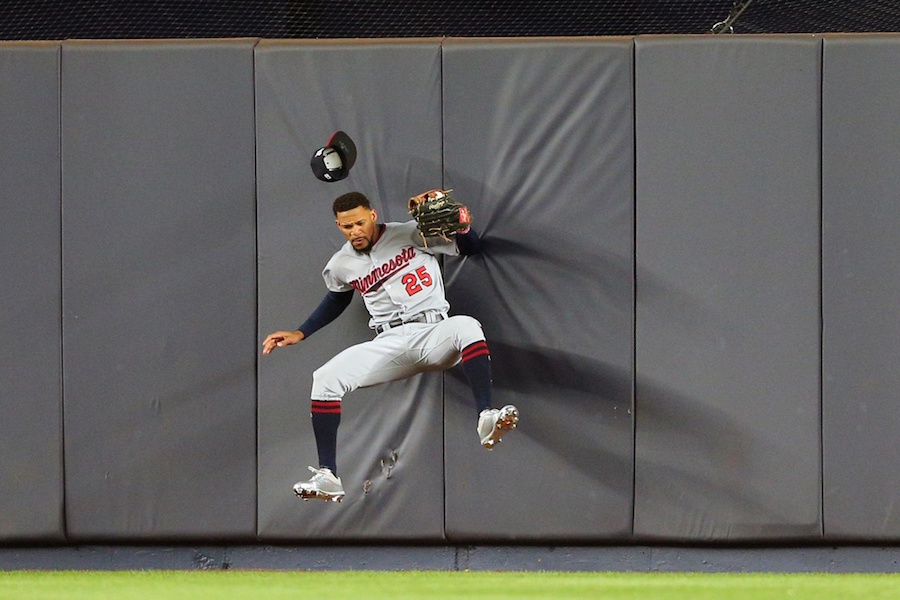 In 2016, the Twins ranked 29th out of 30 MLB teams in Defensive Efficiency Rating. In 2017 they rocketed up to 12th. That's a remarkable jump. Sure, the pitching staff played a role in shaving off 11% of the runs allowed from 2016, but not a very big role. As mentioned above, the K, BB, and HR rates didn't really change. Per FanGraphs, the batted ball profiles – grounder and fly ball rates, ratio of soft/medium/hard contact – also remained virtually identical. The Twins hired a new pitching coach last week, and hopefully they'll target some impact arms this offseason. But what's truly essential is supporting those new and returning hurlers with the best defense possible. Fortunately, this roster already has a top-tier starting alignment locked in. The Twins can bring back all the starters from what was a terrific unit this year – arguably above-average at all but one or two spots. Byron Buxton is, of course, the central figure here. He was probably the most valuable defensive player in the game this year, and as long as he stays healthy at age 24 that should remain true. Those who preordered the Offseason Handbook received a special perk this weekend, when we sent out Parker Hageman's feature on Buxton's impact. You can get that, and another early preview coming later this week, by getting your preorder in now. Flanked by Eddie Rosario and Max Kepler, Buxton can lead the game's best defensive outfield. Jason Castro is a quality backstop. The right side of the infield shapes up nicely with Brian Dozier and Joe Mauer. Really the only question marks are at shortstop and third base, but Paul Molitor can help himself by rotating Jorge Polanco and Miguel Sano through the DH spot frequently while plugging in Ehire Adrianza and Eduardo Escobar. Unless the Twins shake things up with a big trade, we already know how the starting nine will align in the field, more or less. But Derek Falvey and Thad Levine will have opportunities this offseason to make upgrades on the periphery of the roster, and that's where I will be curious to see their approach. In particular, the answers to these three questions will be telling: 1) Will they bring back Robbie Grossman? The most patient hitter in baseball took a step backward after his exceptional first season with the Twins, but was still a relatively useful piece, splitting time between DH and the outfield corners while providing a steady – albeit unexplosive – offensive presence. Grossman's on-base skills fit nicely in a power-packed lineup, but it wouldn't be hard to find another fourth outfielder who can match his .741 OPS, and upgrading his glove would be be easy. When he's in the outfield, Grossman is a rare defensive liability for the Twins, lacking the range to track down anything outside his immediate vicinity. Rosario and Kepler are lined up to man the outfield corners, and both have proven vulnerable to left-handed pitching (especially Kepler), so it'd make sense to replace Grossman with a right-handed hitter who plays good defense. In the Offseason Handbook, you'll find a few names fitting that description. Then again, the arbitration-eligible Grossman will only cost around $2 million to bring back, and his .361 OBP ranked second on the team behind Mauer. 2) Do they trust Mitch Garver behind the plate? It would seem that Garver is ready to take over as Minnesota's backup catcher. He had a great year at Triple-A, earning Twins Minor League Player of the Year honors, and got his feet wet in the majors during the final weeks of the campaign. But do they trust his defense enough go with him as Jason Castro's standalone backup? This much is not clear. Molitor didn't seem to have a ton of faith in Garver behind the plate, giving him only four starts there and none after September 4th. Will the Twins bring back Chris Gimenez, or seek another glove-first option as Castro's caddy? If they do, what does that mean for Garver's future here? He turns 27 in January. 3) Did Ehire Adrianza show enough to get another shot? The Twins claimed Adrianza off waivers ahead of spring camp mainly because of his defensive rep. He played shortstop and he played it well; it wasn't clear Minnesota had a player with that capability on the roster. He ended up playing all over the field and getting a career-high 186 PAs this season. Like Grossman, Adrianza is eligible for his first turn at arbitration this offseason, and won't be expensive to retain (maybe around a million). The Twins need a strong defender they can use frequently on the left side of the infield. Did Adrianza do enough to convince them he's that guy? His defensive metrics were good, though not as strong as they have been in the past. To my eye, he was a bit sloppy at times and not quite the specialist that his reputation suggested. But the tools are clearly there and to me, bringing him back is an easy call, especially since he's the only speed threat on the bench as things currently stand. What are your concerns and questions around the Twins defense as we head into the offseason?
 -
Article: The Hunt For An Ace Starter
Nick Nelson replied to Nick Nelson's topic in Twins Daily Front Page News
Also, we're complaining about the Twins urging him not to rely on his straight 89 MPH fastball in the majors? Huh. Some people just refuse to believe there's any explanation other than coaching ineptitude for successful minor-leaguers who don't translate their numbers to the majors, even though it happens all the time in every organization. There's really no room for common ground when contending with that kind of unnuanced viewpoint. (I say this as someone who thought Slowey got a somewhat raw deal from the Twins.) This is more a discussion of talent/ability than past production. Do you actually think Santana is a better pitcher than Hill? Of course I don't think the Twins should be targeting an injury-prone starter in his late-30s. But they need to identify guys who can dominate the way Hill can. That's really the point here. -
Article: The Hunt For An Ace Starter
Nick Nelson replied to Nick Nelson's topic in Twins Daily Front Page News
Lamet has pitched 1 season with the Padres and wasn't that great. He's not being suggested because of his numbers in San Diego. He's young, has good stuff and a 2.99 ERA in the minors. He's not a "legit 1/2 type" now, that's the point. He's never been a top prospect and wasn't spectacular as a rookie. But he has the underlying components to break out, IMO. The idea is to find those guys BEFORE they make that leap and thus not have to give up the farm. Folks, are we automatically dismissing every pitcher that comes out of the Padres system now? Because, you know, some guy named Kluber was fished out of the very same organization... -
Article: The Hunt For An Ace Starter
Nick Nelson replied to Nick Nelson's topic in Twins Daily Front Page News
Hill over the past 2 years: 2.78 ERA, 3.12 FIP, 1.05 WHIP, 10.8 K/9 Santana over the past 2 years: 3.32 ERA, 4.16 FIP, 1.17 WHIP, 7.2 K/9 That looks to me like the pretty clear delineation between a #1 and #2. Santana has the advantage in durability (Hill and those pesky blisters), but when both healthy I can't imagine there's a person in the baseball world who wouldn't choose Hill to start a playoff game. It's possible. I wouldn't count on it. He had a solid year but he's a long way behind the the starters mentioned at the top of this article, no? Either way, as the teams that are still playing have proven, you need multiple horses atop the rotation. Because they're in desperate need of bats and you gotta pay to play. I'm not saying they'll be actively shopping him, but if the Twins came knocking with, say, Polanco and Kirilloff? -
Clayton Kershaw. Dallas Keuchel. Rich Hill. Justin Verlander. These veteran studs, with their ace-type profiles and plentiful big-game experience, were tabbed by Houston and Los Angeles to start Games 1 and 2 of the World Series. Each played a major role in getting his team to the big stage. The Twins' deficiency in this area is the biggest reason it's hard to view them as serious contenders to make their own deep October run next year. What can they do about it?Minnesota has one starting pitcher who can credibly be placed in the same category as the four mentioned above, and in many ways it feels like a stretch to do so. Sure, Ervin Santana had some core numbers in 2017 that were on par with the league's top tier – namely, a 3.28 ERA and 1.13 WHIP to go along with 16 wins – but for various reasons, he just doesn't quite measure up. There's the track record. To his credit, Santana enjoyed a career year at age 34, but in 2,170 previous MLB innings he had a 4.09 ERA and 1.28 WHIP. There are the peripheral numbers. Santana was among the league's most homer-prone starters this season, with walk and strikeout rates that were closer to average than elite. The success was heavily aided by a career-low .247 BABIP. His 4.77 xFIP suggests the performance was not nearly as good as the results, and that we shouldn't expect the same going forward. And then there is the wear and tear. Santana's durability is to be admired – he has made 30-plus starts in each of the past seven seasons (excepting his suspension-shortened 2015). But all those innings take a toll. Erv threw 100-plus pitches in 17 starts this year, and threw 37% sliders overall. He'll turn 35 in December. There hasn't yet been a drop-off in pitch velocity or quality, but few arms can escape the ravages of time and attrition forever. For all these reasons, Santana looks like a poor bet to be the No. 1 starter that the Twins need in 2017 if they're aiming for a championship. So where can they find this most coveted of assets? If he's coming from within the organization, it'll still probably take at least a couple more years. So let's explore a few avenues for realistically adding an ace-caliber starter from the outside. FREE AGENCY There are three pitchers set to be on the open market who could slot above Santana in the Twins rotation: Jake Arrieta, Lance Lynn and Yu Darvish. All three have the attributes to be a rotation-fronter for a true contender, and each has more or less filled that role within the past few years. Signing Arrieta, Lynn or Darvish will also require more than double the $54 million that Terry Ryan committed to Santana in 2014 when making him the highest-paid free agent in franchise history. So in a way, it's a little hard to envision. Or is it? There's a lot of payroll coming off the books over the next few years. In the 2018 Offseason Handbook (coming next week, make sure to preorder and get yours early!) we'll give you the low-down on these three free agents and 18 more, as well as a breakdown of payroll flexibility and how they all might fit financially. Download attachment: CTA-Banner.jpg TRADES Last winter, in the ultimately fruitless Brian Dozier trade talks, the Twins seemingly targeted the right kinds of arms in a loaded Dodgers system. While they probably won't revisit discussions with LA, this increasingly impressive scouting department undoubtedly has some other names from other organizations on the "Want" list. Are they willing to pony up? High-end pitchers, or prospects with that kind of potential, don't come cheap. Minnesota would surely be looking for a younger guy with multiple years of control, and that only ups the ante. The name that pops here is Chris Archer. One of the best pitchers in the game, he keeps getting mentioned as a candidate to be moved, though it's not clear why; he's 29 and signed very reasonably through 2021 with team options. I can't even imagine the package it would take to get him. Since established aces are exceedingly tough to pry away, the Twins would more likely need to identify someone who is on the verge of reaching that level. A tall task indeed. I'll just throw a name out there: Dinelson Lamet, of the Padres. The 25-year-old right-hander looked solid in his MLB debut this summer, averaging well over a strikeout per inning and featuring a 95 MPH heater. San Diego, perpetually one of the worst offensive teams in the majors, would LOVE to add some promising young bats. Are there other names out there that catch people's attention in the same way? Share in the comments. INTERNATIONAL We may see an unprecedented scenario play out over the next few months. By all accounts, Japanese superstar Shohei Otani fully intends to sign with an MLB team and head to the States. He's been called "Japan's Babe Ruth." Otani touches triple-digits and piles up whiffs with a nasty repertoire. Oh, and he's a good enough hitter that some legitimately believe he could DH on top of pitching. Two-way player or not, there's a decent chance the 23-year-old quickly becomes one of the top starters in the majors. And cost will not really be a factor in acquiring him. Per the new CBA, foreign players under the age of 25 are considered international amateurs and are thus subject to the bonus pool system. Otani could only sign a minor-league deal with a bonus of a few million tops. Many teams have already spent a majority of their allotted amounts. It bears noting that Minnesota is one of eight clubs that could offer a bonus of more than $1 million, though the Rangers and Yankees are also on that list, and probably more attractive destinations. I just don't see how the Twins make this happen. In fact, I really can't see Otani coming over this winter and forfeiting the $100M+ he'd be eligible to earn by waiting two more years. But, he says he's doing it, so we'll have to wait and see what happens. It's going to be an interesting offseason on all fronts. And with the World Series now officially underway, it's suddenly almost upon us. Click here to view the article
-
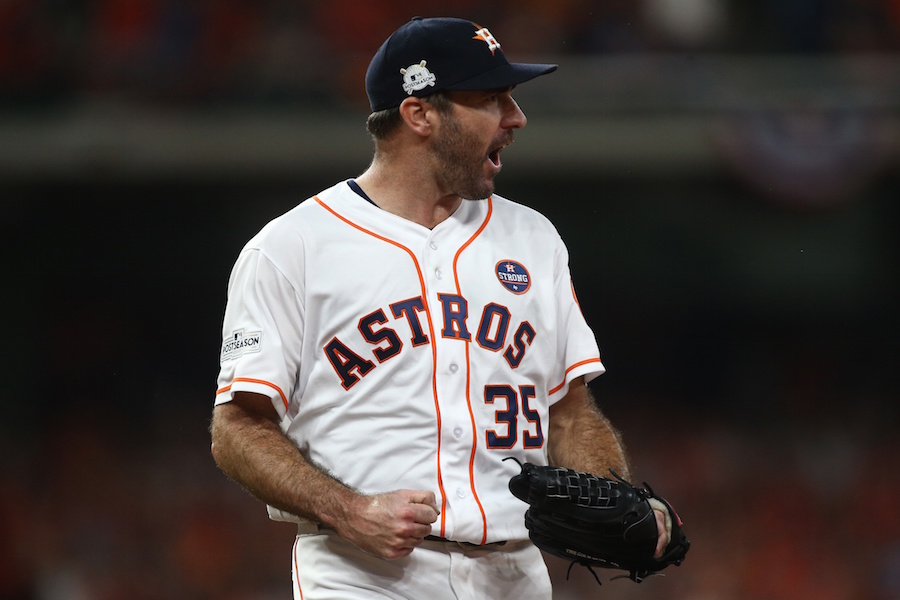 Minnesota has one starting pitcher who can credibly be placed in the same category as the four mentioned above, and in many ways it feels like a stretch to do so. Sure, Ervin Santana had some core numbers in 2017 that were on par with the league's top tier – namely, a 3.28 ERA and 1.13 WHIP to go along with 16 wins – but for various reasons, he just doesn't quite measure up. There's the track record. To his credit, Santana enjoyed a career year at age 34, but in 2,170 previous MLB innings he had a 4.09 ERA and 1.28 WHIP. There are the peripheral numbers. Santana was among the league's most homer-prone starters this season, with walk and strikeout rates that were closer to average than elite. The success was heavily aided by a career-low .247 BABIP. His 4.77 xFIP suggests the performance was not nearly as good as the results, and that we shouldn't expect the same going forward. And then there is the wear and tear. Santana's durability is to be admired – he has made 30-plus starts in each of the past seven seasons (excepting his suspension-shortened 2015). But all those innings take a toll. Erv threw 100-plus pitches in 17 starts this year, and threw 37% sliders overall. He'll turn 35 in December. There hasn't yet been a drop-off in pitch velocity or quality, but few arms can escape the ravages of time and attrition forever. For all these reasons, Santana looks like a poor bet to be the No. 1 starter that the Twins need in 2017 if they're aiming for a championship. So where can they find this most coveted of assets? If he's coming from within the organization, it'll still probably take at least a couple more years. So let's explore a few avenues for realistically adding an ace-caliber starter from the outside. FREE AGENCY There are three pitchers set to be on the open market who could slot above Santana in the Twins rotation: Jake Arrieta, Lance Lynn and Yu Darvish. All three have the attributes to be a rotation-fronter for a true contender, and each has more or less filled that role within the past few years. Signing Arrieta, Lynn or Darvish will also require more than double the $54 million that Terry Ryan committed to Santana in 2014 when making him the highest-paid free agent in franchise history. So in a way, it's a little hard to envision. Or is it? There's a lot of payroll coming off the books over the next few years. In the 2018 Offseason Handbook (coming next week, make sure to preorder and get yours early!) we'll give you the low-down on these three free agents and 18 more, as well as a breakdown of payroll flexibility and how they all might fit financially. TRADES Last winter, in the ultimately fruitless Brian Dozier trade talks, the Twins seemingly targeted the right kinds of arms in a loaded Dodgers system. While they probably won't revisit discussions with LA, this increasingly impressive scouting department undoubtedly has some other names from other organizations on the "Want" list. Are they willing to pony up? High-end pitchers, or prospects with that kind of potential, don't come cheap. Minnesota would surely be looking for a younger guy with multiple years of control, and that only ups the ante. The name that pops here is Chris Archer. One of the best pitchers in the game, he keeps getting mentioned as a candidate to be moved, though it's not clear why; he's 29 and signed very reasonably through 2021 with team options. I can't even imagine the package it would take to get him. Since established aces are exceedingly tough to pry away, the Twins would more likely need to identify someone who is on the verge of reaching that level. A tall task indeed. I'll just throw a name out there: Dinelson Lamet, of the Padres. The 25-year-old right-hander looked solid in his MLB debut this summer, averaging well over a strikeout per inning and featuring a 95 MPH heater. San Diego, perpetually one of the worst offensive teams in the majors, would LOVE to add some promising young bats. Are there other names out there that catch people's attention in the same way? Share in the comments. INTERNATIONAL We may see an unprecedented scenario play out over the next few months. By all accounts, Japanese superstar Shohei Otani fully intends to sign with an MLB team and head to the States. He's been called "Japan's Babe Ruth." Otani touches triple-digits and piles up whiffs with a nasty repertoire. Oh, and he's a good enough hitter that some legitimately believe he could DH on top of pitching. Two-way player or not, there's a decent chance the 23-year-old quickly becomes one of the top starters in the majors. And cost will not really be a factor in acquiring him. Per the new CBA, foreign players under the age of 25 are considered international amateurs and are thus subject to the bonus pool system. Otani could only sign a minor-league deal with a bonus of a few million tops. Many teams have already spent a majority of their allotted amounts. It bears noting that Minnesota is one of eight clubs that could offer a bonus of more than $1 million, though the Rangers and Yankees are also on that list, and probably more attractive destinations. I just don't see how the Twins make this happen. In fact, I really can't see Otani coming over this winter and forfeiting the $100M+ he'd be eligible to earn by waiting two more years. But, he says he's doing it, so we'll have to wait and see what happens. It's going to be an interesting offseason on all fronts. And with the World Series now officially underway, it's suddenly almost upon us.
