


Jump to content
Twins Daily
  • Create Account
  • Twins News & Analysis

    The Falvey And Levine Machine


    Nick Nelson

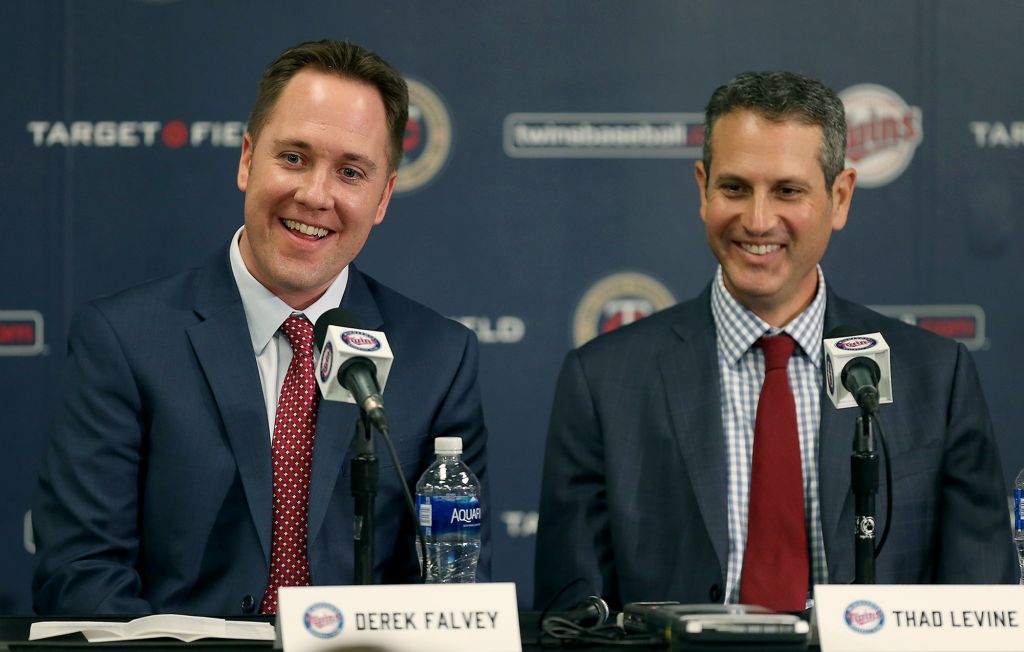
    In some corners, Minnesota's new front office leaders will probably be handed too much credit for their roles in one of the most remarkable turnarounds ever by a major-league team. In Year 1 under Derek Falvey and Thad Levine, the Twins will improve by at least 24 wins, going from 100 losses to a probable playoff berth. The narrative is obvious.

    Twins Video

    But the more striking narrative here pertains to the duo's good fortune, rather than their miraculous intervention.

    Most often, baseball executives getting their first chances to lead a major-league front office are tasked with overhauling a complete mess. From the outside, that's what this looked like: Falvey and Levine inherited the reigning worst team in baseball, one that had lost 90-plus games in five of the last six seasons.

    They spoke frequently about their big-picture mindset, expressing an intent to eschew shortcuts and quick fixes.

    But the staggering improvement we've seen this year owes to something we mostly already knew, despite the 2016 debacle: This rebuild was already well underway when the new Chief Baseball Officer and GM arrived. Most of the critical pieces had reached the big-league ranks and others were on the brink.

    It's just about the most favorable situation one can imagine walking into. For much of that, Falvey and Levine can thank their predecessor Terry Ryan and his colleagues, who assembled a great deal of talent.

    But while Ryan deserves credit for assembling much of this core, the "Boy Geniuses" (as my pal Clarence Swamptown blithely refers to them -- BeeGees for short) have given us plenty of indications that they're the right ones to bring it forward.

    The Deadline Dance

    Recently, I've seen some retrospective debate surrounding the front office's approach at the trade deadline. The critical argument goes like this: Falvey and Levine made a miscalculation by pivoting to seller mode and trading away assets, rather than adding, at the end of July. Regardless of the impact these moves had, the signal was one of resignation, and now it looks bad.

    This line of thinking doesn't really work for me, for two reasons:

    1) It wasn't really a "sell"

    They didn't trade Brian Dozier, or Ervin Santana. They gave up a starter they'd acquired a week earlier, and a reliever who proved nonessential. Good front office execs are opportunistic, and that's exactly how to describe these moves; the market for Jaime Garcia heated up as the Yankees developed a need, and Brandon Kintzler's value was at its absolute peak. Both are heading for free agency.

    And in fact, you can argue there's been significant overall benefit from removing them, as it opened the door for Kyle Gibson and Trevor Hildenberger – who will be around next year – to step into bigger roles and flourish.

    2) It was a perfectly reasonable strategy even if you want to call it a sell

    Look, we don't need to delve into playoff odds and percentages, which were dreadfully low as the Twins reached the end of July, trailing several teams in the race and playing uninspiring ball. An honest assessment showed at the time (and still shows) that this isn't a great team, not yet anyway.

    It would've been impossible to predict that laggards like Gibson and Jorge Polanco would suddenly take off while the rest of the American League completely folded, but the FO didn't do anything to sabotage the Twins' chances in such an event – obviously.

    In fact, I see Minnesota's deadline approach as a savvy one that avoided the pitfalls of this new postseason format. The addition of a second Wild Card slot means more teams are in the mix, and this compels clubs to make "Buy" moves when they're not necessarily warranted*. The Royals traded prospects to acquire Trevor Cahill and Melky Cabrera. The Angels made deals in August to acquire Justin Upton and Brandon Phillips. All of this got them nowhere. Meanwhile, the Twins – who are at the front end of their winning cycle – added future assets and will still get their shot. Falvey and Levine come away from this looking pretty good.

    * As a middling club aiming for a WC berth, you're still facing serious uphill odds with a one-game play-in for the chance to face superior teams in the Division and League Championship Series. I like the system but it begs for a merely solid team to sacrifice long-term thinking in order to chase that tiny chance. Given their position, the Twins were wise to steer clear of this trap.

    Putting Pieces in Place

    How much did the execs influence the team's success this year? It's tough to measure, but I think we can safely say they had a positive impact.

    As mentioned before, the Twins' turnaround was largely driven by players brought into the organization by Ryan and even Bill Smith. Meanwhile, the same manager is running the show. But the dramatic improvement in on-field results has likely been facilitated in some ways by the new regime.

    For one thing, there were free agent signings like Jason Castro and Matt Belisle. Castro has proven a very solid addition, helping the pitching staff with his strong framing work, while Belisle has been brilliant in the ninth, negating the absence of Kintzler.

    Perhaps more importantly, there were organizational changes and coaching staff additions like James Rowson and Jeff Pickler. I don't think it's coincidence that so many young hitters are suddenly turning corners, or that the Twins have suddenly catapulted to the top tier of MLB defenses, with these two handpicked coaches in the dugout.

    Moreover, Levine has mostly pulled the right roster strings throughout the summer, showing a refreshing willingness to shuttle players in and out as needed, and to experiment with a multitude of arms to see what works.

    Through it all, decisions have seemingly been guided by evidence, data, and good intelligence. I'm not confident these guys will always make the right calls – no one does. But I am feeling confident that those calls will be well-informed and guided by the three things mentioned above. My interactions with Falvey and Levine, and everything they've done and said, reinforces the team's decision and leads me to believe this beautiful gift is in very good hands.

    And make no mistake: it is a beautiful gift. The Twins have one of the best and youngest offenses in the game, with every member of a top-tier lineup locked in for next year. They have a strong farm system, with a pipeline ready to deliver. And they also have significant spending freedom on the horizon, with Joe Mauer's $23 million coming off the books next year and minimal contractual commitments beyond that.

    Lefty Gomez once said, "I'd rather be lucky than good."

    Why not both?

    Follow Twins Daily For Minnesota Twins News & Analysis

    Recent Twins Articles

    Recent Twins Videos


    User Feedback

    Recommended Comments


    Featured Comments


    I think not being significant buyers at the deadline was clearly wrong in the short term, and likely wrong in the long term.

    It merely delayed the need to acquire pitching, not avoided it. They will still need to do it.

    And we missed the benefits of such acquisitions in 2017.

    Verlander, for example, was a missed opportunity, and one they didn't even try.

    I think we will have to agree to disagree. While they will still need to acquire pitching they will (IMHO) be in a better position to acquire good pitching during the next 6 to 18 months than they were during July and August this year.

    We did miss the benefits of such acquisitions in 2017 but it's highly unlikely (IMHO) that the benefits would have gotten us a world championship this year. I give you the examples of Oakland and Toronto during the last couple seasons. Both of them went all in and have zero world championships to show for it. Moreover, they are far further (IMHO) from that goal now than they would have been had they not made the big trades they made.

    Verlander was (IMHO) not a good fit for the Twins. They are more than one pitcher away from serious contention for a world championship. The Astros, on the other hand, are close enough that one pitcher is much more likely to make that difference. Moreover, Verlander is 34 years old and appears to be declining. Beyond that, his salary stands at $28M each of the next two seasons and $22M the season after that. Clearly (IMHO) poor bang for the buck. I think the Twins would do much better spending money on pitchers approaching their primes instead of spending it on pitchers past their primes.

    I had no problem with trading Garcia or Kintztler. Garcia has been barely serviceable. And as stated Kintzler was never at a higher value. But he did have a trade value. He was a seventh inning guy in a closers role. Sooner or later that was going to catch up with him. Add that to the free agency, and the teams status at the time of the trade, and I cannot see the angst over the trade. The chance for the return was too good to pass up. For years this team refused to move marginal players during a career year. Sell high was not in their lexicon. I for one welcome the change in philosophy.

    I think we will have to agree to disagree. While they will still need to acquire pitching they will (IMHO) be in a better position to acquire good pitching during the next 6 to 18 months than they were during July and August this year.

    We did miss the benefits of such acquisitions in 2017 but it's highly unlikely (IMHO) that the benefits would have gotten us a world championship this year. I give you the examples of Oakland and Toronto during the last couple seasons. Both of them went all in and have zero world championships to show for it. Moreover, they are far further (IMHO) from that goal now than they would have been had they not made the big trades they made.

    Verlander was (IMHO) not a good fit for the Twins. They are more than one pitcher away from serious contention for a world championship. The Astros, on the other hand, are close enough that one pitcher is much more likely to make that difference. Moreover, Verlander is 34 years old and appears to be declining. Beyond that, his salary stands at $28M each of the next two seasons and $22M the season after that. Clearly (IMHO) poor bang for the buck. I think the Twins would do much better spending money on pitchers approaching their primes instead of spending it on pitchers past their primes.

    We agree they are more than one pitcher away.


    We disagree it's going to be easier or cheaper.


    And I certainly hope 18 months isn't their time frame.


    There is no doubt they weakened the team at the deadline. They not only didn't add, they subtracted. The idea they aren't worse off for not having Kintzler is pretty far fetched.
     

    Worse off, yes, but by how much? In terms of how much closer they would be to a world championship the difference is so slight as to be nearly negligible.

    I had no problem with trading Garcia or Kintztler. Garcia has been barely serviceable. And as stated Kintzler was never at a higher value. But he did have a trade value. He was a seventh inning guy in a closers role. Sooner or later that was going to catch up with him. Add that to the free agency, and the teams status at the time of the trade, and I cannot see the angst over the trade. The chance for the return was too good to pass up. For years this team refused to move marginal players during a career year. Sell high was not in their lexicon. I for one welcome the change in philosophy.

    Tyler Watson was too good to pass up??


    That's a fair thing to say. I consider it a small error with the correct thinking behind it.


    But after the unlikely events that transpired, still an error.


    And as we've seen with the old front office (and other teams), I'd rather see the occasional error with the correct process behind it than the inverse.

    I don't even think its an error. Going into July 31st the Twins were 3 games below .500, in 3rd place in the division 6.5 games back. For the wildcard they were 4.5 games back and had 4 teams between them and the final spot with a cool 5% chance to make the post-season. Advocating buying is essentially like advocating lottery tickets as a good way to make money.

    Cautious selling is 100% the right move.

    Edited by iastfan112


    I don't even think its an error. Going into July 31st the Twins were 3 games below .500, in 3rd place in the division 6.5 games back. For the wildcard they were 4.5 games back and had 4 teams between them and the final spot with a cool 5% chance to make the post-season. Advocating buying is essentially like advocating lottery tickets as a good way to make money.

    Cautious selling is 100% the right move.

    I agree, I'm only saying that after the improbable happened, it became an error.


    A largely unpredictable error but an error none-the-less. I supported the move at the time and still support the thinking that led to it.


    Tyler Watson was too good to pass up??

    Well he is better than getting nothing at all for Kintzler and we made the postseason without Kintzler plus they threw in $500,000 in international bonus money.


    While Watson is not on any top 100 prospect lists he has been an All-Star twice in the minors as he has moved up.  He is young for the levels he has been in.  Granted he is not a hard thrower but since he is only 20 there is projection there.  I believe he has a good curveball which is all the rage these days.


    Personally I question if he has enough stamina and pitches to be a starter but he could end up a very good reliever if he can't make it as a starter.


    He is in our top 20.  If you don't like guys in that range or don't think they can make it then you probably don't like the trade. Personally I like the gamble given that we only had two months left of Brandon and too many pitching holes to truly compete with the big boys this year.


    I'd rather have Watson and $500,000 than Brandon and the same wildcard result.  More good prospects = more chances to get someone who makes it.


    2017 is first time this century only five American League teams will finish the season with a winning record.


    And the AL had only 14 teams the bulk of that time.

    There was only one other time besides this season, that there was only two teams that had 90 plus losses. That season featured a 100 loss team.  There were no really bad teams to pad the win totals/


    Not having Kintzler might very well be the reason we stop moving. And I don't care that it's never happened before. The two team wild card is just a few years old now so that long history of the game doesn't really factor in. Baltimore was flawed, Tampa was flawed, KC was flawed We had winning records against the teams we had to pass. I want a FO who is smarter and not basing decisions on runs scored in April.


    Note that KC only had to go 30-28 after the deadline to finish with 85 wins. So the plan to "go for it" needed to not only foresee that the Twins would catch fire after a 10-15 July, but a recent champion that had been 33-19 in June-July would completely collapse, and then every other WC2 contender that was ahead of, or just about even with, the Twins would also collapse or float around .500 down the stretch.


    Would it be wise for the GM of a 50-53 team with a -72 run differential to bet on all of that falling into place?


    There were reasons why their WC chances at the deadline were less than 5%. And it wasn't just "runs scored in April," or the lineup's 94 wRC+ in the first half and 96 wRC+ in July, or the improbability of every other WC2 contender sucking, or the -72 run differential on July 31, or BaseRuns record (which stands at 79-79 today). I mean, all of that counted, but the pitching also has been below-average all season, except for the one month after the trade deadline, when the staff FIP jumped to 5th in the AL. Looking back now, outside of that outlier month, their record is 63-65. Against the other AL playoff teams, their record is 12-25 with a 122-223 run differential.


    The Twins have an emerging group of young talent, and they caught some breaks this season. If they happen to beat the Yankees on Tuesday, or even advance past the ALDS, great! Is that likely? Are the Twins really on the level of the elite teams, yet?


    If the club goes into next season with essentially the same roster, but counts on Romero/Gonsalves to shore up the rotation holes, because "we've arrived," I expect that fans are going to be disappointed with the 2018 results.


    I think it's actually encouraging that Falvine didn't think, "Here's our chance!" at the July deadline, or even at the end of the hot August. We'll see whether they know how to take the club to the next level, but for now it seems that they have a realistic idea of where the team stands.

    I don't even think its an error. Going into July 31st the Twins were 3 games below .500, in 3rd place in the division 6.5 games back. For the wildcard they were 4.5 games back and had 4 teams between them and the final spot with a cool 5% chance to make the post-season. Advocating buying is essentially like advocating lottery tickets as a good way to make money.


    Cautious selling is 100% the right move.

    I think that 5% was too low with that much baseball left to be played. First of all, Fangraphs projections hated us -- 3rd worst projected rest of season win percentage in the AL at that point, ahead of only the White Sox and barely the Orioles. Lower than Oakland! Lower than Detroit. We have been reading a constant drumbeat on this site about Fangraphs projections underestimating our Twins for 3 years now -- and now we want our front office agreeing with them? 538 doesn't update daily, but they had us at 9% just prior to that, and 24% just 10 days prior (before the Royals win streak).


    Also, outside the Twins, what either playoff odds system doesn't realize is the Royals just had a little hot streak. It is like a .250 "true talent" hitter (assuming there is such a thing for the sake or argument) -- they may have a little hitting streak to spike up to .290 at some point in a season, but they are likely to come down. The projection system says those hits are in the bank and they will hit their true talent .250 from here out, and it will buoy their overall numbers to .270 or so. And that is certainly possible. But we also know that given enough time, just like they over performed for a stretch, they will probably underperform enough for a stretch to wipe out some of gains from the "banked" hits in the final average. All of the playoff odds at the trade deadline were banking wins for the Royals that they were not terribly likely to hold on to with 1/3 of the season left to be played.


    Also, factual correction: there were only 2-3 teams "between" the Twins and the 2nd wild card at the close of play on July 30 depending on how you define between). Red Sox held the 1st wild card, Royals the second, then Rays, Mariners, Twins.


    Look at that crowd: Royals, Rays, Mariners. These are really the teams we want the Twins FO to be afraid of, with 2 months to play? No team is perfect, of course, but those 3 seemed particularly flawed and restricted. The Twins were too, but there was no reason we couldn't hang in that hunt. 1.5-2.5 game deficits behind the Mariners and Rays are darn near meaningless with 2 months to play, and even the 5 game deficit with the Royals was hardly that daunting with 7 head to head games left (and a .667 win percentage against them so far).


    If you want to make the case against a risky buy on July 31, I could see that, but to me, giving up Kintzler was a bit too risky of a sell. We're really kind of lucky that it won't be a big issue in the final regular season standings, but as we assemble postseason rosters, it feels like we are not quite taking as good of a shot at this thing as we should be. We're hopefully still improving in years to come, but our guys were promising enough today to at least deserve keeping their all-star closer over a #18 org prospect still in A ball.

    SEA, BAL, MIN, KC, LAA, TEX, TOR, TB


    These teams didn't fold. They were all struggling to play .500 at the deadline, and are struggling to play .500 at the finish. Only KC really went in the tank. Not the others.

    Edited by Hosken Bombo Disco


    SEA, BAL, MIN, KC, LAA, TEX, TOR, TB

    These teams didn't fold. They were all struggling to play .500 at the deadline, and are struggling to play .500 at the finish. Only KC really went in the tank. Not the others.

    Four .500-ish teams playing at a sub-.450 clip and all but one team playing under .500 ball isn't folding?


    I don't feel like this is a difficult concept to grasp but apparently it is.


    Here's my point, clarified:


    If you have eight .500-ish teams with two months to play, you'll usually end up with a few of them under .500, a few of them will remain around .500, and a few of them will end up over .500. And that's ignoring the potential improvement some of those teams will see by making trades to shore up deficiencies.


    For all of them but one to remain under .500 is a statistical fluke, one you do not see very often in baseball (again, 2017 is the first time this century the AL has ended up with just five teams over .500 and it even happened in a 15 team league, not the previous 14 team league).


    It requires a lot of teams folding to end up at that number, which is why we haven't seen it in at least the past 20 years (I stopped checking at 2000).

    Note that KC only had to go 30-28 after the deadline to finish with 85 wins. So the plan to "go for it" needed to not only foresee that the Twins would catch fire after a 10-15 July, but a recent champion that had been 33-19 in June-July would completely collapse, and then every other WC2 contender that was ahead of, or just about even with, the Twins would also collapse or float around .500 down the stretch.


    "Recent champion", love it. They may not have Cueto, Shields, Ventura, or Davis anymore -- but we'd better give them credit for them!


    You are falling into the trap of selective endpoints (see my post above). The Royals were not that good as the July 30 snapshot suggested and we had ample time/opportunity left to dent the 5 game lead they built over 1 week in July. (In fact, it only took 10 days to completely erase it and put us back into a virtual tie for the wild card -- not that the FO should have predicted it would happen that immediately and quickly, but it was very possible with 2 months remaining.)


    And no one else had to collapse. No other contender was really even good enough on July 30 for their post-July 30 performance to count as a collapse. Tampa, Seattle, etc. continuing to hover around .500 was eminently predictable. There just weren't any dormant powerhouse teams or sleeping giants among the 2nd wild card contenders this year. If you thought the Twins could hang around .500, you basically thought they had a solid chance of hanging in the race until the final weeks.

    Four .500-ish teams playing at a sub-.450 clip and all but one team playing under .500 ball isn't folding?


    I don't feel like this is a difficult concept to grasp but apparently it is.


    Here's my point, clarified:


    If you have eight .500-ish teams with two months to play, you'll usually end up with a few of them under .500, a few of them will remain around .500, and a few of them will end up over .500. And that's ignoring the potential improvement some of those teams will see by making trades to shore up deficiencies.


    For all of them but one to remain under .500 is a statistical fluke, one you do not see very often in baseball (again, this is the first time this century the AL has ended up with just five teams over .500).


    It requires a lot of teams folding to end up at that number, which is why we haven't seen it in at least the past 20 years (I stopped checking at 2000).

    Other posters addressed this up thread. I still think the word "folding" is misleading, but yeah I was surprised no other team made a strong run--although you could argue the Angels did make a strong run, but ran out of gas.


    Other posters addressed this up thread. I still think the word "folding" is misleading, but yeah I was surprised no other team made a strong run--although you could argue the Angels did make a strong run, but ran out of gas.

    The Angels didn't make a strong run. They played two games over .500 for two months after getting Trout back just before the deadline and acquiring a very good Upton for September.


    If you consider their record going into mid-July, they underperformed their previous record by getting back a 1+ WAR per month player and a .900 OPS player in Upton.


    For that team to play 27-25 baseball down the stretch is a pretty big disappointment for them.


    And I don't see how it's not considered "folding" when a full half of those .500-ish teams played sub-.450 baseball after the deadline. That's a lower win percentage than the Oakland A's played all season.

    Four .500-ish teams playing at a sub-.450 clip and all but one team playing under .500 ball isn't folding?


    I don't feel like this is a difficult concept to grasp but apparently it is.


    Here's my point, clarified:


    If you have eight .500-ish teams with two months to play, you'll usually end up with a few of them under .500, a few of them will remain around .500, and a few of them will end up over .500. And that's ignoring the potential improvement some of those teams will see by making trades to shore up deficiencies.


    For all of them but one to remain under .500 is a statistical fluke, one you do not see very often in baseball (again, this is the first time this century the AL has ended up with just five teams over .500).


    It requires a lot of teams folding to end up at that number, which is why we haven't seen it in at least the past 20 years (I stopped checking at 2000).

    Who are the 4? At close of play July 30, we trailed only 3 for the 2nd wild card. (The Angels have actually gone .519 since then!)


    Any teams, or these specific teams? I hope the FO isn't basing their decisions on abstract theoretical teams.


    Also, note that the Twins are up by 5 games. They didn't need the Royals and Rays to play .420 ball the last 2 months to be in the hunt this late. Both could have been right around .500 and we could have lost a couple more and we'd still only be a game out entering the final weekend.

    The Angels didn't make a strong run. They played two games over .500 for two months after getting Trout back two weeks before the deadline and acquiring a very good Upton for September.


    If you consider their record going into mid-July, they underperformed their previous record by getting back a 1+ WAR per month player and a .900 OPS player in Upton.


    For that team to play 27-25 baseball down the stretch is a pretty big disappointment for them.

    Have you seen the Angels pitching staff? Ricky Nolasco? As of late July, they were pinning their hopes on the healthy return of Alex Meyer. That was supposed to intimidate the Twins into selling?


    I feel like you keep bringing up hypotheticals that don't match anything the Twins should have known about the field as of July 30.


    Who are the 4? At close of play July 30, we trailed only 3 for the 2nd wild card. (The Angels have actually gone .519 since then!)

    Any teams, or these specific teams? I hope the FO isn't basing their decisions on abstract theoretical teams.

    Also, note that the Twins are up by 5 games. They didn't need the Royals and Rays to play .420 ball the last 2 months to be in the hunt this late. Both could have been right around .500 and we could have lost a couple more and we'd still only be a game out entering the final weekend.

    Seattle, Tampa, Baltimore, and Kansas City all played sub-.450 ball down the stretch. Half of the eight teams who were in the mix at the deadline.


    Have you seen the Angels pitching staff? Ricky Nolasco? As of late July, they were pinning their hopes on the healthy return of Alex Meyer. That was supposed to intimidate the Twins into selling?

    I feel like you keep bringing up hypotheticals that don't match anything the Twins should have known about the field as of July 30.

    What hypotheticals? That out of eight teams, a flawed and significantly outscored to that point Twins team wouldn't hang with over half the AL for a single postseason spot?


    That's not a hypothetical. The Twins had the worst run differential of the bunch (going from memory) and were in a backwards slide, posting a terrible record in July.


    And it was unreasonable to expect all seven teams to falter. Hell, head-to-head matchups almost dictate that at least one of them would end up a winner.

    What hypotheticals? That out of eight teams, a flawed and significantly outscored to that point Twins team wouldn't hang with over half the AL for a single postseason spot?


    That's not a hypothetical. The Twins had the worst run differential of the bunch (going from memory) and were in a backwards slide, posting a terrible record in July.


    And it was unreasonable to expect all seven teams to falter. Hell, head-to-head matchups almost dictate that at least one of them would end up a winner.

    What team in that group would you have forecast to have great post-July 30 success? None of those teams had a good case of separating from the pack.


    Maybe it's unusual that there is so much mediocrity in the AL now, but there is. And that was apparent in July. Didn't mean the Twins had a great chance, but it meant they had a decent chance. And the Twins FO should be expected to know that and not disregard, even if historically unusual.

    The Angels didn't make a strong run. They played two games over .500 for two months after getting Trout back just before the deadline and acquiring a very good Upton for September.


    If you consider their record going into mid-July, they underperformed their previous record by getting back a 1+ WAR per month player and a .900 OPS player in Upton.


    For that team to play 27-25 baseball down the stretch is a pretty big disappointment for them.


    And I don't see how it's not considered "folding" when a full half of those .500-ish teams played sub-.450 baseball after the deadline. That's a lower win percentage than the Oakland A's played all season.

    Subtract the recent 6 game lose streak from the Angels 27-25 record, and I call that 27-19 record a strong run. You don't, I do. :)

    Brock, I feel like you and others are basically saying the Twins were right to sell because in order to stay relevant, they needed to play great AND see a bunch of teams collapse/falter. But that's not right. That happened, and we actually won the 2nd wild card fairly comfortably. If just one of those things happens, we are still in the hunt. If neither happens to quite the degree that they actually happened, we are still in the hunt.


    At close of play on July 30, we trailed KC by 5, Tampa by 2.5, and Seattle by 1.5, with ~55 to play. We weren't likely to win it, but it wasn't necessarily going to require any miracles either. We were in the thick of it, with no sleeping giants poised to awaken (no, the Royals were not sleeping giants who awoke in late July).

    Brock, I feel like you and others are basically saying the Twins were right to sell because in order to stay relevant, they needed to play great AND see a bunch of teams collapse/falter. But that's not right. That happened, and we actually won the 2nd wild card fairly comfortably. If just one of those things happens, we are still in the hunt. If neither happens to quite the degree that they actually happened, we are still in the hunt.

    At close of play on July 30, we trailed KC by 5, Tampa by 2.5, and Seattle by 1.5, with ~55 to play. We weren't likely to win it, but it wasn't necessarily going to require any miracles either. We were in the thick of it, with no sleeping giants poised to awaken (no, the Royals were not sleeping giants who awoke in late July).

    And this is the key point...the Twins were in it, had been in it all season, and had a very reasonable chance of staying in it.


    After a half decade of suck.


    Don't sell. Add.

    The July 30th Twins team is the reason every Tom,Dick and Harry with any coin in their pocket invites me to poker games. I buy every time I see any chance and lose my a$$.


    Yes, I have hit a few hands, raising 3 kings up when I needed a card for a straight flush comes to mind but every one of you would love for me to sit at your game.


    Y'know, Brandon Kintzler isn't exactly Aroldis Chapman. He's probably not even Eddie Guardado. He's a journeyman who made the Twins' roster only because we had huge bullpen problems. Perkins goes down with a career-threatening shoulder injury. Jepsen, who filled in well for Perkins as closer the season before, can't get anyone out. Kintzler was chosen as closer because he was the least-poorly-suited for the job in the bullpen of a 103-loss team. When the Nationals came asking for him the trade was made because Falvine decided having Watson and $500,000 of pool money was better for the organization than having a 33-year-old relief pitcher who is unlikely to improve in the future, and whose removal from the roster would have a negligible effect on the odds of winning a world championship this season. I think it was completely reasonable to make that trade.


    That's a fair thing to say. I consider it a small error with the correct thinking behind it.


    But after the unlikely events that transpired, still an error.


    And as we've seen with the old front office (and other teams), I'd rather see the occasional error with the correct process behind it than the inverse.


    I think what gets lost in this discussion is that trading Garcia and Kintzler opened the door to keep throwing Gibson out there and promoting Hildenberger... and I'd add that both Gibby and Hildy out performed the guys who were traded in opportunities that they may not have gotten otherwise.


    I still think selling was the right move, and we have more answered questions with guys like Hildenberger and Busenitz right now due to it.

    I think what gets lost in this discussion is that trading Garcia and Kintzler opened the door to keep throwing Gibson out there and promoting Hildenberger... and I'd add that both Gibby and Hildy out performed the guys who were traded in opportunities that they may not have gotten otherwise.


    I still think selling was the right move, and we have more answered questions with guys like Hildenberger and Busenitz right now due to it.

    Both Gibson and Hildenberger would have gotten similar if not identical opportunities even if the Twins ADDED pitching. Check the list of pitchers used.


    Create an account or sign in to comment

    You need to be a member in order to leave a comment

    Create an account

    Sign up for a new account in our community. It's easy!

    Register a new account

    Sign in

    Already have an account? Sign in here.

    Sign In Now

×
×
  • Create New...
