


Jump to content
Twins Daily
  • Create Account
  • Twins News & Analysis

    The Falvey And Levine Machine


    Nick Nelson

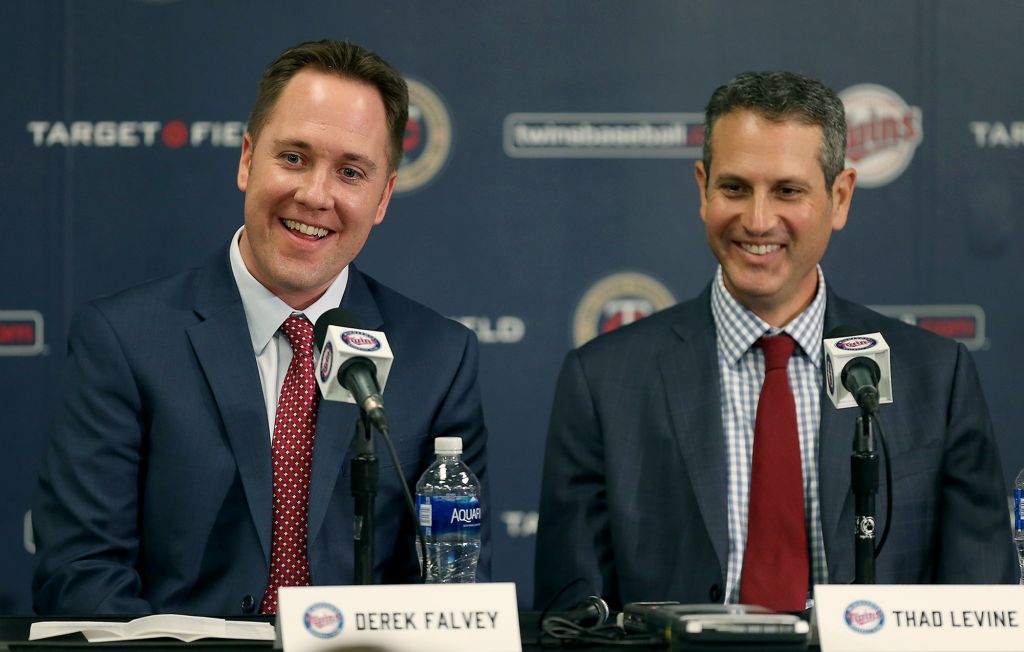
    In some corners, Minnesota's new front office leaders will probably be handed too much credit for their roles in one of the most remarkable turnarounds ever by a major-league team. In Year 1 under Derek Falvey and Thad Levine, the Twins will improve by at least 24 wins, going from 100 losses to a probable playoff berth. The narrative is obvious.

    Twins Video

    But the more striking narrative here pertains to the duo's good fortune, rather than their miraculous intervention.

    Most often, baseball executives getting their first chances to lead a major-league front office are tasked with overhauling a complete mess. From the outside, that's what this looked like: Falvey and Levine inherited the reigning worst team in baseball, one that had lost 90-plus games in five of the last six seasons.

    They spoke frequently about their big-picture mindset, expressing an intent to eschew shortcuts and quick fixes.

    But the staggering improvement we've seen this year owes to something we mostly already knew, despite the 2016 debacle: This rebuild was already well underway when the new Chief Baseball Officer and GM arrived. Most of the critical pieces had reached the big-league ranks and others were on the brink.

    It's just about the most favorable situation one can imagine walking into. For much of that, Falvey and Levine can thank their predecessor Terry Ryan and his colleagues, who assembled a great deal of talent.

    But while Ryan deserves credit for assembling much of this core, the "Boy Geniuses" (as my pal Clarence Swamptown blithely refers to them -- BeeGees for short) have given us plenty of indications that they're the right ones to bring it forward.

    The Deadline Dance

    Recently, I've seen some retrospective debate surrounding the front office's approach at the trade deadline. The critical argument goes like this: Falvey and Levine made a miscalculation by pivoting to seller mode and trading away assets, rather than adding, at the end of July. Regardless of the impact these moves had, the signal was one of resignation, and now it looks bad.

    This line of thinking doesn't really work for me, for two reasons:

    1) It wasn't really a "sell"

    They didn't trade Brian Dozier, or Ervin Santana. They gave up a starter they'd acquired a week earlier, and a reliever who proved nonessential. Good front office execs are opportunistic, and that's exactly how to describe these moves; the market for Jaime Garcia heated up as the Yankees developed a need, and Brandon Kintzler's value was at its absolute peak. Both are heading for free agency.

    And in fact, you can argue there's been significant overall benefit from removing them, as it opened the door for Kyle Gibson and Trevor Hildenberger – who will be around next year – to step into bigger roles and flourish.

    2) It was a perfectly reasonable strategy even if you want to call it a sell

    Look, we don't need to delve into playoff odds and percentages, which were dreadfully low as the Twins reached the end of July, trailing several teams in the race and playing uninspiring ball. An honest assessment showed at the time (and still shows) that this isn't a great team, not yet anyway.

    It would've been impossible to predict that laggards like Gibson and Jorge Polanco would suddenly take off while the rest of the American League completely folded, but the FO didn't do anything to sabotage the Twins' chances in such an event – obviously.

    In fact, I see Minnesota's deadline approach as a savvy one that avoided the pitfalls of this new postseason format. The addition of a second Wild Card slot means more teams are in the mix, and this compels clubs to make "Buy" moves when they're not necessarily warranted*. The Royals traded prospects to acquire Trevor Cahill and Melky Cabrera. The Angels made deals in August to acquire Justin Upton and Brandon Phillips. All of this got them nowhere. Meanwhile, the Twins – who are at the front end of their winning cycle – added future assets and will still get their shot. Falvey and Levine come away from this looking pretty good.

    * As a middling club aiming for a WC berth, you're still facing serious uphill odds with a one-game play-in for the chance to face superior teams in the Division and League Championship Series. I like the system but it begs for a merely solid team to sacrifice long-term thinking in order to chase that tiny chance. Given their position, the Twins were wise to steer clear of this trap.

    Putting Pieces in Place

    How much did the execs influence the team's success this year? It's tough to measure, but I think we can safely say they had a positive impact.

    As mentioned before, the Twins' turnaround was largely driven by players brought into the organization by Ryan and even Bill Smith. Meanwhile, the same manager is running the show. But the dramatic improvement in on-field results has likely been facilitated in some ways by the new regime.

    For one thing, there were free agent signings like Jason Castro and Matt Belisle. Castro has proven a very solid addition, helping the pitching staff with his strong framing work, while Belisle has been brilliant in the ninth, negating the absence of Kintzler.

    Perhaps more importantly, there were organizational changes and coaching staff additions like James Rowson and Jeff Pickler. I don't think it's coincidence that so many young hitters are suddenly turning corners, or that the Twins have suddenly catapulted to the top tier of MLB defenses, with these two handpicked coaches in the dugout.

    Moreover, Levine has mostly pulled the right roster strings throughout the summer, showing a refreshing willingness to shuttle players in and out as needed, and to experiment with a multitude of arms to see what works.

    Through it all, decisions have seemingly been guided by evidence, data, and good intelligence. I'm not confident these guys will always make the right calls – no one does. But I am feeling confident that those calls will be well-informed and guided by the three things mentioned above. My interactions with Falvey and Levine, and everything they've done and said, reinforces the team's decision and leads me to believe this beautiful gift is in very good hands.

    And make no mistake: it is a beautiful gift. The Twins have one of the best and youngest offenses in the game, with every member of a top-tier lineup locked in for next year. They have a strong farm system, with a pipeline ready to deliver. And they also have significant spending freedom on the horizon, with Joe Mauer's $23 million coming off the books next year and minimal contractual commitments beyond that.

    Lefty Gomez once said, "I'd rather be lucky than good."

    Why not both?

    Follow Twins Daily For Minnesota Twins News & Analysis

    Recent Twins Articles

    Recent Twins Videos

    Twins Top Prospects

    Marek Houston

    Cedar Rapids Kernels - A+, SS
    The 22-year-old went 2-for-5 on Friday night, his fourth straight multi-hit game. Heading into the week, he was hitting .246/.328/.404 (.732). Four games later, he is hitting .303/.361/.447 (.808).

    User Feedback

    Recommended Comments


    Featured Comments


    No, which is why no prediction models had the Twins with a good chance of a berth.

    Except for mine of course :)

    Also was the only person who had faith that year they were down 3 with 4 to play and called my shot :) Pretty sure Stat was supposed to leave for life after that!

    Edited by DaveW


    Really, at that point you would have bet money at less than 1:1 odds that they'd make the playoffs?


    And, you'd have made that bet in July, when the Twins had to make a decision also?

    So the only way to invalidate an opinion is to challenge somebody if they would bet money?  Before the July trade deadline they were 38-30 against the teams not playoff bound.  They were done with  3 of the best teams in baseball that they fared 3-14  against.  5-8 against the Indians.  Given how they had played over the course of the season given the teams they had to play the final months of the season should be no surprise. It is what they were capable of.


    Except for mine of course :)

    Also was the only person who had faith that year they were down 3 with 4 to play and called my shot :) Pretty sure Stat was supposed to leave for life after that!

    I remember it well.


    Mainly because 11 years later, you still won't shut up about it. 

    :D


    I agree, I'm only saying that after the improbable happened, it became an error.


    A largely unpredictable error but an error none-the-less. I supported the move at the time and still support the thinking that led to it.


    The fact that there's a narrow range of opinion about the quality of the Kintzler decision tells me a lot. I don't call it an error, but I can see why some would view it as a good decision and others a bad decision. I cut Falvey slack on the basis of the degree of difficulty. It could end up as a bad decision/good result scenario, who knows? But I also think it's terribly premature to form an opinion about the results. Tyler Watson could flame out in AA, but that $500k in IFA money could attract a stud. That's Lewis Thorpe or Jorge Polanco money, right? I'm going to wait.

    The fact that there's a narrow range of opinion about the quality of the Kintzler decision tells me a lot. I don't call it an error, but I can see why some would view it as a good decision and others a bad decision. I cut Falvey slack on the basis of the degree of difficulty. It could end up as a bad decision/good result scenario, who knows? But I also think it's terribly premature to form an opinion about the results. Tyler Watson could flame out in AA, but that $500k in IFA money could attract a stud. That's Lewis Thorpe or Jorge Polanco money, right? I'm going to wait.

    Not quite, Polanco got $700k. But that was 8 years ago, and Thorpe's $500k was even 5 years ago. Also Polanco and Thorpe both signed on July 2nd, but we will only be able to use the Kintzler $500k later in the signing period. This article suggests the Twins are still almost a millon under the cap, even before the added money, and I'm not sure who they will spend it on:


    https://www.mlbtraderumors.com/2017/09/twins-to-sign-venezuelan-prospect-carlos-aguiar.html


    Obviously we can evaluate those returns over time, but right now it looks pretty much like fair market value for a 2 month rental reliever. Given that, I think I would have rather had the 2 month rental reliever, given the wide open 2nd wild card race and our pitching needs.


    Not quite, Polanco got $700k. But that was 8 years ago, and Thorpe's $500k was even 5 years ago. Also Polanco and Thorpe both signed on July 2nd, but we will only be able to use the Kintzler $500k later in the signing period. This article suggests the Twins are still almost a millon under the cap, even before the added money, and I'm not sure who they will spend it on:

    https://www.mlbtraderumors.com/2017/09/twins-to-sign-venezuelan-prospect-carlos-aguiar.html

    Obviously we can evaluate those returns over time, but right now it looks pretty much like fair market value for a 2 month rental reliever. Given that, I think I would have rather had the 2 month rental reliever, given the wide open 2nd wild card race and our pitching needs.


    Yeah, I don't have a strong opinion on the quality of the Kintzler decision itself, other than that both decisions had merit. Although I wouldn't have traded him myself because he didn't represent surplus.


    I was talking about unknown results being prematurely judged. I probably should have used other examples instead of Thorpe and Polanco, could have used, say, Felix Jorge or someone, but the point I attempted to make is that the potential is certainly there for the organization to score an IFA of considerable future value. Plenty of IFA talent is eligible to sign after July 2 but not before, so while the pool of talent isn't as strong after July 2, unique   opportunities exist. Having dry powder to pursue these opportunities is not something most teams possess, so I'm loathe to discount the potential that $500k represents. And Watson was gaining some believers too.


    They got just shy of 100 innings of 124 ERA+ ball from Gray.


    That's a better per-inning value than any Twins starter by a healthy margin.

    bref says Santana has thrown 211.1 innings to an ERA+ of 135 There is a little extra value in that Erv also pitches about 4/10 of an inning more per game.  No knock against Gray,  I don't think the Twins had the quality pieces in the minors to compete with the Yankees offer.

    Sonny Gray FIP 3.90, Ervin Santana 4.46.

    Sonny Gray xFIP 3.76, Ervin Santana 4.77.


    Ervin Santana averaged about one more out per start. Then again, Yankees bullpen is way more trustworthy, so the Yankees had no issues with pulling a starter.

    Edited by jimmer

    Sonny Gray FIP 3.90, Ervin Santana 4.46.

    Sonny Gray xFIP 3.76, Ervin Santana 4.77.


    Ervin Santana averaged about one more out per start. Then again, Yankees bullpen is way more trustworthy, so the Yankees had no issues with pulling a starter.

    We can disagree about what it might mean for the future, but as a measure of worth, FIP/xFIP is completely, totally irrelevant looking backward.


    Sonny Gray FIP 3.90, Ervin Santana 4.46.

    Sonny Gray xFIP 3.76, Ervin Santana 4.77.


    Ervin Santana averaged about one more out per start. Then again, Yankees bullpen is way more trustworthy, so the Yankees had no issues with pulling a starter.

    Pick your stat.   Santana has pitched 64 games the last two years, Gray 49. A pitcher that can't pitch isn't very conducive e to a team's success. What happened in the other 14 games? FIP and xfip are strikeout driven numbers. Sanatana has a better  hitting team, a better fielding team behind him than Gray did with the A's.  Pitching is not strike out every batter. That is the limitation of fip and xfip.

    I just like the fact that the BeeGees didn't immediately throw a supercharger on the brand new sports they were given and risk blowing the engine and voiding the warranty.   First of all I never felt this team was quite ready, but yes in hindsight it would be great to have another dependable arm in the bullpen.  Also, I have no idea what was happening behind the scenes in trying to acquire additional pieces for a possible run, so it hard for me too judge the BeeGees with a broad brush. I feel they made an honest evaluation of the situation.  You can't wish for numbers guys and then get mad at them when they make statistical decisions.  Like Sun Tsu said:  “If ignorant both of your enemy and yourself, you are certain to be in peril.”

    Let's ask these questions. If the Twins had not made this deadline trades, or giveaways to some, would they have finished higher? Caught NY? Caught Cleveland? We ended up further than anyone thought. We will play NY in NY. And while it's going to be very difficult not to have Garcia pitch for us, the main issue will be if we get ahead and don't have Kintzler to close. Or Perkins? Or Joe Nathan? Garcia was almost a reclamation project traded to a team more desperate and well heeled than us. Kintzler was a ground ball pitch to contact closer. The truth is while he had a nice run, and seemed to have the psyche to close, if Brandon Kintzler is the best your bullpen has to offer, you have pitching issues. I don't want us to just hang around every year hoping for the ducks to line up for a second WC chance. I want us to be at the top, looking down at the peons hoping for someone else to lose 6 games in a row so they can call themselves a playoff team. I hope that's what Falvine are looking for. Otherwise, even if they keep adding "playoff" spots, crappy baseball is still crappy baseball.

    https://www.fangraphs.com/library/pitching/fip/


    FIP does a better job of predicting the future than measuring the present, as there can be a lot of fluctuation in small samples. It is less effective in describing a pitcher’s single game performance and is more appropriate in a season’s worth of innings. That doesn’t mean it isn’t a retrospective statistic, simply that it requires more than a handful of innings to be a reliable indicator of performance, just like any statistic.

    Yeah, I don't have a strong opinion on the quality of the Kintzler decision itself, other than that both decisions had merit. Although I wouldn't have traded him myself because he didn't represent surplus.


    I was talking about unknown results being prematurely judged. I probably should have used other examples instead of Thorpe and Polanco, could have used, say, Felix Jorge or someone, but the point I attempted to make is that the potential is certainly there for the organization to score an IFA of considerable future value. Plenty of IFA talent is eligible to sign after July 2 but not before, so while the pool of talent isn't as strong after July 2, unique opportunities exist. Having dry powder to pursue these opportunities is not something most teams possess, so I'm loathe to discount the potential that $500k represents. And Watson was gaining some believers too.

    Sounds like you are prematurely judging unknown results too in your second paragraph, just in the Twins favor. You are invoking Polanco for unallocated IFA cash, and I've seen others bringing up Kluber in regards to Watson. The Twins didn't get that here, they got 2 lottery tickets with very low chances of that kind of return. Perhaps not meaningfully different than the lottery tickets already in the system or signable under our original IFA pool. (And in the FO's favor, I don't necessarily think they will deserve further blame if those lottery tickets don't produce meaningful contributions down the line.)


    I think the only way to really judge a trade like this right now is to assume both sides got fair market value. In which case, it is prioritizing type of return. And for a team with a real opportunity to play meaningful games after July 30 (and not just our own 10% wild card odds, but a much higher chance of staying in the race until the end given the suspect competition), and clearly not dealing from a surplus, it's enough to make me question it. It feels almost like the FO got too cute with a future strategy here, when they should have let the present strategy simply play out instead, and got bailed out on it so far by the unlikely result of us winning the 2nd WC by 5+ games.


    Still more returns left by which to judge the trade, of course. Our pen in the playoffs, and the front office's efforts to get meaningful future value from Watson and the IFA investment. Probably a small part too in where Kintzler signs and performs versus our own efforts to address our pen this winter.


    On IFA specifically, even players who are not eligible to sign on July 2nd generally have deals arranged with clubs. Haven't heard anything about the Twins plans for their remaining cash. Other late signings who go under the radar generally don't command big bonuses (like Fernando Romero'a $260k). Not that it is valueless, but it does seem the value of additional IFA money goes down the further away from July 2nd you get, and the further you are under your original IFA cap to begin with. (Personally, pessimistically, I wonder if the money was included as a speculative hedge because Watson alone wasn't valuable enough?)

    https://www.fangraphs.com/library/pitching/fip/


    FIP does a better job of predicting the future than measuring the present, as there can be a lot of fluctuation in small samples. It is less effective in describing a pitcher’s single game performance and is more appropriate in a season’s worth of innings. That doesn’t mean it isn’t a retrospective statistic, simply that it requires more than a handful of innings to be a reliable indicator of performance, just like any statistic.

    So if you could go back to the start of the season, and have your choice between


    the pitcher who threw more innings, at a lower ERA, or


    The pitcher who threw fewer innings, at a higher ERA, but a better FIP


    You'd pick the second guy?


    Sounds like you are prematurely judging unknown results too in your second paragraph, just in the Twins favor. You are invoking Polanco for unallocated IFA cash, and I've seen others bringing up Kluber in regards to Watson. The Twins didn't get that here, they got 2 lottery tickets with very low chances of that kind of return. Perhaps not meaningfully different than the lottery tickets already in the system or signable under our original IFA pool. (And in the FO's favor, I don't necessarily think they will deserve further blame if those lottery tickets don't produce meaningful contributions down the line.)

    I think the only way to really judge a trade like this right now is to assume both sides got fair market value. In which case, it is prioritizing type of return. And for a team with a real opportunity to play meaningful games after July 30 (and not just our own 10% wild card odds, but a much higher chance of staying in the race until the end given the suspect competition), and clearly not dealing from a surplus, it's enough to make me question it. It feels almost like the FO got too cute with a future strategy here, when they should have let the present strategy simply play out instead, and got bailed out on it so far by the unlikely result of us winning the 2nd WC by 5+ games.

    Still more returns left by which to judge the trade, of course. Our pen in the playoffs, and the front office's efforts to get meaningful future value from Watson and the IFA investment. Probably a small part too in where Kintzler signs and performs versus our own efforts to address our pen this winter.

    On IFA specifically, even players who are not eligible to sign on July 2nd generally have deals arranged with clubs. Haven't heard anything about the Twins plans for their remaining cash. Other late signings who go under the radar generally don't command big bonuses (like Fernando Romero'a $260k). Not that it is valueless, but it does seem the value of additional IFA money goes down the further away from July 2nd you get, and the further you are under your original IFA cap to begin with. (Personally, pessimistically, I wonder if the money was included as a speculative hedge because Watson alone wasn't valuable enough?)


    I believe you're inserting things into my comments that aren't there. You think they got cute and the trade was ill-advised, Fine. As I said, i don't have a strong opinion about the quality of the decision and can see both your side and the other side. All I said about the trade results is that it's too early to judge that part of things. I don't buy into your pessimism and your belief that the value of that $500k has "diminished" to any measurable extent. But the point I'm making relates to the majority of comments from people who have already judged the results, making no mention at all of the IFA money and forming a definitive viewpoint about Watson's future value. I don't have an opinion about what that value is and don't find any use for nitpicking about whether that $500k has more or less value post July 2..


    https://www.fangraphs.com/library/pitching/fip/


    FIP does a better job of predicting the future than measuring the present, as there can be a lot of fluctuation in small samples. It is less effective in describing a pitcher’s single game performance and is more appropriate in a season’s worth of innings. That doesn’t mean it isn’t a retrospective statistic, simply that it requires more than a handful of innings to be a reliable indicator of performance, just like any statistic.

    FIP and x fip as measures of pitching. They use a standard of league average BABIP as if it should normalize to an average over a season. By that kind of logic they should have kept running Nik Turley, Haley, and Wilk out there. As they have ungodly high babip that number should normalize lower. They were the most unlucky pitchers since Andrew Albers, Pat Dean or Worley.. Small sample sizes, the numbers would normalize lower, right?    

    Falvey and Levine were likely right in the lack of mortgaging the future on a 3/4 time starter. The had plenty of pieces with upside available


    So if you could go back to the start of the season, and have your choice between

    the pitcher who threw more innings, at a lower ERA, or

    The pitcher who threw fewer innings, at a higher ERA, but a better FIP

    You'd pick the second guy?


    well, I think the point is that Gray might have pitched to a lower ERA if he had MN's defense.....


    but if I know the ERA before hand, of course you pick teh ERA leader.


    But, this whole thing started with someone saying Gray didn't help the Yankees win, I believe.....I presume to say it didn't matter the Twins didn't trade for him or anyone else that could have helped....but I could be wrong about that. Not sure why someone would make that contention about Gray.


    Create an account or sign in to comment

    You need to be a member in order to leave a comment

    Create an account

    Sign up for a new account in our community. It's easy!

    Register a new account

    Sign in

    Already have an account? Sign in here.

    Sign In Now

×
×
  • Create New...
