


Twins Video
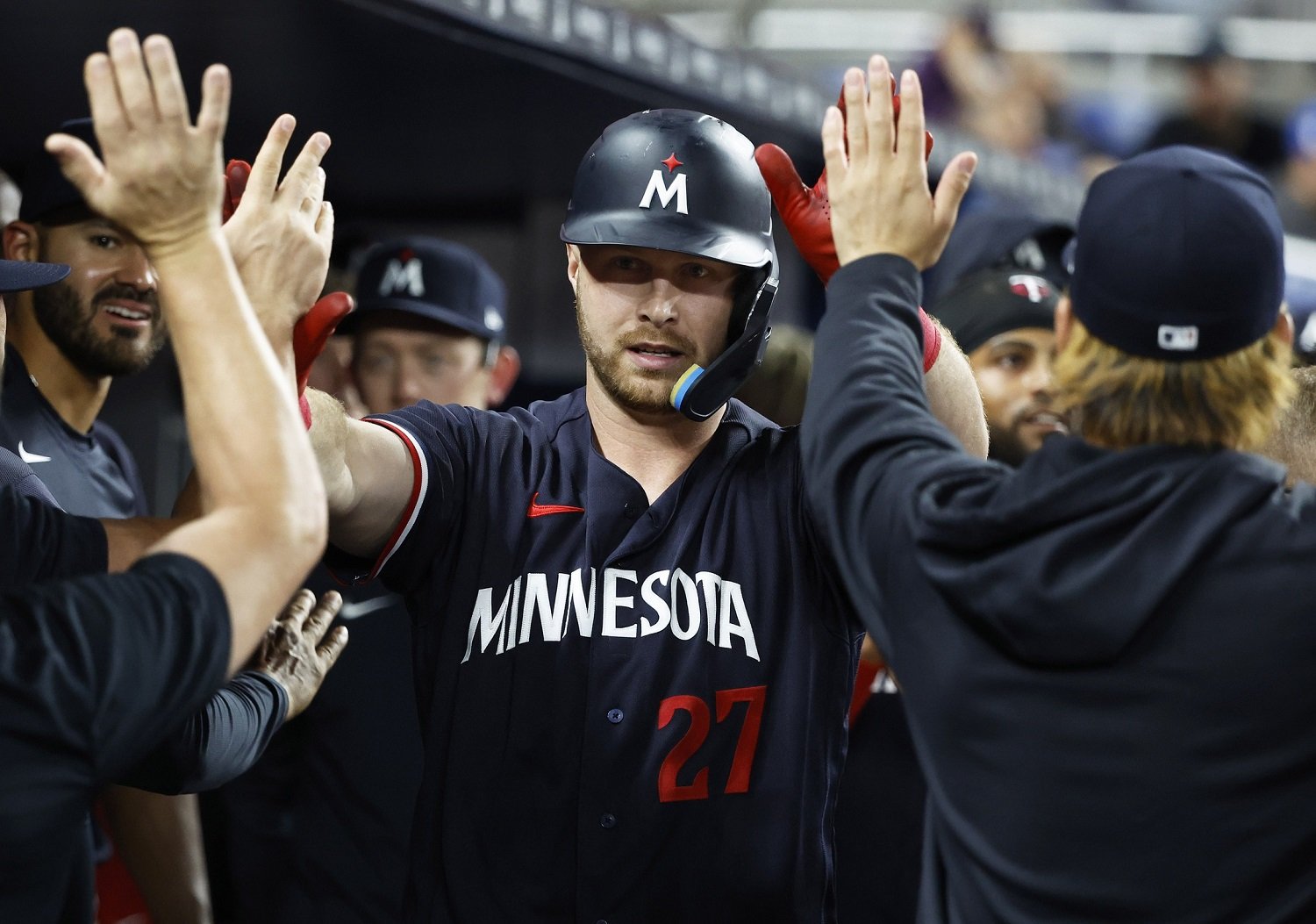
Christian Vazquez is currently on pace for his worst offensive season since 2018, where he hit .207/.257/.283 with a paltry 42 wRC+; Vazquez's current line of .214/.290/.250 with a 57 wRC+ hasn't inspired much confidence. On the other side of the catching tandem, Ryan Jeffers has looked reinvented this season. With career bests in OBP, SLG, wRC+, and wOBA, the Twins' catching rotation of 65/35 Vazquez to Jeffers' playing time split may need some altering.
Vazquez has never been a feared hitter in a lineup. He has one non-shortened season with a wRC+ over 100 (102 in 2019) and has four seasons with a wRC+ under 80. The most troubling part of Vazquez's struggles isn't that this type of performance is unprecedented for him, it's that he may have made an approach adjustment at the plate, and so far, it has backfired.
Vazquez, throughout his career, has been a low-walk/high-contact player that hasn't hit for much power. However, Vazquez has cut down his swing rate on both pitches outside and inside the strike zone this season. The good news is Vazquez's chase% is significantly lower than it has been in his career, leading to a career-best BB%, but the bad news is he's sacrificed a good amount of contact without adding power.
Looking at both zone-contact and chase-contact rates on Baseball Savant, Vazquez has experienced alarming drops in both numbers. A zone-contact% of only 76.8% is almost 10% lower than his career average at 86.6% and has fallen below the league average of 82%. Vazquez has also seen a similar drop in his chase-contact%, with a career-worst 54.9% compared to a career average of 70.4%. Again, he has fallen below the league average mark of 58.2%.
If Vazquez showed flashes of power, contact rate dropping is less of a concern, but it's been the opposite case thus far. Vazquez is seeing his lowest average exit velocity since 2017 and according to Statcast, has yet to barrel a single pitch this season. I don't need a blue dot to tell me a barrel% of 0% is the worst in the league.
Comparing raw production numbers to Ryan Jeffers, it seems like a no-brainer that Jeffers should start eating a majority of the playing time, but Jeffers' .828 OPS might be fake news. His .273/.373/.455 on the surface is all-star-level production from Jeffers, but his quality of contact would say it's not sustainable.
With only 50 plate appearances or so in, Jeffers has career-worst numbers in expected batting average (.200), expected slugging (.365), hard hit% (40.7%), average exit velocity (87.7), and barrel% (11.1%). I should also point out that Jeffers has the best BB% of his career (11.8%) and still has more extra-base hits than Vazquez, despite roughly half the plate appearances.
Even if Jeffers is due for some heavy regression, his expected slash line is still better than what Vazquez has been. Jeffers provides an added dimension of power that Vazquez doesn't have. If Vazquez's contact rates have dropped below league averages, he loses his advantage over Jeffers at the plate.
Perhaps Vazquez deserves the benefit of the doubt. After all, he is a two-time World Series champion and could be adjusting to a new home. Vazquez is still following through on his heralded defensive value (despite some ugly throwing errors), with his pitch framing ranking in the 76th percentile on Statcast and pitchers having only a 3.26 ERA when throwing to him.
Unfortunately, a playing time controversy arises when the team is struggling to score runs, and you're being out-hit by your backup. While not supported by peripheral numbers, at some point, Ryan Jeffers should start to eat into Vazquez's innings and plate appearances if both players continue their current trends. I would like to see the Twins to implement a more 50-50 split for the catching duo moving forward.








Recommended Comments
Create an account or sign in to comment
You need to be a member in order to leave a comment
Create an account
Sign up for a new account in our community. It's easy!
Register a new accountSign in
Already have an account? Sign in here.
Sign In Now