

Twins Video
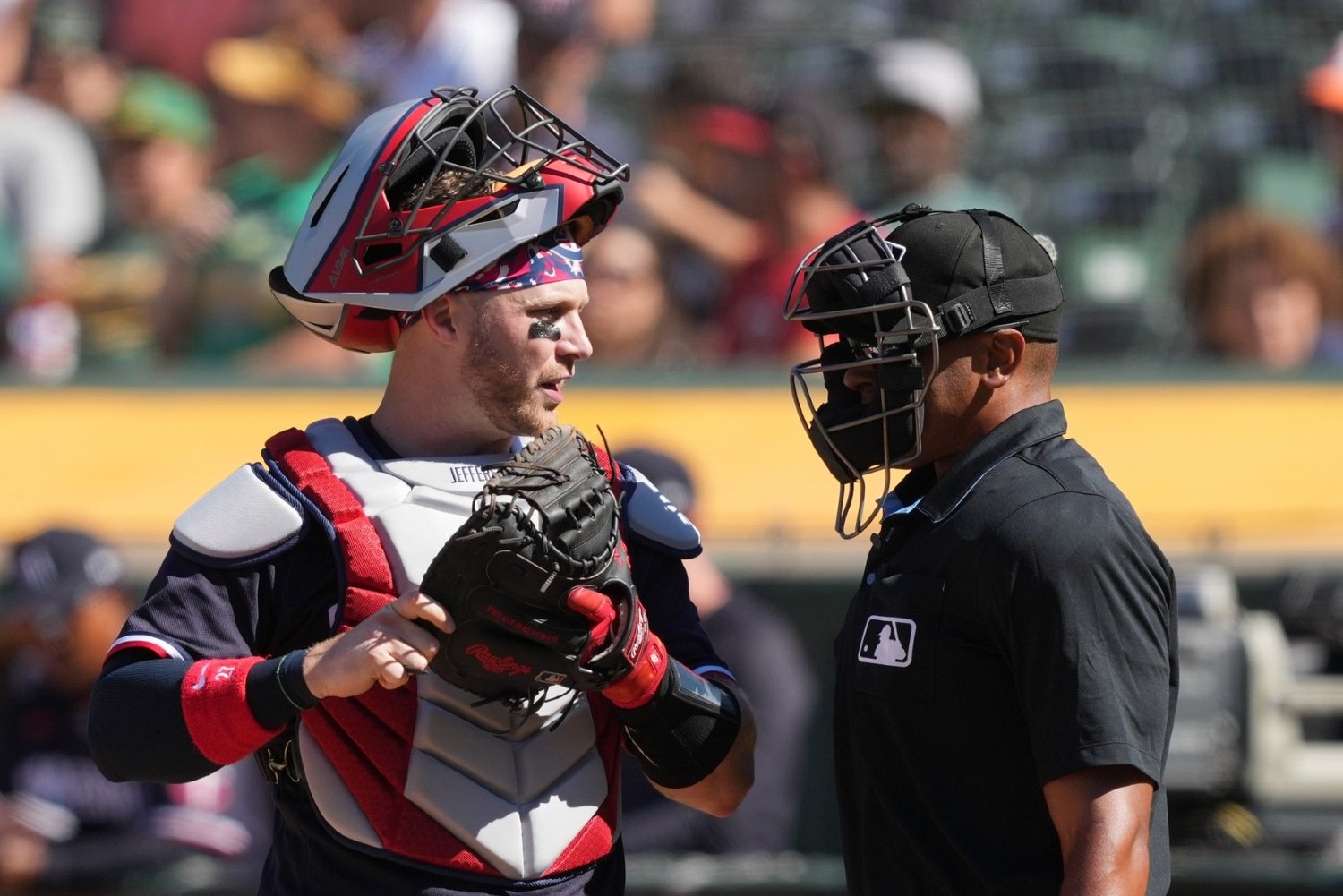
Ryan Jeffers had a terrific offensive year in 2023. As he looks to build on it—or merely repeat it—he has room to grow, and returning to form defensively could help him garner All-Star attention.
One of the most pleasant surprises in 2023 for the Minnesota Twins was Ryan Jeffers's year at the plate. In 335 plate appearances, he had an OPS of .858, 34 percent above league average, fueled by a second half in which he slashed .294/.379/.549. Among guys who primarily played catcher with at least 160 plate appearances, Jeffers had the best wRC+, at 138.
A year like that was so unexpected that the Twins had brought in a defense-first catcher (in Christian Vázquez) on a three-year deal last offseason to start ahead of Jeffers. Despite Jeffers outhitting Vazquez by .260 in OPS, Vazquez accumulated 20 more plate appearances over the year.
Though he started only 71 games at catcher, Jeffers was worth approximately three wins above replacement (WAR), according to both FanGraphs and Baseball Reference, which roughly translates to being an above-average regular on the year. Again, he did that, starting less than half the time behind the plate (and just six times as a designated hitter).
The offense wasn't a surprise to those following Jeffers throughout his professional career: he had a reputation as a bat-first player. However, beyond a 19-game debut in the 2020 abbreviated season, Jeffers failed to hit a league-average level between 2021 and 2022. Nonetheless, his defensive ability behind the plate was rated favorably. The progress he's made so far is why Cody Christie wrote yesterday on the question of whether Jeffers is underrated on a national level.
The defense, as opposed to his bat, was not expected to be a strength when drafted. As the years went by, Jeffers took a different profile annually. Let's start at the beginning.
As noted, the Twins drafted him as a bat-first catcher out of UNC-Wilmington. In the 2018 draft, Baseball America had him ranked as the 295th prospect, though they assumed he could go somewhere in the middle of the top 10 rounds if a team believed in his bat. The Twins—in a pick that seemed at the time to be due to Andy Reid-level clock mismanagement—picked him in the second round.
They did believe in his bat. At the time, many expected his days behind the plate would end. He was viewed as a potential first baseman or designated hitter because his work behind the plate wouldn't cut it.
However, as a minor leaguer, with the help of catching coordinator Tanner Swanson, Jeffers improved his footwork and his ability to receive the ball. By the time he reached Double-A, he was viewed as a potential plus behind the plate, in addition to his dangerous bat.
He broke into the Majors in 2020, putting up solid hitting numbers, and showed a penchant for pitch-framing—ensuring that all strikes are called strikes and even making some borderline balls out to be strikes. His style wasn't the most aesthetically pleasing--occasionally derided as "finger painting"--but it worked.
He wasn't good at blocking pitches or throwing out baserunners, throwing out just two of 16 base stealers, but that could be overlooked (to a degree) due to his framing and his bat. That could be improved with the same amount of work he had put into receiving, right?
In 2021, he fared better in both categories, per FanGraphs's catching metrics. However, he was still slightly below average at throwing runners out (24 percent caught stealing, as opposed to the general benchmark of 25 percent). However, in 2022, his metrics in both categories plummeted, including catching just seven of 38 runners (18 percent). Nonetheless, his strong framing kept him at least at a league-average level of defense overall.
His offensive numbers between 2021 and 2022 didn't justify a starting role. A so-so defensive catcher with a mediocre bat is a backup. At least one of those traits needs to be above-average, so pairing him with an established veteran like Vázquez was a priority.
Still, his pitch framing remained consistently effective—not elite, but enough to justify his presence behind the plate. If he could also improve in controlling the running game and blocking pitches in front of him, he could reach his ceiling as a plus catcher. He went through an arm-strengthening program before the 2023 season, determined to eliminate that weakness from his game.
Despite a solid start to the year, based on numbers provided by FanGraphs, Jeffers caught just 14 percent of runners at second base, compared to a 29 percent expected rate, given the speed and position of the runners when he caught the ball. He caught five fewer runners than expected, 61st of 63 in the league.
However, as in past years, his struggles with the running game could have been negated by his ability to frame pitches. Instead, surprisingly, Jeffers ranked in the bottom quartile of the league in framing runs with -4. For reference, he had two runs saved in 2021 and 2022 in less action each year. He negated two years of good pitch framing in a single year.
I can't sit here and tell you definitively that he sacrificed his framing to be a better thrower behind the plate—though he did struggle mightily framing anything that wasn't up and to his left, despite previous success with pitches down in the zone. If there was a change in his approach to be better able to get rid of the ball that prevented him from getting those low calls—such as setting up less often on one knee—it might be worth reevaluating, though.
For example, see the two videos below. The first is from 2022, as Jeffers gets a called strike off the plate. The second is from 2023, and he fails to get a strike call. In the second, he waits longer to get down, seemingly to hold the runner and stay in a position that allows him to get up. Furthermore, he catches the ball with his arm full extended, perhaps to get the ball as soon as possible, which leads to a jerkier receiving motion.
Neither his baserunner control nor his blocking saw any benefit to whatever changes he made coming into last season (if there were any any), to the point that he was (overall) a far worse than average defensive catcher, with all areas diminishing.
If Jeffers can return to form with his framing in 2024, even without a marked improvement to his other abilities, he can elevate his game and become one of the league's top catchers.
He might not repeat the offensive year that ranked him the top-hitting catcher. Still, if he can pair well-above-average offense with an average to above-average total defensive package, he could be one of the best overall catchers in the league.
He's earned more time than he got in 2023. However, the Twins have tended to prefer a timeshare at catcher. If he starts 60 percent of the team's games, that would amount to 95 starts and approximately 400 plate appearances, giving him the potential to turn in a 4-WAR season—a good baseline standard for an All-Star. To be in that conversation, he must restore his framing to its former glory.







Recommended Comments
Create an account or sign in to comment
You need to be a member in order to leave a comment
Create an account
Sign up for a new account in our community. It's easy!
Register a new accountSign in
Already have an account? Sign in here.
Sign In Now