


Twins Video
While the Twins could not reach the World Series this year. We can assign blame to various factors, including lack of offense at critical moments, poor timing defensively at others, and savvy postseason-experienced veterans of an American League dynasty may have been too much to handle in a best-of-5 series.
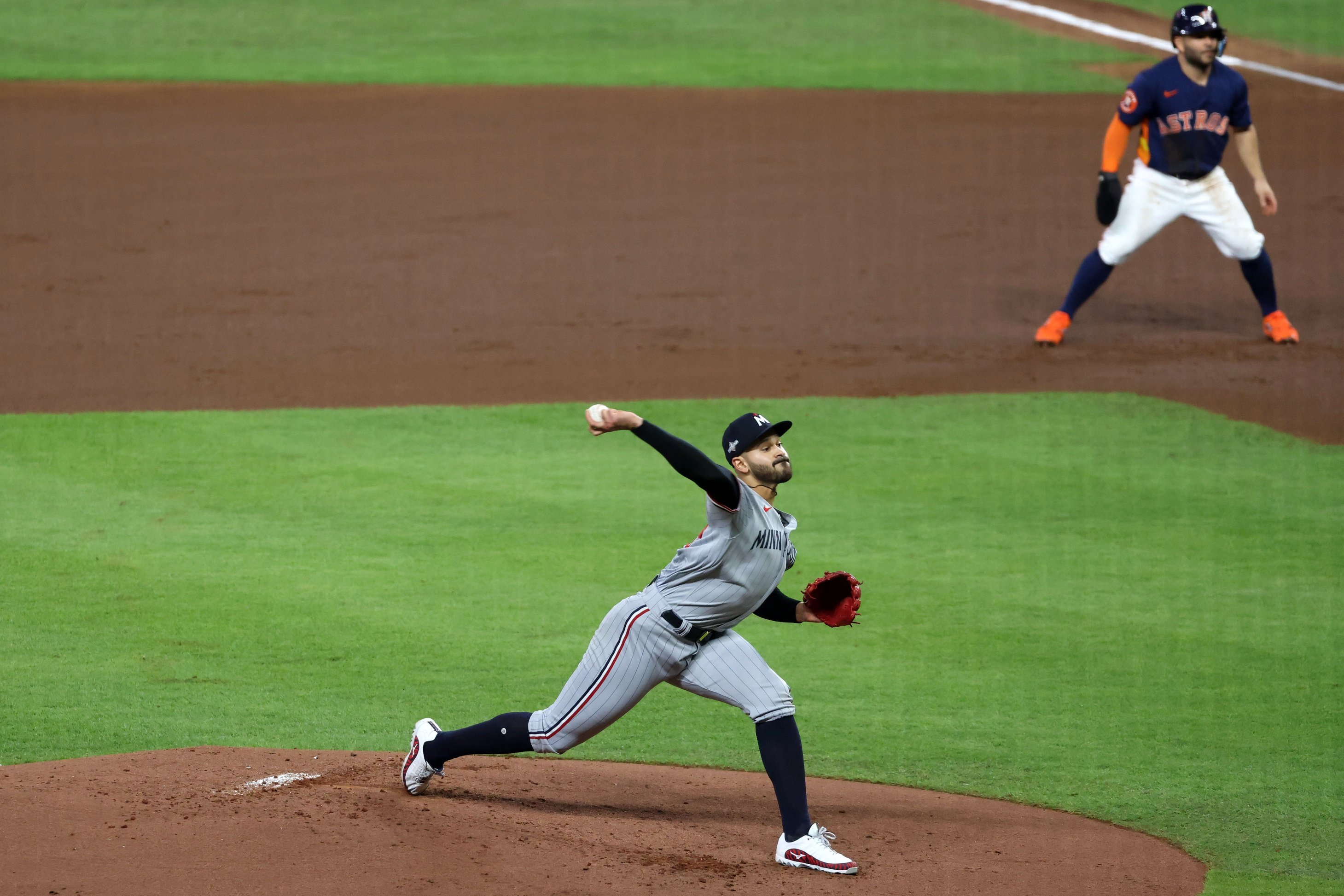
It takes a complete team to have success in the postseason. (And a little bit of good fortune.) But when you focus on the starting rotation, the Twins make an interesting comparison with those currently in the World Series. So, how do they stack up against these championship contenders?
Staff Aces
Rangers: Jordan Montgomery (3.22 ERA, 188 IP, 21.4% strikeout rate, 3.7% walk rate, 4.3 fWAR)
Diamondbacks: Zac Gallen (3.47 ERA, 210 IP, 26% strikeout rate, 6% walk rate, 5.2 fWAR)
Twins: Pablo López (3.66 ERA, 194 IP, 29.2% strikeout rate, 6% walk rate, 4.5 fWAR)
As it stands, each of these three arms had stellar seasons, even ace-level in some respects. They each stayed healthy throughout the year, starting at least 32 games. All three had strong strikeout and walk rates under the hood and found themselves in the top 13 regarding wins above replacement for a starting pitcher.
Montgomery was a mid-season addition at the trade deadline and had a fantastic two-month stretch with his new team, where he had a 2.79 ERA across 11 starts, even though his strikeout numbers were just OK.
Gallen has been one of the best starting pitchers since being traded to Arizona in 2019, and he has taken a significant leap to ace status since the beginning of the 2022 season. The Snakes' top arm is becoming quite the household name after pitching 396 innings of 3.04 ERA ball over the last two seasons.
These stats are purely looking at each player's regular season numbers. But if we consider the two brilliant performances that López accomplished in the playoffs, this one looks even closer.
If the Twins had pushed the Astros series to a winner-take-all Game 5, López would have had another chance to shine under a national spotlight. With another start like his first two in the postseason (0.71 ERA, 12 ⅔ innings pitched, ten strikeouts, three walks), the Twins' ace might have a big enough reputation to top the other two arms, but instead the edge has to go to Gallen.
Next arms up:
Rangers: Nathan Eovaldi (3.63 ERA, 144 IP, 22.9% K-rate, 3.8% BB-rate, 2.5 fWAR)
Diamondbacks: Merrill Kelly (3.29 ERA, 177 ⅔ IP, 25.9% K-rate, 9.6% BB-rate, 3.2 fWAR)
Twins: Sonny Gray (2.79 ERA, 184 IP, 24.3% K-rate, 7.3% BB-rate, 5.3 fWAR)
There is a case that Gray had a superior season to López, but for this exercise, we'll have him line up as the second starter. Considering how the two lined up in the Wild Card series, it's only fair. Again, all three starters in this matchup had rock-solid campaigns, though Eovaldi missed a handful of turns in the rotation due to forearm soreness. Still, each pitcher showed top-of-the-rotation stuff when healthy and arms that you would easily roll out early in a playoff series.
Eovaldi has lost a couple of ticks on his once-electric fastball, which is understandable for a 33-year-old veteran. But he still found a way to get out of jams by inducing plenty of ground balls (86th percentile). He was one of the best at limiting damage with runners in scoring position, where his opponents hit an anemic .168 against him (third-best in baseball, according to Inside Edge). That's extremely valuable, especially in high-octane settings like the MLB playoffs.
Kelly has some of the best off-speed stuff in the game but showed a tendency to lose control in 2023. His chase rate was in the 88th percentile, and like Eovaldi, he got plenty of ground balls (68th percentile) to help him wriggle out of danger. While he isn't on the same level as Gallen, Kelly is still a formidable opponent.
Gray had the best season of his career in 2023, and he will almost certainly find himself getting some Cy Young award consideration. He was as consistent as any pitcher in the game, with only two blemishes on his 32-start game log. Gray was the best of these three pitchers at limiting hard contact, especially on pitches in the strike zone (.394 opponent slugging, second-best in MLB). That helps to provide some context as to how he avoided giving up the long ball (just eight home runs allowed all season).
Regular season numbers might point to Gray having the edge, but his start against the Astros in Game 3 of the ALDS proved how anything can happen in one game. The Twins might not have Sonny Gray to include in this list next year, yet his abilities equal that of a good number two starter in any playoff series.
Rounding out the playoff rotations:
Rangers: Max Scherzer (3.77 ERA, 152 ⅔ IP, 28% K-rate, 7.2% BB-rate, 2.2 fWAR)
Diamondbacks: Brandon Pfaadt (5.72 ERA, 96 IP, 22.3% K-rate, 6.2% BB-rate, 0.3 fWAR)
Twins: Joe Ryan (4.51 ERA, 161 ⅔ IP, 29.3% K-rate, 5.1% BB-rate, 2.2 fWAR)
Here's where things get dicey for all three clubs. The rotations take very similar turns at this point in a series, as all three of these arms are likely facing short starts in high-pressure games.
Scherzer is a slam dunk for the Hall of Fame when that time comes, but he finds himself playing through a nagging injury that kept him out of the rotation for weeks leading up to the ALCS.
Still, the allure that made him an enticing trade acquisition at the deadline remains. He still possesses elite expected numbers (86th percentile xERA, 90th percentile xBA) and has an extensive history of turning it on in October (3.86 ERA, 29.2% K-rate across 140 career postseason innings). But he was lit up in his two starts in the ALCS, where he allowed seven earned runs in just 6⅔ innings pitched.
Pfaadt was one of the better pitching prospects in Arizona's farm system coming into this season. His regular season numbers may have been pedestrian, if not disappointing, but he has been a revelation in the postseason. Across his four October starts, the righty has a 2.70 ERA with a 1.08 WHIP across 16 ⅔ innings pitched.
Ryan should be considered an exciting arm for Twins fans going forward, but his lone playoff start against the Astros showed he's still a step behind the veterans in his rotation. In 2023, Ryan gave up home runs at an alarming rate (1.78 HR/9) and ran out of gas in the second half. His strikeout-to-walk rate shows there is still a lot to like for the 27-year-old, and it's encouraging to see him start his off-season with an evaluation from Driveline. Still, the edge has to go to the savvy veteran in Scherzer or the hot hand in Pfaadt.
What do you think? How do you see the Twins' rotation matching the Rangers and Diamondbacks' rotations? Let us know your thoughts in the comment section below, and as always, keep it sweet.






Recommended Comments
Create an account or sign in to comment
You need to be a member in order to leave a comment
Create an account
Sign up for a new account in our community. It's easy!
Register a new accountSign in
Already have an account? Sign in here.
Sign In Now