Jump to content
Twins Daily
  • Create Account
  • Twins News & Analysis

    No Such Thing as Too Much Pitching, Right?


    Tom Froemming

    The Twins were already in pursuit of pitching this offseason, but the news that Ervin Santana will miss 10-12 weeks really emphasizes the team’s need to add to its staff. The number of pitchers in the rotation at any given time is obviously five, but how many starting pitchers can a team expect to rely on over the course of a season?

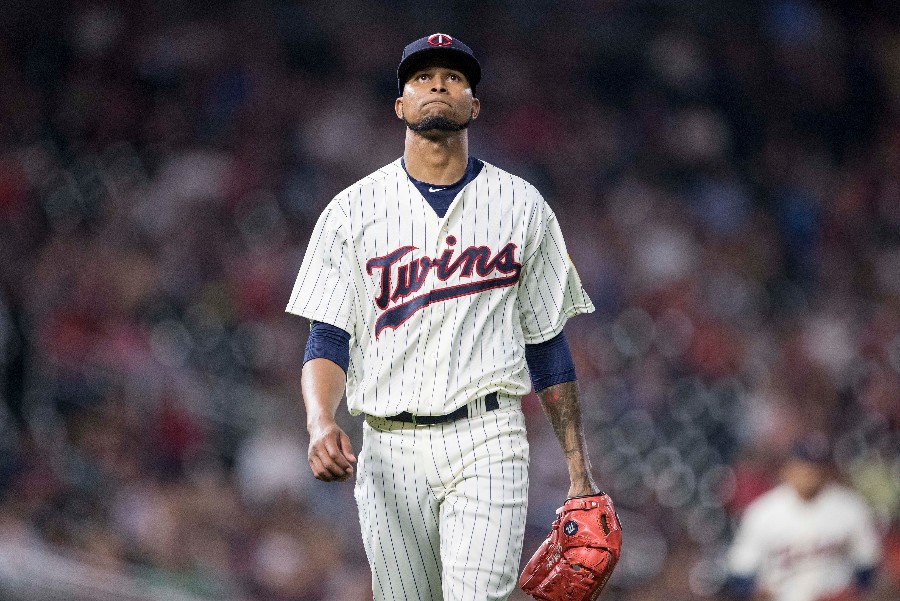
    Image courtesy of Jesse Johnson-USA TODAY Sports

    Twins Video

    Last season, the Twins used an insane number of starting pitchers. Injuries in addition to some performance issues and odd roster shuffling (the Jaime Garcia game) all made for the perfect storm, and the 2017 Twins started 16 different pitchers. Ugh.

    That’s an abnormally high number, but over the past five seasons the Twins have averaged 11.8 different starting pitchers, 9.8 of whom made at least three starts.

    Some teams are a little more fortunate. Cleveland, for example, has only averaged 8.8 different starting pitchers per season over the past five years, 7.8 of whom made at least three starts. Not everyone’s so lucky. There were 315 pitchers who started at least one game in 2017, an average of 10.5 per team.

    Why so many? Well, the workhorse has become a dying breed. There were only 46 pitchers in all of baseball who made at least 30 starts. If you go back just to even 2012 and look at some of these same numbers, the differences are dramatic. There were 286 pitchers to start a game that year, 9.5 per team, and 65 hurlers made 30 or more starts.

    Shifting gears to the Twins, let’s take a look at who’s currently in the org, keeping in mind that the team will more than likely need to depend on 10 or 11 of these guys. This isn’t a power ranking of starting pitching options per se, I’ve broken them up into categories instead.

    Locks

    Ervin Santana

    Jose Berrios

    Kyle Gibson

    Adalberto Mejia

    No, Ervin won’t be ready for Opening Day, but the good news is that it sounds like he’ll be back with the Twins sometime in May. So I’m still going to include him as a lock.

    Extra Depth

    Aaron Slegers

    Dietrich Enns

    Felix Jorge

    Myles Jaye

    Slegers is really close to being a lock to make at least a few starts. His status will have a great deal to do with who/how many free agent starters are signed. All four of these guys made their major league debuts last season, Jaye as a member of the Tigers. The Twins signed him to a minor league deal in late November.

    New Role/In Recovery

    Tyler Duffey

    Trevor May

    Phil Hughes

    Michael Pineda

    Duffey is going to get the chance to stretch out in spring training, but if the injury bug hits the bullpen it would be no surprise to see him shifted back there. You could say the same thing about May, Hughes and Pineda, who are all in various stages of recovering from injuries. The plan for now is to prepare May to come back as a starter, but he of all people should know that plans can change.

    Rookies

    Stephen Gonsalves

    Fernando Romero

    Zack Littell

    Gonsalves has made a handful of starts at Triple-A, and is a good bet to debut sometime in the second half. But Romero (23 starts in Double-A) and Littell (14 starts in Double-A) are less experienced in the high minors.

    OK, so that gives us 15 pitchers currently inside the Twins organization who could realistically start at some point in 2018. That sounds like a lot, right? Sure, but there are a whole lot of question marks surrounding several of those players.

    Some of these names are not guys you’d trust right now to be successful at the major league level. It’d be fun to watch a couple of those rookies come up, but those guys could be in for rough adjustment due to the (idiotic) differences in the major and minor league baseballs. Remember how bad Berrios was in 2016?

    There’s also the fact that there will certainly be more injuries, and probably ones that keep guys out more than 10-12 weeks. What are the odds that one of these guys suffers a torn UCL or major shoulder injury?

    Knowing what we know today, how many more starting pitchers should the Twins add?

    I'd say at least two who can be counted on to be in the rotation and one more on a minor league deal. How does Yu Darvish, Jaime Garcia and Drew Hutchison sound?

    Is that too much to ask? How about Alex Cobb, Jason Vargas and A.J. Griffin?

    Fine, I'll settle for Andrew Cashner, Ubaldo Jimenez and Jesse Chavez. OK, you're right, that's taking it a little too far. What do you think? Who would you like to see the Twins target? Would you rather see them be aggressive or leave room for some of the young guns to emerge?
    Follow Twins Daily For Minnesota Twins News & Analysis

    Recent Twins Articles

    Recent Twins Videos

    Twins Top Prospects

    Marek Houston

    Cedar Rapids Kernels - A+, SS
    The 22-year-old went 2-for-5 on Thursday night, his third straight multi-hit game. Heading into the week, he was hitting .246/.328/.404 (.732). Three games later, he is hitting .296/.359/.437 (.796).

    User Feedback

    Recommended Comments


    Featured Comments


    I  also feel the Twins need to sign 1 top flight starter and a flyer or two.  Things may work out, but squadering the chance is not good.

    I still would try to do it on the cheaper side - sign Cobb, and give Tillman a 1-year prove it contract - like 1-6 or 1-7, with perhaps a club option for like 10 the following year. Then I would look to trade for Archer or as has been suggested on here Teheran.


    This would give the team a rotation as follows:


    Archer/Teheran

    Santana

    Berrios

    Cobb

    Gibson


    with proven backup options ready to fill gaps/injuries:

    ​Tillman

    Mejia


    along with injury recovery options:


    Pineda

    May

    Hughes

    Duffey


    and finally the rookie crop:


    Slagers

    Enns

    Gonsalves

    Romero

    Jorge 

    et al


    I'm assuming a trade for Teheran or Archer would cost at least Gordon and perhaps one of those rookie SPs. Considering how our rotation would shake out for the next few years (with contracts expiring) - I'd do it in a heartbeat. 


    I still would try to do it on the cheaper side - sign Cobb, and give Tillman a 1-year prove it contract - like 1-6 or 1-7, with perhaps a club option for like 10 the following year. Then I would look to trade for Archer or as has been suggested on here Teheran.


    This would give the team a rotation as follows:


    Archer/Teheran

    Santana

    Berrios

    Cobb

    Gibson


    with proven backup options ready to fill gaps/injuries:

    ​Tillman

    Mejia


    along with injury recovery options:


    Pineda

    May

    Hughes

    Duffey


    and finally the rookie crop:


    Slagers

    Enns

    Gonsalves

    Romero

    Jorge 

    et al


    I'm assuming a trade for Teheran or Archer would cost at least Gordon and perhaps one of those rookie SPs. Considering how our rotation would shake out for the next few years (with contracts expiring) - I'd do it in a heartbeat. 


    Archer would require about 2x that much value. If it is Gordon, you also need 2 SP minor league players and a guy like Kiriloff, maybe Kepler......


    Or, Lewis and 2-3 other minor league players.

    Your example of an average from career BAPIP doesn't work because it doesn't look like FIP considers more than the single past year. So, apples to apples, only the single year BAPIP should be used to compare Darvish and Lynn to the projected FIP that was being discussed

    FIP and BABIP are just stats which can be calculated on a career, season, or even a per game basis. They get more useful/predictive with a larger sample. They are not projections themselves. Projections like Steamer incorporate multiple years of BABIP and FIP (and/or its components).

    Is there no longer any thought being given to trading for Chris Archer? Seems the ideal time to plug him in for Santana and then have an even stronger rota when Ervin comes back. The cost will be high, but do any of the Twins pitching prospects project to be better than Archer when they eventually get to the majors? 


    Well, the only way to figure out why something doesn't make sense is to do a little digging.The only defense I've ever seen you use is to say something doesn't apply (without much support, and in a flippant way) or just to say that X stat is better than Y stat because that's what Statcast/Steamer or Teams use to determine value. I'm pretty sure that MLB teams are much more sophisticated than Steamer is, but I realize there are probably some really dumb GMs out there.


    I think that the Steamer gang would probably tell you that they aren't very good, relatively speaking, at accurately predicting an individual player's numbers. I've seen no comparisons of Steamer to the 2016 or 2017 projections that they made other than they were generally better than the other 7 or 8 prognosticators, however they don't give the method they used to rank them. For instance, what percentage of their WAR projections are within 25% of the actual WAR? 


    A somewhat sideways BAPIP IS considered in FIP. FIP is an attempt to eliminate defensive players from the picture, but it does it by weighing things that may or may not do what it tries to do. To assume that every batted ball is hit in the same way is not really a great way to do it.I freely admit that it would be a very hard thing to do, but because it's hard to do, and SOs are very heavily weighted, it doesn't really reflect what makes a pitcher effective. It would be a better stat if it made an allowance for the deviation from the player's BAPIP to the league BAPIP, because that WOULD give pitchers credit for being more fieldable.


    Your example of an average from career BAPIP doesn't work because it doesn't look like FIP considers more than the single past year. So, apples to apples, only the single year BAPIP should be used to compare Darvish and Lynn to the projected FIP that was being discussed My points were to show why FIP wasn't a good measure for these two pitchers in this current year. Once again I'd bet Steamer would agree, because so many of Darvish's singles turn into doubles, and doubles to triples because Darvish can't hold people on base and he throws a ton of wild pitches.  


    One other thing, I think Santana did have a BAPIP that was pretty high as a rookie. How do you suppose his WAR from that year looked compared to the following year's projection?


    Maybe you could take some time to give us your take on why Darvish's ERA was 15% higher than Lynn's. Dig in to the stats a bit. It might help us understand why Darvish is clearly more productive than Lynn. 


    If you're looking for a better analytic than FIP look at SIERA. It takes batted ball profiles into account (i.e. BABIP). It is an ERA emulator but it functions as an ERA predictor even better than FIP does. It too thinks Darvish is a significantly better pitcher than Lynn.


    As for wild pitches, Darvish had 12 last season out of a total of 3054 pitches.  Another way to state that once every 3 games he has a wild pitch. Seems likely that has a statistically insignificant impact on his performance.


    On an unrelated note I'm excited for the new statcast data to be incorporated into the analytics. I would think knowing average exit velocities and launch angles could greatly enhance an ERA estimator/emulator.

    I am always a fan of building from within, but the Twins are truly well into the onset of their window to compete. With the rebuilt bullpen, the two remaining biggest holes for this team is a RH corner OF/1B bat and a true #1 SP. Although we obviously also need at least one more veteran SP as a contingency with question marks surrounding the position. We have the trade capital to land that #1 if an opposing team is in fact shopping one. We need to go on this, and then use our FA dollars to land that veteran lower-rotation veteran arm and that RH bat. We've already missed out on Cole, I hope we make every effort to land Archer because I doubt there are any other teams considering shopping a young controllable top-of-the-rotation type pitcher. 


    FIP and BABIP are just stats which can be calculated on a career, season, or even a per game basis. They get more useful/predictive with a larger sample. They are not projections themselves. Projections like Steamer incorporate multiple years of BABIP and FIP (and/or its components).


    The prior year's FIP is a projection, and the formula bears that out. I don't know how Steamer uses FIP, but his projection is pretty much Lynn's 2017 FIP with little or no correlation to previous years. I was pointing out that it's not a valid comparison between Darvish and Lynn.  It's not, because it doesn't account for Darvish's SBs and WPs, and their affect on his earned runs is projectable. They will likely cost 7+ runs every year unless he improves dramatically.  The only things that would make Darvish more valuable last year are more subjective than objective.


    If you're looking for a better analytic than FIP look at SIERA. It takes batted ball profiles into account (i.e. BABIP). It is an ERA emulator but it functions as an ERA predictor even better than FIP does. It too thinks Darvish is a significantly better pitcher than Lynn.


    As for wild pitches, Darvish had 12 last season out of a total of 3054 pitches.  Another way to state that once every 3 games he has a wild pitch. Seems likely that has a statistically insignificant impact on his performance.


    On an unrelated note I'm excited for the new statcast data to be incorporated into the analytics. I would think knowing average exit velocities and launch angles could greatly enhance an ERA estimator/emulator.


    Thanks for the info on SIERA, I'll take a look.


    Each pitch doesn't tie to a runner advancing.  WPs and SBs do.  In addition to his WPs, he gave up 30% of the Rangers' stolen bases.  Together, they make a significant impact on his ERA.  It could easily be 15%.


    I don't know how Steamer uses FIP,


    [...]


    It's not, because it doesn't account for Darvish's SBs and WPs, 


    These would seem to be mutually exclusive statements. You can't claim to not know the math behind Steamer and simultaneously claim it doesn't take into account SB's and WP's.


    Thanks for the info on SIERA, I'll take a look.


    Each pitch doesn't tie to a runner advancing.  WPs and SBs do.  In addition to his WPs, he gave up 30% of the Rangers' stolen bases.  Together, they make a significant impact on his ERA.  It could easily be 15%.


    According to Tom Tango's run expectancy charts Darvish's SB - CS added ~3 runs to his season total last year. Finishing the math that means if Darvish didn't allow any SB's last season (nor any CS) he would have had an ERA of 3.71. When you do the math on WP's (which was ~3 runs as well) it works out to an ERA of 3.69.  Combined they lower his ERA to 3.55.  Or a difference of 8%.


    I'm not sure what this has to do with the larger point though.  Darvish > Lynn.


    Edit:  I hate not being able to put in 2 spaces after periods.

    Edited by Oxtung

    Just sign Andrew Cashner and Wade Miley, both have decent track records and are former 1st rounders (so they have the ability to be a bargain).


    Also, I could see both turning into effective relievers as well if someone (Gonsalves, Romero, Little, May, Duffey) steps up and performs. I especially see Miley (smaller frame) (if that matters?) having the abilty to be that max effort guy in the pen ready to be unleashed.

    Re: Too much pitching.


    It is possible and leaves me a bit quesy. I'd much rather be rolling. (Yaw is right out)


    Oh you were talking about baseball? And perhaps you meant pitching talent? If there is some zero sum talentwise involved, i am sure there is a point of diminishing pitching returns, when it is better to invest in other talent to round out the team. No i don't think the Twins are there yet. I am wondering how the younger untried talent will step up of given half a chance, amd of course i am looking forward to the season as i bet most folk here and wondering how the free agent situation will shake out.


    Bummer about Santana's finger, but not the end of the world as we know it...

    The prior year's FIP is a projection, and the formula bears that out. I don't know how Steamer uses FIP, but his projection is pretty much Lynn's 2017 FIP with little or no correlation to previous years.

    Keep in mind, at its core FIP is just a shortcut to describe a pitcher's K rate, BB rate, and HR rate on an ERA scale. Projecting those rates is what creates the projection. (Although FIP can be derived from the projection too.)


    You can see Steamer doesn't like Lynn's K rate or HR rate to bounce back. With a return to normal BABIP, that makes for another high FIP, and Steamer basically projects guys ERA right around their FIP. I think Steamer is maybe overly pessimistic on Lynn, probably because it is agnostic about the TJ surgery/recovery context, but a non-elite K rate guy coming off a career low K rate is a concern. He hasn't yet bounced back fully from TJ in terms of K rate (and velocity?), and there remains the chance that he never will, particularly past the age of 30.


    Another projection is ZIPS which looks better for him -- gives his 2017 rates and thus FIP a little boost, and gives him a better ERA than FIP too. Still has him at .289 BABIP, a tick lower than Steamer but much closer to average than his 2017 mark.


    https://www.fangraphs.com/blogs/2018-zips-projections-st-louis-cardinals/


    In my opinion, Lynn is no slouch, but I still prefer Darvish, who is not without risk of course, but has already come back better/farther from TJ in terms of K rate and velocity, while a contract for Lynn would be a bet on that full recovery which hasn't yet happened. And Darvish has a higher ceiling (peaked at 5.9 bWAR, compared to 3.7 bWAR for Lynn) and probably a higher floor (he's basically been a 4+ bWAR performer, prorated to 31 GS, in each of his 5 MLB seasons so far).


    I am sure the Twins have their own criteria that goes beyond any data we have (or could comprehend!) but from my vantage point, Darvish is the higher aim, and I would like them to aim high, given the circumstances.

    Edited by spycake


    These would seem to be mutually exclusive statements. You can't claim to not know the math behind Steamer and simultaneously claim it doesn't take into account SB's and WP's.


    ME:  They're referring to different things.  I DON'T know how steamer uses the FIP calculation in their projections, but I DO know that FIP does not allow for SB or WP.  I hope this helps.


    According to Tom Tango's run expectancy charts Darvish's SB - CS added ~3 runs to his season total last year. Finishing the math that means if Darvish didn't allow any SB's last season (nor any CS) he would have had an ERA of 3.71. When you do the math on WP's (which was ~3 runs as well) it works out to an ERA of 3.69.  Combined they lower his ERA to 3.55.  Or a difference of 8%.


    ME:  He is determining this value based on the runs scored in a game. The methodology isn't explained, and I wasn't able to find it, but it looks like he's saying that a SB is worth a larger percent of a run in a higher run scoring environment because there would be more bases advanced during the game.  For instance, if you were to steal in a 20 run game, you would be pretty likely to score, thus a SB in a 20 run game might be in the 4s or 5s (but as I think about it, I think it would reach an absolute max value).  His valuation might be applicable here, but he's got a lot of variables to work with.  By their nature this type of valuation generally uses plug numbers to allow iterations.  I don't know where he might have used them.


    I've never seen a specific average value for SB or WP, but it wouldn't be as complex as his calculations were. I would say that a net 18 SB and 12 WP together would make more runs than that because they'd likely be to 2B, 3B or Home,  But, like I said, I don't know their values,, you could be correct.  


    I'm not sure what this has to do with the larger point though.  Darvish > Lynn.


    Edit:  I hate not being able to put in 2 spaces after periods.


    I hate the single space after too.  I'm also not great at the quotes. sorry


    Edited by bcs4


    Keep in mind, at its core FIP is just a shortcut to describe a pitcher's K rate, BB rate, and HR rate on an ERA scale. Projecting those rates is what creates the projection. (Although FIP can be derived from the projection too.)

    You can see Steamer doesn't like Lynn's K rate or HR rate to bounce back. With a return to normal BABIP, that makes for another high FIP, and Steamer basically projects guys ERA right around their FIP. I think Steamer is maybe overly pessimistic on Lynn, probably because it is agnostic about the TJ surgery/recovery context, but a non-elite K rate guy coming off a career low K rate is a concern. He hasn't yet bounced back fully from TJ in terms of K rate (and velocity?), and there remains the chance that he never will, particularly past the age of 30.

    Another projection is ZIPS which looks better for him -- gives his 2017 rates and thus FIP a little boost, and gives him a better ERA than FIP too. Still has him at .289 BABIP, a tick lower than Steamer but much closer to average than his 2017 mark.

    https://www.fangraphs.com/blogs/2018-zips-projections-st-louis-cardinals/

    In my opinion, Lynn is no slouch, but I still prefer Darvish, who is not without risk of course, but has already come back better/farther from TJ in terms of K rate and velocity, while a contract for Lynn would be a bet on that full recovery which hasn't yet happened. And Darvish has a higher ceiling (peaked at 5.9 bWAR, compared to 3.7 bWAR for Lynn) and probably a higher floor (he's basically been a 4+ bWAR performer, prorated to 31 GS, in each of his 5 MLB seasons so far).

    I am sure the Twins have their own criteria that goes beyond any data we have (or could comprehend!) but from my vantage point, Darvish is the higher aim, and I would like them to aim high, given the circumstances.


    Phew, I thought this thing was headed south fast.  Thanks for your takes, they're very insightful.  Bill

    Well, the only way to figure out why something doesn't make sense is to do a little digging.

    FWIW, I meant that line to say that you are now arriving at some of the core tenets of modern sabermetrics (BABIP and ERA prediction). I edited it out around the same time you responded because I thought I wasn't communicating that well. Nothing wrong with digging deeper for a better understanding, of course! But if you feel I am being too dismissive of your points, please keep in mind that this debate is far bigger than you and I and the context of Lynn and Darvish, and I may not be the best emissary for modern sabermetric thought. :) But I'll do my best as my time and typing allows.

    Yes, statisticians and actuaries have their hands full, how can we understand and apply? The more complex a stat, generally the less useful if becomes. People use them incorrectly, and the weighting of the  calculations are subjective.


    I liked Sabermetrics when it discovered that bunting, stealing bases, switch hitting, and having enough LHP  and hitting in the rotation generally hurt more than they helped. Most Managers and GMs still overvalue that stuff.


    ME:They're referring to different things.I DON'T know how steamer uses the FIP calculation in their projections, but I DO know that FIP does not allow for SB or WP.I hope this helps.


    Thanks for clarifying. It seems you're a bit confused by some of these analytics. I will try and simplify the last 15 years of SABR thought into a few sentences. If you already know this I apologize and you can ignore me.  :)


    As you said FIP only uses a few variables; K's, BB's and HR's primarily, which makes it an easy analytic to use. As such it can be used to estimate how a pitcher performed without taking into account things like the defense behind him, the ballpark he plays in, etc.. that the pitcher has no control over. So for 2017 Darvish struckout 209 batters and walked 58 (which FIP LOVES) but also gave up 27 HR's (Which FIP hates). That makes for an above average FIP and this is how it was originally meant to be used.


    However, FIP can also be used as a projection system in two separate ways. First, the 2016 FIP correlates more highly to a players 2017 ERA than a players 2016 ERA to their 2017 ERA. So often a players 2017 FIP is used as a short hand for how a pitcher's ERA might perform the next season. Second, given a projected number of K's, BB's and HR's it can predict a 2018 FIP for players. This is where Steamer comes in. Steamer (and others like ZIPS) uses past trends in year to year fluctuations in a stat, say strikeouts, to predict what a players future number of strikeouts will be.


    He is determining this value based on the runs scored in a game. The methodology isn't explained, and I wasn't able to find it, but it looks like he's saying that a SB is worth a larger percent of a run in a higher run scoring environment because there would be more bases advanced during the game.For instance, if you were to steal in a 20 run game, you would be pretty likely to score, thus a SB in a 20 run game might be in the 4s or 5s (but as I think about it, I think it would reach an absolute max value).His valuation might be applicable here, but he's got a lot of variables to work with.By their nature this type of valuation generally uses plug numbers to allow iterations.I don't know where he might have used them.


    I've never seen a specific average value for SB or WP, but it wouldn't be as complex as his calculations were. I would say that a net 18 SB and 12 WP together would make more runs than that because they'd likely be to 2B, 3B or Home,But, like I said, I don't know their values,, you could be correct.


    I didn't look closely enough at his methodology and that was more complex than the one I was looking for, sorry! Disregard my previous mathematical analysis. Though I still think you're overvaluing SB's and WP's. I'll look more closely and repost.

    This all has to be seen within the context of the 40-man roster that is full right now.  And the first name off that roster if/when the Twins add a free agent pitcher is likely Slegers (or Enns), so you adding and losing.


    That's why, if the Twins are going after a second pitcher (which they should, because in order to compete in the post-season, they need 2 SP better than Berrios and now they have zero,) it has to be via a trade.


    Other than Darvish, I don't think that any of the FA SP are worth it, not only because of the loss of the draft pick for the other top 3, but because I think that they will be at the Gibson level at the AL...


    Absolutely no to bottom feeding because Gonsalves, Romero, Littel, Enns, & Co could provide similar or better results than Vargas or Garcia and hold the last spot or two until May and Santana are ready in May.


    This team has to decide whether it will be a contender in 2018 or 2019.  If they want to be a contender in 2018 they need 2 starters.  In 2019, they will effectively replace Santana with Pineda, May, Berrios, Mejia would be a year more seasoned, and Gonsalves, Romero, Littel would be closer.


    They just need a top of the rotation pitcher (or 2) depending on how they see 2018.


    LOVE this post. Very smart. But we will continue to disagree on 2 pitchers better than Berrios. But that comes down to belief as well as cost and affect. Despite this unfortunate injury, I'm a believer in Santana, and never bought in to the theory his arm would fall off in 2018. He has pretty much performed as well as or better with the Twins than he ever has. (Obviously this minor injury clouds things a bit). Even with some regression, Santana is a very nice pitcher. And I believe Berrios will only continue to get better. Darvish is obviously a HUGE need and potential get. (Honestly, I'm not sure why he hasn't taken the best opportunity and contract and signed already), but some of the other options still move the needle for me, if the numbers make sense.


    But Darvish, (I hope), Santana and an improving Berrios does a lot for me. After that is Gibson, Mejia, and a few really nice prospects, (maybe not quite ready) plus the rehabbing May. Just not sure I buy in to another SP better than Berrios. But I could absolutely buy in to a flier/1 year deal at this point to offset any Santana issues. It would deepen the initial rotation and buy time for May and the kids. Who knows, might get lucky and have a flip asset.


    I still would try to do it on the cheaper side - sign Cobb, and give Tillman a 1-year prove it contract - like 1-6 or 1-7, with perhaps a club option for like 10 the following year. Then I would look to trade for Archer or as has been suggested on here Teheran.


    This would give the team a rotation as follows:


    Archer/Teheran

    Santana

    Berrios

    Cobb

    Gibson


    with proven backup options ready to fill gaps/injuries:

    ​Tillman

    Mejia


    along with injury recovery options:


    Pineda

    May

    Hughes

    Duffey


    and finally the rookie crop:


    Slagers

    Enns

    Gonsalves

    Romero

    Jorge 

    et al


    I'm assuming a trade for Teheran or Archer would cost at least Gordon and perhaps one of those rookie SPs. Considering how our rotation would shake out for the next few years (with contracts expiring) - I'd do it in a heartbeat. 

    NO!!! Please aim high.


    Thanks for clarifying. It seems you're a bit confused by some of these analytics. I will try and simplify the last 15 years of SABR thought into a few sentences. If you already know this I apologize and you can ignore me.  :)


    As you said FIP only uses a few variables; K's, BB's and HR's primarily, which makes it an easy analytic to use. As such it can be used to estimate how a pitcher performed without taking into account things like the defense behind him, the ballpark he plays in, etc.. that the pitcher has no control over. So for 2017 Darvish struckout 209 batters and walked 58 (which FIP LOVES) but also gave up 27 HR's (Which FIP hates). That makes for an above average FIP and this is how it was originally meant to be used.


    However, FIP can also be used as a projection system in two separate ways. First, the 2016 FIP correlates more highly to a players 2017 ERA than a players 2016 ERA to their 2017 ERA. So often a players 2017 FIP is used as a short hand for how a pitcher's ERA might perform the next season. Second, given a projected number of K's, BB's and HR's it can predict a 2018 FIP for players. This is where Steamer comes in. Steamer (and others like ZIPS) uses past trends in year to year fluctuations in a stat, say strikeouts, to predict what a players future number of strikeouts will be.


    I understand what you're saying, but I don't see numbers that support it yet.  Averaged over the only years that I was able to use them, both ERA and FIP averaged being off by roughly .5. I realize that's not a sample, but I'd love to see some actual comparisons overall. How close is projecting ERA and how close is FIP?  The people that use FIP say that it's better, but there should be a basis somewhere to establish it.  It wouldn't be hard to do if someone merged a couple of databases, and if it averages .5 off, it's not that much of a help, in fact it's kind of a hindrance because people don't bother to look at individual stats to see what's actually going on.


    Please don't take this in any way to demean your valuations of players. It's that I see a lot of people that say one pitcher is crappy, and another is great based solely on WAR, when they really don't know if it's valid for an individual player. WAR definitions generally even use a disclaimer that says players within 1 (or something around there) of each other are about the same.


    Thanks for the assistance.  


    I understand what you're saying, but I don't see numbers that support it yet.Averaged over the only years that I was able to use them, both ERA and FIP averaged being off by roughly .5. I realize that's not a sample, but I'd love to see some actual comparisons overall. How close is projecting ERA and how close is FIP?The people that use FIP say that it's better, but there should be a basis somewhere to establish it.It wouldn't be hard to do if someone merged a couple of databases, and if it averages .5 off, it's not that much of a help, in fact it's kind of a hindrance because people don't bother to look at individual stats to see what's actually going on.


    Please don't take this in any way to demean your valuations of players. It's that I see a lot of people that say one pitcher is crappy, and another is great based solely on WAR, when they really don't know if it's valid for an individual player. WAR definitions generally even use a disclaimer that says players within 1 (or something around there) of each other are about the same.


    Thanks for the assistance.


    There have been many year to year correlation studies done. Let me be upfront, none of our current analytics do a very good job of predicting future performance. That said they are still the best we currently have. Here is a matrix showing correlations from a few years ago. The best predictors of future ERA are FIP, xFIP, SIERA, tERA. They are more accurate predictors of 2018 ERA's than a players 2017 ERA. 


    On a related note, has anyone seen the Steamer/ZIP correlation numbers?


    There have been many year to year correlation studies done. Let me be upfront, none of our current analytics do a very good job of predicting future performance. That said they are still the best we currently have. Here is a matrix showing correlations from a few years ago. The best predictors of future ERA are FIP, xFIP, SIERA, tERA. They are more accurate predictors of 2018 ERA's than a players 2017 ERA. 


    On a related note, has anyone seen the Steamer/ZIP correlation numbers?


    Thanks for the link!  


    Is there a glossary for this chart? I can't remember all of the abbreviations.


    Here is a link to Fangraphs' pitching glossary page. You should be able to find most of them there including links for more indepth explanations if needed.

    Edited by Oxtung

    Here is a link to Fangraphs' pitching glossary page. You should be able to find most of them there including links for more indepth explanations if needed.

    Fangraphs... Glossary... that was too tough a Google search for me to come up with today. Thanks for humoring me. :)


    Is there no longer any thought being given to trading for Chris Archer? Seems the ideal time to plug him in for Santana and then have an even stronger rota when Ervin comes back. The cost will be high, but do any of the Twins pitching prospects project to be better than Archer when they eventually get to the majors? 

    I just don't think TB wants to trade away Archer, unless they get blown away with an offer. And the Twins shouldn't do that.


    Create an account or sign in to comment

    You need to be a member in order to leave a comment

    Create an account

    Sign up for a new account in our community. It's easy!

    Register a new account

    Sign in

    Already have an account? Sign in here.

    Sign In Now

×
×
  • Create New...