Jump to content
Twins Daily
  • Create Account
  • Twins News & Analysis

    Falvey, Levine Well-Suited To Solve Roster Riddles


    Tom Froemming
    Image courtesy of Ken Blaze, USA Today

    Twins Video

    Among the challenges that puzzled the 2016 Twins was putting the optimal defensive lineup on the field. Derek Falvey and company likely will be facing similar challenges next season. Is there any reason to be confident those issues will be resolved in 2017? Based on how we've seen the Cleveland Indians lineup evolve the past few seasons, I think so.

    The Twins ranked 12th in baseball in home runs, 13th in OPS, scored the 16th most runs. So while there's always room for improvement, hitting is far from the team's biggest concern. The defense, on the other hand, desperately needs to improve after the Twins ranked 29th in Defensive Runs Above Average. Improving the team may not require a complete overhaul, but rather just shifting a few pieces.

    But Twins fans know all too well that can be a dangerous game to play. Miguel Sano to the outfield was a disaster. Luckily, Falvey knows how dangerous that can be, as well.

    Falvey's first-hand experience with Carlos Santana should be particularly valuable in concern to trying to resolve some of the Twins' issues. For the first four years of his career, Santana was primarily a catcher. Then Cleveland asked him to do some strange things in 2014, having him learn third base in spring training while still catching sparingly. Santana got off to a terrible start and suffered a concussion in June. That led Cleveland to use Santana strictly as a 1B/DH from there forward.

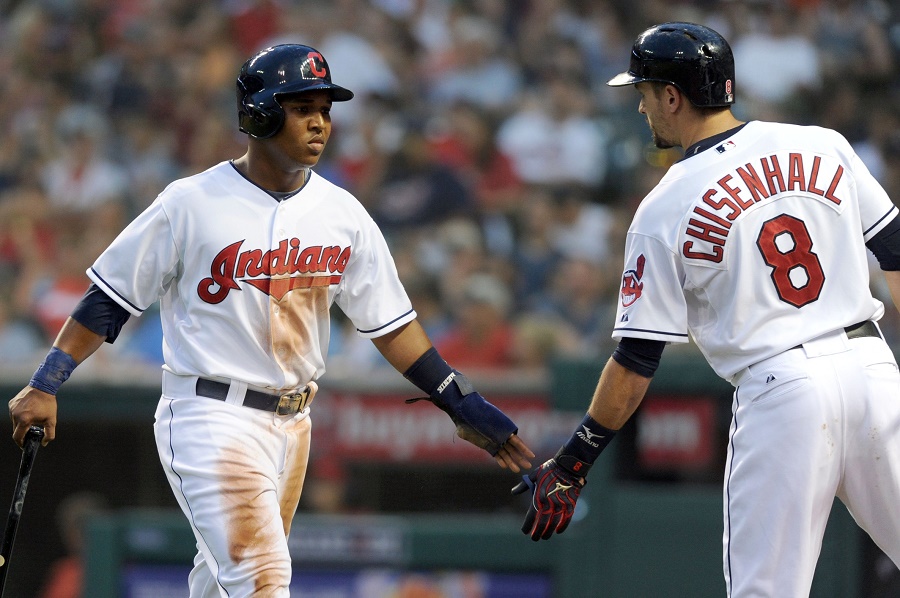
    It also took a few seasons for Cleveland to find defensive homes for Jose Ramirez and Lonnie Chisenhall. Both players have filled unexpected needs this season. Had Juan Uribe panned out at third base and Michael Brantley been healthy who knows what would have happened with Ramirez and Chisenhall. But even when those two appeared to just be spare parts, Cleveland wisely held on to both of them.

    It was reported by La Velle E. Neal III this week Texas Assistant General Manager Thad Levine was expected to be the Twins next GM. Evan Grant of the Dallas Morning News confirmed that report. While nothing will be made official until after the World Series, there hasn't been a shred of news from either team denying those reports.

    The Rangers also have an encouraging recent track record of finding creative ways to put together a lineup. They took a big gamble on Ian Desmond last offseason, converting him from shortstop to outfield, and were rewarded with a solid season. They also had to solve the puzzle of how to use Jurickson Profar. He ended up playing 10 or more games at each of 3B, 2B, 1B, LF and SS.

    When you win your division, like Cleveland and Texas did, all those moves look really smart and inventive. One could argue that each of those decisions were made with the same intention as most of the Twins' tinkering. But the difference in the results is undeniable.

    Of course, Falvey and Levine aren't going to try to do the exact same things they did with their previous organizations. They're going to be flexible based on the team's personnel. But how might those lessons learned be applied to the Twins?

    In the case of Santana, Cleveland opted to put their best hitter in the best possible position to succeed, regardless of other positional needs. Then they filled holes with secondary players like Ramirez and Chisenhall. What might that look like on the Twins? Putting Miguel Sano at DH full-time and letting the other chips fall where they may. That may make Kennys Vargas and Byungho Park appear to be redundant, but you never know.

    Desmond was a case of the Rangers eyeing a player who they believed could be a difference maker, but they didn't have an obvious defensive position to plug him into. What might that look like on the Twins?

    Well, we're not sure if Jorge Polanco can be a big league shortstop, but his bat looks legit. If Brian Dozier sticks around and Falvey/Levine don't trust Polanco at short everyday, they may have to get creative to keep his bat in the lineup. Could Polanco be a Plan B in left field if Eddie Rosario can't improve? Seems as plausible as Ian Desmond signing as a center fielder a year ago at this time: Crazy.

    That's just me spit-balling a few ideas that could be considered. Without knowing how the roster will shake out it's tough to even speculate what kinds of changes may be bandied about. But with new evaluators coming in, new ideas will surely be presented and I'm sure no stone will be left unturned.

    After so many years of the Twins having such a predictable approach under Terry Ryan, it's anyone's guess the direction the new front office may take. It should be a fascinating offseason.

    Want more Twins in your Google results? Add us as a preferred source.

    Follow Twins Daily For Minnesota Twins News & Analysis

    Recent Twins Articles

    Recent Twins Videos

    Twins Top Prospects

    Yasser Mercedes

    Cedar Rapids Kernels - A+, OF
    On Thursday in the Fall League, Mercedes went 2-for-4 with his first double and his first homer run of the AFL season.

    User Feedback

    Recommended Comments


    Featured Comments


    It's clear that athletes today are generally, nearly always, better than back in the day......but I guess I was comparing Winfield to his peers, relative to Sano to his peers......and that's no contest.


    I'm not sure Sano is better even w/o taking into account 40 years of genetics and training and whatnot...what was this thread about, again?

    When I think of athleticism for a baseball player, I include arm and raw power to the other things we would think of in terms of athleticism.  Sano has incredible raw power and one of the best arms of any position player in MLB.


    What if he were in "Winfield" like shape?


    They were worse but scorekeepers were more lax in those days, didn't usually go as an error.

    Um, no, scorekeepers were much harder on fielders in the old days.  They expected major leaguers to make major league plays until like 20 years ago (or around when money started getting ridiculous and players regularly called the scoring booths all ticked off that scorers dared give them an error.).  Now I think the standard is high school level defense when it comes to scorers.


    For example, an OF is running full speed (for him) and a ball goes in and out of the glove.  Guy didn't dive, ball just bounced right off hiss open face glove. The batter gets an inside the park HR, no error.  Yeah, that happens.  We got an inside the park HR that way this year. 


    I also doubt Ozzie EVER gets 20 error in a season if he played today.

    Edited by jimmer


    When I think of athleticism for a baseball player, I include arm and raw power to the other things we would think of in terms of athleticism.  Sano has incredible raw power and one of the best arms of any position player in MLB.


    What if he were in "Winfield" like shape?


    That would be sweet. He's not.


    That would be sweet. He's not.

    and they knew he wasn't when he showed up to spring training, but they decided to play him in the OF anyway ;-)


    BTW, are we even taking into account how bad he actually was and the fact that they decided to never put him back out there again?  If it was such a good idea (and a success), why not put him back?

    Edited by jimmer


    I don't think that's a fair assessment.   People with far greater credentials than most of us believe that it is a good practice as evidenced by the frequency it is done.  In  other words, it should be done.  Your premise suggests that the people critiquing this practice on the internet understand what should or should not be done better than the people making these decisions.  That is highly unlikely, IMO.


    It's a fair point, but we know now how many practices that were done in baseball were demonstrably poor ideas.  From the frequency of bunting, to the downplaying of walks, to a host of other things. We can show mathematically how those ideas led to less of what they were trying to accomplish (run scoring), not more.  


    Also, simply citing decades of practice isn't a sufficient argument.  It suggests frequency of occurrence over time is sufficient for determining whether the practice is a good one.  That's fallacious reasoning.  "That's the way it's always been done" just won't cut it for me.  It's not that I think I'm more of an expert, but I'd definitely say my argument is stronger on the face of it.  I'm following more objective standards for good practice than simply falling in lock step with tradition.  

    Um, no, scorekeepers were much harder on fielders in the old days.  They expected major leaguers to make major league plays until like 20 years ago (or around when money started getting ridiculous and players regularly called the scoring booths all ticked off that scorers dared give them an error.).  Now I think the standard is high school level defense when it comes to scorers.


    For example, an OF is running full speed (for him) and a ball goes in and out of the glove.  Guy didn't dive, ball just bounced right off hiss open face glove. The batter gets an inside the park HR, no error.  Yeah, that happens.  We got an inside the park HR that way this year. 


    I also doubt Ozzie EVER gets 20 error in a season if he played today.

    It was a joke. "Scorekeepers are harder on players today" is not something you ever hear. At least I never have.

    Sano was taken out of the outfield as quickly as he was put in it becasue of the butchery he made of the position (and a few near miss collisions) and Kyle Schwarber broke his damn knee out there because he didn't call the ball. Outfielding 101.

    Its safe to say the Internet nerds got those two calls right and the pros got em wrong.


    giphy.gif


    Athletes in general have gotten gradually bigger and marginally faster since the 70s.  That much is true.


    But Sano is not "more athletic" than Dave Winfield.  Winfield led the Big Ten in rebounding one year.  He was a fantastic college pitcher in addition to outfielder.  He was drafted by TWO different professional basketball leagues, an NFL team, and of course the Padres in MLB.  


    And for what it's worth, Flip Saunders was VERY athletic.  He was a starting Big Ten point guard, ferpetesakes.


    There were athletes in the 70's, too.  Good ones.


    As they say..you could look it up.

    http://www.sports-reference.com/cbb/schools/minnesota/1973.html


    I'm a huge Winfield fan, but I think the legend is growing.  He actually never lead the team in rebounding, he played his 2 years with Jim Brewer, so it would have been hard to lead the team.  He went to the University on a full baseball scholarship, not a basketball.  He played basketball in his junior and senior season.


    He was drafted by the 3 sports, but in basketball and football, he was drafted in rounds that no longer exist.  In the 5th round in the NBA and 17th round in the NFL.  Back when Winfield was drafted in the NBA, they were drafting trainer in the late rounds and the NFL was a hometown Viking pick.  It's a great show of respect, but he really wasn't a prospects in the other leagues.

    Edited by ken

    I'm looking forward to seeing the kind of decisions the new FO makes (like what position players are expected to play most of the time, what trades are made, when extensions are done, etc.)and the changes that get implemented (like in minor league development, philosophies, etc).

    Edited by jimmer


    I don't think a single person who predicted the Sano experiment to fail didn't already know that some players can make the position switch just fine. 


    Exactly, if the Cubs continue with Schwarber in the OF, I'll call that foolish too.

    OK, another mod note.  This thread is about Falvey/Levine fixing roster holes, not about rehashing Sano to the OF and every mistake that the Ryan administration made.  That time is now officially over, so I think it's fair to stop bringing it up in every other thread and let the work that Falvey/Levine do speak for itself.  Feel free to criticize there when they do something you don't like, but let's give them a pass for Ryan's mistakes.


    Thanks.


    And yes, respond to someone's comments instead of just dismissing them.  That really is disrespectful and doesn't accomplish anything other than to slight someone else. If you don't have anything worth responding to, then ignore it. 


    For clarification, are the roster riddles the new FO has to fix only roster holes or would one roster riddle be having Mauer, Vargas, Park, Plouffe and Sano? (Mostly underwhelming options and only 3 spots to put them)

    Edited by jimmer


    For clarification, are the roster riddles the new FO has to fix only roster holes or would one roster riddle be having Mauer, Vargas, Park, Plouffe and Sano? (Mostly underwhelming options and only 3 spots to put them)

    This riddle does not seem that tough.  Non-tender Plouffe.  Give Sano this entire season to assess if he can play 3B.  The tough question is what are you willing to except for Dozier if an ideal scenario does not present itself?  The hope here is for ML ready SP.  Anyone trading for Dozier with 2 years of control is not going to trade ML ready starting pitching.  At least not one with the kind of ceiling we want in return. 


    The bullpen is a quite the riddle as well.  You cant rely on Perkins at all.  Then, there is Hughes.  You have to have a spot to give these guys a shot at coming back, right?

    Edited by Major Leauge Ready


    The bullpen is a quite the riddle as well.  You cant rely on Perkins at all.  Then, there is Hughes.  You have to have a spot to give these guys a shot at coming back, right?

    I don't think either are "owed" a spot. They are owed money. Those are not the same things.


    One thing I hope for from new leadership is greater recognition of that reality.


    I don't think either are "owed" a spot. They are owed money. Those are not the same things.

    One thing I hope for from new leadership is greater recognition of that reality.

    The wording I used could easily be misconstrued.  “Need a spot to give them a shot” is not at all the same as giving them a spot.  People endorse low risk high leverage acquisitions her all the time.  There is absolutely no risk with either player.  We already owe them the money.  Both have been very good performers at times, especially Perkins.  

    The wording I used could easily be misconstrued. “Need a spot to give them a shot” is not at all the same as giving them a spot. People endorse low risk high leverage acquisitions her all the time. There is absolutely no risk with either player. We already owe them the money. Both have been very good performers at times, especially Perkins.


    I agree they've both been good players in the past.


    But there are only 40 spots on the roster and 25 spots on the big league team. Those spots should go to players management thinks have the best chance to add wins in the future, not the players owed money. Maybe those are the same guys. But maybe not.


    "We already owe them the money" IS the risk. I think it's been too much of a factor in the past.


    I agree they've both been good players in the past.


    But there are only 40 spots on the roster and 25 spots on the big league team. Those spots should go to players management thinks have the best chance to add wins in the future, not the players owed money. Maybe those are the same guys. But maybe not.

    "We already owe them the money" IS the risk. I think it's been too much of a factor in the past.

    There is a very large gap in how fans see this as compared to people that have or have had P&L responsiblity for organizations that generate 9 figures in revenue.  The "its not my money" perspective is incredibly naive.


    There is a very large gap in how fans see this as compared to people that have or have had P&L responsiblity for organizations that generate 9 figures in revenue.  The "its not my money" perspective is incredibly naive.


    I don't think you've ever posted this before. Is there a better way to make your point? Because it clearly isn't sticking with some people. An honest question, it isn't sticking, so is there a better way? I can't think of one, because what you type is true. OTOH, we are Fans, not rational beings. Rational beings wouldn't care if the Twins win....so I'm not sure rational discussions always work. That's what my leadership training says, if you are in an emotional discussion, rational arguments may make it worse....

    I agree they've both been good players in the past.

    But there are only 40 spots on the roster and 25 spots on the big league team. Those spots should go to players management thinks have the best chance to add wins in the future, not the players owed money. Maybe those are the same guys. But maybe not.

    "We already owe them the money" IS the risk. I think it's been too much of a factor in the past.

    I personally like your idea of playing the best players, but that's just me. Do you have room for one more in the naive club?

    There is a very large gap in how fans see this as compared to people that have or have had P&L responsiblity for organizations that generate 9 figures in revenue. The "its not my money" perspective is incredibly naive.

    The money is already spent. Nobody is asking to spend someone else's money. It's already spent.


    Which would be a better use of resources?

    A) Stubbornly rostering a player who gives you 0.5 WAR because you don't want to cut your losses.


    Or


    B) Giving that roster spot to a guy making the league minimum gives you 1.5 WAR.


    Now, I get there is no guarantee that the guy who gets that roster spot will be better enough to justify the extra 500k, but then again Chief didn't claim as much, just that it should be considered if there is a better player.

    Any decently-run business understands the concept of sunk costs. Companies cut investments loose all the time. So the idea that it's unrealistic to make decisions based on future returns, rather than past commitments, is just factually incorrect. I'd love some real world examples that show otherwise - that companies decided they had to stick with a sunk cost rather than move on to something with more future potential. SEC filers have to disclose a lot of their major decisions, so if it happens with regularity then there should be huge numbers of examples that can be shown. 


    One area where some fans are unrealistic is the matter of annual player budgets - for instance, suggesting that a lower budget in one year should essentially allow for the 'savings' to be allocated to another year. Businesses don't treat operating expenses that way and so its no surprise baseball teams don't. 

    Edited by drivlikejehu

    Any decently-run business understands the concept of sunk costs. Companies cut investments loose all the time. So the idea that it's unrealistic to make decisions based on future returns, rather than past commitments, is just factually incorrect. I'd love some real world examples that show otherwise - that companies decided they had to stick with a sunk cost rather than move on to something with more future potential. SEC filers have to disclose a lot of their major decisions, so if it happens with regularity then there should be huge numbers of examples that can be shown.


    One area where some fans are unrealistic is the matter of annual player budgets - for instance, suggesting that a lower budget in one year should essentially allow for the 'savings' to be allocated to another year. Businesses don't treat operating expenses that way and so its no surprise baseball teams don't.

    Actually many businesses do operate that way (spreading out costs over multiple years).

    It's pretty common for a company to invest in an expensive piece of equipment and spread that cost over the expected life of the equipment.

    And, in Minnesota at least, it's legal to do it that way for tax reporting.


    Any decently-run business understands the concept of sunk costs. Companies cut investments loose all the time. So the idea that it's unrealistic to make decisions based on future returns, rather than past commitments, is just factually incorrect. I'd love some real world examples that show otherwise - that companies decided they had to stick with a sunk cost rather than move on to something with more future potential. SEC filers have to disclose a lot of their major decisions, so if it happens with regularity then there should be huge numbers of examples that can be shown. 


    One area where some fans are unrealistic is the matter of annual player budgets - for instance, suggesting that a lower budget in one year should essentially allow for the 'savings' to be allocated to another year. Businesses don't treat operating expenses that way and so its no surprise baseball teams don't. 

    You don't understand the definition of a sunk cost and neither do a number of people here who keep using it incorrectly.  If there is still hope of a return it's not a sunk cost. 

    Edited by Major Leauge Ready

    You don't understand the definition of a sunk cost and neither do a number of people here who keep using it incorrectly. If there is still hope of a return it's not a sunk cost.

    And nobody is arguing that they should be dumped if there is still hope that they can return to form.

    Some of just hope that if the day comes that that hope is no longer realistic, that they aren't given a roster spot just because they are under contract.


    Actually many businesses do operate that way (spreading out costs over multiple years).
    It's pretty common for a company to invest in an expensive piece of equipment and spread that cost over the expected life of the equipment.
    And, in Minnesota at least, it's legal to do it that way for tax reporting.


    For capital assets, yes, depreciation is often mandatory for financial accounting and tax purposes. States follow federal tax depreciation rules for the most part, save sometimes for bonus depreciation.


    For the portion of Target Field that the Twins paid for, for instance, they would depreciate the structure over 39 years for tax, concessions equipment over 5 years, and so on. But teams do not treat players like capital assets, even though baseball contracts do have some characteristics of a capital investment. They treat payroll like . . . payroll. I don't know how else they could really do it, since it would be a pro forma method of accounting that they couldn't use for anything other than internal decision-making.


    Major Leauge Ready, on 02 Nov 2016 - 9:59 PM, said:


    You don't understand the definition of a sunk cost and neither do a number of people here who keep using it incorrectly.  If there is still hope of a return it's not a sunk cost.


    A simple google search contradicts you because you misunderstand "return."  A sunk cost is one that has been incurred and cannot be recovered. The financial commitment to a player cannot be recovered financially - on-field production is irrelevant from that standpoint, though of course a team will want to keep productive players.

    Edited by drivlikejehu


    Create an account or sign in to comment

    You need to be a member in order to leave a comment

    Create an account

    Sign up for a new account in our community. It's easy!

    Register a new account

    Sign in

    Already have an account? Sign in here.

    Sign In Now

×
×
  • Create New...