


Twins Video
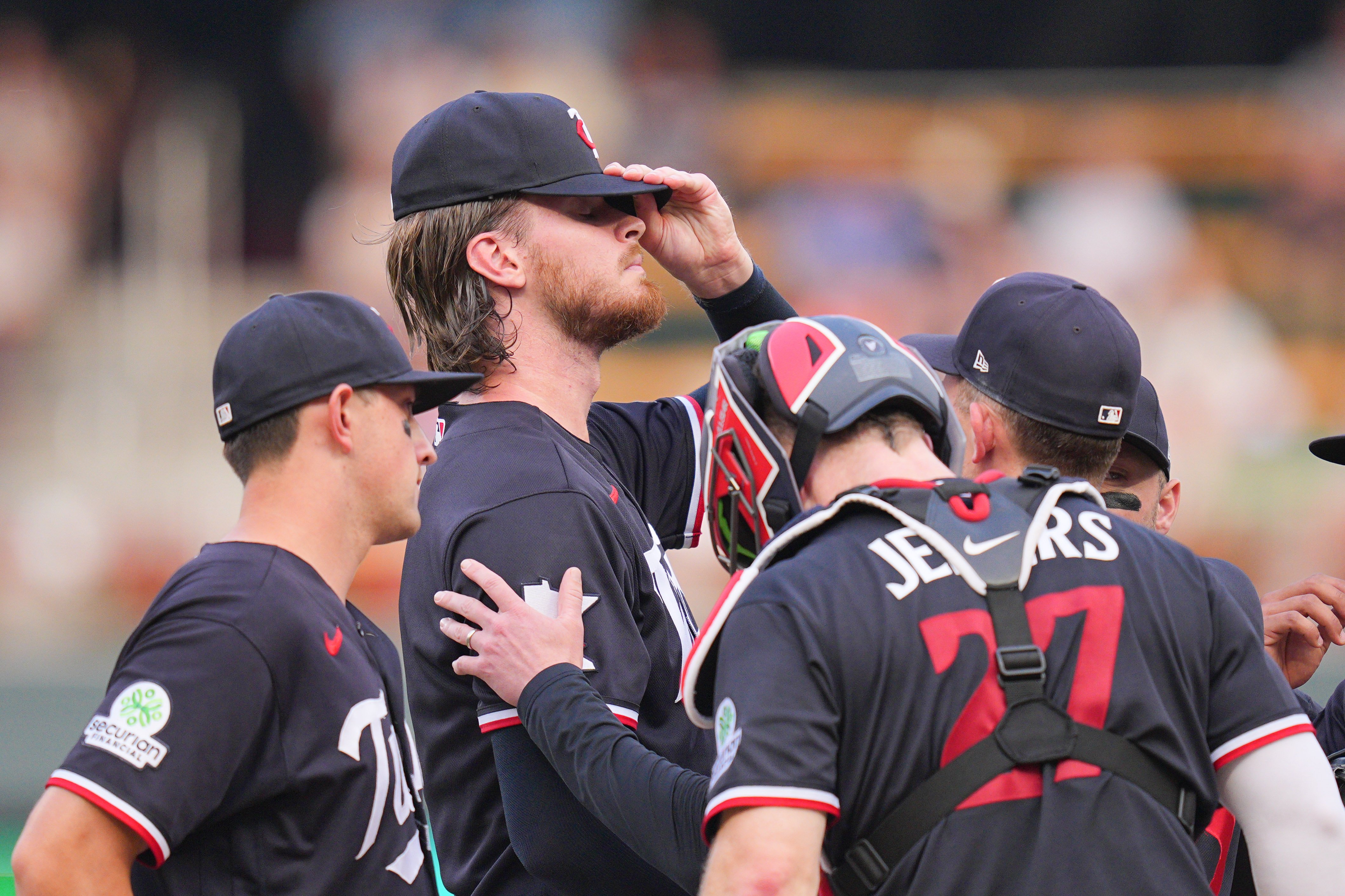
Bailey Ober has become something of a unicorn in modern-day baseball.
When you see a 6-foot-9, 260-pound pitcher standing on the mound, the natural assumption is that he is going to overpower hitters with a high-velocity fastball. Ober, however, has never fit that mold. He has built his career around deception, extension and an unusual ability to make a relatively mediocre fastball play above its radar-gun reading. That formula has made him a key member of the Twins’ rotation over the past handful of seasons. But it’s becoming increasingly difficult to ignore how little room for error there is in Ober’s approach.

Ober’s fastball is averaging just 88 mph this season, the lowest mark among all major league starting pitchers. And while velocity has never been his calling card, the problem is that the rest of his arsenal isn't compensating for it the way it once did. Through 99 innings, Ober owns a 4.64 ERA. That’s certainly an improvement from the 5.10 ERA he posted in 2025, but it’s hardly the type of production the Twins can comfortably build around. More concerning is that the underlying numbers don't exactly suggest a pitcher who has simply been the victim of some bad luck.
Ober's whiff rate and strikeout rate both rank in the 11th percentile or lower among major league pitchers. That's particularly noteworthy because one of the biggest selling points of his unique profile has always been his ability to use his 6-foot-9 frame and more than seven feet of extension to make his pitches play differently than their raw velocity would suggest. Right now, that advantage doesn't appear to be doing enough. Additionally, there’s another issue that has followed Ober throughout his career: home runs.
He has surrendered 17 homers in 99 innings this season, putting him at 1.5 home runs per nine innings. This isn't an isolated down year, either. Ober allowed 1.4 homers per nine innings in 2024 and 1.8 in 2025. His 11th-percentile barrel rate this season further illustrates the problem. Hitters aren’t merely making contact against Ober; they’re finding ways to do significant damage when they square him up. That's the tradeoff that comes with pitching at the bottom of the league in velocity. If Ober isn't generating many whiffs and isn't consistently getting weak contact, there isn't much left to fall back on when hitters get comfortable at the plate. And over the past few seasons, that appears to be happening more often.
Ober's velocity has gradually ticked downward, his strikeout and whiff numbers have as well, and the home runs have remained a persistent problem. At some point, the question stops being whether Ober can make adjustments and becomes whether the Twins can continue waiting for those adjustments to materialize.
That doesn't mean Ober suddenly has no value. He’s been a legitimate major league starter for a handful of years, and there’s still plenty to like about a 6-foot-9 pitcher who has demonstrated an ability to navigate lineups despite lacking premium velocity. His track record also matters. This isn't a pitcher who has never shown an ability to succeed at the major league level. But the Twins also have to look beyond what Ober has been and consider what he is likely to be moving forward.
Ober turns 32 next year and will enter the final year of his contract. That puts him at an interesting crossroads, particularly for a team whose rotation could look dramatically different by the time next season begins. Assuming Pablo López and Mick Abel don't encounter any further setbacks in their recoveries, both should factor heavily into Minnesota's plans alongside Joe Ryan. Taj Bradley has also taken a step forward this season and should have a firm grip on a rotation spot. Connor Prielipp and Zebby Matthews remain in the picture, while Dean Kremer is now another legitimate option after joining the Twins at the trade deadline. Minnesota could also decide to add another starting pitcher — or perhaps even multiple starters — during the offseason.
Suddenly, Ober's place doesn't look nearly as secure as it once did.
Of course, injuries will inevitably play a role. Starting pitchers miss time every year, and the Twins could easily enter next season needing more depth than they currently have. It's also possible that one or more of the pitchers currently viewed as rotation pieces won't be with the organization by Opening Day. Those realities could create a path for Ober to remain in the rotation. But that's different from saying he should be considered a lock. For years, Ober's unusual profile made him an interesting exception to the conventional rules of pitching. A starting pitcher throwing in the upper 80s shouldn't work as well as it has. And for a while, Ober consistently found ways to make it work. The question now is whether that formula is finally breaking down.
The declining velocity is concerning. The lack of whiffs is concerning. The elevated barrel rate is concerning, and the continued home-run problems are becoming increasingly difficult to overlook. Taken individually, none of those issues necessarily spells the end of Ober's time in Minnesota. Taken together, however, they paint a much more concerning picture.
With a crowded rotation, a pitcher entering his age-32 season, and the possibility of more additions on the horizon, Ober's long-term role is no longer something the Twins can take for granted. It may not happen this offseason. It may not even happen before next season. But given everything we've seen from Ober lately, we may be witnessing the beginning of the end.







Recommended Comments
Create an account or sign in to comment
You need to be a member in order to leave a comment
Create an account
Sign up for a new account in our community. It's easy!
Register a new accountSign in
Already have an account? Sign in here.
Sign In Now