


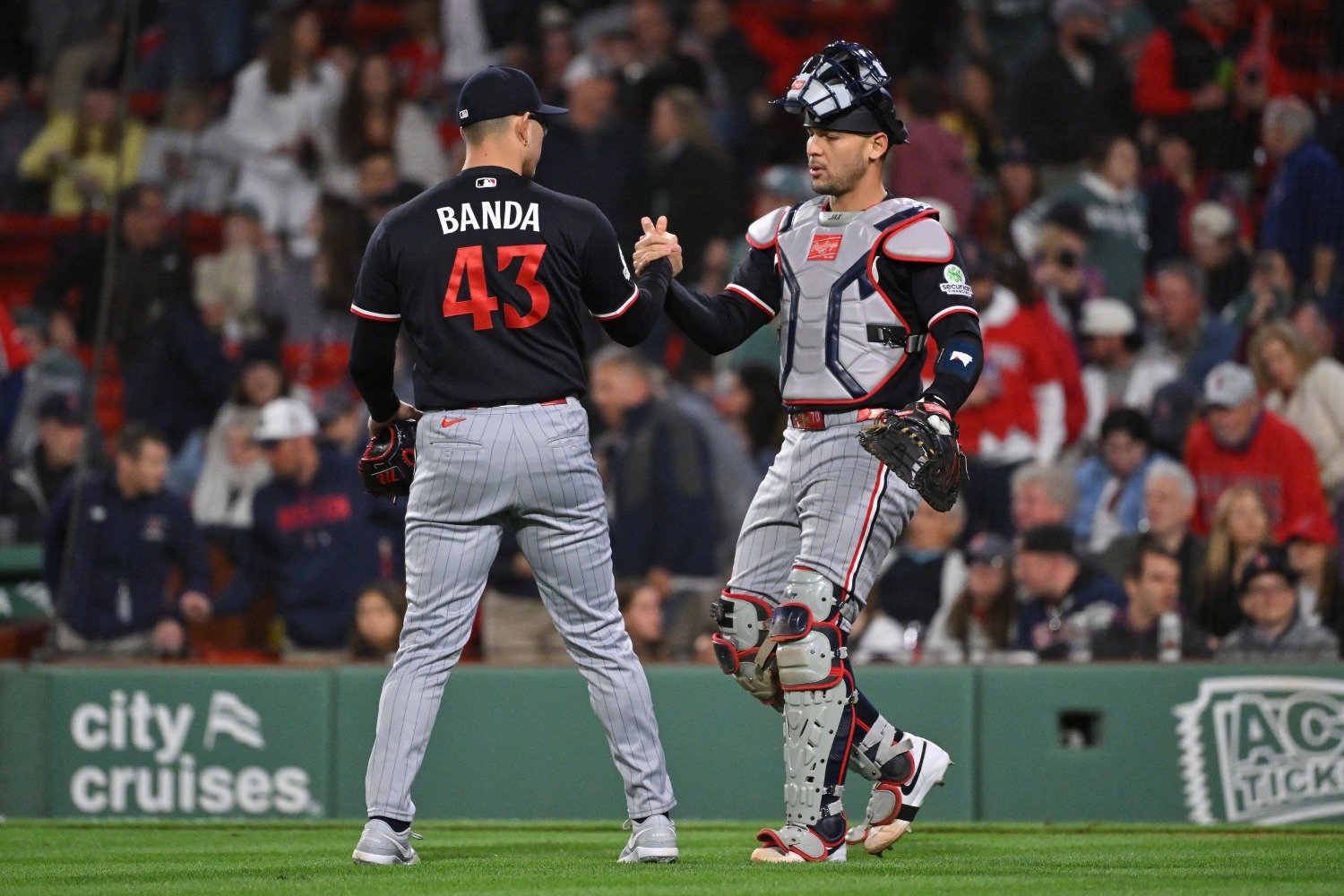
Image courtesy of © Eric Canha-Imagn Images
Twins Video
Since the beginning of the 2015 MLB regular season, the Minnesota Twins have had 23 different catchers attempt a throw to second base. Of those 23 catchers, Caleb Hamilton had the slowest average pop time, averaging 2.13 seconds over three attempts in 2022. On the flip side, Ben Rortvedt averaged the fastest pop time among Twins catchers during that stretch, averaging 1.92 seconds over eight attempts in 2021. That was until Alex Jackson made his first start behind the plate as a member of the Twins last Friday.
In the bottom of the third inning of last Friday night’s contest between the Twins and the Boston Red Sox, Andruw Monasterio attempted to steal second base on Connor Prielipp. Monasterio’s steal attempt was snuffed, however, as Jackson threw him out to end the bottom half of the inning. On that play, Jackson generated the quickest pop time of any Twins catcher in the Statcast era, getting the ball from his glove to that of second baseman Luke Keaschall in 1.87 seconds.
Jackson netting this record (if we can call it that; the timeframe for which we have hard data on this is still pretty short) shouldn’t come as a surprise to those who follow the sport. In 2025, Jackson tied for the sixth-fastest pop time of all catchers in baseball while with the Baltimore Orioles. The backstop made minimal appearances behind the plate from 2022 through 2024, due to his offensive shortcomings. However, he also tied for the fifth-fastest pop time (tied with Rortvedt, funny enough) of all major-league catchers in 2021.
Most of that speed comes from elite sheer arm strength. Jackson’s throw to second base came in at 82.6 MPH, which is the 13th-fastest throw of all catchers this season. Unsurprisingly, the veteran backstop had the 15th-fastest throw down to second base last season, coming in at 83.4 MPH. Combining Jackson’s elite arm with his plus exchange time (he tied for the 12th-fastest exchange time in 2025), Minnesota has one of the best run-game mitigating catchers in baseball. This is not a strength of Ryan Jeffers or Victor Caratini.
It's also worth paying some attention to the accuracy of the peg. Jackson's throw took Keaschall right to the sliding runner, tailing but strong and low. In the modern game, this is the ideal throw by a catcher. Teams want them to lead the tagger into the slider, allowing the fielder to get the ball onto the body of the runner as early as possible. Before replay could fix umpire errors, throws like this risked letting a runner be called safe due to a "high" tag, with more of the runner's body past the tagged part than we think of as ideal. Now, though, throwing into the space just to the first-base side of second is optimal; replay will catch whatever an ump might miss in real time.
This is a skill at which Jackson excels, too. He rates in the top quintile of the league in throwing accuracy since the start of 2025, according to Statcast. Here's a sampling of infielders catching his throws, with the one Friday in prime position.

Jackson’s addition to the 26-man roster came at the unfortunate expense of losing Jeffers (who was in the midst of a career year offensively) to the 10-day IL with a broken left hamate bone. Still, while Jackson won’t be able to make up for Jeffers’s absence in the batter’s box, he will add value behind the plate, likely being Minnesota’s best run-stopping catcher since Joe Mauer transitioned into a full-time first baseman in 2014.







Recommended Comments
Create an account or sign in to comment
You need to be a member in order to leave a comment
Create an account
Sign up for a new account in our community. It's easy!
Register a new accountSign in
Already have an account? Sign in here.
Sign In Now