


Twins Video
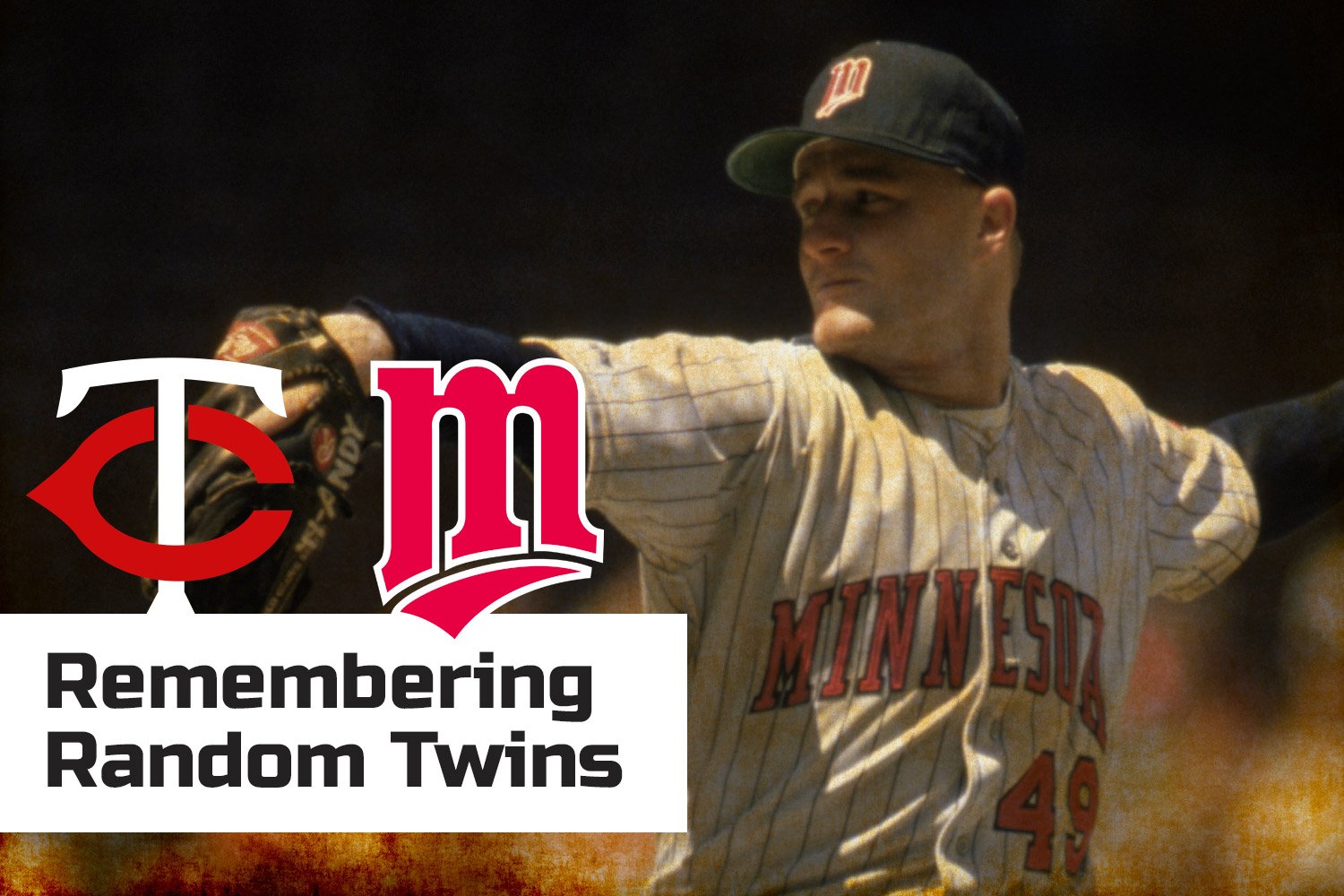
Maybe it’s just me, but when I think of the Minnesota Twins and their history, I think first of offense – batting titles, power hitters, M&M boys, and Bomba Squad. That’s not to say they have had continuous terrible pitching. Over 60-plus years, a franchise is bound to have years when pitching is above average. Any team should be able to produce numerous memorable pitchers over more than 60 years. The Twins have had Kaat, Blyleven, Viola, Radke, Santana, and others. But the Twins had the American League leader in earned run average in 1988 who gets lost in history and I don’t hear his name often. Let’s look deeper at the career of left-handed starting pitcher Allan Anderson.
Allan Anderson was born on January 7, 1964, in Lancaster, Ohio. In high school, Anderson was a flame-throwing left-handed pitcher, throwing four no-hitters, including two in back-to-back games, and getting the attention of major league scouts. The Twins drafted Anderson after high school in the 2nd round of the 1982 Major League Baseball June Amateur Draft. The future looked bright. However, that was about to change.
In 1983, his first year in professional baseball, he tore an elbow ligament while with the Class A Wisconsin Rapid Twins, which probably altered his career to a significant extent. The flame thrower would be forced to rely on control and changing speeds to be effective. He had a great year with the Class A Visalia Oaks in 1984, followed by a good year and a half with the AAA Toledo Mud Hens in 1985 and 1986, earning a call to MLB.
On June 11, 1986, Anderson made his major league debut with the Minnesota Twins against the Texas Rangers. It was excellent. He pitched an unheard-of (at least by today’s standards) 10 innings, giving up single runs in the 1st and 3rd innings before settling in and holding Texas scoreless for the rest of his outing. Unfortunately, he was matched up against the rubber-armed knuckleballer, Charlie Hough. Hough went 13 innings and gave up only two runs. The Rangers finally broke for four runs in the 16th inning off the Twins bullpen to win the game 6-2. Anderson finished his first season with ten starts in 21 games, with a 3-6 record and a 5.55 ERA.
In 1987, Anderson was a candidate to make the Twins starting rotation but suffered a back injury in spring training. After recovering from the injury, he began the season with the AAA Portland Beavers. It was an up-and-down season from there. He pitched for the Twins sparingly in May and June but was ineffective and returned to Portland. He turned his season around and had a good August, but it was too little too late as he did not return to pitch for the Twins during that regular season or postseason. He was forced to sit and watch the 1987 heroics.
1988 is when Anderson finally put it all together. After three starts and one complete game with AAA Portland, he returned to the Twins on April 28, 1998. He started that day’s game against Baltimore and got the win, pitching 6.1 innings and allowing two runs. From there, he took a regular spot in the rotation and started 30 games. He had three complete games. He had a personal six-game winning streak from July 24 to August 22. He was good and consistent all season. His ERA reached as high as 4.50 after a June 5 start. From there, it decreased consistently in almost every game. He capped off the season with a three-hit shutout against Oakland on September 27, dropping his ERA to 2.45, the best in the American League. He finished the season with a 16-9 record. He pitched 202.1 innings but had only 83 strikeouts – a likely byproduct of the earlier elbow injury and his transition to soft-tossing control pitcher. Anderson had a stellar season with 16 wins and a 2.45 ERA. However, he was overshadowed by his teammate, Frank Viola, who won the 1988 AL Cy Young Award. Anderson received no Cy Young support. Voters nationally were probably too enamored with Viola to appreciate Anderson’s career year.
1989 was a good follow-up season. He was selected as the opening-day starter, winning 17 games, pitched 196.2 innings, and had a 3.80 ERA. Again, his strikeouts were limited – only 69. Sometime in 1989, he tore a labrum in his shoulder, and that injury showed its effects in the following seasons. In 1990, he took the ball for a fair number of innings (188.2), but his other numbers worsened. His record dipped to 7-18, and his ERA ballooned to 4.53. 1991 was another struggle with a 5-11 record and 4.96 ERA. He pitched almost all of 1991 with the Twins – there was a short demotion to AAA – but he was left off the postseason roster again. So, despite his career from 1986 to 1991, all with the Twins, he was not part of playoffs or World Series in either season.
After the 1991 season, Anderson became a free agent and signed with the New York Yankees, but he never returned to MLB. He later had minor league stints in the Texas and Cleveland organizations before retiring after the 1993 season. His overall career line was 49 wins, 54 losses, 818.2 innings pitched, 4.11 ERA, and an ERA+ of 102. His outstanding 1988 season saw him achieve an ERA+ of 166!
After retiring from baseball in 1994, Anderson served as a pitching coach in the Texas Rangers minor league system. He is now a firefighter, real estate agent, and auctioneer.
I will never forget Anderson’s 1986 MLB debut, as I recall listening to the game on WCCO. I could not sleep listening to that marathon. Wow, a 10-inning debut! Thankfully, there was no school in June, so I’m sure I slept in and talked about it the next day while playing wiffle ball with my friends.
Allan Anderson didn’t have the longest or most distinguished career in the Minnesota Twins history, but he is memorable to me for his 1986 MLB debut and the 1988 ERA title.
Do you approve of Twins ownership?

Are you interested in Twins history? Then check out the Minnesota Twins Players Project, a community-driven project to discover and collect great information on every player to wear a Twins uniform!
View The Players ProjectFollow Twins Daily For Minnesota Twins News & Analysis



- nicksaviking, Shaitan, Karbo and 1 other
-
 4
4


Recommended Comments
Create an account or sign in to comment
You need to be a member in order to leave a comment
Create an account
Sign up for a new account in our community. It's easy!
Register a new accountSign in
Already have an account? Sign in here.
Sign In Now