



Parker Hageman
-
Posts
4,152 -
Joined
-
Last visited
-
Days Won
6
Content Type
Profiles
News
Minnesota Twins Videos
2026 Minnesota Twins Top Prospects Ranking
2022 Minnesota Twins Draft Picks
Minnesota Twins Free Agent & Trade Rumors, Notes, & Tidbits
Guides & Resources
2023 Minnesota Twins Draft Picks
The Minnesota Twins Players Project
2024 Minnesota Twins Draft Picks
2025 Minnesota Twins Draft Pick Tracker
2026 Minnesota Twins Draft Tracker: Picks & Bonuses
Forums
Blogs
Events
Store
Downloads
Gallery
Everything posted by Parker Hageman
-
 Here's what I will say about Berrios' release points: I don't believe the change has anything to do with the grip or any manipulation at the actual point of release. Mechanically speaking, most of the issues pitchers have out front stem from issues in the back. The arm mirrors the hips. In Berrios' case, since the end of July, his hip rotational action has increased from driving toward home plate to driving toward third base line then home: https://twitter.com/ParkerHageman/status/1160637308347080706 This directional movement is going to pull the arm further away from the rubber toward the third base line. Likewise, if his initial direction is first going toward third base, he's not going to get that same extension out front. Clean up the hips, you'll clean up the arm.
 -
how bout now?
-
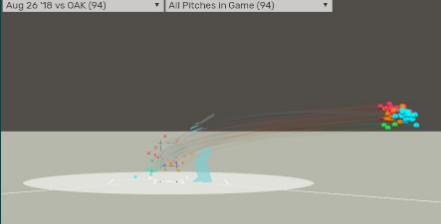
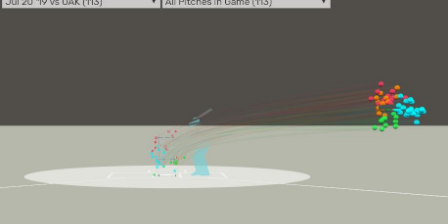
that's actually a good indicator of what is happening with berrios and it may be what is tipping off hitters. in the baseball savant pitch visualization app, you'll see that berrios' curveball has been coming out of his hand at a lower point than his fastball (particularly the 4s). https://twitter.com/ParkerHageman/status/1162905056326356998 you'll see the tight cluster in 2018 and the loose one in 2019 (light blue cluster is the curveball): the astros are a team that talked about how they use this type of data to create windows for pitches. if they know a pitcher's offering with come from a certain area, they can eliminate it right away. good overall summary of berrios' issues.
-
logan paul reference. this is the audience who knows and loves logan paul.
- 5 replies
-
- 1
-

-
- rally squirrel
- rodents
- (and 3 more)
-
In late June, Miguel Sano’s 2019 season felt like it was on the brink of collapse. From his delayed start in May through the end of June, the Minnesota Twins’ third baseman led baseball with a grotesque 42 percent strikeout rate. He had been strikeout prone but now in nearly half of his trips to the plate, he headed back to the bench without putting a ball in play, often looking a fool in the process. While the game was trending toward more whiffs, the average hitter still managed to strike out in only 20 percent of his plate appearances. Pitchers had him eating out of their hands. The Twins staff finally intervened, retooled, and rewired his swing. The results have been no short of outstanding. Since the end of June, Sano’s 627 slugging percentage has been one of the best in the game. His average exit velocity of 95.6 miles per hour has been the third highest among qualified hitters and he has hit 60 percent of his balls in play over 95 miles per hour (third best in MLB). While all the rocket shots and batted ball data is intriguing, perhaps most importantly, Sano no longer leads all hitters in strikeouts. So what changed? Here’s how Miguel Sano became hotter than hard seltzer this summer.Sano’s low point involved a frustrating pitch selection and inexplicable inability to make contact with fastballs. He would swing through low 90s center-cut fastballs or flail at a breaking ball that bounced in the left-handed batter’s box. To repair, the Twins and Sano focused on his hand path, starting with eliminating the extra movement before getting to his launch point. As innocuous as it may seem, with the added bat tip forward Sano would put himself in the position of having to cheat to catch up to fastballs while getting burnt on breaking and offspeed pitches. Refraining from tipping the barrel toward the pitcher (as seen on the left) provided him with the ability to read pitches better. Since reducing the slack, Sano is swinging less, chasing pitches out of the zone less and swinging through fewer pitches. Download attachment: FSFrameGIFImage (10).GIF “The goal is to put his hands in a position to handle balls out over the plate to get to that ball up a little bit better and to be able to stay through the ball so that he can get on top of the ball consistently or to be able to drive through it more consistently,” Twins’ hitting coach James Rowson told The Athletic’s Dan Hayes. That ball up, as Rowson noted, was Sano’s kryptonite. Pitchers who threw even the softest of gas could tie him in knots when elevating in the upper third. Before the correction, Sano swung through 66% of fastballs up in the zone and had just one hit. After Rowson and Rudy Hernandez performed their magic — working on drills that reduced hand movement from his start to his launch point — Sano improved his swing-and-miss rate on fastballs up from 66% to 28% and has three home runs on fastballs in that area of the zone. Before the adjustment, Sano’s swing was powerful but one-dimensional. He mashed fastballs in one spot in the zone (outer-third, waist high) yet, because of his delayed swing process, his barrel would struggle to find anything middle-in. As long as opponents stayed away from that zone with their fastball, Sano’s power was muted. Again, speeding up his timing mechanism paid dividends. Over those first 30 games, Sano hit just .120/.267/.280 on fastballs middle-in but has since hit .395/.469/.907 with 7 home runs. Download attachment: Sano Average.png And that has been the key to Sano’s turnaround: hammering the heat. Former player and manager Matt Williams used to say that the best way to hit a curveball was to not miss the fastball. In Sano’s case he would miss the fastball and would be reduced to rubble on various breaking balls. Even with the new approach, Sano has not handled non-fastballs well when swinging. However, he has greatly reduced the number of hacks at them. Download attachment: Sano Approach.PNG Sano also points to another factor in his offensive uptick. He told Fox Sports North that Rowson had recommended adjusting his grip on the bat, aligning his middle knuckles rather than having his top hand bottom (proximal) knuckles aligning with his bottom hand bottom (proximal) knuckles. This is a similar effect to how Axe Bat-type handles naturally align knuckles, a feature that some hitters have raved about, which the Cubs’ Kris Bryant credited with turning his 2019 season around. It stands to reason that once he was able to decipher good from bad pitches, he would be able to drive them better with a new grip and more efficient hand path. His load adjustment provided him with the ability to separate pitch types earlier while his grip allows him to drive through the ball. Needless to say, Sano’s in-season turnaround is a testament to the Twins’ coaching process as well as his ability to implement changes on the fly. Click here to view the article
- 28 replies
-
- 5
-
-
- miguel sano
- scouting
- (and 1 more)
-
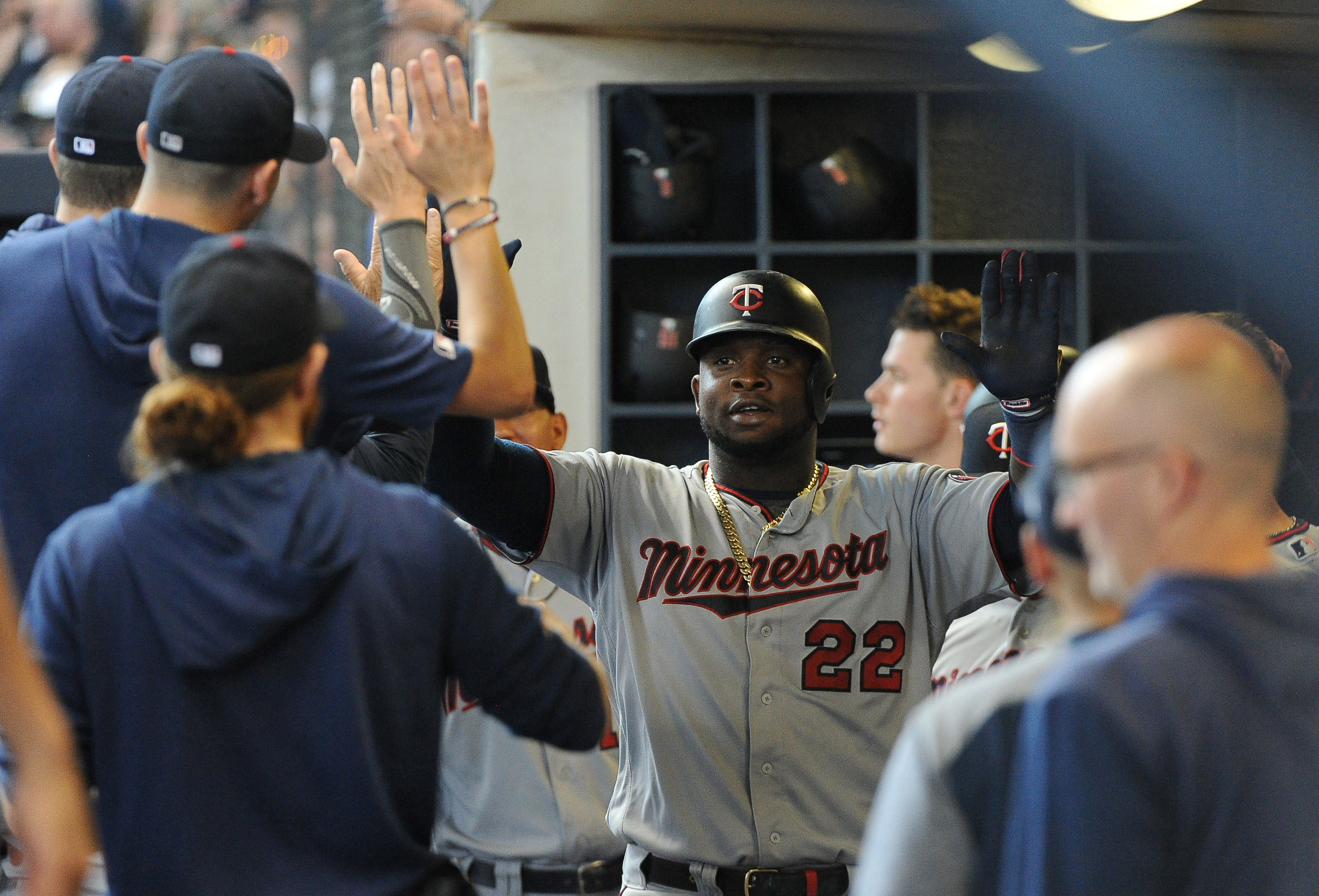 Sano’s low point involved a frustrating pitch selection and inexplicable inability to make contact with fastballs. He would swing through low 90s center-cut fastballs or flail at a breaking ball that bounced in the left-handed batter’s box. To repair, the Twins and Sano focused on his hand path, starting with eliminating the extra movement before getting to his launch point. As innocuous as it may seem, with the added bat tip forward Sano would put himself in the position of having to cheat to catch up to fastballs while getting burnt on breaking and offspeed pitches. Refraining from tipping the barrel toward the pitcher (as seen on the left) provided him with the ability to read pitches better. Since reducing the slack, Sano is swinging less, chasing pitches out of the zone less and swinging through fewer pitches. “The goal is to put his hands in a position to handle balls out over the plate to get to that ball up a little bit better and to be able to stay through the ball so that he can get on top of the ball consistently or to be able to drive through it more consistently,” Twins’ hitting coach James Rowson told The Athletic’s Dan Hayes. That ball up, as Rowson noted, was Sano’s kryptonite. Pitchers who threw even the softest of gas could tie him in knots when elevating in the upper third. Before the correction, Sano swung through 66% of fastballs up in the zone and had just one hit. After Rowson and Rudy Hernandez performed their magic — working on drills that reduced hand movement from his start to his launch point — Sano improved his swing-and-miss rate on fastballs up from 66% to 28% and has three home runs on fastballs in that area of the zone. Before the adjustment, Sano’s swing was powerful but one-dimensional. He mashed fastballs in one spot in the zone (outer-third, waist high) yet, because of his delayed swing process, his barrel would struggle to find anything middle-in. As long as opponents stayed away from that zone with their fastball, Sano’s power was muted. Again, speeding up his timing mechanism paid dividends. Over those first 30 games, Sano hit just .120/.267/.280 on fastballs middle-in but has since hit .395/.469/.907 with 7 home runs. And that has been the key to Sano’s turnaround: hammering the heat. Former player and manager Matt Williams used to say that the best way to hit a curveball was to not miss the fastball. In Sano’s case he would miss the fastball and would be reduced to rubble on various breaking balls. Even with the new approach, Sano has not handled non-fastballs well when swinging. However, he has greatly reduced the number of hacks at them. Sano also points to another factor in his offensive uptick. He told Fox Sports North that Rowson had recommended adjusting his grip on the bat, aligning his middle knuckles rather than having his top hand bottom (proximal) knuckles aligning with his bottom hand bottom (proximal) knuckles. This is a similar effect to how Axe Bat-type handles naturally align knuckles, a feature that some hitters have raved about, which the Cubs’ Kris Bryant credited with turning his 2019 season around. It stands to reason that once he was able to decipher good from bad pitches, he would be able to drive them better with a new grip and more efficient hand path. His load adjustment provided him with the ability to separate pitch types earlier while his grip allows him to drive through the ball. Needless to say, Sano’s in-season turnaround is a testament to the Twins’ coaching process as well as his ability to implement changes on the fly.
 -
In the movie Fastball, Wade Boggs said that he faced Juan Berenguer on a day when he hit 101.5 on a radar gun.
- 22 replies
-
- 4
-
-
- brusdar graterol
- jorge alcala
- (and 3 more)
-
Front Page: Is It Time To Platoon C.J. Cron?
Parker Hageman replied to John Bonnes's topic in Twins Daily Front Page News
I'm not entirely certain Cron's increase in whiffs in August has anything to do with the thumb injury -- after all, when he made contact this month he's had the highest exit velocity of the season (95). It could play a role, specifically with timing, but another factor is that Cron was pressed into some tough assignments this month when Cruz went down. He had to face some guys with very good fastballs in Clevinger, Bieber and Civale that he might not have had Cruz been healthy (not to mention, starts against Keller and Foltynewicz). That being said, Sano faced a lot of the same guys and maintained a low swing/miss rate at their fastballs. Still based on his exit velo, I'm in favor of letting him find it but it does merit consideration that if Cron can't handle the tougher right-handers, there's got to be someone available. -
Which finger the pitch comes off is a product of the hand supination -- if the hand is turned, you can't really have contact with the middle finger at the last point. if your hand is behind the ball, you can have both. I will say that in terms of pitch design, one of the missing links is pressure points from the fingers. You can have the edgertronic slo-mo cams capture some of the exterior clips but it would be really beneficial to measure the pressure from the ball. That's probably the next steps in pitch designing -- using a ball that can capture different pressure points.
- 3 replies
-
- 1
-
-
- jake odorizzi
- rapsodo
- (and 3 more)
-
Several weeks ago in this space we discussed how Rapsodo technology can help pitchers and coaches establish a baseline with their breaking balls. Now it is time to look at what data says about the heater.This past March, the Chanhassen High School baseball program visited Starters Sports Training in Shakopee to put all of our arms under the Rapsodo microscope. One of the first things we got the data back from Starters was convert all fastballs into Bauer Units. For those unfamiliar, Driveline Baseball champions Bauer Units as a good measuring stick to tell if a player’s fastball is better suited for a 4-seam or 2-seam based on the spin rate divided by the velocity. If the fastball had a high Bauer Unit -- 27 BUs or higher -- a pitcher’s fastball would play better with a 4-seam grip. A lower Bauer Unit -- says 21 or lower -- and it would be better to use a 2-seam fastball. This would give us a fastball roadmap for each pitcher. Why is knowing fastball spin rate important? After all, for generations players and coaches used their eyes and intuition to figure out how a fastball moves. It’s heavy. It has late-life. It has rise. It has sink. Why should we strive to assign a number to every aspect of the game? As a real world example (and to loosely tie this into a Twins-related subject for Twins-related website) let’s consider Jake Odorizzi and Trevor May. In terms of velocity, Odorizzi (whose 4-seamer comes in at 92.8 mph on average) has a fastball that is 2 clicks below May's (94.9). Factoring in spin rate, May has approximately 100 more rpms on his fastball (2,338 rpm) than Odorizzi (2,239 rpm). Based on those two data points alone one might think May has a superior fastball. However, both share fastball Bauer Units of 24. While that amounts to a decisively average Bauer Unit among all MLB pitchers according to the Baseball Savant database, it is partly the reason why Odorizzi can be so effective at the top of the zone with a little less firepower than May. On the surface, Odorizzi might be considered a softer throwing arm in the modern era — seeing that his fastball “only” averages 93 — but it is with the additional metadata that you can concoct a game plan for him. Prior to the prolIferation of TrackMan, Rapsodo, et al, pitchers like Odorizzi may have been told to work on keeping his fastball down in the zone — which is exactly what happened to Odor: In fact, both Milwaukee and Kansas City informed Odorizziduring his player development days that if he didn’t adjust and hit the bottom of the zone, he wouldn’t make it in the big leagues. That changed when he arrived in the forward-thinking Tampa Bay organization and he would embrace the high ride heater. This year, 57 of his 70 strikeouts on fastballs have been located in the upper third of the zone or higher. It makes you wonder how many pitchers were jettisoned because they were higher-spin pitchers instructed to throw the ball down in the zone (or else). How can this information be applied to the amateur ranks? With regard to the Chanhassen program, we found that the bulk of the fastballs fell within the average Bauer Units range — leaning toward neither end of the spectrum. As a practice, those with average-ish Bauer Units who had three-quarter deliveries were asked to try 2-seam or cut fastballs and those with higher Bauer Units and more over-the-top deliveries worked on getting behind their 4-seamers in efforts to get better spin direction and carry (like Odorizzi). The high spin Bauer Unit rate guys were interesting to observe. In subsequent bullpen sessions or warmups, some confessed that they were taught to shoot for the knees, a counterproductive concept based on their stuff. It seemed clear that years of being told to hit the bottom of the zone was deeply ingrained whereas intentionally elevating felt foreign. Meanwhile, in game action, you could watch the same pitchers throw fastballs above the belt and hitters swing underneath as they struggled to reconcile the fact that the pitch’s trajectory was not falling the way their brains were suggesting it would. With high spin fastballs being all the rage and 2-seamers the cargo shorts of the pitching world, we needed to consider what to do with two intriguing outliers with super low Bauer Units. The first, Cade Plath (2019), was a genuine athlete. Here was a big, strong young man who is headed to play Division 1 football and had a mid-80s fastball. However, the combination of a low three-quarter slot and 4-seam grip seemed to result in a ton of glove-side carry. He also had a Bauer Unit of 15, a telltale sign that a 4-seam fastball might not be conducive to success for him. Following the Rapsodo session, Cade tried out a fresh new 2-seam grip, trying to capture that laminar flowgoodness. In his first live AB session, teammates who stepped into the box against him were impressed by what they perceived as late movement darting to his arm side. We lacked the funds for a high-speed slow-mo camera but even from the grainy iPhone camera you can still see the difference in movement between the 4-seam grip (from March on the left) and the 2-seam grip (from June on the right): Download attachment: FSFrameGIFImage (8).GIF What was interesting is that those two pitches above — despite having very different movement — spit out virtually the same movement data from the Rapsodo. Download attachment: PLATH FB.PNG This was confounding. We figured he had made the necessary grip change and the feedback from hitters and catchers suggested this pitch was doing something different. Why wasn’t the data saying so? Turns out, Driveline Baseball already studied this very phenomenon. According to their research Rapsodo “detects the ball’s spin rate, spin direction, and velocity and recalculates trajectory based on a physics model – hence why it thinks both pitches shown in the video have nearly identical movement when in reality they are quite different.” In short, there is an issue when using Rapsodo data to try to incorporate a . Armed with his 2-seam action, Cade’s in-season results were impressive. His walk rate dropped significantly from the previous season and he increased his swing-and-miss rate. A lot of his success came because of his steadfast conditioning, overall athleticism, and the fact he threw a “heavy ball” from a three-quarter slot but swapping out fastball grips played a role in his being able to locate that pitch more effectively. The other super low Bauer Units pitcher was junior Kody Dalen (2020). During the initial March session, Kody told us that he threw a 2-seamer, even showing us his grip, yet the Rapsodo data didn’t reflect 2-seam action. If anything, it had the exact opposite movement -- it had cut and a healthy amount of vertical drop. The low spin rate made it difficult to hit — another example of the proverbial “heavy fastball”. In season, Kody’s fastballs averaged approximately 80 mph, but touched 84. His 63 percent ground ball rate was second on the staff only to Cade (65 percent ground ball rate) while allowing just seven hits in 18.2 innings. After one of his outings, an umpire, supposedly impartial referees maintaining law and order, approached a member of our coaching staff and said how impressed he was at his movement. The cases of Cade and Kody raised more questions: Why, if two pitchers who have the same low spin rate, similar arm slots, and used the same 2-seam grip, are they producing two very different movements? It was only later that we came to find out the difference was generated by how the ball came out of their hand -- something that Rapsodo can’t pick up (or the human eye for that matter). In the clip below, you will see a side-by-side of Kody (left) vs Cade’s (right) 2-seam fastball. Download attachment: FSFrameGIFImage (7).GIF For Kody, his 2-seam is punctuated by glove-side run and a late sharp downward break. Cade’s more conventional laminar 2-seamer fights against the glove-side run and moves back toward right-handed batters late in the path. Now watch how the ball comes out of their hands: Download attachment: FSFrameGIFImage (9).GIF If thrown the conventional way, the two black dots should be spinning outward. Cade, on the right, has his fingers stay behind the baseball at release, imparting both the tilt and spin angle necessarily to give the pitch the standard 2-seam run. Meanwhile Kody supinates his hand at release, getting his fingers to the side of the baseball producing the cut action. This action likely costs him some velocity but the added movement appears to make up for it threefold. You often hear of pitchers having natural cut on their pitches and this is one of those in action. Kody’s movement is just that. To revisit the initial question -- why is knowing a fastball’s spin rate important -- it is because that knowledge helps take the guesswork out. If you know that a pitcher has a high-speed, high-carry fastball, you can work with them to develop a more vertical breaking ball. Now you have a solid plan of attack: high fastballs up at the top of the zone and a 12-6 curveball to drop out of that same tunnel. If you have a repertoire like Kody who has a bunch of pitches that run in to a left-handed batter, it was suggested by one of Starters’ instructors to tinker with a slider to give him a variety of pitches that run in (the Dalin Betances model). You absolutely could accomplish the same thing without the use of technology but, to paraphrase the reigning College World Series champions’ director of player development, if you don’t use it, you are behind. Click here to view the article
-
 This past March, the Chanhassen High School baseball program visited Starters Sports Training in Shakopee to put all of our arms under the Rapsodo microscope. One of the first things we got the data back from Starters was convert all fastballs into Bauer Units. For those unfamiliar, Driveline Baseball champions Bauer Units as a good measuring stick to tell if a player’s fastball is better suited for a 4-seam or 2-seam based on the spin rate divided by the velocity. If the fastball had a high Bauer Unit -- 27 BUs or higher -- a pitcher’s fastball would play better with a 4-seam grip. A lower Bauer Unit -- says 21 or lower -- and it would be better to use a 2-seam fastball. This would give us a fastball roadmap for each pitcher. Why is knowing fastball spin rate important? After all, for generations players and coaches used their eyes and intuition to figure out how a fastball moves. It’s heavy. It has late-life. It has rise. It has sink. Why should we strive to assign a number to every aspect of the game? As a real world example (and to loosely tie this into a Twins-related subject for Twins-related website) let’s consider Jake Odorizzi and Trevor May. In terms of velocity, Odorizzi (whose 4-seamer comes in at 92.8 mph on average) has a fastball that is 2 clicks below May's (94.9). Factoring in spin rate, May has approximately 100 more rpms on his fastball (2,338 rpm) than Odorizzi (2,239 rpm). Based on those two data points alone one might think May has a superior fastball. However, both share fastball Bauer Units of 24. While that amounts to a decisively average Bauer Unit among all MLB pitchers according to the Baseball Savant database, it is partly the reason why Odorizzi can be so effective at the top of the zone with a little less firepower than May. On the surface, Odorizzi might be considered a softer throwing arm in the modern era — seeing that his fastball “only” averages 93 — but it is with the additional metadata that you can concoct a game plan for him. Prior to the prolIferation of TrackMan, Rapsodo, et al, pitchers like Odorizzi may have been told to work on keeping his fastball down in the zone — which is exactly what happened to Odor: In fact, both Milwaukee and Kansas City informed Odorizzi during his player development days that if he didn’t adjust and hit the bottom of the zone, he wouldn’t make it in the big leagues. That changed when he arrived in the forward-thinking Tampa Bay organization and he would embrace the high ride heater. This year, 57 of his 70 strikeouts on fastballs have been located in the upper third of the zone or higher. It makes you wonder how many pitchers were jettisoned because they were higher-spin pitchers instructed to throw the ball down in the zone (or else). How can this information be applied to the amateur ranks? With regard to the Chanhassen program, we found that the bulk of the fastballs fell within the average Bauer Units range — leaning toward neither end of the spectrum. As a practice, those with average-ish Bauer Units who had three-quarter deliveries were asked to try 2-seam or cut fastballs and those with higher Bauer Units and more over-the-top deliveries worked on getting behind their 4-seamers in efforts to get better spin direction and carry (like Odorizzi). The high spin Bauer Unit rate guys were interesting to observe. In subsequent bullpen sessions or warmups, some confessed that they were taught to shoot for the knees, a counterproductive concept based on their stuff. It seemed clear that years of being told to hit the bottom of the zone was deeply ingrained whereas intentionally elevating felt foreign. Meanwhile, in game action, you could watch the same pitchers throw fastballs above the belt and hitters swing underneath as they struggled to reconcile the fact that the pitch’s trajectory was not falling the way their brains were suggesting it would. With high spin fastballs being all the rage and 2-seamers the cargo shorts of the pitching world, we needed to consider what to do with two intriguing outliers with super low Bauer Units. The first, Cade Plath (2019), was a genuine athlete. Here was a big, strong young man who is headed to play Division 1 football and had a mid-80s fastball. However, the combination of a low three-quarter slot and 4-seam grip seemed to result in a ton of glove-side carry. He also had a Bauer Unit of 15, a telltale sign that a 4-seam fastball might not be conducive to success for him. Following the Rapsodo session, Cade tried out a fresh new 2-seam grip, trying to capture that laminar flow goodness. In his first live AB session, teammates who stepped into the box against him were impressed by what they perceived as late movement darting to his arm side. We lacked the funds for a high-speed slow-mo camera but even from the grainy iPhone camera you can still see the difference in movement between the 4-seam grip (from March on the left) and the 2-seam grip (from June on the right): What was interesting is that those two pitches above — despite having very different movement — spit out virtually the same movement data from the Rapsodo. This was confounding. We figured he had made the necessary grip change and the feedback from hitters and catchers suggested this pitch was doing something different. Why wasn’t the data saying so? Turns out, Driveline Baseball already studied this very phenomenon. According to their research Rapsodo “detects the ball’s spin rate, spin direction, and velocity and recalculates trajectory based on a physics model – hence why it thinks both pitches shown in the video have nearly identical movement when in reality they are quite different.” In short, there is an issue when using Rapsodo data to try to incorporate a .Armed with his 2-seam action, Cade’s in-season results were impressive. His walk rate dropped significantly from the previous season and he increased his swing-and-miss rate. A lot of his success came because of his steadfast conditioning, overall athleticism, and the fact he threw a “heavy ball” from a three-quarter slot but swapping out fastball grips played a role in his being able to locate that pitch more effectively. The other super low Bauer Units pitcher was junior Kody Dalen (2020). During the initial March session, Kody told us that he threw a 2-seamer, even showing us his grip, yet the Rapsodo data didn’t reflect 2-seam action. If anything, it had the exact opposite movement -- it had cut and a healthy amount of vertical drop. The low spin rate made it difficult to hit — another example of the proverbial “heavy fastball”. In season, Kody’s fastballs averaged approximately 80 mph, but touched 84. His 63 percent ground ball rate was second on the staff only to Cade (65 percent ground ball rate) while allowing just seven hits in 18.2 innings. After one of his outings, an umpire, supposedly impartial referees maintaining law and order, approached a member of our coaching staff and said how impressed he was at his movement. The cases of Cade and Kody raised more questions: Why, if two pitchers who have the same low spin rate, similar arm slots, and used the same 2-seam grip, are they producing two very different movements? It was only later that we came to find out the difference was generated by how the ball came out of their hand -- something that Rapsodo can’t pick up (or the human eye for that matter). In the clip below, you will see a side-by-side of Kody (left) vs Cade’s (right) 2-seam fastball. For Kody, his 2-seam is punctuated by glove-side run and a late sharp downward break. Cade’s more conventional laminar 2-seamer fights against the glove-side run and moves back toward right-handed batters late in the path. Now watch how the ball comes out of their hands: If thrown the conventional way, the two black dots should be spinning outward. Cade, on the right, has his fingers stay behind the baseball at release, imparting both the tilt and spin angle necessarily to give the pitch the standard 2-seam run. Meanwhile Kody supinates his hand at release, getting his fingers to the side of the baseball producing the cut action. This action likely costs him some velocity but the added movement appears to make up for it threefold. You often hear of pitchers having natural cut on their pitches and this is one of those in action. Kody’s movement is just that. To revisit the initial question -- why is knowing a fastball’s spin rate important -- it is because that knowledge helps take the guesswork out. If you know that a pitcher has a high-speed, high-carry fastball, you can work with them to develop a more vertical breaking ball. Now you have a solid plan of attack: high fastballs up at the top of the zone and a 12-6 curveball to drop out of that same tunnel. If you have a repertoire like Kody who has a bunch of pitches that run in to a left-handed batter, it was suggested by one of Starters’ instructors to tinker with a slider to give him a variety of pitches that run in (the Dalin Betances model). You absolutely could accomplish the same thing without the use of technology but, to paraphrase the reigning College World Series champions’ director of player development, if you don’t use it, you are behind.
 -
Max Kepler says his 2018 season was sidetracked when he got caught up in thinking about launch angle. “I’ll be honest,” the Twins outfielder confided this spring, “I bought into it a little bit -- the launch stuff -- and I wanted to see if it would work for me. I wouldn’t say that it didn’t [work] but it certainly opened my eyes to my strengths and what works for me.” The confession was strange considering Kepler had been an advocate of hitting down through the ball. As more hitters sang from the gospel of getting the ball in the air, heading into the 2017 season he went so far as saying he found the idea of elevating the ball to be “completely bogus” as he based his philosophy to advice from Barry Bonds, who told him to focus on hitting “hard ground balls” and “hit the ball through the pitcher’s forehead”. The growing trend was too strong for him to resist.By his own admission, Kepler’s ultimate goal was never to hit ground balls. He wanted a level swing. One, he said, that imparted backspin on the ball to help it carry. While batted balls can certainly travel with different variations of spin (back, top, side) more recent research has found that concepts like chopping or cutting a ball to create that spin is a fool’s errand. In fact, physics show that more spin can even suppress the distance, regardless of spin direction. The end goal, as Twins hitting coach James Rowson so eloquently put it in his instructional video, should be to hit the ball square. In 2018 Kepler would post the highest launch angle average of his career (15.2 degrees) but also learned the lesson that if you hit too many balls into the vast wasteland of the middle of the ballpark, many of those can be tracked down. Target Field was especially unforgiving for him when he wasn’t pulling the ball. “Last year I tried to work on my swing mechanically, and that’s the result I got, popping up a lot of balls,” Kepler said. “One of the lowest batting averages on balls in play, someone brought that up.” He hit .203 on fly balls well below the league’s .283 average on fly balls, so you can see how that can grind. You find the money part of the barrel only to watch another well-struck ball land in a welcoming center fielder’s glove. Kepler acknowledged it was frustrating but resigned himself to concentrate on the process, not the results. The thing the Minnesota Twins evaluators enjoyed about Kepler’s 2018 season was his ability to make consistent solid contact. He finished the year just behind Joe Mauer and Miguel Sano in terms of average exit velocity. They figured it wouldn’t take much to tweak that into improved production. The Twins worked with him on his bat path into the zone (trying not to be as steep into the swing zone), his posture including straightening up in his stance, and had him close his front side up a bit. Download attachment: Kepler Stance Difference.png All the moves have aided in his increased power production but one element has been more of a catalyst for the home run totals. Removing the wider front leg starting point helps keep from cutting himself off and frees him up to pull the ball more. Watch his front leg travel inward a longer distance in 2018: Download attachment: FSFrameGIFImage (6).GIF With momentum carrying toward home plate, this limited his ability to turn and open up on a pitch effectively. This is why he hit more of his hard hit balls to center instead of pulling them. You might also notice is occasional toe tap he implements in 2019 as well. With the shortened stance, this helps him stay back instead of aggressively attacking the pitch and pulling it foul. Even with a vow of returning to his previous methods and avoid getting caught in a launch angle-centric trap, Kepler entered 2019 hitting the ball in a very similar manner that he did the year before -- in the air. The difference was that rather than sending the balls with premium contact into the big part of the field, with adjusting his set-up, Kepler started to pull the ball: Download attachment: Max Kepler 95 Spray Chart.png After pulling all balls in play 48% of the time last year, he’s yanking 64% of balls in play this season. That shift in approach has led to more power and the added home runs has inflated in that average on fly balls to .342. Now, after hitting a career-best 28th home run of the season, Kepler has increased his home run percentage to 6.4 percent -- one of the top 15 home run rates in baseball. It must be far more satisfying watching those balls disappear over the fence instead of into an outfielder's glove. Click here to view the article
- 10 replies
-
- 9
-
-
- max kepler
- james rowson
- (and 2 more)
-
 By his own admission, Kepler’s ultimate goal was never to hit ground balls. He wanted a level swing. One, he said, that imparted backspin on the ball to help it carry. While batted balls can certainly travel with different variations of spin (back, top, side) more recent research has found that concepts like chopping or cutting a ball to create that spin is a fool’s errand. In fact, physics show that more spin can even suppress the distance, regardless of spin direction. The end goal, as Twins hitting coach James Rowson so eloquently put it in his instructional video, should be to hit the ball square. In 2018 Kepler would post the highest launch angle average of his career (15.2 degrees) but also learned the lesson that if you hit too many balls into the vast wasteland of the middle of the ballpark, many of those can be tracked down. Target Field was especially unforgiving for him when he wasn’t pulling the ball. “Last year I tried to work on my swing mechanically, and that’s the result I got, popping up a lot of balls,” Kepler said. “One of the lowest batting averages on balls in play, someone brought that up.” He hit .203 on fly balls well below the league’s .283 average on fly balls, so you can see how that can grind. You find the money part of the barrel only to watch another well-struck ball land in a welcoming center fielder’s glove. Kepler acknowledged it was frustrating but resigned himself to concentrate on the process, not the results. The thing the Minnesota Twins evaluators enjoyed about Kepler’s 2018 season was his ability to make consistent solid contact. He finished the year just behind Joe Mauer and Miguel Sano in terms of average exit velocity. They figured it wouldn’t take much to tweak that into improved production. The Twins worked with him on his bat path into the zone (trying not to be as steep into the swing zone), his posture including straightening up in his stance, and had him close his front side up a bit. All the moves have aided in his increased power production but one element has been more of a catalyst for the home run totals. Removing the wider front leg starting point helps keep from cutting himself off and frees him up to pull the ball more. Watch his front leg travel inward a longer distance in 2018: With momentum carrying toward home plate, this limited his ability to turn and open up on a pitch effectively. This is why he hit more of his hard hit balls to center instead of pulling them. You might also notice is occasional toe tap he implements in 2019 as well. With the shortened stance, this helps him stay back instead of aggressively attacking the pitch and pulling it foul. Even with a vow of returning to his previous methods and avoid getting caught in a launch angle-centric trap, Kepler entered 2019 hitting the ball in a very similar manner that he did the year before -- in the air. The difference was that rather than sending the balls with premium contact into the big part of the field, with adjusting his set-up, Kepler started to pull the ball: After pulling all balls in play 48% of the time last year, he’s yanking 64% of balls in play this season. That shift in approach has led to more power and the added home runs has inflated in that average on fly balls to .342. Now, after hitting a career-best 28th home run of the season, Kepler has increased his home run percentage to 6.4 percent -- one of the top 15 home run rates in baseball. It must be far more satisfying watching those balls disappear over the fence instead of into an outfielder's glove.
 -
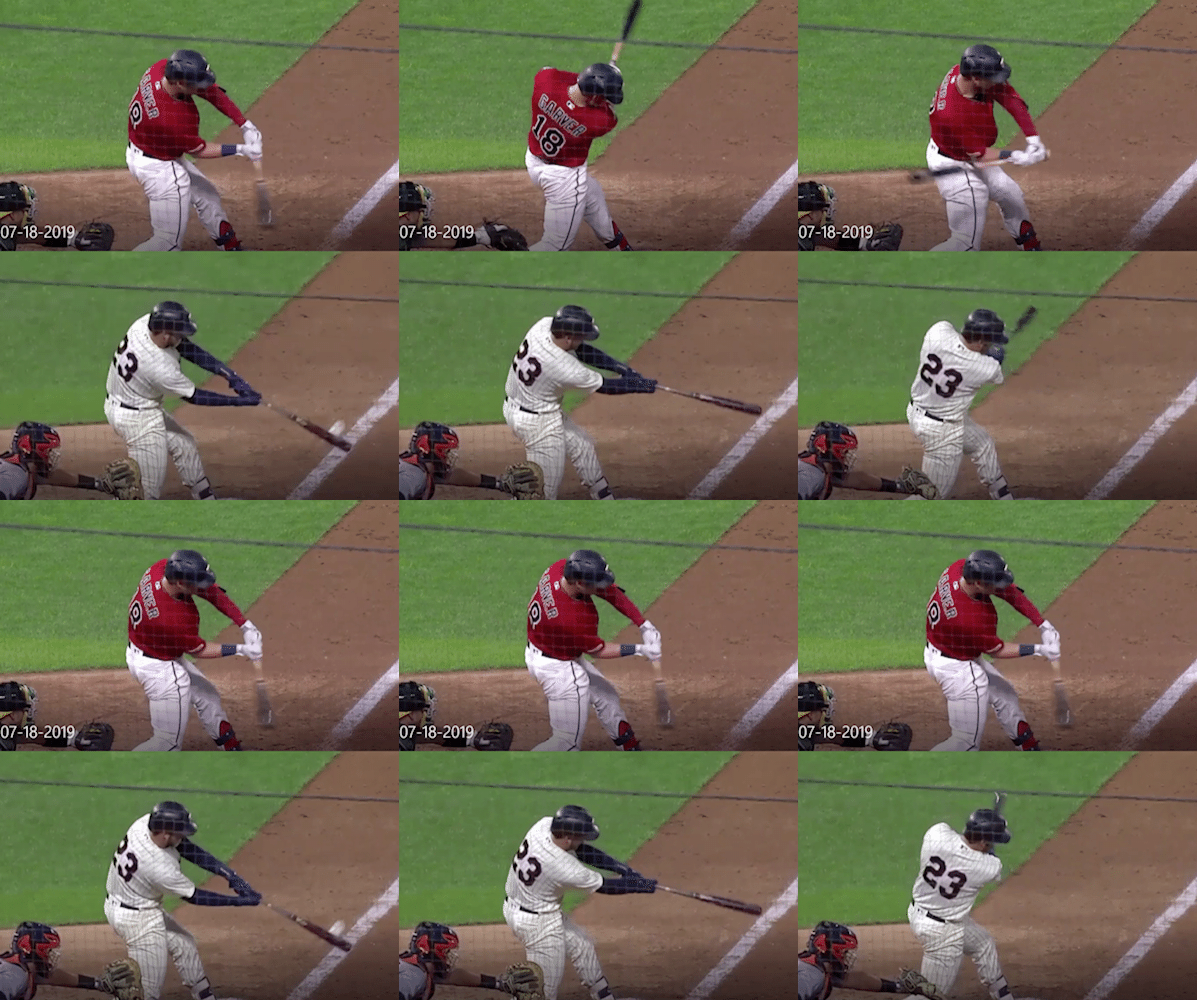
Good post. There are some exceptions I take to Smalley's assessment. Not that he's wrong, it's just that he fixates on one aspect of it (SHORT TO THE BALL) and doesn't explain, elaborate and compare to show viewers what he's talking about. Instead, he repeats that cue every time Garver does something good offensively. Here are some additional things I think he should be talking about to expand on that topic: 1. Short to the ball. You highlighted some pretty good stuff there but let's take a look at what his short to the ball now means. The top clip is from 2019 and the bottom one is from last year. Both pitches are similar speeds and locations. Watch just the hands travel. In 2018's swing the hands turn at the same rate but then travel forward to meet the ball (a pulling the bat action, if you will). In 2019, they turn then just pivot. Hence, shorter action. The key for me, while it's quicker, is how in 2018 he releases his top wrist *before* contact. 2. Long through the ball. This aspect of his swing is not discussed enough on the broadcasts. Smalley did mention that Rowson was trying to keep him from "spinning out" with his front shoulder. What Rowson is trying to accomplish is to get Garver to swing long through the ball (having the bat path travel forward after contact instead of immediately turning toward his body). With the top wrist releasing, it is difficult to have a long through swing. You almost will always start to turn away from the pitch plane. Think about Sano earlier in the year. His pull-centric approach had him pulling off that plane quickly. By straying from that path, a hitter's contact zone decreases and they swing and miss more often. Garver's improvement in this area is one of the reasons he has so much more power to center field this year versus last year. .500 BA/1.094 SLG with 6 HRs in 2019 vs .352 BA/.451 SLG with 0 HRs in 2018 when hitting the ball to center. 3. Rear Hip Load Compared to last year, Garver loads up on his rear leg/hip much better, creating power connection from the lower half to the upper body better. You'll see an inward turn of his hip, loading power. This was not nearly as pronounced last year (you'd see him turn the front hip inward but not the back hip). One of the things a Twins coach told me that Garver focused on was hitting the ball outfront more than he did in the past. The contact point is one way to increase your fly ball rate without dropping the barrel all the time. It also helps a hitter become more pull focused but staying through the ball (as noted above) keeps him from pulling off of the pitch plane.


-
Article: How Miguel Sano Can Fix His Swing
Parker Hageman replied to Parker Hageman's topic in Twins Daily Front Page News
Strib's Jim Souhan wrote a column today basically confirming that the Twins and Sano are essentially working on the hands. and stuff from Falvey: You heard it hear first folks.- 36 replies
-
- 2
-
-
- miguel sanonelson cruz
- mike trout
- (and 1 more)
-
Article: How Miguel Sano Can Fix His Swing
Parker Hageman replied to Parker Hageman's topic in Twins Daily Front Page News
It might be to him but, mechanically speaking, there are plenty of large individuals who drive the ball without needed to roll to and through the launch point (Aaron Judge is another that comes to mind). He doesn't *need* to do it to mash. A lot of hitters use some movement as a timing mechanism (Brian Dozier's pre-swing barrel tip comes to mind). One of the things that has made Buxton so effective this year is his brief pause at the launch point instead of rolling through it into the swing. It creates a stretch point and the added ability to shut a swing down. The Twins have far more tools and people on staff to ID and create a plan of attack to solve. I'm certain they know this and more. They are likely trying to do things but it just takes time. -
Article: How Miguel Sano Can Fix His Swing
Parker Hageman replied to Parker Hageman's topic in Twins Daily Front Page News
I don't know if they are resistant. Players like to do things the way they have done things. Byron Buxton is a prime example. I think in the case of Sano -- and I'm wildly speculating here -- that he does know that he's struggling and has tried to shift some things. During the series in Cleveland Sano tried to kill his leg kick much like Buxton did. And like Buxton, it looked completely foreign. It must have felt that way too since he came back after a rain delay with the leg kick. https://twitter.com/ParkerHageman/status/1136455283226681344 There's also the case of when he struggles for a bit and then hammers a pitch into the third deck, there's a burst of reaffirmation that he's doing things correctly. But really it's just that he ran into a mistake pitch in the one spot he's swinging well at. After that, he goes about everything the same way and winds up picked apart again. That's my view from the couch. In regards to why it wasn't fixed in the minors, it's probably because Sano mashed everything in the minor leagues. It's possible that he rarely saw good velocity fastballs up. We're only a few years into the understanding of high spin fastballs and that pitchers are asked to elevate. (It's crazy, i remember writing an article in 2014 begging the Twins to start elevating fastballs and it took another 2 years before it became a regular thing.) The Twins now have their players using Blast Motion sensors that measures swing plane elements. There's an analyst hired -- Rachel Heacock -- who I believe is in charge of that program. They now have tons of data, analysts crunching it and coaches distributing it through out the minor leagues. If a player has an obvious shortcoming or hole in their swing, they will attack it then instead of allowing a player to advance. -
Article: How Miguel Sano Can Fix His Swing
Parker Hageman replied to Parker Hageman's topic in Twins Daily Front Page News
Kepler has fared much better at fastballs up this year. In fact, 5 of his home runs have come on fastballs up in the zone (like this one, this one, and this one). There's a reason behind that which I hope to discuss more in a post in the coming weeks. He still swings through a lot of those fastballs but the ones he does connect in that area, he's lifting well. But his swing plane isn't really geared toward that portion of the zone, he does most of his damage on fastballs down whereas Eddie Rosario's barrel turn does most of his damage on fastballs up (and struggling a bit on fastballs down). Barrel turning, like any movement, it can be added to the swing. It just takes time and dedication. It is difficult to see a hitter make that kind of adjustment in season. The suggestion of getting to the launch point sooner isn't that much of a fundamental difference in the overall swing. Turning the barrel would be a big change from how he has delivered it in the past. 1. Axe bats are great. This spring I was talking with Michael Cuddyer about hitting and I asked him his thoughts on the Axe bats, half expecting him to poo-poo them as newfangled science. He lit up. He says all his kids now swing Axe bats and he wished he had that opportunity while playing in the pros. I've since bought my daughter one for her fastpitch season and you can see how well it keeps wrists from rolling early. It definitely is a different feel in your hand so I can see what some players might be resistant. 2. It's possible that's what they are working on -- driving things to right-center. Here's another stat that missed the cut for the article: the volume of fastballs middle-in that he yanks foul is staggering. He's fouled off 65% of fastballs he's swung at on the middle-third, the highest in baseball. That says to me he's trying to pull those pitches with a vengeance. And that's fine. Do damage. However, the more times you miss something middle-in and foul it off, the quicker you might get to two-strikes. The quicker you get to two-strikes, the more likely you will see those stupid sliders and spinning fastballs at your letters. If he makes adjustments and starts driving those pitches early (instead of fouling them off), he could get on a tear.- 36 replies
-
- 1
-
-
- miguel sanonelson cruz
- mike trout
- (and 1 more)
-
Article: How Miguel Sano Can Fix His Swing
Parker Hageman replied to Parker Hageman's topic in Twins Daily Front Page News
It's possible but we don't have data from anything before 2009 to prove that out. What we do know is that the narrative that is cited in local broadcasts that umpires are calling higher strikes more frequently is not accurate, at least as far as recent history goes. I'll amend this -- the amount of fastballs called strikes at the upper third of the strike zone has shrunk from 2009 (23%) to 2019 (19%). Fewer fastballs are getting called at the top of the zone. HOWEVER, more BREAKING BALLS at the top of the zone are getting called strikes: In 2009 it was 34% and now it's up to 37%, highest it's been in that era. Furthermore, breaking balls ABOVE the zone are getting called at a 5.5% clip (compared to 3% last season). Switching to feel mode now, I feel like I've seen more high breaking balls that barely catch the upper reaches of the broadcast's strike zone box called more often this season -- those high breaking balls that are at a hitter's eyes and then somehow grab the upper line of the zone. So when we hear the broadcasters talk about more called strikes at the top of the zone, it's possible it is happening when it comes to breaking balls. But, yes, high fastballs are difficult for any hitter to handle -- that's why hitters are a group have hit .231 vs fastballs up and .284 vs fastballs down since 2009. That is definitely one driver for why teams are instructing their pitchers to go up. -
Article: How Miguel Sano Can Fix His Swing
Parker Hageman replied to Parker Hageman's topic in Twins Daily Front Page News
Very good observation and thoughts. While I think the balance factor isn't an issue for Sano's pitch recognition portion, it definitely does effect his swing. I just finished reading The MVP Machine (sick reading brag, I know) and they talk to hitting instructor Doug Latta -- who rebuilt Justin Turner and Mookie Bett's swing -- emphasizes balance in the swing. He works to instill some bigger movement in guys like Turner and Betts but both swings have adjustability and balance (and both can hit the fastball upstairs). You look where their hands are at and, while they move like Sano's, they get to the launch point much sooner in the process. Here's one last video that was left on the article's cutting room floor (mostly because I felt like I had beaten the point to death) was this clip of Mike Trout's swing covering the northern and southern reaches of the strike zone: This, to me, is what all hitters should strive for.- 36 replies
-
- 3
-
-
- miguel sanonelson cruz
- mike trout
- (and 1 more)
-
When Miguel Sano first arrived in Minnesota in 2015, Twins team president Dave St. Peter said that fans “don't want to miss a Miguel Sano at-bat because you just never know what might happen, and at any given moment, he may hit a home run 500-plus feet. That's a trait very few players have.” In August 2015 during the Summer of Sano, the rookie bashed nine home runs, one dinger every 10.78 at bats. He also struck out in 38 percent of his plate appearances. Four seasons later, Sano still has that massive power. He has hit a home run in one out of every 11.67 at bats in 2019. He also has struck out in 42 percent of his plate appearances. From day one it’s an all-or-nothing approach for Sano but the narrative feels like it is trending more to the nothing. It does not have to be this way. Sano doesn't have to be an all-or-nothing hitter. Here's how he can move toward being a complete hitter.There is no denying that Miguel Sano hasn't been clicking on all cylinders.This season, Sano has approximately one portion of the zone in which his swing does damage. See if you can pick that out. Download attachment: trumedia_baseball_grid.png On balls that are thrown on the outer-third/middle-third section, Sano is hitting .579 with five home runs. It is absolutely crazy that teams still manage to pour a pitch or two in that area every couple of games -- just like the Royals did twice this past series -- but it happens because Sano’s largest swing holes happen to be a section above or a section below that spot. Let's start by discussing his inefficiencies above that spot. Sano’s swing path is highly susceptible to fastballs up in the zone. With the increasing emphasis on high spin fastballs, it is no surprise that teams have gone upstairs on him. In two-strike counts this year, Sano has swung-and-missed at 90 percent of fastballs. That’s helpless territory. So what can the big man do to fill this swing hole that can be seen from space? The first is simply learn to lay off that pitch. To Sano’s credit, he has actually decreased the amount of swings at fastballs up in the zone over his previous years. Early in the count he spits on those pitches, swinging at only a quarter whereas in the past, there was a 50-50 chance that he would take a hack. Contrary to what you might have heard on the local broadcasts, umpires are actually not calling more strikes on fastballs up in the zone. In 2011, if you took an elevated fastball, there was a 23 percent chance it would be called a strike. So far in 2019 those fastballs have been called a strike 17 percent of the time, which is the lowest rate dating back to 2009. So there isn’t a grand umpire conspiracy to call more elevated fastballs strikes. Laying off more of those pitches is not going to advance the count in a pitcher’s favor. What’s more is that hitters in general have curbed their appetites for high fastballs as well, demonstrating a swing diet three percentage points lower this season than it was in 2017 when the Boston Red Sox pitching staff rode the elevated fastball to the American League’s second best ERA. Teams have started to use spin data to help hitters know when they should adjust their approach, swinging above the baseball when there’s a high spin hurler on the mound. They have also incorporated more high velocity pitching machines in batting practice that attempts to duplicate what they will face that night rather than facing a soft-tossing coach for on-field bee pee. So it is no surprise to see offenses starting to counter the attack. That being said, when hitters do offer at high fastballs, they are missing at a greater rate than ever before and Miguel Sano is no exception. Although he is swinging less frequently than he has in his career, he is swinging through more. Compared to last year, Sano swung and missed at 34 percent of elevated four-seamers. This year that’s at a grotesque 50 percent clip (and you will recall the sheer futility in the aforementioned two-strike situations). So far in 2019 Sano has opted for the path of least resistance -- not swinging at elevated fastballs, at least until it is imperative that he protect the zone. Given what he is currently working with, this is a decent option. Sano has what ill-informed broadcasters like to call a “launch angle swing” but, more accurately, Sano’s swing path is down-to-up trajectory that does a ton of damage on balls down in the zone. In his career, the big man holds a .698 slugging percentage against all fastball types in the lower third of the zone. At the top of the zone, pitchers have turned him into Drew Butera with a .287 slugging percentage. It is no surprise then to see that in a series versus Boston, frontrunners in the high fastball industry, Sano struck out 9 times in 15 plate appearances as the Red Sox pitchers threw 26 of their 41 fastballs in the upper third of the strike zone (he swung through 36 percent of those too). So while we can point to Sano’s swing path as a reason why he has trouble catching high fastballs on the barrel that doesn’t answer the question as to why he swings over breaking balls that actually bounce in a neighboring zip code. For anyone who follows PitchingNinja or Driveline coaches on Twitter knows, pitchers have some absolutely filthy stuff right now and, to make matters worse, they have also found ways to make it even more disgusting. The TrackMan data has helped pitchers tunnel pitches better. The high speed cameras and Rapsodo devices have helped add extra break. Hitters are completely outgunned. At the very least Major League Baseball has seemingly done the hitters a solid by tossing in a juiced ball to help even the playing field but pitchers have the development advantage. So there is an element of that behind Sano’s increased strikeout rate. There is also an element of simply telling Miguel Sano to go up there and be Miguel Sano -- the man who can crush monster second deck tanks. Rip the governor off and open it up. Chuck three pointers and don’t worry about the missed shots. Strikeouts be damned. But that’s not why Sano has trouble with his pitch selection. One issue that appears to be hindering him his timing mechanism in his mechanics. It is a main reason why he keeps getting beat on fastballs up, regardless of velocity. And it’s one of the factors behind his inability to lay off those acid-soaked breaking balls. Watch this clip of Sano next to teammate Nelson Cruz. Watch for where they get their hands to the launch point (where the bat starts firing forward). Download attachment: FSFrameGIFImage (2).GIF If you are stumped, here it is: Download attachment: Cruz-Sano.png What you will notice is that Cruz has his hands and bat in a position to fire forward before the 97-mile-per-hour fastball leaves Gerrit Cole’s fingers. It requires no extra travel from this point. This gives him additional time to read and react. Sano, on the other hand, brings his hands back to a spot when Ryan Braiser’s 97-mile-per-hour cheese is quickly approaching the plate. This means he has to make his decision to swing earlier -- before getting the right read on the spin. This is part of the reason why you see Sano swinging over so many breaking balls: out of the hand they look destined for that juicy lower third of the zone before *fart noises* vanishing. Furthermore, Sano has a rolling launch point, almost continually moving his hands which means that he will get beat on fastballs up as well as inside if he starts them late. As another example, consider Mike Trout. Admittedly, it is cheating to take the world’s greatest living hitter and say “do what he’s doing” but there are some existing components in Trout’s swing path that is similar to Sano’s. Both Trout and Sano share that down-to-up swing that decimates balls low in the zone. However, Trout has the ability to get to pitches up in the zone (although, like Sano, this year he’s spitting on more of them). Similar to Cruz, Trout gets his hands to the launch point early, giving him time to recognize the pitch and shut down his swing on things he doesn’t like. Download attachment: Sano Cruz Trout.png It’s difficult to tell hitters change their approach drastically in midseason -- especially when every one out of eleven at bats results in a home run. Still, it is not about a total overhaul, it’s making the right tweaks to improve deficiencies. This is something that just a few years ago, Jorge Polanco cleaned up and has since entered the land of ten thousand rakes. Prior to making that change, he had posted a .245/.296/.351 batting line in 147 games. Since taking the slack out of his drawback, Polanco has hit .308/.368/.502 over his last 204 games. Polanco had been blessed with world class bat-to-ball skills but this modification has allowed him to drive the ball. Another successful Twins convert of the reduced slack swing was Eduardo Escobar. Escobar modified his swing in 2017 which gave him the ability to better differentiate fastballs and breaking balls. From 2014 through 2016, Escobar produced a .626 OPS versus breaking balls with a 30 percent strikeout rate. From 2017 on, he’s posted a .815 OPS against breaking balls and reduced his strikeout rate to 25 percent. And he still hammers fastballs. Sano could be one of them. He could be like Polanco or Escobar. He could be a non-slacker. While the movement may seem minor, it takes a lot of muscle memory to commit that to the body. There are plenty of hitters too, like Sano, who have similar big pre-swing movements (Josh Donaldson comes to mind) but those hitters get their hands to the launch point sooner as well. The solution may not be to swing like Cruz, Polanco or Trout, it maybe simply get your hands moving earlier in the process. There is no question that Sano can hit a ton in his swing plane. His exit velocity on fastballs down in the zone is 98 miles per hour. But more teams are seeing the blueprints to getting him out -- avoid the lower portion of the zone. When or if the adjustments come, then maybe -- just maybe -- we can stop reading about Miguel Sano’s supposed failure as a player. Click here to view the article
- 36 replies
-
- 2
-
-
- miguel sanonelson cruz
- mike trout
- (and 1 more)
-
 There is no denying that Miguel Sano hasn't been clicking on all cylinders.This season, Sano has approximately one portion of the zone in which his swing does damage. See if you can pick that out. On balls that are thrown on the outer-third/middle-third section, Sano is hitting .579 with five home runs. It is absolutely crazy that teams still manage to pour a pitch or two in that area every couple of games -- just like the Royals did twice this past series -- but it happens because Sano’s largest swing holes happen to be a section above or a section below that spot. Let's start by discussing his inefficiencies above that spot. Sano’s swing path is highly susceptible to fastballs up in the zone. With the increasing emphasis on high spin fastballs, it is no surprise that teams have gone upstairs on him. In two-strike counts this year, Sano has swung-and-missed at 90 percent of fastballs. That’s helpless territory. So what can the big man do to fill this swing hole that can be seen from space? The first is simply learn to lay off that pitch. To Sano’s credit, he has actually decreased the amount of swings at fastballs up in the zone over his previous years. Early in the count he spits on those pitches, swinging at only a quarter whereas in the past, there was a 50-50 chance that he would take a hack. Contrary to what you might have heard on the local broadcasts, umpires are actually not calling more strikes on fastballs up in the zone. In 2011, if you took an elevated fastball, there was a 23 percent chance it would be called a strike. So far in 2019 those fastballs have been called a strike 17 percent of the time, which is the lowest rate dating back to 2009. So there isn’t a grand umpire conspiracy to call more elevated fastballs strikes. Laying off more of those pitches is not going to advance the count in a pitcher’s favor. What’s more is that hitters in general have curbed their appetites for high fastballs as well, demonstrating a swing diet three percentage points lower this season than it was in 2017 when the Boston Red Sox pitching staff rode the elevated fastball to the American League’s second best ERA. Teams have started to use spin data to help hitters know when they should adjust their approach, swinging above the baseball when there’s a high spin hurler on the mound. They have also incorporated more high velocity pitching machines in batting practice that attempts to duplicate what they will face that night rather than facing a soft-tossing coach for on-field bee pee. So it is no surprise to see offenses starting to counter the attack. That being said, when hitters do offer at high fastballs, they are missing at a greater rate than ever before and Miguel Sano is no exception. Although he is swinging less frequently than he has in his career, he is swinging through more. Compared to last year, Sano swung and missed at 34 percent of elevated four-seamers. This year that’s at a grotesque 50 percent clip (and you will recall the sheer futility in the aforementioned two-strike situations). So far in 2019 Sano has opted for the path of least resistance -- not swinging at elevated fastballs, at least until it is imperative that he protect the zone. Given what he is currently working with, this is a decent option. Sano has what ill-informed broadcasters like to call a “launch angle swing” but, more accurately, Sano’s swing path is down-to-up trajectory that does a ton of damage on balls down in the zone. In his career, the big man holds a .698 slugging percentage against all fastball types in the lower third of the zone. At the top of the zone, pitchers have turned him into Drew Butera with a .287 slugging percentage. It is no surprise then to see that in a series versus Boston, frontrunners in the high fastball industry, Sano struck out 9 times in 15 plate appearances as the Red Sox pitchers threw 26 of their 41 fastballs in the upper third of the strike zone (he swung through 36 percent of those too). So while we can point to Sano’s swing path as a reason why he has trouble catching high fastballs on the barrel that doesn’t answer the question as to why he swings over breaking balls that actually bounce in a neighboring zip code. For anyone who follows PitchingNinja or Driveline coaches on Twitter knows, pitchers have some absolutely filthy stuff right now and, to make matters worse, they have also found ways to make it even more disgusting. The TrackMan data has helped pitchers tunnel pitches better. The high speed cameras and Rapsodo devices have helped add extra break. Hitters are completely outgunned. At the very least Major League Baseball has seemingly done the hitters a solid by tossing in a juiced ball to help even the playing field but pitchers have the development advantage. So there is an element of that behind Sano’s increased strikeout rate. There is also an element of simply telling Miguel Sano to go up there and be Miguel Sano -- the man who can crush monster second deck tanks. Rip the governor off and open it up. Chuck three pointers and don’t worry about the missed shots. Strikeouts be damned. But that’s not why Sano has trouble with his pitch selection. One issue that appears to be hindering him his timing mechanism in his mechanics. It is a main reason why he keeps getting beat on fastballs up, regardless of velocity. And it’s one of the factors behind his inability to lay off those acid-soaked breaking balls. Watch this clip of Sano next to teammate Nelson Cruz. Watch for where they get their hands to the launch point (where the bat starts firing forward). If you are stumped, here it is: What you will notice is that Cruz has his hands and bat in a position to fire forward before the 97-mile-per-hour fastball leaves Gerrit Cole’s fingers. It requires no extra travel from this point. This gives him additional time to read and react. Sano, on the other hand, brings his hands back to a spot when Ryan Braiser’s 97-mile-per-hour cheese is quickly approaching the plate. This means he has to make his decision to swing earlier -- before getting the right read on the spin. This is part of the reason why you see Sano swinging over so many breaking balls: out of the hand they look destined for that juicy lower third of the zone before *fart noises* vanishing. Furthermore, Sano has a rolling launch point, almost continually moving his hands which means that he will get beat on fastballs up as well as inside if he starts them late. As another example, consider Mike Trout. Admittedly, it is cheating to take the world’s greatest living hitter and say “do what he’s doing” but there are some existing components in Trout’s swing path that is similar to Sano’s. Both Trout and Sano share that down-to-up swing that decimates balls low in the zone. However, Trout has the ability to get to pitches up in the zone (although, like Sano, this year he’s spitting on more of them). Similar to Cruz, Trout gets his hands to the launch point early, giving him time to recognize the pitch and shut down his swing on things he doesn’t like. It’s difficult to tell hitters change their approach drastically in midseason -- especially when every one out of eleven at bats results in a home run. Still, it is not about a total overhaul, it’s making the right tweaks to improve deficiencies. This is something that just a few years ago, Jorge Polanco cleaned up and has since entered the land of ten thousand rakes. Prior to making that change, he had posted a .245/.296/.351 batting line in 147 games. Since taking the slack out of his drawback, Polanco has hit .308/.368/.502 over his last 204 games. Polanco had been blessed with world class bat-to-ball skills but this modification has allowed him to drive the ball. Another successful Twins convert of the reduced slack swing was Eduardo Escobar. Escobar modified his swing in 2017 which gave him the ability to better differentiate fastballs and breaking balls. From 2014 through 2016, Escobar produced a .626 OPS versus breaking balls with a 30 percent strikeout rate. From 2017 on, he’s posted a .815 OPS against breaking balls and reduced his strikeout rate to 25 percent. And he still hammers fastballs. Sano could be one of them. He could be like Polanco or Escobar. He could be a non-slacker. While the movement may seem minor, it takes a lot of muscle memory to commit that to the body. There are plenty of hitters too, like Sano, who have similar big pre-swing movements (Josh Donaldson comes to mind) but those hitters get their hands to the launch point sooner as well. The solution may not be to swing like Cruz, Polanco or Trout, it maybe simply get your hands moving earlier in the process. There is no question that Sano can hit a ton in his swing plane. His exit velocity on fastballs down in the zone is 98 miles per hour. But more teams are seeing the blueprints to getting him out -- avoid the lower portion of the zone. When or if the adjustments come, then maybe -- just maybe -- we can stop reading about Miguel Sano’s supposed failure as a player.
 -
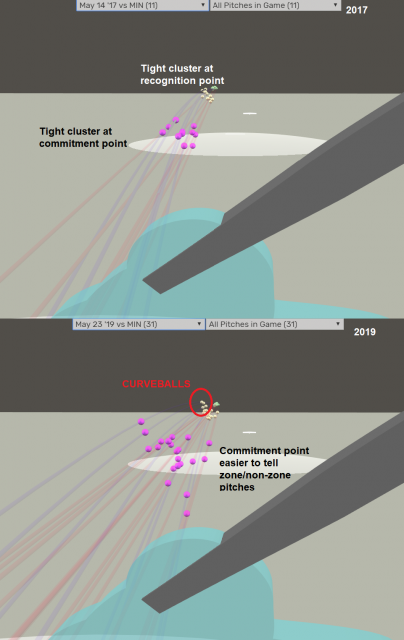
My quick and dirty drive-by on Allen is that the velocity drop is a bit of a concern but what jumps out is how both his fastball and curveball have been ineffective. So I went to look at StatCast's data and found that Allen has had significant issues tunneling his pitches in 2019. Here are two Cody Allen outings versus the Twins, the first from 2017 and the second from this year. In 2017 his recognition point -- the point where hitters decipher the pitch type -- and the commit point -- where they swing -- have a tight cluster between his two pitches. It's difficult to distinguish the fastball versus the curve. This season however, after tinkering with his mechanics in spring training, it resulted in the two pitches being able to be recognized easier. The knuckle curve now tunnels through a higher spot than the fastball. Many teams now have those types of reports waiting for hitters (i.e. if you see the ball coming from this window, it's a X). Here it is at a glance: Allen, despite the velocity in the low-90s now, still has a very high spin rate fastball -- one that would be the highest on the Twins' staff. that can play. Interestingly, perhaps because of his mechanics tinker or maybe because of the Angels direction, Allen did not use that fastball up in the zone as much as he did in his Indians days. The Twins will attempt to reign all this in. Unlike the Angels, they have a robust analytics team, coaching staff and now have shown they are effective at using both. I don't know if Allen will be able to get to where he needs to be but if the Twins can tweak him, he could be a very good arm in the bullpen down the stretch. Time will tell.
- 38 replies
-
- 10
-
-
- cody allen
- derek falvey
- (and 1 more)
-
The check swings aren't inherently bad. It's often a product of the YES-YES-NO approach in the box (getting the swing started early then shutting it down late when you don't like the pitch). I don't know if I would call it regularly -- it's just 18 swing/misses on pitches 94 mph and lower -- however, and I've pointed this out over the years, Sano's swing isn't conducive to fastballs up in the zone. That's where the majority of his swing/misses are on those, regardless of velo. Boston picked him apart up there this series.
- 148 replies
-
- 5
-
-
- minnesota twins
- miguel sano
- (and 1 more)
-
Nearly every team in Major League Baseball uses some variation of pitch tracking technologies to analyze their pitchers. By now, you have undoubtedly heard that the Minnesota Twins have gone all-in on the Rapsodo craze. However, if you are not entrenched in a team's analytics department or pitching staff, you may not know what that provides. Fortunately, this past spring our high school baseball program had the luxury of having our pitchers throw under the watchful, data-collecting eye of a Rapsodo device. Here’s what we discovered.To other coaches and players out there: Buy one. I cannot recommend this enough. There is almost no substitute for the advantage that this tech can create as far as pitching development goes. If you cannot afford the $4,000 price tag -- which, let’s be honest, not many high school programs can -- go find a nearby college program or a private baseball training facility that has one and see if you can use it. That's what we did. In March Chanhassen High School’s newly minted head coach Ross VanHauen -- a forward-thinking, Driveline podcast-listening, constant learner -- connected with Starters Sports Training in Shakopee and arranged for the program the use of Starter’s Rapsodo device at their facility as part of the pitching evaluation process. Not only would we get a consistent velocity baseline for pitchers across all grade levels, we would also be able to gather spin rates — maybe even identifying a Ryne Harper-type pitcher who may have underwhelming velo but spun breaking balls at an unhittable rate. Plenty of the arms in the system had worked with private instructors and some had experience using Rapsodo device but for those that didn’t participate in club programs or showcase events, we wanted a better understanding of what we were working with. We wanted, nay, needed to the data. From my personal perspective, as a new member of the Chanhassen coaching staff, these were pitchers with whom I had no prior interaction and this data could help quickly establish a roadmap going forward. In most cases, it would take days, weeks, and hours of observing bullpens and game action to properly quantify how a pitcher’s arsenal works. There are some obvious things that can be ascertained from watching a bullpen -- for instance, a pitcher’s arm slot can tell you a lot about how certain pitches should behave -- but Rapsodo data was a bridge that connected the seen and the unseen. What the first visit amounted to was a basic light bullpen session: Each player threw 25-30 pitches, displaying their fastballs, changeups and whatever they felt was their breaking ball. One of the initial objectives was to determine how everyone’s breaking ball works. When you ask a young pitcher what they throw, they will often say “curveball”, a generic catchall for their secondary pitch. In actuality, it spins or moves closer to a slider or slurve. Rapsodo can differentiate this because it measures spin efficiency — basically the ratio of the transverse spin (movement spin) to total spin. Curveballs tend to have a spin efficiency over 60% (with most of the big league curveballs operating at a near 100% spin efficiency mark). What we learned on the first day with a Rapsodo was that the vast majority of pitchers in our program fell short of that rate. By our account, there were approximately four pitchers in the entire program who threw what would be truly classified as a curveball. Here is a real world example of the difference between a high spin efficiency and a low spin efficiency breaking ball. These two right-handed pitchers in the Chanhassen program have very good secondary pitches that have distinctly different movements. On the left is junior Greg Ryun (2020) while on the right is freshman Jake Ryan (2022). Here is their breaking ball grips at release: On the left, Greg’s breaking ball had over ten inches of horizontal break and five inches of drop on average with a 49 percent spin efficiency. This running slurve aided Greg in registering 27 strikeouts in 20.1 innings in the varsity season. Comparatively, Jake, who spent his first year in the program at the junior varsity level, had a breaking ball with five inches of horizontal run and nearly 20 inches of vertical break and a robust spin efficiency of 89 percent. This big breaking 12-to-6er complemented his high spin fastball extremely well. You can see how the two pitches fall on the pitch type spectrum. Download attachment: GRJS_RP.PNG A lot of how a pitcher’s breaking ball moves is connected with his arm slots. As pitching instructor Lantz Wheeler explains, it’s an arranged marriage: Those with a three-quarter or lower tend of have more slurve, horizontal running breaking balls while those with over-the-top deliveries favor 12-6 breaking ball action. This was a big distinction between pitchers like Greg, who released his pitch at a little over five feet in height, compared to Jake, who released his closer to six feet in height. What can you do once with that data and knowledge? Let’s say you are a pitcher with a low spin efficiency breaking ball, what could you do going forward? From a practical standpoint, you could do several things. You could attempt to adjust the grip and/or release to create more of a curveball action. You could embrace the slider ride, trying to reduce that spin efficiency and increase some velocity. Using Greg’s slurve as an example, if he were so inclined he could refine it into more of a slider, adding velocity and reducing the spin efficiency. It would better suit his arm angle. That said, if he wanted to have more of a curve sharp he could work on increasing the vertical drop. Or do both. However, without regular access to a Rapsodo and having a high-speed camera fixed on the pitcher’s release point, trying to adjust is a time-consuming trial-and-error experiment. Coach: Try to spike the seam and do this at release. Pitcher: How’d that look? Coach: Better...maybe? Did you keep your fingers to the side or on top? Pitcher: I don’t know. Coach: OK, well, try that out on the mound next game and see what happens. That’s why professional organizations have invested heavily in that technology. As recently as 2016, then-Minnesota Twins closer Glen Perkins talked about his process of trying to tweak his slider grip where he simply threw it a few times in the bullpen, felt like it moved better north-south, and then threw it that night in a game. No data. No numbers. All feel. The next offseason following Perkins’ slider tweak, journeyman reliever Craig Breslow tried to rejuvenate this career with the help of a Rapsodo device, which earned him a contract with the Minnesota Twins. That spring, the Twins bought one of their own and tried it out on their spring training backfields. Now they have them everywhere. You can choose to approach player development without that information of course, but it is an analog approach in a digital world. In just limited exposure to the machines, the value Rapsodo data can provide in analyzing breaking ball was clear to see. In the next post, we will discuss how fastballs can be optimized under the power provided by the pitch-tracking tech. Click here to view the article
