


Twins Video
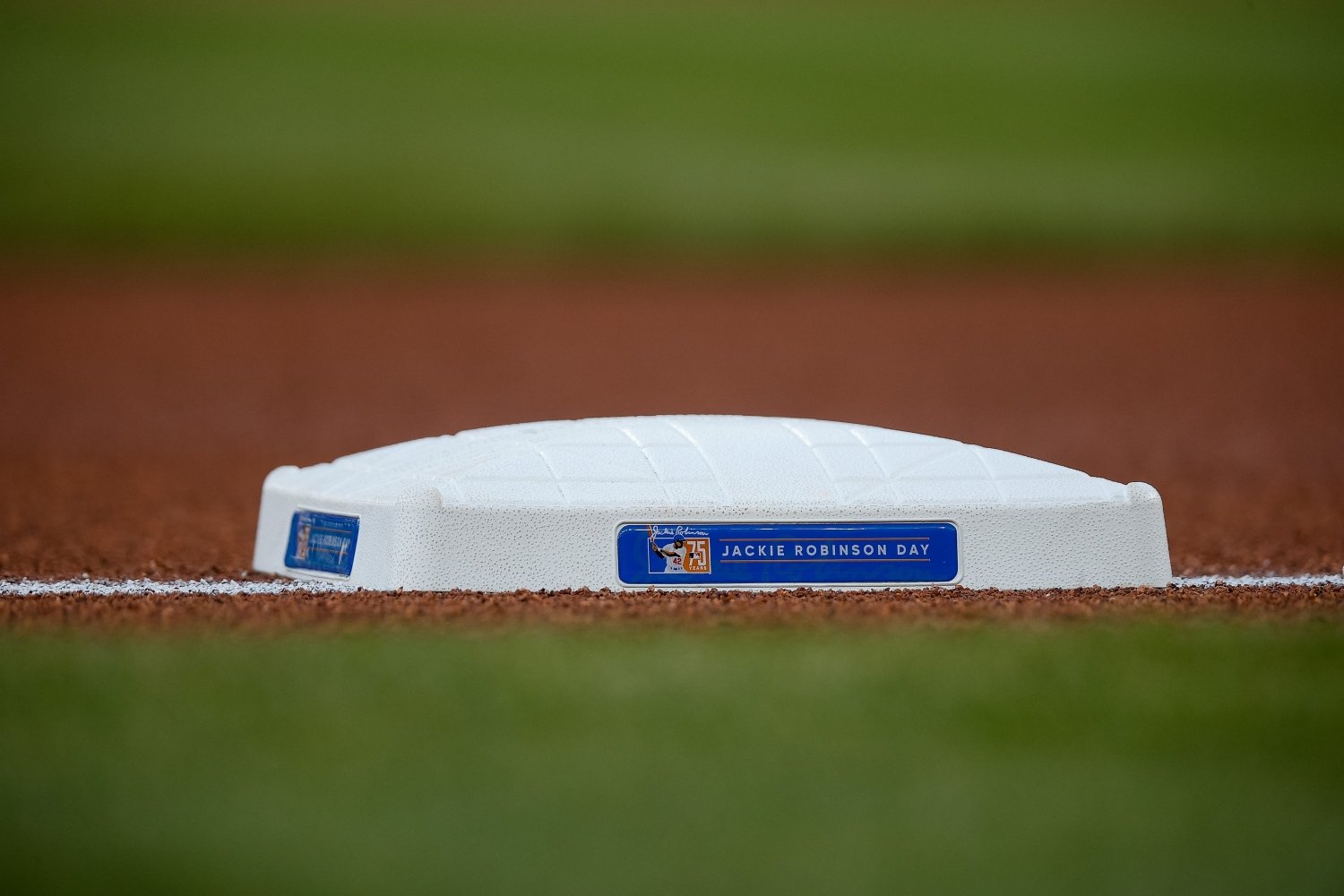
Four score minus two years ago, a few brave people (with hundreds of thousands at their backs and millions standing shoulder-to-shoulder in their path) brought forth upon this continent the first worthwhile version of the United States of America. Jackie Robinson took the field for the Brooklyn Dodgers that day, breaking what had been a six-decade color barrier for entry into Major League Baseball.
Robinson, a former Army officer who made a stand against segregation on the Texas base where he served during World War II, was an acutely self-aware symbol of the nascent 20th-century Civil Rights Movement. At various times in the decades since then, biographers and orthogonal narrators of that moment have downplayed that fact, preferring to cast Robinson as someone who just wanted to play his beloved game without fetter or restriction. He did want that equality of opportunity, but not in some boyish, vapid way, and not just because he had a deep competitive fire. By the time Robinson and Branch Rickey set fire to the official barrier between MLB and the Negro Leagues, the fire of the Civil Rights Movement had been burning for a handful of years.
It wasn't just Robinson who spoke up and fought successfully against segregation during World War II, but he had a certain level of privilege and leverage: he was serving domestically, not in combat, and his excellent educational background (he was raised in an integrated Pasadena, California, and attended UCLA) made him much more difficult to cast as a troublemaker or to browbeat than many other servicepeople of color were. When the Allies defeated the Nazis in May 1945 and then mercilessly crushed Japan with the atomic bombings of Hiroshima and Nagasaki in August, huge waves of soldiers returned from battlefields where they and their fellows had been wounded, tortured, killed, or traumatized by the violence they themselves had had to inflict, in order to stay alive or complete a mission on which they were told the fate of their beloved Republic hinged. A great many of those soldiers, Black and White alike, came home disillusioned and resentful.
The way the Armed Services themselves treated divisions of different colors was intentionally disparate. White soldiers got better weapons, better assignments, better supplies, and far, far more respect. At times, Black soldiers—and not a few White ones, watching it all happen—felt that they were fighting to preserve a country built on lip service to ideals it was betraying even as it demanded they put their lives in peril. When all those soldiers came home, the disparity in the opportunities and the aid that awaited them was just as wide. It was galvanizing, for Black communities beginning to be empowered by the Great Migration and the roots they'd put down over the previous generation in places more like Pasadena than like Shreveport, La. It was also eye-opening, for many White people who had previously held segregationist, racist views or had failed to grasp the profundity of the rot at the root of the American flower.
Robinson was not uniquely talented, among the greats of the Negro Leagues. He was not a happy accident—a "lucky us" scouting find by Rickey and the Dodgers. He was not just a ballplayer, though even he sometimes used that oversimplification as a shield to keep the (literal) haters at bay. He was the result of a monthslong pressure campaign by local and national groups in favor of racial progress, involving coordinated letter-writing; a rising tide of editorials and opinion columns in even White-owned newspapers, from even White columnists; and boycotts. He was carefully chosen for his background as a part of that movement, having won a court-martial after being arrested for refusing to move to the back of a military transport bus.
He was chosen for his commitment to nonviolence and for his refusal to compromise on the question of his own qualifications or humanity. He was the tip of the spear that would be shoved into the heart of Jim Crow, inch by inch, by Rosa Parks, Malcolm X, Martin Luther King Jr., Fannie Lou Hamer, John Lewis, and millions more over the ensuing three decades. He was also a beneficiary of the time being right. Seeing the widespread disrespect and maltreatment that befell even heroes of battles on which hung the question of the survival of American democracy made many see the dark hypocrisy at the heart of their country. Spending a decade fighting (not, at first, with weapons and troops, but fighting straight through, from 1935 or so through the end of the war) the Nazis and their atrocious, vile extermination campaign against so many innocent civilians threw the sins of American racism into such sharp relief that it could no longer be ignored.
Yes, therefore, Robinson was a DEI hire. That is, unequivocally, a good thing, and the clearest illustration of the need for such hires that can be offered. He was an exceptionally qualified applicant for a job long held by players who were much worse than him, sheltered from competition with him by systematic racism. He brought diversity, equality and inclusion into the workplace, not diminishing meritocracy in the process, but introducing real meritocracy for the first time in the history of that workplace.
It's important to say these things now, because the United States has sagged badly since gaining all the ground that Robinson helped begin claiming 80 years ago. America has never been what it claimed to be, and for some, that illegitimizes it entirely. For others, inexcusably but truly, it's not a problem, because they never wanted America to be what it claimed to be, anyway. A plurality of us live in the middle. We believe that what America aspires to—not what Thomas Jefferson or George Washington (let alone Andrew Jackson or Richard Nixon) aspired to, but what the country has stood for in a broad sense over almost two and a half centuries—is worthwhile. We believe that its failure to even come especially close to that goal is unacceptable, but not in such a way as to make continuing to pursue that goal unworthy.
The United States has never met its own standards for success. The American dream has yet to be realized. Until this date in 1947, though, the country didn't even try—not really, not hard enough. Beginning with the movements and efforts that culminated in that day, though, we did try, and try hard, for a long time. The results weren't good enough, because "good enough", like the American dream itself, is perhaps something only to be chased, and never to be grasped. However, looking back over the last 78 years—to Parks on the bus in Montgomery, Alabama, and to Lewis and King on the bridge in Selma; to Harry Truman following Rickey's lead by desegregating the military, and the Supreme Court following it by desegregating the nation's schools; to movements that gave rise to generations of genuinely empowered Black thinkers, artists, and businesspeople; to Barack Obama in Grant Park in 2008—it's impossible to conclude that there wasn't progress. It's impossible not to believe that that progress was worthwhile, and hard for me not to conclude that there is hope yet for the country Robinson brought forth upon the diamond in 1947.
Yet, we're surrounded by urgent indicators that all that progress is in jeopardy. The Department of Defense, newly led by a coalition dedicated to erasing that progress and the hope it infused in so many, tried to remove Robinson's story from before he became a sports hero, because they know how much power lies in the connection between his service (and the racism he faced therein) and his later barrier-breaking, given the way World War II stirred the movement. Corporations, including MLB, are being bullied and cowed into either doing away with DEI initiatives or pretending they matter less than they do, all on the urgent and diametrically dishonest premise that DEI damages meritocracy, rather than being its only reliable set of guiding principles in a multicultural world.
Abraham Lincoln, himself a deeply flawed man with no stainless racial record, faced a moment like this. He stood astride a country that was fracturing and falling apart, because (in two very different ways) its two halves could no longer live with the lies they had told each other to make the union work in the first place. Lincoln himself saw right through the Declaration of Independence, to its hidden agendas and crucial elisions. Still, he knew that the best hope for the future of his people—even the ones in the opposing uniforms—was to re-establish that the United States was "conceived in liberty, and dedicated to the proposition that all men are created equal." He knew that promise had not been delivered upon, and he knew it would be a long time before it would be, but he believed it was worth persisting in the pursuit.
Now, as then, we find ourselves facing a test of "whether any nation so conceived and so dedicated can long endure." It's not a hopeful moment. When Lincoln resorted to those words, he was standing amid a battlefield still pockmarked by pools of blood. It's comforting, though, to remember that while Lincoln came just 80 years after Jefferson and his Declaration, Robinson came just 80 years after Lincoln. Robinson was the first beacon of light in a generation of it—of shining, surging hope, and huge victories. He's the first symbol of America making a more serious, informed, earnest dedication to its founding ideals, and although those ideals now seem as much in danger as they did in the days just before Gettysburg or D-Day, Robinson's legacy is the reminder that we have already come a long way, and that bravely pushing forward against resistance can take us even further.
The last two decades, with a bit less bloodshed than the Civil War or World War II on the parts of American soldiers, have done plenty to open the eyes and the minds of Americans. That hopeful plurality with which I identified myself above is better able to see and name the things they're fighting for, and the things they're fighting against, than such pluralities could have been at any previous moment of American history.
Ultimately, that only matters if we all here dedicate ourselves to the great task remaining before us. Today, when you turn on a baseball game and everyone is wearing Jackie Robinson's 42, consider the gravity of that symbol, but remember that it's a mere echo of the real moment that mattered. Robinson, whose most famous bit of wisdom was that we only matter if we leave a mark on one another, would surely want you to see his mark on the backs of so many players and think about how you can leave your own.









Recommended Comments
Create an account or sign in to comment
You need to be a member in order to leave a comment
Create an account
Sign up for a new account in our community. It's easy!
Register a new accountSign in
Already have an account? Sign in here.
Sign In Now