Jump to content
Twins Daily
  • Create Account
  • Twins News & Analysis

    Reflecting On Hard Truths About Prospects


    Nick Nelson

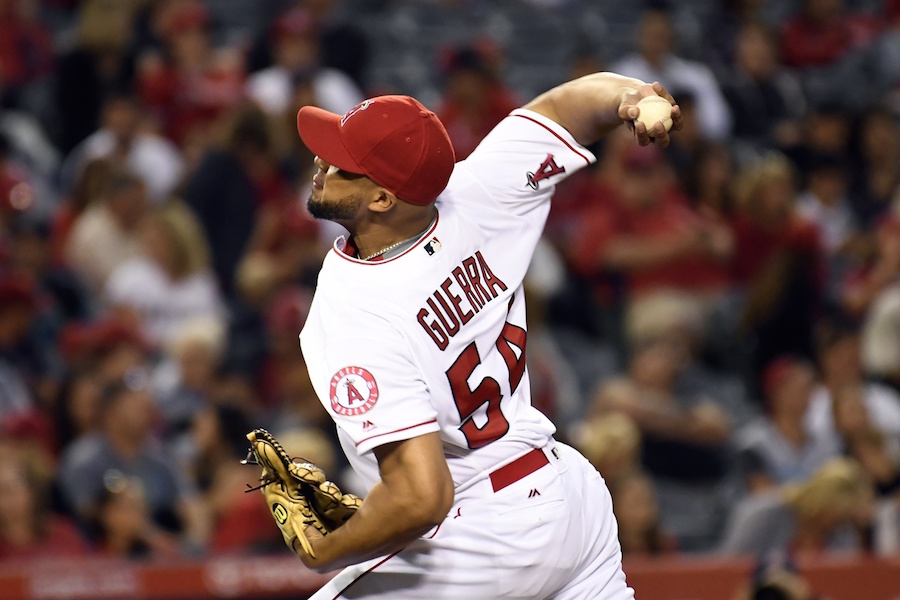
    Recently in Anaheim, a familiar figure took the mound to face the Twins. This particular player, like many others, serves to remind us of the fickleness of prospects in baseball.

    It's a reality that is weighing heavily on this rebuilding Minnesota club.

    Image courtesy of Richard Mackson, USA Today

    Twins Video

    One week ago, Deolis Guerra tossed the seventh and eighth innings for the Angels in a blowout loss against the Twins at home. You may recall that Guerra was once a key piece in the package given up by the Mets to acquire Johan Santana, all the way back in 2007.

    At the time, Guerra was only 18 years old. Coming off a solid season at Single-A, he was ranked by Baseball America as the 35th-best prospect in the game. With a big sturdy build, developing velocity and an already eye-catching changeup, Guerra oozed potential.

    Having already reached High-A as a teenager, the young righty was on an accelerated path to the majors. The hope was that he would become an impact addition to Minnesota's rotation within a few years, helping justify the loss of an elite pitcher.

    Of course, that's not how it played out. Guerra struggled, stalled, got hurt, switched roles, switched organizations multiple times. Nearly a decade after being sent to the Twins in the Santana blockbuster, Guerra is only now beginning to establish himself in the major leagues. He was knocked around last year during his first exposure to the big leagues as a member of Pittsburgh's bullpen, but is showing some very positive signs now as a reliever for the Angels, with a 3.00 ERA, 0.73 WHIP and 15-to-0 K/BB ratio in 15 innings.

    If Guerra continues on this path, it obviously won't turn out as a best-case scenario for a hurler who was once considered to have top-of-the-rotation upside. But it won't be a worst-case scenario. At least he will end up being a useful major league player, which is more than many highly rated prospects can ever say.

    Guerra is a case study in the volatility of prospects, and the length of time that it can sometimes take before they really figure it out at the highest level.

    Carlos Gomez, who came over to Minnesota in the same package as Guerra, is another example worth looking at. He eventually did fulfill his promise, becoming a borderline MVP caliber player in 2013 and 2014 with the Brewers, but not until a few years after he left the Twins. By the time Gomez reached his peak, he had accumulated more than 1500 MLB plate appearances and was 27. That's the same age Guerra is now. It's the same age David Ortiz was when he transformed into a superstar with the Red Sox. It's the age Oswaldo Arcia will turn in May of 2018.

    Plenty of top prospects catch on quickly and become instant big-league stars. Most do not. Development curves are varied and unpredictable. It really shouldn't be too surprising that Byron Buxton is overwhelmed by MLB pitching at age 22, nor that Jose Berrios got knocked around in his first taste at 21, nor that Eddie Rosario and Tyler Duffey have been stymied by the league's adjustments in their sophomore seasons.

    But just because these outcomes aren't particularly surprising doesn't mean they aren't problematic. The Twins are fully dependent on this young core to turn around their fledgling franchise. The fact that so many of them look so far from even approaching their potential is indeed perturbing.

    Follow Twins Daily For Minnesota Twins News & Analysis

    Recent Twins Articles

    Recent Twins Videos

    Twins Top Prospects

    Marek Houston

    Cedar Rapids Kernels - A+, SS
    The 22-year-old went 2-for-5 on Friday night, his fourth straight multi-hit game. Heading into the week, he was hitting .246/.328/.404 (.732). Four games later, he is hitting .303/.361/.447 (.808).

    User Feedback

    Recommended Comments


    Featured Comments


    I think it is safe to say we did not see the potential in Ortiz, Gomez, or Hardy. I think we gave up to a certain extent. No? The Gomez for Hardy trade in my opinion was two org's who gave up on their guy. Milwaukee didn't think Hardy was going to be the guy he was and we flat out were down on the potential of Gomez. A few years later trading Hardy for Hoey tells me that we were writing off Hardy. In both cases as well as Ortiz, we would have been much better keeping them.

    I think the big tally is 3 to 1. Papi, Gomez, and Hardy to Johan. If we throw in the others and do more research but guess is we find a few more guys that made an all star appearance. But by and large the number of misses and WAR of those guys has been a net negative to the Twins. Is it development, coaching, talent recognition, financial concerns? I don't know. But it is a miss in my opinion.

    Hardy's knock, in my view, will always be his health.  When he was healthy, he was very good at the plate and in the field.  His big years in Baltimore were largely due to his good healthy.  That trade in particular bothered me a lot.  They got nothing for a starting caliber SS.  I've never minded the Gomez trade all that much.  

    Hardy's knock, in my view, will always be his health.  When he was healthy, he was very good at the plate and in the field.  His big years in Baltimore were largely due to his good healthy.  That trade in particular bothered me a lot.  They got nothing for a starting caliber SS.  I've never minded the Gomez trade all that much.

    Hardy missed 60 games in his one year here and 40 the year before. However he was worth 1.8 WAR in those 100 games in 2010 and was only making $5-6M. He had hit 60 HR in his previous three years. And we traded him for a relief pitcher who was terrible, then ushered in a period where we ran out Nishi, Casilla, and Pedro Floriman at SS. The case could have been made that we didn't really have anything lined up, so keep Hardy and whatever he provides in innings would be better than the alternative.


    No way to slice this one. It was a terrible baseball move.


    I think you have three big misses and one the other way.

    I remember writing at the time about Hardy supposedly being "injury prone"


    http://twinsfanatnicks.blogspot.com/2010/12/myth-of-injury-prone.html


    Just a ludicrous notion. A guy hurts his wrist sliding into a base so he's injury prone? Nonsense. We saw how that worked out when he averaged 147 games over the next 4 years with Baltimore. The Gomez trade would have actually been a good one if they'd held on and gotten that production. Instead it was just a total disaster.


    Ugh. Why do you guys have to get me all riled up thinking about Hardy? 

    "Injury prone" was about as valid an excuse to deal Hardy, as Gardy wanting more speed from his middle infielders.


    That might be the worst trade in modern Twins history.  I mean, it doesn't appear we were even trying to get value back for him, just wanting someone to take his salary after we signed Nishioka instead.  Seriously, a starting MLB shortstop for a 28 year old minor league reliever with ~6 BB/9 the previous two seasons mostly in AA...


    "Injury prone" was about as valid an excuse to deal Hardy, as Gardy wanting more speed from his middle infielders.


    That might be the worst trade in modern Twins history.  I mean, it doesn't appear we were even trying to get value back for him, just wanting someone to take his salary after we signed Nishioka instead.  Seriously, a starting MLB shortstop for a 28 year old minor league reliever with ~6 BB/9 the previous two seasons mostly in AA...


    kind of like giving away Dozier to make room for Polanco.


    I'm pretty sure trading Hardy was a Gardy thing, not a BS generated move (well it was BS, but you know what I mean).   If your manager wants you to do it, and your billy smith, well you probably do it.


    Disaster.

    Before Hardy was traded, Gardy came out and said that even if Hardy was on the team, Casilla would compete for the shortstop position.  Cause, you know, speed.  He got his wish and oh boy, Casilla worked out great at shortstop...


    kind of like giving away Dozier to make room for Polanco.

    Sorta.  Although Polanco is cheap, and Nishi was actually more expensive than Hardy.  And while he is still young, I'd venture that Polanco is probably more projectible as a competent MLB player now than Nishi was at the time.


    Also, I don't know that many people have advocated dealing Dozier even for a Hoey-level return.  If that was really the best offer right now, pretty sure all but the most extreme posters here would pass.  (Dozier's remaining guarantee of ~$16.67 mil would represent more significant salary relief than Hardy's $5.85 mil, although we didn't need that level of salary relief then or now.)


    Interestingly, Hardy at the time of the trade was actually younger than Dozier is now too.


    I think a lot more posters would endorse sending Plouffe packing for pure salary relief, since he's likely to be a deserving non-tender in the offseason anyway, and it would open a spot at 3B for Sano and perhaps some opportunities for Polanco as well.


    kind of like giving away Dozier to make room for Polanco.

    You don't trade for aging relief pitchers period. Or guys that have run out of options. And be very careful about those 41st players that a team has that YOU have to add to your roster. Chances are, they can be claimed on the waiver wire, if you really really wait.


    Hardy was a combination of "how much would he cost" as the Twins didn't seem ready to offer him a multi-year contract and they lived in fear of paying a high arbitration salary (shades of what will happen with Plouffe, you'd think?).


    There is a system failure when a team is too cautious with bringing players up, or really have no idea how they wish to construct their playing field and/or lineup in the coming season/seasons. 


    Which is where we stand with Dozier. Is he still a bargain? Can he be a longterm answer at second, giving us more power than Polanco, for example? Who will be the second baseman of the future if Dozier stays here another 3-4 years? Is Polanco then exposed? Or do we go with someone who might bunt, hit-run, show speed and plate discipline, and play a better second than short? But who do we put at short...the nimble Nunez or the powerhouse Escobar? How long do we wait for Gordon? Are there other bodies between today and Gordon and what do they bring to the plate? Would our middle infield (and centerfield) be fast but power light? Is that reason enough to keep Dozier? Is that reason enough to retain Plouffe (although he will have a say in it come 2018)?


    A major league club is a big puzzle. You have coaching staff evaluating players, management evaluating players, lots of guys working with players. You push and develop them in certain ways (Gomez didn't want to be a speedy bunter, for example). Cost is always the factor. Players eat up their costs. Aaron Hicks...you get something for him today, or you pay a salary arbitration penalty to keep trying to improve him next season and thereafter and see his value go down...or up. 


    It's sad that you have to start putting so much emphasis on new talent. You have no idea how most old talent will work, and it can be an expense you can't control and have no control over once you sign a player to a lucrative contract. At that point, a player becomes a product of major league abseball and not a particular team. 


    Sorta.  Although Polanco is cheap, and Nishi was actually more expensive than Hardy.  And while he is still young, I'd venture that Polanco is probably more projectible as a competent MLB player now than Nishi was at the time.


    Also, I don't know that many people have advocated dealing Dozier even for a Hoey-level return.  If that was really the best offer right now, pretty sure all but the most extreme posters here would pass.  (Dozier's remaining guarantee of ~$16.67 mil would represent more significant salary relief than Hardy's $5.85 mil, although we didn't need that level of salary relief then or now.)


    Interestingly, Hardy at the time of the trade was actually younger than Dozier is now too.


    I think a lot more posters would endorse sending Plouffe packing for pure salary relief, since he's likely to be a deserving non-tender in the offseason anyway, and it would open a spot at 3B for Sano and perhaps some opportunities for Polanco as well.

    As someone that advocates trading Dozier, I would certainly not make the move for a Hoey-level return.  If they can get a reasonable return on him then I see no reason not to trade him.  I feel that's where this team is at - trade veterans for younger talent and to make room for prospects.  I'm more willing to move Plouffe for less so Sano gets out of the outfield.  I don't see Plouffe in the long term picture, whereas Dozier still a couple of years.  

    To be clear.....I hated the Hardy deal. 100% hated it. And, trading Dozier would be different....but not totally. The main reason you'd deal Dozier right now is to give Polanco a shot.....because no one is going to give you a big return for him, imo. 


    To be clear.....I hated the Hardy deal. 100% hated it. And, trading Dozier would be different....but not totally. The main reason you'd deal Dozier right now is to give Polanco a shot.....because no one is going to give you a big return for him, imo. 

    I think you'd be doing well if you could get a top 100 prospect for him.  Otherwise, I think the answer is simply not trading him.  The question then becomes, is he going to be your 2B when this team should be peaking in 3 to 5 years?  I don't and I think Polanco will eventually take over.  Another question would be, do you trade Polanco?  Does he have more or less value than Dozier?


    I worry a bit that Dozier is a Dan Uggla type.  

    Edited by wsnydes

    In 3 - 5 years it's highly probable that Polanco is going to be a better player in his mid-late 20's then Dozier will be in his mid 30's. If the Twins aren't shopping their entire IF right now to try and make room for a Polanco audition they're doing it wrong...


    That's assuming they actually have a rotation that's worth a damn, otherwise it doesn't really matter who's playing what other positions...


    I'm pretty sure trading Hardy was a Gardy thing, not a BS generated move (well it was BS, but you know what I mean).   If your manager wants you to do it, and your billy smith, well you probably do it.


    Disaster.


    Yeah, I've always suspected the same,especially in light of scattered "reports" that Hardy wasn't exactly a beloved figure in various clubhouses. A good GM doesn't make this trade. Period.


    370-510 over the last 6 years a .420 winning percentage, yep everything is great.

    How bad does it need to get and for how long before people stop defending this inept organization?


    I guess as long as the checks keep coming in.. No need for change..

    I think the Twins need to change their progression methods. Top prospects should be advanced quickly to a high level (like AA) where the guy struggles--then see if he can work it out, even if he stalls for 2-3 years.  Allowing top prospects to slowly progress has two negative results:  the prospect has it too easy and doesn't adapt to adversity and other franchises see him pile-up success and thus he must be added to the 40-man roster earlier than necessary.

    Here are the Twins all stars from 2003 to 2015.


    Cuddy, Mauer, Mays, Dozier, Liriano, Santana, Justin, Nathan, Perkins, Hunter, Eddie G, Johan, Suzuki, and Hunter.


    With the exception of Johan and Suzuki, every one of these guys was either drafted by the Twins or acquired via trade when they were prospects or in their first year or two. They weren’t give up on by the other team as much as assets traded for. With Suzuki having a career 2 month stretch prior to his one appearance and overall being one of the worst catchers in the league. So that is what we have gained.


    On the other side of the ledger and I am sure I am missing a few, off the top of my head:


    Gomez, Papi, Hardy, Neshek, Balfour, and Crain


    Career WAR of Johan and Kurt with Twins was 36 (33 + 3)


    Career WAR of these six guys after leaving (Papi 50, Gomez 20, Hardy 15, Balfour 9, Crain 6, Neshek 4)


    So I come up with 104 WAR to 36. A 68 WAR gap, or 5.6 wins per seasons over this period.


    Now I get this analysis is not perfect. You could choose another metric other than all star games, I did because it was relatively easy to look up. I just don’t have four hours today. If someone else wants to look at this another way feel free to do the legwork. I am guessing the conclusion won’t materially change.

    Why would you chose a subjective measure that does not entail the catch or release of prospect status players or released players in discussing prospects.

    There are also how many seasons your difference on average would have made a difference? One. So the horror of it all, it did not impact the final outcme

    Edited by The Wise One

    Why would you chose a subjective measure that does not entail the catch or release of prospect status players or released players in discussing prospects.

    There are also how many seasons your difference on average would have made a difference? One. So the horror of it all, it did not impact the final outcme

    I picked all stars because I didn't have the time. Feel free to take a crack with another


    Feel free to take a crack using a different metric. I think the fact is, we have lost three significant players and only plucked one.


    Was it meaningful? I think we would have won more games, mostly during a period of futility. But this is just one piece of the puzzle.

    Edited by tobi0040

    I picked all stars because I didn't have the time. Feel free to take a crack with another


    Feel free to take a crack using a different metric. I think the fact is, we have lost three significant players and only plucked one.


    Was it meaningful? I think we would have won more games, mostly during a period of futility. But this is just one piece of the puzzle.

    In an attempt to look at prospects missed on versus prospects you found that others missed on, wouldn't it be better to compare those types of players gained and lost? Yup the team lost Jesse Crain. He was not a prospect anymore. He was a free agent and chose to leave. He cited that he wanted to be a closer. The team traded JJ Hardy, It was a bad trade, but trade none the less. He was not released, the same for Gomez. At what point is a player no longer a prospect? Subjectivity says whatever the person deems. That Kershaw feller is one heckofa prospect, eh?

    I would also contend that Mays, Nathan and Liriano were given up on by their team. Mays, like Ortiz, was traded for a fading veteran. You generally wouldn't trade an All Star for a fading vet. A J was a decent catcher, but not worthy of 2 All Stars. Choose your narrative to fit your objective regardless of reality.

    Edited by The Wise One

    In an attempt to look at prospects missed on versus prospects you found that others missed on, wouldn't it be better to compare those types of players gained and lost? Yup the team lost Jesse Crain. He was not a prospect anymore. He was a free agent and chose to leave. He cited that he wanted to be a closer. The team traded JJ Hardy, It was a bad trade, but trade none the less. He was not released, the same for Gomez. At what point is a player no longer a prospect? Subjectivity says whatever the person deems. That Kershaw feller is one heckofa prospect, eh?

    I would also contend that Mays, Nathan and Liriano were given up on by their team. Mays, like Ortiz, was traded for a fading veteran. You generally wouldn't trade an All Star for a fading vet. A J was a decent catcher, but not worthy of 2 All Stars. Choose your narrative to fit your objective regardless of reality.

    Of the four guys of consequence, Johan, Ortiz, Hardy, and Gomez, all with the exception of Hardy were either prospects or in the period where they were adjusting to MLB. The article was about players who were prospects that came up and struggled and how long the adjustment can be. For the most part that was true of a few of these guys. You see guys not click until 26-27 all the time.


    Ortiz was 26 with 1,500 AB’s, two full seasons and parts of another three. He falls into the Jose Bautista/Chris Davis realm.


    Hardy was 27. He was almost reverse, a guy with a ton of success who the Twins must have concluded was never going to have another 27 HR, .800+ OPS season. If they thought he would I am not sure why you don’t pay him $5.8m to be the SS.


    Gomez was 23 when we traded him and the reality is he probably should have been in AA or AAA two more years. We had him on the MLB roster because we needed something to show for that Johan guy fans were used to seeing.


    Johan was 20 or 21.


    But if you feel this analysis and or conclusion is flawed, feel free to run your own analysis and prove this conclusion wrong. It is one thing to criticize someone else’s work, it is another to do your own and contribute to the dialogue.

    Of the four guys of consequence, Johan, Ortiz, Hardy, and Gomez, all with the exception of Hardy were either prospects or in the period where they were adjusting to MLB. The article was about players who were prospects that came up and struggled and how long the adjustment can be. For the most part that was true of a few of these guys. You see guys not click until 26-27 all the time.


    Ortiz was 26 with 1,500 AB’s, two full seasons and parts of another three. He falls into the Jose Bautista/Chris Davis realm.


    Hardy was 27. He was almost reverse, a guy with a ton of success who the Twins must have concluded was never going to have another 27 HR, .800+ OPS season. If they thought he would I am not sure why you don’t pay him $5.8m to be the SS.


    Gomez was 23 when we traded him and the reality is he probably should have been in AA or AAA two more years. We had him on the MLB roster because we needed something to show for that Johan guy fans were used to seeing.


    Johan was 20 or 21.


    But if you feel this analysis and or conclusion is flawed, feel free to run your own analysis and prove this conclusion wrong. It is one thing to criticize someone else’s work, it is another to do your own and contribute to the dialogue.

    The methodology of your study is flawed. If you can't stand criticism, don't post. There is no need to post a counter study to prove your method is flawed. Adding Nathan's and Liriano's WAR to the totals and the difference in WAR per year on average is about 3. Again, what you can't claim is that it makes a difference. Edited by The Wise One

    I would also add for you that the pitchers added by the Twins through trades, rule v and released from other teams that played from 2003-2013 have combined WAR as Twins of 80 and 43.3 for position players. The game is a team game, more than just the All Stars.

    Edited by The Wise One

    The methodology of your study is flawed. If you can't stand criticism, don't post. There is no need to post a counter study to prove your method is flawed. Adding Nathan's and Liriano's WAR to the totals and the difference in WAR per year on average is about 3. Again, what you can't claim is that it makes a difference.

    Again I didn't include veteran trades because in the case of AJ, we were not giving up on the guy like we were Gomez, Ortiz, etc. But if you want to add Liriano and Nathan's 28 WAR with us, you should probably think about the 14 WAR AJ had. And while we are at it, we should probably lump in the Delmon trade. We got a WAR of 1.3 out of him and saw Garza and Bartlett go on to post 24 WAR. Or Ramos 7 WAR and counting, while Capps put up 2.


    At the end of the day, it is really silly to have to do any work at all to confirm we have lost more talent than we have gained. This should be very obvious.

    I would also add for you that the pitchers added by the Twins through trades, rule v and released from other teams that played from 2003-2013 have combined WAR as Twins of 80 and 43.3 for position players. The game is a team game, more than just the All Stars.

    Johan was the bulk of that and he was included. But again I was focusing on guys we have given up on versus other teams given up on. Trading Knoblauch or AJ for prospects is not a trade where either team is giving up on a guy. It is a standard producing veteran for promising prospects trade. That is not at all what the article was about.


    Johan was the bulk of that and he was included. But again I was focusing on guys we have given up on versus other teams given up on. Trading Knoblauch or AJ for prospects is not a trade where either team is giving up on a guy. It is a standard producing veteran for promising prospects trade. That is not at all what the article was about.

    Johan, JJ, Gomez,Crain Ramos .  Will people never tire of bashing the Bill Smith era? That is right, Ryan was secretly the GM


    Create an account or sign in to comment

    You need to be a member in order to leave a comment

    Create an account

    Sign up for a new account in our community. It's easy!

    Register a new account

    Sign in

    Already have an account? Sign in here.

    Sign In Now

×
×
  • Create New...