


Twins Video
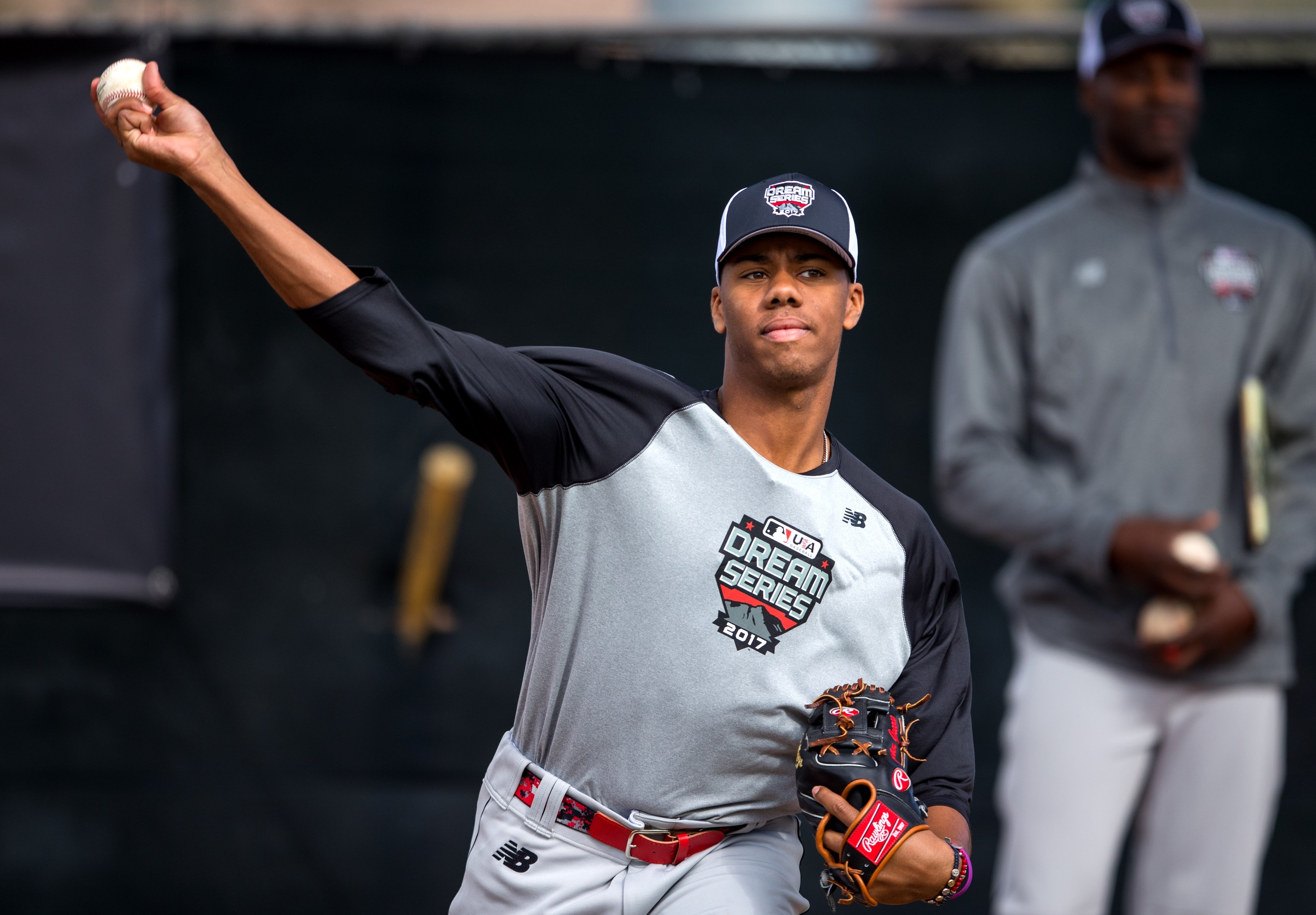
If you are following baseball’s upcoming draft, you have undoubtedly heard the name Hunter Greene - the two-way hard-throwing kid from a Los Angeles-area prep school. If you somehow missed it, Sports Illustrated offered a glowing profile of a kid with plus makeup and off the charts attitude. After reading it, you come away certain this is a can’t miss, surefire Hall of Famer. To drive the point home, on the cover the magazine asked “Baseball’s Lebron or the next Babe?”
In less than 24 hours we will know which direction Derek Falvey, Thad Levine and company have decided to lead the Minnesota Twins. Will they go with the sky-high ceiling of prep school graduate Hunter Greene or target a “safer” college pitcher like Kyle Wright or Brendan McKay, two arms that are further along the development timeline, or, hell, even a position player like Royce Lewis or Pavin Smith?
If you are basing your reaction off the SI article, you will be sadly disappointed when and if the Twins decide to go another direction. Here’s one reason why the Twins might be vindicated on the decision to pass on baseball’s Lebron.
Believe it or not, there are good reasons for the Twins to pass on Greene (as noted recently by Nick Nelson in his excellent profile). Most seem to be concerned with his injury potential and while that may be one of them, we have to remember that almost all pitchers are a high injury risk to some degree. A study from 2016 that links the usage of fastballs (rather than velocity) may make Greene’s reliance on his fastball a slightly higher risk for Tommy John.
One of the more common criticisms levied against Greene is the relatively weak set of secondary offerings to go along with his hundred mile per hour fastball. He throws a curve, slider and changeup but none of them stand out in reports. The Pioneer Press’s Charley Walters echoed this in a recent column saying "despite a fastball that reaches 100 mph, [Greene] has little concept of a breaking ball.”
Is that right? Little concept? In his senior season Greene has flashed signs that he has some concept of a breaking ball as you can see on this little ditty below.
Of course, that specific pitch may have been a rare one-off, well-executed bender for him. Plus, he is squaring off against high school competition that is doing everything possible to just touch the elite velocity pitch. Anything other than the fastball thrown is likely going to induce a big miss. Nevertheless, If we are to take the consensus at its face, scouting reports have been consistent in that criticism about Greene. In May MLB.com’s Jim Callis said that some scouts have rated his curveball as well-below average. While his secondary offerings may not be in the same universe as, say, Josh Beckett’s or Kerry Wood’s curveball coming out of high school, the point is, that depth, tilt and location is evidence that Greene has *some* concept of a breaking ball and that may be a significant factor in the decision whether or not to draft Hunter Greene number one overall.
In terms of the tools Greene possesses as a pitcher, the most touted is his ability to reach triple-digits heat as a 17-year-old. That, in and of itself, is a big reason why he has garnered national attention. If you pop the glove at that type of speed at that age, you will be swarmed by men in bucket hats and polo shirts carrying radar guns all summer long. Having said that, the super hard throwing high school pitcher club is not the exclusive fraternity that it once was. There are 14-year-olds shoving 92 in Alabama (by comparison, Greene was hitting 83 as a freshman in high school). Elite velocity still gets hitters out at a high clip at the major league level but almost all pitchers need a wrinkle to mix in and scouts have felt Greene’s secondary offerings have average potential at best.
The curveball has become a weapon du jour of analytics teams. Tom Verducci wrote an article about the revival of the pitch in major league baseball, noting the rise of Houston’s Lance McCullers and his reliance on his unhittable deuce as the reason for his big season. In the profile Verducci remarked that “[o]rganizations have learned that if someone does not show an aptitude to spin a baseball as an amateur, it’s foolish to expect him to acquire the skill.” Houston’s general manager Jeff Ludlow did not disagree. In short, if you don’t already have a snapdragon bender that spins at 2,900-plus rpm by the time you are drafted, chances are it will never come. The ability the spin a ball depends on years of release point feel, it's not like a slider or changeup that pitchers can learn in the ranks.
With that in mind, it is somewhat concerning that evaluators lack confidence in Greene’s curveball and this might give an organization pause before pulling the trigger at 1-1. In the draft room, Twins staff must be contemplating this and balancing that with the fact that both Vanderbilt’s Wright and Louisville’s McKay already have curves that have been described as plus pitches. Baseball America said that Wright’s curve has been “showing tight spin and late vertical break early and often...the pitch has plus potential.” MLB.com’s draft profile said that McKay’s was “a consistent plus pitch”.
The Twins war room will have to weigh this carefully. There is no doubting his makeup and talent. The real question is, do the Twins have enough confidence in Greene to develop a secondary pitch, anything to take pressure off of throwing his fastball all day long?





Recommended Comments
Create an account or sign in to comment
You need to be a member in order to leave a comment
Create an account
Sign up for a new account in our community. It's easy!
Register a new accountSign in
Already have an account? Sign in here.
Sign In Now