


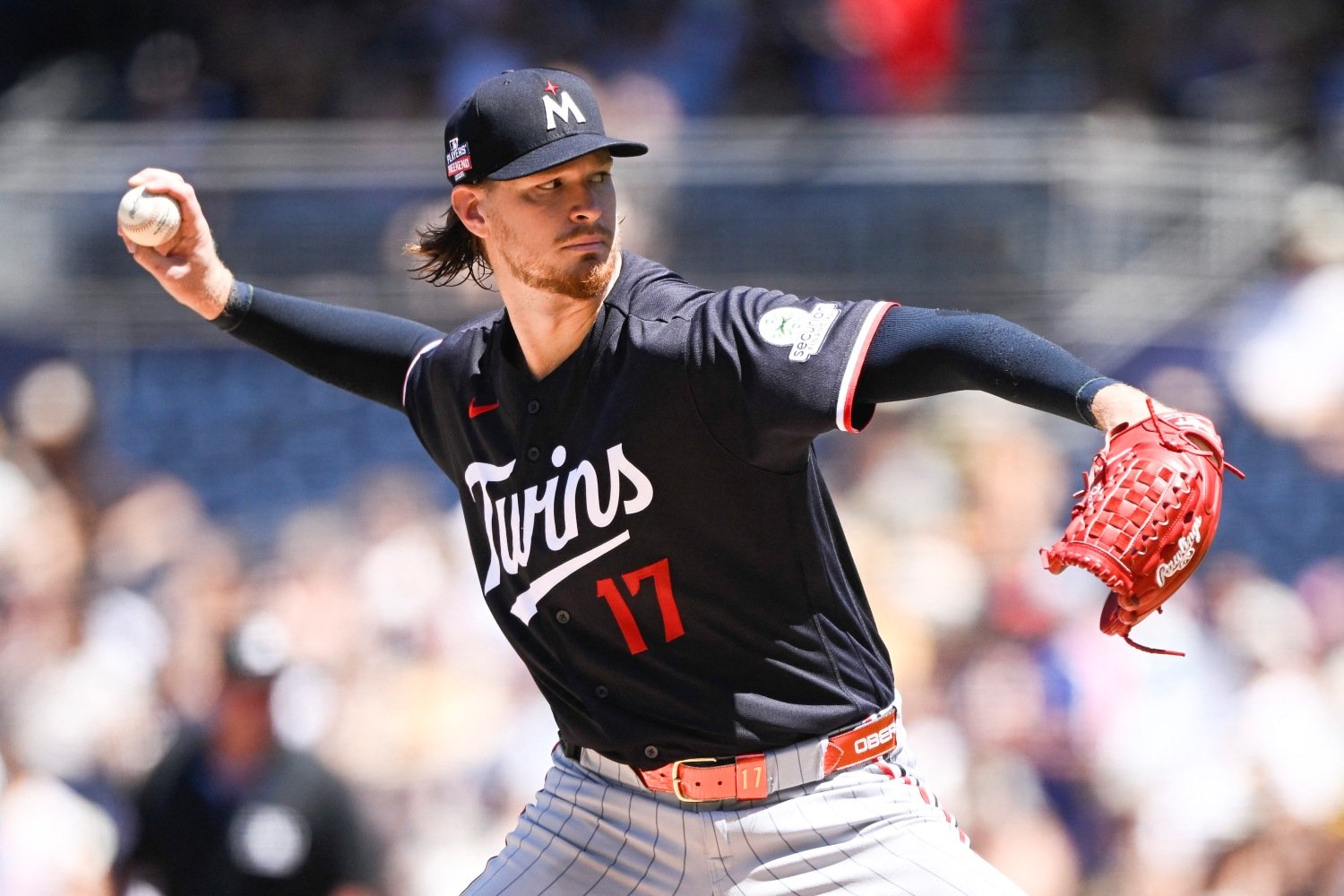
Twins Video
Don't look now, but Bailey Ober has (essentially) a league-average ERA. His 4.28 mark this season is about 0.82 better than the one he put up last year, and his ERA+ of 98 puts him within a whisker of the league average. He's made 22 starts, and figures to make at least two more, including one Tuesday night at Target Field. The Twins are 12-10 when he takes the mound; he's not the problem with this deeply flawed team.
However, if you've watched closely of late, it's evident that the Twins are trusting him less than they did a few months ago. On August 11, Ober worked six innings, threw 100 pitches and faced 26 batters, but since then, he hasn't seen the sixth or gone past 22 batters faced. In his last three outings, Derek Shelton has removed him shy of 90 pitches. That's despite Ober allowing just six runs (five of them earned) in 18 2/3 pitches over those four appearances. August 11 was also the last time he worked on four days' rest; he's gotten five days or more between outings ever since.
Why? It's relatively simple. Ober is surviving by his wits, with great feel and command but virtually no real stuff left with which to work. His fastball has lost velocity not only year by year, but month by month, which has also reduced the velocity gap between his heater and his best secondary offerings, the slider and changeup:

Even that slight recovery you see at the far right of the graph above is an illusion. Ober only seems to be throwing his fastballs harder this month because he's being lifted so proactively, and because he's using that pitch less than he ever has before. His changeup isn't even a secondary pitch anymore; it's become his bread and butter.

In a fairly obvious way, that loss of speed and separation produces a degradation in fastball efficacy and stuff ratings. Less obviously, though, it also compromises those slower offerings. Hitters can cover the change and the breaking stuff better because Ober is throwing considerably slower.
Using FanGraphs's PitchingBot Visualizer tool (part of their wonderful FanGraphs Lab suite), we can now show more clearly how that's happening—how the loss of velocity and raw stuff reduces Ober's margin for error and has diminished the team's confidence in him late in the season. Here's a set of visualizations that illustrate his 2024 season, before he lost his velocity and when he was still striking out 26% of opposing batters with an ERA under 3.30.
.png.375acc7359476f96dc031a5dfc3a8b76.png)
As the headers indicate, this shows (from left to right) the command, stuff and overall ratings of each pitch Ober threw that year, with red meaning good and blue meaning bad. On the left, you see what you should expect to see from such a model: lots of red around the edges of the strike zone, lots of blue far outside it and in the heart, and relatively little grayish in-between stuff. In the middle panel, we're looking only at the caliber of his stuff, based on velocity, release, movement and spin, so location isn't automatically governing the results. As you might guess, though, the higher you go in that graphic, the bluer things get. PitchingBot has always given Ober's fastball a low grade, even when it drew rave reviews for its deceptiveness from his low arm angle. Really, the heater has always benefited from Ober's command and execution on his other offerings, and those others are the ones that tend to show up in red on the middle panel.
The right side is where the most interesting results show up, for this year and the other two we'll consider. Notice that it looks roughly (but not exactly) like the command chart. Throwing the ball well outside the zone is almost always bad; throwing it right down the middle can be even worse if you have subpar stuff. There's wiggle room, though. Mostly, it works against Ober, but not in a devastating way. There's a little more blue in what you could think of as the innermost ring around the center of the zone than there is on the command chart. Even then, Ober's underwhelming stuff could get hit pretty hard in spots that might have been safe for more electric arms.
Ober is good at hitting his spots, though. You already knew that. This chart looks the way it does because he fills up those edges. In 2024, the Visualizer tells us, 4.0% of the pitches he threw were classified as Dangerous Misses—pitches with below-average stuff ratings that were in the hitter's happy zone. The league average for that is closer to 5%, so count him as ahead of the curve at avoiding hard contact for that season, at least process-wise. His Waste Miss (below-average stuff on offerings outside the zone) rate was 29.8%, which is also below the league average (around 31%). Only 8.0% of his pitches were Squandered ones, where he achieved a stuff rating in the top third of his own range but was outside the zone. That's (you guesssed it) lower than the league average, which is more like 10%. Overall, thanks to his sterling command, Ober earned a 53.3 PitchingBot rating for that season, a tick above the average of 50.
Here's the same set of visuals for 2025.
.png.b6772eff26c6988df83e4df35cd72224.png)
The middle panel says plenty, because there's both less red and lighter shades of red where it does appear. But Ober's big problem last season—as he was always quick to say—was command. He stopped hitting the edges as consistently, as he battled multiple physical issues that led to mechanical ones. His Danger Miss rate rose to 6.6%; his Waste Miss rate to 31.7%; and his Squandered rate to 9.9%. Worse stuff ratings hurt him even when he did successfully locate at the bottom and top of the zone, and being able to work east and west became more important; that's part of why his strikeout rate went down. He never adequately compensated for all that, though, which is why he ended the season with an ERA over 5.00 and an orange-flag PitchingBot rating of 48.7.
Now, for 2026:
.png.b43bc4efcf73b2872e57105415aab51c.png)
There's nothing left in Ober's arsenal that grades out as above-average by stuff. He's recovered some of his command, though. He's hitting spots better, but there's a practical limit to how well anyone can do so, and at the level of lifelessness he's dealing with, that ceiling is too low. Look how big the blue in the center of the strike zone has gotten. That's not because Ober is missing there much more often, but because he's been forced to go there a bit more often after falling behind in counts (due to hitters not chasing or whiffing on his tepid stuff) and because pitches that used to be lively enough to work if he kept them out of that middle-middle zone are now just as hittable even a few inches farther in any given direction.
This season, Ober's Waste Miss rate is down slightly, to 30.9%. His Squandered rate is lower, too: 9.4%. But his Danger Miss rate has spiked to 7.5%, meaning that one in every 12 pitches he throws is begging to be hit for extra bases. That's untenable. That's why the Twins are slowly giving up on him.
Ober is a thoughtful and dedicated hurler. He's added a sinker and increased his comfort with the slider, to try to counteract these trends. Right now, though, he's too much of a sitting duck for Shelton to leave him in the third time through an opposing lineup—and the Twins need to start looking at other options for their 2027 starting rotation. Hopefully, further tinkering can unlock something for Ober, as he tries to change to more of a lateral-movement approach to pitching. For now, though, it's hard to fault the Twins for thinking it's time to move on.
Do you approve of the job the Twins front office is doing?

Follow Twins Daily For Minnesota Twins News & Analysis



- Andy MacPhail, thelanges5 and mikelink45
-
 2
2
-
 1
1


Recommended Comments
Create an account or sign in to comment
You need to be a member in order to leave a comment
Create an account
Sign up for a new account in our community. It's easy!
Register a new accountSign in
Already have an account? Sign in here.
Sign In Now