


Twins Video
Overview
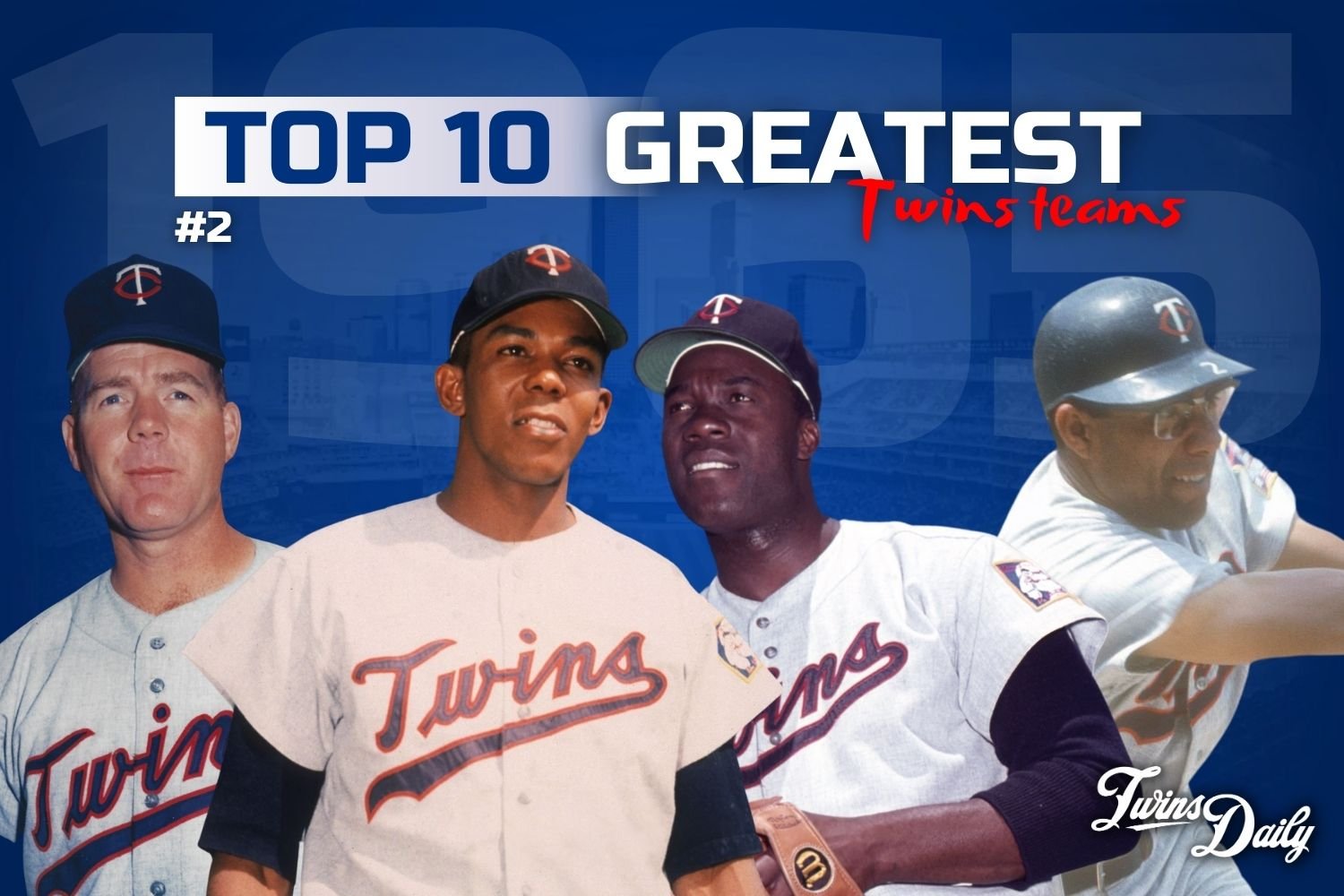
The early '60s Twins were shockingly talented for a team that had freshly arrived in a new city. The 1961 team—the first one officially known as “the Twins”—featured two future MVPs in the lineup (Harmon Killebrew and Zoilo Versalles), and an eventual Hall-of-Famer in the rotation (Jim Kaat). Times were pretty good, better than they should have been.
But Mickey Mantle was smack dab in the middle of his goliath destruction of AL pitching, and the rest of the team around him was pretty good. Those Yankees won the pennant every year from 1960-1964, often cracking 100 wins in the process. They rejected a pair of solid Twins squads in 1962 and 1963, and a down year in 1964 meant the team never came close to a serious run at the World Series. So, with oodles of talent—and enough classic names to fill a history book—the 1965 Twins set off on their greatest adventure yet, decimating the league with shocking efficiency.
Lineup
Minnesota saw seven separate regulars post an OPS+ of at least 115 on their way to scoring nearly 100 runs more than their closest AL competitor*. Killebrew led the group with a pedestrian-for-him 145 mark, while Tony Oliva finished just a few points lower at 141. Yes, how new: a 1960s Twins team had Killebrew and Oliva as the best contributors.
What did stand out about this team was the breadth of stud hitters behind those two. Don Mincher—one of the underappreciated sluggers of his time—cracked 22 home runs and led the league in intentional walks with 15. Not bad for a guy who was almost strictly a pinch-hitter until June. Earl Battey was his typical, reliable self, enjoying the 3rd-best OPS+ of his career (119). Bob Allison was much the same—although his numbers did dip from the skyscraping highs they stood at the two years prior.
And then there was Jimmie Hall. Hall has been lost to time somewhat, forgotten in the great churn of baseball players. The ones who remember him are few and likely don’t find themselves in the company of people who care much to know about him. But, dammit, he owns one of the most fascinating career arcs in baseball history.
Norm King, writing for SABR, briefly summarizes Hall’s odyssey: “Hall burst on the scene with a bang with the Minnesota Twins in 1963. Actually, he had 33 of them, which broke Ted Williams’s AL record for home runs by a first-year player who had never batted in his rookie year. Yes, THAT Ted Williams! But after five seasons that ranged from respectable to excellent, Hall hit seven home runs in his last three campaigns and then disappeared from the game.”**
Hall was still in the midst of that great run in 1965; he essentially matched his line from the previous year but also added 14 steals and sliced a solid chunk off his strikeout rate.
But the man of the year was Zoilo Versalles. He reached his baseball apex, leading the league in runs, doubles, triples, and total bases while playing Gold Glove defense at shortstop. He also stole 27 bases, because why the hell not? In all but seven games, Versalles was the first Twin the opposing starting pitcher battled that day.
Oh, and Versalles is perhaps an even more bizarre case than Hall. Steve Treder dedicated an extended piece at The Hardball Times to ancillary figures in the margins of baseball's strange sudden drop-offs, with Versalles serving as his main character (and Hall as a sidekick). He writes: “[1965] was a lofty perch, and Versalles’ fall was immediate and sickening. In 1966, he saw his batting average drop by 24 points while producing fewer than half as many extra-base hits as in ’65: his Isolated Power went from .189 to .095. He went from a 27-for-32 base stealer to 10-for-22. He went from 32 Win Shares to 12. And he was just getting started.”*** Two years later, Zoilo was a Dodger, and three years after that, he took his final at-bat in the big leagues.
Pitching
The Twins weren’t as great at pitching as they were at hitting, but they were close. Their 114 team ERA+ was the 4th-best in the majors, and the second-best in the AL, only just beaten by the Orioles. The rotation saw one of the better years of Jim Kaat’s Hall-of-Fame career. Mudcat Grant backed him up with his second (and final) All-Star season; he won 21 games and finished 6th in the MVP vote despite a pedestrian ERA by his standards.
The rest of the starting staff was an assortment of chewed gum and sawdust, a smorgasbord of arms used whenever manager Sam Mele needed the man behind the ligament to eat innings for him.
The horribly underrated and typically excellent Camilo Pascual toughed through shoulder tightness—and a nearly three-month-long run without a win—to toss “just” 156 frames. The injury helped push veteran Jim Perry into the starting rotation (where he probably should have been), and he excelled, carrying a 2.63 ERA, the third-lowest of his career. The search for arms was desperate enough that eclectic names like Dwight Siebler and Mel Nelson earned starts as Mele tried anything to get his staff going.
Fortunately, the manager knew he had two studs at the back of his bullpen: Johnny Klippstein and Al Worthington. The two had been big leaguers since the Truman and Eisenhower administrations, respectively. Worthington—a man of such conviction that one of his former employers once jettisoned the righty for disagreeing with their sign-stealing system—joined Minnesota as a spry 35-year-old the previous season and would continue to pitch very effectively for the team into his age 40 seasons.*** The now 94-year-old is still kicking and was recently inducted into the Virginia Baseball Coaches Association Hall-of-Fame for his work at Liberty College.**** Klippstein also became a Twin in 1964; 1965 was his best full season with the team; he held a 2.24 ERA and occasionally spelled Worthington in closing situations.
Postseason
Because this was 1965, the Twins had a simple playoff itinerary: go play the Dodgers for the World Series. LA enjoyed the late-blooming talents of Maury Wills, the truncated Hall-of-Fame arm of Don Drysdale, and the rookie of the year credentials of Jim Lefebvre. But, every other player was window dressing to the resplendent, radiant Sandy Koufax. Baseball had never seen a pitcher so dominant since Cy Young walked off the mound for the final time. His regal excellence shone as brightly in 1965 as they had in any other year; it would take Nolan Ryan’s superhuman power for a mortal to best Koufax’s strikeout total from this season (382). He threw MLB's eighth perfect game just one month prior.
Minnesota claimed the first two games in outstanding fashion. An 8-2 drumming of Drysdale started the series before the team outlasted Koufax in Game Two, instead cracking Ron Perranoski for a trio of runs to back up Kaat in a complete game.
LA won the next three games in their home—all of them as perplexingly convincing as the victories the Twins earned. Game Six knotted the series when Bob Allison and Mudcat Grant—yes, the pitcher—both crushed homers in a Grant complete game, setting up Game Seven as the ultimate do-or-die. Unfortunately for the Twins, Koufax was still very much an outlandish pitching force; he struck out 10 in a complete game shutout to claim the Dodgers’ third championship since moving west.
Concluding Thoughts
I think there’s a very strong argument this team should be #1. No Twins team has won more regular season games, and their offense, relative to the league average, was tremendous. They didn’t even get a full season out of Harmon Killebrew! It didn’t matter; Minnesota still lapped the AL field in scoring.
Sure, they could have pitched better. If you’re splitting hairs, like we have to do in this endeavor, then Kaat is merely a solid ace, not a Frank Viola-type capable of constantly single-handedly shutting down a game. Their best bet for that player may have actually been Jim Perry, who absolutely should have started more than he did.
Still, 102 wins and by far the best run differential in MLB sure looks like an all-time team to me. I think if they win that Game Seven, then there really isn’t a discussion. They take the mantle over any other team. So, should we let one simple game stand between appreciating greatness and ranking a 95-win team above them? I don’t know.
"The legends on that team are just remarkable. Killebrew. Oliva. Allison. Zoilo's MVP season, which could have been Tony O's. Kaat was great. Grant was incredible. Again, just a legendary group. And they won 102 games." -Seth Stohs
"It was before my time, but I can’t imagine how exciting it must have been to go from not having Major League Baseball in Minnesota to hosting the World Series in less than five years. This team won 102 games, still a franchise record. Zoilo Versalles and Tony Olive finished 1-2 in AL MVP voting. If it wasn’t for Sandy Koufax, this team would have been world champs and probably in the top spot on this list." -Tom Froemming
"This is probably the best Twins team, but they didn't win the World Series, which I think rightfully holds a lot of weight. If this team had won the World Series, they likely would have been number one of this list." -Cody Schoenmann
Previous Entries
#10 - 2010
#9 - 2023
#8 - 2002
#7 - 1970
#6 - 2019
#5 - 2006
#4 - 1969
#3 - 1987
Honorable Mentions
Sources
*774, to be exact. Detroit scored 680.
King, Norm, "Jimmie Hall," SABR.
Tredder, Steve, "Of Fades, Flops, and Zoilo," The Hardball Times, November 23rd, 2004.
Laurila, David, "Sunday Notes: Kody Clemens Has Grown Into His Pop," Fangraphs, February 13th, 2022.
Liberty Flames, "Former Liberty Head Baseball Coach Al Worthington to be Inducted into the VBCA Hall of Fame," December 7th, 2023.





Recommended Comments
Create an account or sign in to comment
You need to be a member in order to leave a comment
Create an account
Sign up for a new account in our community. It's easy!
Register a new accountSign in
Already have an account? Sign in here.
Sign In Now