


Twins Video
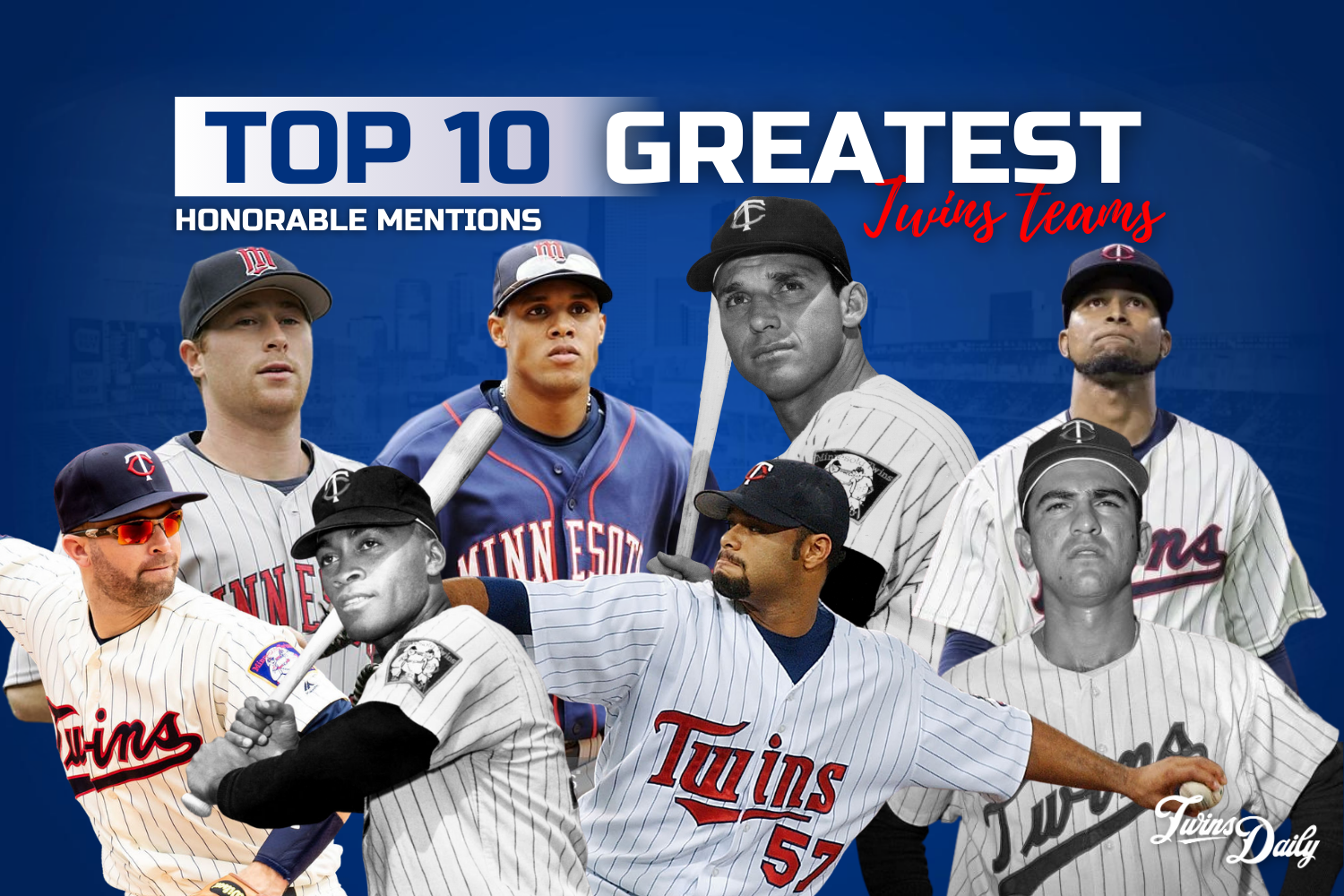
Starting today and going until the weekend before pitchers and catchers report, you’ll find a weekly post highlighting a team we considered among the best in Twins history, Senators not included. (Sorry, Walter Johnson .)
The methodology was simple: I asked our writers to rank the ten greatest teams in Twins history, with potential notes or comments on their selections as they saw fit. From there, points were awarded in reverse order (e.g., 1st place was worth 10 points, 10th place was worth 1 point). I double, triple, then, finally, quadruple-checked to ensure my elementary arithmetic was still intact before the final list—and accompanying honorable mentions—took shape.
What defines “greatest?” I let our voters decide; no boundary or guideline came from me. Perhaps some writers valued regular season performance, playoff success, individual accomplishments, run differential, or just how much fun it was to watch said team in their consideration. Individual ballots reflected their personality to a degree, but I think the consensus represents a solid, well-rounded group touching on numerous critical eras for the team.
No more yapping. Let’s get on to the honorable mentions:
2004 Twins
Our first list-misser was a top-heavy team in transition. A kid named Joe Mauer made an outstanding first impression- and suffered his first injury - with the squad, slashing .308/.369/.570 with nearly as many walks as strikeouts, providing a glimpse as to why the Twins selected the hometown prospect first overall in 2001. Johan Santana won his first Cy Young award with a dominant campaign; he led the league in ERA, strikeouts, ERA+, FIP, WHIP, H/9, and K/9. Throw in the usual excellence from Brad Radke and Torii Hunter, mix in surprise breakouts in Lew Ford and Joe Nathan (only one would stick, take a guess), and it’s not shocking that this team won 92 games, enough to claim the AL Central crown.
This was a 21st-century Twins team, though, which meant their ultimate fate was falling to the New York Yankees in the playoffs.
2009 Twins
It’s rare for one image to symbolize an entire team, but the one for Twins this year is clear and defined: Carlos Gomez streaking around 3rd, dashing home in a hopeful sprint as his teammates explode with exuberance and cheers. He would be safe, they knew, and his successful score capped off one of the greatest games of Twins history, the final regular season game Minnesota would play in the Metrodome. The AL Central was now the Twins’ to own.
The rest of the season went pretty well, too. Nathan, Matt Guerrier, and Jose Mijares headlined a top 10 bullpen by ERA, while an ensemble lineup plated the 5th-most runs of any team in MLB. Orchestrating that offense was a 26-year-old Mauer, who led the league in all three triple-slash categories—as a catcher, mind you—carrying him to an easy MVP despite “only” playing in 138 games.
But, hey, wouldn’t you know it, the Yankees were pretty good this year, too, and they romped the Twins on their way to winning the World Series. So it goes.
1962 Twins
This one may be a surprise even for those well-versed in Twins history: the 1960s teams are usually considered monolithically good, with 1965 as the crowning club. What, then, is there to make of the other teams?
Considering 1962 was only the second season the team played in Minneapolis, the importance of this team may actually be understated. “[F]or them to be really good already in 1962 was huge,” wrote Seth Stohs when voting for them. Indeed, a familiar cast of Camilo Pascual, Jim Kaat, Earl Battey, Bob Allison, Zoilo Versalles, and Harmon Killebrew led Minnesota’s first foray into winning baseball in 1962. Mickey Mantle’s Yankees halted them from going to the World Series—they were pretty good, also, if you didn’t know—but 1962 remained a solid stepping stone for the franchise, one that would lead them into a profoundly successful decade of dominance.
1967 Twins
Hey, it’s the 60s again! This team featured some new stars—mainly a young Rod Carew, a reborn Dean Chance, and arguably the best years of Jim Merrit and Dave Boswell’s careers—but this was still the Killebrew/Allison/Tony Oliva show; Oliva claimed the worst OPS+ of the trio with a 130 mark.
This was also the final season for manager Sam Mele. The Queens native was Minnesota’s skipper since Cookie Lavagetto received the boot partway through the team’s inaugural season. What went around came back to Mele; owner Calvin Griffith pulled the plug on him after the team stood at .500 50 games into the season. Cal Ermer took over, and the team won 20 more games than they lost the rest of the way.
Entering a critical final two-game set against the Red Sox—whom they tussled with in the standings—Minnesota stood at the edge of the playoffs. They blew it, losing both games to send Carl Yastrzemski and the “Impossible Dream” Boston squad to the World Series in their place. Two more measly wins may have reversed history and raised this team’s placement on the rankings, but those excruciating losses knocked them down to honorable mention status.
1963 Twins
This is the final mention of the 60s in this article, I swear. It may seem strange to consider a team that only finished in 3rd place, but—as Tom Froemming wrote—“[t]he 1963 Twins only won 91 games, but had the fourth-best run differential in Twins history (+165). They had a Pythagorean record of 98-63. A lot of franchise icons were on this roster, they went on to do bigger and better things, but this was still a really strong Twins squad.”
Indeed, Allison, Pascual, and rookie sensation Jimmie Hall spearheaded a team that led MLB in runs scored and pitched to the 3rd-best ERA in the AL. Future nerds might call this team “unlucky,” but there’s no reward for poor fortune; all this team could do was watch the Yankees win the World Series again.
2017 Twins
This was a fun Twins team. They weren’t a great one, but they were certainly fun. Fresh off a disastrous 103-loss season, the team cleaned house—but kept manager Paul Molitor—and rebounded to win 85 games, just enough to nab a playoff spot for the first time in seven seasons.
A personal favorite of writer Cody Schoenmann, he writes that having “young players in Byron Buxton, Max Kepler, Jorge Polanco, Eddie Rosario, and Miguel Sano emerge” amongst veteran leaders in Ervin Santana and Brian Dozier was fun to watch.
It may reveal a lot about the actual quality of this squad that “fun” is the consistent adjective used by those who remember the team. Santana, Dozier, and Buxton were excellent players—and Mauer had his best post-injuries season—but depth was thin, and the team couldn’t escape themselves in the postseason, blowing a 4-0 lead in their matchup against… the Yankees. Good lord, 2023 couldn’t happen soon enough.
1988 Twins
Our final team of the day is the often-forgotten follow-up to the famous 1987 squad. The same heroes of before were here—Kirby Puckett, Frank Viola, Kent Hrbek, and more—but their fortune was left in the past; a 104-win Oakland team boasting some bashing brothers flew by the Twins in the division. This was still a formidable group of players: Puckett finished 3rd in MVP voting, while Viola took home the Cy Young, and an otherwise non-descript lefty named Allan Anderson shocked the league by winning the ERA title, becoming the first Twins pitcher to accomplish the feat (how about that for bar trivia!)
But, still, there’s no ring to show for this team, which stuffs them into the “honorable mentions” compartment.
That concludes our honorable mentions. Join us next week to learn who ranked 10th in our Greatest Twins Teams list.








Recommended Comments
Create an account or sign in to comment
You need to be a member in order to leave a comment
Create an account
Sign up for a new account in our community. It's easy!
Register a new accountSign in
Already have an account? Sign in here.
Sign In Now