


Twins Video
MLB Commissioner Rob Manfred has introduced many ideas during his tenure that have changed the game. From the pitch clock to bigger bases, baseball is trying to grow its audience by altering the on-field product. Recently, Matthew Lenz explained the Gold Batter rule and explained that it could be something that breaks traditional baseball fans. In that piece, he said, “In short, the idea is that a team could send their best hitter to the plate regardless of where their spot was in the batting order once a game. So instead of (say) Christian Vázquez being forced to hit in a crucial at-bat, the Twins could use their ‘Golden At-Bat’ and have Royce Lewis get the chance instead.”
Here are some of the most significant Twins moments seen through the lens of revisionist history. How could the “Golden Batter” rule alter the team’s biggest games?
1965 World Series, Game 7
Bottom of the 5th, 1 Out
Frank Quilici doubled with one out in the inning to bring the tying run to the plate. Rich Rollins was used as a pinch hitter against Sandy Koufax and worked the count full before drawing a walk and putting two runners on. Zoilo Versalles was up next, and there is no way the Twins would use the Golden Batter rule for the man who won the AL MVP that year. He hit a hard liner to third base for the second out of the inning. However, the man batting after him was Joe Nossek, a batter who posted a .556 OPS during the regular season and might have provided the team with the perfect time to get back in the game.
The season was on the line, and Harmon Killebrew and his mighty swing could have used the Golden Batter rule to step in and change World Series history for the Twins. He had already hit one home run early in the series and was getting on base over 44% of the time in the seven-game set. Killebrew had ten plate appearances against Koufax in his career and went 4-for-9 (.444 BA) with one walk and one strikeout. It could have provided a Hall of Fame moment for the two players who eventually ended up in Cooperstown.
1987 World Series, Game 7
Bottom of the 5th, 1 Out
The Twins ran into multiple outs during the bottom of the fifth inning as the team tried to take the lead in a winner-take-all Game 7. Greg Gagne knocked a one-out single to get the inning started before Kirby Puckett drove him in with a double. Gary Gaetti followed with a walk to put two base runners on with one out. In the game, Don Baylor was batting, and Puckett was thrown out while trying to steal third. Baylor singled later in the at-bat, but Gaetti was thrown out trying to score from second. The scoring opportunity died on the bases, and the Twins had to find other ways to score in the late innings.
Since Danny Cox, a right-handed hitter, was on the mound, the Twins could have used the Golden Batter rule to allow Kent Hrbek to bat in place of Baylor. Baylor had a tremendous World Series, going 5-for-13 (.385 BA) with a home run. However, the Twins could have played the platoon advantage with Hrbek, who hit a grand slam in Game 6. Perhaps using the Golden Batter rule would have stopped the Twins from running their batters into the outs during that inning.
1991 World Series, Game 7
Bottom of the 2nd, 2 Outs
Game 7 of the 1991 World Series is arguably one of baseball’s greatest games. However, the Golden Batter rule could have changed the outcome in favor of either team. It was only going to take one run to win this game, so both teams would have used the Golden Batter rule at some point. Some of Minnesota’s biggest moments in the game came in the bottom of the 8th or the bottom of the 10th inning. However, one moment earlier in the game might have produced a golden opportunity.
In the bottom of the second inning, Brian Harper and Shane Mack had back-to-back singles with two outs in the frame. Third baseman Mike Pagliarulo, the number eight hitter, was due up next and the Twins could have substituted another hitter in his place. Minnesota could have played the platoon advantage or sent up their best hitter. Puckett had his signature moment in Game 6 with the walk-off home run, but this would have given him an opportunity in Game 7. Tom Kelly could use the Golden Batter rule and never look back from the team’s second World Series title.
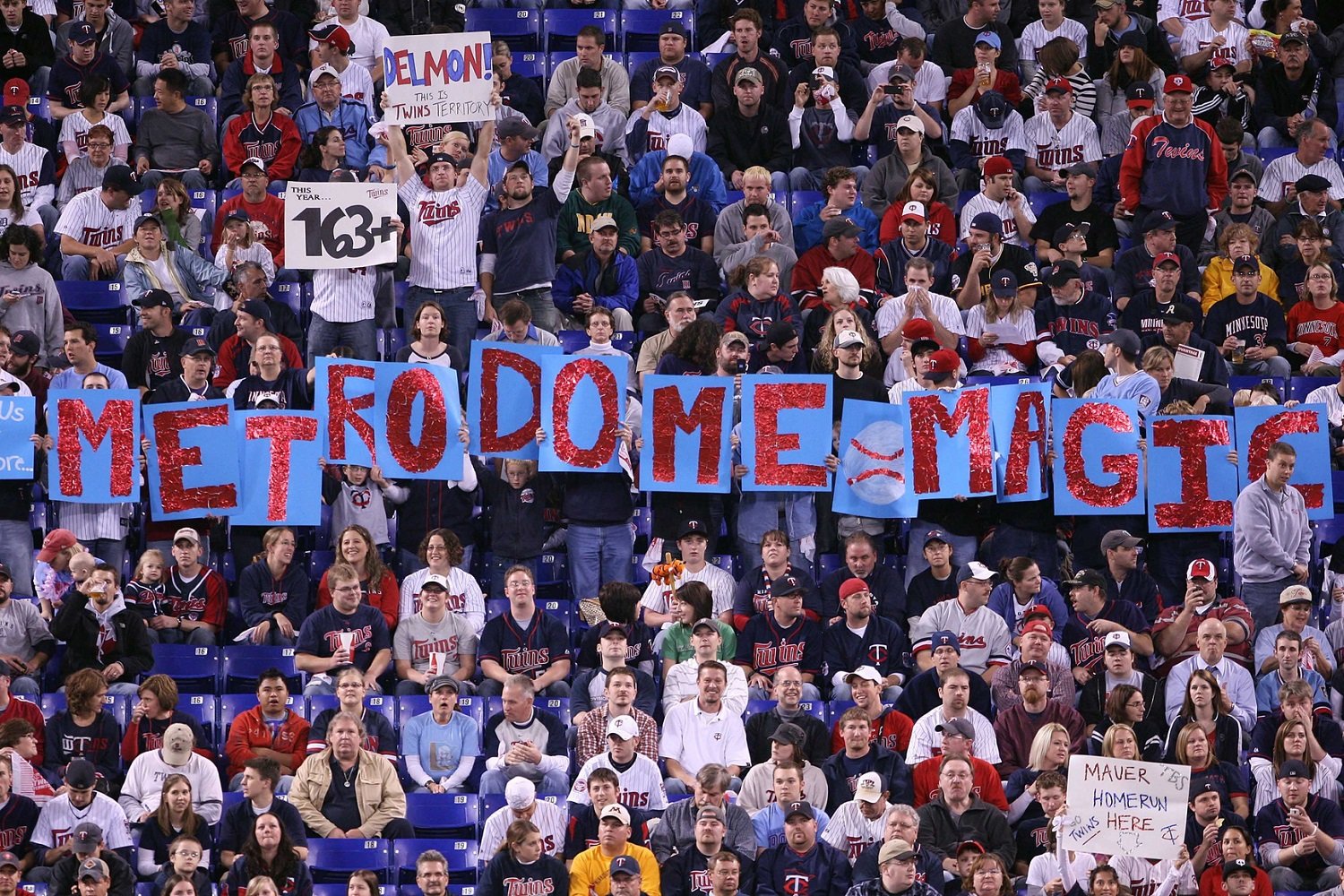
Game 163 (2009)
Bottom of the 9th, 2 Outs
The Twins were going to send the Metrodome out with a bang, and that happened in one of the most dramatic ways. The Twins and Tigers battled back and forth for twelve innings before Minnesota came out on top. Alexi Casilla drove in Carlos Gómez with a single in extra-innings, and over 50,000 Twins fans exploded as Gómez slid headfirst into home plate. However, the Golden Batter rule could have saved some late-inning heroics.
Minnesota had a chance to win the game in the bottom of the ninth with two outs. Nick Punto had walked to start the inning before moving to second on a Denard Span bunt. Joe Mauer was intentionally walked with first base open, so Gómez stepped up with a chance to end the game. It would be interesting to see how this rule could be used in this situation. It would make the most sense for the Twins to have Mauer bat again since he was the eventual AL MVP. Minnesota only needed a single to let Punto score from second. Bring Mauer up to end the game.
Many lifelong baseball fans will be trepidatious about any rule change. However, it's fun to look back at Twins history and see how moments could have changed with a different batter at the plate.
What other moments from Twins history would have been altered by this rule change? Leave a COMMENT and start the discussion.
Do you approve of the job the Twins front office is doing?

Are you interested in Twins history? Then check out the Minnesota Twins Players Project, a community-driven project to discover and collect great information on every player to wear a Twins uniform!
View The Players Project



Recommended Comments
Create an account or sign in to comment
You need to be a member in order to leave a comment
Create an account
Sign up for a new account in our community. It's easy!
Register a new accountSign in
Already have an account? Sign in here.
Sign In Now