



Sarah
-
Posts
336 -
Joined
-
Last visited
Content Type
Profiles
News
Minnesota Twins Videos
2026 Minnesota Twins Top Prospects Ranking
2022 Minnesota Twins Draft Picks
Minnesota Twins Free Agent & Trade Rumors, Notes, & Tidbits
Guides & Resources
2023 Minnesota Twins Draft Picks
The Minnesota Twins Players Project
2024 Minnesota Twins Draft Picks
2025 Minnesota Twins Draft Pick Tracker
2026 Minnesota Twins Draft Tracker: Picks & Bonuses
Forums
Blogs
Events
Store
Downloads
Gallery
Everything posted by Sarah
-
I have six left. I guess you will be making a return trip to Atlanta and Texas once they get their new stadiums but I have been able to get so far because most of the teams have new stadiums now. I think the only one where I have been to the old stadium but not the new stadium is Cincinnati, the rest I either never got to the old stadium or have been to both the old stadium and the new stadium. I want to go to Atlanta because then I can go to a Lookouts game at the same time but I figured I might as well wait until they got their new stadium. I might make it to Texas before they get their new stadium though since that's still a few years away. The ones I have left are Toronto, Cincinnati, Atlanta, Miami, Texas and Houston and out of the ones I've been to so far PNC Park in Pittsburgh is my favorite. I just went to Citi Field in New York over Fourth of July weekend and really liked that one. I would definitely go back there before I would go back to Yankee Stadium but maybe that's partly because I'm a Twins fan who has some strong feelings about the Yankees.
-

Should The Twins Sign Alex Rodriguez?
Sarah replied to Seth Stohs's topic in Twins Daily Front Page News
Ugh, this makes me want to puke. Just go away A-Rod. Always so depressing to see a once great player just hanging on...- 74 replies
-
- 2
-

-
- alex rodriguez
- jim thome
- (and 3 more)
-
I figured the game last night (makeup from Wednesday's rain out) wouldn't be on TV but it was so they must have some kind of rule about broadcasting makeup games?
-
Meh...I liked Go Go as much as anyone when he was with the Twins but he's not getting any younger. We have plenty of (much younger) outfielders that we need to get figured out.
-
I have been watching some of it and am not enjoying NBC's coverage either. I realize that you want the gymnastics events on in prime time but it's so poorly edited that it is hard to follow. "Here's her performance on the vault...and here's her gold medal." Huh? I'm pretty sure something happened in between. It would be more interesting to watch some of the other performances so you have a better reference for how spectacular the women's team really is. And there has been a lot of talk about sexism - where the heck are men's gymnastics? I like to watch that too. I do have cable so have been enjoying some of the coverage on the other channels. In one of the archery matches they were talking about how the participants shoot between 300 and 400 arrows a day to prepare. And water polo - how do you tread water for so long? Some amazing athletes out there...
-
Great article, I agree with you about this. I have ticket stubs from many games, performances, museums, etc I have visited. It's a cheap memento and helps you remember when you actually went to something. I am taking my niece and nephews to the Twins game next weekend and I chose getting the tickets in the mail because I like them to have the experience of having their own ticket and handing it to the usher to get in. It's fun!
-
Yes, I second what everyone else has said - you should definitely make a side trip. It's a great museum and Cooperstown is a lovely town. I was there in 2011 for Bert Blyleven's introduction - what a great experience. I probably won't go back though unless someone else is driving. It is out of the way from most places so I guess that's another reason to visit since you're already going to be in upstate New York. Enjoy!
-
I just went to a LaCrosse Loggers game in the Northwoods League and let's just say they sell beer at those games. Apparently they have a promotion called the beer batter where if one of the guys on the other team strikes out you get free beer (yes, it was a small beer). So when this happened about half of the stadium left to go to the concession stand and as he was walking by me a guy yelled at the batter returning to the dugout, "Thanks for the beer, 44!" All I could think was, "This is SO Wisconsin." I have been to a few games in the Northwoods League too - would definitely recommend it. The ballpark in LaCrosse is right on the river, free parking, great brats and really cute log cabin type suites in the outfield.
-
The one bad thing about Minneapolis is there is a lot of construction going on around downtown and by the Walker Art Center and sculpture garden area. In addition to the Stone Arch Bridge, you can go up to the "Endless Bridge" at the Guthrie Theater for a great view of the riverfront (it's like an observation platform and it's free). Definitely check out the chain of lakes area! Chicago is awesome too, sounds like you will be visiting some great American cities!
-
Best Food or Beverage Deal at Target Field
Sarah replied to strumdatjaguar's topic in Minnesota Twins Talk
You can also sign up for designated driver and get a cup of water instead of soda - I don't think they are allowed to give cups out if you don't have the coupon though. They have regular water on the fountain taps at Target Field but apparently not at all ballparks (I asked if they had water on their fountain tap with my DD coupon at Citi Field and the lady looked at me like I was crazy.) I have brought lots of food into the stadium. The other thing that I have tried that is reasonably priced are the beef tacos - I think you get two for $6 and they are tasty. -
The Independence Day Baseball Blackout
Sarah replied to Nick Nelson's topic in Twins Daily Front Page News
I was at the game and understand that FSN doesn't broadcast many weekday afternoon games but geez, you'd think they would make an exception for the 4th of July. I remember one year the Twins were off (not even playing) on Memorial Day and when I saw that on the schedule I was like, whaaatt??? Ugh, you should be able to watch the national pastime on a national holiday. That is all. -
You will love it! Target Field really is spectacular - get there early because there are lots of different areas to check out like Minnie and Paul, Town Ball Tavern, Hrbeks, etc. My favorite concessions are Kramarczuk’s bratwurst and Butcher and the Boar rib tips. And I agree with everyone else here, considering how the Twins are doing this year you will not have trouble getting tickets. And you are coming at a great time of year, Minnesota is really nice in September. You will love Citi Field too! I was just at the Mets-Cubs game last week and it is a great ballpark. They have a really welcoming atrium area where you walk in, beautiful views of the field all around the ballpark and tons of great food options. (I had the lobster roll - it was delicious.) I took the subway to the ballpark - they run more trains before and after the game and the one we took back to Manhattan after the game was an express so it skipped some of the stops which was nice. (Plus, you get a great view of Manhattan on the way back.) I told my cousin who lives in New York I would much rather go to a game there than Yankee Stadium but I am biased as a Twins fan who hates the Yankees... Enjoy!
-
Thanks for the recap, I wanted to come to this but you can only go on so many trips...the Saints are hosting the American Association All-Star Game in August so that will be fun!
-
More than 100 years ago Minnesota was home to one of the best baseball teams in the country. The St. Paul Colored Gophers, who in 1909 beat the Chicago-based Leland Giants for the title of “Blackball World Champions,” are just one of the teams highlighted in the new book “They Played for the Love of the Game: Untold Stories of Black Baseball in Minnesota” by Frank White. A thoroughly researched addition to our state’s history, this title is also visually appealing with the inclusion of approximately 100 photos, including one of Prince Honeycutt, Minnesota’s presumed first black baseball player who helped form the Fergus Falls North Stars baseball club in 1873, and scorecards from the Uptown Sanitary Shop, a baseball club formed by a dry cleaning business in St. Paul in 1922. The Negro National League, which ultimately included some of the most famous names in baseball history including Satchel Paige and Josh Gibson, was started by Chicagoan Rube Foster in 1920. When reading White’s book, one question comes to mind: with Minnesota’s prominence in the world of black baseball why weren’t they awarded a team when the league started? Perhaps it was because of an issue that still confronts us today – travel. “It was probably just too financially difficult to have a team in Minnesota,” Frank White told me recently. “Minnesota was considered far away from the other teams.” In today’s over stimulated world of endless varieties of entertainment, another theme of the book is the rise of baseball as America’s game – one picture from 1925 shows a girls team from the Phyllis Wheatley Settlement House in north Minneapolis. What was it about baseball that captivated a nation no matter who you were? “It allowed you to walk away from everyday challenges,” said White. “For those who played the game, there was nothing quite as satisfying as the feeling of hitting the ball flush with a wooden bat.” White also includes a personal connection to this slice of state history – his father, Louis White, played with the Twin City Colored Giants in the 1950’s and Buck O'Neil (who gained fame after eloquently sharing his remembrances of the Negro Leagues for the PBS miniseries "Baseball") once tried to recruit him to join the Kansas City Monarchs. The annals of baseball lore run deep and the stories are seemingly endless for those who played for the love of the game. Frank White will be doing a talk at the Hosmer Library in Minneapolis on Monday, June 27 from 6:30 - 8 pm. For more information or for future events, you can visit his website at http://www.minnesotablackbaseball.com
-
If you are looking for another sports related broadcast, Sean Aronson, the Saints broadcaster and general media relations guru, has launched a podcast called "The Voice Behind the Voice" where he talks with announcers from lots of different sports (not just baseball). I found it on Facebook and have enjoyed the episodes I have listened to.
-
And keep in mind that these guys get paid very handsomely for watching baseball - even if it's bad baseball.
-
How is that a hit?” Most baseball fans have said this after the scoreboard flashes the result on a sharp grounder or botched fly ball. The person in charge of making these hit/error determinations is the official scorer, often an anonymous recorder of stats until his judgment puts him in the spotlight. Recently I had a chance to shadow Stew Thornley, one of the Twins official scorers, to get firsthand insight into this sometimes misunderstood part of the game. How is that a hit?” Most baseball fans have said this after the scoreboard flashes the result on a sharp grounder or botched fly ball. The person in charge of making these hit/error determinations is the official scorer, often an anonymous recorder of stats until his judgment puts him in the spotlight. Recently I had a chance to shadow Stew Thornley, one of the Twins official scorers, to get firsthand insight into this sometimes misunderstood part of the game. At Target Field, the official scorer sits in the first seat in the front row of the press box on the left as you’re looking at the field. When I picked up my media pass I noticed the person who signed in before me was from MBC Korea, one of that country’s three major broadcasting systems. Most of the time the press box was quiet, punctuated mainly by the sound of typing. For the official scorer, the tools of the trade include a laptop, binoculars, a scoresheet plus extra notepads to keep pertinent information close at hand and a TV monitor showing the FSN feed. I realized quickly how useful it was to have the monitor on a ten second delay, not just for the official scorer but also for the datacaster who sits next to the official scorer and is responsible for recording all game action for those following online. There is no specific time the official scorer needs to get there before the game, Thornley said, but it’s his preference to arrive early and get into a routine (routines are not just for the men on the field). When I arrived at 5 pm for a 7:10 start he was already there, double-checking information for that night’s game. As many do, he began his lifelong relationship with the statistical side of the game by keeping score when attending games at Metropolitan Stadium as a kid. When he said that he had a knack for it, he paused and chuckled as he said, “Yeah, I know - why couldn’t I have gotten a knack for something useful, right?” He has previously worked as an official scorer for the Minneapolis Loons and St. Paul Saints and started with the Twins in 2007. He splits the duties with Gregg Wong, a former Pioneer Press sports reporter, and there is also a backup official scorer. (Thornley also has a “day job” as Health Educator with the Minnesota Department of Health.) Official scorers are paid $170 per game and are employees of Major League Baseball, not any specific team. Last year, Marie-Claude Marcotte-Pelland joined the few female official scorers in Major League Baseball history when she worked a Blue Jays-Marlins game in Toronto. In mentioning this, Thornley, a member of the local chapter of the Society for American Baseball Research (SABR), also shared the story of Eliza Green Williams, who secretly served as the official scorer in the 1880’s for the Chicago White Stockings or Colts, the team that would be renamed the Cubs in the next century. She would submit her reports as “E.G. Green” so as to not identify herself as a woman. There is a distinct element of “hurry up and wait” in the job as an official scorer, as we casually chatted about the baseball topic of the day until a sharp grounder caused all eyes to turn to the video monitor while the official scorer grabbed the microphone to announce his ruling on that specific play. As the game went along, there were also periodic announcements from Dustin Morse, the Twins Senior Director of Communications, for such things as pitching changes and home run distance announcements. “I was nervous when I first started with the Twins,” Thornley admitted, while he explained the tension between wanting to get the call right and wanting to sound confident and announce the call right away. If players or teams strongly disagree with a call, they can submit it to Major League Baseball for review by the league office. He said he has gotten more complaints from the batting team if they don’t get a hit. Being an umpire would be good practice for becoming an official scorer, he said, because you get really good at being decisive and “taking a lot of crap.” (I’ve also seen the job of an official scorer described as getting paid $5 for scoring the game and $165 for taking the grief that goes with it, but I guess you could say that about any job.) If you don’t like being questioned and having to defend yourself, he said, being an official scorer is not for you. But in comparison to the umpires, he noted that “They are the ones who make the calls that can determine who wins or loses…we do stats.” The evolution of official scoring is an interesting aspect of the history of the game itself, and Thornley chairs a SABR committee that studies and interprets the changes throughout the years. As we looked upon a beautifully manicured grass infield, he reminisced about how everyone was told that the advent of artificial turf meant that you would never have to worry about a bad hop. When the third baseman took up the shortstop position during a shift, I asked him if the sometimes dramatic shifts employed by teams in recent years can get confusing for those recording stats. He professed his love for the teams who put player numbers on both the front and back of the jerseys and said you can often look for other distinguishing features – for example, in the game I attended, two of the Tigers infielders were sporting high socks. “I know it’s easy to sit at home and think you could do it better,” he said. “I have friends who constantly pepper me with questions on why I called what I did, (friends) who have never been an official scorer…and there’re also people who just don’t understand the rules of the game. It does give you respect for everyone in this game who gets second-guessed.” In an effort to standardize scoring, Thornley has attended meetings in New York with other official scorers around the league, where they will review plays and discuss controversies. “It’s always a judgment call with a human element and the line will continue to be fuzzy, not fine. It’s our hope to continue to reduce the level of fuzziness.” View full article
-
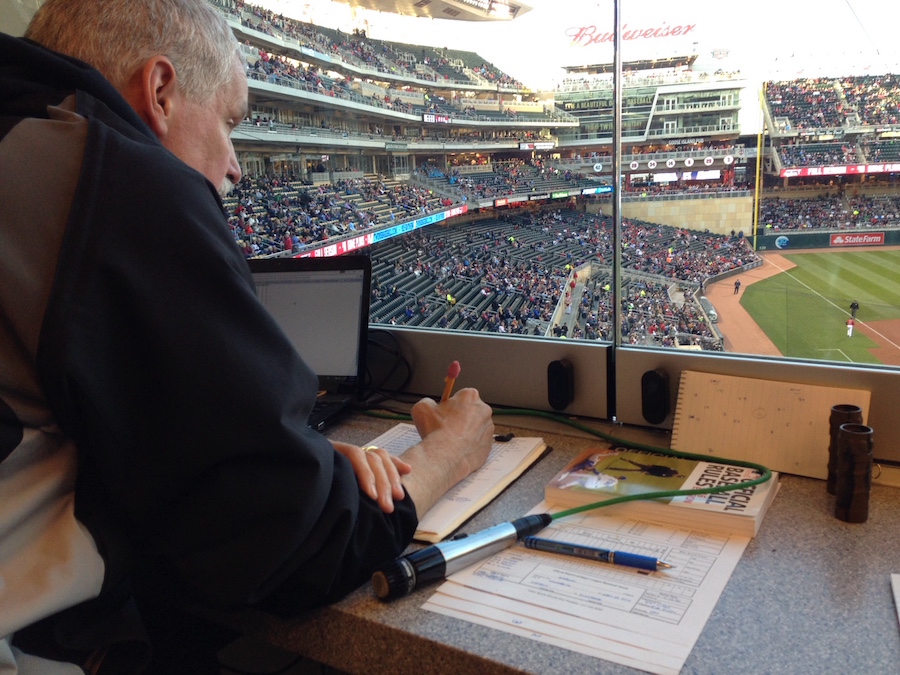 At Target Field, the official scorer sits in the first seat in the front row of the press box on the left as you’re looking at the field. When I picked up my media pass I noticed the person who signed in before me was from MBC Korea, one of that country’s three major broadcasting systems. Most of the time the press box was quiet, punctuated mainly by the sound of typing. For the official scorer, the tools of the trade include a laptop, binoculars, a scoresheet plus extra notepads to keep pertinent information close at hand and a TV monitor showing the FSN feed. I realized quickly how useful it was to have the monitor on a ten second delay, not just for the official scorer but also for the datacaster who sits next to the official scorer and is responsible for recording all game action for those following online. There is no specific time the official scorer needs to get there before the game, Thornley said, but it’s his preference to arrive early and get into a routine (routines are not just for the men on the field). When I arrived at 5 pm for a 7:10 start he was already there, double-checking information for that night’s game. As many do, he began his lifelong relationship with the statistical side of the game by keeping score when attending games at Metropolitan Stadium as a kid. When he said that he had a knack for it, he paused and chuckled as he said, “Yeah, I know - why couldn’t I have gotten a knack for something useful, right?” He has previously worked as an official scorer for the Minneapolis Loons and St. Paul Saints and started with the Twins in 2007. He splits the duties with Gregg Wong, a former Pioneer Press sports reporter, and there is also a backup official scorer. (Thornley also has a “day job” as Health Educator with the Minnesota Department of Health.) Official scorers are paid $170 per game and are employees of Major League Baseball, not any specific team. Last year, Marie-Claude Marcotte-Pelland joined the few female official scorers in Major League Baseball history when she worked a Blue Jays-Marlins game in Toronto. In mentioning this, Thornley, a member of the local chapter of the Society for American Baseball Research (SABR), also shared the story of Eliza Green Williams, who secretly served as the official scorer in the 1880’s for the Chicago White Stockings or Colts, the team that would be renamed the Cubs in the next century. She would submit her reports as “E.G. Green” so as to not identify herself as a woman. There is a distinct element of “hurry up and wait” in the job as an official scorer, as we casually chatted about the baseball topic of the day until a sharp grounder caused all eyes to turn to the video monitor while the official scorer grabbed the microphone to announce his ruling on that specific play. As the game went along, there were also periodic announcements from Dustin Morse, the Twins Senior Director of Communications, for such things as pitching changes and home run distance announcements. “I was nervous when I first started with the Twins,” Thornley admitted, while he explained the tension between wanting to get the call right and wanting to sound confident and announce the call right away. If players or teams strongly disagree with a call, they can submit it to Major League Baseball for review by the league office. He said he has gotten more complaints from the batting team if they don’t get a hit. Being an umpire would be good practice for becoming an official scorer, he said, because you get really good at being decisive and “taking a lot of crap.” (I’ve also seen the job of an official scorer described as getting paid $5 for scoring the game and $165 for taking the grief that goes with it, but I guess you could say that about any job.) If you don’t like being questioned and having to defend yourself, he said, being an official scorer is not for you. But in comparison to the umpires, he noted that “They are the ones who make the calls that can determine who wins or loses…we do stats.” The evolution of official scoring is an interesting aspect of the history of the game itself, and Thornley chairs a SABR committee that studies and interprets the changes throughout the years. As we looked upon a beautifully manicured grass infield, he reminisced about how everyone was told that the advent of artificial turf meant that you would never have to worry about a bad hop. When the third baseman took up the shortstop position during a shift, I asked him if the sometimes dramatic shifts employed by teams in recent years can get confusing for those recording stats. He professed his love for the teams who put player numbers on both the front and back of the jerseys and said you can often look for other distinguishing features – for example, in the game I attended, two of the Tigers infielders were sporting high socks. “I know it’s easy to sit at home and think you could do it better,” he said. “I have friends who constantly pepper me with questions on why I called what I did, (friends) who have never been an official scorer…and there’re also people who just don’t understand the rules of the game. It does give you respect for everyone in this game who gets second-guessed.” In an effort to standardize scoring, Thornley has attended meetings in New York with other official scorers around the league, where they will review plays and discuss controversies. “It’s always a judgment call with a human element and the line will continue to be fuzzy, not fine. It’s our hope to continue to reduce the level of fuzziness.”
-
“How is that a hit?” Most baseball fans have said this after the scoreboard flashes the result on a sharp grounder or botched fly ball. The person in charge of making these hit/error determinations is the official scorer, often an anonymous recorder of stats until their judgment puts them in the spotlight. Recently I had a chance to shadow Stew Thornley, one of the Twins official scorers, to get firsthand insight into this sometimes misunderstood part of the game. At Target Field, the official scorer sits in the first seat in the front row of the press box on the left as you’re looking at the field. When I picked up my media pass I noticed the person who signed in before me was from MBC Korea, one of the country’s three major broadcasting systems. Most of the time the press box was quiet, punctuated mainly by the sound of typing. For the official scorer, the tools of the trade include a laptop, binoculars, a scoresheet plus extra notepads to keep pertinent information close at hand and a TV monitor showing the FSN feed. I realized quickly how useful it was to have the monitor on a ten second delay, not just for the official scorer but also for the datacaster who sits next to the official scorer and is responsible for recording every game action for those following online. There is no specific time the official scorer needs to get there before the game, Thornley said, but it’s his preference to arrive early and get into a routine (they’re not just for the men on the field). When I arrived at 5 p.m. for a 7:10 start he was already there, double checking information for that night’s game. As many do, he began his lifelong relationship with the statistical side of the game by keeping score when attending games at Metropolitan Stadium as a kid. When he said that he had a knack for it, he paused and chuckled as he said, “Yeah, I know - why couldn’t I have gotten a knack for something useful, right?” He has previously worked as an official scorer for the Minneapolis Loons and St. Paul Saints and started with the Twins in 2007. He splits the duties with Gregg Wong, a former Pioneer Press sports reporter, and they also have a backup official scorer. (He also has a “day job” as Health Educator with the Minnesota Department of Health.) Official scorers are paid $170 per game and are employees of Major League Baseball, not any specific team. Last year, Marie-Claude Marcotte-Pelland joined the few female official scorers in Major League Baseball history when she worked a Blue Jays-Marlins game in Toronto. In mentioning this, Thornley, a member of the local chapter of the Society for American Baseball Research (SABR), also shared the story of Eliza Green Williams, who secretly served as the official scorer in the 1880’s for the Chicago White Stockings or Colts, the team that would be renamed the Cubs in the next century. She would submit her reports as “E.G. Green” so as to not identify herself as a woman. There is a distinct element of “hurry up and wait” in the job as an official scorer, as we casually chatted about the baseball topic of the day until a sharp grounder caused all eyes to turn to the video monitor while the official scorer grabbed the microphone to announce his ruling on that specific play. As the game went along, there were also periodic announcements from Dustin Morse, the Twins Senior Director of Communications, for such things as pitching changes and home run distance announcements. “I was nervous when I first started with the Twins,” Thornley admitted, while he explained the juxtaposition between wanting to get the call right and wanting to sound confident and announce the call right away. If players or teams strongly disagree with a call, they can submit it to Major League Baseball for review by the league office. He said he has gotten more complaints from the batting team if they don’t get a hit. Being an umpire would be good practice for becoming an official scorer, he said, because you get really good at being decisive and “taking a lot of crap.” (I’ve also seen the job of an official scorer described as getting paid $5 for scoring the game and $165 for taking the grief that goes with it, but I guess you could say that about any job.) If you don’t like being questioned and having to defend yourself, he said, being an official scorer is not for you. But in comparison to the umpires, he noted that “They are the ones who make the calls that can determine who wins or loses…we do stats.” The evolution of official scoring is an interesting aspect of the history of the game itself, and Thornley chairs a SABR committee that studies and interprets the changes throughout the years. As we looked upon a beautifully manicured grass infield, he reminisced about how everyone was told that the advent of artificial turf meant that you would never have to worry about a bad hop. When the third baseman switched places with the shortstop, I asked him if the sometimes dramatic shifts employed by teams in recent years can get confusing for those recording stats. He professed his love for the teams who put player numbers on both the front and back of the jerseys and said you can often look for other distinguishing features – for example, in the game I attended, two of the Tigers infielders were sporting high socks. “I know it’s easy to sit at home and think you could do it better,” he said. “I have friends who constantly pepper me with questions on why I called what I did who have never been an official scorer…and there’s also people who just don’t understand the rules of the game. It does give you respect for everyone in this game who gets second guessed.” In an effort to standardize scoring, Thornley has attended meetings in New York with other official scorers around the league, where they will review plays and discuss controversies. “It’s always a judgment call with a human element and the line will continue to be fuzzy not fine. It’s our hope to continue to reduce the level of fuzziness.”
-
“I know that guy had an extra RBI in 1954.” Minnesotan Hans van Slooten gets these inquiries daily as the primary developer for Baseball-Reference.com. The Halsey Hall chapter of the Society for American Baseball Research invites you to join us at the Roseville Library on Monday, May 16 as we welcome Hans to give a presentation on this popular site that has become an indispensible resource for statheads, casual fans, current and ex-players, baseball researchers and everyone in between. Van Slooten will provide a brief history of the website, reveal some of the lesser known corners of the site and provide a tutorial on the site’s play indexes. He will also answer questions and run any play index queries requested by the audience. While some may consider spending their day working with baseball stats a dream job, van Slooten told me recently with a laugh, “It’s not nearly as glamorous as it sounds.” The main office is in Philadelphia so he works normal business hours (“on east coast time”) from his home in St. Paul. A typical day may include fixing bugs on the site or developing new features. “I spent a lot of time earlier getting ready for the new season,” said van Slooten, who has a degree in computer science. Another big responsibility is responding to daily inquiries – “A lot of the historical questions get forwarded onto Retrosheet but I also get emails from former minor leaguers saying, ‘Hey, you spelled my name wrong.’ And I can’t just take their word for it, I have to verify that they are who they say they are before I can correct it.” With the sheer amount of information on the site, it’s easy to get lost in a mountain of data. “Sometimes I forget everything we have on the site,” van Slooten says. “It’s fun to search for random stuff like a Hall of Famer’s worst game or guys who played one major league game.” The site is 15 years old so it has its bugs and the work is ongoing – continuing projects include speeding up the site’s loading time and improving the mobile capabilities. So if you’ve ever wondered how many complete games Old Hoss Radbourn had in 1884 (73 – take that, Bert Blyleven), join us for an evening of stats, baseball history and random information that every baseball fan needs filling their brain on a daily basis. An Evening with Hans van Slooten Monday, May 16, 2016 7 pm Roseville Library 2180 Hamline Avenue, Roseville, 55113 Hamline Avenue and County Road B This event is free and no RSVP is required.
-
Spring Training 2016: Questions/Info/Help/Etc
Sarah replied to dougkoebernick's topic in Minnesota Twins Talk
Hey, no one has mentioned Sun Harvest Citrus - I loved that place. It's about a mile down the road from Hammond Stadium and it has free samples of different types of citrus, yummy smoothies, ice cream cones, etc. I also second the Thomas Edison estate, I thought that was really interesting - fun thing to do in the morning before the game. Hopefully I will be going down again one of these years, it's really great - enjoy! -
As George Will once said, nothing about baseball is trivial. I always like his opening day quiz.
-
Special Night At Target Field: The Diamond Awards
Sarah replied to Seth Stohs's topic in Twins Daily Front Page News
Thanks for the recap Seth, I've always wanted to attend this but it's a little out of my price range. -
Oh, and since this is a baseball forum I watched "The Battered Bastards of Baseball" which is available streaming on Netflix. It was one of the best baseball documentaries I've seen in a long time!
-
I still have that one too Swain Zag - hopefully someday I will get them all to sign it!
