



Teflon
-
Posts
982 -
Joined
-
Last visited
-
Days Won
2
Content Type
Profiles
News
Minnesota Twins Videos
2026 Minnesota Twins Top Prospects Ranking
2022 Minnesota Twins Draft Picks
Minnesota Twins Free Agent & Trade Rumors, Notes, & Tidbits
Guides & Resources
2023 Minnesota Twins Draft Picks
The Minnesota Twins Players Project
2024 Minnesota Twins Draft Picks
2025 Minnesota Twins Draft Pick Tracker
2026 Minnesota Twins Draft Tracker: Picks & Bonuses
Forums
Blogs
Events
Store
Downloads
Gallery
Everything posted by Teflon
-
I had a thought yesterday that actually made me cringe and continues to give me little waves of nausea... the potential Hall of Fame acceptance speeches of Barry Bonds and Roger Clemens. I'd rather keep both out of Cooperstown just to avoid those speeches - not necessarily for rendering portions of their careers inauthentic by using PEDs. I can envision only two types of acceptance speeches from them. Both are cringe-worthy.The first would be an attempt at humility so obviously contrived that lunches could easily be lost on the Cooperstown lawn. (I view this as the less likely possibility given the Trump-size egos Bonds and Clemens would have to keep in check.) The more likely option would be the vindication speech. Bonds and Clemens were unjustly treated, they persevered through unfair and anguishing circumstances to now stand in their rightful places, etc. More lunches lost, some breakfasts, too. I have a thought. We got so used to Rusty Hardin speaking for Roger, let's just let him handle the Hall of Fame stuff, too. (If Rusty can make it that long.) http://www.sportsmansdaily.com/thescrum/wp-content/img19382089.jpg
-
It's puzzling that a player that's younger than Kinsler and Pedroia is getting worse in defensive metrics. It would be interesting to understand if the Twins have been positioning him any differently. They had an inexperienced 1B beside him in '14 and were making more IF shifts in '15 under Molitor.
-
Some additional information... The Lahman database has a list of years players attended colleges. Using the same players from aging trends data, here is a breakdown of the years of college for the non-pitching starters by year: There was a trend into the mid 90's of an increasing number of starters being 3-year college players that was indirectly proportional to the falloff in the number of players with no college. (0 years). This has since reverted. Starters are now increasingly likely not to have college experience. So this does support sane09's assertions - but isn't the sole reason as the reverting college trend hasn't surpassed the early 70s level as the aging trend has. Pitchers show the same change - perhaps even more so: And just to finish this train of thought, I decided to look at the aging trend of managers: Since this is a smaller set of data, it tends to be skewed by persons at the extremes like Connie Mack. Still, the overall trend is that the average age of managers is rising.
-
Agreed. With players back to having normal peaks of performance followed by a normal decline instead of more extended plateaus - front offices realize the return on investment now more quickly diminishes for later contracts. A model to better balance the return based on the declining age trend would be to shorten the amount of years teams control players, allowing them to reach free agency a year, if not two, sooner, so the second contracts are given earlier and expire earlier but contain more true worth.
-
If an increased emphasis on signing college players (which is what "selecting older players in the amateur draft" means ) was the major factor driving the average age up, then the now declining age trend would mean that the opposite is occurring - and it isn't.
-
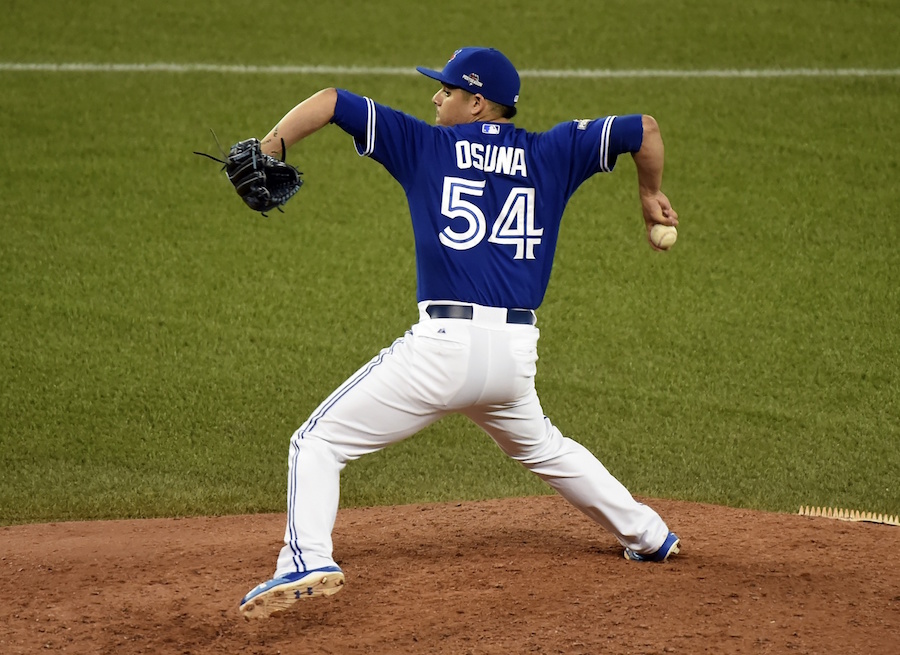
In 1971 the average age of MLB non-DH starting position players was 28.9. This began rising year by year to a peak of 30.1 years of age in 1996. One could assume this was due largely to players’ careers being extended artificially by PEDs. Or one could also possibly assume teams were selecting older players in the amateur draft or perhaps being more deliberate with their prospects. Image courtesy of Nick Turchlaro- USAToday-- Roberto Osuna, youngest player in MLB, born 2-7-1995 In 1971 the average age of MLB non-DH starting position players was 28.9. This began rising year by year to a peak of 30.1 years of age in 1996. One could assume this was due largely to players’ careers being extended artificially by PEDs. Or one could also possibly assume teams were selecting older players in the amateur draft or perhaps being more deliberate with their prospects. Based on how the trend changed following a Senate hearing, a BALCO bust and a couple of Jose Canseco tell-all books, however, I mostly assume the former. And here’s how the trend changed. The average age of starting MLB position players has dropped by three years, to 26.9. This going-to-youth trend is observed at every position. Pitchers, who have been hovering around the same average age of 29 for the last 35 years, were younger in comparison to hitters through the 70s, 80s, and 90s but are now older in comparison – even though their trend has been moving slightly downward since 2004. (This is the dotted black line - based on the top10 innings-pitched pitchers on each team, each season) A three-year shift in the age of hitters means teams are increasingly built around the earlier contracts of players. A larger number of players at low-end salaries means even more money thrown into the fewer top-end salaries - meaning the pay gap gets bigger and bigger and the already-dwindling MLB middle class gets even smaller. (Basically one Donald Trump on the payroll and 24 fast-food drive-through employees) To me, these changes represent a major philosophical and practical shift in the way baseball teams now make decisions, but no one seems to be talking about it. A three-year shift in the average age of players is huge. View full article
-
 Based on how the trend changed following a Senate hearing, a BALCO bust and a couple of Jose Canseco tell-all books, however, I mostly assume the former. And here’s how the trend changed. The average age of starting MLB position players has dropped by three years, to 26.9. This going-to-youth trend is observed at every position. Pitchers, who have been hovering around the same average age of 29 for the last 35 years, were younger in comparison to hitters through the 70s, 80s, and 90s but are now older in comparison – even though their trend has been moving slightly downward since 2004. (This is the dotted black line - based on the top10 innings-pitched pitchers on each team, each season) A three-year shift in the age of hitters means teams are increasingly built around the earlier contracts of players. A larger number of players at low-end salaries means even more money thrown into the fewer top-end salaries - meaning the pay gap gets bigger and bigger and the already-dwindling MLB middle class gets even smaller. (Basically one Donald Trump on the payroll and 24 fast-food drive-through employees) To me, these changes represent a major philosophical and practical shift in the way baseball teams now make decisions, but no one seems to be talking about it. A three-year shift in the average age of players is huge.
-
In 1971, the average age of MLB non-DH starting position players was 28.9. This began rising steadily year-by-year to a peak of 30.1 years of age in 1996. One could assume this was due largely to players’ careers being extended artificially by PEDs – or one could possibly assume teams were selecting older players in the amateur draft or perhaps being more deliberate with their prospects. Based on how the trend changes following a senate hearing, a BALCO bust and a couple of Jose Canseco tell-all books, however, I mostly assume the former. And here’s how the trend changed. The average age of starting MLB position players has dropped by 3 years! (To 26.9.) This reverting-to-youth trend is observed at every position. Pitchers -who have been hovering around the same average age of 29 for the last 35 years - were younger in comparison to hitters through the 70s, 80s, and 90s but are now older in comparison – even though their trend has been moving slightly downward since 2004. (Dotted black line - based on the top-10 innings-pitched pitchers on each team each season) A three-year shift in the age of hitters means teams are increasingly built around the earlier contracts of players. A larger number of players at low-end salaries means even more money thrown into the fewer top-end salaries - meaning the pay gap gets bigger and bigger and the already-dwindling MLB middle class gets even smaller. (Basically one Donald Trump on the payroll and 24 fast-food drive-through employees) To me, these changes represent a major philosophical shift in the way baseball teams now make decisions but no one seems to be talking about it. A three-year shift in the average age of players is huge.
-
You don't like it when people plan to be spontaneous?
-
1. The adjective "electric" as applied to pitcher's stuff. Hack announcers have now claimed so many pitchers to have "electric" stuff that bullpens need to be grounded and catchers mitts need to be UL tested. 2. Feigning indifference in dugouts after noteworthy hits. It was cute and funny the first time. Not so much the 600th time. Ditto the obligatory towel of shaving cream in the face during post-game interviews. 3. Managers and coaches still wearing uniforms. Most of them just pull smocks on over their uniforms anyway to cover up their beer guts. Gardy and Scioscia should have been allowed to wear bowling shirts if they wanted. Teams would then also have more prime numbers to give out to prospects improving their self-esteem. Please feel free to add your own list of stuff that's getting old.
-
Mauer: Lack of Training and Overflow of Excuses Catching Up to Him
Teflon replied to DrNeau's topic in Minnesota Twins Talk
This won't advance the pro or anti Mauer sentiment in either direction but I find it fascinating that Joe's fantasy production has been cyclical this year in repeating 5 or 6 week bell curves. His peaks have occurred in weeks 3, 7, 13, and 18 while his valleys have occurred in weeks 1, 5, 10, 16, and 21 with the weeks between the peaks and valleys in ascent or descent. There are three very discernible full cycles like this in his season with partial cycles at front and rear. Of the 23 weeks this season, two I would classify as outside of this pattern but neither of those are outlying spikes or drops, but two-week continuations of one of the stages. Our fantasy points take into consideration hits, walks, runs, HBPs, RBIs, total bases, with negatives for Ks and GIDPs - so is a fairly comprehensive picture of Joe's performance. Over 143 games played and 23 weeks, this seems less than a random distribution of weekly points. Not saying that this depicts some lingering physical or cognitive issues from the concussions - merely asking if this seems possible. One could argue, I suppose, that this could reflect off-days in the schedule or Molitor's resting Joe in certain weeks but I find that equally as unlikely to be this regular.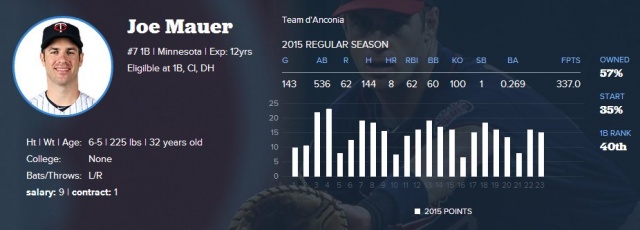
- 139 replies
-
- 1
-

-
- joe mauer
- bilateral everything weakness
- (and 3 more)
-
Bat Flips: More Controversial Than PEDs and The Wave?
Teflon commented on Twins and Losses's blog entry in Twins and Losses
I also think middle infielders should get to yank out second base and spike it every time they turn a double play. That would be cool. -
Should we be worried that Miguel Sano's numbers through 200 plate appearances (289/.394/.584) involve a .424 batting average on balls in play? (BAbip) Last year, Danny Santana batted .319/.353/.472 but with a batting average on balls in play (BAbip) of .405 - a number many Twins Daily posters thought would regress back to the norm (around .300) causing Santana's 2015 numbers to be significantly less impressive. It did (.297) and they were. (.218/.242/.298) If Sano had a more-normal .300 BAbip this year, his slash line would be (assuming all the hits that went away were singles) .229/.343/.524. Still a force for sure - but more of a Dave Kingman type of force than a David Ortiz force. Sano's current extreme strike-out rate will improve with more MLB experience (one would hope, anyway) but the pitching strategies and fielding shifts deployed against him should become more effective too as scouting departments get more data points to evaluate. (Tampa may want to put a fielder in the catwalk after last night. Holy Crap!) How do you see Sano progressing or regressing next year?
-
Of course, then there's this.
-
If I already had loads of money (check), was now being widely criticized where I was once universally praised (check) and realized my game had declined past my own standards (not sure on this one) - yes, I would. I would go to that nice cabin in the woods in the summer and hang out with my wife and kids. Check on my investments from time to time. Accept that ceremonial front office position the Twins will offer me to show up for a few functions each year. Fund some scholarships for Cretin kids. Open an instructional hitting camp in Fort Myers...
-
http://static01.mediaite.com/med/wp-content/uploads/gallery/republican-sports-stars/cal-ripken-jr.png On the occasion of Cal Ripken Jr’s 55th birthday, I looked back at his playing record and was struck by the fact that Cal, who played 21 seasons with the Baltimore Orioles, won the AL MVP award and played in his only World Series in his second full season (defeating the Phillies) never made it back. In the 18 seasons that followed for Cal, the closest the Baltimore Orioles got was losing in the ALCS to the Yankees in 1996 and the Indians in 1997. As deservedly recognized and revered as Ripken was, (Rookie of the Year, 2 MVPs, 2 Gold Gloves, 8 Silver Sluggers, 19 All-Star games) his greatest team success unfortunately came early in his career and was never matched. It also struck me how much Ripken’s career paralleled another outstanding player’s – the NFL’s Dan Marino. Marino, who had a 17 year career in the NFL with the Dolphins, won the league MVP award in his second season in the NFL and led the Dolphins to their only Super Bowl of his career, losing to the 49ers in 1985. In the 15 seasons that followed, the Dolphins made it to two Conference Championships, losing to the Patriots the next season and the Bills in 1992. Marino was also widely lauded (MVP, 9-time Pro Bowl, 3-time first team All-Pro) but, like Ripken, could never match the team success from early in his career. Five years after each retired, they were enshrined in their respective Halls of Fame – Marino in 2005 and Ripken in 2007. (Cal was voted in on 537 of the 545 ballots. You have to wonder what the other 8 voters were thinking.) As many of you know, Cal got his 3000th hit versus the Twins in the Metrodome. What many of you might not know is that he came out after the game and signed autographs for all the kids in the stands that had come down to the Orioles dugout. That’s my favorite Ripken memory – better even than the night he broke Gehrig’s consecutive game streak in Baltimore. Happy Birthday, Cal!
-
Serious question - would Joe Mauer's pride and the realization of his fall-off ever make him consider retiring before his contract is up?
-
That worked well, I thought.
-
What Happened To Oswaldo Arcia?
Teflon replied to Nick Nelson's topic in Twins Daily Front Page News
Dealing a player with more value than Arcia both with the bat and the glove (Plouffe) so Arcia can have a roster spot as a right-hand only platooned DH is about as beneficial a roster move as Gardy insisting on carrying three catchers. -
What Happened To Oswaldo Arcia?
Teflon replied to Nick Nelson's topic in Twins Daily Front Page News
Arcia's poor play has actually been fortunate for the Twins this year in that it has enabled ample playing time for Rosario and another chance to look at Hicks - both of whom can also field their positions. -
When I look at the number of plays made, the fielding percentages, the rate of assists and double plays, (did a sort of power average of these) the Twins outfield defense that stands out (surprisingly) was the trio of Bobby Mitchell, Gary Ward, and Tom Brunansky circa 1982 and 1983. (Even more so than the 2000 outfield of Lawton, Hunter, and Jones which showed up next) You'd think the addition of Puckett in 1984 would have been an improvement from '82 and '83 squads but Puckett's arrival also coincided with Mickey Hatcher and Randy Bush getting more outfield playing time. The '84 outfield of Pucket, Brunansky and Hatcher still comes in 3rd, however. Other top performing outfield defenses were the '96 grouping of Marty Cordova, Roberto Kelly, and Rich Becker (Becker had 17 outfield assists that year and fielded .993) and the '90 trio of Puckett, Dan Gladden, and Shane Mack. The best unit from the Metropolitan Stadium days I could find was the 1971 outfield of Cesar Tovar, Jim Holt and Tony Oliva - although only middle of the pack overall in Twins history.
-
Thinking WAY, WAY, WAY (another WAY), WAY outside the Box
Teflon replied to Loosey's topic in Minnesota Twins Talk
If our pitchers just were a touch better at pitching to contact, would we even need a catcher? -
Twins Have Been Broken Since The Break
Teflon replied to Nick Nelson's topic in Twins Daily Front Page News
It seems less likely that a breakdown by every Twins starting pitcher has occurred at the same time than it does that an overall pitching approach that worked earlier is no longer effective. Any observations for or against this? -
Twins Should Call Up & Platoon Kepler NOW.
Teflon replied to nytwinsfan's topic in Minnesota Twins Talk
...misplays the carom off the outfield wall and another run scores. ...ignores the cutofff and throws home too late to get the runner, the batter advancing to second base. ...get's a late break on the ball and and watches it fall in for a base hit. ...swings wildly at a pitch at the letters to end the inning, stranding the runner at second. ...connects, lifting one deep to the outfield as he flips his bat, taps his chest and points to the sky. It's carrying to the wall - and is off the wall. He'll have to hustle if he wants to make it into second base... http://www.totalprosports.com/wp-content/uploads/2013/08/oswaldo-arcia-hit-in-face-catching-fail.gif -
Will The Twins Ever Hit Again?
Teflon replied to Parker Hageman's topic in Twins Daily Front Page News
Wouldn't that make Mauer the rich man's Doug Mientkiewicz? I think Doug Mientkiewicz was already the poor man's Doug Mientkiewicz.- 45 replies
-
- 1
-
-
- joe mauer
- ronda rousey
- (and 3 more)
