Nick Nelson
-
Posts
8,327 -
Joined
-
Last visited
-
Days Won
56
Content Type
Profiles
News
Minnesota Twins Videos
2026 Minnesota Twins Top Prospects Ranking
2022 Minnesota Twins Draft Picks
Minnesota Twins Free Agent & Trade Rumors, Notes, & Tidbits
Guides & Resources
2023 Minnesota Twins Draft Picks
The Minnesota Twins Players Project
2024 Minnesota Twins Draft Picks
2025 Minnesota Twins Draft Pick Tracker
2026 Minnesota Twins Draft Tracker: Picks & Bonuses
Forums
Blogs
Events
Store
Downloads
Gallery
Everything posted by Nick Nelson
-
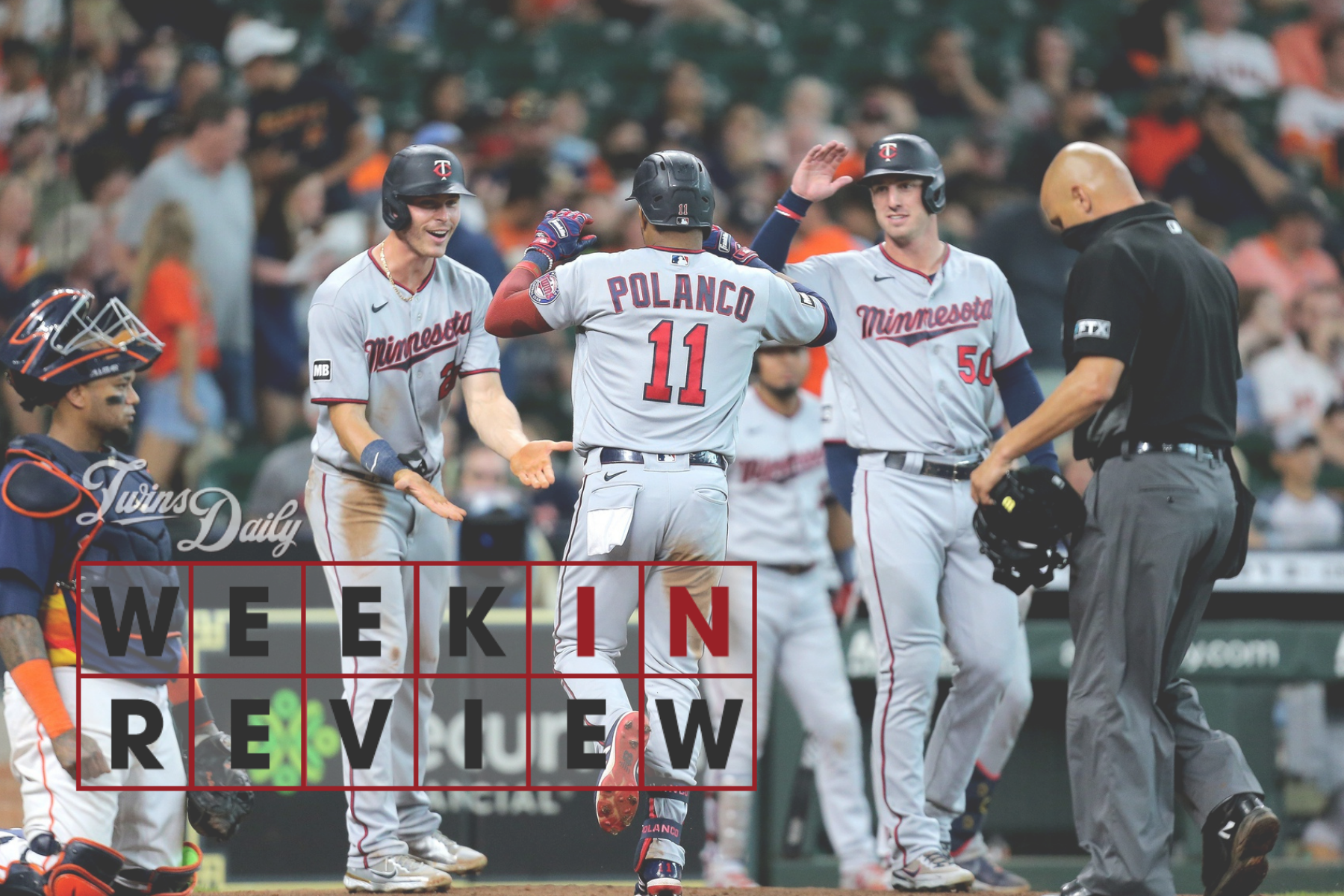 Weekly Snapshot: Mon, 8/2 thru Sun, 8/8 *** Record Last Week: 4-2 (Overall: 48-64) Run Differential Last Week: +2 (Overall: -73) Standing: 5th Place in AL Central (17.5 GB) Last Week's Game Recaps: Game 107 | MIN 7, CIN 5: Garver, Polanco Power Exciting Win Game 108 | CIN 6, MIN 5: Twins Comeback Falls Short Game 109 | MIN 5, HOU 3: Jax Earns First MLB Win as Starter Game 110 | MIN 5, HOU 4: Twins Rally from Early Deficit Game 111 | HOU 4, MIN 0: Lineup Has No Answers for Houston Pitching Game 112 | MIN 7, HOU 5: Polanco's 2 Homers Lift Twins to Series Win NEWS & NOTES Sidelined since early June by a bad hammy strain, Rob Refsnyder finally returned from the Injured List on Thursday, and has since resumed his role as semi-regular center fielder in Byron Buxton's absence. Refsnyder's activation led to Nick Gordon being optioned to Triple-A, which caused some consternation among fans who wished to see Gordon get a real shot. I get it. I like Gordon as a person and would love to see him succeed. It can feel hard to understand what's holding him back from more playing time on a bad team that's going nowhere. But this move makes it all the clearer how the Twins view him, and ... can you really blame them? While the speed is nice, Gordon has simply shown no signs that he can be an impactful contributor on a major-league team. He's a capable defender at several spots, but nowhere is he a standout, and the Twins seem to have zero interest in playing him at short. When you combine that defensive profile with a completely punchless bat, there isn't much value to be found. During his time in the majors, Gordon put 70 balls in play and recorded one barrel. He slashed .176/.263/.235 in his final 20 games. He lacks any discipline at the plate, offering at 45.8% pitches outside the zone, which is second on the team behind (of course) Willians Astudillo. It's not happening for Gordon this year. Now that doesn't preclude the possibility that he works his ass off during the winter, bulks up, and comes out next spring with a significantly bolstered skill set. We'll see if the Twins hold him on the 40-man roster and pursue that avenue. For now, the sad fact is that Refsnyder has a better chance of being a valuable contributor on the 2022 Twins. In other roster news of the week: Another right-handed reliever picked up off waivers. Just days after snagging Edgar Garcia following his DFA from Cincinnati, the Twins claimed former Astro Ralph Garza Jr., who was immediately optioned to Triple-A to join Garcia on the Saints. Garza, like many pitchers the Twins have added of late, has intriguing attributes and big strikeout rates in the minors, but also some clear flaws. There's no particular reason to think he or Garcia – discarded cast-offs from other organizations – will turn to anything useful. But then again, the same thing applies in the bullpen as in the rotation: the Twins are going to need help from the minors and every lottery ticket helps. It's a numbers game and the team is improving its odds. HIGHLIGHTS With veterans José Berríos and J.A. Happ departing at the deadline, Minnesota plugged in Griffin Jax and Charlie Barnes, who join incumbent rookie Bailey Ober in a suddenly very inexperienced rotation. It's quite the departure from Opening Day, when Berríos was their youngest starter. While veteran holdovers Kenta Maeda and Michael Pineda are interesting to track for their own reasons, the youth movement is now the central focus for the starting corps. None of the three rookies currently in the rotation are top prospects, but in the numbers game, it's all about letting them run and seeing if one emerges. This past week, the numbers showed some things to like from Jax and Ober: Jax spun 5 ⅓ innings of one-run ball in Houston on Thursday against the highest-scoring offense in the majors. (Albeit one missing several key bats.) He allowed only three hits and one walk in an efficient and impressive performance. Jax recorded zero strikeouts and only three swinging strikes in the outing, which is concerning, but he did pile up six strikeouts on 16 whiffs against the White Sox two starts prior, so he has at least shown the capability to miss bats. In his past three starts dating back to that one, Jax has a 1.88 ERA with six hits allowed in 14 ⅓ frames. Ober's start on Saturday was a mixed bag. On the one hand, we saw his strengths on display, with five strikeouts and one walk pushing his outstanding seasonal ratio to 56-to-15 ratio in 52 ⅓ innings. Ober's 3.7 K/BB ranks second among Twins starters behind Pineda. Ober also gave up two home runs in his five innings of work, surfacing his biggest weakness, but in general he too has been on a good track. In his past three starts, Ober has a 3.77 ERA and 15-to-3 K/BB ratio in 14 ⅓ frames. Several relievers also had strong showings as the bullpen rebounded from a very ugly run the previous week. Jorge Alcala allowed one hit (a home run) in three innings of work, striking out six of the 11 batters he faced. Alex Colomé worked four scoreless appearances and picked up three saves. Juan Minaya struck out eight over 4 ⅓ shutout innings between three appearances, allowing just two hits. On the offensive side, it was a relatively quiet week with a few standout performances. In spite of his barking knees, Luis Arraez continues to rake; he notched hits in every game he played and went 10-for-17 overall to raise his average to .318, which would rank sixth in baseball if qualified. Jorge Polanco drilled three more homers, and leads the American League in long balls over the past month. It's a remarkable turnaround from a player whose power had been totally sapped. Miguel Sanó did not have a particularly strong week overall, but he did make a game-saving defensive play at third on Friday night, and did this to a baseball on Sunday: LOWLIGHTS While Jax and Ober came through with encouraging performances, Barnes was less inspiring. Facing Cincinnati on Wednesday, the left-hander was knocked around for five earned runs on seven hits and two walks in four innings of work. Through two major-league starts he has a 6.23 ERA with three strikeouts and three walks in 8 ⅔ innings. He has induced only seven swinging strikes on 148 pitches between the two outings (5%). Barnes isn't embarrassing as a spot-starter type but it'd be nice to get someone in that fifth rotation slot with a little more upside. The Twins are slowly starting to get healthier in their starting pitching ranks, so maybe a few options will emerge in the coming weeks. Lewis Thorpe was activated from a lengthy IL stint and started Sunday for the Saints. Randy Dobnak was reportedly doing some "light throwing at Target Field" on Sunday morning, suggesting he's on the comeback trail. I realize these names aren't going to have folks leaping with excitement but they both have a better chance of factoring significantly into the 2022 rotation than Barnes. Brent Rooker cooled off following a red-hot start to his second stint with the Twins this year, going just 3-for-22, although he continued to flash power with all three hits going for doubles. Selectiveness at the plate will be the key thing to watch from Rooker, and he's leaving much to be desired in that area. He's not working into enough favorable counts and when at-bats end with pitchers ahead, he's just 1-for-29 this season. Alas, Rooker looks like an unstoppable offensive force in comparison to Andrelton Simmons. Anyone does. Simmons just continues sinking to new depths, with a 2-for-18 week dropping his slash line to a pitiful .216/.280/.275. His last extra-base hit came on July 2nd, 30 games ago, and since then he has a .355 OPS. There's no point in continuing to run him out there. Remaining money owed is unfortunately a sunk cost. The Twins would be better off sliding Polanco back over to short for the rest of the season and giving the reps at second base to someone like Arraez or Gordon or even Jose Miranda. TRENDING STORYLINE When they acquired him as the headliner in the Berríos trade, I wrote about why Austin Martin is a prospect very much worth getting excited about. Since the trade, he's been doing plenty to fuel the hype. Following a three-hit game for the Wichita Wind Surge on Sunday, Martin is now batting .400 with a .571 on-base percentage since coming over to the Twins organization. His eye at the plate is outrageously good, as illustrated by a 1-to-6 K/BB ratio in six games with Wichita. He has proven already to be a playmaker in the outfield and on the basepaths. Since the start of July, Martin has reached base in 52% of his plate appearances. That's no tiny sample. The idea of him complementing Arraez at the top of order, in front of a proven pack of power hitters, is beyond tantalizing. How far is it from becoming a reality? Next year seems likely, and maybe even from the start. But in order to make Martin a viable candidate for Opening Day, the Twins will need to take some preparatory steps. I'll be quite curious to see if he joins the club as a September call-up, or at least gets a late-season look in Triple-A. His defensive profile makes Martin an especially intriguing piece in the team's planning. Could he take over in center field if Buxton is traded this offseason? Maybe Martin steps in at second with Polanco pivoting back to short. Or perhaps, as I posited in my theoretical 2022 lineup on Twitter, left field is Martin's best initial entry point into the majors. LOOKING AHEAD It bums me out to look ahead at the schedule right now. If things had gone as planned, this would've been an absolutely crucial and thrilling stretch: The Twins, returning home from their longest road trip of the year, face off against the White Sox, Rays, and Cleveland, in consecutive series at Target Field. Could you imagine the stakes and intensity if Minnesota was in contention?! Alas, they are not. So all we can really look forward to is the return of Nelson Cruz to Target Field in another uniform. Hooray. MONDAY, 8/9: WHITE SOX @ TWINS – RHP Lucas Giolito v. LHP Charlie Barnes TUESDAY, 8/10: WHITE SOX @ TWINS – LHP Dallas Keuchel v. RHP Griffin Jax WEDNESDAY, 8/11: WHITE SOX @ TWINS – RHP Lance Lynn v. RHP Bailey Ober FRIDAY, 8/13: RAYS @ TWINS – LHP Shane McClanahan v. RHP Michael Pineda SATURDAY, 8/14: RAYS @ TWINS – RHP Michael Wacha v. RHP Kenta Maeda SUNDAY, 8/15: RAYS @ TWINS – LHP Josh Fleming v. LHP Charlie Barnes MORE FROM TWINS DAILY — Latest Twins coverage from our writers — Recent Twins discussion in our forums — Follow Twins Daily via Twitter, Facebook or email
- 37 comments
-
- 11
-

-
- griffin jax
- bailey ober
- (and 3 more)
-
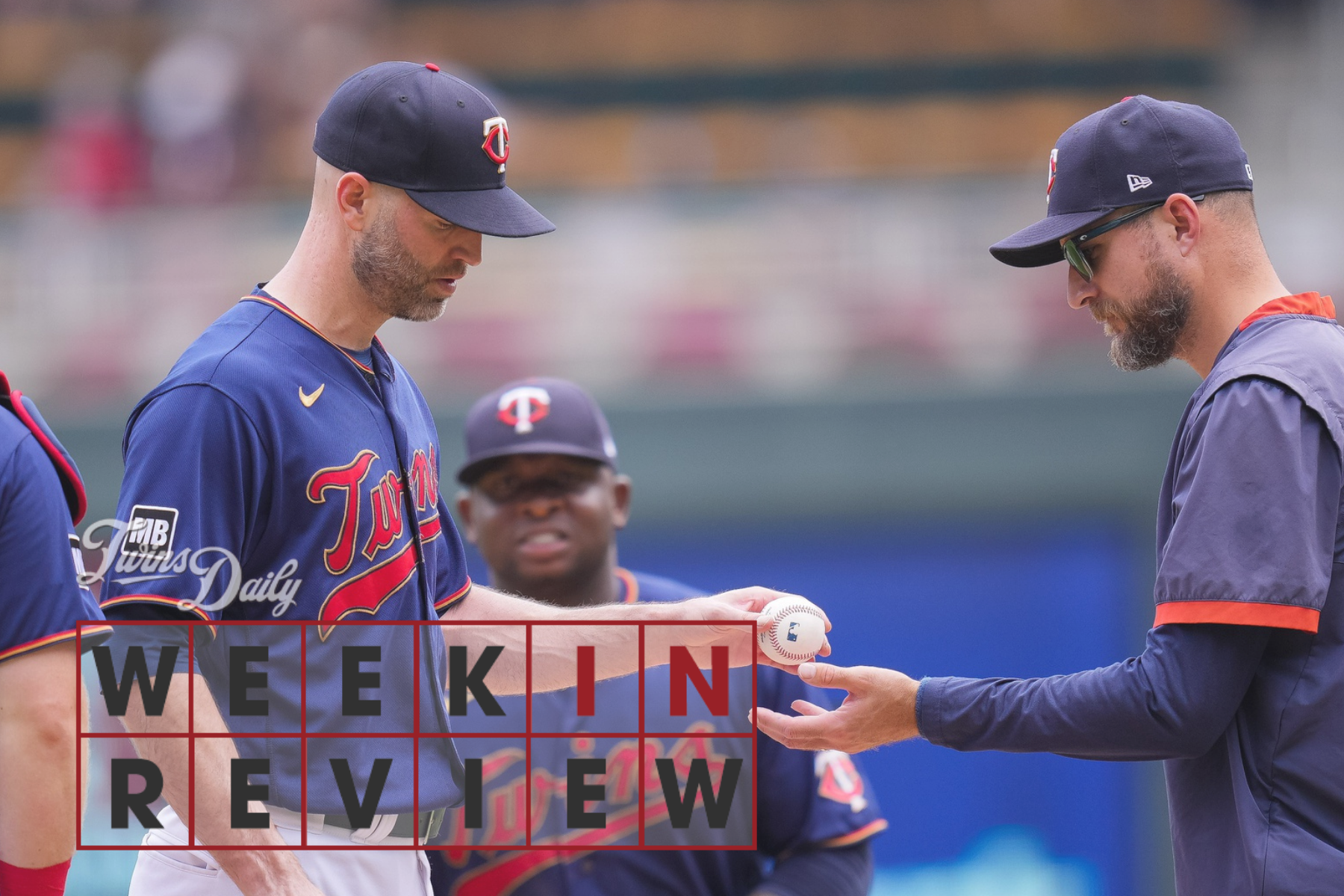 Weekly Snapshot: Mon, 7/26 through Sun, 8/1 *** Record Last Week: 2-4 (Overall: 44-62) Run Differential Last Week: -4 (Overall: -75) Standing: 5th Place in AL Central (18.0 GB) Last Week's Game Recaps: Game 101 | MIN 6, DET 5: Twins Lose Rogers, Win Roller-Coaster Game Game 102 | DET 6, MIN 5: Late Lapse from Robles Leads to Loss Game 103 | DET 17, MIN 14: Twins Fall Short in Offensive Slugfest Game 104 | STL 5, MIN 1: Offense, Bullpen Can't Back Up Jax's Strong Outing Game 105 | MIN 8, STL 1: Pitching and Power Propel Twins to Victory Game 106 | STL 7, MIN 3: Sloppy, Sleepy Play Sinks Minnesota NEWS & NOTES The Twins made one of their most significant deadline "sell" moves in franchise history on Friday, trading José Berríos to the Blue Jays for a pair of Top 100 prospects in Austin Martin and Simeon Woods Richardson. It's a tough loss but a major haul, as Martin and Woods Richardson arguably now become two of the top three prospects Minnesota's system. Berríos made his Jays debut on Sunday, pitching six shutout innings. Getting used to the sight of him in a Toronto jersey will take some time. The front office made a couple other smaller-scale moves on Friday, dealing J.A. Happ to St. Louis for MLB reliever John Gant and minor-league lefty Evan Sisk, as well as Hansel Robles to Boston for pitching prospect Alex Scherff. Surprisingly, that was the extent of their movement on deadline day. Josh Donaldson, Andrelton Simmons, Byron Buxton, and – most inexplicably – Michael Pineda all stayed put. Taylor Rogers would likely have been among the departing players if not for a finger injury suffered earlier in the week that landed him on IL. The issue was described as a sprain and it's not clear how long Rogers will be sidelined – very possibly the rest of the year. Beau Burrows replaced him on the active roster. Another new arm joined the organization, beyond the many acquired in trades: Edgar Garcia, who was claimed off waivers from Cincinnati. He was optioned to St. Paul but should presumably get a look in the big-league bullpen later this season. Finally, Luis Arraez was activated and Gilberto Celestino sent to Triple-A. HIGHLIGHTS The Twins seem fully committed to giving Brent Rooker a very real look here in the second half of the season, and so far he's taking advantage. Recalled the day after Nelson Cruz was traded, Rooker has since started every game, and has been the No. 2 hitter in eight straight. The past week saw him doing damage from the damage spot, collecting eight hits in 24 at-bats including a double and a pair of homers. Perhaps most importantly, he struck out only three times against three walks. Previously he had a 22-to-1 K/BB ratio as a big-leaguer. We know the power is going to be there for Rooker, who leads the organization in home runs with 23 between Triple-A and the majors. But his overall impact at the plate, and ultimately his value as a player, will be dictated by an ability to draw walks and hit for a decent average. We've seen promising signs on that front since his return. Some other noteworthy batting performances in a big week for the offense: With Cruz gone and Donaldson dealing with another leg injury, Jorge Polanco has become the clear focal point of the lineup. He batted leadoff or third in every game last week and was a consistent threat, finishing 11-for-28 with seven runs scored. In a season full of disappointment, Polanco's rebound has been a much-needed positive development. Miguel Sanó also finds himself breaking free of a prolonged slump that stretched back to last year. He had an absolute monster week, going 9-for-23 with two homers, two doubles, and nearly as many walks (6) as strikeouts (7). He posted a .253/.349/.480 line in July after slashing .254/.280/.507 in June. Much like Rooker, the key for Sanó is not so much the home runs as what he does in between, so it's very nice to see his average hanging in the .250 range and the patience coming back. Twins catchers collectively drove in 14 runs in the six games, with Mitch Garver and Ryan Jeffers chipping in grand slams on consecutive days. Garver just continues to do his thing, boosting his OPS up into the vicinity of .900 which seemed unthinkable early in the year. Jeffers getting on track offensively is very nice to see; with two walks and three homers in his two starts, he lifted his OPS by 73 points last week alone. While it's nice to see the offense clicking again, what we'll really be looking for in these final two months is positive signs on the pitching staff – particularly from those who can play a role next year and help offset the critical loss of Berríos. Griffin Jax took the ball in JB's place on Friday night, and delivered an impressive performance with five innings of one-run ball against the Cards. The following night, Bailey Ober delivered four stellar innings, allowing one run on four hits and one walk while striking out six. Charlie Barnes, recalled to fill Happ's vacated roster spot, will likely take his turn in the rotation on Wednesday. These aren't top prospects, but they're MLB-ready arms with good minor-league track records. What kinds of roles could they play on a reshaped 2022 staff? These three and others should have plenty of chances to make their cases the rest of the way, although Rocco Baldelli must balance the need to carefully manage workloads (as we saw with Ober, who was pulled after just 64 pitches on Saturday). LOWLIGHTS Things did not go well for the Twins bullpen last week. On Monday night, the team took a two-run lead into the ninth and turned to its All-Star closer. Unfortunately, Rogers had to exit during the first plate appearance, and in came Alex Colomé, who promptly gave up a single and a home run to tie the game. The Twins did end up winning in 10. They weren't so lucky the following night, when Robles amazingly managed to blow a four-run lead in the ninth by serving up a grand slam to Detroit's Eric Haase. Wednesday was the lowlight of the season for Minnesota's staff, which coughed up 17 runs against a mediocre Tigers offense. Burrows and Juan Minaya combined to give up eight of those runs in six innings of relief, after Happ surrendered nine in his three-inning start. The final appearances from Happ and Robles as Twins could hardly have gone worse, making it all the more surprising that takers for either (let alone both) stepped up on the trade market. Alas, they're gone, and soon enough Colomé, Burrows and Minaya will follow them. It's tough to get too worked up about struggles from guys who have no future here. Trevor Larnach, conversely, does have a future here, and hopefully a very long and successful one. For now, he continues to deal with growing pains as a rookie facing the league's adjustments. Baldelli remains committed to playing him almost everyday, but has bumped Larnach down to the lower part of the lineup as his skid persists. The last week saw him go 3-for-22 with nine strikeouts and one walk. In the month of July he slashed .191/.252/.266 with 43 strikeouts and just seven walks. Reputed as a disciplined hitter with a knack for putting bat to ball, Larnach is clearly out of sorts. It's jarring to see him striking out 40% of the time. One wonders if the slumping will reach a point where the Twins feel a return to Triple-A might be in order, but it doesn't feel like we're quite there yet. TRENDING STORYLINE The Twins need to start getting a grasp on what they're going to do with the bullpen going forward. There will be no shortage of innings to go around with Robles shipped out and Rogers out indefinitely. How long before Triple-A relievers with legitimate potential – such as Yennier Cano, Jovani Moran, and Ian Hamilton – are called up for a look-see? None are presently on the 40-man roster, but clearing up space shouldn't be too difficult. Garcia, acquired off waivers last week, also should be in line for an imminent call-up. With the game outcomes no longer mattering, one of the most productive things the Twins can do in the remainder of this lost season is gain any kind of clarity around what they have going forward in their embattled relief corps. Presently the outlook for that unit is bleakly uncertain, especially with Tyler Duffey's dramatic drop-off this year. LOOKING AHEAD Their longest road trip of the season rolls into next week as the Twins travel to Cincinnati and then Houston. Maeda will have an opportunity to hit and run the bases on Tuesday, which he's surely excited about. Official starters have not yet been announced for Wednesday and Thursday, but I'm assuming Barnes and Jax fill the rotation spots of Berríos and Happ. TUESDAY, 8/3: TWINS @ REDS – RHP Kenta Maeda v. RHP Tyler Mahle WEDNESDAY, 8/4: TWINS @ REDS – LHP Charlie Barnes v. RHP Luis Castillo THURSDAY, 8/5: TWINS @ ASTROS – RHP Griffin Jax v. LHP Framber Valdez FRIDAY, 8/6: TWINS @ ASTROS – RHP Bailey Ober v. RHP Zack Greinke SATURDAY, 8/7: TWINS @ ASTROS – RHP Michael Pineda v. RHP Luis Garcia SUNDAY, 8/8: TWINS @ ASTROS – RHP Kenta Maeda v. Lance McCullers Jr. MORE FROM TWINS DAILY — Latest Twins coverage from our writers — Recent Twins discussion in our forums — Follow Twins Daily via Twitter, Facebook or email
 -
The Twins traded away three pitchers on deadline day, including their best starter. Now, the team moves ahead with the directive of establishing a new identity, minus a franchise fixture. Read on for our recap of a week that saw big roster shakeups, along with encouraging showings from young pitchers and key hitters. Weekly Snapshot: Mon, 7/26 through Sun, 8/1 *** Record Last Week: 2-4 (Overall: 44-62) Run Differential Last Week: -4 (Overall: -75) Standing: 5th Place in AL Central (18.0 GB) Last Week's Game Recaps: Game 101 | MIN 6, DET 5: Twins Lose Rogers, Win Roller-Coaster Game Game 102 | DET 6, MIN 5: Late Lapse from Robles Leads to Loss Game 103 | DET 17, MIN 14: Twins Fall Short in Offensive Slugfest Game 104 | STL 5, MIN 1: Offense, Bullpen Can't Back Up Jax's Strong Outing Game 105 | MIN 8, STL 1: Pitching and Power Propel Twins to Victory Game 106 | STL 7, MIN 3: Sloppy, Sleepy Play Sinks Minnesota NEWS & NOTES The Twins made one of their most significant deadline "sell" moves in franchise history on Friday, trading José Berríos to the Blue Jays for a pair of Top 100 prospects in Austin Martin and Simeon Woods Richardson. It's a tough loss but a major haul, as Martin and Woods Richardson arguably now become two of the top three prospects Minnesota's system. Berríos made his Jays debut on Sunday, pitching six shutout innings. Getting used to the sight of him in a Toronto jersey will take some time. The front office made a couple other smaller-scale moves on Friday, dealing J.A. Happ to St. Louis for MLB reliever John Gant and minor-league lefty Evan Sisk, as well as Hansel Robles to Boston for pitching prospect Alex Scherff. Surprisingly, that was the extent of their movement on deadline day. Josh Donaldson, Andrelton Simmons, Byron Buxton, and – most inexplicably – Michael Pineda all stayed put. Taylor Rogers would likely have been among the departing players if not for a finger injury suffered earlier in the week that landed him on IL. The issue was described as a sprain and it's not clear how long Rogers will be sidelined – very possibly the rest of the year. Beau Burrows replaced him on the active roster. Another new arm joined the organization, beyond the many acquired in trades: Edgar Garcia, who was claimed off waivers from Cincinnati. He was optioned to St. Paul but should presumably get a look in the big-league bullpen later this season. Finally, Luis Arraez was activated and Gilberto Celestino sent to Triple-A. HIGHLIGHTS The Twins seem fully committed to giving Brent Rooker a very real look here in the second half of the season, and so far he's taking advantage. Recalled the day after Nelson Cruz was traded, Rooker has since started every game, and has been the No. 2 hitter in eight straight. The past week saw him doing damage from the damage spot, collecting eight hits in 24 at-bats including a double and a pair of homers. Perhaps most importantly, he struck out only three times against three walks. Previously he had a 22-to-1 K/BB ratio as a big-leaguer. We know the power is going to be there for Rooker, who leads the organization in home runs with 23 between Triple-A and the majors. But his overall impact at the plate, and ultimately his value as a player, will be dictated by an ability to draw walks and hit for a decent average. We've seen promising signs on that front since his return. Some other noteworthy batting performances in a big week for the offense: With Cruz gone and Donaldson dealing with another leg injury, Jorge Polanco has become the clear focal point of the lineup. He batted leadoff or third in every game last week and was a consistent threat, finishing 11-for-28 with seven runs scored. In a season full of disappointment, Polanco's rebound has been a much-needed positive development. Miguel Sanó also finds himself breaking free of a prolonged slump that stretched back to last year. He had an absolute monster week, going 9-for-23 with two homers, two doubles, and nearly as many walks (6) as strikeouts (7). He posted a .253/.349/.480 line in July after slashing .254/.280/.507 in June. Much like Rooker, the key for Sanó is not so much the home runs as what he does in between, so it's very nice to see his average hanging in the .250 range and the patience coming back. Twins catchers collectively drove in 14 runs in the six games, with Mitch Garver and Ryan Jeffers chipping in grand slams on consecutive days. Garver just continues to do his thing, boosting his OPS up into the vicinity of .900 which seemed unthinkable early in the year. Jeffers getting on track offensively is very nice to see; with two walks and three homers in his two starts, he lifted his OPS by 73 points last week alone. While it's nice to see the offense clicking again, what we'll really be looking for in these final two months is positive signs on the pitching staff – particularly from those who can play a role next year and help offset the critical loss of Berríos. Griffin Jax took the ball in JB's place on Friday night, and delivered an impressive performance with five innings of one-run ball against the Cards. The following night, Bailey Ober delivered four stellar innings, allowing one run on four hits and one walk while striking out six. Charlie Barnes, recalled to fill Happ's vacated roster spot, will likely take his turn in the rotation on Wednesday. These aren't top prospects, but they're MLB-ready arms with good minor-league track records. What kinds of roles could they play on a reshaped 2022 staff? These three and others should have plenty of chances to make their cases the rest of the way, although Rocco Baldelli must balance the need to carefully manage workloads (as we saw with Ober, who was pulled after just 64 pitches on Saturday). LOWLIGHTS Things did not go well for the Twins bullpen last week. On Monday night, the team took a two-run lead into the ninth and turned to its All-Star closer. Unfortunately, Rogers had to exit during the first plate appearance, and in came Alex Colomé, who promptly gave up a single and a home run to tie the game. The Twins did end up winning in 10. They weren't so lucky the following night, when Robles amazingly managed to blow a four-run lead in the ninth by serving up a grand slam to Detroit's Eric Haase. Wednesday was the lowlight of the season for Minnesota's staff, which coughed up 17 runs against a mediocre Tigers offense. Burrows and Juan Minaya combined to give up eight of those runs in six innings of relief, after Happ surrendered nine in his three-inning start. The final appearances from Happ and Robles as Twins could hardly have gone worse, making it all the more surprising that takers for either (let alone both) stepped up on the trade market. Alas, they're gone, and soon enough Colomé, Burrows and Minaya will follow them. It's tough to get too worked up about struggles from guys who have no future here. Trevor Larnach, conversely, does have a future here, and hopefully a very long and successful one. For now, he continues to deal with growing pains as a rookie facing the league's adjustments. Baldelli remains committed to playing him almost everyday, but has bumped Larnach down to the lower part of the lineup as his skid persists. The last week saw him go 3-for-22 with nine strikeouts and one walk. In the month of July he slashed .191/.252/.266 with 43 strikeouts and just seven walks. Reputed as a disciplined hitter with a knack for putting bat to ball, Larnach is clearly out of sorts. It's jarring to see him striking out 40% of the time. One wonders if the slumping will reach a point where the Twins feel a return to Triple-A might be in order, but it doesn't feel like we're quite there yet. TRENDING STORYLINE The Twins need to start getting a grasp on what they're going to do with the bullpen going forward. There will be no shortage of innings to go around with Robles shipped out and Rogers out indefinitely. How long before Triple-A relievers with legitimate potential – such as Yennier Cano, Jovani Moran, and Ian Hamilton – are called up for a look-see? None are presently on the 40-man roster, but clearing up space shouldn't be too difficult. Garcia, acquired off waivers last week, also should be in line for an imminent call-up. With the game outcomes no longer mattering, one of the most productive things the Twins can do in the remainder of this lost season is gain any kind of clarity around what they have going forward in their embattled relief corps. Presently the outlook for that unit is bleakly uncertain, especially with Tyler Duffey's dramatic drop-off this year. LOOKING AHEAD Their longest road trip of the season rolls into next week as the Twins travel to Cincinnati and then Houston. Maeda will have an opportunity to hit and run the bases on Tuesday, which he's surely excited about. Official starters have not yet been announced for Wednesday and Thursday, but I'm assuming Barnes and Jax fill the rotation spots of Berríos and Happ. TUESDAY, 8/3: TWINS @ REDS – RHP Kenta Maeda v. RHP Tyler Mahle WEDNESDAY, 8/4: TWINS @ REDS – LHP Charlie Barnes v. RHP Luis Castillo THURSDAY, 8/5: TWINS @ ASTROS – RHP Griffin Jax v. LHP Framber Valdez FRIDAY, 8/6: TWINS @ ASTROS – RHP Bailey Ober v. RHP Zack Greinke SATURDAY, 8/7: TWINS @ ASTROS – RHP Michael Pineda v. RHP Luis Garcia SUNDAY, 8/8: TWINS @ ASTROS – RHP Kenta Maeda v. Lance McCullers Jr. MORE FROM TWINS DAILY — Latest Twins coverage from our writers — Recent Twins discussion in our forums — Follow Twins Daily via Twitter, Facebook or email View full article
-
 Personally I'm not all that surprised. He always had it in him, and showed flashes during his time here. Nice to see Gibby pull it all together.
 -
Yep, I think you're correct on all counts.
-
5 Things to Know About Twins Deadline Centerpiece Austin Martin
Nick Nelson posted an article in Twins
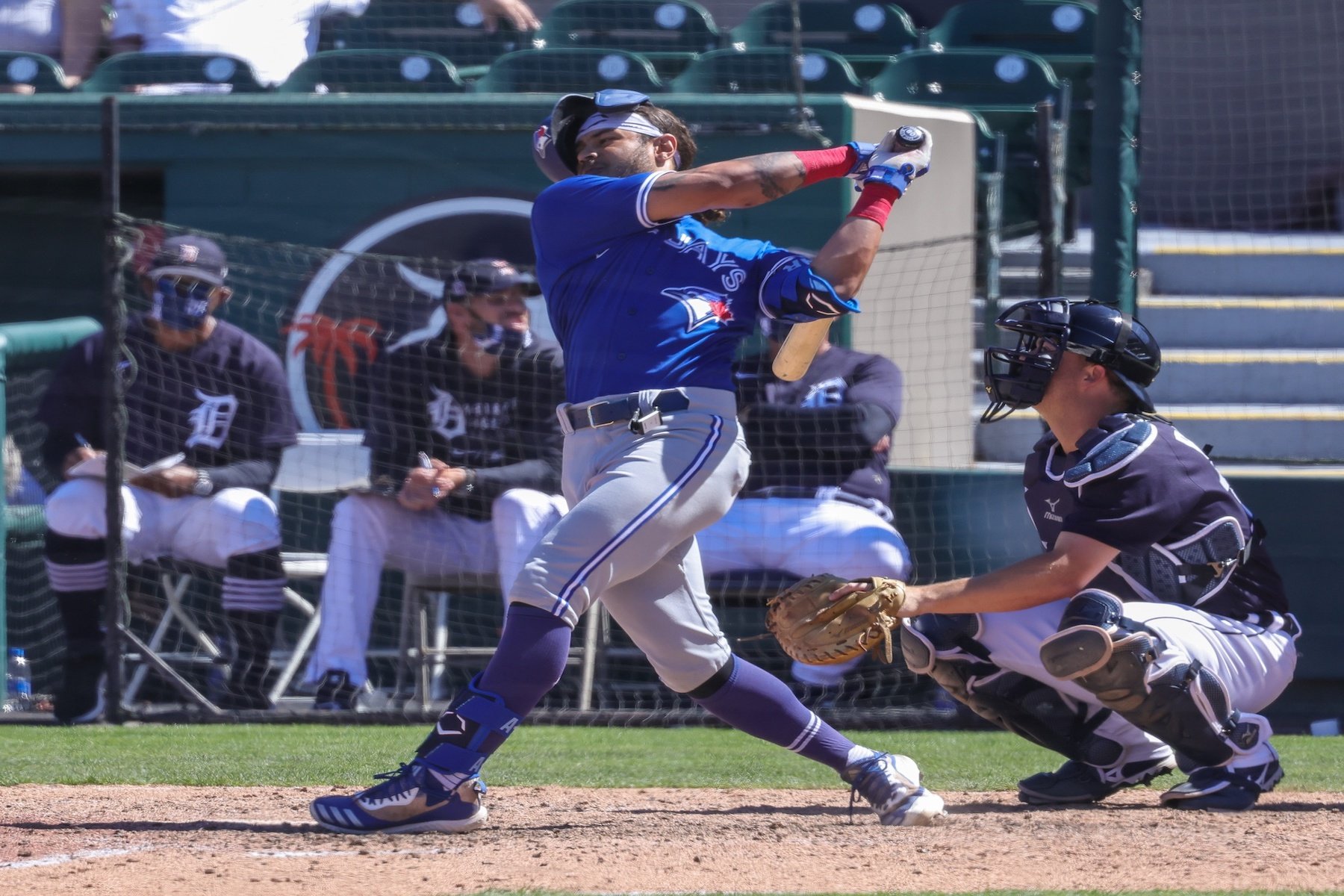 1. Some felt Martin was the top player in last year's draft class. The Vanderbilt star ended up going to the Jays fifth overall, but plenty of outsiders (and I would imagine some insiders) viewed him as the best player available in the 2020 draft – both before and after it took place. CBS Sports had Martin ranked No. 1 on their board ahead of the draft, one spot ahead of Arizona State's Spencer Torkelson, who ended up going first overall to Detroit. Months later, when The Athletic's Keith Law put together his preseason top prospect rankings for 2021, he remarked: "The best prospect in the 2020 draft class slipped to the Blue Jays, who picked fifth." This appears to be a fairly common sentiment, and it's not hard to see why analysts and evaluators would be high on Martin's potential. He had a monster collegiate career, marked by standout athleticism, defensive versatility, steadily increasing power, and ridiculous bat-to-ball skills. (In his COVID-shortened junior year, he struck out twice in 69 plate appearances.) "This bat at a skill position is pretty unusual and gives him some MVP upside," said Law in his writeup. 2. Most prominent prospect publications now view him as the Twins' best prospect. In our recently released midseason top 30 prospects update, we had Royce Lewis ranked as Minnesota's top prospect, which reflects the industry consensus now that Alex Kirilloff has graduated. Some outlets still view it that way – MLB Pipeline has Lewis ahead of Martin, though it's close (No. 13 versus No. 16 in the overall top 100 rankings), and FanGraphs has Lewis ranked No. 32 compared to Martin at No. 59. That's one virtual tie, and one outlier. The rest of the big pubs view Martin more favorably than Lewis, and often by significant margins. Law's preseason rankings for The Athletic had Martin at No. 14, and Lewis at No. 46. (Law's updated midseason top 50 saw Martin move up to 12, with Royce not appearing.) Baseball America has Martin ranked 21st, and Lewis ranked 60th. Baseball Prospectus likes them both, but also gives Martin the edge: their preseason rankings had him at No. 22 with Lewis at No. 31, and the midseason top 50 bumped Martin up to 20 with Lewis sliding off. Said BP in their latest blurb on Martin: "There are too many ways he can provide value to a team for abject failure to be a possibility." It's difficult to assess the two in comparison right now. Martin is a 22-year-old getting his first taste of the majors at Double-A, whereas Lewis is out for this whole season and hasn't played since 2019. The bottom line is that they're both really high-caliber prospects and the Twins have a very healthy system with these two at the top. 3. He could end up filling one of several positions of uncertainty for the Twins. One of the most intriguing things about Martin is his defensive fit. Like Lewis, his future in the field is uncertain, but as with Royce, that's not because he's bad with the glove – quite the contrary. Martin can play several different positions well, which is surely something that drew the Twins to him. This year at Double-A, he has split time evenly between shortstop and center field. By the end of his career at Vanderbilt, he was playing primarily third base. Hmm... what are the most glaring positions of uncertainty for the Twins going forward? Well, there's center field, where Byron Buxton is heading into a walk year, and shaping up as an offseason trade candidate. Then there's shortstop, which is essentially unspoken for after Andrelton Simmons wraps his one-year deal. Oh, and let's not forget third base, where 34-year-old Josh Donaldson is a chronic injury risk and also could be shipped out next winter. Perhaps Martin's future is not as a full-timer at any one spot. The Twins love their flexibility, and it's probably not by accident that their top two position prospects embody such a quality. As R.J. Anderson wrote in Martin's pre-draft profile for CBS Sports: "A creative team could maximize his value by having him split time between the infield and the outfield, a la Whit Merrifield and Scott Kingery, among others." 4. He posted a .500 on-base percentage over 76 plate appearances in July for the Class-AA New Hampshire Fisher Cats. Martin's pro career got off to a bit of a slow start, but he's improved with each passing month. May: .265/.378/.353 June: .284/.402/.432 July: .296/.500/.352 Yes, you read that right: Martin reached base in 50% of his plate appearances this past month. Sandwiched in their was an appearance at the 2021 Futures Game, where he batted second and started at shortstop. You'll never guess: he reached base both times up. This speaks to Martin's offensive strengths. He's a natural-born lead-off hitter, with tremendous discipline, solid speed, and a knack for finding knocks. In his July slash line we also see Martin's biggest current shortcoming: the .352 slugging percentage – just one double and one triple in those 76 plate appearances. But the 22-year-old is still growing into his body and most scouts agree that power will come, and on-base skills like this are a lot rarer in today's game than slugging prowess. 5. He's the best minor-league talent the Twins have acquired in decades. I mean, time will tell whether this ACTUALLY proves to be true. But if you look at prospect rankings and available evidence when moves were made, it's hard to find a precedent for the Twins making an acquisition like this. The closest example would have to be Delmon Young, who was viewed as one of the best prospects in baseball before the Twins traded Matt Garza for him, but he'd already played a season and change in the big leagues. (Not a great precedent, obviously, but Martin and Young are polar opposites as players.) Outside of that, who would even qualify in this discussion? Carlos Gomez was the centerpiece of the Johan Santana package, and was highly regarded as a prospect but not on the level of Martin. (Gomez ranked No. 52 according to BA and No. 65 according to BP when the Twins acquired him, and also, he'd already played some in the majors.) How far back do you have to go to find a real comp for Martin? Back before the days of prospect rankings really even being a thing, I would think. The bottom line is, this organization has rarely ever brought in a prospect of this caliber because they've rarely been willing to do what it takes to land one. In Martin, the Twins added a true prize with legitimate franchise-altering potential. Now that's how you sell at the deadline. It doesn't take away the sting of losing a cherished fixture in Berríos, but makes it a whole lot easier to stomach. MORE FROM TWINS DAILY — Latest Twins coverage from our writers — Recent Twins discussion in our forums — Follow Twins Daily via Twitter, Facebook or email
 -
The Twins traded away their top pitcher on Friday, but in return, they might've gotten back a new top prospect. Make no mistake: Austin Martin is a phenomenal talent and one of the best young players in the game. These five facts will help explain why he's a worthy deadline centerpiece. 1. Some felt Martin was the top player in last year's draft class. The Vanderbilt star ended up going to the Jays fifth overall, but plenty of outsiders (and I would imagine some insiders) viewed him as the best player available in the 2020 draft – both before and after it took place. CBS Sports had Martin ranked No. 1 on their board ahead of the draft, one spot ahead of Arizona State's Spencer Torkelson, who ended up going first overall to Detroit. Months later, when The Athletic's Keith Law put together his preseason top prospect rankings for 2021, he remarked: "The best prospect in the 2020 draft class slipped to the Blue Jays, who picked fifth." This appears to be a fairly common sentiment, and it's not hard to see why analysts and evaluators would be high on Martin's potential. He had a monster collegiate career, marked by standout athleticism, defensive versatility, steadily increasing power, and ridiculous bat-to-ball skills. (In his COVID-shortened junior year, he struck out twice in 69 plate appearances.) "This bat at a skill position is pretty unusual and gives him some MVP upside," said Law in his writeup. 2. Most prominent prospect publications now view him as the Twins' best prospect. In our recently released midseason top 30 prospects update, we had Royce Lewis ranked as Minnesota's top prospect, which reflects the industry consensus now that Alex Kirilloff has graduated. Some outlets still view it that way – MLB Pipeline has Lewis ahead of Martin, though it's close (No. 13 versus No. 16 in the overall top 100 rankings), and FanGraphs has Lewis ranked No. 32 compared to Martin at No. 59. That's one virtual tie, and one outlier. The rest of the big pubs view Martin more favorably than Lewis, and often by significant margins. Law's preseason rankings for The Athletic had Martin at No. 14, and Lewis at No. 46. (Law's updated midseason top 50 saw Martin move up to 12, with Royce not appearing.) Baseball America has Martin ranked 21st, and Lewis ranked 60th. Baseball Prospectus likes them both, but also gives Martin the edge: their preseason rankings had him at No. 22 with Lewis at No. 31, and the midseason top 50 bumped Martin up to 20 with Lewis sliding off. Said BP in their latest blurb on Martin: "There are too many ways he can provide value to a team for abject failure to be a possibility." It's difficult to assess the two in comparison right now. Martin is a 22-year-old getting his first taste of the majors at Double-A, whereas Lewis is out for this whole season and hasn't played since 2019. The bottom line is that they're both really high-caliber prospects and the Twins have a very healthy system with these two at the top. 3. He could end up filling one of several positions of uncertainty for the Twins. One of the most intriguing things about Martin is his defensive fit. Like Lewis, his future in the field is uncertain, but as with Royce, that's not because he's bad with the glove – quite the contrary. Martin can play several different positions well, which is surely something that drew the Twins to him. This year at Double-A, he has split time evenly between shortstop and center field. By the end of his career at Vanderbilt, he was playing primarily third base. Hmm... what are the most glaring positions of uncertainty for the Twins going forward? Well, there's center field, where Byron Buxton is heading into a walk year, and shaping up as an offseason trade candidate. Then there's shortstop, which is essentially unspoken for after Andrelton Simmons wraps his one-year deal. Oh, and let's not forget third base, where 34-year-old Josh Donaldson is a chronic injury risk and also could be shipped out next winter. Perhaps Martin's future is not as a full-timer at any one spot. The Twins love their flexibility, and it's probably not by accident that their top two position prospects embody such a quality. As R.J. Anderson wrote in Martin's pre-draft profile for CBS Sports: "A creative team could maximize his value by having him split time between the infield and the outfield, a la Whit Merrifield and Scott Kingery, among others." 4. He posted a .500 on-base percentage over 76 plate appearances in July for the Class-AA New Hampshire Fisher Cats. Martin's pro career got off to a bit of a slow start, but he's improved with each passing month. May: .265/.378/.353 June: .284/.402/.432 July: .296/.500/.352 Yes, you read that right: Martin reached base in 50% of his plate appearances this past month. Sandwiched in their was an appearance at the 2021 Futures Game, where he batted second and started at shortstop. You'll never guess: he reached base both times up. This speaks to Martin's offensive strengths. He's a natural-born lead-off hitter, with tremendous discipline, solid speed, and a knack for finding knocks. In his July slash line we also see Martin's biggest current shortcoming: the .352 slugging percentage – just one double and one triple in those 76 plate appearances. But the 22-year-old is still growing into his body and most scouts agree that power will come, and on-base skills like this are a lot rarer in today's game than slugging prowess. 5. He's the best minor-league talent the Twins have acquired in decades. I mean, time will tell whether this ACTUALLY proves to be true. But if you look at prospect rankings and available evidence when moves were made, it's hard to find a precedent for the Twins making an acquisition like this. The closest example would have to be Delmon Young, who was viewed as one of the best prospects in baseball before the Twins traded Matt Garza for him, but he'd already played a season and change in the big leagues. (Not a great precedent, obviously, but Martin and Young are polar opposites as players.) Outside of that, who would even qualify in this discussion? Carlos Gomez was the centerpiece of the Johan Santana package, and was highly regarded as a prospect but not on the level of Martin. (Gomez ranked No. 52 according to BA and No. 65 according to BP when the Twins acquired him, and also, he'd already played some in the majors.) How far back do you have to go to find a real comp for Martin? Back before the days of prospect rankings really even being a thing, I would think. The bottom line is, this organization has rarely ever brought in a prospect of this caliber because they've rarely been willing to do what it takes to land one. In Martin, the Twins added a true prize with legitimate franchise-altering potential. Now that's how you sell at the deadline. It doesn't take away the sting of losing a cherished fixture in Berríos, but makes it a whole lot easier to stomach. MORE FROM TWINS DAILY — Latest Twins coverage from our writers — Recent Twins discussion in our forums — Follow Twins Daily via Twitter, Facebook or email View full article
-
Twins Daily writers live-streamed and reacted live as Friday afternoon's trade deadline arrived, interacting with fans in real-time as news broke. You can watch the full show below. Nick, Seth and Matthew break down a busy trade deadline, sharing thoughts on the José Berríos, J.A. Happ and Hansel Robles deals. You can catch future live streams by following our YouTube, Twitter and Facebook channels. View full article
-
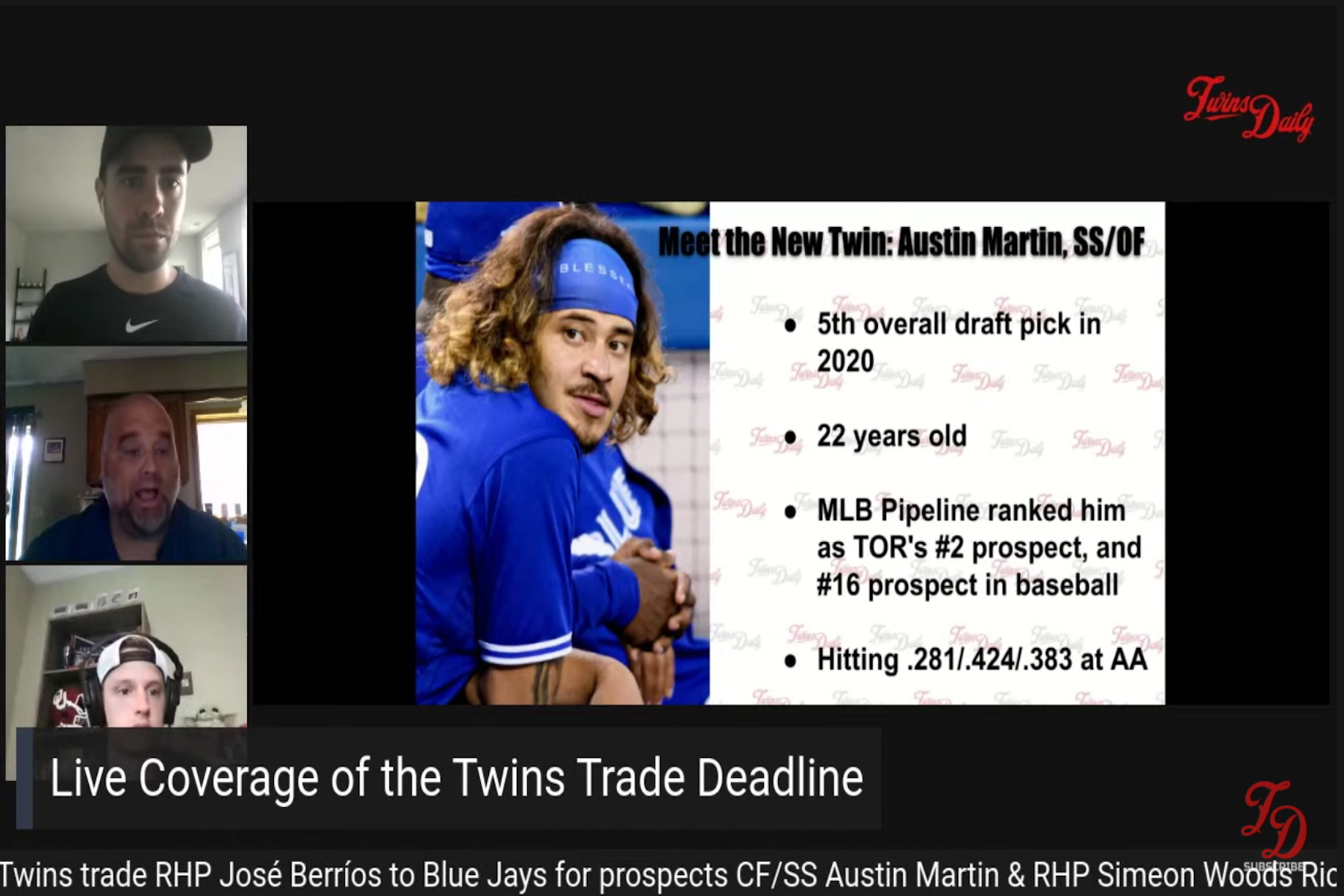 Nick, Seth and Matthew break down a busy trade deadline, sharing thoughts on the José Berríos, J.A. Happ and Hansel Robles deals. You can catch future live streams by following our YouTube, Twitter and Facebook channels.
 -
Letting Byron Buxton Walk Will Haunt
Nick Nelson replied to Nick Nelson's topic in Twins Daily Front Page News
Right. It's definitely not a "blank check" situation, and it's possible Buxton's camp is just totally uninterested in a reasonable accord (I did see La Velle tweet "they think the agent is determined to bring him to free agency"). But the reported "improved" offer from the Twins is just so far away from even the parameters you laid out. -
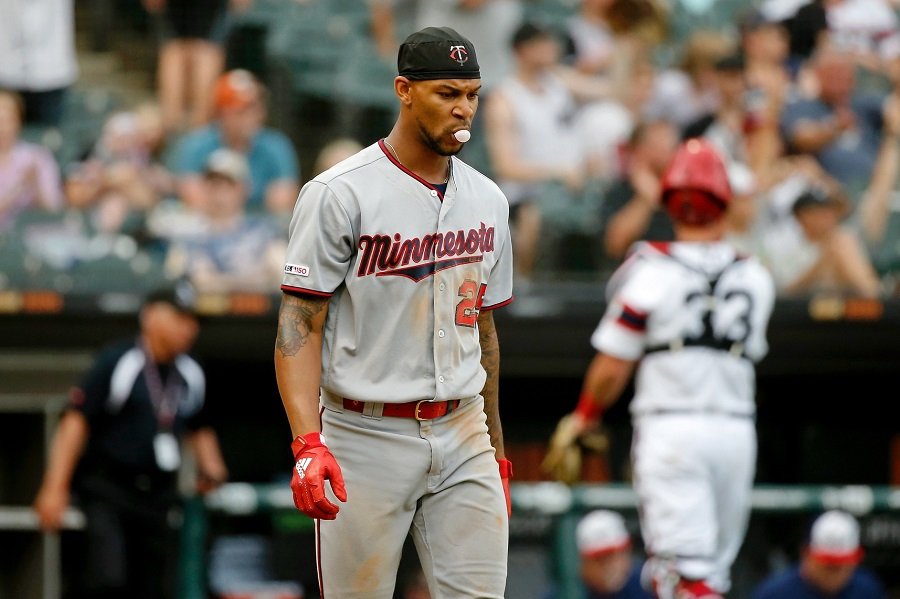 In Minnesota baseball lore, David Ortiz is the equivalent of Boston's Bambino, or Wrigleyville's billy goat. The very mention of Big Papi causes a visceral shudder for any Twins fan within earshot, surfacing deep feelings of regret and lament. How differently things might have gone for the Twins had Ortiz stayed in Minnesota. (Aaron Gleeman wrote a fun "what if" article about this last year.) Naturally, the Ortiz example is invoked any time a promising Twins player departs unduly – the sports fan's equivalent of a PTSD reaction. Lingering fear of a recurrence envelopes us, clouding our judgment. In most cases, this apprehension proves unwarranted. Nonetheless, the Curse of Papi persists. You all know where I'm going with this: Is Byron Buxton the next David Ortiz?? In some ways, it's a fitting parallel. Ortiz left Minnesota in his late 20s, having shown flashes of standout ability, before immediately blossoming elsewhere. In Boston, he emerged as a perennial MVP contender, postseason legend, and franchise icon. It's all too easy to envision the same path for Buxton, except therein lies the difference: you don't need to imagine it. Buxton already IS that guy. He was the AL Player of the Month in April and has been one of the game's best players on a per-game basis for the last three years. After a long and meandering path, he has finally reached his true potential as a top-shelf elite MLB player. Yes, the injuries have remained a constant. But that's exactly why a long-term extension with Buxton would even be attainable right now for a team like the Twins. If not for the implications and associated risk of his health history, he'd likely be eyeing a deal outside of Minnesota's realistic scope. It might seem odd when you're talking about offering more than $100 million to a player whose track record is as sparse as Buxton's, but the Twins should theoretically be able to secure a relative bargain here due to the circumstances. Alas, the front office seems a tad too ambitious in its hunt for a bargain. The allure of signing Buxton long-term is that he can offer a potential impact on the level of a Mike Trout, Bryce Harper, or Fernando Tatis Jr., but at a fraction of the guaranteed commitment. That said, the clear value needs to be there for Buxton, who knows his level of ability, and it is evidently not. His camp rejected Minnesota's offer, which reportedly elevated from $73 million to $80 million in guaranteed money with a "unique incentive package." Sounds like those incentives were the sticking point. At this juncture we don't what was proposed or countered, so analyzing the negotiation is murky. Then again, it's also difficult to fathom what kind of request or suggested terms from Buxton's agent would make the Twins balk to the point they're giving up on an opportunity to secure this generational talent, at the precipice of true superstardom. A somewhat similar dynamic is at play with José Berríos, who was drafted the same year as Buxton and is also looking ahead to free agency at the end of 2022. One can certainly argue that Berríos is more critical to the Twins' future, given their scarcity of high-quality arms. But in a way, he is the antithesis of Buxton: ultra-reliable with a capped ceiling. Berríos has been one of the most durable and consistent pitchers in the game – steadily very good, just short of great, always available. Meanwhile, Buxton has improved every season in a setback-riddled career that's been full of ups and downs. He's just now reaching his full form, displaying game-changing greatness that is almost unparalleled. Yes, Berríos will be difficult to replace, in that arms like his don't come along often. The Twins certainly haven't proven adept at finding or developing them. But Buxton is irreplaceable in a more absolute sense. Athletes and human beings like him almost NEVER come along. His speed, power, and defense are off-the-charts good. He's one of the most entertaining players I've ever seen. And he's still getting better. I can see the rationale in moving on from Berríos. He's clearly intent on testing free agency and maximizing his earnings. There will be no discount or bonus-contingent contract in play there. And it's awfully hard for a mid-market team to build balanced contending rosters when paying one of their five starting pitchers $25+ million annually. Their everyday center fielder, though? One who's proven to be an MVP-caliber talent while on the field? And who won't even be reaching that salary range unless he's staying on the field enough to trigger incentives? I'm struggling to understand why the Twins aren't stepping up here. Target Field was ostensibly built for the exact purpose of keeping a player like this. From available evidence, it doesn't seem like the team is making a particularly hearty effort to do what it takes to retain him. Whatever Buxton's side is asking for – $30-plus million in annual achievable salary, an early opt-out clause, lower-than-desired bonus thresholds – none of those should be deal-breakers. Maybe there's still a way. Buxton said on Monday "it's not the end," leaving some faint cause for hope. But at this point, the outlook is grim. It's true that signing Buxton long-term would entail some risk. But it pales in comparison to the risk of watching him go elsewhere, shake off the snakebitten injury luck, and emerge as a late-blooming legend while Twins fans spend another decade lamenting the one that got away. In this case, it'd be a much less excusable gaffe than releasing David Ortiz. MORE FROM TWINS DAILY — Latest Twins coverage from our writers — Recent Twins discussion in our forums — Follow Twins Daily via Twitter, Facebook or email
 -
Extension talks have fizzled between the Twins and Byron Buxton, and media reports on the matter have a sense of finality to them. It appears Buxton is heading for free agency, if not departing via trade before then. I adamantly believe this is a mistake that will haunt the franchise for years to come. But it's not too late to reverse course. In Minnesota baseball lore, David Ortiz is the equivalent of Boston's Bambino, or Wrigleyville's billy goat. The very mention of Big Papi causes a visceral shudder for any Twins fan within earshot, surfacing deep feelings of regret and lament. How differently things might have gone for the Twins had Ortiz stayed in Minnesota. (Aaron Gleeman wrote a fun "what if" article about this last year.) Naturally, the Ortiz example is invoked any time a promising Twins player departs unduly – the sports fan's equivalent of a PTSD reaction. Lingering fear of a recurrence envelopes us, clouding our judgment. In most cases, this apprehension proves unwarranted. Nonetheless, the Curse of Papi persists. You all know where I'm going with this: Is Byron Buxton the next David Ortiz?? In some ways, it's a fitting parallel. Ortiz left Minnesota in his late 20s, having shown flashes of standout ability, before immediately blossoming elsewhere. In Boston, he emerged as a perennial MVP contender, postseason legend, and franchise icon. It's all too easy to envision the same path for Buxton, except therein lies the difference: you don't need to imagine it. Buxton already IS that guy. He was the AL Player of the Month in April and has been one of the game's best players on a per-game basis for the last three years. After a long and meandering path, he has finally reached his true potential as a top-shelf elite MLB player. Yes, the injuries have remained a constant. But that's exactly why a long-term extension with Buxton would even be attainable right now for a team like the Twins. If not for the implications and associated risk of his health history, he'd likely be eyeing a deal outside of Minnesota's realistic scope. It might seem odd when you're talking about offering more than $100 million to a player whose track record is as sparse as Buxton's, but the Twins should theoretically be able to secure a relative bargain here due to the circumstances. Alas, the front office seems a tad too ambitious in its hunt for a bargain. The allure of signing Buxton long-term is that he can offer a potential impact on the level of a Mike Trout, Bryce Harper, or Fernando Tatis Jr., but at a fraction of the guaranteed commitment. That said, the clear value needs to be there for Buxton, who knows his level of ability, and it is evidently not. His camp rejected Minnesota's offer, which reportedly elevated from $73 million to $80 million in guaranteed money with a "unique incentive package." Sounds like those incentives were the sticking point. At this juncture we don't what was proposed or countered, so analyzing the negotiation is murky. Then again, it's also difficult to fathom what kind of request or suggested terms from Buxton's agent would make the Twins balk to the point they're giving up on an opportunity to secure this generational talent, at the precipice of true superstardom. A somewhat similar dynamic is at play with José Berríos, who was drafted the same year as Buxton and is also looking ahead to free agency at the end of 2022. One can certainly argue that Berríos is more critical to the Twins' future, given their scarcity of high-quality arms. But in a way, he is the antithesis of Buxton: ultra-reliable with a capped ceiling. Berríos has been one of the most durable and consistent pitchers in the game – steadily very good, just short of great, always available. Meanwhile, Buxton has improved every season in a setback-riddled career that's been full of ups and downs. He's just now reaching his full form, displaying game-changing greatness that is almost unparalleled. Yes, Berríos will be difficult to replace, in that arms like his don't come along often. The Twins certainly haven't proven adept at finding or developing them. But Buxton is irreplaceable in a more absolute sense. Athletes and human beings like him almost NEVER come along. His speed, power, and defense are off-the-charts good. He's one of the most entertaining players I've ever seen. And he's still getting better. I can see the rationale in moving on from Berríos. He's clearly intent on testing free agency and maximizing his earnings. There will be no discount or bonus-contingent contract in play there. And it's awfully hard for a mid-market team to build balanced contending rosters when paying one of their five starting pitchers $25+ million annually. Their everyday center fielder, though? One who's proven to be an MVP-caliber talent while on the field? And who won't even be reaching that salary range unless he's staying on the field enough to trigger incentives? I'm struggling to understand why the Twins aren't stepping up here. Target Field was ostensibly built for the exact purpose of keeping a player like this. From available evidence, it doesn't seem like the team is making a particularly hearty effort to do what it takes to retain him. Whatever Buxton's side is asking for – $30-plus million in annual achievable salary, an early opt-out clause, lower-than-desired bonus thresholds – none of those should be deal-breakers. Maybe there's still a way. Buxton said on Monday "it's not the end," leaving some faint cause for hope. But at this point, the outlook is grim. It's true that signing Buxton long-term would entail some risk. But it pales in comparison to the risk of watching him go elsewhere, shake off the snakebitten injury luck, and emerge as a late-blooming legend while Twins fans spend another decade lamenting the one that got away. In this case, it'd be a much less excusable gaffe than releasing David Ortiz. MORE FROM TWINS DAILY — Latest Twins coverage from our writers — Recent Twins discussion in our forums — Follow Twins Daily via Twitter, Facebook or email View full article
-
Week in Review: Mounting Losses
Nick Nelson replied to Nick Nelson's topic in Twins Daily Front Page News
This lineup -- with no Cruz, Buxton, Kirilloff, or Arraez -- is not good. And the pitching staff is worse. No manager would have this team succeeding.- 17 replies
-
- 3
-
-
- nelson cruz
- andrelton simmons
- (and 1 more)
-
 Weekly Snapshot: Mon, 7/19 through Sun, 7/25 *** Record Last Week: 3-5 (Overall: 42-58) Run Differential Last Week: -5 (Overall: -71) Standing: 5th Place in AL Central (17.0 GB) Last Week's Game Recaps: Game 93 | MIN 3, CWS 2: Jax Deals, Twins Steal One in Extras Game 94 | CWS 5, MIN 3: Berrios Goes Deep, Then Sheets Does Game 95 | CWS 9, MIN 5: Bullpen Implodes in Five-Run 8th Inning Game 96 | MIN 7, CWS 2: Polanco, Kepler Power Twins to Split Game 97 | LAA 3, MIN 2: Cruz-less Offense Comes Up Short Game 98 | MIN 5, LAA 4: Aggressive Baserunning Sparks Win Game 99 | LAA 2, MIN 1: Twins Narrowly Avoid Getting No-hit Game 100 | LAA 6, MIN 2: Bats Go Silent Once Again NEWS & NOTES The sell-off has officially begun. Nelson Cruz always ranked No. 1 on the list of Twins players most likely to be traded, and the front office didn't waste time, striking a deal with the Tampa Bay Rays eight days ahead of the deadline. Losing Cruz is painful in the sense that he's a legendary and incredibly likable player, but this is best for all involved. He ends up on a contending team where he makes a huge difference. Tampa reached the World Series last year and Nelly can help propel them back. Meanwhile, the Twin landed a pair of intriguing pitching prospects who are verging on big-league ready. And those prospects now have a much clearer path than in Tampa's crowded pitching pipeline. Naturally, we had plenty of coverage here; I recommend reading the articles below, which include Seth's instant report, Lucas' breakdown of the return package, John's reaction to the deal, and Nash's tribute to Cruz. Twins Trade Nelson Cruz to the Rays for Two AAA Starting Pitchers, by Seth Stohs Twins Minor League Pitching Report: Joe Ryan and Drew Strotman, by Lucas Seehafer Three Things to Like (and Hate) About the Nelson Cruz Trade, by John Bonnes Thank You Nelson Cruz! By Nash Walker We won't be seeing Cruz in a Twins uniform again this year. Nor Alex Kirilloff. The rookie outfielder opted for wrist surgery after reporting that the pain stemming from a torn ligament had intensified recently. His rehab will carry through the rest of the season but he'll have plenty of time to get ready for 2022, which is really all that matters at this point. Kirilloff finishes his first MLB campaign with a .251/.299/.423 slash line and eight home runs in 59 games. Adding to the exodus of high-quality hitters, Luis Arraez hit the Injured List on Saturday after injuring his knee early in the week. Thankfully, his absence looks to be more temporary than the other two, although his continuing knee troubles don't bode well for the 24-year-old. While the Twins suffered some tough losses last week, they did also get some guys back. Mitch Garver returned with a bang on Monday, launching home runs in his first two at-bats. Brent Rooker was recalled after mashing in Triple-A, and should get an extended look at DH in Cruz's stead. Jake Cave was also activated following a two-month stay on IL. HIGHLIGHTS With the trade deadline fast approaching, it's possible we'll see the Twins part with one or more of their foundational building block type players. Jorge Polanco is probably not among them, which is just fine because he's been busy proving he still deserves to be in that class. Polanco struggled last year and throughout the early weeks of 2021. He entered June with a sub-700 OPS but then finally started to find his groove again, swinging with greater authority and driving the ball with more consistency. Finding himself back near the top of the order regularly, Polanco is keying the offense right now; the past week saw him chip in a pair of three-hit games and two home runs, finishing 10-for-25 with six RBIs. Dating back to the start of June he's slashing .297/.346/.506, which is nearly identical to his overall line in 2019 (.295/.356/.485). On Wednesday, Michael Pineda took the mound for the first time in two weeks, and it was a big step in the right direction at a crucial moment. Through five efficient innings, Pineda held the White Sox to one run on four hits, striking out three and walking one. It wasn't a dominating whiff clinic like we saw earlier this year when Big Mike was at his best, but a reassuring performance nonetheless for any interested buyer. Pineda's slated to face the Tigers on Monday – his last turn before the deadline. Whatever Pineda gets back in a trade, it won't be much. To really score a haul, the Twins will need to give up one of their most in-demand pitching assets, and both are doing plenty to stoke their markets. Taylor Rogers tossed a pair of scoreless innings with three strikeouts, while José Berríos was masterful in his Saturday night start, allowing just two unearned runs over seven innings against the Halos. LOWLIGHTS The front office would surely love to unload Andrelton Simmons and the remaining millions he's owed before re-entering free agency at season's end. Problem is, they might be hard-pressed to find a taker. Simmons has been good in the field, but not good enough to offset the complete and total lack of offense. With each passing week, the shortstop slides further and further into futility at the plate. He went 2-for-22 in the most recent one, and is now slashing a woeful .220/.287/.288 with a negative WAR. Is any contending team really going to view him as enough of an upgrade to take on his remaining $4 million or so in salary? Getting back any kind of prospect is out of the question. Another dead-end move from the past offseason for this front office. It's beginning to look like we can place Hansel Robles in that bucket too. The Twins are more likely to find a buyer for him than Simmons, given the lesser money involved and the ubiquitous need for relief pitching, but he's not making himself a prized asset. Robles pitched twice this past week and gave up three runs (two earned) on three hits, including a back-breaking home run against the White Sox on Tuesday. Robles has a 5.32 ERA over his past 24 appearances, with opponents hitting .292/.376/.528 against him. One way or another, Robles will be gone after this year. Alex Colomé too. Rogers is "likely to be dealt" at the deadline according to Ken Rosenthal. Beyond Tyler Duffey there is no continuity built into this bullpen, especially because Jorge Alcala has obliterated all confidence. The right-hander is completely unraveling, and the past week added to his woes with five runs allowed over three innings of work. In his past dozen appearances Alcala has taken three losses, blown two saves, and given up 14 earned runs on 19 hits in 10 ⅓ innings (12.20 ERA). It's not even clear he should be in the majors right now, let alone pitching meaningful innings. You look at this relief corps in its current state, and it's just so immensely difficult to envision the kind of abrupt and drastic turnaround needed for the Twins to return to contention in 2022. Which may partially explain why the front office has seemingly softened its commitment to holding players with control beyond this year. This is starting to look more like a full-on rebuild. TRENDING STORYLINE The biggest storyline trending around the Twins right now is a deeply disheartening one: Byron Buxton reportedly rejected the team's contract extension offer as the two sides sought to find common ground, at perhaps their last opportunity to do so. It sounds like the club's final offer to Buxton was around $80 million plus incentives, which understandably wasn't enough to entice the superstar center fielder's camp as free agency looms. Hitting a wall in extension negotiations will compel the Twins to fully explore Buxton's trade market, but probably not until the offseason. The more immediate names to watch are guys like Berríos, Rogers, and Josh Donaldson, who could all be shipped out this week along with impending free agents. The deadline falls on Friday at 3:00 PM – and it's a hard deadline this time, with no post-waiver avenue available. Buyers need to stock up, nor or never. How different will the Twins' roster, and future, in a week? We should all be bracing ourselves for a major shakeup. LOOKING AHEAD The July 30th trade deadline is, of course, the date to circle. Rumors are sure to be flying throughout the next four days, with all the action building up to Friday afternoon. Berríos is scheduled to pitch for the Twins that night; will he still be here? Or have we already seen him for the last time in a Twins uniform? MONDAY, 7/26: TIGERS @ TWINS – TBD v. RHP Michael Pineda TUESDAY, 7/27: TIGERS @ TWINS – LHP Tyler Alexander v. RHP Kenta Maeda WEDNESDAY, 7/28: TIGERS @ TWINS – RHP Wily Peralta v. LHP J.A. Happ FRIDAY, 7/30: TWINS @ CARDINALS – RHP José Berríos v. LHP Wade LeBlanc SATURDAY, 7/31: TWINS @ CARDINALS – RHP Bailey Ober v. RHP Jake Woodford SUNDAY, 8/1: TWINS @ CARDINALS – RHP Michael Pineda v. RHP Johan Oviedo MORE FROM TWINS DAILY — Latest Twins coverage from our writers — Recent Twins discussion in our forums — Follow Twins Daily via Twitter, Facebook or email
- 17 comments
-
- 1
-
-
- nelson cruz
- andrelton simmons
- (and 1 more)
-
The Twins lost their best veteran hitter to a trade, and lost their best young hitter to wrist surgery. Now they face the prospect of losing their best all-around player in the near future, following news of failed extension negotiations. Things are decidedly not chill in Twins Territory. Weekly Snapshot: Mon, 7/19 through Sun, 7/25 *** Record Last Week: 3-5 (Overall: 42-58) Run Differential Last Week: -5 (Overall: -71) Standing: 5th Place in AL Central (17.0 GB) Last Week's Game Recaps: Game 93 | MIN 3, CWS 2: Jax Deals, Twins Steal One in Extras Game 94 | CWS 5, MIN 3: Berrios Goes Deep, Then Sheets Does Game 95 | CWS 9, MIN 5: Bullpen Implodes in Five-Run 8th Inning Game 96 | MIN 7, CWS 2: Polanco, Kepler Power Twins to Split Game 97 | LAA 3, MIN 2: Cruz-less Offense Comes Up Short Game 98 | MIN 5, LAA 4: Aggressive Baserunning Sparks Win Game 99 | LAA 2, MIN 1: Twins Narrowly Avoid Getting No-hit Game 100 | LAA 6, MIN 2: Bats Go Silent Once Again NEWS & NOTES The sell-off has officially begun. Nelson Cruz always ranked No. 1 on the list of Twins players most likely to be traded, and the front office didn't waste time, striking a deal with the Tampa Bay Rays eight days ahead of the deadline. Losing Cruz is painful in the sense that he's a legendary and incredibly likable player, but this is best for all involved. He ends up on a contending team where he makes a huge difference. Tampa reached the World Series last year and Nelly can help propel them back. Meanwhile, the Twin landed a pair of intriguing pitching prospects who are verging on big-league ready. And those prospects now have a much clearer path than in Tampa's crowded pitching pipeline. Naturally, we had plenty of coverage here; I recommend reading the articles below, which include Seth's instant report, Lucas' breakdown of the return package, John's reaction to the deal, and Nash's tribute to Cruz. Twins Trade Nelson Cruz to the Rays for Two AAA Starting Pitchers, by Seth Stohs Twins Minor League Pitching Report: Joe Ryan and Drew Strotman, by Lucas Seehafer Three Things to Like (and Hate) About the Nelson Cruz Trade, by John Bonnes Thank You Nelson Cruz! By Nash Walker We won't be seeing Cruz in a Twins uniform again this year. Nor Alex Kirilloff. The rookie outfielder opted for wrist surgery after reporting that the pain stemming from a torn ligament had intensified recently. His rehab will carry through the rest of the season but he'll have plenty of time to get ready for 2022, which is really all that matters at this point. Kirilloff finishes his first MLB campaign with a .251/.299/.423 slash line and eight home runs in 59 games. Adding to the exodus of high-quality hitters, Luis Arraez hit the Injured List on Saturday after injuring his knee early in the week. Thankfully, his absence looks to be more temporary than the other two, although his continuing knee troubles don't bode well for the 24-year-old. While the Twins suffered some tough losses last week, they did also get some guys back. Mitch Garver returned with a bang on Monday, launching home runs in his first two at-bats. Brent Rooker was recalled after mashing in Triple-A, and should get an extended look at DH in Cruz's stead. Jake Cave was also activated following a two-month stay on IL. HIGHLIGHTS With the trade deadline fast approaching, it's possible we'll see the Twins part with one or more of their foundational building block type players. Jorge Polanco is probably not among them, which is just fine because he's been busy proving he still deserves to be in that class. Polanco struggled last year and throughout the early weeks of 2021. He entered June with a sub-700 OPS but then finally started to find his groove again, swinging with greater authority and driving the ball with more consistency. Finding himself back near the top of the order regularly, Polanco is keying the offense right now; the past week saw him chip in a pair of three-hit games and two home runs, finishing 10-for-25 with six RBIs. Dating back to the start of June he's slashing .297/.346/.506, which is nearly identical to his overall line in 2019 (.295/.356/.485). On Wednesday, Michael Pineda took the mound for the first time in two weeks, and it was a big step in the right direction at a crucial moment. Through five efficient innings, Pineda held the White Sox to one run on four hits, striking out three and walking one. It wasn't a dominating whiff clinic like we saw earlier this year when Big Mike was at his best, but a reassuring performance nonetheless for any interested buyer. Pineda's slated to face the Tigers on Monday – his last turn before the deadline. Whatever Pineda gets back in a trade, it won't be much. To really score a haul, the Twins will need to give up one of their most in-demand pitching assets, and both are doing plenty to stoke their markets. Taylor Rogers tossed a pair of scoreless innings with three strikeouts, while José Berríos was masterful in his Saturday night start, allowing just two unearned runs over seven innings against the Halos. LOWLIGHTS The front office would surely love to unload Andrelton Simmons and the remaining millions he's owed before re-entering free agency at season's end. Problem is, they might be hard-pressed to find a taker. Simmons has been good in the field, but not good enough to offset the complete and total lack of offense. With each passing week, the shortstop slides further and further into futility at the plate. He went 2-for-22 in the most recent one, and is now slashing a woeful .220/.287/.288 with a negative WAR. Is any contending team really going to view him as enough of an upgrade to take on his remaining $4 million or so in salary? Getting back any kind of prospect is out of the question. Another dead-end move from the past offseason for this front office. It's beginning to look like we can place Hansel Robles in that bucket too. The Twins are more likely to find a buyer for him than Simmons, given the lesser money involved and the ubiquitous need for relief pitching, but he's not making himself a prized asset. Robles pitched twice this past week and gave up three runs (two earned) on three hits, including a back-breaking home run against the White Sox on Tuesday. Robles has a 5.32 ERA over his past 24 appearances, with opponents hitting .292/.376/.528 against him. One way or another, Robles will be gone after this year. Alex Colomé too. Rogers is "likely to be dealt" at the deadline according to Ken Rosenthal. Beyond Tyler Duffey there is no continuity built into this bullpen, especially because Jorge Alcala has obliterated all confidence. The right-hander is completely unraveling, and the past week added to his woes with five runs allowed over three innings of work. In his past dozen appearances Alcala has taken three losses, blown two saves, and given up 14 earned runs on 19 hits in 10 ⅓ innings (12.20 ERA). It's not even clear he should be in the majors right now, let alone pitching meaningful innings. You look at this relief corps in its current state, and it's just so immensely difficult to envision the kind of abrupt and drastic turnaround needed for the Twins to return to contention in 2022. Which may partially explain why the front office has seemingly softened its commitment to holding players with control beyond this year. This is starting to look more like a full-on rebuild. TRENDING STORYLINE The biggest storyline trending around the Twins right now is a deeply disheartening one: Byron Buxton reportedly rejected the team's contract extension offer as the two sides sought to find common ground, at perhaps their last opportunity to do so. It sounds like the club's final offer to Buxton was around $80 million plus incentives, which understandably wasn't enough to entice the superstar center fielder's camp as free agency looms. Hitting a wall in extension negotiations will compel the Twins to fully explore Buxton's trade market, but probably not until the offseason. The more immediate names to watch are guys like Berríos, Rogers, and Josh Donaldson, who could all be shipped out this week along with impending free agents. The deadline falls on Friday at 3:00 PM – and it's a hard deadline this time, with no post-waiver avenue available. Buyers need to stock up, nor or never. How different will the Twins' roster, and future, in a week? We should all be bracing ourselves for a major shakeup. LOOKING AHEAD The July 30th trade deadline is, of course, the date to circle. Rumors are sure to be flying throughout the next four days, with all the action building up to Friday afternoon. Berríos is scheduled to pitch for the Twins that night; will he still be here? Or have we already seen him for the last time in a Twins uniform? MONDAY, 7/26: TIGERS @ TWINS – TBD v. RHP Michael Pineda TUESDAY, 7/27: TIGERS @ TWINS – LHP Tyler Alexander v. RHP Kenta Maeda WEDNESDAY, 7/28: TIGERS @ TWINS – RHP Wily Peralta v. LHP J.A. Happ FRIDAY, 7/30: TWINS @ CARDINALS – RHP José Berríos v. LHP Wade LeBlanc SATURDAY, 7/31: TWINS @ CARDINALS – RHP Bailey Ober v. RHP Jake Woodford SUNDAY, 8/1: TWINS @ CARDINALS – RHP Michael Pineda v. RHP Johan Oviedo MORE FROM TWINS DAILY — Latest Twins coverage from our writers — Recent Twins discussion in our forums — Follow Twins Daily via Twitter, Facebook or email View full article
-
You all know the story. Two years ago, the Washington Nationals turned around a wayward season in June and became World Series champions. It's a precedent that many Twins fans steadfastly clung to as the current season spiraled. For Minnesota, such a rise was never in the cards this year. For Washington, it could be. Perhaps the Twins front office can take advantage? What's Their Situation? The Nationals checked in at the All-Star break with a 42-47 record. They're in fourth place but only six games out of first, precisely where they sat at the break in 2019. Granted, this team is clearly in worse shape overall than that one (which was 47-42 and within closer range of a wild-card spot), but the current Nats squad should be considered a player with intent to add at the deadline. Especially because, as we'll discuss, they've got an aging veteran ace reaching the end of his deal, and a barren farm system. Now is the time to push for one more, and perhaps even add some help for the coming years. What Do They Need? You may recall that when the Nationals made their improbable run two years ago – from 19-31 in May to hoisting a trophy in October – they were fueled by star power: a three-headed monster in the rotation (Scherzer, Strasburg, Corbin), plus a lineup powered by MVP candidate Anthony Rendon and rookie phenom Juan Soto. Most of those pieces are still in place (minus Rendon), which is why it seems silly for the Nationals not to make a push. Especially because one of those remaining pieces – Max Scherzer – is at the height of his prowess. He was the All-Star Game starter and is a Cy Young front-runner. He's also 36, so it's not like he's got too many years like this left in him. This is his final year under contract with the Nats. The trouble is that, while Scherzer is the kind of horse who can carry you through a postseason, he needs some help in the rotation if they're gonna get there. Stephen Strasburg's been out almost two months weeks with a neck injury. Patrick Corbin is struggling. Jon Lester has proven to be a J.A. Happ-caliber veteran pickup. A significant outside boost for this rotation would make a world of difference, especially with Strasburg expected back around the deadline. Can a return of that three-headed monster formula in August and September fuel a familiar surge? Of course, the Nationals could also use a boost in the lineup. They rank 11th out of 15 National League teams in runs scored, despite the pre-injury slugging heroics of Kyle Schwarber. The most glaring weakness in their lineup is Rendon's former home, third base, where Starlin Castro produced 0.5 fWAR before going on administrative leave last week amidst domestic abuse allegations. Which Twins Are the Best Fit? If we're making a list of plausible destinations for Josh Donaldson, I'm pretty sure Washington is at the very top. I mean, the Nats were finalists to sign Donaldson two offseasons ago, when he opted for the Twins. They're a free-spending big-market club that could afford to take on a healthy portion of his contract. And the need at third base is crystal clear. A healthy Donaldson delivers a transformative jolt for this team, and going forward, he wouldn't be blocking anyone set to emerge from their ... thin farm system (more on that in a moment). Donaldson is, of course, a considerable risk. Maybe a bigger one than this semi-longshot wants to take on. The real prize in Washington's eyes is likely José Berríos. Adding a durable top-end starter to their rotation alongside Scherzer and Strasburg for the stretch run would give the Nats a huge boost, and Berríos' return in 2022 (at least) would help fill the void of Scherzer's potential departure as a free agent. Who Could The Twins Get Back? Here's the sticking point: Washington is not rich with prospect capital. Coming into this season, their system was ranked as the 30th out of 30 teams by MLB.com. They had only two prospects in the overall Top 100, and one of them – 2019 first-rounder Jackson Rutledge – has been hampered by shoulder issues all year. The real prize would seem to be right-hander Cade Cavalli, who ranked as MLB.com's #77 prospect before the season (two spots ahead of Jhoan Duran) and recently graduated to Double-A, where he's been missing plenty of bats. He would be an excellent get, and perhaps a worthy headliner in a Berríos package, but Cavalli is just one year removed from being drafted in the first round. He's Washington's only bona fide stud prospect and is on track to be ready next year. Are the Nats going to part with such a cost-controlled asset in exchange for the pricy proposition of acquiring and extending Berríos? If they choose to lower their sights and go for someone like Donaldson, there are plenty of interesting pieces in this system for Minnesota to pick from. Seven of Washington's top 10 prospects are pitchers, and the system has several raw young position players that could soften the blow of losing JD in a salary dump. MORE FROM TWINS DAILY — Latest Twins coverage from our writers — Recent Twins discussion in our forums — Follow Twins Daily via Twitter, Facebook or email View full article
-
 What's Their Situation? The Nationals checked in at the All-Star break with a 42-47 record. They're in fourth place but only six games out of first, precisely where they sat at the break in 2019. Granted, this team is clearly in worse shape overall than that one (which was 47-42 and within closer range of a wild-card spot), but the current Nats squad should be considered a player with intent to add at the deadline. Especially because, as we'll discuss, they've got an aging veteran ace reaching the end of his deal, and a barren farm system. Now is the time to push for one more, and perhaps even add some help for the coming years. What Do They Need? You may recall that when the Nationals made their improbable run two years ago – from 19-31 in May to hoisting a trophy in October – they were fueled by star power: a three-headed monster in the rotation (Scherzer, Strasburg, Corbin), plus a lineup powered by MVP candidate Anthony Rendon and rookie phenom Juan Soto. Most of those pieces are still in place (minus Rendon), which is why it seems silly for the Nationals not to make a push. Especially because one of those remaining pieces – Max Scherzer – is at the height of his prowess. He was the All-Star Game starter and is a Cy Young front-runner. He's also 36, so it's not like he's got too many years like this left in him. This is his final year under contract with the Nats. The trouble is that, while Scherzer is the kind of horse who can carry you through a postseason, he needs some help in the rotation if they're gonna get there. Stephen Strasburg's been out almost two months weeks with a neck injury. Patrick Corbin is struggling. Jon Lester has proven to be a J.A. Happ-caliber veteran pickup. A significant outside boost for this rotation would make a world of difference, especially with Strasburg expected back around the deadline. Can a return of that three-headed monster formula in August and September fuel a familiar surge? Of course, the Nationals could also use a boost in the lineup. They rank 11th out of 15 National League teams in runs scored, despite the pre-injury slugging heroics of Kyle Schwarber. The most glaring weakness in their lineup is Rendon's former home, third base, where Starlin Castro produced 0.5 fWAR before going on administrative leave last week amidst domestic abuse allegations. Which Twins Are the Best Fit? If we're making a list of plausible destinations for Josh Donaldson, I'm pretty sure Washington is at the very top. I mean, the Nats were finalists to sign Donaldson two offseasons ago, when he opted for the Twins. They're a free-spending big-market club that could afford to take on a healthy portion of his contract. And the need at third base is crystal clear. A healthy Donaldson delivers a transformative jolt for this team, and going forward, he wouldn't be blocking anyone set to emerge from their ... thin farm system (more on that in a moment). Donaldson is, of course, a considerable risk. Maybe a bigger one than this semi-longshot wants to take on. The real prize in Washington's eyes is likely José Berríos. Adding a durable top-end starter to their rotation alongside Scherzer and Strasburg for the stretch run would give the Nats a huge boost, and Berríos' return in 2022 (at least) would help fill the void of Scherzer's potential departure as a free agent. Who Could The Twins Get Back? Here's the sticking point: Washington is not rich with prospect capital. Coming into this season, their system was ranked as the 30th out of 30 teams by MLB.com. They had only two prospects in the overall Top 100, and one of them – 2019 first-rounder Jackson Rutledge – has been hampered by shoulder issues all year. The real prize would seem to be right-hander Cade Cavalli, who ranked as MLB.com's #77 prospect before the season (two spots ahead of Jhoan Duran) and recently graduated to Double-A, where he's been missing plenty of bats. He would be an excellent get, and perhaps a worthy headliner in a Berríos package, but Cavalli is just one year removed from being drafted in the first round. He's Washington's only bona fide stud prospect and is on track to be ready next year. Are the Nats going to part with such a cost-controlled asset in exchange for the pricy proposition of acquiring and extending Berríos? If they choose to lower their sights and go for someone like Donaldson, there are plenty of interesting pieces in this system for Minnesota to pick from. Seven of Washington's top 10 prospects are pitchers, and the system has several raw young position players that could soften the blow of losing JD in a salary dump. MORE FROM TWINS DAILY — Latest Twins coverage from our writers — Recent Twins discussion in our forums — Follow Twins Daily via Twitter, Facebook or email
 -
Week in Review: Short and Sour
Nick Nelson replied to Nick Nelson's topic in Twins Daily Front Page News
Where was it insinuated that anyone should feel sorry about Sano? All I'm talking about is team strategy and what makes the most sense moving forward. They are committed to him for a lot of money still so they should try to extract some value from it. He ... did get out of his slump? He had a .550 OPS in mid-May and since then it's over .800. I'm not saying he's been a world-beater but he's been hitting pretty well in recent weeks, as noted in the article. In fact, his OPS is 60 points higher than Kirilloff's over the past two months. -
The Minnesota Twins enjoyed an extended All-Star break thanks to a rain-out in Detroit on Friday, which also reduced their four-game series against the Tigers to a three-gamer. The Twins managed to pack a lot of ugliness into the short week, starting the second half on a sour note and planting themselves firmly in fourth place. Weekly Snapshot: 7/12 through Sun, 7/18 *** Record Last Week: 0-3 (Overall: 39-53) Run Differential Last Week: -9 (Overall: -66) Standing: 4th Place in AL Central (17.0 GB) Last Week's Game Recaps: Game 90 | DET 1, MIN 0: Bats Come Up Empty in Barnes Debut Game 91 | DET 5, MIN 4: Tigers Walk Off Twins on Bloop Single Game 92 | DET 7, MIN 0: Offense Snoozes Again in Sweep-Clinching Rout NEWS & NOTES I wrote last week about key question marks the Twins need to find clarity on in the second half, and Randy Dobnak is near the top of that list. Unfortunately, it doesn't look like we're going to see much more of him this year. Dobnak was moved to the 60-day Injured List coming out of the break, indicating that his return from a finger strain is nowhere near. The righty last pitched on June 19th, so he won't be back on the mound for the Twins until at least late August. Devin Smeltzer was also transitioned to the 60-day IL; it sounds like he's hit some bumps on the rehab road and is still a ways off. Filling their spots on the 40-man roster are Charlie Barnes and Juan Minaya. The latter addition supplements a bullpen that's now short-handed again, with Derek Law going on the shelf due to a shoulder impingement. Barnes gives the Twins another rookie to evaluate in the starting rotation, and he had a pretty good showing in his major-league debut, which we'll discuss below. In a welcome bit of good news, it sounds like Mitch Garver's return is imminent. He wrapped up a short rehab stint in St. Paul and is set to join the team in Chicago on Monday. Jake Cave, who also embarked on a rehab assignment with the Saints last week, is not far behind. HIGHLIGHTS He's not one of the top pitching prospects in the organization. He doesn't project as a front-line talent, and maybe not even a full-time MLB starter. But nonetheless Barnes is an interesting and important player for the Twins. Time and time again, we've seen the impact of rotation depth beyond the top five, and Barnes has a real chance to factor into that picture over the next few seasons. A fourth-round draft pick out of Clemson back in 2017, Barnes has risen steadily through the organization, posting a 3.72 ERA in the minors over parts of four seasons. In his Twins debut on Friday, the lefty was as advertised, peppering the zone and keeping hitters off-balance with a quality changeup that paces his repertoire. He gave up a lead-off homer and basically shut the Tigers down after that, finishing with four hits, one walk, and one strikeout in 4 ⅔ innings. Barnes should get plenty more opportunities this year out of necessity. Minnesota's starting depth has been largely eradicated, and may get thinner yet. We noted earlier that Dobnak and Smeltzer won't be back for a while. Lewis Thorpe also remains sidelined. Michael Pineda will likely get traded if he's healthy (and if not, more innings to cover anyway). Bailey Ober's workload will be managed vigilantly. The Twins need to find innings wherever they can get them. Which is why I'm sad to say that J.A. Happ probably is not going anywhere, despite his clunker on Sunday ranking among the weekend's lowlights. There was no shortage of them. LOWLIGHTS The Twins not only lost all three games in Detroit, erasing whatever semblance of momentum they generated with a sweep of this same Tigers team heading into the break. They lost them all in strikingly hideous fashion. In Game 1 it was a shutout fueled primarily by Jose Urena and Daniel Norris, both of whom have ERAs north of six. Game 2 saw Detroit win in a walk-off when a routine pop-up with an expected batting average of .000 dropped between Nick Gordon and Andrelton Simmons in shallow center field. In the finale, Minnesota was flat-out dominated by this lousy Tigers team in a 7-0 trouncing. The Twins went 0-for-8 with runners in scoring position and Happ coughed up all seven runs. The pitching was customarily ineffective, but the complete lack of offense from the Twins in this series was surprising and disappointing. The Tigers have a bad, bad staff and Minnesota could do nothing to take advantage. Trevor Larnach's slump carried over from before the break. He saw his hitless streak extend to 17 at-bats before delivering a single on Sunday ... and then promptly getting thrown out trying to stretch it at second. Alex Kirilloff went 1-for-11. Max Kepler and Ryan Jeffers combined to produce zero hits in 18 plate appearances. Simmons is batting .158 this month after another hitless game on Sunday, and his OPS is on the verge of dropping below .600. With very few exceptions, the lineup completely sleepwalked through this series, despite the fact that everyone other than Nelson Cruz – who participated in All-Star festivities and appeared briefly in Tuesday night's game – was running on five full days of rest. It was as listless and sloppy a performance as we've seen all year. I long ago gave up on the idea of the Twins playing meaningful baseball in the second half, and I recognize things are sure to get worse once the sell-off is underway, but I'd still like to have a reason to tune in. The offense should be that. It's a talented group and theoretically a foundation to build upon if the Twins want to reassert themselves as contenders in short order. But what we saw over the past three days offered little to like or feel good about. TRENDING STORYLINE What exactly is the plan with Miguel Sanó? He sat in two of the three games in Detroit, further cementing his status as a part-time platoon player. It's not clear how this course of action benefits the Twins in any way at the moment. Firstly, taking Sanó out of the lineup doesn't appear to make it better. The Twins were shut out in both games he was benched for over the weekend, and while I'm not saying he'd have turned the tides, he has been hitting pretty well of late. In his past 25 games, the first baseman is slashing .265/.307/.470 with a 31% K-rate that is well below his norm. In fact, his OPS over the past two months is nearly .800. Meanwhile, it is apparent that Larnach and Kirilloff (among others) could use a few more days off mixed in. Secondly, there is the contractual attachment to Sanó. I realize that many fans would like to be done and wash their hands of the frustrating slugger, but the reality is that they team is on the hook for another $12 million after this year ($9.25M salary in 2022 and $2.75M buyout for 2023 option). The only way out of that commitment, or some portion of it, is trading Sanó. But keeping him on the bench regularly, as Rocco Baldelli has of late, prevents any trade market from taking shape. A classic surge in July could MAYBE raise the eyebrows of a power-needy team at the deadline. Sticking him on the bench every other day doesn't send any good signals. Moreover, the Twins just need to do whatever they can to help Sanó rediscover his game. It might feel like ancient history with all that's happened since, but he is only separated from his stellar 2019 season – 34 home runs, 79 RBIs, and a .923 OPS in 105 games – by less than six months, in baseball terms. He's 28 years old, not 34. To simply give up on him at this point, when it also means eating $12 million in dead salary, makes no sense, unless the front office is completely and utterly convinced he's lost what he once had. The flashes we've seen from him at times this year make that hard to believe. The coming offseason will likely define Sanó's baseball career. He's either going to put in the work, come back next year and re-establish himself, or he may very well end up finding that the best offer for him afterward is to go play ball overseas. You might not feel he's worth betting on. I wouldn't necessarily blame you. But the Twins don't really have much choice. LOOKING AHEAD The Twins have a full, busy week of action ahead, with eight games in seven days, and they will have their work cut out for them. The week opens with a rookie (Griffin Jax) going up against a Cy Young front-runner (Lance Lynn), and ends with another rookie (Ober) going up against an MVP front-runner (Shohei Ohtani). Given what we just saw against Detroit, it's hard to envision things going particularly well for the Twins during this stretch, but team results on the field will be a secondary storyline with the trade deadline now less than two weeks away. From that perspective, the Pineda start on Wednesday looms large. MONDAY, 7/19 (G1): TWINS @ WHITE SOX – RHP Griffin Jax v. RHP Lance Lynn MONDAY, 7/19 (G2): TWINS @ WHITE SOX – RHP José Berríos v. TBD TUESDAY, 7/20: TWINS @ WHITE SOX – RHP Bailey Ober v. LHP Dallas Keuchel WEDNESDAY, 7/21: TWINS @ WHITE SOX – RHP Michael Pineda v. RHP Dylan Cease THURSDAY, 7/22: ANGELS @ TWINS – LHP Andrew Heaney v. RHP Kenta Maeda FRIDAY, 7/23: ANGELS @ TWINS – RHP Alex Cobb v. LHP J.A. Happ SATURDAY, 7/24: ANGELS @ TWINS – LHP Patrick Sandoval v. RHP Jose Berrios SUNDAY, 7/25: ANGELS @ TWINS – RHP Shohei Ohtani v. RHP Bailey Ober MORE FROM TWINS DAILY — Latest Twins coverage from our writers — Recent Twins discussion in our forums — Follow Twins Daily via Twitter, Facebook or email View full article
-
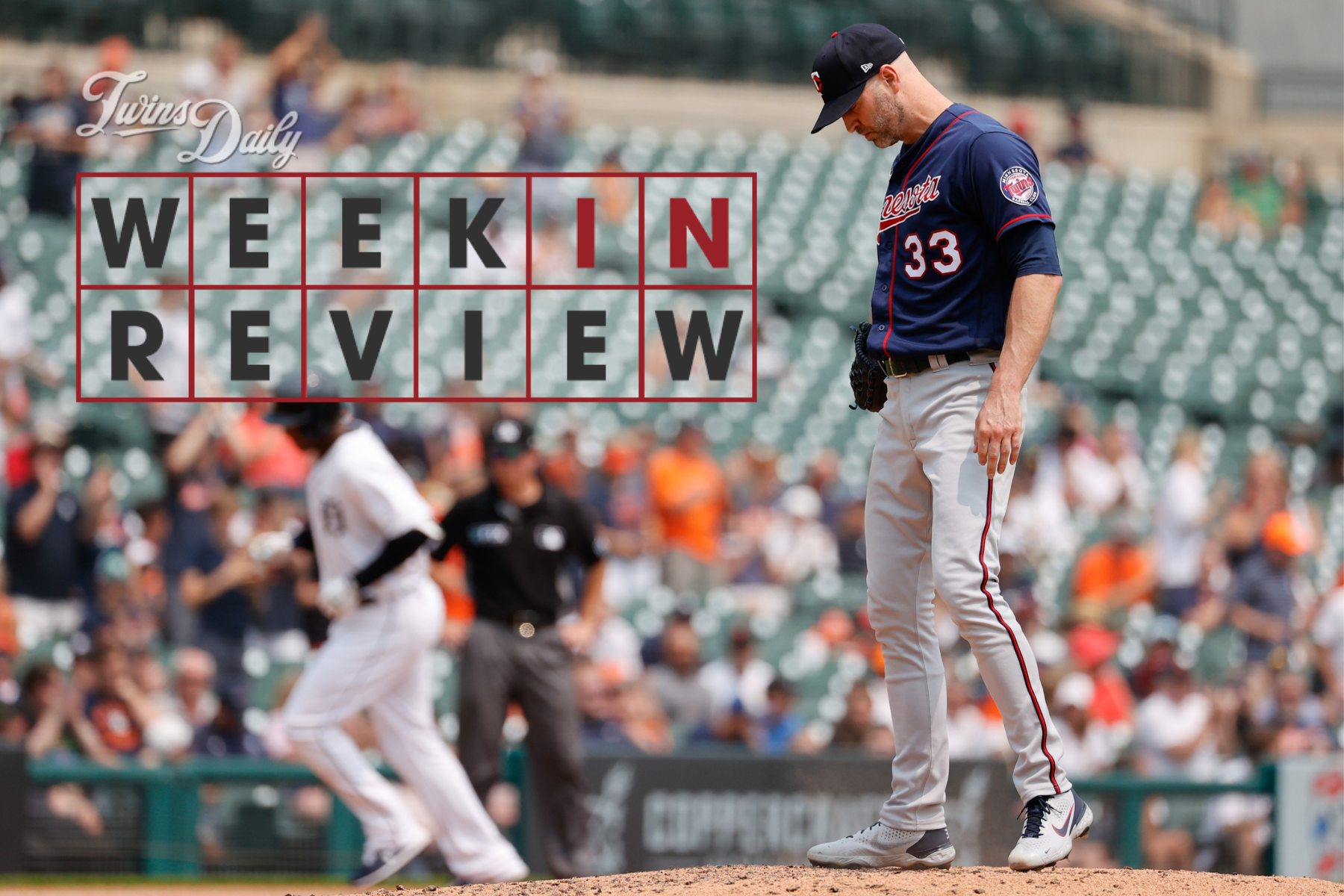 Weekly Snapshot: 7/12 through Sun, 7/18 *** Record Last Week: 0-3 (Overall: 39-53) Run Differential Last Week: -9 (Overall: -66) Standing: 4th Place in AL Central (17.0 GB) Last Week's Game Recaps: Game 90 | DET 1, MIN 0: Bats Come Up Empty in Barnes Debut Game 91 | DET 5, MIN 4: Tigers Walk Off Twins on Bloop Single Game 92 | DET 7, MIN 0: Offense Snoozes Again in Sweep-Clinching Rout NEWS & NOTES I wrote last week about key question marks the Twins need to find clarity on in the second half, and Randy Dobnak is near the top of that list. Unfortunately, it doesn't look like we're going to see much more of him this year. Dobnak was moved to the 60-day Injured List coming out of the break, indicating that his return from a finger strain is nowhere near. The righty last pitched on June 19th, so he won't be back on the mound for the Twins until at least late August. Devin Smeltzer was also transitioned to the 60-day IL; it sounds like he's hit some bumps on the rehab road and is still a ways off. Filling their spots on the 40-man roster are Charlie Barnes and Juan Minaya. The latter addition supplements a bullpen that's now short-handed again, with Derek Law going on the shelf due to a shoulder impingement. Barnes gives the Twins another rookie to evaluate in the starting rotation, and he had a pretty good showing in his major-league debut, which we'll discuss below. In a welcome bit of good news, it sounds like Mitch Garver's return is imminent. He wrapped up a short rehab stint in St. Paul and is set to join the team in Chicago on Monday. Jake Cave, who also embarked on a rehab assignment with the Saints last week, is not far behind. HIGHLIGHTS He's not one of the top pitching prospects in the organization. He doesn't project as a front-line talent, and maybe not even a full-time MLB starter. But nonetheless Barnes is an interesting and important player for the Twins. Time and time again, we've seen the impact of rotation depth beyond the top five, and Barnes has a real chance to factor into that picture over the next few seasons. A fourth-round draft pick out of Clemson back in 2017, Barnes has risen steadily through the organization, posting a 3.72 ERA in the minors over parts of four seasons. In his Twins debut on Friday, the lefty was as advertised, peppering the zone and keeping hitters off-balance with a quality changeup that paces his repertoire. He gave up a lead-off homer and basically shut the Tigers down after that, finishing with four hits, one walk, and one strikeout in 4 ⅔ innings. Barnes should get plenty more opportunities this year out of necessity. Minnesota's starting depth has been largely eradicated, and may get thinner yet. We noted earlier that Dobnak and Smeltzer won't be back for a while. Lewis Thorpe also remains sidelined. Michael Pineda will likely get traded if he's healthy (and if not, more innings to cover anyway). Bailey Ober's workload will be managed vigilantly. The Twins need to find innings wherever they can get them. Which is why I'm sad to say that J.A. Happ probably is not going anywhere, despite his clunker on Sunday ranking among the weekend's lowlights. There was no shortage of them. LOWLIGHTS The Twins not only lost all three games in Detroit, erasing whatever semblance of momentum they generated with a sweep of this same Tigers team heading into the break. They lost them all in strikingly hideous fashion. In Game 1 it was a shutout fueled primarily by Jose Urena and Daniel Norris, both of whom have ERAs north of six. Game 2 saw Detroit win in a walk-off when a routine pop-up with an expected batting average of .000 dropped between Nick Gordon and Andrelton Simmons in shallow center field. In the finale, Minnesota was flat-out dominated by this lousy Tigers team in a 7-0 trouncing. The Twins went 0-for-8 with runners in scoring position and Happ coughed up all seven runs. The pitching was customarily ineffective, but the complete lack of offense from the Twins in this series was surprising and disappointing. The Tigers have a bad, bad staff and Minnesota could do nothing to take advantage. Trevor Larnach's slump carried over from before the break. He saw his hitless streak extend to 17 at-bats before delivering a single on Sunday ... and then promptly getting thrown out trying to stretch it at second. Alex Kirilloff went 1-for-11. Max Kepler and Ryan Jeffers combined to produce zero hits in 18 plate appearances. Simmons is batting .158 this month after another hitless game on Sunday, and his OPS is on the verge of dropping below .600. With very few exceptions, the lineup completely sleepwalked through this series, despite the fact that everyone other than Nelson Cruz – who participated in All-Star festivities and appeared briefly in Tuesday night's game – was running on five full days of rest. It was as listless and sloppy a performance as we've seen all year. I long ago gave up on the idea of the Twins playing meaningful baseball in the second half, and I recognize things are sure to get worse once the sell-off is underway, but I'd still like to have a reason to tune in. The offense should be that. It's a talented group and theoretically a foundation to build upon if the Twins want to reassert themselves as contenders in short order. But what we saw over the past three days offered little to like or feel good about. TRENDING STORYLINE What exactly is the plan with Miguel Sanó? He sat in two of the three games in Detroit, further cementing his status as a part-time platoon player. It's not clear how this course of action benefits the Twins in any way at the moment. Firstly, taking Sanó out of the lineup doesn't appear to make it better. The Twins were shut out in both games he was benched for over the weekend, and while I'm not saying he'd have turned the tides, he has been hitting pretty well of late. In his past 25 games, the first baseman is slashing .265/.307/.470 with a 31% K-rate that is well below his norm. In fact, his OPS over the past two months is nearly .800. Meanwhile, it is apparent that Larnach and Kirilloff (among others) could use a few more days off mixed in. Secondly, there is the contractual attachment to Sanó. I realize that many fans would like to be done and wash their hands of the frustrating slugger, but the reality is that they team is on the hook for another $12 million after this year ($9.25M salary in 2022 and $2.75M buyout for 2023 option). The only way out of that commitment, or some portion of it, is trading Sanó. But keeping him on the bench regularly, as Rocco Baldelli has of late, prevents any trade market from taking shape. A classic surge in July could MAYBE raise the eyebrows of a power-needy team at the deadline. Sticking him on the bench every other day doesn't send any good signals. Moreover, the Twins just need to do whatever they can to help Sanó rediscover his game. It might feel like ancient history with all that's happened since, but he is only separated from his stellar 2019 season – 34 home runs, 79 RBIs, and a .923 OPS in 105 games – by less than six months, in baseball terms. He's 28 years old, not 34. To simply give up on him at this point, when it also means eating $12 million in dead salary, makes no sense, unless the front office is completely and utterly convinced he's lost what he once had. The flashes we've seen from him at times this year make that hard to believe. The coming offseason will likely define Sanó's baseball career. He's either going to put in the work, come back next year and re-establish himself, or he may very well end up finding that the best offer for him afterward is to go play ball overseas. You might not feel he's worth betting on. I wouldn't necessarily blame you. But the Twins don't really have much choice. LOOKING AHEAD The Twins have a full, busy week of action ahead, with eight games in seven days, and they will have their work cut out for them. The week opens with a rookie (Griffin Jax) going up against a Cy Young front-runner (Lance Lynn), and ends with another rookie (Ober) going up against an MVP front-runner (Shohei Ohtani). Given what we just saw against Detroit, it's hard to envision things going particularly well for the Twins during this stretch, but team results on the field will be a secondary storyline with the trade deadline now less than two weeks away. From that perspective, the Pineda start on Wednesday looms large. MONDAY, 7/19 (G1): TWINS @ WHITE SOX – RHP Griffin Jax v. RHP Lance Lynn MONDAY, 7/19 (G2): TWINS @ WHITE SOX – RHP José Berríos v. TBD TUESDAY, 7/20: TWINS @ WHITE SOX – RHP Bailey Ober v. LHP Dallas Keuchel WEDNESDAY, 7/21: TWINS @ WHITE SOX – RHP Michael Pineda v. RHP Dylan Cease THURSDAY, 7/22: ANGELS @ TWINS – LHP Andrew Heaney v. RHP Kenta Maeda FRIDAY, 7/23: ANGELS @ TWINS – RHP Alex Cobb v. LHP J.A. Happ SATURDAY, 7/24: ANGELS @ TWINS – LHP Patrick Sandoval v. RHP Jose Berrios SUNDAY, 7/25: ANGELS @ TWINS – RHP Shohei Ohtani v. RHP Bailey Ober MORE FROM TWINS DAILY — Latest Twins coverage from our writers — Recent Twins discussion in our forums — Follow Twins Daily via Twitter, Facebook or email
 -
My thought is: stay the course. I pretty much agree with your assessment although I think you're underselling Garver. He looked phenomenal before the latest injury. I'm not sure what to make of Jeffers offensively. Rortvedt has definitely shown me this year he's got a long future as a quality backup MLB catcher at least.
-
 1. Will Nick Gordon have a role on the 2022 Twins? The former first-round pick has finally found his way to the majors and is getting a chance to show what he's got ... but not much of a chance. Gordon's playing time has been sporadic at best; in the past calendar month, he's appeared in 11 of 24 games, starting only seven. Personally I'm a little skeptical of Gordon having a stong fit on a contending MLB roster, and his production hasn't exactly forced the issue – he's slashing .167/.222/.262 in his last 45 plate appearances – but it hurts nothing to give him an extended look in the second half and see if he can find some traction. There are some intriguing skills here, from the standout speed to the emerging defensive flexibility, but Gordon turns 26 in October and it'll tough to hold onto him anymore as a development project. He needs to prove he can play a valuable role in the immediate future, and the Twins should give him that chance. 2. What's up with Randy Dobnak? Unlike Gordon, Dobnak's spot in the organization is secure. He signed a five-year extension in the spring and while the total money involved is not going to keep the Twins attached to him for the duration, it'll definitely keep him in the mix as a factor next year. So... can he pitch in the majors? The answer seemed to be a resounding yes through his first 15 big-league appearances, when he posted a 1.69 ERA through 58 ⅔ innings. Since then he has allowed 53 earned runs in 60 innings (7.95 ERA) along with 86 hits. He's been tagged with a 2-9 record in 17 outings during that span. Will the real Randy Dobnak please stand up? It bears noting that the right-hander has dealt with challenging circumstances this year, from an uncertain role out of the gates to a fingernail injury to an unrelated finger strain that currently has him on the Injured List. Hopefully the second half will help the Twins get a handle on whether those circumstances are primarily responsible for his drop-off, or if the former undrafted pitcher's magic has simply run out. Their conclusion will dictate whether they can count on him to help fill out a needy rotation in 2022. 3. Can Bailey Ober be penciled into next year's Opening Day rotation? Speaking of filling out a needy rotation, Ober is another potential plug. With a juiced-up fastball that suddenly touches mid-90s, the 6-foot-9 right-hander has quickly shifted from middling prospect to the makings of a legit MLB starter. There are promising signs in his performance as a rookie – especially the 37-to-11 K/BB ratio in 33 innings. But Ober's performance, which includes a 5.45 ERA and nine home runs allowed in eight short starts, hasn't been good enough to assert himself as a clear option for next year's rotation. As I pondered in the latest Week in Review column: "Can he solve the long-ball woes in the second half? And how much opportunity will have to do so, as the Twins carefully manage his workload coming off the lost season?" If the Twins ultimately determine they can count on neither Dobnak or Ober to be one of their five guys out of the gates next year, the front office will face a major uphill climb in filling out the rotation with limited spending power during the offseason. 4. Is Brent Rooker a major-league player? He doesn't have much left to prove in Triple-A, from an offensive standpoint anyway. Rooker has been absolutely crushing for the St. Paul Saints, with a 1.073 OPS in his past 30 games. He launched three home runs on Tuesday night, then added another on Wednesday to move ahead of Nelson Cruz for the organizational lead in home runs on the season, with 19. That's the kind of power you seemingly want to find a spot for ... but the Twins have been unable to do so. Amidst all their injuries and depth issues, Rooker's gotten only 30 MLB plate appearances this year. The biggest barrier is his defense – it's clear the Twins don't trust him anywhere in the field, even first base. That should cease to be an issue by the end of the month. Nelson Cruz will be traded to a contender, opening up the DH spot. From there, Rooker will need to make a case that he's going to hit enough in the majors to be a viable full-time option at the position next year. Or, he'll have to make the most out of whatever chances he gets in the field to show he's at least usable. As a no-glove slugger, the bar for hitting is extremely high for Rooker to be a valuable big-leaguer. His 18-to-1 K/BB ratio with the Twins up to this point doesn't offer much promise on that front. He's got some work to do. 5. What's salvageable in this bullpen? Tyler Duffey, Taylor Rogers (assuming he's not traded) ... what else is there to build on here as Minnesota tries to pick up the pieces from a disastrous relief corps? Caleb Thielbar will likely be in the picture next year, although he's struggling mightily here in July. Jorge Alcala will remain in play, although his home run proneness has severely diminished his shine. The Twins need to take advantage of the outcome-agnostic nature of this second half to take deeper looks at anyone with a hint of intrigue or potential to factor in next year. Keep running out Derek Law and give him some looks in leverage. Call up Beau Burrows and Ian Hamilton for auditions. Hopefully guys like Luke Farrell, Cody Stashak, and Lewis Thorpe get healthy enough that you can give them some run. Maybe even consider promoting legit relief prospects like Yennier Cano and Jovani Moran, if they're deemed ready. Throw it all against the wall and see what sticks. 6. What's the plan for the middle infield? Right now it is anyone's guess. With Andrelton Simmons likely to be shipped out ahead of the deadline, the Twins will have some flexibility to try out different alignments during the second half. Getting Jorge Polanco regular looks at shortstop may help the team assess if they'd be comfortable moving him back there full-time next year. The same goes for Luis Arraez at second. Feeding Gordon a healthy amount of playing time will be instructional as well. Could Rob Refsnyder re-enter the mix once he gets healthy again? The Twins will want to get a firm grasp on what they have in the middle infield so they can make informed plans for the offseason. With Simmons gone and last winter's offseason shakeup reset, they'll basically be back at square one. Let's hear from you. Which questions do you think will be most important for the Twins to answer during the second half of this season? MORE FROM TWINS DAILY — Latest Twins coverage from our writers — Recent Twins discussion in our forums — Follow Twins Daily via Twitter, Facebook or email
 -
The Minnesota Twins won't be making a pennant push in the second half of the season. That's unfortunate. But it doesn't mean the front office can't operate with a purpose. The remainder of the schedule should be used, in part, to answer these six questions with critical implications for the team's outlook beyond 2021. 1. Will Nick Gordon have a role on the 2022 Twins? The former first-round pick has finally found his way to the majors and is getting a chance to show what he's got ... but not much of a chance. Gordon's playing time has been sporadic at best; in the past calendar month, he's appeared in 11 of 24 games, starting only seven. Personally I'm a little skeptical of Gordon having a stong fit on a contending MLB roster, and his production hasn't exactly forced the issue – he's slashing .167/.222/.262 in his last 45 plate appearances – but it hurts nothing to give him an extended look in the second half and see if he can find some traction. There are some intriguing skills here, from the standout speed to the emerging defensive flexibility, but Gordon turns 26 in October and it'll tough to hold onto him anymore as a development project. He needs to prove he can play a valuable role in the immediate future, and the Twins should give him that chance. 2. What's up with Randy Dobnak? Unlike Gordon, Dobnak's spot in the organization is secure. He signed a five-year extension in the spring and while the total money involved is not going to keep the Twins attached to him for the duration, it'll definitely keep him in the mix as a factor next year. So... can he pitch in the majors? The answer seemed to be a resounding yes through his first 15 big-league appearances, when he posted a 1.69 ERA through 58 ⅔ innings. Since then he has allowed 53 earned runs in 60 innings (7.95 ERA) along with 86 hits. He's been tagged with a 2-9 record in 17 outings during that span. Will the real Randy Dobnak please stand up? It bears noting that the right-hander has dealt with challenging circumstances this year, from an uncertain role out of the gates to a fingernail injury to an unrelated finger strain that currently has him on the Injured List. Hopefully the second half will help the Twins get a handle on whether those circumstances are primarily responsible for his drop-off, or if the former undrafted pitcher's magic has simply run out. Their conclusion will dictate whether they can count on him to help fill out a needy rotation in 2022. 3. Can Bailey Ober be penciled into next year's Opening Day rotation? Speaking of filling out a needy rotation, Ober is another potential plug. With a juiced-up fastball that suddenly touches mid-90s, the 6-foot-9 right-hander has quickly shifted from middling prospect to the makings of a legit MLB starter. There are promising signs in his performance as a rookie – especially the 37-to-11 K/BB ratio in 33 innings. But Ober's performance, which includes a 5.45 ERA and nine home runs allowed in eight short starts, hasn't been good enough to assert himself as a clear option for next year's rotation. As I pondered in the latest Week in Review column: "Can he solve the long-ball woes in the second half? And how much opportunity will have to do so, as the Twins carefully manage his workload coming off the lost season?" If the Twins ultimately determine they can count on neither Dobnak or Ober to be one of their five guys out of the gates next year, the front office will face a major uphill climb in filling out the rotation with limited spending power during the offseason. 4. Is Brent Rooker a major-league player? He doesn't have much left to prove in Triple-A, from an offensive standpoint anyway. Rooker has been absolutely crushing for the St. Paul Saints, with a 1.073 OPS in his past 30 games. He launched three home runs on Tuesday night, then added another on Wednesday to move ahead of Nelson Cruz for the organizational lead in home runs on the season, with 19. That's the kind of power you seemingly want to find a spot for ... but the Twins have been unable to do so. Amidst all their injuries and depth issues, Rooker's gotten only 30 MLB plate appearances this year. The biggest barrier is his defense – it's clear the Twins don't trust him anywhere in the field, even first base. That should cease to be an issue by the end of the month. Nelson Cruz will be traded to a contender, opening up the DH spot. From there, Rooker will need to make a case that he's going to hit enough in the majors to be a viable full-time option at the position next year. Or, he'll have to make the most out of whatever chances he gets in the field to show he's at least usable. As a no-glove slugger, the bar for hitting is extremely high for Rooker to be a valuable big-leaguer. His 18-to-1 K/BB ratio with the Twins up to this point doesn't offer much promise on that front. He's got some work to do. 5. What's salvageable in this bullpen? Tyler Duffey, Taylor Rogers (assuming he's not traded) ... what else is there to build on here as Minnesota tries to pick up the pieces from a disastrous relief corps? Caleb Thielbar will likely be in the picture next year, although he's struggling mightily here in July. Jorge Alcala will remain in play, although his home run proneness has severely diminished his shine. The Twins need to take advantage of the outcome-agnostic nature of this second half to take deeper looks at anyone with a hint of intrigue or potential to factor in next year. Keep running out Derek Law and give him some looks in leverage. Call up Beau Burrows and Ian Hamilton for auditions. Hopefully guys like Luke Farrell, Cody Stashak, and Lewis Thorpe get healthy enough that you can give them some run. Maybe even consider promoting legit relief prospects like Yennier Cano and Jovani Moran, if they're deemed ready. Throw it all against the wall and see what sticks. 6. What's the plan for the middle infield? Right now it is anyone's guess. With Andrelton Simmons likely to be shipped out ahead of the deadline, the Twins will have some flexibility to try out different alignments during the second half. Getting Jorge Polanco regular looks at shortstop may help the team assess if they'd be comfortable moving him back there full-time next year. The same goes for Luis Arraez at second. Feeding Gordon a healthy amount of playing time will be instructional as well. Could Rob Refsnyder re-enter the mix once he gets healthy again? The Twins will want to get a firm grasp on what they have in the middle infield so they can make informed plans for the offseason. With Simmons gone and last winter's offseason shakeup reset, they'll basically be back at square one. Let's hear from you. Which questions do you think will be most important for the Twins to answer during the second half of this season? MORE FROM TWINS DAILY — Latest Twins coverage from our writers — Recent Twins discussion in our forums — Follow Twins Daily via Twitter, Facebook or email View full article
-
I mean, does that need to be stated? I think we all understand that it's possible to find a hidden gem or unlock something in a lesser prospect, but the bottom line is that nobody's going to trade a prospect they think really highly of for 2 months of a 41-year-old DH, not matter how good he is. On the other hand, they'll have to do just that to pry away Berrios or Rogers.
- 74 replies
-
- 3
-
-
- jose berrios
- taylor rogers
- (and 1 more)
-
Cashing In at the Deadline Will Require Painful Decisions for Twins
Nick Nelson posted an article in Twins
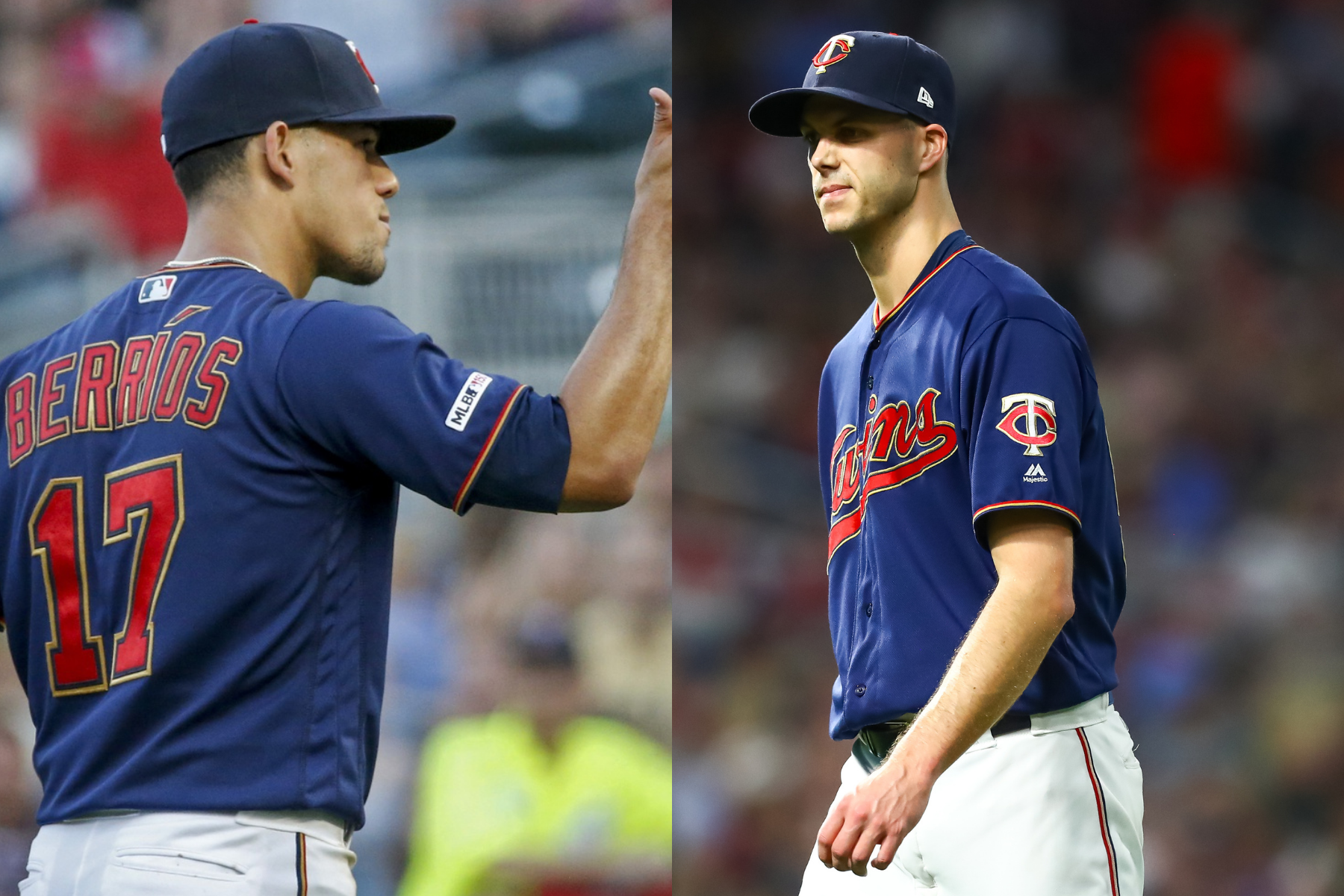 The Twins, destined for irrelevance this season, have a variety of players they'd be more than happy to ship out. Impending free agents like Andrelton Simmons, Michael Pineda, Hansel Robles and J.A. Happ? Why not? Makes no difference really. Those players will be free for anyone to sign come November, and there's no reason to be clamoring for an extension with any of them. Even players under control beyond this year, like Josh Donaldson and Miguel Sanó, could be dealt with a viable argument their salary allotment is better diverted elsewhere. The problem, of course, is that none of these players are likely to generate significant demand at the deadline. Due either to performance, contracts, injuries, or some combination, they're all burdened by drawbacks that significantly dash their trade value. In any of these cases, the Twins are going to be accepting an underwhelming return. Many trade scenarios would qualify as no more than a salary dump. When it comes to selling high, the front office has three opportunities, and in only two of those cases will they be able to dictate a market and drive up the asking price. Fresh off his All-Star appearance, Nelson Cruz is an elite hitter, and basically the biggest offensive upgrade a team could ask for at the deadline. He's a bona fide difference-maker for a contender, and all but certain to get moved. But as a 41-year-old pure DH with two months left on his deal, Cruz's market is inherently limited. When you narrow down the field of teams that actually have a fit, are willing to pay his remaining salary, and are in contention for a championship, you wind up with a handful at most. Cruz will almost surely be traded, but he's not going to bring back a game-changing prospect. That's the nature of the beast. If the Twins want to sell high and compel another team to overpay at the deadline, they're going to need to trade away either their best starter, José Berríos, or their best reliever, Taylor Rogers. Now this is not an endorsement of that course of action. I feel the same reservations as many people reading this do. In part, the attachment is sentimental. Berríos and Rogers are both extremely likable, as well as extremely familiar. They are among the longest-tenured Twins players – both drafted in 2012 before making major-league debuts in 2016. They've remained constants in the rotation and bullpen while the team has changed drastically around them. Both are models of durability and consistency. But sentimentality aside, the more important factor here is that both Berríos and Rogers are critical if not essential to any hopes of the Twins rebounding and returning to contention in 2022. It's already difficult enough to envision the club fielding a contention-caliber rotation OR bullpen next year, given the sorry current state of both units. But when you remove the top performer (by a wide margin) in each, the task feels insurmountable. Berríos and Rogers should theoretically be centerpieces of a retool-and-reset strategy. They are both under team control at a reasonable rate next year, and each is on top of his game. Berríos ranks seventh among AL starters in fWAR, while Rogers ranks fifth among relievers – a first-time All-Star with career highs in K-rate, swinging-strike rate, and FIP. Of course, these are exactly the reasons they will generate outsized demand. Whereas Cruz has a narrow field of suitors, Berríos and Rogers are attractive to any team that's even THINKING about buying. Which brings us back to the point at hand. I don't like the idea of trading either of these long-time fixtures, especially when you'd be subtracting from a clear area of weakness. But no one can deny that if the Twins want to make a real splash and acquire substantial prospect capital to aid whatever scale of rebuild they are about to undertake ... they really have no other choice. This front office prides itself on being opportunistic, and has never been weighed down by sentimentality. We'll see where they land. MORE FROM TWINS DAILY — Latest Twins coverage from our writers — Recent Twins discussion in our forums — Follow Twins Daily via Twitter, Facebook or email
- 74 comments
-
- 5
-
-
- jose berrios
- taylor rogers
- (and 1 more)