



Nick Nelson
-
Posts
8,326 -
Joined
-
Last visited
-
Days Won
56
Content Type
Profiles
News
Minnesota Twins Videos
2026 Minnesota Twins Top Prospects Ranking
2022 Minnesota Twins Draft Picks
Minnesota Twins Free Agent & Trade Rumors, Notes, & Tidbits
Guides & Resources
2023 Minnesota Twins Draft Picks
The Minnesota Twins Players Project
2024 Minnesota Twins Draft Picks
2025 Minnesota Twins Draft Pick Tracker
2026 Minnesota Twins Draft Tracker: Picks & Bonuses
Forums
Blogs
Events
Store
Downloads
Gallery
Everything posted by Nick Nelson
-
 Yep, once Kinley's ERA gets back in line with his 6.70 xFIP (which accounts for all the things you mentioned) he'll be good to go. Luv 2 have a "mop-up pitcher" who can't give me more than one (terrible) inning at a time. Bard looked fairly good in his short time with the Angels, the Twins would be lucky to get him back. I'm not sure what the point is in bringing up Burdi. He's on the DL, recovering from surgery, as we all knew he would be.
 -
Article: Week in Review: Too Many Missteps
Nick Nelson replied to Nick Nelson's topic in Twins Daily Front Page News
This is fair but I will point out that the bullpen's xFIP (4.17) is way lower than its ERA (4.70) and the group is currently sporting an inflated .327 BABIP. They're averaging 9.5 K/9 after averaging 7.6 last year, which to me is a promising early sign. Let's see what happens as the luck starts to neutralize a bit. -
Article: Week in Review: Too Many Missteps
Nick Nelson posted a topic in Twins Daily Front Page News
The Minnesota Twins played only five games over the past week, though it felt like they got two in on Wednesday when they outlasted the Indians over 16 innings. In a week that unfortunately featured a lot more lowlights than highlights, we'll cover both below while also looking ahead to one of the toughest series on the schedule. Weekly Snapshot: Mon, 4/16 through Sun, 4/22 *** Record Last Week: 1-4 (Overall: 8-8) Run Differential Last Week: -16 (Overall: -2) Standing: 2nd Place in AL Central (1..5 GB) HIGHLIGHTS Eduardo Escobar met Nicolas Cage in Puerto Rico and got a photo with him. Pretty hard to top that: The offense was quiet for much of the week, scoring once in two games and twice in another, but did show impressive resilience by mounting comebacks against the Rays on Friday and Sunday. One of the few hitters to shine throughout the week was Brian Dozier, who extended his team-record season-opening hitting streak to 16 games on Sunday. Dozier went 9-for-26 for the week and is slashing .310/.372/.535 on the season. Helping drive his success is the fact that he has significantly cut down on the whiffs; the second baseman's 15.4% K-rate is well below last year's 20% mark. He's still producing plenty of power, while also protecting the plate and using all fields. Dozier looks fantastic. LOWLIGHTS The Twins played easily their worst ball of the season in Tampa Bay, where they were swept by the Rays in a series that featured plenty of puzzlement and frustration. A few items of note: * At a time where Robbie Grossman should seemingly be playing his way out of the Twins' plans, he is instead somehow working his way into more critical spots. Grossman's season started on a very positive note, when he delivered a game-tying two-run bloop single as a pinch-hitter in the opener. Since then, it's been ugly. He has looked terrible defensively when in the outfield, and has gone 3-for-33 with 14 strikeouts and two walks since the aforementioned single. With Byron Buxton sidelined by migraines, Grossman started all five games last week, going 2-for-16 at the plate and committing an error in right field on Friday that cost a run. Despite this lack of effectiveness at the plate, Paul Molitor inexplicably had Grossman in as his cleanup hitter on Saturday in Tampa, and then in the No. 3 spot on Sunday. Maybe it was just an attempt to boost his confidence. Whatever the case, it's hard to believe that Grossman – who ranks second-to-last on the team in WAR (ahead of only Logan Morrison) – has a particularly long leash. He needs to hit to have value, and when you combine his poor start with his pedestrian 2017 campaign and a .720 career OPS, there's just not a lot to fall back on. * As expected, Phil Hughes was called up to make Sunday's start with the Twins finally in need of a fifth rotation member. He looked about exactly like one would expect – which is to say, not good enough. He needed 70 pitches to get 10 outs, giving up five hits (including a homer) with two walks and two strikeouts. Molitor pulled him after he gave up two singles in the fourth. Hughes had decent enough command, but there's just no upside in his repertoire at this point. He doesn't have the stuff to consistently get big-league hitters out and while it's commendable that he's doing what he can to reinvent himself, sooner than later the Twins will need to come to grips with the situation and make a decision for the good of the team. As we'll discuss in the "Down on the Farm" section, one starter in particular may be poised to force their hand. * Miguel Sano's struggles were profiled in this space last time around, and the contact-challenged slugger went on to endure another tough week. His solo home run in extra innings against Cleveland, while huge, was one of only three hits in 22 plate appearances. He struck out eight times without drawing a walk, and saw his OPS drop from .908 to .744. Sano has only one multi-hit game this season. * While Grossman, Hughes and Sano took their lumps, the biggest culprit in a 1-4 week that dropped the Twins to .500 was, without question, the bullpen. Gabriel Moya gave up a run on Tuesday, then surrendered three more on Saturday and found himself demoted to make room for Hughes. Tyler Kinley followed Moya in Saturday's game and also allowed three runs, pushing his ERA to 12.00 in three appearances. Fernando Rodney blew his second save on Friday night and Zach Duke followed by losing the game when he failed to touch first base and retire Denard Span as the winning run crossed home. Even Addison Reed, who's been lights-out all year, couldn't avoid the damage, coughing up Carlos Gomez's walk-off homer on Sunday. TRENDING STORYLINE A bad week for the bullpen shouldn't necessarily fling us all into a panic; there's still much to like about the unit. But with games scheduled for the next 16 consecutive days, and the first four of those coming at Yankee Stadium, the Twins will need all the relief help they can get. The luxury of being able to stash their Rule 5 pick Kinley for sporadic usage in inconsequential situations is going to evaporate, especially with a fifth starter now on the roster. Down in Rochester, Tyler Duffey has been pitching like a man on a mission, with 11 scoreless innings and a 14-to-1 K/BB ratio in four appearances. Duffey was solid as the team's long man last year and the decision to carry Kinley over him out of spring training was somewhat dubious. A swap feels imminent. We'll see how long it takes, and whether they can find a way to keep Kinley in the organization. DOWN ON THE FARM Kinley isn't the only one who's being pushed by a strong performer in Triple-A. As mentioned earlier, Hughes doesn't have a ton of ground to stand on in the rotation. Twins Daily's No. 2 prospect Fernando Romero was masterful for the Red Wings on Sunday, allowing one run on two hits over 6 2/3 innings with 10 strikeouts and two walks. His ERA sits at 1.69. A few more outings like that should quickly put him in the discussion for that fifth starter spot. Meanwhile, No. 1 prospect Royce Lewis lifted his batting average at Cedar Rapids from .222 to .323 on Saturday with a four-hit game. All is going well for the teen phenom in the Midwest League, where he has struck out only three times in 35 plate appearances. Zack Littell, who we ranked as the organization's 11th-best prospect and fifth-best pitcher, has piled up 25 strikeouts in 14 innings at Chattanooga after fanning eight over 5 2/3 on Tuesday. He has induced double-digit swinging strikes in each of his three starts with an eye-popping 17% whiff rate overall. Certainly something to keep an eye on. No. 7 prospect Brent Rookerslumped out of the gates at Chattanooga, entering last week with a .212 average to go along with no walks and no extra-base hits. Not exactly what you like to see out of a highly drafted college player lauded for his advanced bat. But he got it going in six games for the Lookouts last week, posting a 7-for-23 (.304) with his first Double-A homer as well as a double and triple. He still hasn't worked a single walk this season though. LOOKING AHEAD Heading to the Bronx for a four-game series against the Yankees and their loaded lineup isn't exactly the ideal elixir for a slumping team with a beleaguered bullpen, but that is what's what the Twins now face. It could be a rough week for the pitching staff, but the team will at least get a reprieve when they return home for the weekend to host Cincinnati, a team so bad it fired its manager after a 3-15 start. MONDAY, 4/23: TWINS @ YANKEES – RHP Jake Odorizzi v. RHP Masahiro Tanaka TUESDAY, 4/24: TWINS @ YANKEES – RHP Jose Berrios v. LHP CC Sabathia WEDNESDAY, 4/25: TWINS @ YANKEES – RHP Lance Lynn v. RHP Sonny Gray THURSDAY, 4/26: TWINS @ YANKEES – RHP Kyle Gibson v. LHP Jordan Montgomery FRIDAY, 4/27: REDS @ TWINS – RHP Luis Castillo v. RHP Phil Hughes SATURDAY: 4/28: REDS @ TWINS – RHP Sal Romano v. RHP Jake Odorizzi SUNDAY, 4/29: REDS @ TWINS – RHP Tyler Mahle v. RHP Jose Berrios Catch Up On Twins Daily Game Recaps Game 12 | CLE 6, MIN 1: Kluber, Lindor Outshine Twins in Puerto RicoGame 13 | MIN 2, CLE 1: Berrios Stars, LaMarre Plays Hero as Twins Survive 16-Inning DuelGame 14 | TB 8, MIN 7: Playing the Wrong NotesGame 15 | TB 10, MIN 1: Snell Stifles Twins BatsGame 16 | TB 8, MIN 6: Twins Swept on Gomez Walk-off HomerMore on Twins Daily "If Joe Mauer retired today, there is a good chance he wouldn’t get the call from Cooperstown." What can he do going forward to change that? Cody Christie explored Mauer's Hall of Fame caseand how the first baseman can strengthen it before he retires.Meanwhile, Andrew Thares examined the myth around Mauer's supposed lack of clutch hitting. His findings are worth your time.Jamie Cameron broke down the numerous improvements we've seen from Max Kepler at the plate early on.Luke Albrecht filed a report from his experience Puerto Rico, where he watched both games between the Twins and Indians.Ted Schwerzler wrote about the stunning success of Ryan Pressly, who finally seems to be pulling it all together and turning his stuff into results. Pressly was flat-out nasty on Sunday, striking out four of the five hitters he shut down in order. Click here to view the article- 10 replies
-
- 1
-

-
- jose berrios
- brian dozier
- (and 2 more)
-
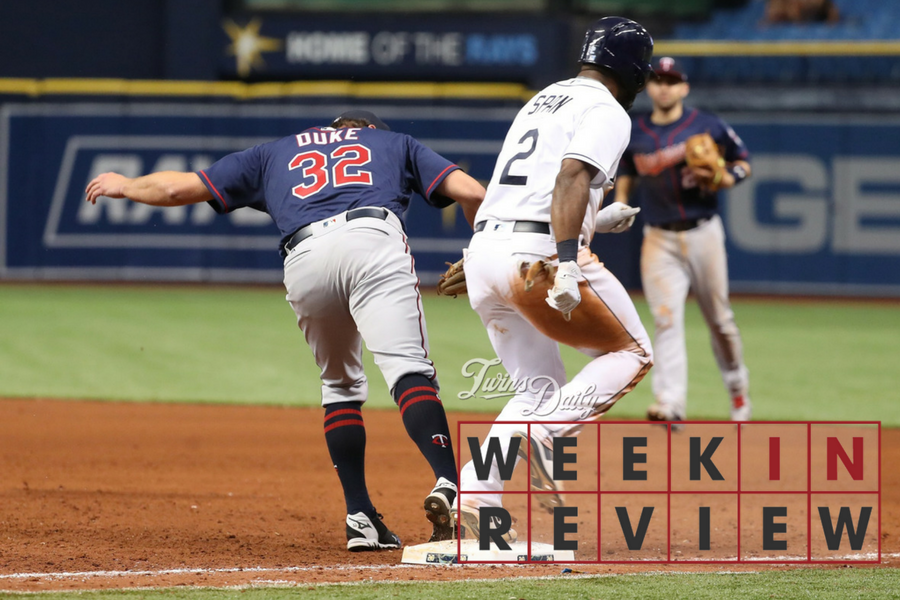 Weekly Snapshot: Mon, 4/16 through Sun, 4/22 *** Record Last Week: 1-4 (Overall: 8-8) Run Differential Last Week: -16 (Overall: -2) Standing: 2nd Place in AL Central (1..5 GB) HIGHLIGHTS Eduardo Escobar met Nicolas Cage in Puerto Rico and got a photo with him. Pretty hard to top that: https://twitter.com/morsecode/status/986673486851649537 Whitney McIntosh of SB Nation wrote up an article later in the week discussing seven things we know and 10 we don't about the meeting – very amusing read. Also, there was baseball. As far as bright spots on the field over the past week, Wednesday's marathon victory over Cleveland in San Juan is really the only qualifier. That game featured plenty of encouraging developments, namely the third absolute gem this year from Jose Berrios – who is very much pitching like an elite ace – and strong work from seven relievers who followed him. https://twitter.com/ParkerHageman/status/987024391249825792 The offense was quiet for much of the week, scoring once in two games and twice in another, but did show impressive resilience by mounting comebacks against the Rays on Friday and Sunday. One of the few hitters to shine throughout the week was Brian Dozier, who extended his team-record season-opening hitting streak to 16 games on Sunday. Dozier went 9-for-26 for the week and is slashing .310/.372/.535 on the season. Helping drive his success is the fact that he has significantly cut down on the whiffs; the second baseman's 15.4% K-rate is well below last year's 20% mark. He's still producing plenty of power, while also protecting the plate and using all fields. Dozier looks fantastic. LOWLIGHTS The Twins played easily their worst ball of the season in Tampa Bay, where they were swept by the Rays in a series that featured plenty of puzzlement and frustration. A few items of note: * At a time where Robbie Grossman should seemingly be playing his way out of the Twins' plans, he is instead somehow working his way into more critical spots. Grossman's season started on a very positive note, when he delivered a game-tying two-run bloop single as a pinch-hitter in the opener. Since then, it's been ugly. He has looked terrible defensively when in the outfield, and has gone 3-for-33 with 14 strikeouts and two walks since the aforementioned single. With Byron Buxton sidelined by migraines, Grossman started all five games last week, going 2-for-16 at the plate and committing an error in right field on Friday that cost a run. Despite this lack of effectiveness at the plate, Paul Molitor inexplicably had Grossman in as his cleanup hitter on Saturday in Tampa, and then in the No. 3 spot on Sunday. Maybe it was just an attempt to boost his confidence. Whatever the case, it's hard to believe that Grossman – who ranks second-to-last on the team in WAR (ahead of only Logan Morrison) – has a particularly long leash. He needs to hit to have value, and when you combine his poor start with his pedestrian 2017 campaign and a .720 career OPS, there's just not a lot to fall back on. * As expected, Phil Hughes was called up to make Sunday's start with the Twins finally in need of a fifth rotation member. He looked about exactly like one would expect – which is to say, not good enough. He needed 70 pitches to get 10 outs, giving up five hits (including a homer) with two walks and two strikeouts. Molitor pulled him after he gave up two singles in the fourth. Hughes had decent enough command, but there's just no upside in his repertoire at this point. He doesn't have the stuff to consistently get big-league hitters out and while it's commendable that he's doing what he can to reinvent himself, sooner than later the Twins will need to come to grips with the situation and make a decision for the good of the team. As we'll discuss in the "Down on the Farm" section, one starter in particular may be poised to force their hand. * Miguel Sano's struggles were profiled in this space last time around, and the contact-challenged slugger went on to endure another tough week. His solo home run in extra innings against Cleveland, while huge, was one of only three hits in 22 plate appearances. He struck out eight times without drawing a walk, and saw his OPS drop from .908 to .744. Sano has only one multi-hit game this season. * While Grossman, Hughes and Sano took their lumps, the biggest culprit in a 1-4 week that dropped the Twins to .500 was, without question, the bullpen. Gabriel Moya gave up a run on Tuesday, then surrendered three more on Saturday and found himself demoted to make room for Hughes. Tyler Kinley followed Moya in Saturday's game and also allowed three runs, pushing his ERA to 12.00 in three appearances. Fernando Rodney blew his second save on Friday night and Zach Duke followed by losing the game when he failed to touch first base and retire Denard Span as the winning run crossed home. Even Addison Reed, who's been lights-out all year, couldn't avoid the damage, coughing up Carlos Gomez's walk-off homer on Sunday. TRENDING STORYLINE A bad week for the bullpen shouldn't necessarily fling us all into a panic; there's still much to like about the unit. But with games scheduled for the next 16 consecutive days, and the first four of those coming at Yankee Stadium, the Twins will need all the relief help they can get. The luxury of being able to stash their Rule 5 pick Kinley for sporadic usage in inconsequential situations is going to evaporate, especially with a fifth starter now on the roster. Down in Rochester, Tyler Duffey has been pitching like a man on a mission, with 11 scoreless innings and a 14-to-1 K/BB ratio in four appearances. Duffey was solid as the team's long man last year and the decision to carry Kinley over him out of spring training was somewhat dubious. A swap feels imminent. We'll see how long it takes, and whether they can find a way to keep Kinley in the organization. DOWN ON THE FARM Kinley isn't the only one who's being pushed by a strong performer in Triple-A. As mentioned earlier, Hughes doesn't have a ton of ground to stand on in the rotation. Twins Daily's No. 2 prospect Fernando Romero was masterful for the Red Wings on Sunday, allowing one run on two hits over 6 2/3 innings with 10 strikeouts and two walks. His ERA sits at 1.69. A few more outings like that should quickly put him in the discussion for that fifth starter spot. Meanwhile, No. 1 prospect Royce Lewis lifted his batting average at Cedar Rapids from .222 to .323 on Saturday with a four-hit game. All is going well for the teen phenom in the Midwest League, where he has struck out only three times in 35 plate appearances. Zack Littell, who we ranked as the organization's 11th-best prospect and fifth-best pitcher, has piled up 25 strikeouts in 14 innings at Chattanooga after fanning eight over 5 2/3 on Tuesday. He has induced double-digit swinging strikes in each of his three starts with an eye-popping 17% whiff rate overall. Certainly something to keep an eye on. No. 7 prospect Brent Rooker slumped out of the gates at Chattanooga, entering last week with a .212 average to go along with no walks and no extra-base hits. Not exactly what you like to see out of a highly drafted college player lauded for his advanced bat. But he got it going in six games for the Lookouts last week, posting a 7-for-23 (.304) with his first Double-A homer as well as a double and triple. He still hasn't worked a single walk this season though. LOOKING AHEAD Heading to the Bronx for a four-game series against the Yankees and their loaded lineup isn't exactly the ideal elixir for a slumping team with a beleaguered bullpen, but that is what's what the Twins now face. It could be a rough week for the pitching staff, but the team will at least get a reprieve when they return home for the weekend to host Cincinnati, a team so bad it fired its manager after a 3-15 start. MONDAY, 4/23: TWINS @ YANKEES – RHP Jake Odorizzi v. RHP Masahiro Tanaka TUESDAY, 4/24: TWINS @ YANKEES – RHP Jose Berrios v. LHP CC Sabathia WEDNESDAY, 4/25: TWINS @ YANKEES – RHP Lance Lynn v. RHP Sonny Gray THURSDAY, 4/26: TWINS @ YANKEES – RHP Kyle Gibson v. LHP Jordan Montgomery FRIDAY, 4/27: REDS @ TWINS – RHP Luis Castillo v. RHP Phil Hughes SATURDAY: 4/28: REDS @ TWINS – RHP Sal Romano v. RHP Jake Odorizzi SUNDAY, 4/29: REDS @ TWINS – RHP Tyler Mahle v. RHP Jose Berrios Catch Up On Twins Daily Game Recaps Game 12 | CLE 6, MIN 1: Kluber, Lindor Outshine Twins in Puerto Rico Game 13 | MIN 2, CLE 1: Berrios Stars, LaMarre Plays Hero as Twins Survive 16-Inning Duel Game 14 | TB 8, MIN 7: Playing the Wrong Notes Game 15 | TB 10, MIN 1: Snell Stifles Twins Bats Game 16 | TB 8, MIN 6: Twins Swept on Gomez Walk-off Homer More on Twins Daily "If Joe Mauer retired today, there is a good chance he wouldn’t get the call from Cooperstown." What can he do going forward to change that? Cody Christie explored Mauer's Hall of Fame case and how the first baseman can strengthen it before he retires. Meanwhile, Andrew Thares examined the myth around Mauer's supposed lack of clutch hitting. His findings are worth your time. Jamie Cameron broke down the numerous improvements we've seen from Max Kepler at the plate early on. Luke Albrecht filed a report from his experience Puerto Rico, where he watched both games between the Twins and Indians. Ted Schwerzler wrote about the stunning success of Ryan Pressly, who finally seems to be pulling it all together and turning his stuff into results. Pressly was flat-out nasty on Sunday, striking out four of the five hitters he shut down in order.
 -
Despite his pristine numbers at every level of the minors, Jose Berrios had his share of detractors in the prospect analyst community. The knock on him was usually the same, and it made sense: When diminutive fly-ball pitchers with no downward plane go up against giant big-league hitters with uppercut swings, the home runs tend to mount. And yet, what was supposed to be the right-hander's biggest weakness has in fact been one of his greatest strengths.After keeping Cleveland hitters in the yard over seven shutout innings on Wednesday night, Berrios has allowed only one home run over four starts this season. Last year, he surrendered only 15 long balls in 145 innings. His 0.93 HR/9 rate was best among Twins starters, and would have placed him among MLB's top 10 if he qualified. Still only 23 years old, Berrios is establishing himself as one of the stingiest pitchers in the game when it comes to homers. It isn't exactly hard to see why. Batters have struggled to catch up to his 94 MPH fastball. The lively two-seamer has so much run it's almost impossible to barrel. And his heavily featured curveball has a case as one of the best pitches in the game today. Berrios delivers it with such consistent zip and tight spin that he pretty much never hangs one. According to the PitchFX data available through Brooks Baseball, opponents have slugged .095 against Berrios' curve this year. Zero ninety five! The batted ball data bears this out as well. Check out the ratio of hard-hit versus soft-hit, and how it's evolved in his three seasons as a big-leaguer: Download attachment: berriosbbdatafg.JPG So when Berrios isn't striking people out, which he's done at an exceptional rate, he's inducing weak contact like no one else. His soft contact rate is the highest in the league and his hard contact rate is tied with Philadelphia's Aaron Nola as the lowest. Even with the somewhat rough go in his second start (an outing in which he was brilliant through three innings before unraveling in sub-30 conditions), Berrios has been as close to perfect on the hill as you'll ever see. His 1.63 ERA matches up almost exactly with his 1.70 FIP, reinforcing that there's been zero luck involved with his transcendent performance. It's only four starts. We're still in the middle of April. But Jose Berrios is showing every sign of being ready to turn the corner and become an ace for the Twins. Click here to view the article
-
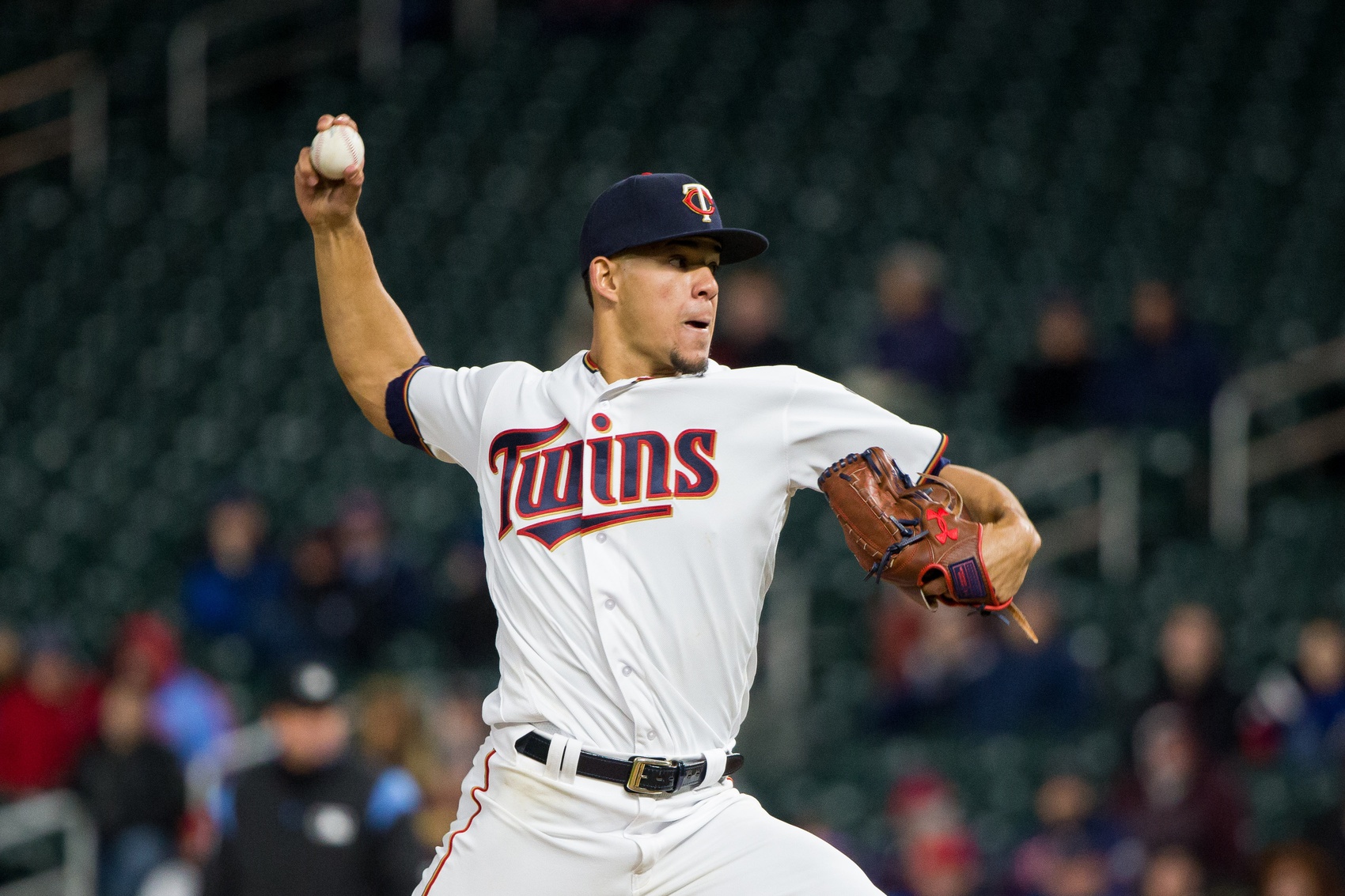 After keeping Cleveland hitters in the yard over seven shutout innings on Wednesday night, Berrios has allowed only one home run over four starts this season. Last year, he surrendered only 15 long balls in 145 innings. His 0.93 HR/9 rate was best among Twins starters, and would have placed him among MLB's top 10 if he qualified. Still only 23 years old, Berrios is establishing himself as one of the stingiest pitchers in the game when it comes to homers. It isn't exactly hard to see why. Batters have struggled to catch up to his 94 MPH fastball. The lively two-seamer has so much run it's almost impossible to barrel. And his heavily featured curveball has a case as one of the best pitches in the game today. Berrios delivers it with such consistent zip and tight spin that he pretty much never hangs one. According to the PitchFX data available through Brooks Baseball, opponents have slugged .095 against Berrios' curve this year. Zero ninety five! The batted ball data bears this out as well. Check out the ratio of hard-hit versus soft-hit, and how it's evolved in his three seasons as a big-leaguer: So when Berrios isn't striking people out, which he's done at an exceptional rate, he's inducing weak contact like no one else. His soft contact rate is the highest in the league and his hard contact rate is tied with Philadelphia's Aaron Nola as the lowest. Even with the somewhat rough go in his second start (an outing in which he was brilliant through three innings before unraveling in sub-30 conditions), Berrios has been as close to perfect on the hill as you'll ever see. His 1.63 ERA matches up almost exactly with his 1.70 FIP, reinforcing that there's been zero luck involved with his transcendent performance. It's only four starts. We're still in the middle of April. But Jose Berrios is showing every sign of being ready to turn the corner and become an ace for the Twins.
 -
Article: Twins vs. Indians Series Preview
Nick Nelson replied to Andrew Thares's topic in Twins Daily Front Page News
I wish we could watch Kluber and Berrios face off. That'd be an epic showdown with the way both are going. -
All of the weekend's games were lost to your standard mid-April blizzard, which will lead to some rescheduling challenges, but the Minnesota Twins did manage to get in four contests at Target Field over the past week. They won three, made a statement against the defending champs, and saw one of their all-time greats check off a noteworthy milestone. Weekly Snapshot: Mon, 4/9 through Sun, 4/15 *** Record Last Week: 3-1 (Overall: 7-4) Run Differential Last Week: +6 (Overall: +14) Standing: 1st Place in AL Central (0.5 GA) Joe Mauer's AVG Last Week: .500 (Season: .412) As a housekeeping note, over the course of the season I will be regularly rotating in and out different tracking stats for the weekly snapshot above. This week I've added Joe Mauer's batting average, which currently leads the majors. He has collected hits in each of his first 11 games and went 6-for-12 with six walks over the past week, reaching base at a .667 clip. HIGHLIGHTS It's only natural that we lead with The Natural himself. Mauer's final hit of the week was the 2,000th of his career. It looked an awful lot like his first one, 14 years earlier: However, Busenitz doesn't appear destined to stick around long. The Twins can bring back LaMarre as a 26th player for their two upcoming games in Puerto Rico due to a lengthy travel stipulation, but will have to send him back down afterward, as they can't officially recall him until 10 days after the option. So they'll likely need to shuffle out Busenitz, their ninth reliever, in favor of another outfielder at that point – maybe Zack Granite or Jake Cave. Eventually the Twins will need to call up another starter. Evidence strongly suggests that Adalberto Mejia, rather than Phil Hughes, was in line to get the call on Friday night. Instead, Mejia worked on Saturday in relief of Aaron Slegers, tossing two innings. When he's been on the hill, Mejia has looked good, allowing only one run on two hits over four frames with five strikeouts, but circumstances have prevented him from getting into any kind of workload rhythm. We're halfway through April and he still hasn't recorded more than six outs in an appearance. WIth off days sandwiching the Puerto Rico series this week, Minnesota can again push off its fifth starter decision. The Twins won't have a need until the second game of next week's series in New York. Mejia could be the guy if he gets a full start in this week and stretches out a bit. Hughes, who tossed five scoreless innings at Single-A in Fort Myers on Saturday, should probably be viewed as the favorite. But don't count out Fernando Romero, who was scheduled to start Sunday in Rochester's rainout. DOWN ON THE FARM It's not often you see a healthy 23-year-old former No. 4 overall pick, with a 3.10 ERA in the minors and plenty of experience in Double-A, go unprotected and undrafted in the Rule 5. But it speaks to where Kohl Stewart's stock stood as of this past offseason. He's got a lot of work to do in order to earn his way back into Minnesota's plans, but took a great first step in his 2018 debut for Chattanooga on Monday, striking out nine with zero walks over five innings of one-run ball. He was cruising along again in his second start Sunday, carrying a perfect game into the fifth, but gave up a three-run homer in the sixth. Returning to the field after losing all of 2017 to Tommy John surgery, Twins Daily No. 5 prospect Alex Kirilloff started a bit slow in Cedar Rapids, going 1-for-12 in his first three games, but busted out big-time last week with multiple hits in three games, including a two-homer outburst on Wednesday. It's safe to say one of the best bats in the Twins system is back on track. At Chattanooga, No. 4 prospect Stephen Gonsalves continues to make his case for an overdue Triple-A promotion, and for being in the Twins' fifth starter mix. He logged four more scoreless innings on Thursday and hasn't allowed a run in two starts. No. 1 prospect Royce Lewis launched his first Single-A home run on Thursday in Peoria, yanking one out to left off 22-year-old Cardinals prospect Jake Walsh with two runners aboard. The big bop sparked a comeback for the Kernels, who were down 4-0 at the time and wound up winning 9-5. LOOKING AHEAD The Twins will happily leave behind this miserable endless winter in favor of much warmer environs, traveling to San Juan for a two-game set against Cleveland. Minnesota is billed as the home team, meaning they'll get last ups. Then it's back to the mainland for a manageable three-game road matchup against a Rays team that's been among baseball's worst. TUESDAY, 4/17: INDIANS @ TWINS – RHP Carlos Carrasco v. RHP Jake Odorizzi WEDNESDAY, 4/18: INDIANS @ TWINS – RHP Trevor Bauer v. RHP Jose Berrios FRIDAY, 4/20: TWINS @ RAYS – RHP Lance Lynn v. RHP Chris Archer SATURDAY, 4/21: TWINS @ RAYS – RHP Kyle Gibson v. LHP Blake Snell SUNDAY, 4/22: TWINS @ RAYS – RHP Jake Odorizzi v. RHP Jake Faria Catch Up On Twins Daily Game Recaps Game 8 | HOU 2, MIN 0: Failure to LaunchGame 9 | MIN 4, HOU 1: Odorizzi, Twins Battle Their Way to VictoryGame 10 | MIN 9, HOU 8: Max to the Rescue!Game 11 | MIN 4, CWS 0: Mauer Reaches 2,000 Hits, Leads Twins to VictoryMore on Twins Daily As Cody Christie notes, this week's short series in Puerto Rico comes with added importance, and not just because of the Twins' ties to the territory. The island is still hurting after last year's hurricane devastation.Matt Johnson's latest Twins Almanac entry peers into the past week in Twins history, reminding us of Cal Ripken's 3,000th hit at the Dome, the first grand slam ever for the franchise, and Jason Kubel's cycle-cinching grandy (obviously not the same one). Click here to view the article
-
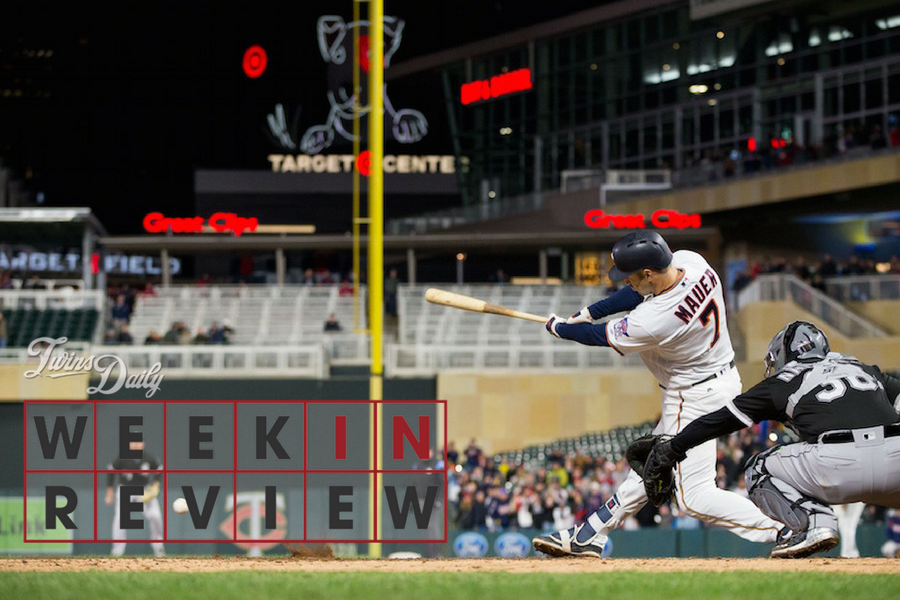 Weekly Snapshot: Mon, 4/9 through Sun, 4/15 *** Record Last Week: 3-1 (Overall: 7-4) Run Differential Last Week: +6 (Overall: +14) Standing: 1st Place in AL Central (0.5 GA) Joe Mauer's AVG Last Week: .500 (Season: .412) As a housekeeping note, over the course of the season I will be regularly rotating in and out different tracking stats for the weekly snapshot above. This week I've added Joe Mauer's batting average, which currently leads the majors. He has collected hits in each of his first 11 games and went 6-for-12 with six walks over the past week, reaching base at a .667 clip. HIGHLIGHTS It's only natural that we lead with The Natural himself. Mauer's final hit of the week was the 2,000th of his career. It looked an awful lot like his first one, 14 years earlier: https://twitter.com/ParkerHageman/status/984656068792979456 The signature seeing-eye single also drove in two runs, essentially sealing up Thursday's win against the White Sox. Mauer has been a tremendously effective weapon toward the top of Minnesota's lineup, which produced 17 runs in three games after getting shut out by Houston on Monday. To celebrate Mauer's milestone achievement, we had a number of articles dedicated to him here on the site: I wrote exactly 2,000 words in tribute to the Minnesota-made star, musing about his aptitude for the game, his inexplicable detractors, and his five biggest hits ever Ted Schwerzler put together a retrospective on Mauer's career, and drew parallels with Kirby Puckett, who also saw his path altered by health issues Matthew Lenz took a quick look at Mauer's future, laying out three options the veteran will face at season's end I recommend checking out all three pieces, and if you've got your own thoughts to share on Mauer, you're encouraged to try your hand in Twins Daily's blog section. There was a good submission there this week from Jonathon Zenk on prospect Ben Rortvedt, who's got a chance to be the franchise's next great catcher. It has been viewed more than 4,000 times. While it's easy to focus on Mauer, he wasn't the only bright spot for the Twins during the past week by any means. A day earlier, Max Kepler had delivered the first Target Field walk-off of 2018, burying the Astros with his second home run of the game: https://twitter.com/TwinsHighlights/status/984174861286338562 Kepler has looked roundly excellent at the plate in this young season, and already has as many homers as he did last year through mid-May. His presence in the lower half of the order helps equip it with lethal depth, giving Minnesota the ability to churn out relentless rallies, like the eight-run onslaught in the fourth that culminated with Kepler's first bomb. And not to be forgotten: Jose Berrios, ladies and gents. On Thursday, for the second time in three starts, the right-hander spun an absolute gem, firing seven scoreless frames with 11 strikeouts. Once again, the 23-year-old showed the kind of masterful control conducive to peak performance, throwing 73 of 99 pitches for strikes and issuing zero walks. As I said this spring while in Fort Myers, where his progress was clearly on display: "If Berrios is staying in the zone and hitting his spots, he's going to be a force. I have zero doubt." Through 20 2/3 innings, he has allowed only one free pass while throwing 68% strikes. He has a 2.18 ERA and opponents are hitting .164/.187/.233 against him. Whew. Berrios evolving into a true ace is the kind of development that would turn the Twins from scrappy wild-card contenders to a bona fide championship threat. He sure as hell looks the part right now. LOWLIGHTS Another big component of that World Series recipe is Miguel Sano clicking at the heart of the lineup. This week, what we saw from the big man was a bunch more whiffing and wasted opportunity. With Brian Dozier raking and Mauer getting on base more than half the time, Sano has stepped up with in plenty of ducks on the pond, but repeatedly failed to cash in this past week. He went 2-for-13 with eight strikeouts, amazingly stranding 20 baserunners in three games. Sano has looked tentative at the plate, constantly check-swinging and showing a visible lack of confidence in his pitch recognition. He's batting .143 with men in scoring position, which isn't what you like to see from a guy in his position. On Thursday, Sano did at least flash a glimpse of his immense power, connecting with an outside pitch and driving it high off Target Field's right-field wall for a double. It was a reminder that when the third baseman makes contact, he's pretty much always going to smash it; Sano's average exit velocity ranks fifth in baseball. But contact has been tough to come by over the first couple weeks. Sano's 48.9% K-rate leads baseball by a wide margin. TRENDING STORYLINE On Friday the Twins optioned outfielder Ryan LaMarre to Triple-A. The reason for the move wasn't totally clear, but per this report from the Star Tribune's Phil Miller, it sounds like the team wanted to add another arm due to concerns over Addison Reed's lingering illness. Sure enough, the Twins recalled Alan Busenitz on Sunday, so they'll have another big arm available for a bit. As Parker notes, the right-hander's combination of premier velocity and spin makes him an intriguing specimen: https://twitter.com/ParkerHageman/status/985562134879850498 However, Busenitz doesn't appear destined to stick around long. The Twins can bring back LaMarre as a 26th player for their two upcoming games in Puerto Rico due to a lengthy travel stipulation, but will have to send him back down afterward, as they can't officially recall him until 10 days after the option. So they'll likely need to shuffle out Busenitz, their ninth reliever, in favor of another outfielder at that point – maybe Zack Granite or Jake Cave. Eventually the Twins will need to call up another starter. Evidence strongly suggests that Adalberto Mejia, rather than Phil Hughes, was in line to get the call on Friday night. Instead, Mejia worked on Saturday in relief of Aaron Slegers, tossing two innings. When he's been on the hill, Mejia has looked good, allowing only one run on two hits over four frames with five strikeouts, but circumstances have prevented him from getting into any kind of workload rhythm. We're halfway through April and he still hasn't recorded more than six outs in an appearance. WIth off days sandwiching the Puerto Rico series this week, Minnesota can again push off its fifth starter decision. The Twins won't have a need until the second game of next week's series in New York. Mejia could be the guy if he gets a full start in this week and stretches out a bit. Hughes, who tossed five scoreless innings at Single-A in Fort Myers on Saturday, should probably be viewed as the favorite. But don't count out Fernando Romero, who was scheduled to start Sunday in Rochester's rainout. DOWN ON THE FARM It's not often you see a healthy 23-year-old former No. 4 overall pick, with a 3.10 ERA in the minors and plenty of experience in Double-A, go unprotected and undrafted in the Rule 5. But it speaks to where Kohl Stewart's stock stood as of this past offseason. He's got a lot of work to do in order to earn his way back into Minnesota's plans, but took a great first step in his 2018 debut for Chattanooga on Monday, striking out nine with zero walks over five innings of one-run ball. He was cruising along again in his second start Sunday, carrying a perfect game into the fifth, but gave up a three-run homer in the sixth. Returning to the field after losing all of 2017 to Tommy John surgery, Twins Daily No. 5 prospect Alex Kirilloff started a bit slow in Cedar Rapids, going 1-for-12 in his first three games, but busted out big-time last week with multiple hits in three games, including a two-homer outburst on Wednesday. It's safe to say one of the best bats in the Twins system is back on track. At Chattanooga, No. 4 prospect Stephen Gonsalves continues to make his case for an overdue Triple-A promotion, and for being in the Twins' fifth starter mix. He logged four more scoreless innings on Thursday and hasn't allowed a run in two starts. No. 1 prospect Royce Lewis launched his first Single-A home run on Thursday in Peoria, yanking one out to left off 22-year-old Cardinals prospect Jake Walsh with two runners aboard. The big bop sparked a comeback for the Kernels, who were down 4-0 at the time and wound up winning 9-5. LOOKING AHEAD The Twins will happily leave behind this miserable endless winter in favor of much warmer environs, traveling to San Juan for a two-game set against Cleveland. Minnesota is billed as the home team, meaning they'll get last ups. Then it's back to the mainland for a manageable three-game road matchup against a Rays team that's been among baseball's worst. TUESDAY, 4/17: INDIANS @ TWINS – RHP Carlos Carrasco v. RHP Jake Odorizzi WEDNESDAY, 4/18: INDIANS @ TWINS – RHP Trevor Bauer v. RHP Jose Berrios FRIDAY, 4/20: TWINS @ RAYS – RHP Lance Lynn v. RHP Chris Archer SATURDAY, 4/21: TWINS @ RAYS – RHP Kyle Gibson v. LHP Blake Snell SUNDAY, 4/22: TWINS @ RAYS – RHP Jake Odorizzi v. RHP Jake Faria Catch Up On Twins Daily Game Recaps Game 8 | HOU 2, MIN 0: Failure to Launch Game 9 | MIN 4, HOU 1: Odorizzi, Twins Battle Their Way to Victory Game 10 | MIN 9, HOU 8: Max to the Rescue! Game 11 | MIN 4, CWS 0: Mauer Reaches 2,000 Hits, Leads Twins to Victory More on Twins Daily As Cody Christie notes, this week's short series in Puerto Rico comes with added importance, and not just because of the Twins' ties to the territory. The island is still hurting after last year's hurricane devastation. Matt Johnson's latest Twins Almanac entry peers into the past week in Twins history, reminding us of Cal Ripken's 3,000th hit at the Dome, the first grand slam ever for the franchise, and Jason Kubel's cycle-cinching grandy (obviously not the same one).
 -
2,000 Words on Joe Mauer to Celebrate 2,000 Hits
Nick Nelson replied to Nick Nelson's topic in Twins Daily Front Page News
Only for one year. I transferred to St. Louis Park as a sophomore and graduated an Oriole. But the blue and orange shall always remain close to my heart. -
2,000 Words on Joe Mauer to Celebrate 2,000 Hits
Nick Nelson replied to Nick Nelson's topic in Twins Daily Front Page News
Thank you all for the kind words! Really glad so many people have enjoyed the piece. And for the record, it was definitely at 2,000 words exactly when I published it! Subsequent edits may have changed that, as there were undoubtedly a number of typos because I churned out the entire thing in the course of one ~3-hour game while kinda half-watching the TV. -
Joe Mauer has never been much of a compiler. Despite his .309 career average and three batting titles, it has taken him 15 MLB seasons to amass 2,000 hits, in large part because of his agnostic view on reaching first base. A hit is the same as a walk, so he has been more than content to settle for the latter. Joe is a man after my own heart. As a writer, I've never understood the fascination some scribes have with compiling massive word counts. From my view, the more concisely you can make a point, the better. Efficiency is king. But with Mauer reaching his big milestone on Thursday night, it only felt right to shed this perspective and focus on that big round number, formerly a mainstay of doomsday proclamists. And so, I'm going to spend exactly 2,000 words in this post musing and reflecting on one of the greatest Twins to ever don the jersey. I don't think I'll have a hard time getting there. Image courtesy of Brad Rempel, USA Today THE NATURAL In a number of ways. I've always felt a personal connection to Joe Mauer. Maybe it's because we both grew up in the Twin Cities, and are only about two years apart in age. Maybe it's because our subsequent paths have been so closely intertwined. When I was on the freshman baseball team at Washburn High in South Minneapolis, our varsity team faced off against Mauer's Cretin-Derham Hall at the Metrodome; he hit for the cycle with an extra triple. His one-strikeout prep career, which turned him into a top draft pick, was the stuff of legend for any of his contemporaries. Maybe it's because we're both dorky white boys with closet aspirations of being rap stars. It's probably a combination of all these, but more than anything, it's simply an appreciation for watching Mauer play the game. As someone who coaches young kids in the summer months, I have an acute appreciation for the fundamentals and instincts on display every time Mauer takes the field. He was hailed as one of the best defensive catchers in the game during his heyday behind the plate, and it's utterly unsurprising that he has quickly developed into one of the league's finest at first. His aptitude for the sport is unbelievable. Purely in terms of fundamentals, he plays baseball as soundly as anyone as I have ever seen. I still find myself marveling about stuff like this all the time: Of course, he never did fully evolve into the mythical force that flashed in 2009, and for that, his will always be a story of unfulfilled promise in the eyes of some. But plenty of us will happily appreciate Mauer as a unique figure in franchise history, whose No. 7 may never be worn again. THE HATERS Haters gonna hate. That's always been my basic stance regarding the confounding level of negative sentiment toward Mauer from Twins fans. It's easy enough to tune out. I've kind of gotten used to doing so from experience, actually. Here's the thing: My dad? He's one of those naysayers. In fact, he is a model example. Pretty much any time Mauer's name is brought up around him, there'll be a reference to the salary. The ill-advised contract. The blasé "oh hey neato" attitude. Dad's not being mean-spirited, really. There is just a certain level of grumbling, griping and grousing that is inherent to the sports experience for many – almost therapeutic in a way – and Mauer is a fairly easy target. I get that. I'll never understand why folks find it so easy to overlook his considerable positives, but alas. I can see why the big salary, the absence of fiery competitiveness, and the lack of prototypical slugging prowess make him a lightning rod. There's no point in trying to sway anyone at this point. If you're reading this, you're either nodding your head and basking in Mauer's generational greatness or rolling your eyes, and that's fine. But if you're sour on the guy, I would urge you to try and enjoy the present. At this point his salary is completely immaterial. Even if it wasn't, right now Mauer's earning the checks by playing some pretty incredible ball. His plate approach is as good as any in the league, and he's driving pitches as fiercely and consistently as he has in many years. You really could not ask for a better No. 2 hitter, wedged between the elite power bats of Brian Dozier and Miguel Sano. The only people who should be cursing Mauer right now are opposing pitchers trying to navigate this minefield of a lineup. MINNESOTA MADE The other thing that I really love about Mauer is how unbelievably, ridiculously, outrageously Minnesotan he is. Maybe that's why so many locals feel an innate animosity toward him – they look at Mauer and see so much of themselves. His distinct accent, his (almost creepily) friendly demeanor, his understated personality. I mean, look at him: It's no secret I'm a sucker for the story of Glen Perkins: Minnesota high school phenom turned college star turned first-round pick turned All Star big-leaguer. An entire career spent in his own backyard. Well, Mauer takes the hometown hero narrative to new extremes, rarely seen in the history of sport. Born and raised in Minnesota's capital city, he became a prep legend, then a No. 1 draft pick by the team he grew up watching. And during a 15-year career, all spent with that same team, he has won an MVP and made six All Star teams. He'll be a borderline Hall of Fame case when he hangs 'em up. Through it all, he's still the same soft-spoken, easygoing dude with an almost nonexistent ego. Alright, how we doing. Not even at 1,000 words yet? Hoo boy. Alright, well as I try to hammer out a word for every hit in Mauer's career, let's look back and try to pluck out the five biggest and most memorable from that pool of two thousand. (Obviously this is very subjective, and I'd love to hear your own submissions in the comments.) 5 BIGGEST HITS OF JOE MAUER'S CAREER Notches His First Career Hit: April 5, 2004 Mauer was in the Opening Day lineup on April 5th, 2004, facing Cleveland at the Metrodome. Still only 20 years old at the time, he drew a walk against CC Sabathia in his first career plate appearance. Mauer then struck out, walked again, and led off the ninth with his first MLB hit — fittingly, a ground ball single to center. He'd add a second in extra innings. Seals Up His First Batting Title: October 1, 2006 Entering play on the final day of the '06 season, Mauer had the slimmest of leads over New York's Derek Jeter in average – .346 to .345 – and so the American League batting title was very much on the line. Mauer later admitted he had "never been so nervous in (his) life," and struck out swinging in his first at-bat. But he came back with a big double in his next AB and followed with a single to basically clinch the honor. Oh, and in the meantime, the Twins clinched the AL Central crown, with Mauer's two-hit day helping fuel a critical victory. Opens His MVP Campaign with a Bang: May 1, 2009 Joe wasn't quite right when he showed up to spring training in '09, and he ended up missing the first month of the regular season due to a lower-back issue. When he made his highly anticipated debut on the first of May, I was in attendance at the Metrodome, with uncharacteristically good seats. Tucked a few rows behind the visiting dugout on the first-base line, I had a perfect view of Mauer's first swing of the season: a home run drilled over the left field wall. It was a booming start to one of the great months in the modern baseball history – he batted .414 with a 1.338 OPS and 11 home runs... as a Gold Glove catcher! Of course, he'd rightfully go on to win the AL MVP, leading the league in AVG/OBP/SLG. Sparks Twins Rally in 11th Inning of ALDS Game 2: October 9, 2009 Leading off the top of the 11th in an epic seesaw battle in the Bronx, Mauer delivered his second hit of the game – a double, drilled down the left field line off Damaso Marte. Jason Kubel followed with a ground ball single up the middle, scoring Mauer and giving Minnesota the lead. Claiming a huge win on the road, the Twins were able to even the series at one, finally canceling their lengthy hex against the Yankees and heading back home with momentum. Oh, wait. No. In actuality, Mauer's obvious double was inexplicably ruled a foul by Phil Cuzzi, who was staring directly at the ball from about 15 feet away when it bounced well inside the line. Mauer did end up singling in the at-bat, but instead of scoring on Kubel's ensuing base hit he moved up to second, and then to third on a single by Michael Cuddyer. Yanks reliever David Robertson (yep, same David Robertson), went on to retire three straight batters to leave the bases loaded. Mark Teixeira hit a walkoff home run to lead off the bottom of the inning. And the hex lives on to this day. That moment was in so many ways emblematic of Mauer's entire career, and his legacy with a segment of fans. He did end up coming through and getting on base, but not in the singlehandedly game-changing fashion that dances through our heads still to this day. So while it wasn't actually a hit, I'm counting it. Dangit Cuzzi. Tallies Hit No. 2,000 Amid Late-Career Renaissance: April 12, 2018 There have been plenty of other noteworthy knocks in Mauer's fantastic career, many of which surely deserve to be replace the copout selection above. But choosing favorites from a sea of 2,000 is a tall task, which speaks to the caliber of his body of work. Closing your eyes, you can probably picture a montage of Mauer hits: solidly stroked singles to left, double to the gap or down the line, a ground ball single up the middle – like the one that started it all at the Dome 14 years ago, and the one he struck last night in Target Field for the big milestone. Slogging through the miserable 2011, 2012 and 2013 seasons was tough enough as a Twins fan, but watching Mauer go through his concussion, and come back as a sub-mediocre player, took the agony to new heights. The thought of Minnesota trying to rise back to contention in spite of him, rather than because of him in some way, was tough to stomach. As such, it has been incredibly gratifying to see Mauer return to his former offensive glory just as the team reemerges. I honestly didn't know if we'd ever see the 34-year-old (35 in one week) perform at this level again, and the way it's come together... well, to borrow his vernacular, it's pretty neat. Looks like I've still got about 60 words left to burn, so I'll close by imparting you with some wisdom from the man himself, according to BrainyQuotes: "It frustrates me if I'm not good at something, so I do it until I get good at it." “I hate striking out, doesn’t matter what time of the game. I just don’t like striking out.” "I like Lil Wayne." "I'm not as cool as I'm supposed to be." "Nobody wants to hear me rap." I suspect no human has made it this far into the article, least of all Joe Mauer himself. But Joe, if you are somehow reading this, please know this much: You're as cool as you need to be. And I want to hear you rap. Very badly. Very, very, very badly. View full article
-
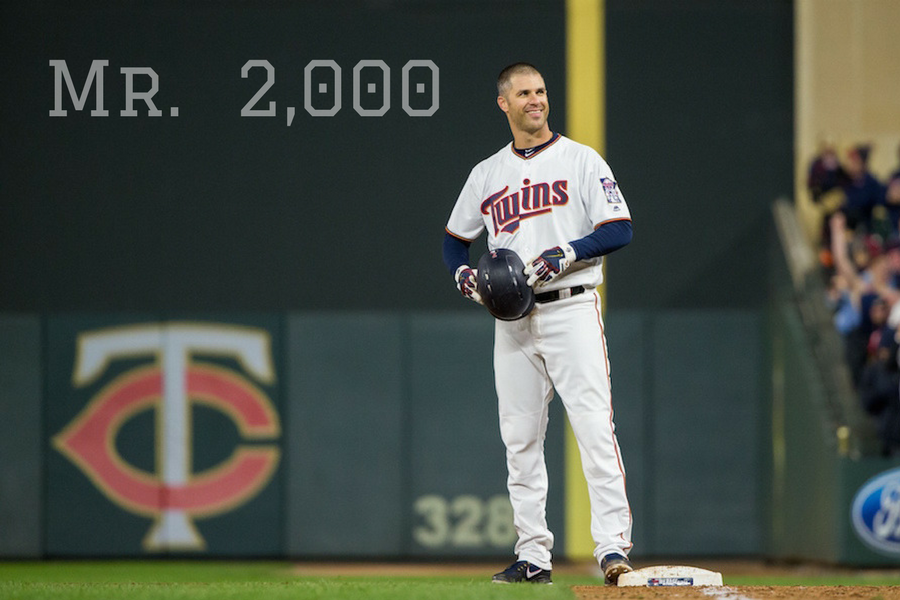 THE NATURAL In a number of ways. I've always felt a personal connection to Joe Mauer. Maybe it's because we both grew up in the Twin Cities, and are only about two years apart in age. Maybe it's because our subsequent paths have been so closely intertwined. When I was on the freshman baseball team at Washburn High in South Minneapolis, our varsity team faced off against Mauer's Cretin-Derham Hall at the Metrodome; he hit for the cycle with an extra triple. His one-strikeout prep career, which turned him into a top draft pick, was the stuff of legend for any of his contemporaries. Maybe it's because we're both dorky white boys with closet aspirations of being rap stars. It's probably a combination of all these, but more than anything, it's simply an appreciation for watching Mauer play the game. As someone who coaches young kids in the summer months, I have an acute appreciation for the fundamentals and instincts on display every time Mauer takes the field. He was hailed as one of the best defensive catchers in the game during his heyday behind the plate, and it's utterly unsurprising that he has quickly developed into one of the league's finest at first. His aptitude for the sport is unbelievable. Purely in terms of fundamentals, he plays baseball as soundly as anyone as I have ever seen. I still find myself marveling about stuff like this all the time: Of course, he never did fully evolve into the mythical force that flashed in 2009, and for that, his will always be a story of unfulfilled promise in the eyes of some. But plenty of us will happily appreciate Mauer as a unique figure in franchise history, whose No. 7 may never be worn again. THE HATERS Haters gonna hate. That's always been my basic stance regarding the confounding level of negative sentiment toward Mauer from Twins fans. It's easy enough to tune out. I've kind of gotten used to doing so from experience, actually. Here's the thing: My dad? He's one of those naysayers. In fact, he is a model example. Pretty much any time Mauer's name is brought up around him, there'll be a reference to the salary. The ill-advised contract. The blasé "oh hey neato" attitude. Dad's not being mean-spirited, really. There is just a certain level of grumbling, griping and grousing that is inherent to the sports experience for many – almost therapeutic in a way – and Mauer is a fairly easy target. I get that. I'll never understand why folks find it so easy to overlook his considerable positives, but alas. I can see why the big salary, the absence of fiery competitiveness, and the lack of prototypical slugging prowess make him a lightning rod. There's no point in trying to sway anyone at this point. If you're reading this, you're either nodding your head and basking in Mauer's generational greatness or rolling your eyes, and that's fine. But if you're sour on the guy, I would urge you to try and enjoy the present. At this point his salary is completely immaterial. Even if it wasn't, right now Mauer's earning the checks by playing some pretty incredible ball. His plate approach is as good as any in the league, and he's driving pitches as fiercely and consistently as he has in many years. You really could not ask for a better No. 2 hitter, wedged between the elite power bats of Brian Dozier and Miguel Sano. The only people who should be cursing Mauer right now are opposing pitchers trying to navigate this minefield of a lineup. MINNESOTA MADE The other thing that I really love about Mauer is how unbelievably, ridiculously, outrageously Minnesotan he is. Maybe that's why so many locals feel an innate animosity toward him – they look at Mauer and see so much of themselves. His distinct accent, his (almost creepily) friendly demeanor, his understated personality. I mean, look at him: It's no secret I'm a sucker for the story of Glen Perkins: Minnesota high school phenom turned college star turned first-round pick turned All Star big-leaguer. An entire career spent in his own backyard. Well, Mauer takes the hometown hero narrative to new extremes, rarely seen in the history of sport. Born and raised in Minnesota's capital city, he became a prep legend, then a No. 1 draft pick by the team he grew up watching. And during a 15-year career, all spent with that same team, he has won an MVP and made six All Star teams. He'll be a borderline Hall of Fame case when he hangs 'em up. Through it all, he's still the same soft-spoken, easygoing dude with an almost nonexistent ego. Alright, how we doing. Not even at 1,000 words yet? Hoo boy. Alright, well as I try to hammer out a word for every hit in Mauer's career, let's look back and try to pluck out the five biggest and most memorable from that pool of two thousand. (Obviously this is very subjective, and I'd love to hear your own submissions in the comments.) 5 BIGGEST HITS OF JOE MAUER'S CAREER Notches His First Career Hit: April 5, 2004 Mauer was in the Opening Day lineup on April 5th, 2004, facing Cleveland at the Metrodome. Still only 20 years old at the time, he drew a walk against CC Sabathia in his first career plate appearance. Mauer then struck out, walked again, and led off the ninth with his first MLB hit — fittingly, a ground ball single to center. He'd add a second in extra innings. Seals Up His First Batting Title: October 1, 2006 Entering play on the final day of the '06 season, Mauer had the slimmest of leads over New York's Derek Jeter in average – .346 to .345 – and so the American League batting title was very much on the line. Mauer later admitted he had "never been so nervous in (his) life," and struck out swinging in his first at-bat. But he came back with a big double in his next AB and followed with a single to basically clinch the honor. Oh, and in the meantime, the Twins clinched the AL Central crown, with Mauer's two-hit day helping fuel a critical victory. Opens His MVP Campaign with a Bang: May 1, 2009 Joe wasn't quite right when he showed up to spring training in '09, and he ended up missing the first month of the regular season due to a lower-back issue. When he made his highly anticipated debut on the first of May, I was in attendance at the Metrodome, with uncharacteristically good seats. Tucked a few rows behind the visiting dugout on the first-base line, I had a perfect view of Mauer's first swing of the season: a home run drilled over the left field wall. It was a booming start to one of the great months in the modern baseball history – he batted .414 with a 1.338 OPS and 11 home runs... as a Gold Glove catcher! Of course, he'd rightfully go on to win the AL MVP, leading the league in AVG/OBP/SLG. Sparks Twins Rally in 11th Inning of ALDS Game 2: October 9, 2009 Leading off the top of the 11th in an epic seesaw battle in the Bronx, Mauer delivered his second hit of the game – a double, drilled down the left field line off Damaso Marte. Jason Kubel followed with a ground ball single up the middle, scoring Mauer and giving Minnesota the lead. Claiming a huge win on the road, the Twins were able to even the series at one, finally canceling their lengthy hex against the Yankees and heading back home with momentum. Oh, wait. No. In actuality, Mauer's obvious double was inexplicably ruled a foul by Phil Cuzzi, who was staring directly at the ball from about 15 feet away when it bounced well inside the line. Mauer did end up singling in the at-bat, but instead of scoring on Kubel's ensuing base hit he moved up to second, and then to third on a single by Michael Cuddyer. Yanks reliever David Robertson (yep, same David Robertson), went on to retire three straight batters to leave the bases loaded. Mark Teixeira hit a walkoff home run to lead off the bottom of the inning. And the hex lives on to this day. That moment was in so many ways emblematic of Mauer's entire career, and his legacy with a segment of fans. He did end up coming through and getting on base, but not in the singlehandedly game-changing fashion that dances through our heads still to this day. So while it wasn't actually a hit, I'm counting it. Dangit Cuzzi. Tallies Hit No. 2,000 Amid Late-Career Renaissance: April 12, 2018 There have been plenty of other noteworthy knocks in Mauer's fantastic career, many of which surely deserve to be replace the copout selection above. But choosing favorites from a sea of 2,000 is a tall task, which speaks to the caliber of his body of work. Closing your eyes, you can probably picture a montage of Mauer hits: solidly stroked singles to left, double to the gap or down the line, a ground ball single up the middle – like the one that started it all at the Dome 14 years ago, and the one he struck last night in Target Field for the big milestone. Slogging through the miserable 2011, 2012 and 2013 seasons was tough enough as a Twins fan, but watching Mauer go through his concussion, and come back as a sub-mediocre player, took the agony to new heights. The thought of Minnesota trying to rise back to contention in spite of him, rather than because of him in some way, was tough to stomach. As such, it has been incredibly gratifying to see Mauer return to his former offensive glory just as the team reemerges. I honestly didn't know if we'd ever see the 34-year-old (35 in one week) perform at this level again, and the way it's come together... well, to borrow his vernacular, it's pretty neat. Looks like I've still got about 60 words left to burn, so I'll close by imparting you with some wisdom from the man himself, according to BrainyQuotes: "It frustrates me if I'm not good at something, so I do it until I get good at it." “I hate striking out, doesn’t matter what time of the game. I just don’t like striking out.” "I like Lil Wayne." "I'm not as cool as I'm supposed to be." "Nobody wants to hear me rap." I suspect no human has made it this far into the article, least of all Joe Mauer himself. But Joe, if you are somehow reading this, please know this much: You're as cool as you need to be. And I want to hear you rap. Very badly. Very, very, very badly.
 -
Baseball is back. The Minnesota Twins have launched into the new season with an impressive showing of power, both from their bats and arms. Here's a rundown of everything that's happened so far and a look ahead to what's next. Weekly Snapshot: Thursday, 3/29 through Sunday, 4/8 *** Record Last Week: 4-3 (Overall: 4-3) Run Differential Last Week: +8 (Overall: +8) Standing: 1st Place in AL Central (1.0 GA) Just to lay some groundwork, this is the first installment of a new series that will be running all season here at Twins Daily. Each Monday morning you'll find a new "Week in Review" column, covering the best and worst of the past seven days (in this case the past 11), as well as a key storyline worth tracking, and a rundown of the most noteworthy developments in the minor leagues. Additionally, we'll take a look ahead at what's on tap for the coming week. The idea here is to present sort of a micro/macro-hybrid analysis throughout the season, by zooming in on takeaways from each ~1/24th chunk of the schedule and tying them to the bigger picture that is the 2018 campaign. If there's anything else you'd like to see in this weekly space, please don't hesitate to let me know in the comments! HIGHLIGHTS "Bombs and Bullpen" was the title of Tom Froemming's recap from the home opener on Thursday, and it pretty well summarizes up the first week-plus of Twins games – mostly in good ways. A young lineup vaunted for its balance and pop has displayed both in spades. Picking up where they left off in 2017, the Twins have impressively tallied 12 home runs through seven games, and rank 7th among MLB teams in OPS. Minnesota has received production throughout the order. Some hitters have looked better than others, but no one has been totally discouraging. Among the standout performers: Brian Dozier is off to a rousing start, with four homers through his first seven games. The second baseman has been a notoriously slow starter, leading us all to wonder what would happen if he put it together from start to finish here in his walk year. So far, so good.After missing the final stretch of 2017, Miguel Sano has quickly made his presence felt back in the lineup. Despite striking out in nearly half his plate appearances, he's rocking a team-leading 1.147 OPS with four homers and eight RBI.Dozier and Sano are the biggest home run threats in an offense full with them, but amidst all the deep drives, it is the disciplined approaches and scrappy ABs that have stood out most. Max Kepler has struck out only once in 27 plate appearances, with five walks. He's looked much more comfortable against left-handed pitching, which was his pivotal priority this season. Joe Mauer continues to resemble his old self at the plate; he has a .462 OBP and 2-to-4 K/BB ratio thus far. Thrust into starting duty, Eduardo Escobar has come charging out of the gates with a 1.131 OPS, and his nine-pitch battle that resulted in an RBI single during a rally on Saturday stands out as one of the club's best at-bats through a week-plus.In every game thus far, the offense has either given the pitching staff a cozy lead to cruise on, or mounted a comeback of sorts when put in a hole. That's exactly what we're hoping to see on a consistent basis. The rotation started off brilliantly, with 21 consecutive shutout innings (driven by some serious batted ball luck). Twins starters have since looked more human, but still good enough to inspire confidence. And the bullpen was looking stellar up until its first meltdown on Saturday. Paul Molitor has leaned heavily on his newly acquired free agent right-handers Fernando Rodney and Addison Reed who've combined for seven appearances already. Rodney's been effective, outside of the walk-off homer surrendered to Adam Jones on Opening Day. Reed has certainly been living up this bullpen ace billing, with just one hit allowed through his first 5 1/3 innings of work. Taylor Rogers has turned in three scoreless appearances. Ryan Pressly and Gabriel Moya look like the kinds of reliable arms you love to have available for middle-inning roles. In total, Twins relievers have struck out 27 in 24 2/3 innings, upping the intimidation factor after ranking 29th in K rate last year. The depth and quality of both the lineup and pitching staff have mostly been substantiated early on. LOWLIGHTS I say "mostly" because neither group has been without its warts. Not everyone has looked great at the plate. Jason Castro (.461 OPS) and Byron Buxton (.407 OPS) have been among the laggards, but their defensive impacts help make up for it. Logan Morrison is batting .053, but hasn't looked lost or hopeless at the plate. You can't expect everyone to be clicking simultaneously out of the gates. I don't see serious cause for concern with any hitters. There are, however, some noteworthy early issues in the bullpen. Trevor Hildenberger didn't look quite right all spring and that's carried over to the regular season. He has struck out only one of the 17 batters he's faced, and the command has been plainly amiss. He left to two hangers out over the plate on Saturday and they were hammered for a three-run double and two-run homer, turning a surmountable deficit into a blowout. Three of the runs that came across on Hildenberger's watch were charged to Zach Duke, who had loaded the bases. Duke has had a rough go of it as well, although his 16.88 ERA overstates things. He still seems to be finding his control, but shows some truly nasty stuff and has struck out 41% of the batters he's faced so it's not all bad. Duke's safe for now. Hildenberger might be on shakier ground, given that he's got options while the Twins have Alan Busenitz and Tyler Duffey ready in Triple-A. Molitor can ill afford to have any untrusted commodities in the bullpen, given that he's already working around a Rule 5 albatross. Which brings us to this week's... TRENDING STORYLINE Through seven games, it has become crystal clear that Molitor isn't ready to use Tyler Kinley in remotely competitive situations. The manager had chances to deploy Kinley with three- or four-run leads, but ultimately used him only once, with the Twins trailing by seven. During his one inning of work, Kinley showed both why the team would strain to keep him on the roster, and why Molitor has been reluctant to use him in any kind of leverage spot. The fastball and slider were legit, causing looks of bewilderment on the faces of batters. But they were also erratic; in his lone appearance, Kinley issued a walk, and allowed a run to score on a very wild pitch. It's been easy enough for Molitor to work around Kinley's presence up to this point, thanks to all open days and the four-man rotation. But soon enough, the Twins will need to make a decision. The fifth-starter ultimatum was pushed back by Sunday's freezeout, but Minnesota now faces a slate of games on seven straight days at Target Field. Further cancellations are of course very possible, but if all games are played the Twins will need another starter on Friday night against the White Sox. Soon enough, a reliever is gonna need to go in order to make room for Phil Hughes or whoever gets that nod. Kinley's the only one who makes sense, right? The Twins just can't realistically hope to hide him all year as they have so far. But then again, they've become quite invested in the big righty at this point. (Can't help but notice that JT Chargois and Luke Bard, both lost so the Twins could protect Kinley, have been pitching well for the Dodgers and Angels so far.) We'll see. DOWN ON THE FARM Action in the minors has been limited at the opening of the season due to weather. But here are a few noteworthy tidbits. Nick Gordon, who might've been unpleasantly surprised to find himself assigned to Chattanooga after spending the entire 2017 season there, made a statement right off the bat with a four-hit night in the Double-A opener. He played shortstop.Zack Littell, who also has a pretty good case for deserving to be one level higher, struck out seven over 4 1/3 innings of two-run ball in the Lookouts opener.Count Stephen Gonsalves in the same category as the two above; he entered the season with a 2.17 ERA in 28 starts at Double-A. He turned in a very clean first start on Saturday, tossing 5 1/3 hitless innings with three strikeouts and three walks. The lefty has now allowed 110 hits in 167 innings at Chattanooga. What is he still doing there?Tyler Jay relieved Gonsalves in that game and recorded five outs (two on strikeouts) with one hit allowed.LOOKING AHEADCold weather and snow in the forecast could throw this week's plan into turmoil, but here's how things are currently slated to lay out: MONDAY, 4/9: ASTROS @ TWINS – RHP Justin Verlander v. RHP Lance Lynn TUESDAY, 4/10: ASTROS @ TWINS – LHP Dallas Keuchel v. RHP Jake Odorizzi WEDNESDAY, 4/11: ASTROS @ TWINS – RHP Lance McCullers v. RHP Kyle Gibson THURSDAY, 4/12: WHITE SOX @ TWINS – RHP Lucas Giolito v. RHP Jose Berrios FRIDAY, 4/13: WHITE SOX @ TWINS – RHP Reynaldo Lopez v. Undecided SATURDAY, 4/14: WHITE SOX @ TWINS – RHP Miguel Gonzalez v. RHP Lance Lynn SUNDAY, 4/15: WHITE SOX @ TWINS – RHP Carson Fulmer v. RHP Jake Odorizzi Catch Up On Twins Daily Game Recaps Game 1 | BAL 3, MIN 2: Opening D'OhGame 2 | MIN 6, BAL 2: Good Gibby Rides Again!Game 3 | MIN 7, BAL 0: Berri0sGame 4 | PIT 5, MIN 4: Lynn Surrenders Grand Slam in Twins DebutGame 5 | MIN 7, PIT 3: Rosario Sparks Comeback, Inspires Some Head-ScratchingGame 6 | MIN 4, SEA 2: Bombs and BullpenGame 7 | SEA 11, MIN 4: That Escalated QuicklyMore on Twins Daily Dozier, Mauer Approaching Milestones by Cody ChristieJason Castro and a Cup of Coffee by Jamie CameronProven Leadership Will Set Tone for 2018 Red Wings by Ted SchwerzlerTalented Lookouts Eye Repeat in Southern League by Seth StohsBlackmon's Deal with Rockies Sets Precedent for Dozier by Nick Nelson Click here to view the article
- 9 replies
-
- 8
-
-
- brian dozier
- miguel sano
- (and 2 more)
-
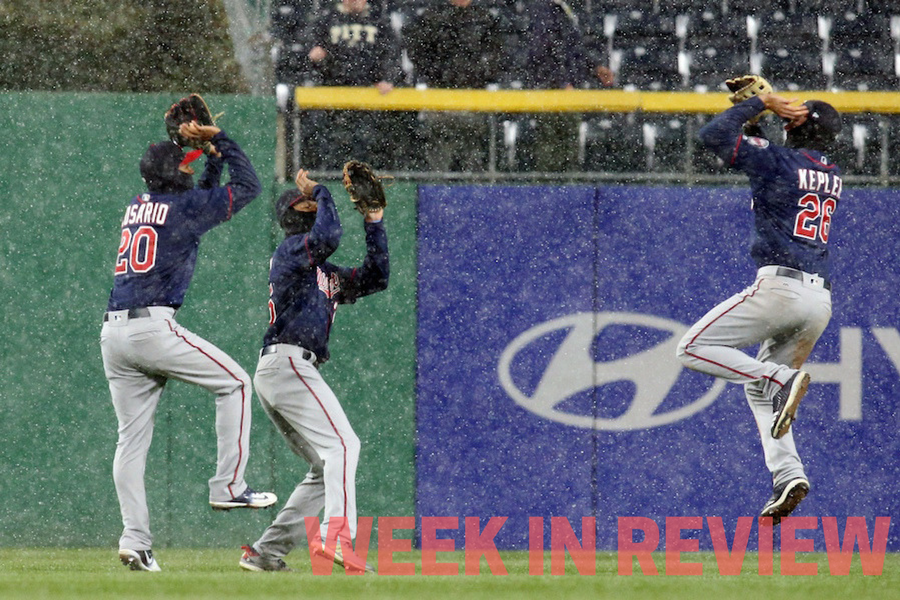 Weekly Snapshot: Thursday, 3/29 through Sunday, 4/8 *** Record Last Week: 4-3 (Overall: 4-3) Run Differential Last Week: +8 (Overall: +8) Standing: 1st Place in AL Central (1.0 GA) Just to lay some groundwork, this is the first installment of a new series that will be running all season here at Twins Daily. Each Monday morning you'll find a new "Week in Review" column, covering the best and worst of the past seven days (in this case the past 11), as well as a key storyline worth tracking, and a rundown of the most noteworthy developments in the minor leagues. Additionally, we'll take a look ahead at what's on tap for the coming week. The idea here is to present sort of a micro/macro-hybrid analysis throughout the season, by zooming in on takeaways from each ~1/24th chunk of the schedule and tying them to the bigger picture that is the 2018 campaign. If there's anything else you'd like to see in this weekly space, please don't hesitate to let me know in the comments! HIGHLIGHTS "Bombs and Bullpen" was the title of Tom Froemming's recap from the home opener on Thursday, and it pretty well summarizes up the first week-plus of Twins games – mostly in good ways. A young lineup vaunted for its balance and pop has displayed both in spades. Picking up where they left off in 2017, the Twins have impressively tallied 12 home runs through seven games, and rank 7th among MLB teams in OPS. Minnesota has received production throughout the order. Some hitters have looked better than others, but no one has been totally discouraging. Among the standout performers: Brian Dozier is off to a rousing start, with four homers through his first seven games. The second baseman has been a notoriously slow starter, leading us all to wonder what would happen if he put it together from start to finish here in his walk year. So far, so good. After missing the final stretch of 2017, Miguel Sano has quickly made his presence felt back in the lineup. Despite striking out in nearly half his plate appearances, he's rocking a team-leading 1.147 OPS with four homers and eight RBI. Dozier and Sano are the biggest home run threats in an offense full with them, but amidst all the deep drives, it is the disciplined approaches and scrappy ABs that have stood out most. Max Kepler has struck out only once in 27 plate appearances, with five walks. He's looked much more comfortable against left-handed pitching, which was his pivotal priority this season. Joe Mauer continues to resemble his old self at the plate; he has a .462 OBP and 2-to-4 K/BB ratio thus far. Thrust into starting duty, Eduardo Escobar has come charging out of the gates with a 1.131 OPS, and his nine-pitch battle that resulted in an RBI single during a rally on Saturday stands out as one of the club's best at-bats through a week-plus. In every game thus far, the offense has either given the pitching staff a cozy lead to cruise on, or mounted a comeback of sorts when put in a hole. That's exactly what we're hoping to see on a consistent basis. The rotation started off brilliantly, with 21 consecutive shutout innings (driven by some serious batted ball luck). Twins starters have since looked more human, but still good enough to inspire confidence. And the bullpen was looking stellar up until its first meltdown on Saturday. Paul Molitor has leaned heavily on his newly acquired free agent right-handers Fernando Rodney and Addison Reed who've combined for seven appearances already. Rodney's been effective, outside of the walk-off homer surrendered to Adam Jones on Opening Day. Reed has certainly been living up this bullpen ace billing, with just one hit allowed through his first 5 1/3 innings of work. Taylor Rogers has turned in three scoreless appearances. Ryan Pressly and Gabriel Moya look like the kinds of reliable arms you love to have available for middle-inning roles. In total, Twins relievers have struck out 27 in 24 2/3 innings, upping the intimidation factor after ranking 29th in K rate last year. The depth and quality of both the lineup and pitching staff have mostly been substantiated early on. LOWLIGHTS I say "mostly" because neither group has been without its warts. Not everyone has looked great at the plate. Jason Castro (.461 OPS) and Byron Buxton (.407 OPS) have been among the laggards, but their defensive impacts help make up for it. Logan Morrison is batting .053, but hasn't looked lost or hopeless at the plate. You can't expect everyone to be clicking simultaneously out of the gates. I don't see serious cause for concern with any hitters. There are, however, some noteworthy early issues in the bullpen. Trevor Hildenberger didn't look quite right all spring and that's carried over to the regular season. He has struck out only one of the 17 batters he's faced, and the command has been plainly amiss. He left to two hangers out over the plate on Saturday and they were hammered for a three-run double and two-run homer, turning a surmountable deficit into a blowout. Three of the runs that came across on Hildenberger's watch were charged to Zach Duke, who had loaded the bases. Duke has had a rough go of it as well, although his 16.88 ERA overstates things. He still seems to be finding his control, but shows some truly nasty stuff and has struck out 41% of the batters he's faced so it's not all bad. Duke's safe for now. Hildenberger might be on shakier ground, given that he's got options while the Twins have Alan Busenitz and Tyler Duffey ready in Triple-A. Molitor can ill afford to have any untrusted commodities in the bullpen, given that he's already working around a Rule 5 albatross. Which brings us to this week's... TRENDING STORYLINE Through seven games, it has become crystal clear that Molitor isn't ready to use Tyler Kinley in remotely competitive situations. The manager had chances to deploy Kinley with three- or four-run leads, but ultimately used him only once, with the Twins trailing by seven. During his one inning of work, Kinley showed both why the team would strain to keep him on the roster, and why Molitor has been reluctant to use him in any kind of leverage spot. The fastball and slider were legit, causing looks of bewilderment on the faces of batters. But they were also erratic; in his lone appearance, Kinley issued a walk, and allowed a run to score on a very wild pitch. It's been easy enough for Molitor to work around Kinley's presence up to this point, thanks to all open days and the four-man rotation. But soon enough, the Twins will need to make a decision. The fifth-starter ultimatum was pushed back by Sunday's freezeout, but Minnesota now faces a slate of games on seven straight days at Target Field. Further cancellations are of course very possible, but if all games are played the Twins will need another starter on Friday night against the White Sox. Soon enough, a reliever is gonna need to go in order to make room for Phil Hughes or whoever gets that nod. Kinley's the only one who makes sense, right? The Twins just can't realistically hope to hide him all year as they have so far. But then again, they've become quite invested in the big righty at this point. (Can't help but notice that JT Chargois and Luke Bard, both lost so the Twins could protect Kinley, have been pitching well for the Dodgers and Angels so far.) We'll see. DOWN ON THE FARM Action in the minors has been limited at the opening of the season due to weather. But here are a few noteworthy tidbits. Nick Gordon, who might've been unpleasantly surprised to find himself assigned to Chattanooga after spending the entire 2017 season there, made a statement right off the bat with a four-hit night in the Double-A opener. He played shortstop. Zack Littell, who also has a pretty good case for deserving to be one level higher, struck out seven over 4 1/3 innings of two-run ball in the Lookouts opener. Count Stephen Gonsalves in the same category as the two above; he entered the season with a 2.17 ERA in 28 starts at Double-A. He turned in a very clean first start on Saturday, tossing 5 1/3 hitless innings with three strikeouts and three walks. The lefty has now allowed 110 hits in 167 innings at Chattanooga. What is he still doing there? Tyler Jay relieved Gonsalves in that game and recorded five outs (two on strikeouts) with one hit allowed. LOOKING AHEAD Cold weather and snow in the forecast could throw this week's plan into turmoil, but here's how things are currently slated to lay out: MONDAY, 4/9: ASTROS @ TWINS – RHP Justin Verlander v. RHP Lance Lynn TUESDAY, 4/10: ASTROS @ TWINS – LHP Dallas Keuchel v. RHP Jake Odorizzi WEDNESDAY, 4/11: ASTROS @ TWINS – RHP Lance McCullers v. RHP Kyle Gibson THURSDAY, 4/12: WHITE SOX @ TWINS – RHP Lucas Giolito v. RHP Jose Berrios FRIDAY, 4/13: WHITE SOX @ TWINS – RHP Reynaldo Lopez v. Undecided SATURDAY, 4/14: WHITE SOX @ TWINS – RHP Miguel Gonzalez v. RHP Lance Lynn SUNDAY, 4/15: WHITE SOX @ TWINS – RHP Carson Fulmer v. RHP Jake Odorizzi Catch Up On Twins Daily Game Recaps Game 1 | BAL 3, MIN 2: Opening D'Oh Game 2 | MIN 6, BAL 2: Good Gibby Rides Again! Game 3 | MIN 7, BAL 0: Berri0s Game 4 | PIT 5, MIN 4: Lynn Surrenders Grand Slam in Twins Debut Game 5 | MIN 7, PIT 3: Rosario Sparks Comeback, Inspires Some Head-Scratching Game 6 | MIN 4, SEA 2: Bombs and Bullpen Game 7 | SEA 11, MIN 4: That Escalated Quickly More on Twins Daily Dozier, Mauer Approaching Milestones by Cody Christie Jason Castro and a Cup of Coffee by Jamie Cameron Proven Leadership Will Set Tone for 2018 Red Wings by Ted Schwerzler Talented Lookouts Eye Repeat in Southern League by Seth Stohs Blackmon's Deal with Rockies Sets Precedent for Dozier by Nick Nelson
 -
By the time Polanco returns, someone else might have taken his job. The Twins are gonna have a hard time relying on him as a full-timer once he's back, because they won't have him in the playoffs. They need someone else primed for the task. And that's not to mention the questions his positive test raises around last year's power breakout. Santana and Gordon were more established players so it's a bit different, but you're right, it's entirely possible that from 2019 and on he'll be fine.
-
I'm not talking about MLB Trade Rumors. I'm talking about everyone, everywhere. No one anticipated these free agency outcomes. I'm sorry but to say there's "no evidence" that MLB teams are re-valuing free agents is an indefensible stance, no matter how many handpicked examples and dubious comparisons you want to cite (Brett Anderson was "definitely superior" to Lance Lynn?? What?). The subject has been written about time and time and time again. You can argue that this trend is overstated, but not that it doesn't exist.
-
Why would the player ever want that latter deal? It would be a complete bet against himself (which is partially what makes me wary of Darvish's demands).
-
Another advantage of a 3-year deal is that it would end at exactly the same time Buxton is scheduled to hit free agency. The logic behind these contracts -- from a team's standpoint -- is fine and defensible, yes. But if you think Lynn and Morrison would've gotten the same deals in past winters I don't know what to tell ya. It is very evidently not true. And while Darvish and Martinez did get long-term deals, both were smaller than anyone expected for the top pitcher and hitter on the market. (The Hosmer contract is inexplicable and an outlier.) I mean, seriously, go look at ANY free agent contract projections prior to the offseason. Almost nobody made close to what analysts expected based on precedent.
-
That's not really an accurate description of the offseason that just played out. Plenty of players who are above average got contracts much smaller than any previous norm. Lance Lynn and Logan Morrison are pretty clear evidence of a re-valuing of free agents across the league.
-
I think this is right about where I stand. And I could see it making sense for Dozier, especially if the young nucleus takes a step forward this year. Three more well-paid seasons with a strong contender, then a shot at another free agency payday at age 34. My concern is that he's going to push for more player-option years on top of the first three, like Blackmon has. And I have serious reservations about such a deal.
-
Brian Dozier wants get paid what he's worth. As he should. The superstar second baseman has earned a relative pittance in his MLB career up to this point. Trouble is, in a suddenly fluctuating player market, it's a bit tricky to assess just what his worth is, practically speaking. But a new $108 million contract extension struck on Wednesday by the Rockies with their stud center fielder Charlie Blackmon may provide some clues.Not so long ago, a Gold Glove infielder with elite power production would've been a shoe-in for a monster deal. But the past offseason made it clear that valuations are changing across the league, and the standard indicators of a surefire free agent windfall are shifting. Dozier, for his part, seems to get it. "If you hit 30 home runs and drive in 80 and you’re one-dimensional and your WAR is a .8 you aren’t going to get paid like players used to," he said during spring training. "If you’ve had a high WAR for many years, I think you’ll do all right.” That last viewpoint is surely helping to fuel Dozier's confidence as he approaches his first date with the open market. Blackmon's new deal will only serve to bolster it. Over the past two seasons, Dozier ranks 13th among all big-leaguers in WAR (the FanGraphs version) at 10.8; Blackmon ranks one spot behind him, with his 10.6 mark checking at No. 14. Blackmon is a year older than Dozier and has followed a somewhat similar career path — a late-bloomer who turned the corner from quality performer to top-tier stud in his late 20s. Although they are different players in many ways, Dozier and his agent now have a reasonable baseline to work against. Breaking Down Blackmon's Deal Here's how the pact for Blackmon works out, per NBC Sports: 2018: $12 million + $2 million signing bonus, which basically replaces the $14 million arbitration-avoiding deal Blackmon signed in January; 2019: $21 million; 2020: $21 million; 2021: $21 million; 2022: $21 million Player Option; 2023: $10 million Player Option, subject to various bonuses and escalators. So essentially, it's a five-year extension with opt-outs in the last two years. That works out to an average of almost $19 million per season, which is about what Dozier could expect in 2019 if he were to accept a qualifying offer from the Twins. Given his desire to cash in with a career payday and lock up long-term security, I see almost no chance the second baseman would accept a QO unless something happens to seriously diminish his value between now and then. But offering it is essentially a no-brainer for Minnesota. What Kind of Offer Would Make Sense for the Twins? We're getting ahead of ourselves here, obviously. Dozier and the Twins have both made clear that in-season negotiations are off the table, so any negotiations will need to take place in the coming offseason, where Minnesota will have to bid against the field. Considering the prudence they've shown up to this point, it seems unlikely the Twins front office would be willing to offer a five-year, $100 million contract in the realm of Blackmon's. Their best bet might be to try to retain Dozier with something in the three-year, $75 million range. It would minimize his risk of diminishing production with age, and by the time such a deal expired, prospects like Royce Lewis and Wander Javier figure to be just breaking into the majors. My sense, however, is that Dozier will prioritize length in his next contract, and recognizing that the Twins won't meet his terms may be the basis for his evident resignation. I continue to believe this will be his last year in Twins uniform, but the potentially career-altering PED suspension for Jorge Polanco – Dozier's possible heir apparent at second – could change things. In any case, with Blackmon and the Rockies hammering out a long-term agreement, we at least have some clarity around what kind of commitment Dozier might realistically command. More on Twins Daily: Steve Buhr lists some highlights from media night for what figures to be a very intriguing Cedar Rapids Kernels teamMy breakdown of the first Twins homestand, which kicks off Thursday with the Target Field openerYour chance to win free tickets to a meet-and-greet with Twins DH Logan MorrisonCody Christie's preview of this year's Ft. Myers Miracle squad Click here to view the article
-
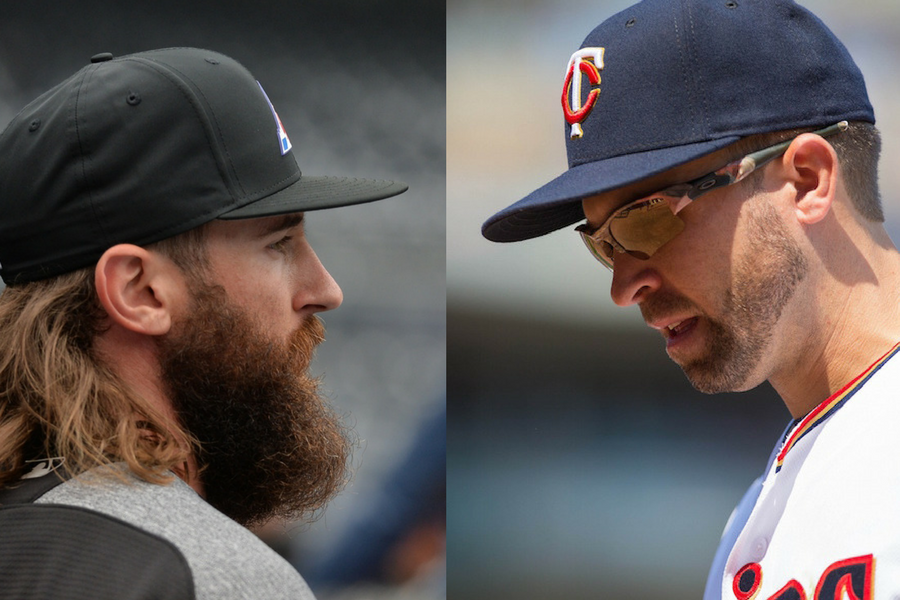 Not so long ago, a Gold Glove infielder with elite power production would've been a shoe-in for a monster deal. But the past offseason made it clear that valuations are changing across the league, and the standard indicators of a surefire free agent windfall are shifting. Dozier, for his part, seems to get it. "If you hit 30 home runs and drive in 80 and you’re one-dimensional and your WAR is a .8 you aren’t going to get paid like players used to," he said during spring training. "If you’ve had a high WAR for many years, I think you’ll do all right.” That last viewpoint is surely helping to fuel Dozier's confidence as he approaches his first date with the open market. Blackmon's new deal will only serve to bolster it. Over the past two seasons, Dozier ranks 13th among all big-leaguers in WAR (the FanGraphs version) at 10.8; Blackmon ranks one spot behind him, with his 10.6 mark checking at No. 14. Blackmon is a year older than Dozier and has followed a somewhat similar career path — a late-bloomer who turned the corner from quality performer to top-tier stud in his late 20s. Although they are different players in many ways, Dozier and his agent now have a reasonable baseline to work against. Breaking Down Blackmon's Deal Here's how the pact for Blackmon works out, per NBC Sports: 2018: $12 million + $2 million signing bonus, which basically replaces the $14 million arbitration-avoiding deal Blackmon signed in January; 2019: $21 million; 2020: $21 million; 2021: $21 million; 2022: $21 million Player Option; 2023: $10 million Player Option, subject to various bonuses and escalators. So essentially, it's a five-year extension with opt-outs in the last two years. That works out to an average of almost $19 million per season, which is about what Dozier could expect in 2019 if he were to accept a qualifying offer from the Twins. Given his desire to cash in with a career payday and lock up long-term security, I see almost no chance the second baseman would accept a QO unless something happens to seriously diminish his value between now and then. But offering it is essentially a no-brainer for Minnesota. What Kind of Offer Would Make Sense for the Twins? We're getting ahead of ourselves here, obviously. Dozier and the Twins have both made clear that in-season negotiations are off the table, so any negotiations will need to take place in the coming offseason, where Minnesota will have to bid against the field. Considering the prudence they've shown up to this point, it seems unlikely the Twins front office would be willing to offer a five-year, $100 million contract in the realm of Blackmon's. Their best bet might be to try to retain Dozier with something in the three-year, $75 million range. It would minimize his risk of diminishing production with age, and by the time such a deal expired, prospects like Royce Lewis and Wander Javier figure to be just breaking into the majors. My sense, however, is that Dozier will prioritize length in his next contract, and recognizing that the Twins won't meet his terms may be the basis for his evident resignation. I continue to believe this will be his last year in Twins uniform, but the potentially career-altering PED suspension for Jorge Polanco – Dozier's possible heir apparent at second – could change things. In any case, with Blackmon and the Rockies hammering out a long-term agreement, we at least have some clarity around what kind of commitment Dozier might realistically command. More on Twins Daily: Steve Buhr lists some highlights from media night for what figures to be a very intriguing Cedar Rapids Kernels team My breakdown of the first Twins homestand, which kicks off Thursday with the Target Field opener Your chance to win free tickets to a meet-and-greet with Twins DH Logan Morrison Cody Christie's preview of this year's Ft. Myers Miracle squad
 -
An April blizzard in Minneapolis – boy, isn't it sad you can't even bat an eye at that string of words? – raged deep into Tuesday night, blanketing Target Field in snow as Thursday afternoon's home opener rapidly approaches. MLB schedules were designed to account for inclement weather on the early end. But even with a continuing abundance of open dates, the Twins will face some challenges in their upcoming 10-game homestand. Not all of them weather-related.MARINERS VS. TWINS 3 Games | Thurs, 4/5 – Sun, 4/8 Looking out the window as I write this, there is still no end to the snowfall in sight. I assume at some point it will peter out, but our new winter coating isn't likely to disappear quickly. The current forecast calls for highs to stay below freezing on Wednesday, Friday and Saturday. It works out nicely, I suppose, that Target Field will host a game on only one of those days. But we could see three first pitches at sub-40 temps in this series. This figures to make matters difficult for these scheduled starters: Thursday: LHP James Paxton v. RHP Kyle Gibson Saturday: RHP Mike Leake v. RHP Jose Berrios Sunday: LHP Marco Gonzales v. RHP Lance Lynn If the projected high of 29 on Saturday holds, the Twins would set a record for lowest game time starting temperature in Target Field history. Tough assignment for Berrios coming off a career-best performance in Baltimore. Of course, the ball won't exactly be flying off the bat in this chill. As Michael Rand recently pointed out, these conditions beg the question: how cold is too cold to play baseball? But as Rand notes, the Mariners don't have another trip to Minnesota, and that creates headaches with rescheduling. The same is true for the next visiting opponent. ASTROS VS. TWINS 3 Games | Mon, 4/9 – Weds, 4/11 As I turn away from the bleak apocalyptic setting outside, I dial up the MLB scoreboard on an app. Oh, look, the Yankees have slaughtered the Rays, and Didi Gregorius – perhaps the fourth-best hitter in their lineup – went 4-for-4 with eight RBIs. How nice. Being forced to think about that stacked roster, which has been resoundingly upgraded after knocking Minnesota out of the playoffs last October, served to harsh my good early season vibes. I do feel the Twins have played quite well in their first four games, despite the 2-2 outcome. But when you consider a team like the Yankees, you're reminded that the bar for a pennant in this league is quite high. And New York isn't even the class of the AL. That distinction belongs to the reigning champs, who head into town next week to give the Twins a major early-season test. The young and absurdly talented Astros have, unsurprisingly, picked up where they left off. As this blog post went to press, they were leading the Orioles and on their way to a fifth victory in six games. Jose Altuve's hitting almost .500. They look dominant. Hopefully the unfamiliar cold weather in Minnesota can throw them off their game. This series looks to be warmer than the previous one, but temperatures are not expected to escape the mid-40s. By this point, the Twins will have least had a few home games to acclimate themselves. In this light, you could perhaps view the timing of this meeting as slightly advantageous. But under no circumstance is Houston going to be an easy matchup. The offense is star-studded and relentless. And these probable pitching matchups are DAUNTING: Monday: RHP Justin Verlander v. RHP Jake Odorizzi Tuesday: LHP Dallas Keuchel v. RHP Kyle Gibson Wednesday: RHP Lance McCullers v. ??? The final game of the Astros series represents the first time all year the Twins will need a fifth starter, although preceding cancellations could change that. Phil Hughes, working back from a "mild oblique strain," threw four innings in Triple-A on Saturday. He'll get to pitch in warm weather during his next rehab start at Ft. Myers on Thursday, but won't be so lucky if he takes the mound in Minnesota next week. There has to be some concern around his oblique tightening up in cold weather. But for now, that's a distant concern. We'll see how many games the Twins are able to get in leading up to that one. They might be able to stretch the four-starter arrangement out just a bit longer. WHITE SOX VS. TWINS 4 Games | Thurs, 4/12 – Sun, 4/15 This series looks like a welcome respite, for multiple reasons. The extended forecast calls for temps in the 50s, which would actually resemble baseball weather. And of course, the White Sox are not the Astros. This young Chicago club is probably more feisty and threatening than Kansas City or Detroit, but should be overmatched by the Twins anyway. It's probably the softest opponent of the month, and an opportunity to get a little fat before running the gauntlet of Indians-Rays-Yankees, all on the road. While it feels almost pointless to lay out probable starters this far out, here's how they'd currently shape up: Thursday: RHP Lucas Giolito v. RHP Jose Berrios Friday: RHP Reynaldo Lopez v. RHP Lance Lynn Saturday: RHP Miguel Gonzalez v. RHP Jake Odorizzi Sunday: RHP Michael Fulmer v. RHP Kyle Gibson Given the extreme likelihood of multiple rainouts (or freezeouts) before the White Sox series, those matchups are beyond tentative, but it gives you a look at the kind of favorable tilts Minnesota figures to see, regardless of how the names align. After wrapping up this series, the Twins get to escape the cold and head for a much warmer climate in Puerto Rico – a two-game series helpfully surrounded by a pair of off days. The Indians will supply Minnesota with its second early test. As it lines up now, Berrios would be starting the first game in his native territory. That's by design. But, you know about what they say about the best laid plans... Click here to view the article
-
 MARINERS VS. TWINS 3 Games | Thurs, 4/5 – Sun, 4/8 Looking out the window as I write this, there is still no end to the snowfall in sight. I assume at some point it will peter out, but our new winter coating isn't likely to disappear quickly. The current forecast calls for highs to stay below freezing on Wednesday, Friday and Saturday. It works out nicely, I suppose, that Target Field will host a game on only one of those days. But we could see three first pitches at sub-40 temps in this series. This figures to make matters difficult for these scheduled starters: Thursday: LHP James Paxton v. RHP Kyle Gibson Saturday: RHP Mike Leake v. RHP Jose Berrios Sunday: LHP Marco Gonzales v. RHP Lance Lynn If the projected high of 29 on Saturday holds, the Twins would set a record for lowest game time starting temperature in Target Field history. Tough assignment for Berrios coming off a career-best performance in Baltimore. Of course, the ball won't exactly be flying off the bat in this chill. As Michael Rand recently pointed out, these conditions beg the question: how cold is too cold to play baseball? But as Rand notes, the Mariners don't have another trip to Minnesota, and that creates headaches with rescheduling. The same is true for the next visiting opponent. ASTROS VS. TWINS 3 Games | Mon, 4/9 – Weds, 4/11 As I turn away from the bleak apocalyptic setting outside, I dial up the MLB scoreboard on an app. Oh, look, the Yankees have slaughtered the Rays, and Didi Gregorius – perhaps the fourth-best hitter in their lineup – went 4-for-4 with eight RBIs. How nice. Being forced to think about that stacked roster, which has been resoundingly upgraded after knocking Minnesota out of the playoffs last October, served to harsh my good early season vibes. I do feel the Twins have played quite well in their first four games, despite the 2-2 outcome. But when you consider a team like the Yankees, you're reminded that the bar for a pennant in this league is quite high. And New York isn't even the class of the AL. That distinction belongs to the reigning champs, who head into town next week to give the Twins a major early-season test. The young and absurdly talented Astros have, unsurprisingly, picked up where they left off. As this blog post went to press, they were leading the Orioles and on their way to a fifth victory in six games. Jose Altuve's hitting almost .500. They look dominant. Hopefully the unfamiliar cold weather in Minnesota can throw them off their game. This series looks to be warmer than the previous one, but temperatures are not expected to escape the mid-40s. By this point, the Twins will have least had a few home games to acclimate themselves. In this light, you could perhaps view the timing of this meeting as slightly advantageous. But under no circumstance is Houston going to be an easy matchup. The offense is star-studded and relentless. And these probable pitching matchups are DAUNTING: Monday: RHP Justin Verlander v. RHP Jake Odorizzi Tuesday: LHP Dallas Keuchel v. RHP Kyle Gibson Wednesday: RHP Lance McCullers v. ??? The final game of the Astros series represents the first time all year the Twins will need a fifth starter, although preceding cancellations could change that. Phil Hughes, working back from a "mild oblique strain," threw four innings in Triple-A on Saturday. He'll get to pitch in warm weather during his next rehab start at Ft. Myers on Thursday, but won't be so lucky if he takes the mound in Minnesota next week. There has to be some concern around his oblique tightening up in cold weather. But for now, that's a distant concern. We'll see how many games the Twins are able to get in leading up to that one. They might be able to stretch the four-starter arrangement out just a bit longer. WHITE SOX VS. TWINS 4 Games | Thurs, 4/12 – Sun, 4/15 This series looks like a welcome respite, for multiple reasons. The extended forecast calls for temps in the 50s, which would actually resemble baseball weather. And of course, the White Sox are not the Astros. This young Chicago club is probably more feisty and threatening than Kansas City or Detroit, but should be overmatched by the Twins anyway. It's probably the softest opponent of the month, and an opportunity to get a little fat before running the gauntlet of Indians-Rays-Yankees, all on the road. While it feels almost pointless to lay out probable starters this far out, here's how they'd currently shape up: Thursday: RHP Lucas Giolito v. RHP Jose Berrios Friday: RHP Reynaldo Lopez v. RHP Lance Lynn Saturday: RHP Miguel Gonzalez v. RHP Jake Odorizzi Sunday: RHP Michael Fulmer v. RHP Kyle Gibson Given the extreme likelihood of multiple rainouts (or freezeouts) before the White Sox series, those matchups are beyond tentative, but it gives you a look at the kind of favorable tilts Minnesota figures to see, regardless of how the names align. After wrapping up this series, the Twins get to escape the cold and head for a much warmer climate in Puerto Rico – a two-game series helpfully surrounded by a pair of off days. The Indians will supply Minnesota with its second early test. As it lines up now, Berrios would be starting the first game in his native territory. That's by design. But, you know about what they say about the best laid plans...
