



Nick Nelson
-
Posts
8,326 -
Joined
-
Last visited
-
Days Won
56
Content Type
Profiles
News
Minnesota Twins Videos
2026 Minnesota Twins Top Prospects Ranking
2022 Minnesota Twins Draft Picks
Minnesota Twins Free Agent & Trade Rumors, Notes, & Tidbits
Guides & Resources
2023 Minnesota Twins Draft Picks
The Minnesota Twins Players Project
2024 Minnesota Twins Draft Picks
2025 Minnesota Twins Draft Pick Tracker
2026 Minnesota Twins Draft Tracker: Picks & Bonuses
Forums
Blogs
Events
Store
Downloads
Gallery
Everything posted by Nick Nelson
-
 Yeah, he has a strong arm and used to post great CS rates, but he also wasn't very good last year after returning from knee surgery. Part of me wonders if he's just not popping up and firing as quick as he did before the injury. I do like the idea of bringing him home, and righting the wrong from eight years ago. If only we could trade Matt Capps for him.
 -
Ramos would be a solid option as well. Good bat, and you might be right that he's more likely to move than Flowers. The thing that snags me there is how bad he's been at controlling the run game -- teams are 17-for-18 on steals against him this year.
-
Now that we're into June, the MLB trade deadline is becoming visible on the horizon. As the Twins assess their needs, they find themselves in the rare position of feeling good about pitching depth. Reinforcements on that front will be arriving via the minors, or the disabled list. Even on the position-player side, Minnesota looks fairly well set, with one very notable exception. I believe they should be thinking big when it comes to acquiring a difference-maker at catcher. In fact, a blockbuster deal to bring in a long-term solution ought to be in play.Heading into the season, I called out the team's questionable catching depth as a primary concern. The Twins just didn't have much in the way of established commodities behind starter Jason Castro (who himself was basically an average player). Two months in, Castro is out for the year and Minnesota's iffy catching depth is being put to the test. Mitch Garver had a solid April but since May 1st he is hitting .188/.278/.234 with three extra-base hits (all doubles) in 72 PA. The lack of production would be easy enough to live with if his defense stood out, but Paul Molitor doesn't appear to feel that way; why else would light-hitting minor-league journeyman Bobby Wilson (slashing .167/.196/.333 since his call-up) be getting so many reps? I'm not giving up on Garver but realistically, he was a fringe prospect who isn't showing much offensively here at age 27. There isn't a ton of upside there. All of the organization's best catching prospects remain several years away. And while Castro is under contract for 2019, he'll be returning as a 31-year-old coming off major knee surgery. The Twins could use a serious big-league addition at catcher, and not necessarily in the form of a 2018 rental. However, even that route would potentially yield a meaningful upgrade capable of making a pivotal impact. As I look at the current landscape around the majors, there are three opportunities I see for making a splash and reeling in some serious help behind the plate. Here they are, from the least dramatic to the most (and I've gotta admit, Option C is my favorite right now). Option A: Trade with the Atlanta Braves for Tyler Flowers The Braves, who find themselves leading the NL East here in June, aren't in position to be dumping valuable assets, but they could live without Flowers. The 32-year-old is having another good season, slashing .270/.403/.444 after posting an .823 OPS last year, but he's in a timeshare with fellow veteran backstop (and former Twin) Kurt Suzuki. Even with their surprisingly strong start, the Braves are still a young, future-minded team. Presumably they'd be open to shipping out Flowers, who's eligible for free agency after this season, in exchange for controllable talent with upside. Flowers has far more MLB experience than any of Minnesota's present fixtures, and is considered a strong pitch framer. Plus, his OBP skills would bolster the lower half of the Twins lineup. A Suzuki reunion would also be possible, I suppose, but I prefer Flowers as a fit for this team. Option B: Trade with the Oakland Athletics for Jonathan Lucroy When Oakland signed Lucroy to a one-year, $6.5 million deal around the same time in March that Minnesota added Lance Lynn, it was assumed he'd be used as trade bait around the deadline. And even though the A's find themselves above the .500 mark two months in, that's still the likely plan. They have no real shot at contending in a division with three clearly superior teams. The price to acquire Lucroy would probably be higher than a Flowers type, but not by a ton. At 31, Lucroy isn't the offensive force he once was — he has only one home run thus far — but he's a capable hitter and a steady vet with a .264 average and .338 OBP dating back to the start of last year. Option C: Trade with the Miami Marlins for J.T. Realmuto This is the "aim high" option and — in many ways — a very logical one. Unlike Flowers and Lucroy, Realmuto is still relatively young (he turned 27 in March) with multiple years of team control (he's arbitration eligible through 2020). He's also very good, with a .761 career OPS and a .301/.359/.510 line this year. The Marlins were shopping Realmuto during the offseason, but he was one of the few attractive assets they ended up keeping (much to his chagrin). The Nationals are among the clubs that made a run at him, but ultimately they couldn't meet Miami's asking price. This tells us Minnesota will have to pony up if they want to make something happen, especially since Realmuto's having an excellent season. But from my view, names like Stephen Gonsalves and Nick Gordon should be on the table. Realmuto is just that kind of commodity, capable of making a franchise-altering impact as the Twins (hopefully) enter their contention window. What do you think? Do you have a preference among these options? Perhaps another trade scenario strikes your fancy? Or would you be satisfied with staying the course, letting Garver stay in the driver's seat while hoping someone like newly signed Triple-A farmhand Cameron Rupp can step in if needed? Please share your thoughts in the comments if you've got 'em. Click here to view the article
-
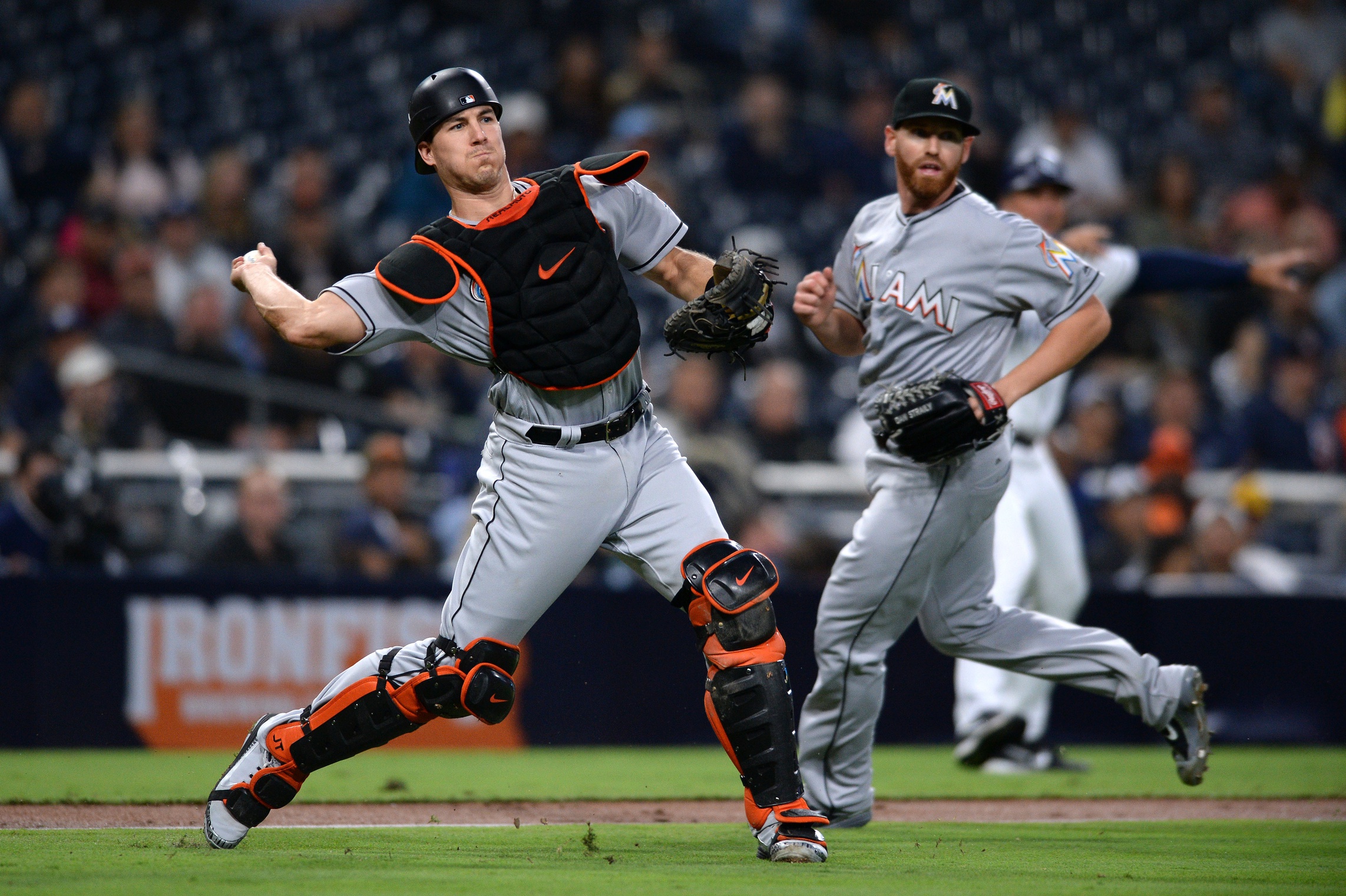 Heading into the season, I called out the team's questionable catching depth as a primary concern. The Twins just didn't have much in the way of established commodities behind starter Jason Castro (who himself was basically an average player). Two months in, Castro is out for the year and Minnesota's iffy catching depth is being put to the test. Mitch Garver had a solid April but since May 1st he is hitting .188/.278/.234 with three extra-base hits (all doubles) in 72 PA. The lack of production would be easy enough to live with if his defense stood out, but Paul Molitor doesn't appear to feel that way; why else would light-hitting minor-league journeyman Bobby Wilson (slashing .167/.196/.333 since his call-up) be getting so many reps? I'm not giving up on Garver but realistically, he was a fringe prospect who isn't showing much offensively here at age 27. There isn't a ton of upside there. All of the organization's best catching prospects remain several years away. And while Castro is under contract for 2019, he'll be returning as a 31-year-old coming off major knee surgery. The Twins could use a serious big-league addition at catcher, and not necessarily in the form of a 2018 rental. However, even that route would potentially yield a meaningful upgrade capable of making a pivotal impact. As I look at the current landscape around the majors, there are three opportunities I see for making a splash and reeling in some serious help behind the plate. Here they are, from the least dramatic to the most (and I've gotta admit, Option C is my favorite right now). Option A: Trade with the Atlanta Braves for Tyler Flowers The Braves, who find themselves leading the NL East here in June, aren't in position to be dumping valuable assets, but they could live without Flowers. The 32-year-old is having another good season, slashing .270/.403/.444 after posting an .823 OPS last year, but he's in a timeshare with fellow veteran backstop (and former Twin) Kurt Suzuki. Even with their surprisingly strong start, the Braves are still a young, future-minded team. Presumably they'd be open to shipping out Flowers, who's eligible for free agency after this season, in exchange for controllable talent with upside. Flowers has far more MLB experience than any of Minnesota's present fixtures, and is considered a strong pitch framer. Plus, his OBP skills would bolster the lower half of the Twins lineup. A Suzuki reunion would also be possible, I suppose, but I prefer Flowers as a fit for this team. Option B: Trade with the Oakland Athletics for Jonathan Lucroy When Oakland signed Lucroy to a one-year, $6.5 million deal around the same time in March that Minnesota added Lance Lynn, it was assumed he'd be used as trade bait around the deadline. And even though the A's find themselves above the .500 mark two months in, that's still the likely plan. They have no real shot at contending in a division with three clearly superior teams. The price to acquire Lucroy would probably be higher than a Flowers type, but not by a ton. At 31, Lucroy isn't the offensive force he once was — he has only one home run thus far — but he's a capable hitter and a steady vet with a .264 average and .338 OBP dating back to the start of last year. Option C: Trade with the Miami Marlins for J.T. Realmuto This is the "aim high" option and — in many ways — a very logical one. Unlike Flowers and Lucroy, Realmuto is still relatively young (he turned 27 in March) with multiple years of team control (he's arbitration eligible through 2020). He's also very good, with a .761 career OPS and a .301/.359/.510 line this year. The Marlins were shopping Realmuto during the offseason, but he was one of the few attractive assets they ended up keeping (much to his chagrin). The Nationals are among the clubs that made a run at him, but ultimately they couldn't meet Miami's asking price. This tells us Minnesota will have to pony up if they want to make something happen, especially since Realmuto's having an excellent season. But from my view, names like Stephen Gonsalves and Nick Gordon should be on the table. Realmuto is just that kind of commodity, capable of making a franchise-altering impact as the Twins (hopefully) enter their contention window. What do you think? Do you have a preference among these options? Perhaps another trade scenario strikes your fancy? Or would you be satisfied with staying the course, letting Garver stay in the driver's seat while hoping someone like newly signed Triple-A farmhand Cameron Rupp can step in if needed? Please share your thoughts in the comments if you've got 'em.
 -
Article: Week in Review: Offense Takes Flight
Nick Nelson replied to Nick Nelson's topic in Twins Daily Front Page News
Yeah, there are also rules in the CBA about how many games you can schedule in a row without an off day. Not 100% sure about the specifics.- 21 replies
-
- 6
-

-
- eddie rosario
- miguel sano
- (and 1 more)
-
Article: Week in Review: Offense Takes Flight
Nick Nelson replied to Nick Nelson's topic in Twins Daily Front Page News
I can't blame you for being skeptical, but according to StatCast, Grossman's sprint speed is 27.8 ft/sec compared to Adrianza at 26.7, and Grossman has in fact registered higher in all past seasons. For the player profile he fulfills, Adrianza is stunningly slow. Grossman's speed is also a little underrated, I think.- 21 replies
-
- 8
-
-
- eddie rosario
- miguel sano
- (and 1 more)
-
RUNS!!! They've been an all-too-precious commodity for the Twins this year, but were plentiful last week as Minnesota showed the kind of fierceness and resilience that had been missing for much of the first two months. Weekly Snapshot: Mon, 5/28 through Sun, 6/3 *** Record Last Week: 4-3 (Overall: 25-30) Run Differential Last Week: +9 (Overall: -11) Standing: 3rd Place in AL Central (3.5 GB) HIGHLIGHTS The offense finally woke up. Minnesota had scored more than six runs in a game only seven times all season, and only twice in the last calendar month, before doing so six times in seven games this past week. Unfortunately, in the one contest where the bats came up empty, they wasted a brilliant effort from Kyle Gibson and the bullpen. And on two occasions the Twins scored eight runs and lost, due to previously reliable starters unraveling and creating early deficits that couldn't be surmounted. It's been that kind of year. Still, this was a winning week that ended on a dazzling high note. On Friday morning the Twins were reeling, 6.5 games out of first place in the wake of three straight gut-wrenching losses. By Sunday evening, they were back within 3.5 games, looking reinvigorated as they celebrated a huge walk-off win. Eddie Rosario was rightfully at the center of that celebrating, as his third home run of the day (and fourth of the weekend) clinched the series victory. Rosario is in beast mode again, jumping on whatever you've got, inside or outside the zone, and driving it. His confidence level right now is off the charts. On another note, you've gotta feel a little bit for Alan Busenitz. The reliever performed very well during his time with the Twins last season, but was an odd man out with the team signing three free agent relievers in the offseason. He received a brief chance with Minnesota in April, but has since been stuck in Rochester, where he's been unbelievably good. In five weeks since returning to the minors, Busenitz hasn't allowed a run, or even an extra-base hit. He has a 23-to-4 K/BB ratio in 16 1/3 innings. In seven of his 10 appearances during that span he has recorded more than three outs. Based on merit, Busenitz should absolutely be in the majors, but right now he's a victim of circumstance. Soon enough his chance will come, and Twins fans should feel good about having such a weapon waiting on deck. LOOKING AHEAD These are the kinds of opportunities that Minnesota needs to capitalize on. The cellar-dwelling White Sox are coming to town for a four-game series, which kicks off with a double-header on Tuesday. You'd love to see the Twins take all four of those games and build some momentum heading into a tougher weekend series against the Angels. TUESDAY, 6/5 (1): WHITE SOX @ TWINS – RHP Reynaldo Lopez v. RHP Fernando Romero TUESDAY, 6/5 (2): WHITE SOX @ TWINS – RHP Lucas Giloito v. RHP Zack Littell WEDNESDAY, 6/6: WHITE SOX @ TWINS – LHP Hector Santiago v. RHP Jake Odorizzi THURSDAY, 6/7: WHITE SOX @ TWINS – LHP James Shields v. RHP Jose Berrios FRIDAY, 6/8: ANGELS @ TWINS – RHP Jaime Barria v. RHP Lance Lynn SATURDAY, 6/9: ANGELS @ TWINS – RHP Garrett Richards v. RHP Kyle Gibson SUNDAY, 6/10: ANGELS @ TWINS – LHP Tyler Skaggs v. RHP Fernando Romero Catch Up On Twins Daily Game Recaps Game 49 | MIN 8, KC 5: Bats Break OutGame 50 | KC 2, MIN 1: Every Game is the Same GameGame 51 | KC 11, MIN 8: We Can’t Have Nice ThingsGame 52 | CLE 9, MIN 8: Twins Fight Back, Fall ShortGame 53 | MIN 7, CLE 4: Escobar é o FogoGame 54 | MIN 7, CLE 1: Twins Battle Their Way to Another VictoryGame 55 | MIN 7, CLE 5: EDDIE! EDDIE! EDDIE!More on Twins Daily The MLB Draft gets underway on Monday. Last week Andrew Thares profiled his top 10 draft prospects. You can find links to the rest of his top 50 within. I recommend catching up with his lists; it's highly likely the Twins first-rounder is in there somewhere.On that note, Seth Stohs listed draft candidates with Minnesota connections.Which Twins prospects are outclassing their current levels in the minors? Jonathon Zenk called out five who should be promoted.SD Buhr chatted hitting with former Twin (and current Cedar Rapids coach) Brian Dinkelman. Click here to view the article
-
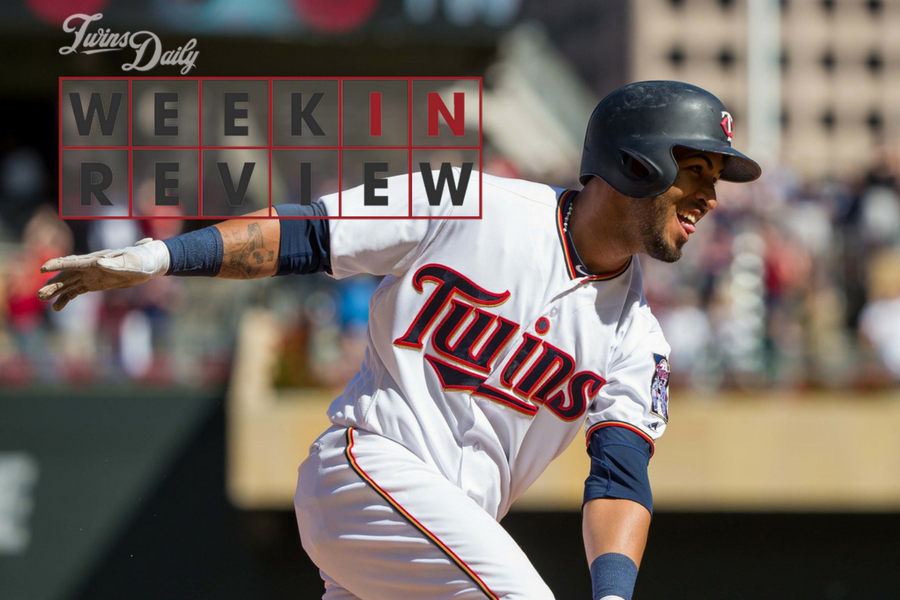 Weekly Snapshot: Mon, 5/28 through Sun, 6/3 *** Record Last Week: 4-3 (Overall: 25-30) Run Differential Last Week: +9 (Overall: -11) Standing: 3rd Place in AL Central (3.5 GB) HIGHLIGHTS The offense finally woke up. Minnesota had scored more than six runs in a game only seven times all season, and only twice in the last calendar month, before doing so six times in seven games this past week. Unfortunately, in the one contest where the bats came up empty, they wasted a brilliant effort from Kyle Gibson and the bullpen. And on two occasions the Twins scored eight runs and lost, due to previously reliable starters unraveling and creating early deficits that couldn't be surmounted. It's been that kind of year. Still, this was a winning week that ended on a dazzling high note. On Friday morning the Twins were reeling, 6.5 games out of first place in the wake of three straight gut-wrenching losses. By Sunday evening, they were back within 3.5 games, looking reinvigorated as they celebrated a huge walk-off win. Eddie Rosario was rightfully at the center of that celebrating, as his third home run of the day (and fourth of the weekend) clinched the series victory. Rosario is in beast mode again, jumping on whatever you've got, inside or outside the zone, and driving it. His confidence level right now is off the charts. https://twitter.com/DanHayesMLB/status/1003405286013579265 But there was something notably different and deeply encouraging about his week, beyond the four homers and 10 RBIs. During Rosario's last red-hot stretch, back in early May, I offered the following caution: "Eventually he'll cool off and stop obliterating every pitch he fancies. At that point we'll find out if Rosario can re-incorporate some of the disciplinary improvements we saw in the latter portion of 2017. Swinging at more than 40% of pitches outside the zone just won't cut it long-term." The ultra-aggressive approach continued for the next two weeks, and he went without a home run. But over this past week, while going 13-for-30, he also drew six walks (four unintentional). He had drawn only five unintentional walks in 48 games heading in. When he adds a modicum of selectiveness to his aggressive and explosive approach at the plate, Rosario is an unstoppable force with staying power. Hopefully this week was only a sign of things to come for Minnesota's probable All Star rep. Rosie wasn't the only source of power. Miguel Sano shook off his rust and turned back into a run-producing difference-maker at the heart of the order, driving in 10 runs in six games with two home runs and two doubles. It makes a big difference when he's a legit threat, and right now he's showing off his strength by mashing mistakes. There's still no sign that Sano has shaken his problematic discipline issues at the plate. We saw him strike out 12 times with one walk in 29 plate appearances last week, frequently swinging at breaking balls way outside the zone. Until that changes, he'll continue to be a feast-or-famine type yielding far too much of the latter. It's a strange state of affairs when I trust Rosario's strike zone judgement more than Sano's but here we are. At least Miggy is back and hitting baseballs incredibly hard. Speaking of hard hits, Eduardo Escobar also had plenty in a week that saw his bat reheat following a lengthy slump. Heading into play on Monday, Escobar had batted just .200 with three extra-base hits (all doubles) and three RBIs in his previous 15 games. His skid worsened in Kansas City as he went 0-for-9 on Monday and Tuesday, but Esco finished that series with a two-hit game and then opened a power tear at Target Field, belting three homers and driving in six runs against Cleveland. This is the Twins offense we were hoping to see from the start: highly dangerous, and capable of ruining a good opposing starter's day even when he's on his game (as they did to Trevor Bauer on Saturday). LOWLIGHTS We've seen a lot of strong performances from the rotation this year, but the trend has been that when things go awry, they really run off the rails. We saw it when Jose Berrios' early-season stretch of dominance gave way to a string of total duds. We've seen plenty of volatility from Lance Lynn. I guess it shouldn't be surprising that the exemplary runs of Fernando Romero and Jake Odorizzi met their ends in flagrant fashion. On Wednesday, Romero gave up almost twice as many earned runs (8) in 1 2/3 innings as he had over 28 2/3 innings in his first five starts (5). It was utterly baffling to see a pitcher with a .194 BAA allow nine hits to 15 batters against one of the league's weakest offenses. His ERA shot from 1.88 to 4.15. The next day, Odorizzi surrendered seven earned runs, one fewer than he'd allowed total in his first five starts of May. The right-hander had become one of Minnesota's steadiest starters, completing 5+ IP with three or fewer earned runs in six straight turns. However, his clunker was a little less surprising than Romero's, given his ongoing struggles keeping the ball in the yard; he has now coughed up 14 homers in 12 starts. If the Twins are giving any consideration to reinforcements for the rotation, those might not be as close as they'd hoped. Ervin Santana is revisiting his finger surgeon after experiencing continued discomfort while battling command and velocity issues in rehab. There's no timetable for his return but it's reasonable to expect he'll be out until July at least. Meanwhile, Trevor May's rehab stint has taken a discouraging turn. He had a rocky start last Sunday, allowing six earned runs in 2 2/3 innings, and made his next appearance in relief on Saturday. May allowed only one hit while cleanly handling the seventh through ninth, picking up a three-inning save, but he induced just two swinging strikes on 37 pitches. The most troubling setbacks, however, were on the position-player side. Joe Mauer appeared to be on the verge of coming off the disabled list late in the week before concussion symptoms started creeping in again as he revved up – a grim development. Luckily, Mauer reported feeling better in the ensuing days, but this is going to be a touch-and-go situation for a while. Meanwhile, Byron Buxton and the Twins finally came to terms with the fact that having him play through a broken toe was doing nobody any good. The center fielder was placed on the disabled list and will now presumably be given several weeks to let it heal. TRENDING STORYLINE Even though they've finally started scoring some runs, the Twins will take whatever offensive help they can get as they try to string together wins and battle back into the division race. To that end, there are two situations in particular worth keeping an eye on. At the start of last week, the Twins claimed Taylor Motter off waivers from Seattle. He's a versatile defender who can play shortstop, and he has occasionally shown some hitting ability. That ought to make Ehire Adrianza nervous. Sure enough, Adrianza had his best week at the plate all season, with a pair of multi-hit games and his first home run. (Although he AGAIN got thrown out on the bases Sunday after mysteriously pinch-running for Robbie Grossman, who is actually faster than him.) While Motter looms in Rochester, another potential plug returned to action last week in Chattanooga. LaMonte Wade had gone on the disabled list in mid-May after colliding with an outfield wall, but was activated by the Lookouts on Tuesday. He has become the on-base king in the Twins system, with a .403 career OBP in the minors and an amazingly good eye at the plate. Wade made a very good impression at spring training and is now slashing .300/.392/.460 in Double-A. With Buxton looking to be sidelined for a while, and Ryan LaMarre's chops as a capable MLB regular in question, Wade could be very useful to the club. His patience is all the more appealing if Mauer will be facing an extended absence. This lineup has really been missing the first baseman's proclivity for getting aboard. DOWN ON THE FARM If there was one quibble to be had with the extremely impressive work being done by an 18-year-old Royce Lewis in Cedar Rapids here in the first half, it was a lack of power. He batted .299 with 13 steals in his first 35 games, but 34 of his 41 hits were singles, resulting in a .365 slugging percentage. Well, Lewis busted out with a two-homer game last Sunday, and followed up with five doubles in five games over the past week. He now has as many extra-base hits in his past seven games (7) as he did in his first 35. It always seemed like a matter of when, not if, Lewis would add strength and start driving the ball more. Now, with his 19th birthday just days away, we're already seeing it to some extent. One scout offered some eye-poppingly high praise for the top prospect, as relayed by Ken Rosenthal of FOX Sports: https://twitter.com/MLBONFOX/status/1003043423094390784 On another note, you've gotta feel a little bit for Alan Busenitz. The reliever performed very well during his time with the Twins last season, but was an odd man out with the team signing three free agent relievers in the offseason. He received a brief chance with Minnesota in April, but has since been stuck in Rochester, where he's been unbelievably good. In five weeks since returning to the minors, Busenitz hasn't allowed a run, or even an extra-base hit. He has a 23-to-4 K/BB ratio in 16 1/3 innings. In seven of his 10 appearances during that span he has recorded more than three outs. Based on merit, Busenitz should absolutely be in the majors, but right now he's a victim of circumstance. Soon enough his chance will come, and Twins fans should feel good about having such a weapon waiting on deck. LOOKING AHEAD These are the kinds of opportunities that Minnesota needs to capitalize on. The cellar-dwelling White Sox are coming to town for a four-game series, which kicks off with a double-header on Tuesday. You'd love to see the Twins take all four of those games and build some momentum heading into a tougher weekend series against the Angels. TUESDAY, 6/5 (1): WHITE SOX @ TWINS – RHP Reynaldo Lopez v. RHP Fernando Romero TUESDAY, 6/5 (2): WHITE SOX @ TWINS – RHP Lucas Giloito v. RHP Zack Littell WEDNESDAY, 6/6: WHITE SOX @ TWINS – LHP Hector Santiago v. RHP Jake Odorizzi THURSDAY, 6/7: WHITE SOX @ TWINS – LHP James Shields v. RHP Jose Berrios FRIDAY, 6/8: ANGELS @ TWINS – RHP Jaime Barria v. RHP Lance Lynn SATURDAY, 6/9: ANGELS @ TWINS – RHP Garrett Richards v. RHP Kyle Gibson SUNDAY, 6/10: ANGELS @ TWINS – LHP Tyler Skaggs v. RHP Fernando Romero Catch Up On Twins Daily Game Recaps Game 49 | MIN 8, KC 5: Bats Break Out Game 50 | KC 2, MIN 1: Every Game is the Same Game Game 51 | KC 11, MIN 8: We Can’t Have Nice Things Game 52 | CLE 9, MIN 8: Twins Fight Back, Fall Short Game 53 | MIN 7, CLE 4: Escobar é o Fogo Game 54 | MIN 7, CLE 1: Twins Battle Their Way to Another Victory Game 55 | MIN 7, CLE 5: EDDIE! EDDIE! EDDIE! More on Twins Daily The MLB Draft gets underway on Monday. Last week Andrew Thares profiled his top 10 draft prospects. You can find links to the rest of his top 50 within. I recommend catching up with his lists; it's highly likely the Twins first-rounder is in there somewhere. On that note, Seth Stohs listed draft candidates with Minnesota connections. Which Twins prospects are outclassing their current levels in the minors? Jonathon Zenk called out five who should be promoted. SD Buhr chatted hitting with former Twin (and current Cedar Rapids coach) Brian Dinkelman.
 -
It's easy to focus on the struggles of the Twins offense. Er, correction: it's extremely difficult not to focus on the struggles of the Twins offense. The club's underperforming bats have become a nightly source of frustration. But let's take a moment here to appreciate how stunningly good the Minnesota pitchers have been. By no means did I expect to find myself making such a statement at this point in the season.It's all relative, of course. The Twins rank 8th out of 15 American League clubs with a 4.21 ERA that is exactly average. They rank ninth in WHIP and 10th in FIP. So they haven't exactly been lighting the world on fire in that context. But this is also a team that, two years ago, ranked dead last in ERA and WHIP while allowing 889 runs, second-most for a Twins club ever. This year they are on pace to allow 719, which would be about 60 fewer than last year when they reached the postseason. And it goes beyond the numbers. Just ask yourself: when was the last time you had faith in almost every single member of a Twins pitching staff? In the rotation, Jose Berrios has been tremendous outside of a hiccup in late April/early May that appears to be behind him. He ranks 12th in the AL in innings pitched, which would've seemed unthinkable not so long ago thanks to his tendency to rack up high pitch counts. Newfound efficiency and control have enabled the right-hander, who turned 24 on Sunday, to pitch into the eighth inning four times in 11 starts, and into the seventh in two others. He has issued two or fewer walks in all but one of his turns. Berrios' 3.67 ERA remains in the good-not-great realm, thanks to that string of clunkers, but his recent performance feels more reflective of what we can expect going forward. And then there is the amazing Fernando Romero, who doesn't turn 24 until December. Hailed as a potential ace as he came up through the minors, Romero has somehow been better than advertised during his initial run in the big leagues. The righty has been absurdly dominant through five starts, with a 1.88 ERA that ranks third among all American League pitchers with 20+ IP. He won't maintain a sub-2 ERA forever, of course, but Romero has a formula that makes sustained ace-level performance feasible. Namely, he's getting grounders at a 50%+ rate while also averaging more than a strikeout per inning – one of five AL starters to hit both marks. Last year, Luis Severino was the league's only qualified SP to finish above those thresholds; he posted a 2.98 ERA for the Yankees. The Twins have two starters pitching at an elite level, which is obviously encouraging, but what's really exciting is that it's a duo of young, controllable former top prospects with stuff and pedigree to match. This isn't Phil Hughes coming out of nowhere after years of mediocrity with the Yankees. This isn't Ervin Santana mustering the best season of his career at age 34. The emergence of Berrios and Romero as a one-two punch atop the rotation is legitimately the best development to come along for this unit in more than a decade. We haven't seen a Minnesota starting corps this strong at the top since Johan Santana and Francisco Liriano were (so briefly) paired together at their peaks. Injuries and setbacks are always on the table, as we know too well (the previous example serving as case-in-point), but let's enjoy this for what it is: the foundation for an actual championship-caliber rotation. Almost equally encouraging is what's happened around Berrios and Romero. Jake Odorizzi has been brilliant, with a 3.34 ERA and 1.28 WHIP through 11 starts. One can easily make the case that good fortune has aided his success – namely an 88 percent strand rate, and eight of 12 homers against him coming with bases empty. But Odorizzi's proneness to home runs is well known to everyone, including himself. He works around it. And I'm not convinced it's entirely luck that has led to hitters slashing .156/.221/.313 against him with men on. He's been buckling down. Even if (when) he regresses a bit, Odorizzi can still be a solid mid-rotation piece and a fantastic return for Jermaine Palacios, who has a .473 OPS with Tampa's Double-A affiliate. Best of all, the Twins have optional control over Odorizzi at a reasonable cost in 2019, putting them in a great position of flexibility. The same is true for Kyle Gibson, who has one more year of arbitration eligibility remaining. Gibson has finally swapped in his profile as a contact-heavy ground ball pitcher for that of a bat-missing filth-flinger, and this one suits him much better. His GB rate has dropped into the average range at 46.7%, but his swinging strike rate has skyrocketed to 11.9%, best among Twins starters and among the league's top 25. Gibson's transformation has been keyed by a heater registering a career-high 92.5 MPH (thanks in part to his increased reliance on the harder four-seamer) and breaking balls that are inducing a mind-boggling 57% miss rate, highest in the majors. Again, this isn't the mirage-like burst of success we've seen so often from Twins pitchers (including Gibby) in the recent past. This is a hurler on top of his game shoving some of the best stuff of anyone in the game. He has shown the ability to flat-out dominate when his command is there. And right now he's Minnesota's fourth starter. Lastly, we come to Lance Lynn. He's one of only two pitchers on the Twins roster with an ERA above 4.02, and it is of course well above, at 6.34. I won't try to convince you he hasn't been bad – I've been as maddened as anyone by his inexplicable inability to throw it over the plate – but cautious optimism is warranted. You've got the long track record of success. You've got the 3.98 ERA in four May starts, along with an improved strike rate (up to 63% from 56% in May) and decreased homer rate (only one allowed this month after five in April). There's also this: remember when I mentioned earlier that Romero is one of five AL starters with a grounder rate over 50% and a K/9 over 9? Lynn is one of the others. Among that group – which also includes Lance McCullers, Charlie Morton and Garrett Richards – he's the only one that hasn't been very good. The main reason for this is obvious, and entirely his own doing: he hasn't thrown enough strikes. But there are clear signs of improvement in this regard, and the peripherals show that when Lynn manages to throw the ball where he wants, it gets the result he wants. Five starters locked in with a K/9 of 8.8 or higher. Incredible. Two years ago, the Twins had zero starting pitchers with a K/9 higher than 7.7. Even if things go south again with Lynn, or any of the other four members of the rotation, Minnesota is well equipped for the occasion. Stephen Gonsalves is tearing it up in Rochester with a 2.39 ERA, 1.10 WHIP, and 10.9 K/9 rate. His success is the only reason we're not talking more about Zack Littell, who has also been phenomenal since his Triple-A promotion (2.05 ERA, 1.00 WHIP, 9.8 K/9). Finally, Trevor May and Ervin Santana are on the comeback trail. There's enough quality depth in play for the Twins rotation that Santana's concerning velocity reports can easily be taken in stride. Out in the bullpen, there is plenty more to like. Fernando Rodney shook off his early troubles and rounded into form beautifully. He's been as reliable as any closer in the game over the past month, converting eight consecutive saves while allowing zero runs on only two hits. Yes, to repeat: Rodney has surrendered two hits – both singles – in a calendar month. Even though his velocity is down a smidge from last year, it's absolutely remarkable to see a 41-year-old out there repeatedly hitting 95 on the gun. He's bringing the kind of overpowering stuff you wanna see in the ninth. Rodney currently looks like a slam-dunk addition for the front office. So too does Addison Reed, who is nicely fulfilling his envisioned role as Twins bullpen ace. Reed ranks second among Minnesota relievers in appearances, and they've almost all come in high-leverage spots. He's responded by delivering consistently, helping him accrue a 0.56 WPA, which leads the bullpen. Reed is on pace to post the highest mark in that category since Glen Perkins in his career year, 2013. As good as Reed's been, the star of this unit has been Ryan Pressly, who is finally pulling it all together at age 29. Last year, he had an odd tendency to get knocked around despite dazzling stuff, premium velocity, and good control. This year, the stuff has gotten even better and hitters just can't handle it. Pressly's swinging strike rate has jumped from 12.2% to 16.8%, which ranks 11th out of 180 qualified MLB relievers. He's been especially lethal in May, where that figure has jumped to 19%. He has given up one home run thus far, after giving up 10 in 2017. The strikeout parade continues with Zach Duke, who has rebounded spectacularly from his own early skid. Duke yielded five earned runs in his first four appearances, saddling him with a 16.88 ERA, but he's been whittling it down ever since. The lefty has been charged with just two earned runs in 19 appearances since then (1.26 ERA) while striking out 16. He's walked only two of 36 batters faced in May. Duke has been lights-out against left-handed hitters (.569 OPS) and good enough against righties so as not to force strict platoon usage. When you combine his output with that of Rodney and Reed, it can hardly be overstated what a profound positive impact the front office's offseason moves have had on the bullpen. One of their quieter additions is also paying dividends. The Twins signed Matt Magill to a minor-league deal in January, without much fanfare. He was the type of 28-year-old journeyman with an unimpressive track record who usually serves as organizational filler. Magill was mediocre with San Diego's Triple-A affiliate last year while usually throwing as a starter, and didn't make it to the majors all season. But Minnesota was intrigued by Magill's past stints in the bullpen, and the velocity increases it triggered. So they've tried him there again with exceptional results. Magill was sent down in spring training despite looking very good with an 8-to-2 K/BB ratio in five innings. At Triple-A, he kept it going with a 13-to-2 K/BB ratio over 8 2/3 frames to earn a call-up in late April. He has since looked the part of a major-league reliever, painting corners with 95 MPH fastballs while posting a 1.88 ERA and 1.16 WHIP through 11 appearances. He hasn't pitched in many big spots, and could be replaced if May comes off the DL this week, but neither is through any fault of his own. Magill looks like a heck of a find. Through all this, we haven't even mentioned the two key mainstays of last year's bullpen, who are also both pitching well. Taylor Rogers' inflated 5.59 ERA hides a 2.18 FIP. He had some ugly outings in late April, at the height of the team's slump, but has a 2.02 ERA in May and now looks like himself. That's also the case for Trevor Hildenberger, who remains perhaps the most important long-term cog in this pen. He has a 2.31 ERA in May, where he's holding opponents to a .186 average and inducing whiffs at an 18% rate. So there you have it. With about one-third of the season in the books, nearly every member of the Minnesota Twins pitching staff is looking like a positive asset. This is a huge credit to the front office, the coaching staff, and so many of these players who have turned corners personally. For the pitchers to be cruising along like this while a lackluster offense drags the team down was not a scenario any of us envisioned, but here we are. The upshot is that if these guys can keep it up as they have, the Twins have potential to really become a complete team if and when the bats awaken. Click here to view the article
- 36 replies
-
- 2
-
-
- jose berrios
- fernando romero
- (and 3 more)
-
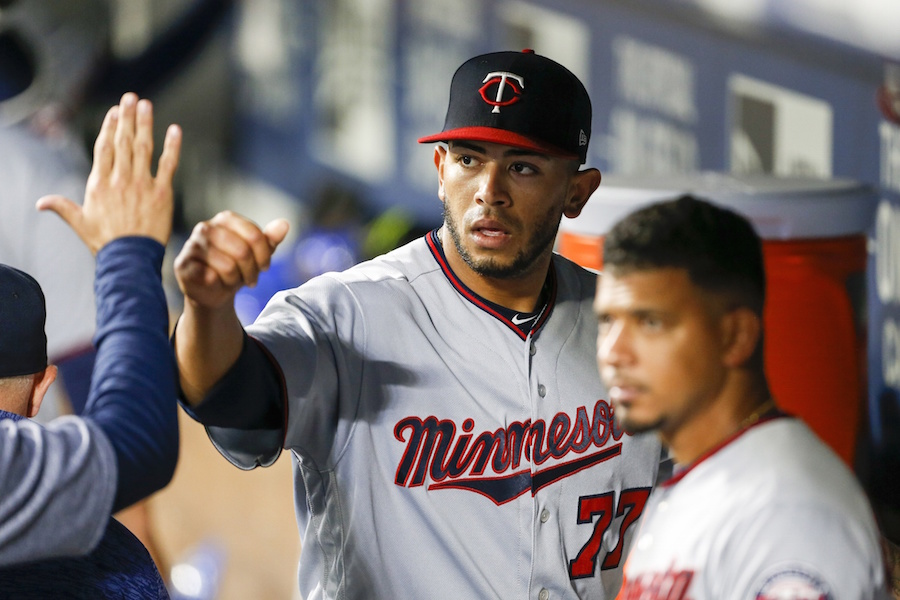 It's all relative, of course. The Twins rank 8th out of 15 American League clubs with a 4.21 ERA that is exactly average. They rank ninth in WHIP and 10th in FIP. So they haven't exactly been lighting the world on fire in that context. But this is also a team that, two years ago, ranked dead last in ERA and WHIP while allowing 889 runs, second-most for a Twins club ever. This year they are on pace to allow 719, which would be about 60 fewer than last year when they reached the postseason. And it goes beyond the numbers. Just ask yourself: when was the last time you had faith in almost every single member of a Twins pitching staff? In the rotation, Jose Berrios has been tremendous outside of a hiccup in late April/early May that appears to be behind him. He ranks 12th in the AL in innings pitched, which would've seemed unthinkable not so long ago thanks to his tendency to rack up high pitch counts. Newfound efficiency and control have enabled the right-hander, who turned 24 on Sunday, to pitch into the eighth inning four times in 11 starts, and into the seventh in two others. He has issued two or fewer walks in all but one of his turns. Berrios' 3.67 ERA remains in the good-not-great realm, thanks to that string of clunkers, but his recent performance feels more reflective of what we can expect going forward. And then there is the amazing Fernando Romero, who doesn't turn 24 until December. Hailed as a potential ace as he came up through the minors, Romero has somehow been better than advertised during his initial run in the big leagues. The righty has been absurdly dominant through five starts, with a 1.88 ERA that ranks third among all American League pitchers with 20+ IP. He won't maintain a sub-2 ERA forever, of course, but Romero has a formula that makes sustained ace-level performance feasible. Namely, he's getting grounders at a 50%+ rate while also averaging more than a strikeout per inning – one of five AL starters to hit both marks. Last year, Luis Severino was the league's only qualified SP to finish above those thresholds; he posted a 2.98 ERA for the Yankees. The Twins have two starters pitching at an elite level, which is obviously encouraging, but what's really exciting is that it's a duo of young, controllable former top prospects with stuff and pedigree to match. This isn't Phil Hughes coming out of nowhere after years of mediocrity with the Yankees. This isn't Ervin Santana mustering the best season of his career at age 34. The emergence of Berrios and Romero as a one-two punch atop the rotation is legitimately the best development to come along for this unit in more than a decade. We haven't seen a Minnesota starting corps this strong at the top since Johan Santana and Francisco Liriano were (so briefly) paired together at their peaks. Injuries and setbacks are always on the table, as we know too well (the previous example serving as case-in-point), but let's enjoy this for what it is: the foundation for an actual championship-caliber rotation. Almost equally encouraging is what's happened around Berrios and Romero. Jake Odorizzi has been brilliant, with a 3.34 ERA and 1.28 WHIP through 11 starts. One can easily make the case that good fortune has aided his success – namely an 88 percent strand rate, and eight of 12 homers against him coming with bases empty. But Odorizzi's proneness to home runs is well known to everyone, including himself. He works around it. And I'm not convinced it's entirely luck that has led to hitters slashing .156/.221/.313 against him with men on. He's been buckling down. Even if (when) he regresses a bit, Odorizzi can still be a solid mid-rotation piece and a fantastic return for Jermaine Palacios, who has a .473 OPS with Tampa's Double-A affiliate. Best of all, the Twins have optional control over Odorizzi at a reasonable cost in 2019, putting them in a great position of flexibility. The same is true for Kyle Gibson, who has one more year of arbitration eligibility remaining. Gibson has finally swapped in his profile as a contact-heavy ground ball pitcher for that of a bat-missing filth-flinger, and this one suits him much better. His GB rate has dropped into the average range at 46.7%, but his swinging strike rate has skyrocketed to 11.9%, best among Twins starters and among the league's top 25. Gibson's transformation has been keyed by a heater registering a career-high 92.5 MPH (thanks in part to his increased reliance on the harder four-seamer) and breaking balls that are inducing a mind-boggling 57% miss rate, highest in the majors. Again, this isn't the mirage-like burst of success we've seen so often from Twins pitchers (including Gibby) in the recent past. This is a hurler on top of his game shoving some of the best stuff of anyone in the game. He has shown the ability to flat-out dominate when his command is there. And right now he's Minnesota's fourth starter. Lastly, we come to Lance Lynn. He's one of only two pitchers on the Twins roster with an ERA above 4.02, and it is of course well above, at 6.34. I won't try to convince you he hasn't been bad – I've been as maddened as anyone by his inexplicable inability to throw it over the plate – but cautious optimism is warranted. You've got the long track record of success. You've got the 3.98 ERA in four May starts, along with an improved strike rate (up to 63% from 56% in May) and decreased homer rate (only one allowed this month after five in April). There's also this: remember when I mentioned earlier that Romero is one of five AL starters with a grounder rate over 50% and a K/9 over 9? Lynn is one of the others. Among that group – which also includes Lance McCullers, Charlie Morton and Garrett Richards – he's the only one that hasn't been very good. The main reason for this is obvious, and entirely his own doing: he hasn't thrown enough strikes. But there are clear signs of improvement in this regard, and the peripherals show that when Lynn manages to throw the ball where he wants, it gets the result he wants. Five starters locked in with a K/9 of 8.8 or higher. Incredible. Two years ago, the Twins had zero starting pitchers with a K/9 higher than 7.7. Even if things go south again with Lynn, or any of the other four members of the rotation, Minnesota is well equipped for the occasion. Stephen Gonsalves is tearing it up in Rochester with a 2.39 ERA, 1.10 WHIP, and 10.9 K/9 rate. His success is the only reason we're not talking more about Zack Littell, who has also been phenomenal since his Triple-A promotion (2.05 ERA, 1.00 WHIP, 9.8 K/9). Finally, Trevor May and Ervin Santana are on the comeback trail. There's enough quality depth in play for the Twins rotation that Santana's concerning velocity reports can easily be taken in stride. Out in the bullpen, there is plenty more to like. Fernando Rodney shook off his early troubles and rounded into form beautifully. He's been as reliable as any closer in the game over the past month, converting eight consecutive saves while allowing zero runs on only two hits. Yes, to repeat: Rodney has surrendered two hits – both singles – in a calendar month. Even though his velocity is down a smidge from last year, it's absolutely remarkable to see a 41-year-old out there repeatedly hitting 95 on the gun. He's bringing the kind of overpowering stuff you wanna see in the ninth. Rodney currently looks like a slam-dunk addition for the front office. So too does Addison Reed, who is nicely fulfilling his envisioned role as Twins bullpen ace. Reed ranks second among Minnesota relievers in appearances, and they've almost all come in high-leverage spots. He's responded by delivering consistently, helping him accrue a 0.56 WPA, which leads the bullpen. Reed is on pace to post the highest mark in that category since Glen Perkins in his career year, 2013. As good as Reed's been, the star of this unit has been Ryan Pressly, who is finally pulling it all together at age 29. Last year, he had an odd tendency to get knocked around despite dazzling stuff, premium velocity, and good control. This year, the stuff has gotten even better and hitters just can't handle it. Pressly's swinging strike rate has jumped from 12.2% to 16.8%, which ranks 11th out of 180 qualified MLB relievers. He's been especially lethal in May, where that figure has jumped to 19%. He has given up one home run thus far, after giving up 10 in 2017. The strikeout parade continues with Zach Duke, who has rebounded spectacularly from his own early skid. Duke yielded five earned runs in his first four appearances, saddling him with a 16.88 ERA, but he's been whittling it down ever since. The lefty has been charged with just two earned runs in 19 appearances since then (1.26 ERA) while striking out 16. He's walked only two of 36 batters faced in May. Duke has been lights-out against left-handed hitters (.569 OPS) and good enough against righties so as not to force strict platoon usage. When you combine his output with that of Rodney and Reed, it can hardly be overstated what a profound positive impact the front office's offseason moves have had on the bullpen. One of their quieter additions is also paying dividends. The Twins signed Matt Magill to a minor-league deal in January, without much fanfare. He was the type of 28-year-old journeyman with an unimpressive track record who usually serves as organizational filler. Magill was mediocre with San Diego's Triple-A affiliate last year while usually throwing as a starter, and didn't make it to the majors all season. But Minnesota was intrigued by Magill's past stints in the bullpen, and the velocity increases it triggered. So they've tried him there again with exceptional results. Magill was sent down in spring training despite looking very good with an 8-to-2 K/BB ratio in five innings. At Triple-A, he kept it going with a 13-to-2 K/BB ratio over 8 2/3 frames to earn a call-up in late April. He has since looked the part of a major-league reliever, painting corners with 95 MPH fastballs while posting a 1.88 ERA and 1.16 WHIP through 11 appearances. He hasn't pitched in many big spots, and could be replaced if May comes off the DL this week, but neither is through any fault of his own. Magill looks like a heck of a find. Through all this, we haven't even mentioned the two key mainstays of last year's bullpen, who are also both pitching well. Taylor Rogers' inflated 5.59 ERA hides a 2.18 FIP. He had some ugly outings in late April, at the height of the team's slump, but has a 2.02 ERA in May and now looks like himself. That's also the case for Trevor Hildenberger, who remains perhaps the most important long-term cog in this pen. He has a 2.31 ERA in May, where he's holding opponents to a .186 average and inducing whiffs at an 18% rate. So there you have it. With about one-third of the season in the books, nearly every member of the Minnesota Twins pitching staff is looking like a positive asset. This is a huge credit to the front office, the coaching staff, and so many of these players who have turned corners personally. For the pitchers to be cruising along like this while a lackluster offense drags the team down was not a scenario any of us envisioned, but here we are. The upshot is that if these guys can keep it up as they have, the Twins have potential to really become a complete team if and when the bats awaken.
 -
I was talking specifically about his defense. But also it's very accurate to say he's trending in the wrong way at the plate. All you need to do is look at the K/BB numbers.
-
In the Charles Dickens classic, A Christmas Carol, Ebenezer Scrooge is visited by three ghosts. The last of these phantoms, the Ghost of Christmas Yet to Come, is most fearsome of all. Why? Because it represents what the future holds for Scrooge if he does not change his ways. Scrooge awakens from this haunting experience a new man, steered back toward a righteous path by the vision of a dire future. I'm not saying the Twins traded for Chris Carter to make a similar impression on Miguel Sano. I'm only saying it'd make a lot of sense.I feel for Carter. Had he come along 10 years earlier, he might've been viewed much differently as an asset. Not so long ago, the thought of a 29-year-old who led the league in home runs being forced to settle for a one-year, $3.5 million deal (as Carter did with the Yankees last February) would've been inconceivable. Forty-one homers got you paid. Period. But it is the reality of today's MLB, where strikeout-prone sluggers who lack complementary offensive skills, or any kind of defensive value, are not commodities. Carter was toiling away in Triple-A before Minnesota traded cash considerations to the Angels for him on Wednesday. After signing (once again, in late February) a minor-league contract with the Halos, he launched 13 homers with a .600 slugging percentage at Salt Lake, but the big-league club had no use for him. Carter will head to the minors in his new organization, too, but maybe not for long. The Twins evidently see a possible need for him, which might speak to the level of concern around Joe Mauer. Surely it's coincidence that Carter arrives in Rochester just as Sano (likely) departs to meet the Twins in Seattle. Surely it is. But... If you could handpick a "Ghost of Christmas Yet to Come" equivalent for Miguel's Ebenezer – in all of baseball – it would be Chris Carter. That's no disrespect to Carter, whose 158 home runs would tie Brian Dozier for 12th in Twins history. His power is prodigious, and has been since he was a 20-year-old mashing 39 home runs at High-A. But his grievously high strikeout rates have suffocated the impact of his immense pop. To be fair, Carter's still playing ball, and has a chance to return to the majors soon. He's hardly a worst-case scenario in the grand scheme. But he was also never gifted with the innate talent of Sano, whose shine has greatly diminished since an incandescent debut in 2015. Even as one who tries to give Sano every benefit of the doubt, I can't ignore the overwhelming evidence of a player who has strayed badly off course. Underwhelming numbers, tons of missed time, off-the-field allegations, and reports from those around him of an inexplicably lackadaisical attitude. Sano's career strikeout rate (36.1%) is considerably higher than Carter's (33.3%). It was at an outrageous 40% before he went down this year. While Sano still looks reasonably capable at third base, he's undeniably trending the wrong direction. The majestic power won't go away. But neither has that of Carter, who now finds himself a journeyman at age 31. Perhaps, if they have a passing encounter on Thursday, Sano will make a note of it. I found this quote from Paul Molitor, while an MLB investigation floated over Sano's head at Twins camp, rather interesting: “I think the trend has been he’s figuring some things out; some things have been a little harder to get through to him,” Molitor said. “At times I’ve tried to involve people that might be able to provide a voice that will penetrate. We’re just trying to get him to see the bigger picture. “He loves to play. It’s all in front of him. He, as much as anyone in that clubhouse, wants what’s in front of him, but I’m not sure he understands what is required to reap those rewards — of competing, winning, financial security, taking care of his family. We’re trying.” The decision to bring Carter aboard was obviously not motivated by a desire to send some overly dramatic message to Sano. But the 24-year-old, very much at a career crossroads, would be wise to take it as such. The thought of that future, given his infinitely higher potential, should scare the dickens out of him. Click here to view the article
-
Did Minnesota Just Summon the Ghost of Christmas Yet to Come?
Nick Nelson posted an article in Twins
 I feel for Carter. Had he come along 10 years earlier, he might've been viewed much differently as an asset. Not so long ago, the thought of a 29-year-old who led the league in home runs being forced to settle for a one-year, $3.5 million deal (as Carter did with the Yankees last February) would've been inconceivable. Forty-one homers got you paid. Period. But it is the reality of today's MLB, where strikeout-prone sluggers who lack complementary offensive skills, or any kind of defensive value, are not commodities. Carter was toiling away in Triple-A before Minnesota traded cash considerations to the Angels for him on Wednesday. After signing (once again, in late February) a minor-league contract with the Halos, he launched 13 homers with a .600 slugging percentage at Salt Lake, but the big-league club had no use for him. Carter will head to the minors in his new organization, too, but maybe not for long. The Twins evidently see a possible need for him, which might speak to the level of concern around Joe Mauer. Surely it's coincidence that Carter arrives in Rochester just as Sano (likely) departs to meet the Twins in Seattle. Surely it is. But... If you could handpick a "Ghost of Christmas Yet to Come" equivalent for Miguel's Ebenezer – in all of baseball – it would be Chris Carter. That's no disrespect to Carter, whose 158 home runs would tie Brian Dozier for 12th in Twins history. His power is prodigious, and has been since he was a 20-year-old mashing 39 home runs at High-A. But his grievously high strikeout rates have suffocated the impact of his immense pop. To be fair, Carter's still playing ball, and has a chance to return to the majors soon. He's hardly a worst-case scenario in the grand scheme. But he was also never gifted with the innate talent of Sano, whose shine has greatly diminished since an incandescent debut in 2015. Even as one who tries to give Sano every benefit of the doubt, I can't ignore the overwhelming evidence of a player who has strayed badly off course. Underwhelming numbers, tons of missed time, off-the-field allegations, and reports from those around him of an inexplicably lackadaisical attitude. Sano's career strikeout rate (36.1%) is considerably higher than Carter's (33.3%). It was at an outrageous 40% before he went down this year. While Sano still looks reasonably capable at third base, he's undeniably trending the wrong direction. The majestic power won't go away. But neither has that of Carter, who now finds himself a journeyman at age 31. Perhaps, if they have a passing encounter on Thursday, Sano will make a note of it. I found this quote from Paul Molitor, while an MLB investigation floated over Sano's head at Twins camp, rather interesting: “I think the trend has been he’s figuring some things out; some things have been a little harder to get through to him,” Molitor said. “At times I’ve tried to involve people that might be able to provide a voice that will penetrate. We’re just trying to get him to see the bigger picture. “He loves to play. It’s all in front of him. He, as much as anyone in that clubhouse, wants what’s in front of him, but I’m not sure he understands what is required to reap those rewards — of competing, winning, financial security, taking care of his family. We’re trying.” The decision to bring Carter aboard was obviously not motivated by a desire to send some overly dramatic message to Sano. But the 24-year-old, very much at a career crossroads, would be wise to take it as such. The thought of that future, given his infinitely higher potential, should scare the dickens out of him.
 -
Careful not to strain yourself with that pat on the back, Chief. Last thing we need around here is another shoulder injury
-
I dunno if it's desperation. I think he had a vision for this team returning to contention with Hughes as a front-line starter and Perkins as a closer, so he locked them up for (at the time) beyond reasonably costs. It was theoretically not a bad plan. They could have declined from where they were at when they signed and still been solid values. He couldn't have foreseen the way things would unravel for both.
-
Carl Pavano signed with the Twins after rejecting a QO following the 2011 season. But that was a long time ago, and I don't even know if it was called a QO back then. You're right that it's pretty rare.
-
He gave it his all. No one could deny that Phil Hughes did everything in his power to battle through major health woes in efforts to provide some return on Minnesota's investment in him. Ultimately, he couldn't fend off the inevitable. His twice-repaired shoulder just didn't have enough to give anymore. And on Monday night, the Twins announced they have designated the veteran right-hander for assignment, effectively ending his tenure with the team and leaving ownership on the hook for around $20 million still owed through 2019.There's no question. Terry Ryan's extension for Hughes in December of 2014, with two years still remaining on the pitcher's contract, was an ill-advised one. It now will cost the Pohlads, who may be able recoup some of the money through insurance (though I've seen nothing to that effect as of yet). But if ever a guy was deserving of such a leap of faith, it was Hughes. Let's not forget: this was a 27-year-old free agent, a former first-round draft pick and elite young talent coming off a down season, who – rather than taking the usual make-good-and-move-on route – signed for three years at a stunningly reasonable rate in Minnesota. Then, Hughes went on to deliver one of the top three seasons by a Twins starter in the past decade. And at the end of it, when he came one out short of reaching a $500K contract escalator at 210 IP, he turned down the team's offer to pony it up. Said it would set a bad precedent. Even for a millionaire pro athlete, that is a lot of money to walk away from. It added to a respect that I'd already built up for Hughes. I enjoyed watching him early in his career from afar, even as a member of the hated Yankees. I was a huge fan of his contract with the Twins – to this day, I consider it the finest Ryan ever signed (even if the extension negated that brilliant stroke). And watching Hughes pitch in 2014 was a true delight. He was at the pinnacle of his craft, consistently hitting spots with lethal precision while setting the all-time MLB record for K/BB ratio. For what it's worth, according to FanGraphs, Hughes was worth $44.7 million in that season alone, accounting for about two-thirds of the $66 million he'll make in his tenure with the club. And while he's never come close to approximating that performance in four seasons since, he has tried. After throwing a career-high 209 innings in 2014, Hughes saw a serious velocity drop in 2015. He fought through and tossed 155 innings with a respectable 4.40 ERA. We all hoped his arm would rebound the next year; he was still under 30, after all. It didn't. Hughes lost more arm strength in 2016 and his performance became untenably bad. A line drive to the leg ended his season, but only beat to the punch the real culprit: a bum shoulder. He underwent surgery for thoracic outlet syndrome a few weeks later. Hughes rehabbed and came back to spring training in 2017 feeling optimistic. But it quickly became apparent he still didn't have it. The Twins tried him as a reliever for a while and then, realizing the same symptoms were inhibiting him as before, had him go under the knife for a second time to relieve his enduring shoulder condition. The success rate for two-time TOS surgery recipients is very low. Hughes recognized that. Through it all, he kept trying to tinker and find some way to get major-league hitters out. Even in my brief interactions with Hughes while covering spring training in Ft. Myers, it was obvious the man experiments relentlessly to find any kind of edge. No amount of tinkering, however, can offset a nonfunctional shoulder. The decision to move on was sadly long overdue, and allows the new front office leadership to move on uninhibited by his burdensome presence on the roster. Hughes is still only 31 years old. It's very possible he'll find his way back after a lengthy period to rest and strengthen his shoulder. I really hope he does. But it wasn't going to happen here. And now that chapter is closed. As of Monday night, the Twins had not announced a replacement for Hughes on the 25-man roster, though we're hearing it'll likely be Ryan LaMarre. The vacant 40-man spot should soon be filled by Trevor May, eligible to come off the 60-day DL in a week. Click here to view the article
-
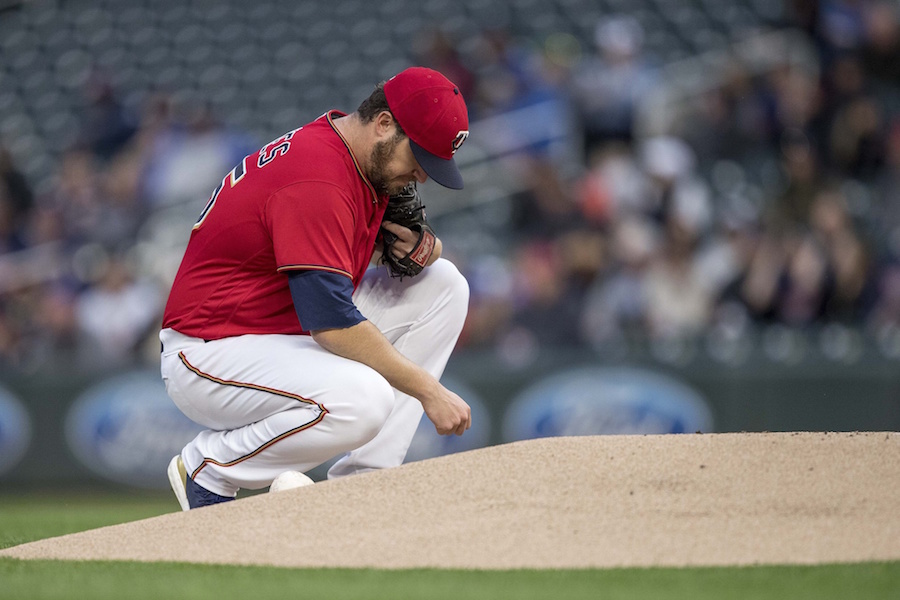 There's no question. Terry Ryan's extension for Hughes in December of 2014, with two years still remaining on the pitcher's contract, was an ill-advised one. It now will cost the Pohlads, who may be able recoup some of the money through insurance (though I've seen nothing to that effect as of yet). But if ever a guy was deserving of such a leap of faith, it was Hughes. Let's not forget: this was a 27-year-old free agent, a former first-round draft pick and elite young talent coming off a down season, who – rather than taking the usual make-good-and-move-on route – signed for three years at a stunningly reasonable rate in Minnesota. Then, Hughes went on to deliver one of the top three seasons by a Twins starter in the past decade. And at the end of it, when he came one out short of reaching a $500K contract escalator at 210 IP, he turned down the team's offer to pony it up. Said it would set a bad precedent. Even for a millionaire pro athlete, that is a lot of money to walk away from. It added to a respect that I'd already built up for Hughes. I enjoyed watching him early in his career from afar, even as a member of the hated Yankees. I was a huge fan of his contract with the Twins – to this day, I consider it the finest Ryan ever signed (even if the extension negated that brilliant stroke). And watching Hughes pitch in 2014 was a true delight. He was at the pinnacle of his craft, consistently hitting spots with lethal precision while setting the all-time MLB record for K/BB ratio. For what it's worth, according to FanGraphs, Hughes was worth $44.7 million in that season alone, accounting for about two-thirds of the $66 million he'll make in his tenure with the club. And while he's never come close to approximating that performance in four seasons since, he has tried. After throwing a career-high 209 innings in 2014, Hughes saw a serious velocity drop in 2015. He fought through and tossed 155 innings with a respectable 4.40 ERA. We all hoped his arm would rebound the next year; he was still under 30, after all. It didn't. Hughes lost more arm strength in 2016 and his performance became untenably bad. A line drive to the leg ended his season, but only beat to the punch the real culprit: a bum shoulder. He underwent surgery for thoracic outlet syndrome a few weeks later. Hughes rehabbed and came back to spring training in 2017 feeling optimistic. But it quickly became apparent he still didn't have it. The Twins tried him as a reliever for a while and then, realizing the same symptoms were inhibiting him as before, had him go under the knife for a second time to relieve his enduring shoulder condition. The success rate for two-time TOS surgery recipients is very low. Hughes recognized that. Through it all, he kept trying to tinker and find some way to get major-league hitters out. Even in my brief interactions with Hughes while covering spring training in Ft. Myers, it was obvious the man experiments relentlessly to find any kind of edge. No amount of tinkering, however, can offset a nonfunctional shoulder. The decision to move on was sadly long overdue, and allows the new front office leadership to move on uninhibited by his burdensome presence on the roster. Hughes is still only 31 years old. It's very possible he'll find his way back after a lengthy period to rest and strengthen his shoulder. I really hope he does. But it wasn't going to happen here. And now that chapter is closed. As of Monday night, the Twins had not announced a replacement for Hughes on the 25-man roster, though we're hearing it'll likely be Ryan LaMarre. The vacant 40-man spot should soon be filled by Trevor May, eligible to come off the 60-day DL in a week.
 -
Article: A Whole New LoMo
Nick Nelson replied to Cody Christie's topic in Twins Daily Front Page News
Good stuff. From my view, seems like Morrison's swing is a bit slow, but when he gets a solid early read he gets the barrel out there nicely. Been a lifesaver this past month. Nauseating to think where they might be right now without him. -
Article: Week in Review: Crisis of Leadership
Nick Nelson replied to Nick Nelson's topic in Twins Daily Front Page News
Did I? Or did you just read the title and take exception to a word you associate with someone's character? Find me an excerpt of this piece that you find unfair. Let's see it. Quit falling back on the same word. I'm not a believer in "leadership" as some intangible personality trait. I have never written about it as such. I call Dozier and Buxton the team's leaders because they are the best players and if they're doing well, the team will most likely do well. If they aren't doing well, they lead the team to mediocrity or worse. The Twins follow their lead. We saw that play out last year, and we're seeing it play out this year. Leadership is delivering on the field when your squad needs you. Leadership is Dozier saying 'we're pissed' after the team's deadline sell in 2017, then going out and tearing it up in August. Leadership is not playing abjectly terrible baseball for a month while being counted on to step up.- 105 replies
-
- 2
-
-
- brian dozier
- byron buxton
- (and 2 more)
-
Article: Week in Review: Crisis of Leadership
Nick Nelson replied to Nick Nelson's topic in Twins Daily Front Page News
For what it's worth, Jim Souhan seems to have similar concerns: http://www.startribune.com/joe-mauer-s-latest-10-day-dl-could-be-troubling/483137561/ Obviously it's in his interest as a columnist to stir people up and exaggerate situations -- and we all know his history of writing about Mauer -- but Souhan is plugged in enough that his sense of alarm here makes me feel even more uneasy. -
Article: Week in Review: Crisis of Leadership
Nick Nelson replied to Nick Nelson's topic in Twins Daily Front Page News
No one accused anyone of laziness or not trying. The fact is that this team is dramatically underperforming and its two best players have been at the root of that for a month now. Am I supposed to not call it out? That is THE story with this team. Dozier and Buxton combined for 8.5 WAR last year and they currently combine for 0.0 WAR. I'm not claiming to know (or care) what's going on in the clubhouse and this article wasn't about that. They're not leading the team with their performance on the field, which is all I'm concerned with. Buxton's a mess and these endless regressions at the plate are getting hard to tolerate. Dozier's been turning in a .275 OBP at the top of the order for the past month and his signature power's gone amiss. This is a weekly recap column and the Twins had a bad week. Their two most important players are in terrible ruts. I'm not sure what you're looking for other than 'doom and gloom.' I think I made clear in the piece that there's still plenty of time to right the ship, no?- 105 replies
-
- 12
-
-
- brian dozier
- byron buxton
- (and 2 more)
-
Last year, Brian Dozier and Byron Buxton ranked first and second among Twins players in WAR. They were driving forces in the team's playoff push and, with a better supporting cast in place, expected to help propel another step forward for Minnesota in 2018. Instead, they've become poster children for a disappointing club that cannot stop tripping over itself at every turn. The past week brought another maddening series of lapses and letdowns. Weekly Snapshot: Mon, 5/14 through Sun, 5/20 *** Record Last Week: 2-4 (Overall: 19-23) Run Differential Last Week: -4 (Overall: -21) Standing: 2nd Place in AL Central (2.5 GB) Before we dive into the usual highlights, lowlights, storylines and minor-league updates, let's just get this out there: the Twins are in disarray, and it is the guys who are supposed to be leading that are in fact dragging them down. Prior to the season, my bold and optimistic prediction was that Dozier and Buxton would both be Top 5 finishers in the American League MVP voting: Call it homerish or pollyannaish if you please, but the take wasn't without solid founding. Dozier and Buxton were among the league's most impactful players in the latter portion of 2017, each earning down-ballot MVP votes. This year, circumstances favored big seasons for both: Dozier in a walk year staring down free agency; Buxton with 1,000 MLB plate appearances in the bank, appearing to have legitimately turned a corner with his approach. Instead, both players have fallen back into their most frustrating patterns at the plate – Dozier skidding through lengthy stretches of unproductivity with an exploitable swing, Buxton resembling an overwhelmed A-baller trying to fend off peak Pedro Martinez in pretty much every AB. Over the past week, the two combined to go 3-for-37 with 13 strikeouts. Dozier is batting .175 in 26 games since the start of the Yankees series. Buxton's OPS is teetering around .400. Meanwhile, other top contributors from 2017 who were hoped to be integral cogs in a contending effort – Miguel Sano, Ervin Santana, Jorge Polanco – have been either mostly or entirely absent. And now another is sidelined with Joe Mauer hitting the disabled list this week following an ominous return of concussion symptoms. Granted, you can't plan for all the injuries and attrition; I'm sure no one foresaw the Twins with Jake Cave, Ehire Adrianza and Bobby Wilson comprising one-third of their lineup for an important Saturday night game in mid-May. But times like this are when you need your leaders to step up. Right now Dozier and Buxton keep falling down. Since moving to 8-5 with an extra-inning victory over Cleveland in Puerto Rico, the Twins have gone 11-18 over the past calendar month. They've been outscored by 31 runs. That's an extended run of performance suggesting this team just isn't very good, which is distressing at a time of such ripe opportunity. More than a dozen clubs are actively trying to tank. The Twins conversely have pushed their payroll past historical thresholds in an effort to contend, and they're coming up empty, being outpaced by acknowledged non-factors. The good news is there's a lot of season left. The ripeness of this opportunity won't go away too soon. Cleveland has yet to take off, and Minnesota still has plenty of games remaining against the division's dregs to help fuel a rapid climb. But before we can even re-enter discussions about their merits as a contender, the Twins actually must first prove they're a quality team. Right now it's very much in question, and urgency is building if they're to prove these aren't their true colors. It's time for the leaders to stop lagging and start leading. HIGHLIGHTS Because he endured such a prolonged slump to open the campaign, it's going to be a while before Logan Morrison's overall numbers broadcast on the Target Field scoreboard look any good. But over the past month he has quietly transformed into the powerful offensive infusion we all hoped he would be. Morrison's low point came in April's 16-inning marathon against the Indians, when he went 0-for-7 to drop his average to .068, his OPS to .271. The next game, in Tampa, brought the slugger's first home run as a Twin, and that sparked a healthy uptick. Since going hitless in Puerto Rico, Morrison is slashing .281/.385/.517 with five home runs and 15 RBIs in 27 games. Over the last week he went 6-for-17 and delivered key hits in both victories, a rare bright spot for this sputtering offense. (Of course, as things are going, even Morrison couldn't escape the infectious jinx plaguing the team; he was picked off at second after a leadoff double on Saturday night, an absolutely critical error.) Now that he's playing up to his ability, we can appreciate the 30-year-old's addition for the majorly impactful move it was by the front office. With Dozier dragging along, Sano absent, and now Mauer gone, Morrison's bat has been life-saving for the lineup. This is especially true when you consider Kennys Vargas, who'd have been counted on for the same role if not for LoMo's spring training sign-on, is batting .213 at Triple-A. LOWLIGHTS While Morrison has come around, another late-offseason free agent addition continues to flounder. What is the freaking deal with Lance Lynn?? After a horrendous month of April the veteran righty appeared to be finally getting on track with his first start of May, picking up his first win on six innings of two-run ball against the White Sox. Most notably, he issued zero walks and threw 73% strikes. But Lynn regressed in his next start, and further unraveled in his latest effort, lasting only three innings against St. Louis on Wednesday while issuing four walks and throwing only 46 of his egregious 82 pitches in the zone. There's a school of thought suggesting the starter's struggles can be attributed to his late start in spring training, and I was sympathetic to that notion for a time, but at this point it's out the window. We're now seven weeks into the season and Lynn has made eight starts. Plus, he came out of the gates firing in his first Grapefruit start, making it clear he was taking care of things on his end while waiting to sign a contract. It's possible, maybe even probable, that being thrown out of his routine contributed to Lynn stumbling out of the gates this year. But this no longer qualifies as a viable excuse. With each successive inexplicably erratic dud, it's becoming easier to see why he was forced to settle for a one-year contract in mid-March, despite his impressive career numbers. At least to some extent, the league saw this coming. Another thing that wasn't too hard to see coming: Jason Castro's absence, like those of so many Twins players to go down with injuries this season, extending beyond than the team's initial timeline. In this case, however, the news is especially bad: upon going under the knife last week, it was determined that Castro needed more extensive surgery than anticipated, and he'll miss the rest of the season. This is a bigger loss for the pitching staff than the lineup, but it's a painful one on that front. Castro brought excellent framing skills along with a good arm, and had developed trust and rapport with the staff. Now, the Twins are forced to rely on still-unproven Mitch Garver and 35-year-old minor-league journeyman Bobby Wilson. Not a situation that inspires a lot of confidence. TRENDING STORYLINE It seems the best hope for the Twins right now is Sano returning to provide a serious jolt that electrifies this sleepwalking lineup. He's on the rehab trail, having played at Rochester on Saturday and Sunday. In those games, Sano went a combined 0-for-4 with three walks and two strikeouts. He committed an error on one of his three chances in the field. Rust is understandably a factor, particularly since Sano wasn't looking very sharp before the injury. But as long as that hamstring is sound, the Twins need to get him back in the fold ASAP to try and ignite something, anything, for the offense. It sounds like the plan is to take it slow with Sano, who will be in Triple-A at least through Wednesday. Ideally he'll show promising signs in LeHigh Valley early this week, then join the Twins in Seattle next weekend when they kick off a six-game road trip. Meanwhile, Trevor May is almost back. The righty stretched out to 58 pitches in a solid four-inning start at Rochester on Thursday. He'll likely work up to ~80 pitches this week and should basically be ready to start in the majors on May 28th, when he's eligible to come off the disabled list. Incidentally, that date (next Monday) coincides exactly with Lynn's turn in the rotation. DOWN ON THE FARM Things are happening in Cedar Rapids. While the most imminent wave of high-caliber young talent is either in the majors (Fernando Romero) or soon to arrive (Stephen Gonsalves, Nick Gordon), the slightly more distant group terrorizing the Midwest League should have Twins fans licking their chops. Right-hander Brusdar Graterol is the most exciting pitcher in the system right now and one of the most exciting in baseball. He dazzled everyone in attendance last Monday with 5 2/3 innings of shutout, two-hit ball. Unleashing numerous 100-MPH heaters, he racked up 10 strikeouts on 21 batters faced. In Twins Daily's profile on Graterol when we ranked him as the organization's No. 9 prospect before the season, Tom Froemming laid it out like this: "Graterol is one of the highest ceiling/lowest floor prospects in all of baseball, let alone the Twins’ system. He definitely has true ace potential, already possessing two plus pitches." We're seeing the ceiling early on from the 19-year-old flamethrower, and it is towering. We saw the floor a little bit in his fourth start on Sunday, when Graterol issued five walks in five innings, but nonetheless he has a 0.93 ERA and 27-to-6 K/BB ratio through 19 1/3 frames. On the same day of Graterol's 10-K masterpiece, Alex Kirilloff was firing up another big week at the plate with a two-hit game. He went on to collect 13 hits in 30 at-bats, and on the season he's batting .324 with seven home runs and a system-leading 34 RBI. Much like Graterol, Kirilloff is finding his stride quickly after losing major time to injury, quickly reaffirming his status as one of the farm's elite talents. LOOKING AHEAD We'll get our first look at Ron Gardenhire and the Tigers to start the week, then it's off to Seattle for late-night West Coast baseball on Memorial Day Weekend. Afterward, the Twins will head to Kansas City for three games before returning home to face Cleveland four times. That has the potential to be a pivotal mid-season series. Will the Twins be within striking distance by the time it arrives? Not if they keep playing the way they have. MONDAY, 5/21: TIGERS @ TWINS – LHP Blaine Hardy v. RHP Jose Berrios TUESDAY, 5/22: TIGERS @ TWINS – LHP Matthew Boyd v. RHP Lance Lynn WEDNESDAY, 5/23: TIGERS @ TWINS – RHP Michael Fulmer v. RHP Kyle Gibson FRIDAY, 5/25: TWINS @ MARINERS – RHP Fernando Romero v. LHP James Paxton SATURDAY, 5/26: TWINS @ MARINERS – RHP Jake Odorizzi v. LHP Wade LeBlanc SUNDAY, 5/27: TWINS @ MARINERS – RHP Jose Berrios v. RHP Mike Leake Catch Up On Twins Daily Game Recaps Game 37 | SEA 1, MIN 0: Twins Get LeBlanc'edGame 38 | MIN 4, STL 1: Berrios is BackGame 39 | STL 7, MIN 5: Lynn with a Dud AgainGame 40 | MIL 8, MIN 3: Gibson Falters, Mauer Exits Due to Neck InjuryGame 41 | MIL 5, MIN 4: Jake Cave Homers in MLB DebutGame 42 | MIN 3, MIL 1: Odorizzi Ks 10, LoMo Delivers Go-Ahead HitMore on Twins Daily Tickets are available now for our "Picnic with the Saints" event, coming up on June 8th. It's an excellent value and a perfect outing for the family. Make sure to sign up before we sell out!Jamie Cameron looked at the evolution of Jose Berrios, highlighting the many adaptations and alterations he's made along the way.Twins Daily user and orthopaedic surgeon Heezy1323 shared some helpful information on knee surgeries and what may have happened with Castro. Click here to view the article
- 105 replies
-
- 5
-
-
- brian dozier
- byron buxton
- (and 2 more)
-
 Weekly Snapshot: Mon, 5/14 through Sun, 5/20 *** Record Last Week: 2-4 (Overall: 19-23) Run Differential Last Week: -4 (Overall: -21) Standing: 2nd Place in AL Central (2.5 GB) Before we dive into the usual highlights, lowlights, storylines and minor-league updates, let's just get this out there: the Twins are in disarray, and it is the guys who are supposed to be leading that are in fact dragging them down. Prior to the season, my bold and optimistic prediction was that Dozier and Buxton would both be Top 5 finishers in the American League MVP voting: https://twitter.com/NickNelsonMN/status/978109572304048128 Call it homerish or pollyannaish if you please, but the take wasn't without solid founding. Dozier and Buxton were among the league's most impactful players in the latter portion of 2017, each earning down-ballot MVP votes. This year, circumstances favored big seasons for both: Dozier in a walk year staring down free agency; Buxton with 1,000 MLB plate appearances in the bank, appearing to have legitimately turned a corner with his approach. Instead, both players have fallen back into their most frustrating patterns at the plate – Dozier skidding through lengthy stretches of unproductivity with an exploitable swing, Buxton resembling an overwhelmed A-baller trying to fend off peak Pedro Martinez in pretty much every AB. Over the past week, the two combined to go 3-for-37 with 13 strikeouts. Dozier is batting .175 in 26 games since the start of the Yankees series. Buxton's OPS is teetering around .400. Meanwhile, other top contributors from 2017 who were hoped to be integral cogs in a contending effort – Miguel Sano, Ervin Santana, Jorge Polanco – have been either mostly or entirely absent. And now another is sidelined with Joe Mauer hitting the disabled list this week following an ominous return of concussion symptoms. Granted, you can't plan for all the injuries and attrition; I'm sure no one foresaw the Twins with Jake Cave, Ehire Adrianza and Bobby Wilson comprising one-third of their lineup for an important Saturday night game in mid-May. But times like this are when you need your leaders to step up. Right now Dozier and Buxton keep falling down. Since moving to 8-5 with an extra-inning victory over Cleveland in Puerto Rico, the Twins have gone 11-18 over the past calendar month. They've been outscored by 31 runs. That's an extended run of performance suggesting this team just isn't very good, which is distressing at a time of such ripe opportunity. More than a dozen clubs are actively trying to tank. The Twins conversely have pushed their payroll past historical thresholds in an effort to contend, and they're coming up empty, being outpaced by acknowledged non-factors. The good news is there's a lot of season left. The ripeness of this opportunity won't go away too soon. Cleveland has yet to take off, and Minnesota still has plenty of games remaining against the division's dregs to help fuel a rapid climb. But before we can even re-enter discussions about their merits as a contender, the Twins actually must first prove they're a quality team. Right now it's very much in question, and urgency is building if they're to prove these aren't their true colors. It's time for the leaders to stop lagging and start leading. HIGHLIGHTS Because he endured such a prolonged slump to open the campaign, it's going to be a while before Logan Morrison's overall numbers broadcast on the Target Field scoreboard look any good. But over the past month he has quietly transformed into the powerful offensive infusion we all hoped he would be. Morrison's low point came in April's 16-inning marathon against the Indians, when he went 0-for-7 to drop his average to .068, his OPS to .271. The next game, in Tampa, brought the slugger's first home run as a Twin, and that sparked a healthy uptick. Since going hitless in Puerto Rico, Morrison is slashing .281/.385/.517 with five home runs and 15 RBIs in 27 games. Over the last week he went 6-for-17 and delivered key hits in both victories, a rare bright spot for this sputtering offense. (Of course, as things are going, even Morrison couldn't escape the infectious jinx plaguing the team; he was picked off at second after a leadoff double on Saturday night, an absolutely critical error.) Now that he's playing up to his ability, we can appreciate the 30-year-old's addition for the majorly impactful move it was by the front office. With Dozier dragging along, Sano absent, and now Mauer gone, Morrison's bat has been life-saving for the lineup. This is especially true when you consider Kennys Vargas, who'd have been counted on for the same role if not for LoMo's spring training sign-on, is batting .213 at Triple-A. LOWLIGHTS While Morrison has come around, another late-offseason free agent addition continues to flounder. What is the freaking deal with Lance Lynn?? After a horrendous month of April the veteran righty appeared to be finally getting on track with his first start of May, picking up his first win on six innings of two-run ball against the White Sox. Most notably, he issued zero walks and threw 73% strikes. But Lynn regressed in his next start, and further unraveled in his latest effort, lasting only three innings against St. Louis on Wednesday while issuing four walks and throwing only 46 of his egregious 82 pitches in the zone. There's a school of thought suggesting the starter's struggles can be attributed to his late start in spring training, and I was sympathetic to that notion for a time, but at this point it's out the window. We're now seven weeks into the season and Lynn has made eight starts. Plus, he came out of the gates firing in his first Grapefruit start, making it clear he was taking care of things on his end while waiting to sign a contract. It's possible, maybe even probable, that being thrown out of his routine contributed to Lynn stumbling out of the gates this year. But this no longer qualifies as a viable excuse. With each successive inexplicably erratic dud, it's becoming easier to see why he was forced to settle for a one-year contract in mid-March, despite his impressive career numbers. At least to some extent, the league saw this coming. Another thing that wasn't too hard to see coming: Jason Castro's absence, like those of so many Twins players to go down with injuries this season, extending beyond than the team's initial timeline. In this case, however, the news is especially bad: upon going under the knife last week, it was determined that Castro needed more extensive surgery than anticipated, and he'll miss the rest of the season. This is a bigger loss for the pitching staff than the lineup, but it's a painful one on that front. Castro brought excellent framing skills along with a good arm, and had developed trust and rapport with the staff. Now, the Twins are forced to rely on still-unproven Mitch Garver and 35-year-old minor-league journeyman Bobby Wilson. Not a situation that inspires a lot of confidence. TRENDING STORYLINE It seems the best hope for the Twins right now is Sano returning to provide a serious jolt that electrifies this sleepwalking lineup. He's on the rehab trail, having played at Rochester on Saturday and Sunday. In those games, Sano went a combined 0-for-4 with three walks and two strikeouts. He committed an error on one of his three chances in the field. Rust is understandably a factor, particularly since Sano wasn't looking very sharp before the injury. But as long as that hamstring is sound, the Twins need to get him back in the fold ASAP to try and ignite something, anything, for the offense. It sounds like the plan is to take it slow with Sano, who will be in Triple-A at least through Wednesday. Ideally he'll show promising signs in LeHigh Valley early this week, then join the Twins in Seattle next weekend when they kick off a six-game road trip. Meanwhile, Trevor May is almost back. The righty stretched out to 58 pitches in a solid four-inning start at Rochester on Thursday. He'll likely work up to ~80 pitches this week and should basically be ready to start in the majors on May 28th, when he's eligible to come off the disabled list. Incidentally, that date (next Monday) coincides exactly with Lynn's turn in the rotation. DOWN ON THE FARM Things are happening in Cedar Rapids. While the most imminent wave of high-caliber young talent is either in the majors (Fernando Romero) or soon to arrive (Stephen Gonsalves, Nick Gordon), the slightly more distant group terrorizing the Midwest League should have Twins fans licking their chops. Right-hander Brusdar Graterol is the most exciting pitcher in the system right now and one of the most exciting in baseball. He dazzled everyone in attendance last Monday with 5 2/3 innings of shutout, two-hit ball. Unleashing numerous 100-MPH heaters, he racked up 10 strikeouts on 21 batters faced. In Twins Daily's profile on Graterol when we ranked him as the organization's No. 9 prospect before the season, Tom Froemming laid it out like this: "Graterol is one of the highest ceiling/lowest floor prospects in all of baseball, let alone the Twins’ system. He definitely has true ace potential, already possessing two plus pitches." We're seeing the ceiling early on from the 19-year-old flamethrower, and it is towering. We saw the floor a little bit in his fourth start on Sunday, when Graterol issued five walks in five innings, but nonetheless he has a 0.93 ERA and 27-to-6 K/BB ratio through 19 1/3 frames. On the same day of Graterol's 10-K masterpiece, Alex Kirilloff was firing up another big week at the plate with a two-hit game. He went on to collect 13 hits in 30 at-bats, and on the season he's batting .324 with seven home runs and a system-leading 34 RBI. Much like Graterol, Kirilloff is finding his stride quickly after losing major time to injury, quickly reaffirming his status as one of the farm's elite talents. LOOKING AHEAD We'll get our first look at Ron Gardenhire and the Tigers to start the week, then it's off to Seattle for late-night West Coast baseball on Memorial Day Weekend. Afterward, the Twins will head to Kansas City for three games before returning home to face Cleveland four times. That has the potential to be a pivotal mid-season series. Will the Twins be within striking distance by the time it arrives? Not if they keep playing the way they have. MONDAY, 5/21: TIGERS @ TWINS – LHP Blaine Hardy v. RHP Jose Berrios TUESDAY, 5/22: TIGERS @ TWINS – LHP Matthew Boyd v. RHP Lance Lynn WEDNESDAY, 5/23: TIGERS @ TWINS – RHP Michael Fulmer v. RHP Kyle Gibson FRIDAY, 5/25: TWINS @ MARINERS – RHP Fernando Romero v. LHP James Paxton SATURDAY, 5/26: TWINS @ MARINERS – RHP Jake Odorizzi v. LHP Wade LeBlanc SUNDAY, 5/27: TWINS @ MARINERS – RHP Jose Berrios v. RHP Mike Leake Catch Up On Twins Daily Game Recaps Game 37 | SEA 1, MIN 0: Twins Get LeBlanc'ed Game 38 | MIN 4, STL 1: Berrios is Back Game 39 | STL 7, MIN 5: Lynn with a Dud Again Game 40 | MIL 8, MIN 3: Gibson Falters, Mauer Exits Due to Neck Injury Game 41 | MIL 5, MIN 4: Jake Cave Homers in MLB Debut Game 42 | MIN 3, MIL 1: Odorizzi Ks 10, LoMo Delivers Go-Ahead Hit More on Twins Daily Tickets are available now for our "Picnic with the Saints" event, coming up on June 8th. It's an excellent value and a perfect outing for the family. Make sure to sign up before we sell out! Jamie Cameron looked at the evolution of Jose Berrios, highlighting the many adaptations and alterations he's made along the way. Twins Daily user and orthopaedic surgeon Heezy1323 shared some helpful information on knee surgeries and what may have happened with Castro.
 -
Another great piece. Thanks for sharing your insights!
