



Nick Nelson
-
Posts
8,327 -
Joined
-
Last visited
-
Days Won
56
Content Type
Profiles
News
Minnesota Twins Videos
2026 Minnesota Twins Top Prospects Ranking
2022 Minnesota Twins Draft Picks
Minnesota Twins Free Agent & Trade Rumors, Notes, & Tidbits
Guides & Resources
2023 Minnesota Twins Draft Picks
The Minnesota Twins Players Project
2024 Minnesota Twins Draft Picks
2025 Minnesota Twins Draft Pick Tracker
2026 Minnesota Twins Draft Tracker: Picks & Bonuses
Forums
Blogs
Events
Store
Downloads
Gallery
Everything posted by Nick Nelson
-
In February and March, Fort Myers isn't just the center of the Twins baseball universe. It IS the Twins baseball universe. Pitchers and catchers report, followed shortly by the rest of the roster. Coaches and front office personnel, from every corner of the organization, gradually assemble. Minor-leaguers eventually show up – all of them. Every media member who covers the team in any capacity is on hand for at least a while. Even a bunch of bloggers from Twins Daily are regularly seen awkwardly stumbling about the bowels of Hammond Stadium. Spring training is almost overwhelming in its scale. For about six weeks, Lee County Sports Complex IS the Twins, making the franchise's supposed hometown of Minneapolis feel further even than its considerable geographic distance. But by the time Opening Day arrives, it all changes. Players, coaches, and execs pack up and ship out. The complex goes from hosting a half-dozen teams to one – the Single-A Fort Myers Miracle, along with a smattering of young kids and extended spring assignees. Usually, focus shifts to Minnesota for the balance of the year. But this ain't your usual season. And as the All Star break concludes, Twins fans are finding far more reason to stay rigidly tuned into the happenings in Fort Myers than to closely follow the big-league club.By wrapping up the first half with a 9-2 home stand, Minnesota undid the damage of a disastrous 1-8 road trip, but this only returned them to their lackluster watermark: six games below .500 and trailing Cleveland by more than a touchdown in the standings. While this recent run has done enough to give the front office pause about unloading everything at the deadline, hope remains a tough sell in the Twin Cities. Less so in Southwest Florida. The Miracle roster currently boasts the top three Twins prospects: teenage phenom Royce Lewis, jaw-dropping hitter Alex Kirilloff, and flamethrowing righty Brusdar Graterol. In the newly updated Baseball America Top 100 rankings, those three rank 10th, 37th, and 61st respectively. It's worth scrolling straight to the "Miracle Matters" section of our minor-league reports each day just to see how this trio performed, and they rarely seem to disappoint. On Wednesday night Kirilloff notched four hits, lifting his average to .323. He has 75 RBIs in 89 games this year between two levels. Lewis, the second-youngest hitter to take an at-bat in the Florida State League, is batting .400 through five games there. And while Graterol hasn't fared well in his first three starts with the Miracle, he is one of only three teenage pitchers in the FSL. His ability is obvious to anyone in range. Baseball America exclaims that he "has the highest ceiling of any Twins pitching prospect, projecting rotation-topping potential." These three players equip Minnesota with a more promising future pipeline than almost any other team can tout, but that "future" part is the sticking point. Twins fans have been looking ahead for eight years. Lewis, Kirilloff and Graterol are all extremely young by Single-A standards, which says a lot about realistic MLB timelines. All of which brings us to this point: the most important player in Fort Myers, at present, is not either of those three. It's the 25-year-old Miguel Sano – almost exactly one year removed from an All-Star appearance – who commands our attention most. If the Twins are going to pull off a highly improbable return to contention in the final stretch of the season, it stands to reason they're going to need Sano, back in star form and powering their lineup. But even beyond that, we all need this. Before fans at large will buy into this next wave of shiny prospects, and the hope they represent, they're gonna need to see what a finished product looks like, rather than another what-if story. Sano ranked as a top 15 prospect in the game three straight years (per BA) before graduating in 2015. He was the epitome of a franchise cornerstone before veering toward the path of a cautionary tale. The good news is he's still young, and under team control for several years. The book is not closed on Sano and the Twins by any means. But it is anyone's guess where the story goes from here. We're all watching it play out, from afar, as he taxis on the Single-A runway and watches the organization's top prospects take off. Hopefully, soon, Sano will give us one less reason to pay careful attention to Fort Myers, FL. He's hitting .328/.442/.453 in 19 games, albeit against vastly inferior competition. If Sano doesn't get bumped up soon, with a quick adaptation to the next level, then Twins fans might need to reset expectations in line with the ETAs of those emerging top prospects. I can't blame you if it's a struggle. Fort Myers is so far away, in every sense. Click here to view the article
- 38 replies
-
- 2
-

-
- miguel sano
- royce lewis
- (and 2 more)
-
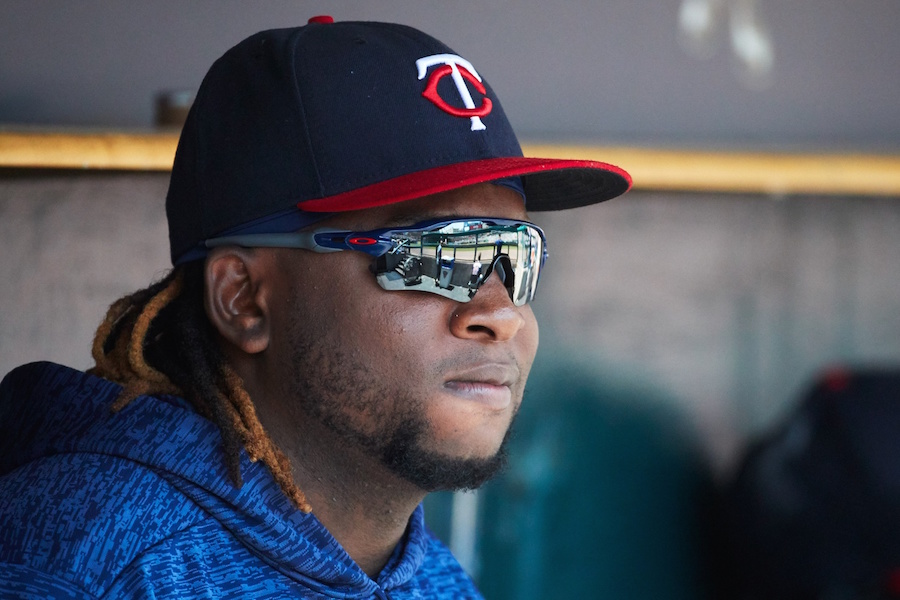 By wrapping up the first half with a 9-2 home stand, Minnesota undid the damage of a disastrous 1-8 road trip, but this only returned them to their lackluster watermark: six games below .500 and trailing Cleveland by more than a touchdown in the standings. While this recent run has done enough to give the front office pause about unloading everything at the deadline, hope remains a tough sell in the Twin Cities. Less so in Southwest Florida. The Miracle roster currently boasts the top three Twins prospects: teenage phenom Royce Lewis, jaw-dropping hitter Alex Kirilloff, and flamethrowing righty Brusdar Graterol. In the newly updated Baseball America Top 100 rankings, those three rank 10th, 37th, and 61st respectively. It's worth scrolling straight to the "Miracle Matters" section of our minor-league reports each day just to see how this trio performed, and they rarely seem to disappoint. On Wednesday night Kirilloff notched four hits, lifting his average to .323. He has 75 RBIs in 89 games this year between two levels. Lewis, the second-youngest hitter to take an at-bat in the Florida State League, is batting .400 through five games there. And while Graterol hasn't fared well in his first three starts with the Miracle, he is one of only three teenage pitchers in the FSL. His ability is obvious to anyone in range. Baseball America exclaims that he "has the highest ceiling of any Twins pitching prospect, projecting rotation-topping potential." These three players equip Minnesota with a more promising future pipeline than almost any other team can tout, but that "future" part is the sticking point. Twins fans have been looking ahead for eight years. Lewis, Kirilloff and Graterol are all extremely young by Single-A standards, which says a lot about realistic MLB timelines. All of which brings us to this point: the most important player in Fort Myers, at present, is not either of those three. It's the 25-year-old Miguel Sano – almost exactly one year removed from an All-Star appearance – who commands our attention most. If the Twins are going to pull off a highly improbable return to contention in the final stretch of the season, it stands to reason they're going to need Sano, back in star form and powering their lineup. But even beyond that, we all need this. Before fans at large will buy into this next wave of shiny prospects, and the hope they represent, they're gonna need to see what a finished product looks like, rather than another what-if story. Sano ranked as a top 15 prospect in the game three straight years (per BA) before graduating in 2015. He was the epitome of a franchise cornerstone before veering toward the path of a cautionary tale. The good news is he's still young, and under team control for several years. The book is not closed on Sano and the Twins by any means. But it is anyone's guess where the story goes from here. We're all watching it play out, from afar, as he taxis on the Single-A runway and watches the organization's top prospects take off. Hopefully, soon, Sano will give us one less reason to pay careful attention to Fort Myers, FL. He's hitting .328/.442/.453 in 19 games, albeit against vastly inferior competition. If Sano doesn't get bumped up soon, with a quick adaptation to the next level, then Twins fans might need to reset expectations in line with the ETAs of those emerging top prospects. I can't blame you if it's a struggle. Fort Myers is so far away, in every sense.
 -
 Yea, what I really meant was that the projection only includes players who still have prospect status, I should've said that instead of current big-leaguers. I certainly expect Romero to be leading this rotation in five years. Granite just didn't make the cut, there were five OFs above him on the list. It wouldn't shock me if he falls off the 40-man roster soon to be honest.
- 25 replies
-
- 3
-
-
- royce lewis
- alex kirilloff
- (and 3 more)
-
The true tragedy of the 2018 season? How it's tarnishing the hopes of so many Minnesota Twins fans who've earnestly bought into the vision of this rebuild, framed around Byron Buxton and Miguel Sano as superstar cornerstones. Watching these heralded can't-miss prospects flounder as they enter what should be their primes – dragging the franchise along with them – can be dispiriting, I know. But please, don't let it jade you on the merits of young talent. Plenty more is on the way, and things do not always go so awry.In advance of this week's All-Star Game, Baseball America published a fun retrospective piece recalling some of its historical prospect rankings and write-ups for the showcase's participants. Among those who never appeared in BA's Top 100: Charlie Blackmon, Paul Goldschmidt, J.D. Martinez, Corey Kluber, Jose Altuve. In fact, Altuve's highest placement on the site's organizational rankings for Houston was 28th. Twenty-eighth! The 28-year-old was 2017 AL MVP and is about to appear in his sixth All-Star Game. What I'm trying to say is that great players come from all corners, and all levels of repute. But of course, those who are acclaimed and touted as they rise through the minors have much higher rates of success, and those outside the top prospect class who exceed expectations usually have at least one standout ingredient that propels them to superiority. This is a big reason we've extended our Twins Daily midseason rankings out to 40. The system is as deep as it's been in memory, with conducive ingredients and raw tools stretching to that point and beyond. Today we'll recap the full updated rankings while breaking down some trends and tidbits worth noting. MINNESOTA TWINS MIDSEASON TOP 40 PROSPECTS 2018: SUMMARY 40. Aaron Whitefield – OF 39. Jaylin Davis – OF 38. Ricky De La Torre – SS 37. Lachlan Wells – LHP 36. Aaron Slegers – RHP 35. Tyler Watson – LHP 34. DaShawn Keirsey, Jr. – OF 33. Gabriel Moya – LHP 32. Andrew Bechtold – 3B 31. Jordan Balazovic – RHP 30. John Curtiss – RHP 29. Zack Granite – OF 28. Jake Cave – OF 27. Tyler Wells – RHP 26. Griffin Jax - RHP 25. Tyler Jay – LHP 24. Felix Jorge – RHP 23. Kohl Stewart – RHP 22. Landon Leach – RHP 21. Jose Miranda – 2B 20. Luis Arraez – 2B 19. Jacob Pearson – OF 18. Ryan Jeffers – C 17. Lewin Diaz – 1B 16. Yunior Severino – 2B 15. Ben Rortvedt – C 14. Lewis Thorpe – LHP 13. Travis Blankenhorn – 3B 12. LaMonte Wade – OF 11. Blayne Enlow – RHP 10. Zack Littell - RHP 9. Wander Javier – SS 8. Akil Baddoo – OF 7. Brent Rooker – 1B 6. Trevor Larnach – OF 5. Stephen Gonsalves – LHP 4. Nick Gordon – SS 3. Brusdar Graterol – RHP 2. Alex Kirilloff – OF 1. Royce Lewis – SS BREAKDOWN BY POSITION Catcher: 2 Infield: 11 Outfield: 10 RH Pitcher: 11 LH Pitcher: 6 METHOD OF ACQUISITION Draft: Lewis, Kirilloff, Gordon, Gonsalves, Larnach, Rooker, Baddoo, Enlow, Wade, Blankenhorn, Rortvedt, Jeffers, Miranda, Leach, Stewart, Jax, T. Wells, Granite, Curtiss, Balazovic, Bechtold, Keirsey, Slegers, De La Torre, Davis Trade: Littell, Pearson, Cave, Moya, Watson International Signing: Graterol, Javier, Thorpe, Diaz, Arraez, Jorge, L. Wells, Whitefield A HEALTHY PIPELINE Premier assets at the top, plenty of quality sprinkled throughout, and low-key intrigue at the back end: It might not rank as a top-three farm system in baseball, but Minnesota boasts a deep and enviable collection of minor-league talent. The beauty of this group, at present? I promise I'm knocking on wood before I type this, but... they're in really good shape, physically. Yes, there was the very unfortunate preseason shoulder injury for Wander Javier, knocking him out for the year at a crucial point of development. And there have naturally been some bumps and bruises along the way, but for the most part, players in the Twins' system have been able to stay on the field. That hasn't been entirely common lately, and is especially refreshing in contrast to the dinged up big-league club. In fact, several prospects have shown very promising signs while trying to rebound from major health tribulations. Alex Kirilloff has of course blasted back onto the scene brilliantly after Tommy John surgery cost him all of 2017. But developments on the pitching side have been even more vitalizing. Graterol had logged only 51 total frames through his first four pro seasons due to health problems, but is already at 55 innings between Cedar Rapids and Fort Myers this year. Thorpe, too, has set a new career-high in innings pitched while rebuilding strength after a long layoff. Toss in Fernando Romero (who has now graduated from his prospect status, but would otherwise be near the top of this list), and you've got three absolutely critical arms that – at least so far – have returned to the fold very successfully after losing multiple seasons to injury. Many who go through such tumult never make it back successfully. And while nothing is promised, for now I'm appreciating a little good fortune on this front. FIRST CLASS Derek Falvey and Thad Levine inherited a good situation in their first year at the helm, with the first overall pick in the 2017 draft and four selections in the top 76. No one could deny they took full advantage, bolstering the system in one fell swoop. All four players taken with those picks now sit among our top 40: Royce Lewis (1), Brent Rooker (7), Blayne Enlow (11), Landon Leach (22). So do a couple others they grabbed in their first draft: Andrew Bechtold (32) and Ricky De La Torre (38). Obviously the sample is small with all these players and their futures have yet to be written, but there's plenty to like in Falvey and Levine's initial class of recruits. Their first two picks Lewis and Rooker, in particular, are looking like slam dunks. And we'll see about the second class but so far Trevor Larnach (6) and Ryan Jeffers (18) aren't looking too shabby. SPEED AT THE TOP There are some very special talents on this list, and in the top five especially, but Royce Lewis is in a class of his own. Promoted to High-A last week, about a month after his 19th birthday, he's on an even faster path than the franchise's last No. 1 overall pick, Joe Mauer, who reached the Florida State League at age 20 in his third pro season. Mauer ended up skipping Triple-A entirely on his way to debuting in the majors at age 20. It's becoming reasonable to envision a similar ascent for Lewis. In fact, as long as he can stay healthy, Lewis is a pretty good bet to become the youngest Twin to reach the big leagues since the turn of the century, beating out Mauer and Jorge Polanco who were close to 21 when they made landing. In his first full season, Lewis has flashed outstanding speed on the field, where he's 22-for-27 on steals in 77 games, and in his development, which continues to progress at an lightning-quick pace. He's currently sitting at No. 10 overall in Baseball America's live Top 100 Rankings, well ahead of all others the Twins considered taking with the first pick last June, so their decision is being roundly reaffirmed one year later. A LINGERING WEAKNESS From the positional breakdown a little further up, you can see that the system has a nice balance for the most part: 17 pitchers, 11 infielders, 10 outfielders. But the lack of depth at another position – one of the absolute most critical – sticks out like a sore thumb. There are only two catchers in the rankings, and neither is higher than 15th. Additionally, neither is expected to arrive in the majors before 2021. Outside of marginal journeymen like Bobby Wilson, the Twins currently have only Mitch Garver, whose defensive aptitude seems in question based on Paul Molitor's usage, and 31-year-old Jason Castro, who will be returning from knee surgery for his final year under contract in 2019. If there's one position that the Twins clearly need to address from outside, it's this one. I have my own ideas, but there are plenty of other routes to go. IMAGINING A BUILT-FROM-WITHIN 2023 MLB ROSTER What might a future 25-man Twins roster, assembled entirely from prospects currently in the system, look like? Subtracting current big-leaguers from the mix and taking a few liberties in terms of positional flexibility, here's a theoretical look at an internally produced lineup, bench, and pitching staff roughly five years down the line: C - Ben Rortvedt 1B - Brent Rooker 2B - Nick Gordon SS - Wander Javier 3B - Travis Blankenhorn LF - LaMonte Wade CF - Royce Lewis RF - Alex Kirilloff DH - Trevor Larnach C - Ryan Jeffers IF - Yunior Severino IF - Luis Arraez OF - Akil Baddoo OF - Jacob Pearson SP - Brusdar Graterol SP - Stephen Gonsalves SP - Zack Littell SP - Blayne Enlow SP - Felix Jorge RP - Lewis Thorpe RP - Tyler Jay RP - Kohl Stewart RP - Gabriel Moya RP - John Curtiss RP - Griffin Jax RP - Tyler Wells FURTHER READING Catch up on the latest news and developments surrounding the system's top talents by reading through Tom Froemming's exhaustive Twins Prospect PulseTrey Cabbage, who ranks somewhere just outside the Top 40, was the subject of SD Buhr's latest column from Cedar RapidsIf you need a reminder that sometimes top prospects pan out beautifully, Jose Berrios will be participating in Tuesday night's All-Star Game at age 24, and up until the contest ends you can still sign up to a win a free baseball signed by BerriosWEIGH IN! What are your thoughts on the state of the Twins system here at the 2018 All-Star break? Did we miss anyone we should've included (other than high-profile international signing Misael Urbina, who came aboard after our ranking process had begun)? Do you have major quibbles with any placements? Let us know in the comments. Click here to view the article
- 25 replies
-
- 2
-
-
- royce lewis
- alex kirilloff
- (and 3 more)
-
2018 Minnesota Twins Midseason Top Prospect List: Recap
Nick Nelson posted an article in Minor Leagues
 In advance of this week's All-Star Game, Baseball America published a fun retrospective piece recalling some of its historical prospect rankings and write-ups for the showcase's participants. Among those who never appeared in BA's Top 100: Charlie Blackmon, Paul Goldschmidt, J.D. Martinez, Corey Kluber, Jose Altuve. In fact, Altuve's highest placement on the site's organizational rankings for Houston was 28th. Twenty-eighth! The 28-year-old was 2017 AL MVP and is about to appear in his sixth All-Star Game. What I'm trying to say is that great players come from all corners, and all levels of repute. But of course, those who are acclaimed and touted as they rise through the minors have much higher rates of success, and those outside the top prospect class who exceed expectations usually have at least one standout ingredient that propels them to superiority. This is a big reason we've extended our Twins Daily midseason rankings out to 40. The system is as deep as it's been in memory, with conducive ingredients and raw tools stretching to that point and beyond. Today we'll recap the full updated rankings while breaking down some trends and tidbits worth noting. MINNESOTA TWINS MIDSEASON TOP 40 PROSPECTS 2018: SUMMARY 40. Aaron Whitefield – OF 39. Jaylin Davis – OF 38. Ricky De La Torre – SS 37. Lachlan Wells – LHP 36. Aaron Slegers – RHP 35. Tyler Watson – LHP 34. DaShawn Keirsey, Jr. – OF 33. Gabriel Moya – LHP 32. Andrew Bechtold – 3B 31. Jordan Balazovic – RHP 30. John Curtiss – RHP 29. Zack Granite – OF 28. Jake Cave – OF 27. Tyler Wells – RHP 26. Griffin Jax - RHP 25. Tyler Jay – LHP 24. Felix Jorge – RHP 23. Kohl Stewart – RHP 22. Landon Leach – RHP 21. Jose Miranda – 2B 20. Luis Arraez – 2B 19. Jacob Pearson – OF 18. Ryan Jeffers – C 17. Lewin Diaz – 1B 16. Yunior Severino – 2B 15. Ben Rortvedt – C 14. Lewis Thorpe – LHP 13. Travis Blankenhorn – 3B 12. LaMonte Wade – OF 11. Blayne Enlow – RHP 10. Zack Littell - RHP 9. Wander Javier – SS 8. Akil Baddoo – OF 7. Brent Rooker – 1B 6. Trevor Larnach – OF 5. Stephen Gonsalves – LHP 4. Nick Gordon – SS 3. Brusdar Graterol – RHP 2. Alex Kirilloff – OF 1. Royce Lewis – SS BREAKDOWN BY POSITION Catcher: 2 Infield: 11 Outfield: 10 RH Pitcher: 11 LH Pitcher: 6 METHOD OF ACQUISITION Draft: Lewis, Kirilloff, Gordon, Gonsalves, Larnach, Rooker, Baddoo, Enlow, Wade, Blankenhorn, Rortvedt, Jeffers, Miranda, Leach, Stewart, Jax, T. Wells, Granite, Curtiss, Balazovic, Bechtold, Keirsey, Slegers, De La Torre, Davis Trade: Littell, Pearson, Cave, Moya, Watson International Signing: Graterol, Javier, Thorpe, Diaz, Arraez, Jorge, L. Wells, Whitefield A HEALTHY PIPELINE Premier assets at the top, plenty of quality sprinkled throughout, and low-key intrigue at the back end: It might not rank as a top-three farm system in baseball, but Minnesota boasts a deep and enviable collection of minor-league talent. The beauty of this group, at present? I promise I'm knocking on wood before I type this, but... they're in really good shape, physically. Yes, there was the very unfortunate preseason shoulder injury for Wander Javier, knocking him out for the year at a crucial point of development. And there have naturally been some bumps and bruises along the way, but for the most part, players in the Twins' system have been able to stay on the field. That hasn't been entirely common lately, and is especially refreshing in contrast to the dinged up big-league club. In fact, several prospects have shown very promising signs while trying to rebound from major health tribulations. Alex Kirilloff has of course blasted back onto the scene brilliantly after Tommy John surgery cost him all of 2017. But developments on the pitching side have been even more vitalizing. Graterol had logged only 51 total frames through his first four pro seasons due to health problems, but is already at 55 innings between Cedar Rapids and Fort Myers this year. Thorpe, too, has set a new career-high in innings pitched while rebuilding strength after a long layoff. Toss in Fernando Romero (who has now graduated from his prospect status, but would otherwise be near the top of this list), and you've got three absolutely critical arms that – at least so far – have returned to the fold very successfully after losing multiple seasons to injury. Many who go through such tumult never make it back successfully. And while nothing is promised, for now I'm appreciating a little good fortune on this front. FIRST CLASS Derek Falvey and Thad Levine inherited a good situation in their first year at the helm, with the first overall pick in the 2017 draft and four selections in the top 76. No one could deny they took full advantage, bolstering the system in one fell swoop. All four players taken with those picks now sit among our top 40: Royce Lewis (1), Brent Rooker (7), Blayne Enlow (11), Landon Leach (22). So do a couple others they grabbed in their first draft: Andrew Bechtold (32) and Ricky De La Torre (38). Obviously the sample is small with all these players and their futures have yet to be written, but there's plenty to like in Falvey and Levine's initial class of recruits. Their first two picks Lewis and Rooker, in particular, are looking like slam dunks. And we'll see about the second class but so far Trevor Larnach (6) and Ryan Jeffers (18) aren't looking too shabby. SPEED AT THE TOP There are some very special talents on this list, and in the top five especially, but Royce Lewis is in a class of his own. Promoted to High-A last week, about a month after his 19th birthday, he's on an even faster path than the franchise's last No. 1 overall pick, Joe Mauer, who reached the Florida State League at age 20 in his third pro season. Mauer ended up skipping Triple-A entirely on his way to debuting in the majors at age 20. It's becoming reasonable to envision a similar ascent for Lewis. In fact, as long as he can stay healthy, Lewis is a pretty good bet to become the youngest Twin to reach the big leagues since the turn of the century, beating out Mauer and Jorge Polanco who were close to 21 when they made landing. In his first full season, Lewis has flashed outstanding speed on the field, where he's 22-for-27 on steals in 77 games, and in his development, which continues to progress at an lightning-quick pace. He's currently sitting at No. 10 overall in Baseball America's live Top 100 Rankings, well ahead of all others the Twins considered taking with the first pick last June, so their decision is being roundly reaffirmed one year later. A LINGERING WEAKNESS From the positional breakdown a little further up, you can see that the system has a nice balance for the most part: 17 pitchers, 11 infielders, 10 outfielders. But the lack of depth at another position – one of the absolute most critical – sticks out like a sore thumb. There are only two catchers in the rankings, and neither is higher than 15th. Additionally, neither is expected to arrive in the majors before 2021. Outside of marginal journeymen like Bobby Wilson, the Twins currently have only Mitch Garver, whose defensive aptitude seems in question based on Paul Molitor's usage, and 31-year-old Jason Castro, who will be returning from knee surgery for his final year under contract in 2019. If there's one position that the Twins clearly need to address from outside, it's this one. I have my own ideas, but there are plenty of other routes to go. IMAGINING A BUILT-FROM-WITHIN 2023 MLB ROSTER What might a future 25-man Twins roster, assembled entirely from prospects currently in the system, look like? Subtracting current big-leaguers from the mix and taking a few liberties in terms of positional flexibility, here's a theoretical look at an internally produced lineup, bench, and pitching staff roughly five years down the line: C - Ben Rortvedt 1B - Brent Rooker 2B - Nick Gordon SS - Wander Javier 3B - Travis Blankenhorn LF - LaMonte Wade CF - Royce Lewis RF - Alex Kirilloff DH - Trevor Larnach C - Ryan Jeffers IF - Yunior Severino IF - Luis Arraez OF - Akil Baddoo OF - Jacob Pearson SP - Brusdar Graterol SP - Stephen Gonsalves SP - Zack Littell SP - Blayne Enlow SP - Felix Jorge RP - Lewis Thorpe RP - Tyler Jay RP - Kohl Stewart RP - Gabriel Moya RP - John Curtiss RP - Griffin Jax RP - Tyler Wells FURTHER READING Catch up on the latest news and developments surrounding the system's top talents by reading through Tom Froemming's exhaustive Twins Prospect Pulse Trey Cabbage, who ranks somewhere just outside the Top 40, was the subject of SD Buhr's latest column from Cedar Rapids If you need a reminder that sometimes top prospects pan out beautifully, Jose Berrios will be participating in Tuesday night's All-Star Game at age 24, and up until the contest ends you can still sign up to a win a free baseball signed by Berrios WEIGH IN! What are your thoughts on the state of the Twins system here at the 2018 All-Star break? Did we miss anyone we should've included (other than high-profile international signing Misael Urbina, who came aboard after our ranking process had begun)? Do you have major quibbles with any placements? Let us know in the comments.
 -
A disappointing first half ended on a high note, with Sunday's walk-off grand slam capping a 9-2 home stand to propel Minnesota into the All-Star break with some serious good vibes. In the wake of a crushing 1-8 road trip, the Twins did what they needed to do, taking all three series at Target Field to move back within six games of .500 and eight games of the division lead. Weekly Snapshot: Mon, 7/9 through Sun, 7/15 *** Record Last Week: 5-2 (Overall: 44-50) Run Differential Last Week: -2 (Overall: -23) Standing: 2nd Place in AL Central (7.5 GB) HIGHLIGHTS The offense was cooking this week, producing 48 runs in seven games. The unit's fine work included strong showings against two of the American League's hottest starters; Minnesota chased All-Star Blake Snell (4-0 with a 0.63 ERA in his previous four starts) after three innings on Thursday, and jumped all over Nathan Eovaldi (2-0 with a 0.95 ERA in his previous three starts) for eight runs on Friday. Contributions came from all corners. Jake Cave continued to entrench himself with his best week as a big-leaguer, starting five of the Twins' seven games and going 8-for-17 (.471) with two doubles, two triples and a pair of runs batted in. It'd be nice to see a little more discipline – he drew one walk last week and has only four in 81 plate appearances, to go along with 23 strikeouts – but at least he's connecting and driving the ball. Cave is looking like a hell of a find by the front office. It's that time of year: Brian Dozier is finding his zone. The now-customary slow start for Dozier was lengthier and uglier than usual this time around, but as usual, he's finding his stroke here around the All-Star break. Last week he went 9-for-28 with three home runs and 10 RBIs, punctuating his first half with a walk-off grand slam. He also showed a better eye at the plate, drawing five walks (one intentional) after posting a 9-to-0 K/BB ratio the previous week. Speaking of reviving patience, Joe Mauer drew twice as many walks from Friday through Sunday (4) as he had in 24 previous games since coming off the disabled list. Coupled with his generally exceptional output during the week (11-for-30 with a homer and seven RBIs), it's a further sign Mauer is starting to see the ball better – a much-needed development. Also chipping in on offense: Eddie Rosario, who had at least one hit in all seven games and now ranks 8th in the AL with a .311 average. Robbie Grossman who hasn't seen his name pop up in the "Highlights" section often but earned it this week by going 8-for-18 (.444) with three doubles and three walks. Heck, even Bobby Wilson joined the fun, following up his first multi-hit game of the season last Saturday with two more in his four starts. His average is all the way up to .177! On the pitching side, Kyle Gibson stayed hot with another brilliant performance on Thursday against Tampa. The righty struck out nine and walked none over eight innings of one-run ball, inducing 16 swinging strikes after setting a career-high with 20 in his previous turn against Baltimore. Gibson has completed seven or more innings six times in his past nine starts; he did so nine times in 2016 and 2017 combined. Right now, Gibby is throwing as well as he has at any point in his career. The timing is interesting as the trade deadline approaches, with Minnesota in sell mode (?) and plenty of contenders seeking impact arms. We'll see what happens. LOWLIGHTS Mitch Garver continued to come up on the short end of the catching timeshare, making three starts to Wilson's four, and for once he was actually out-hit by his counterpart. Garver actually failed to pick up a single knock in 17 plate appearances. That sort of thing is going to happen – his .375 average in the previous 20 games, buoyed by a .432 BABIP, wasn't going to stay propped up forever – but what's nice to see is Garver taking solid ABs and still managing to get himself on base during a hitting slump, as he drew four walks against four strikeouts. He also laid down a key two-strike bunt on Sunday to set up Dozier's walk-off. Even during a down stretch, it's nice to see Garver get playing time, and it's easy to see the value in it. That's not true of Matt Belisle, who has now become a primary source of frustration with this club. When the Twins added the veteran right-hander back in early June, seeking an infusion of leadership to right their wayward ship, it appeared to be a harmless enough move. He hadn't been good with Cleveland but he was to be the last option in the Minnesota bullpen, a mop-up man whose arm they didn't need to worry about. How much damage could he do? Well, he's done his share. After a hideous outing on Saturday in which he coughed up five runs in one frame, pushing the game out of reach and opening the door for an ill-equipped Willians Astudillo to take the mound in the ninth, Belisle has now surrendered 13 earned runs on 23 hits in 12 1/3 innings for Minnesota. He hasn't recorded six outs in an appearance. If he's still on the roster coming out of the break, the Twins are doing it wrong. TRENDING STORYLINE On Sunday, Ervin Santana made his first rehab start at Triple-A, stretching out to 5 2/3 innings and 86 pitches. The results weren't great – he gave up a pair of homers and has allowed five total in six starts in the minors. However, his arm strength should be sufficiently built up to rejoin the big-league club and I don't suspect the Twins will waste any time. He'll likely be reinserted into the rotation immediately after the break for two main reasons: 1) they're having a hard time finding answers for that fifth rotation spot, as Aaron Slegers was shelled on Tuesday and Fernando Romero couldn't get through five innings on Sunday, and 2) they have precious little time to showcase Santana as a deadline chip. Santana may quietly be one of Minnesota's best assets to dangle. He was among the AL's top pitchers last year and started a playoff game. He's an experienced vet with an excellent recent track record. His contract, containing a $14 million team option for 2019, offers convenient flexibility. And if other teams are convinced he's beyond his finger issues, they might actually value the fact that he has hardly pitched all year, as it could improve his odds of staying strong through September and October. Of course, convincing others that Erv is back to 100% will be tough as time runs short. Reports on Santana during his rehab stint have been as mixed as his results. He is lined up to start the first game of the second half on regular rest, and if the Twins plug him in at Kansas City on Friday he'd be able to get in three turns before the July 31st deadline. Would a trio of 2017-caliber efforts be enough to restore Santana's status and generate some competition for his services? That should certainly be the hope as we look ahead to the rest of July. DOWN ON THE FARM At long last, Royce Lewis received his much-deserved promotion to Fort Myers. In moving up from Low-A to High-A, Lewis becomes one of the youngest players in the Florida State League, but that didn't stop him from making a fast impression with four hits in his second game on Sunday. Lewis was, of course, the consensus No. 1 prospect in our recently wrapped midseason top 40 rankings. While the shortstop was bursting onto the FSL scene Sunday, Alex Kirilloff wasn't in the same lineup, because he was starting for Team USA in the Futures Game. He started in right and batted sixth, notching singles in both his at-bats before coming out. Also participating in the showcase was Lewis Thorpe, who didn't fare so well – he came in to pitch the fourth but couldn't complete it as he yielded four runs three hits, including a single to Kirilloff and two home runs, while recording two outs (both on K's). LOOKING AHEAD On Tuesday, Jose Berrios will represent the Twins at the 2018 All-Star Game. Then, following a couple days off, the second half will kick off with a series in Kansas City. Minnesota needs to make hay against the last-place Royals because after that the path steepens, with their road trip bringing them through Toronto and Boston before returning home to face Cleveland. The probable starters below are very much subject to change as both the Twins and Royals may reshuffle their rotations over the break. TUESDAY, 7/17: MLB ALL-STAR GAME – Go Berrios! FRIDAY, 7/20: TWINS @ ROYALS – RHP Kyle Gibson v. LHP Danny Duffy SATURDAY, 7/21: TWINS @ ROYALS – RHP Lance Lynn v. RHP Jake Junis SUNDAY, 7/22: TWINS @ ROYALS – RHP Jake Odorizzi v. RHP Brad Keller Catch Up On Twins Daily Game Recaps Game 88 | MIN 3, KC 1: Minnesota’s All-Star ShinesGame 89 | KC 9, MIN 4: Slegers Slayed by RoyalsGame 90 | MIN 8, KC 5: Twins Recover from Rough StartGame 91 | MIN 5, TB 1: Who’s the Snub?Game 92 | MIN 11, TB 8: Twins Get a Scare on Friday the 13th, Prevail Over Pesky RaysGame 93 | TB 19, MIN 6: This Never HappenedGame 94 | MIN 11, TB 7: Dozier Grand Slam Ends Wild Game, First HalfMore on Twins Daily In the latest roundtable, a panel of Twins Daily writers weighed in with their choices for Minnesota's biggest second-half performerAndrew Thares took a look at potential suitors for Brian Dozier as the deadline approachesI theorized about how a trade for Miami's All-Star catcher J.T. Realmuto might take shapeReporting from Cedar Rapids, SD Buhr wrote of the leadership shown by infielder Jordan Gore and pitcher Randy Dobnak for the Kernels Click here to view the article
-
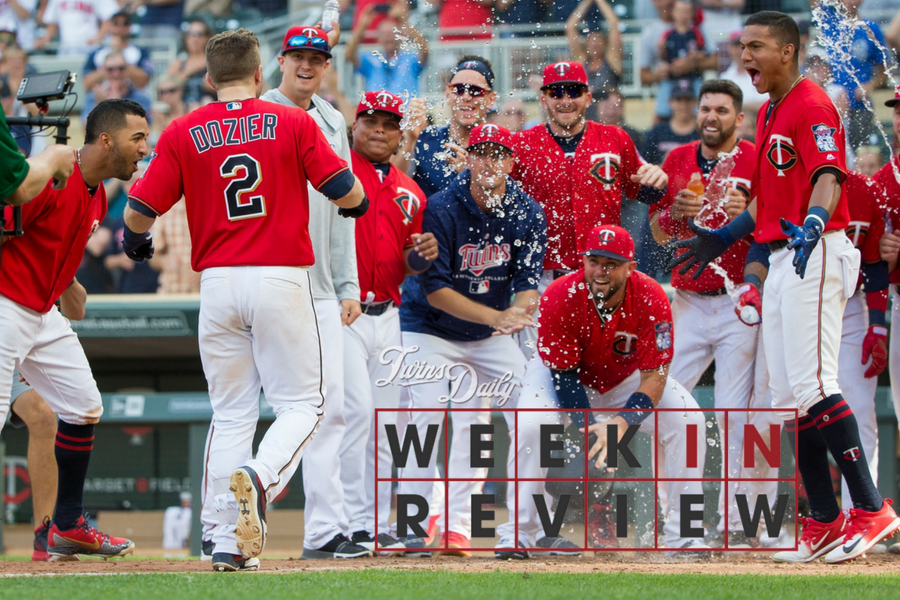 Weekly Snapshot: Mon, 7/9 through Sun, 7/15 *** Record Last Week: 5-2 (Overall: 44-50) Run Differential Last Week: -2 (Overall: -23) Standing: 2nd Place in AL Central (7.5 GB) HIGHLIGHTS The offense was cooking this week, producing 48 runs in seven games. The unit's fine work included strong showings against two of the American League's hottest starters; Minnesota chased All-Star Blake Snell (4-0 with a 0.63 ERA in his previous four starts) after three innings on Thursday, and jumped all over Nathan Eovaldi (2-0 with a 0.95 ERA in his previous three starts) for eight runs on Friday. Contributions came from all corners. Jake Cave continued to entrench himself with his best week as a big-leaguer, starting five of the Twins' seven games and going 8-for-17 (.471) with two doubles, two triples and a pair of runs batted in. It'd be nice to see a little more discipline – he drew one walk last week and has only four in 81 plate appearances, to go along with 23 strikeouts – but at least he's connecting and driving the ball. Cave is looking like a hell of a find by the front office. It's that time of year: Brian Dozier is finding his zone. The now-customary slow start for Dozier was lengthier and uglier than usual this time around, but as usual, he's finding his stroke here around the All-Star break. Last week he went 9-for-28 with three home runs and 10 RBIs, punctuating his first half with a walk-off grand slam. He also showed a better eye at the plate, drawing five walks (one intentional) after posting a 9-to-0 K/BB ratio the previous week. Speaking of reviving patience, Joe Mauer drew twice as many walks from Friday through Sunday (4) as he had in 24 previous games since coming off the disabled list. Coupled with his generally exceptional output during the week (11-for-30 with a homer and seven RBIs), it's a further sign Mauer is starting to see the ball better – a much-needed development. Also chipping in on offense: Eddie Rosario, who had at least one hit in all seven games and now ranks 8th in the AL with a .311 average. Robbie Grossman who hasn't seen his name pop up in the "Highlights" section often but earned it this week by going 8-for-18 (.444) with three doubles and three walks. Heck, even Bobby Wilson joined the fun, following up his first multi-hit game of the season last Saturday with two more in his four starts. His average is all the way up to .177! On the pitching side, Kyle Gibson stayed hot with another brilliant performance on Thursday against Tampa. The righty struck out nine and walked none over eight innings of one-run ball, inducing 16 swinging strikes after setting a career-high with 20 in his previous turn against Baltimore. Gibson has completed seven or more innings six times in his past nine starts; he did so nine times in 2016 and 2017 combined. Right now, Gibby is throwing as well as he has at any point in his career. The timing is interesting as the trade deadline approaches, with Minnesota in sell mode (?) and plenty of contenders seeking impact arms. We'll see what happens. LOWLIGHTS Mitch Garver continued to come up on the short end of the catching timeshare, making three starts to Wilson's four, and for once he was actually out-hit by his counterpart. Garver actually failed to pick up a single knock in 17 plate appearances. That sort of thing is going to happen – his .375 average in the previous 20 games, buoyed by a .432 BABIP, wasn't going to stay propped up forever – but what's nice to see is Garver taking solid ABs and still managing to get himself on base during a hitting slump, as he drew four walks against four strikeouts. He also laid down a key two-strike bunt on Sunday to set up Dozier's walk-off. Even during a down stretch, it's nice to see Garver get playing time, and it's easy to see the value in it. That's not true of Matt Belisle, who has now become a primary source of frustration with this club. When the Twins added the veteran right-hander back in early June, seeking an infusion of leadership to right their wayward ship, it appeared to be a harmless enough move. He hadn't been good with Cleveland but he was to be the last option in the Minnesota bullpen, a mop-up man whose arm they didn't need to worry about. How much damage could he do? Well, he's done his share. After a hideous outing on Saturday in which he coughed up five runs in one frame, pushing the game out of reach and opening the door for an ill-equipped Willians Astudillo to take the mound in the ninth, Belisle has now surrendered 13 earned runs on 23 hits in 12 1/3 innings for Minnesota. He hasn't recorded six outs in an appearance. If he's still on the roster coming out of the break, the Twins are doing it wrong. TRENDING STORYLINE On Sunday, Ervin Santana made his first rehab start at Triple-A, stretching out to 5 2/3 innings and 86 pitches. The results weren't great – he gave up a pair of homers and has allowed five total in six starts in the minors. However, his arm strength should be sufficiently built up to rejoin the big-league club and I don't suspect the Twins will waste any time. He'll likely be reinserted into the rotation immediately after the break for two main reasons: 1) they're having a hard time finding answers for that fifth rotation spot, as Aaron Slegers was shelled on Tuesday and Fernando Romero couldn't get through five innings on Sunday, and 2) they have precious little time to showcase Santana as a deadline chip. Santana may quietly be one of Minnesota's best assets to dangle. He was among the AL's top pitchers last year and started a playoff game. He's an experienced vet with an excellent recent track record. His contract, containing a $14 million team option for 2019, offers convenient flexibility. And if other teams are convinced he's beyond his finger issues, they might actually value the fact that he has hardly pitched all year, as it could improve his odds of staying strong through September and October. Of course, convincing others that Erv is back to 100% will be tough as time runs short. Reports on Santana during his rehab stint have been as mixed as his results. He is lined up to start the first game of the second half on regular rest, and if the Twins plug him in at Kansas City on Friday he'd be able to get in three turns before the July 31st deadline. Would a trio of 2017-caliber efforts be enough to restore Santana's status and generate some competition for his services? That should certainly be the hope as we look ahead to the rest of July. DOWN ON THE FARM At long last, Royce Lewis received his much-deserved promotion to Fort Myers. In moving up from Low-A to High-A, Lewis becomes one of the youngest players in the Florida State League, but that didn't stop him from making a fast impression with four hits in his second game on Sunday. Lewis was, of course, the consensus No. 1 prospect in our recently wrapped midseason top 40 rankings. While the shortstop was bursting onto the FSL scene Sunday, Alex Kirilloff wasn't in the same lineup, because he was starting for Team USA in the Futures Game. He started in right and batted sixth, notching singles in both his at-bats before coming out. Also participating in the showcase was Lewis Thorpe, who didn't fare so well – he came in to pitch the fourth but couldn't complete it as he yielded four runs three hits, including a single to Kirilloff and two home runs, while recording two outs (both on K's). LOOKING AHEAD On Tuesday, Jose Berrios will represent the Twins at the 2018 All-Star Game. Then, following a couple days off, the second half will kick off with a series in Kansas City. Minnesota needs to make hay against the last-place Royals because after that the path steepens, with their road trip bringing them through Toronto and Boston before returning home to face Cleveland. The probable starters below are very much subject to change as both the Twins and Royals may reshuffle their rotations over the break. TUESDAY, 7/17: MLB ALL-STAR GAME – Go Berrios! FRIDAY, 7/20: TWINS @ ROYALS – RHP Kyle Gibson v. LHP Danny Duffy SATURDAY, 7/21: TWINS @ ROYALS – RHP Lance Lynn v. RHP Jake Junis SUNDAY, 7/22: TWINS @ ROYALS – RHP Jake Odorizzi v. RHP Brad Keller Catch Up On Twins Daily Game Recaps Game 88 | MIN 3, KC 1: Minnesota’s All-Star Shines Game 89 | KC 9, MIN 4: Slegers Slayed by Royals Game 90 | MIN 8, KC 5: Twins Recover from Rough Start Game 91 | MIN 5, TB 1: Who’s the Snub? Game 92 | MIN 11, TB 8: Twins Get a Scare on Friday the 13th, Prevail Over Pesky Rays Game 93 | TB 19, MIN 6: This Never Happened Game 94 | MIN 11, TB 7: Dozier Grand Slam Ends Wild Game, First Half More on Twins Daily In the latest roundtable, a panel of Twins Daily writers weighed in with their choices for Minnesota's biggest second-half performer Andrew Thares took a look at potential suitors for Brian Dozier as the deadline approaches I theorized about how a trade for Miami's All-Star catcher J.T. Realmuto might take shape Reporting from Cedar Rapids, SD Buhr wrote of the leadership shown by infielder Jordan Gore and pitcher Randy Dobnak for the Kernels
 -
Article: 2018 Twins Midseason Top Prospect List: 1-5
Nick Nelson replied to Seth Stohs's topic in Twins Daily Front Page News
Just want to set the record straight a little here, lest anyone take these highly subjective and questionable "scouting reports" as gospel. Kirilloff was coming back from an entire season lost to elbow surgery this spring. Plenty common for a guy to experience some initial hiccups in the wake of such an ordeal. Claiming he has a "Ben Revere arm" on the basis of such anecdotal evidence is ridiculous. His arm ain't great but drawing comparisons to one of the worst OF throwers in franchise history is an exaggeration deserving of dismissal. FWIW, BA rates Kirilloff's arm as a 50 on the 20-80 scale — basically average. Gonsalves' curveball is most definitely not his best pitch. I don't even know where you'd come up with that. His change is widely viewed as his best pitch and his curve is in fact generally considered the weak link in his repertoire. In a Strib profile on him this past spring it was noted that "some scouts believe (his curveball) might prevent him from being a true staff ace" and Gonsalves himself noted that "I’ve read a lot of bad stuff about my curveball. I know it needs work.”- 74 replies
-
- 8
-
-
- royce lewis
- alex kirilloff
- (and 3 more)
-
Outside additions won't do it, period. The ability of this team to enter the top-tier will be entirely dependent on players like Buxton, Sano, Kepler and other upcoming talents driving the charge. If that happens, Realmuto definitely helps push this team over the hump. No one is suggesting he's some singular solution to their ailments.
-
Yeah, I definitely didn't mean to take him off the table, I just don't see him moving the needle as a second piece/top arm. I'd love to do Kirilloff/Gonsalves as headliners if Miami was open to it. Can't see it.
-
What's odd to me about Thorpe is that he runs up these high pitch counts despite pretty good control (at least in terms of limiting walks). In his latest start he was pulled after 4 2/3 innings, at 97 pitches, even though he hadn't issued a single walk. I haven't watched any of his starts this season but this tells me he gets into a lot of extended ABs, and while he doesn't let the batter slip away they do take their toll.
- 37 replies
-
- 5
-
-
- blayne enlow
- lamonte wade
- (and 3 more)
-
What could these Minnesota Twins really use right about now? An excellent catcher, certainly. Someone with elite on-base skills wouldn't hurt. How about a couple of high-upside starting pitchers with legit front-end potential? You'll find all of these and more ahead as we continue Twins Daily's midseason Top 40 prospect countdown.15. Ben Rortvedt – C Age: 20 ETA: 2021 2018 Stats (A-/A+): .274/.329/.387 (.716 OPS), 11 2B, 2 3B, 3 HR, 46 K, 16 BB 2018 Ranking: 16 | 2017 Ranking: 19 Seth: 21 | Tom: 10 | Cody: 15 When the Twins took Ben Rortvedt 56th overall in 2016, he became their highest-selected catcher since No. 1 pick Joe Mauer in '01. Having kept a close eye on the Verona, WI, kid as he excelled in high school just hours away, Minnesota was clearly sold on his defensive chops. He had all the tools and a tremendous rep behind the plate. "The kid was born to catch," said Twins scouting director Deron Johnson after the draft. This in and of itself makes him an asset, but a quality bat is a differentiator for such player profiles. And while Rortvedt's receiving skills and powerful arm were quickly on display once he signed and reported to rookie ball, his offensive game lagged behind. In 113 plate appearances between the Gulf Coast and Appy leagues, the small-framed teenager batted .222 and slugged .253. His struggles carried over into the 2017 season, which saw Rortvedt slashing .139/.214/.174 in Cedar Rapids at the end of May. But he put up a solid .721 OPS the rest of the way, and then produced similarly there over the first two months this year before a promotion to Fort Myers. In the pitcher-friendly Florida State League, he's sporting a handsome .269/.338/.388 line with two homers (half of his 2017 total) in 20 games. Rortvedt's upward ascent in our rankings – from 19th pre-2017 to 16th pre-2018 to 15 now – has reflected his progression at the dish. The compact and strong-armed backstop has a naturally high floor thanks to his defensive value, and if his bat keeps improving, his ceiling will follow suit. 14. Lewis Thorpe – LHP Age: 22 ETA: 2019 2018 Stats (AA): 82.2 IP, 4.03 ERA, 1.40 WHIP, 11.3 K/9, 2.6 BB/9, 4.33 K:BB 2018 Ranking: 12 | 2017 Ranking: NR Seth: 13 | Tom: 14 | Cody: 16 When he has been on the mound, Lewis Thorpe has dominated. That's been a consistent trend since he signed with the Twins as a 16-year-old out of Australia. Staying on that mound has been his issue. With 82 2/3 innings in the book this season, he's already one out away from his career high (83, last year). In 2017, the lefty was easing back into action after two full seasons lost to injury. But it speaks to his immense talent that, despite all the missed time, Thorpe still finds himself in Double-A at age 22. And he's wreaking havoc. Never mind the ho-hum ERA and WHIP – they are byproducts of an inflated .370 BABIP. What matters is this: Facing high-minors competition for the first time, with only 250 total pro innings under his belt, Thorpe has put up a phenomenal 104-to-24 K/BB ratio. He has posted a phenomenal 16% swinging strike rate (Jose Berrios, for comparison, had a 10% whiff rate in his first turn at Double-A – granted he was 20). The arsenal, a balanced four-pitch mix, is terrific. But it always has been. What Thorpe needs to do is stay healthy and stay on that mound. If he can do so all year while continuing to make batters miss, he'll absolutely be in our Top 10 come next spring. 13. Travis Blankenhorn – 3B Age: 21 ETA: 2020 2018 Stats (A+): .241/.302/.406 (.708 OPS), 16 2B, 3 3B, 8 HR, 82 K, 19 BB 2018 Ranking: 17 | 2017 Ranking: 9 Seth: 12 | Tom: 9 | Cody: 21 Sometimes power takes a while to develop in young hitters. There's no better testament to this than Brian Dozier, who hit 32 total home runs in college and the minor leagues before launching 164 (and counting) in the big leagues. It's possible that Travis Blankenhorn will be Dozier's successor somewhere down the line – he has played a fair amount of second base since joining the organization as a third-round pick in 2015 – but the 21-year-old profiles better as a third baseman. Coming out of high school, he was the prototype for a slugging corner infielder. Blankenhorn was already big when drafted at 6'1" and 195 lbs. He has since grown a little taller and a little burlier. But the power hasn't quite manifested. Through 308 pro games he has 34 home runs and a .429 slugging percentage, including eight and .406 this year at Fort Myers. His innate strength is plain enough to see – he participated in the Florida State League Home Run Derby a month ago, and won. It's just not flashing consistently enough in games, leading to mediocre production in the FSL. But that power? It's in there, and Blankenhorn is on track to set new career highs in both doubles and home runs. He's still awaiting his true breakthrough but the Pottsville, PA, native has a slugger's frame, keeps the strikeouts in check, and plays quality defense at multiple infield spots. 12. LaMonte Wade – OF Age: 24 ETA: 2018 2018 Stats (AA/AAA): .286/.397/.448 (.845 OPS), 6 2B, 3 3B, 10 HR, 36 K, 45 BB 2018 Ranking: 14 | 2017 Ranking: 15 Seth: 9 | Tom: 15 | Cody: 14 LaMonte Wade has never been a great hitter, in terms of being able to swing the bat and drive the ball with consistency. But he has always, ever since joining the Twins organization in 2015, been a daunting adversary for opposing pitchers, and one of the toughest outs in pro baseball. During his career at the University of Maryland, Wade walked more than he struck out. But his lack of standout speed or power – he hit seven home runs and stole 25 bases in three collegiate seasons – suppressed his stock and caused him to slip to the ninth round, where Minnesota selected him in 2015. The plate discipline that punched his ticket has translated to the pros, and then some. Thanks to his elite skill for laying off non-strikes and coaxing walks, Wade has a .403 OBP and 187-to-222 K/BB ratio in 346 minor-league games. He has never finished at any level with an OBP below .386. Wade impressed the Twins with his approach during spring training, opened the season in Chattanooga, and is now in Rochester doing his usual thing (.261/.404/.455 in 27 games). I'd be surprised if he doesn't get a look as a September call-up, if not before. He'll probably never hit for much power, and he should be relegated to the outfield corners, but Wade can play a valuable role in the majors thanks to a Mauer-esque understanding of the strike zone. 11. Blayne Enlow – RHP Age: 19 ETA: 2022 2018 Stats (A): 50.2 IP, 3.73 ERA, 1.58 WHIP, 6.6 K/9, 4.1 BB/9, 1.61 K/BB 2018 Ranking: 8 | 2017 Ranking: NR Seth: 10 | Tom: 13 | Cody: 13 Coming in under-slot with two of their top three 2017 draft picks (Royce Lewis and Landon Leach) enabled the Twins to go nearly three times over-slot for No. 76 overall pick Blayne Enlow, who turned down a scholarship from Louisiana State to sign for $2 million. Enlow's curveball, vaunted as the best in the country among preps, was unleashed to devastating effect after he signed, leading to eye-popping rookie ball stats and a spot among Twins Daily's Top 10 this spring. Now, after a bit of a tumultuous first half in 2018, he finds himself just on the outside. Impressed with his phenomenal debut, the Twins aggressively pushed Enlow straight to Low-A this year, even though he turned 19 in March. Only three qualified starters in the Midwest League are under 20. Enlow is younger than any of them, but he's not in the "qualified" category, since he's been limited to 12 appearances (10 starts) and 50 2/3 innings by a pair of injuries – first to his back, then his ankle. No, his numbers with the Kernels haven't been great when healthy. But the Twins have been very cautious with his pitch counts (he hasn't thrown 90 pitches in a game, and has only gone over 75 twice in his past 10 outings). He's facing almost exclusively older and more experienced competition. That's not the kind of combo that lends itself to sparkly numbers. That Enlow is even holding his own under these circumstances is commendable. If he gets on a roll in the second half, he'll skyrocket in the ranks. The talent is absolutely there. PREVIOUS INSTALLMENTS: 2018 Twins Midseason Top Prospects: 36-40 2018 Twins Midseason Top Prospects: 31-35 2018 Twins Midseason Top Prospects: 26-30 2018 Twins Midseason Top Prospects: 21-25 2018 Twins Midseason Top Prospects: 16-20 Click here to view the article
-
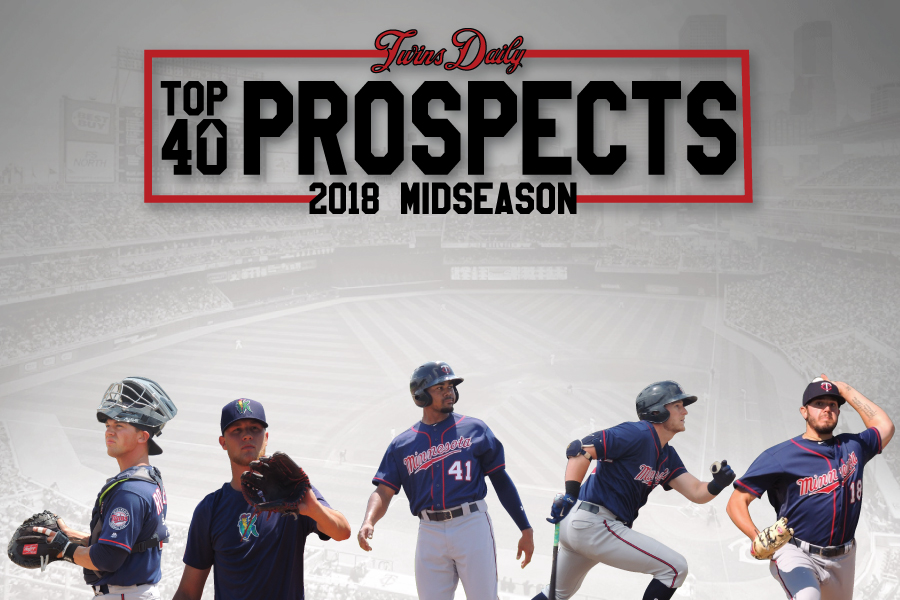 15. Ben Rortvedt – C Age: 20 ETA: 2021 2018 Stats (A-/A+): .274/.329/.387 (.716 OPS), 11 2B, 2 3B, 3 HR, 46 K, 16 BB 2018 Ranking: 16 | 2017 Ranking: 19 Seth: 21 | Tom: 10 | Cody: 15 When the Twins took Ben Rortvedt 56th overall in 2016, he became their highest-selected catcher since No. 1 pick Joe Mauer in '01. Having kept a close eye on the Verona, WI, kid as he excelled in high school just hours away, Minnesota was clearly sold on his defensive chops. He had all the tools and a tremendous rep behind the plate. "The kid was born to catch," said Twins scouting director Deron Johnson after the draft. This in and of itself makes him an asset, but a quality bat is a differentiator for such player profiles. And while Rortvedt's receiving skills and powerful arm were quickly on display once he signed and reported to rookie ball, his offensive game lagged behind. In 113 plate appearances between the Gulf Coast and Appy leagues, the small-framed teenager batted .222 and slugged .253. His struggles carried over into the 2017 season, which saw Rortvedt slashing .139/.214/.174 in Cedar Rapids at the end of May. But he put up a solid .721 OPS the rest of the way, and then produced similarly there over the first two months this year before a promotion to Fort Myers. In the pitcher-friendly Florida State League, he's sporting a handsome .269/.338/.388 line with two homers (half of his 2017 total) in 20 games. Rortvedt's upward ascent in our rankings – from 19th pre-2017 to 16th pre-2018 to 15 now – has reflected his progression at the dish. The compact and strong-armed backstop has a naturally high floor thanks to his defensive value, and if his bat keeps improving, his ceiling will follow suit. 14. Lewis Thorpe – LHP Age: 22 ETA: 2019 2018 Stats (AA): 82.2 IP, 4.03 ERA, 1.40 WHIP, 11.3 K/9, 2.6 BB/9, 4.33 K:BB 2018 Ranking: 12 | 2017 Ranking: NR Seth: 13 | Tom: 14 | Cody: 16 When he has been on the mound, Lewis Thorpe has dominated. That's been a consistent trend since he signed with the Twins as a 16-year-old out of Australia. Staying on that mound has been his issue. With 82 2/3 innings in the book this season, he's already one out away from his career high (83, last year). In 2017, the lefty was easing back into action after two full seasons lost to injury. But it speaks to his immense talent that, despite all the missed time, Thorpe still finds himself in Double-A at age 22. And he's wreaking havoc. Never mind the ho-hum ERA and WHIP – they are byproducts of an inflated .370 BABIP. What matters is this: Facing high-minors competition for the first time, with only 250 total pro innings under his belt, Thorpe has put up a phenomenal 104-to-24 K/BB ratio. He has posted a phenomenal 16% swinging strike rate (Jose Berrios, for comparison, had a 10% whiff rate in his first turn at Double-A – granted he was 20). The arsenal, a balanced four-pitch mix, is terrific. But it always has been. What Thorpe needs to do is stay healthy and stay on that mound. If he can do so all year while continuing to make batters miss, he'll absolutely be in our Top 10 come next spring. 13. Travis Blankenhorn – 3B Age: 21 ETA: 2020 2018 Stats (A+): .241/.302/.406 (.708 OPS), 16 2B, 3 3B, 8 HR, 82 K, 19 BB 2018 Ranking: 17 | 2017 Ranking: 9 Seth: 12 | Tom: 9 | Cody: 21 Sometimes power takes a while to develop in young hitters. There's no better testament to this than Brian Dozier, who hit 32 total home runs in college and the minor leagues before launching 164 (and counting) in the big leagues. It's possible that Travis Blankenhorn will be Dozier's successor somewhere down the line – he has played a fair amount of second base since joining the organization as a third-round pick in 2015 – but the 21-year-old profiles better as a third baseman. Coming out of high school, he was the prototype for a slugging corner infielder. Blankenhorn was already big when drafted at 6'1" and 195 lbs. He has since grown a little taller and a little burlier. But the power hasn't quite manifested. Through 308 pro games he has 34 home runs and a .429 slugging percentage, including eight and .406 this year at Fort Myers. His innate strength is plain enough to see – he participated in the Florida State League Home Run Derby a month ago, and won. It's just not flashing consistently enough in games, leading to mediocre production in the FSL. But that power? It's in there, and Blankenhorn is on track to set new career highs in both doubles and home runs. He's still awaiting his true breakthrough but the Pottsville, PA, native has a slugger's frame, keeps the strikeouts in check, and plays quality defense at multiple infield spots. 12. LaMonte Wade – OF Age: 24 ETA: 2018 2018 Stats (AA/AAA): .286/.397/.448 (.845 OPS), 6 2B, 3 3B, 10 HR, 36 K, 45 BB 2018 Ranking: 14 | 2017 Ranking: 15 Seth: 9 | Tom: 15 | Cody: 14 LaMonte Wade has never been a great hitter, in terms of being able to swing the bat and drive the ball with consistency. But he has always, ever since joining the Twins organization in 2015, been a daunting adversary for opposing pitchers, and one of the toughest outs in pro baseball. During his career at the University of Maryland, Wade walked more than he struck out. But his lack of standout speed or power – he hit seven home runs and stole 25 bases in three collegiate seasons – suppressed his stock and caused him to slip to the ninth round, where Minnesota selected him in 2015. The plate discipline that punched his ticket has translated to the pros, and then some. Thanks to his elite skill for laying off non-strikes and coaxing walks, Wade has a .403 OBP and 187-to-222 K/BB ratio in 346 minor-league games. He has never finished at any level with an OBP below .386. Wade impressed the Twins with his approach during spring training, opened the season in Chattanooga, and is now in Rochester doing his usual thing (.261/.404/.455 in 27 games). I'd be surprised if he doesn't get a look as a September call-up, if not before. He'll probably never hit for much power, and he should be relegated to the outfield corners, but Wade can play a valuable role in the majors thanks to a Mauer-esque understanding of the strike zone. 11. Blayne Enlow – RHP Age: 19 ETA: 2022 2018 Stats (A): 50.2 IP, 3.73 ERA, 1.58 WHIP, 6.6 K/9, 4.1 BB/9, 1.61 K/BB 2018 Ranking: 8 | 2017 Ranking: NR Seth: 10 | Tom: 13 | Cody: 13 Coming in under-slot with two of their top three 2017 draft picks (Royce Lewis and Landon Leach) enabled the Twins to go nearly three times over-slot for No. 76 overall pick Blayne Enlow, who turned down a scholarship from Louisiana State to sign for $2 million. Enlow's curveball, vaunted as the best in the country among preps, was unleashed to devastating effect after he signed, leading to eye-popping rookie ball stats and a spot among Twins Daily's Top 10 this spring. Now, after a bit of a tumultuous first half in 2018, he finds himself just on the outside. Impressed with his phenomenal debut, the Twins aggressively pushed Enlow straight to Low-A this year, even though he turned 19 in March. Only three qualified starters in the Midwest League are under 20. Enlow is younger than any of them, but he's not in the "qualified" category, since he's been limited to 12 appearances (10 starts) and 50 2/3 innings by a pair of injuries – first to his back, then his ankle. No, his numbers with the Kernels haven't been great when healthy. But the Twins have been very cautious with his pitch counts (he hasn't thrown 90 pitches in a game, and has only gone over 75 twice in his past 10 outings). He's facing almost exclusively older and more experienced competition. That's not the kind of combo that lends itself to sparkly numbers. That Enlow is even holding his own under these circumstances is commendable. If he gets on a roll in the second half, he'll skyrocket in the ranks. The talent is absolutely there. PREVIOUS INSTALLMENTS: 2018 Twins Midseason Top Prospects: 36-40 2018 Twins Midseason Top Prospects: 31-35 2018 Twins Midseason Top Prospects: 26-30 2018 Twins Midseason Top Prospects: 21-25 2018 Twins Midseason Top Prospects: 16-20
 -
I was hoping I'd enjoy reading the comments on this one and I really have thus far. Thanks to all for the thoughtful input. Keep it coming!
-
Ah, good thing Castro is two inches shorter and thus very much assured to have no issues returning from a full meniscus repair — in a knee where he's already had meniscus damage and a torn ACL — at age 31. Of course, the elephant in the room here is that Castro wasn't especially good before going down. His upside at this point is average part-time catcher who will be on his way after 2019.
-
Yes, this. The Twins haven't won 90 games in eight years. This is the window of contention they've been building toward. I'm just tired of continually pushing back the goal posts and hoping the next wave of prospects will be the ones to push them through. This system has as much depth as it has at any time I can remember. The Twins won't be gutting their future chances by dealing away a couple of top-end pieces. Players like Realmuto are VERY rarely available on the trade market. It's a situation to take advantage of, IMO.
-
Yes, we all know how smoothly Joe Mauer returned from that "minor" arthroscopic knee surgery in 2010. It's odd to me that you're defending this stance so vigorously based on the fact that you, a non-MLB catcher, have had knee surgeries in the past. Respectfully, I don't really think that makes you an expert, and the idea that an injury described by the team's own website as "much more serious than expected," requiring a surgery that cost him the rest of the season in early May, isn't major is kinda silly. Repeating your argument again and again without evidence or factual support isn't convincing.
-
Perhaps. The Nationals have a pretty desperate need and apparently won’t take that step. As time passes Miami’s leverage shrinks. Are they really gonna get a better package offered than Kirilloff + Romero?
-
As the trade deadline approaches, there's a rightful focus on 'sell' moves the Minnesota Twins should be pursuing. But I would submit there's another, very different sort of swap that Minnesota should be plotting toward. By finding a way to acquire star catcher J.T. Realmuto from Miami, the Twins would be addressing their greatest organizational weakness with authority, while also reinforcing the expectation of a short-term return to contention. Trading for Realmuto wouldn't be so much a buy move for the second half as a buy move for 2019, 2020, and beyond. The reason to do it now is that if they don't, the Twins might miss their chance.This season, the Twins have gotten a lowly .581 OPS from the catcher position, ranking as one of the worst in the majors. But worse even are the Washington Nationals, who have openly tried to upgrade behind the plate. They made a big push for Realmuto during the offseason as Miami held its firesale, but ultimately came up short. Washington's continuing interest in the 27-year-old, who has improved every year in the majors and currently sports a .317/.368/.551 slash line for the Marlins, is well known. But during a late-June radio interview, Nats GM Mike Rizzo was candid in his stance. “They’ve got a great player in Realmuto,” said Rizzo. “They’re not going to sell him cheap. We know what the return has to be on Realmuto, and we’re not willing to meet that price." According to offseason reports and rumors, the Marlins refused to make a deal that didn't include at least one of Victor Robles or Juan Soto. To put that in some context, Robles and Soto ranked No. 1 and No. 2 on Baseball America's list of top Nationals prospects, compiled last November, and the two outfielders placed No. 7 and No. 56 on BA's 2018 preseason list. Soto is now already up in the majors and raking at age 19. So, clearly the Marlins aren't going to settle for anything less than at least one premier, top-end prospect at the front of a Realmuto package. This means that for Minnesota, the conversation would need to start with Royce Lewis, currently 10th in BA's live rankings, or Alex Kirilloff, whose monster season in A-ball has rocketed him up to No. 35. From my view, Lewis is off the table. You just don't trade a player like him away. But pretty much anyone else in the organization should be fair game, including Kirilloff. Could the Twins build a package around the young slugger that gets it done? Should they? Hypothesizing a Prospect Package for Realmuto One can envision Kirilloff striking Miami's fancy as the headliner in an offer for Realmuto – a worthy fallback after they failed to land Robles or Soto. The Marlins system is short on impact bats and Kirilloff has quickly established himself as one of the best in the minors. His sweet left-handed swing draws comparisons to Christian Yelich, who himself enjoyed five stellar seasons with the Fish before being shipped out during the aforementioned offseason firesale. Mired in last place, the Marlins don't really have any hopes of returning to contention within the next couple of seasons, and Realmuto is due for free agency after 2020. Around that same time, Kirilloff figures to be breaking into the big leagues, so the logic behind such a swap from their perspective is easy enough to see. From Minnesota's end, losing Kirilloff would obviously hurt. He's a key piece in their system, especially as offensive production has taken a lackluster turn for the big-league club. But Realmuto's impact in that regard would be enormous, with his polished catching skills and middle-of-the-order bat turning a crucial position from major liability to resounding strength. And, for whatever it's worth, the Twins might have just found themselves another Kirilloff. First-round draft pick Trevor Larnach, who signed last week after starring for Oregon State in the College World Series, has a very similar profile: lefty-swinging, power-hitting corner outfielder, and he'll slot in at just about the same stage of development. It is of course unlikely he'll reach the same level of esteem as Kirilloff, but the Twins at least wouldn't be opening a huge void. So, what else needs to be added alongside Kirilloff to make this happen? I suspect Miami would command another prospect in Minnesota's top tier – perhaps a Nick Gordon or Stephen Gonsalves. Personally I would be reluctantly willing to part with either. But even that might not get it done. Emerging flamethrower Brusdar Graterol, or the more advanced and MLB-ready Fernando Romero, are names that really could get their attention, and while giving either up in addition to Kirilloff would be excruciatingly painful, I think I do it if it gets me two years of Realmuto with a chance to nail down a longer deal. And I might add another prospect from the Twins' Top 10 or 15, too. "The only way to be sustainable over time is to build up the minor league system. That is our focus," said Marlins CEO Derek Jeter during a town hall meeting with fans in December. "I don't expect you to be happy." Dealing Realmuto for a package of prospects headlined by Kirilloff and, say, Graterol might not make Miami fans happy, but it would certainly align within the teardown strategy Jeter was defending. The franchise would add at least two heralded talents with enormous upside while shaving around $6 million off the 2019 payroll. I'll admit, the timing would be a little weird. Why Now? It's not often you see an avowed seller go and flip multiple top prospects for a 27-year-old All-Star at the trade deadline. In fact, I'm not sure it has ever happened. But now is a time for creative, outside-the-box thinking. The Twins – maintaining a focus on short-term contention – aren't your typical deadline seller. Realmuto – tied for second in the National League in WAR and under affordable team control for multiple years – isn't your typical deadline target. As mentioned earlier, one aspect of the rationale here is beating others to the punch. Realmuto is a highly coveted asset and the Marlins are sure to have numerous callers this month. One can argue that it's more logical for Minnesota to wait until the offseason before engaging in these discussions, escaping the leverage dynamics inherent to the deadline, but that isn't necessarily a luxury they can afford. There are also some concrete benefits to pulling the trigger now. Realmuto would have the final two months to acclimate and gain familiarity with the Twins pitching staff, which figures to largely carry over in 2019. There's real value in that for a catcher. And also, Realmuto is just a hell of a player. You could hardly make a more impactful addition at the trade deadline. To whatever extent the Twins remain attached to their nearly invisible postseason hopes, he'd be a huge boost. At the very least, it sends a good message to players and fans: Things haven't gone to plan, but we're still serious about winning, and now. This kind of move would allow them to pursue that goal vigorously while lessening their reliance on Byron Buxton and Miguel Sano to lead the charge. It'd be a major shakeup and strategic pivot for the front office, but I believe such measures are warranted given this current state of affairs. What do you think? What would it take to pry Realmuto from the Marlins, and would you be willing to do it? Click here to view the article
-
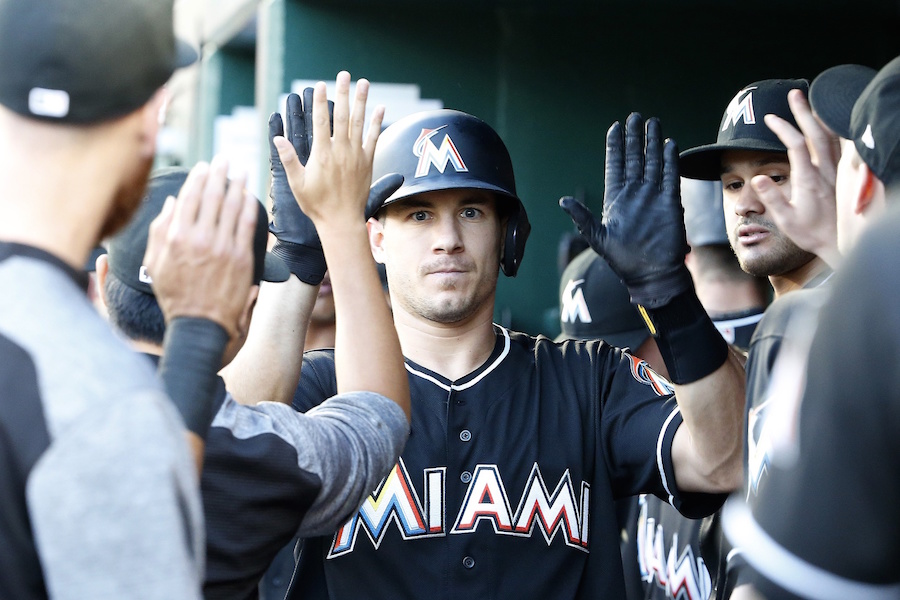 This season, the Twins have gotten a lowly .581 OPS from the catcher position, ranking as one of the worst in the majors. But worse even are the Washington Nationals, who have openly tried to upgrade behind the plate. They made a big push for Realmuto during the offseason as Miami held its firesale, but ultimately came up short. Washington's continuing interest in the 27-year-old, who has improved every year in the majors and currently sports a .317/.368/.551 slash line for the Marlins, is well known. But during a late-June radio interview, Nats GM Mike Rizzo was candid in his stance. “They’ve got a great player in Realmuto,” said Rizzo. “They’re not going to sell him cheap. We know what the return has to be on Realmuto, and we’re not willing to meet that price." According to offseason reports and rumors, the Marlins refused to make a deal that didn't include at least one of Victor Robles or Juan Soto. To put that in some context, Robles and Soto ranked No. 1 and No. 2 on Baseball America's list of top Nationals prospects, compiled last November, and the two outfielders placed No. 7 and No. 56 on BA's 2018 preseason list. Soto is now already up in the majors and raking at age 19. So, clearly the Marlins aren't going to settle for anything less than at least one premier, top-end prospect at the front of a Realmuto package. This means that for Minnesota, the conversation would need to start with Royce Lewis, currently 10th in BA's live rankings, or Alex Kirilloff, whose monster season in A-ball has rocketed him up to No. 35. From my view, Lewis is off the table. You just don't trade a player like him away. But pretty much anyone else in the organization should be fair game, including Kirilloff. Could the Twins build a package around the young slugger that gets it done? Should they? Hypothesizing a Prospect Package for Realmuto One can envision Kirilloff striking Miami's fancy as the headliner in an offer for Realmuto – a worthy fallback after they failed to land Robles or Soto. The Marlins system is short on impact bats and Kirilloff has quickly established himself as one of the best in the minors. His sweet left-handed swing draws comparisons to Christian Yelich, who himself enjoyed five stellar seasons with the Fish before being shipped out during the aforementioned offseason firesale. Mired in last place, the Marlins don't really have any hopes of returning to contention within the next couple of seasons, and Realmuto is due for free agency after 2020. Around that same time, Kirilloff figures to be breaking into the big leagues, so the logic behind such a swap from their perspective is easy enough to see. From Minnesota's end, losing Kirilloff would obviously hurt. He's a key piece in their system, especially as offensive production has taken a lackluster turn for the big-league club. But Realmuto's impact in that regard would be enormous, with his polished catching skills and middle-of-the-order bat turning a crucial position from major liability to resounding strength. And, for whatever it's worth, the Twins might have just found themselves another Kirilloff. First-round draft pick Trevor Larnach, who signed last week after starring for Oregon State in the College World Series, has a very similar profile: lefty-swinging, power-hitting corner outfielder, and he'll slot in at just about the same stage of development. It is of course unlikely he'll reach the same level of esteem as Kirilloff, but the Twins at least wouldn't be opening a huge void. So, what else needs to be added alongside Kirilloff to make this happen? I suspect Miami would command another prospect in Minnesota's top tier – perhaps a Nick Gordon or Stephen Gonsalves. Personally I would be reluctantly willing to part with either. But even that might not get it done. Emerging flamethrower Brusdar Graterol, or the more advanced and MLB-ready Fernando Romero, are names that really could get their attention, and while giving either up in addition to Kirilloff would be excruciatingly painful, I think I do it if it gets me two years of Realmuto with a chance to nail down a longer deal. And I might add another prospect from the Twins' Top 10 or 15, too. "The only way to be sustainable over time is to build up the minor league system. That is our focus," said Marlins CEO Derek Jeter during a town hall meeting with fans in December. "I don't expect you to be happy." Dealing Realmuto for a package of prospects headlined by Kirilloff and, say, Graterol might not make Miami fans happy, but it would certainly align within the teardown strategy Jeter was defending. The franchise would add at least two heralded talents with enormous upside while shaving around $6 million off the 2019 payroll. I'll admit, the timing would be a little weird. Why Now? It's not often you see an avowed seller go and flip multiple top prospects for a 27-year-old All-Star at the trade deadline. In fact, I'm not sure it has ever happened. But now is a time for creative, outside-the-box thinking. The Twins – maintaining a focus on short-term contention – aren't your typical deadline seller. Realmuto – tied for second in the National League in WAR and under affordable team control for multiple years – isn't your typical deadline target. As mentioned earlier, one aspect of the rationale here is beating others to the punch. Realmuto is a highly coveted asset and the Marlins are sure to have numerous callers this month. One can argue that it's more logical for Minnesota to wait until the offseason before engaging in these discussions, escaping the leverage dynamics inherent to the deadline, but that isn't necessarily a luxury they can afford. There are also some concrete benefits to pulling the trigger now. Realmuto would have the final two months to acclimate and gain familiarity with the Twins pitching staff, which figures to largely carry over in 2019. There's real value in that for a catcher. And also, Realmuto is just a hell of a player. You could hardly make a more impactful addition at the trade deadline. To whatever extent the Twins remain attached to their nearly invisible postseason hopes, he'd be a huge boost. At the very least, it sends a good message to players and fans: Things haven't gone to plan, but we're still serious about winning, and now. This kind of move would allow them to pursue that goal vigorously while lessening their reliance on Byron Buxton and Miguel Sano to lead the charge. It'd be a major shakeup and strategic pivot for the front office, but I believe such measures are warranted given this current state of affairs. What do you think? What would it take to pry Realmuto from the Marlins, and would you be willing to do it?
 -
Article: Week in Review: Home Sweet Home
Nick Nelson replied to Nick Nelson's topic in Twins Daily Front Page News
I respect all of those things. That doesn't mean the franchise should be at the mercy of his whims. I'm not one of Mauer's "critics." It's plain to see he's not a good player right now. Guts and desire are admirable but don't win ballgames – hits and runs do.- 19 replies
-
- 7
-
-
- jake cave
- brian dozier
- (and 2 more)
-
A home series against the worst team in baseball was all the Minnesota Twins needed to get back on track and restore some confidence following a devastating road trip. Keep reading for the full rundown on a week that started hideously in Milwaukee and ended beautifully in Minneapolis. Weekly Snapshot: Mon, 7/2 through Sun, 7/8 *** Record Last Week: 4-3 (Overall: 39-48) Run Differential Last Week: +13 (Overall: -21) Standing: 2nd Place in AL Central (9.5 GB) When previewing the upcoming slate in last week's edition of this column, I noted that the "four-game home set against Baltimore in the latter portion would look like a huge opportunity if the Twins hadn't already essentially buried themselves. That Orioles team is really, really bad." True to form, Baltimore came to town and played terribly, dropping all four games to push its MLB-leading loss total to 65. After being swept out of Target Field, the O's find themselves on pace for a 44-118 finish. A good reminder that it could be worse. But things still aren't anywhere near good for the Twins, whose first sweep of the year came on the heels of a gut-wrenching 1-8 road trip that torpedoed their remaining hopes of vaulting into contention. As we head into a new week, the Twins find themselves nine games below .500 and 9 1/2 out in the division despite their modest four-game winning streak. HIGHLIGHTS When a season goes south as this one has, one silver lining is the opportunity to extensively evaluate some potentially useful pieces going forward. One of the most interesting names in this category at present is Jake Cave, who's been enjoying regular playing time with Byron Buxton demoted and Ryan LaMarre designated for assignment. Cave has been taking advantage in a big way. The numbers have been solid – he went 6-for-21 with a pair of doubles this week and has a .785 OPS overall through 20 big-league games – but more noticeable is the energy and hustle. He runs hard on the bases, risked injury with a gutsy headfirst slide into home on Saturday, and has already made several highlight-reel plays in the outfield, including a home run robbery Friday night that earned him some noteworthy praise: When acquired, Cave was described (even by Derek Falvey) as a somewhat fringy center fielder better suited for the corners, but he looked awfully capable making six straight starts in the middle this past week. We'll see where things go from here, but right now Cave is building his case to be part of the 2019 picture. One theoretical outfield mix would have the Twins carrying four lefty-swinging outfielders (Cave, Eddie Rosario, Max Kepler, LaMonte Wade) on the active roster next year. We might even see that combination in place this September. Speaking of Kepler, he also put forth a strong effort over the past seven days, going 8-for-25 with a pair of home runs while starting all seven games. During Minnesota's nightmarish road trip Kepler had produced zero extra-base hits and one RBI in 34 plate appearances, so it was good to see him hit some balls hard and drive in four during the Baltimore series. Returning to the fold after his 80-game PED suspension to open the season, Jorge Polanco had an assuring first week of action. Starting every game at shortstop, the 25-year-old went 7-for-26 with a pair of doubles and two walks. He's looked sharp on defense, and ended Saturday's game with an excellent backhand play in the hole. On the pitching side there were some impressive performances as well. Aaron Slegers made his first start of the season for the Twins on Thursday and he was money, tossing six very efficient innings with one run, one walk and three hits allowed to pick up his first MLB win. Because his stuff and strikeouts have never matched up with his intimidating frame, the 6-foot-10 righty has never been viewed as a high-end prospect, but the consistent results are hard to ignore. In his tidy victory over Baltimore, Slegers showed why a manager likes to have him around – he worked quickly, pounded the strike zone, and kept his fielders busy while limiting hard contact. Adalberto Mejia, sent back to the minors after getting one chance to start in unbearable heat, certainly deserves another look. So does Fernando Romero, who has put up a 1.45 ERA in three starts at Rochester since an arguably unearned demotion. But Slegers, much like Cave, is one of those borderline players the Twins should be using this second half to assess. It's gonna be tough to find room for holding all these auditions in the rotation unless Minnesota can open up some vacancies, which is why the trade deadline will be key. One candidate to be dealt further bolstered his stock over the weekend. Kyle Gibson shook off a rocky first frame to get through seven innings of three-run ball with nine strikeouts. He set a new career-high by inducing 20 swinging strikes, second-most for a Twins starter all season (Lance Lynn tallied 21 at Detroit in mid-June). Granted, the sterling effort came against a truly lousy Orioles squad, but it was another reminder of Gibby's vastly improved arsenal. There were reportedly scouts on hand to watch the right-hander's previous outing, and if any were in the house at Target Field on Saturday they undoubtedly came away impressed. My stance is that the Twins shouldn't move Gibson unless they're blown away by an offer. But that's not an implausible scenario. Another strong week worth mentioning: Trevor Hildenberger bounced back from his weird implosion at Wrigley Field with three scoreless appearances, striking out five while allowing one hit and two walks. That's more like it. And finally, in the Baby Steps Department: At Triple A, Buxton collected seven hits, including a two doubles and a homer, while scoring seven times and keeping his K-rate below 25%. At Single A, Miguel Sano went 7-for-21 and is sporting a .340 average. LOWLIGHTS Before his monster sixth inning on Sunday, in which he hit both a leadoff double and a subsequent three-run homer, Brian Dozier was 4-for-24 (.167) with nine strikeouts and zero walks on the week. Like much of the second baseman's scant production this year, his big blast – a signature upper-decker yanked to straightaway left – didn't exactly come at a pivotal time, as it extended the team's lopsided lead from seven runs to 10. This trend has led Dozier to a -1.67 Win Probability Added, worst on the team by far, and magnifies the disappointing nature of his performance this season. According to Baseball Reference, the 31-year-old is hitting .123/.206/.193 in "Close and Late" situations, compounding a conspicuous career-long weakness (Dozier's lifetime OPS in such spots is nearly 200 points lower than his overall mark). None of this will do much to prop up his value in the eyes of shopping contenders as the deadline approaches. The only longer-tenured Twin, Joe Mauer, also had a quiet week, picking up five hits in 24 at-bats (.208) with one RBI and one walk. Mauer's keen eye has disappeared since his return from the disabled list. He's coaxed only two free passes in 79 plate appearances (2.5%) after drawing 28 in 167 PA (16.8%) before stirring up concussion symptoms in May. As a result, his OBP has gone from .404 before the injury to .253 since. When answering a fan's question about whether Mauer might return on a one-year deal in 2019, Star Tribune beat reporter La Velle E. Neal III responded, "He wants to play next year, so yes." If it's a true reflection of the organization's mindset, it's annoying. With all due respect, Mauer's desires and preferences should not be dictating the team's plans. He is a leadoff man who, over the past month, hasn't been able to get on base. A first baseman who can't hit for power (subtracting those weird two games at Wrigley Field at the end of June, Mauer has slugged .266 in 18 games since coming off the DL). A lineup staple and ostensible team leader with a 0.3 WAR through half the season. Maybe this is just a short-term slump, and Mauer will soon get back to the level he was at before. But given his history of prolonged droughts following concussion issues, it's not easy to feel confident in that. TRENDING STORYLINE Bobby Wilson badly needed a game like the one he had on Saturday. The "backup" catcher was sporting an unsightly .114/.191/.203 slash line before breaking out with two hits and three RBIs in the victory. Obviously his overall numbers still aren't pretty, and it's fairly clear Wilson doesn't belong in the majors, much less starting on a semi-regular basis. I put the word "backup" in quotes above because Wilson really hasn't functioned as one – more of a straight-up timeshare partner. Since the start of June, Mitch Garver has made 18 starts behind the plate to Wilson's 17, and the two have been pretty close in total plate appearances (72 for Garver versus 56 for Wilson, despite the former out-hitting the latter by 500+ points of OPS during that span). In recent weeks, the catching workload has actually swung very much in Wilson's favor, as he's made 10 starts behind the plate to Garver's seven over the past 17 contests. That Paul Molitor has shifted the balance this way, despite a massive offensive chasm, speaks to a pretty evident lack of faith in Garver's receiving skills. While that's understandable enough given his relative lack of MLB experience, the Twins can't exactly afford to exhibit endless patience with Garver, who turns 28 in January. If he's this far away now from where he needs to be, is he going to get there? How's it gonna happen when he's not getting regular reps? And even if they are unenthused with his defense, why aren't the Twins finding Garver more starts at DH or first? Why was he batting ninth on Friday despite a .333/.393/.451 line over his previous 20 games, and eighth on Sunday after chipping in two hits and a walk on Friday? The handling of Garver has been odd, and the present state of the catcher position is unacceptable. One would think something's gotta give. DOWN ON THE FARM It's been a little bit of a weird season for Lewis Thorpe. The lefty, who returned successfully to Single-A last season after losing two full years to injury and illness, has now taken the step up to Double A where he has dominated... kinda. The core numbers don't reflect it. Through 82 2/3 innings Thorpe has a 4.04 ERA and 1.40 WHIP, which are hardly eye-popping numbers for a 22-year-old in the Southern League. But he has also posted a stellar 104-to-24 K/BB ratio. His stuff has by all accounts been excellent, and at times that has clearly manifested, like on June 21st when he struck out 12 over seven shutout innings while allowing one hit and one walk. But then he has weird games, like his dud in early June where he coughed up nine runs on nine hits over 3 1/3 innings, even though he induced 16 whiffs on 85 pitches. There was another start in April where he yielded 10 hits over 4 2/3 despite striking out seven, walking none, and again drawing 16 swings and misses. Thorpe has struck out hitters in droves while showing good control, but he's been haunted by a .370 BABIP and elevated pitch counts. Luckily, the folks assembling the Futures Game rosters looked past this and handed the Melbourne native a spot on the World team. He'll likely take the mound at some point next Sunday in DC during the prospect showcase. Maybe he'll even get a chance to face Alex Kirilloff, who will represent the Twins on the U.S. team. The most impressive week on the farm belonged to Brent Rooker, who collected multiple hits in five of seven games and doubled in the winning run for Chattanooga on Saturday. Sporting a 1.047 OPS since the start of June, the 2017 draftee is a compelling candidate to spend time in Rochester or even Minnesota later this season. LOOKING AHEAD If they want to keep this winning streak going, the Twins could hardly ask for a better slate in the final week before the All-Star break. The Royals, closely trailing Baltimore for most losses in the majors at 64, arrive on Monday for a three-game series. Then it's a four-game set versus the mediocre Rays. If the Twins were able to go, say, 6-1 in the coming week while cutting into Cleveland's sizable division lead, one wonders if the front office's deadline calculus would change at all. MONDAY, 7/9: ROYAL @ TWINS – LHP Danny Duffy v. RHP Jose Berrios TUESDAY, 7/10: ROYALS @ TWINS – RHP Ian Kennedy v. RHP Aaron Slegers WEDNESDAY, 7/11: ROYALS @ TWINS – RHP Jason Hammel v. RHP Lance Lynn THURSDAY, 7/12: RAYS @ TWINS – LHP Blake Snell v. RHP Kyle Gibson FRIDAY, 7/13: RAYS @ TWINS – RHP Nathan Eovaldi v. RHP Jake Odorizzi SATURDAY, 7/14: RAYS @ TWINS – RHP Chris Archer v. RHP Jose Berrios SUNDAY, 7/15: RAYS @ TWINS – RHP Matt Andriese v. RHP Aaron Slegers Catch Up On Twins Daily Game Recaps Game 81 | MIL 6, MIN 5: Oh, That Rodney ExperienceGame 82 | MIL 2, MIN 0: Strikeouts GaloreGame 83 | MIL 3, MIN 2: Pushing Against a StoneGame 84 | MIN 5, BAL 2: Slegers, Cave Lift Twins Out of SlumpGame 85 | MIN 6, BAL 2: Jake Cave Is the Hero We DeserveGame 86 | MIN 5, BAL 4: More Baltimore, PleaseGame 87 | MIN 10, BAL 1: Twins Pick Up First Sweep of 2018 Click here to view the article
- 19 replies
-
- 1
-
-
- jake cave
- brian dozier
- (and 2 more)
-
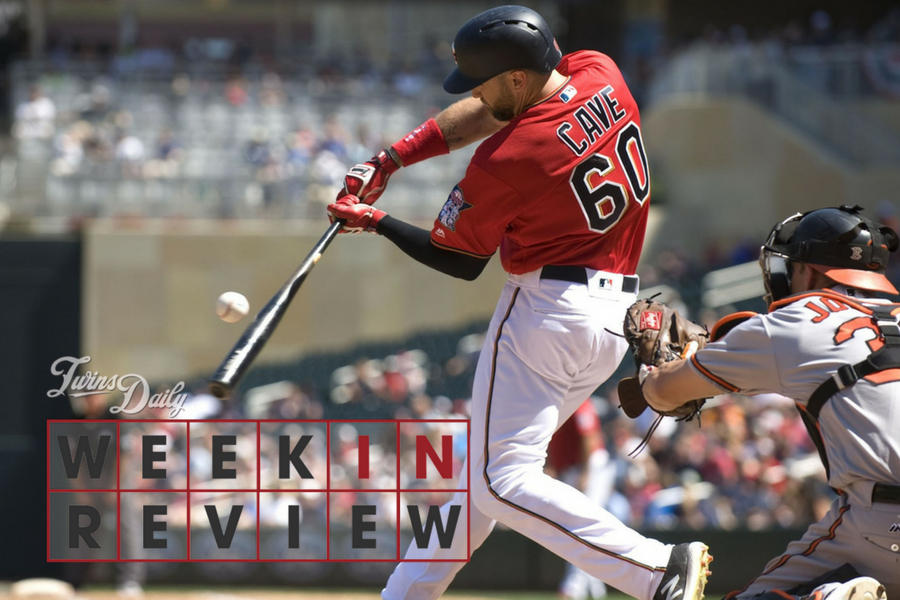 Weekly Snapshot: Mon, 7/2 through Sun, 7/8 *** Record Last Week: 4-3 (Overall: 39-48) Run Differential Last Week: +13 (Overall: -21) Standing: 2nd Place in AL Central (9.5 GB) When previewing the upcoming slate in last week's edition of this column, I noted that the "four-game home set against Baltimore in the latter portion would look like a huge opportunity if the Twins hadn't already essentially buried themselves. That Orioles team is really, really bad." True to form, Baltimore came to town and played terribly, dropping all four games to push its MLB-leading loss total to 65. After being swept out of Target Field, the O's find themselves on pace for a 44-118 finish. A good reminder that it could be worse. But things still aren't anywhere near good for the Twins, whose first sweep of the year came on the heels of a gut-wrenching 1-8 road trip that torpedoed their remaining hopes of vaulting into contention. As we head into a new week, the Twins find themselves nine games below .500 and 9 1/2 out in the division despite their modest four-game winning streak. HIGHLIGHTS When a season goes south as this one has, one silver lining is the opportunity to extensively evaluate some potentially useful pieces going forward. One of the most interesting names in this category at present is Jake Cave, who's been enjoying regular playing time with Byron Buxton demoted and Ryan LaMarre designated for assignment. Cave has been taking advantage in a big way. The numbers have been solid – he went 6-for-21 with a pair of doubles this week and has a .785 OPS overall through 20 big-league games – but more noticeable is the energy and hustle. He runs hard on the bases, risked injury with a gutsy headfirst slide into home on Saturday, and has already made several highlight-reel plays in the outfield, including a home run robbery Friday night that earned him some noteworthy praise: https://twitter.com/toriihunter48/status/1015432081936146432 When acquired, Cave was described (even by Derek Falvey) as a somewhat fringy center fielder better suited for the corners, but he looked awfully capable making six straight starts in the middle this past week. We'll see where things go from here, but right now Cave is building his case to be part of the 2019 picture. One theoretical outfield mix would have the Twins carrying four lefty-swinging outfielders (Cave, Eddie Rosario, Max Kepler, LaMonte Wade) on the active roster next year. We might even see that combination in place this September. Speaking of Kepler, he also put forth a strong effort over the past seven days, going 8-for-25 with a pair of home runs while starting all seven games. During Minnesota's nightmarish road trip Kepler had produced zero extra-base hits and one RBI in 34 plate appearances, so it was good to see him hit some balls hard and drive in four during the Baltimore series. Returning to the fold after his 80-game PED suspension to open the season, Jorge Polanco had an assuring first week of action. Starting every game at shortstop, the 25-year-old went 7-for-26 with a pair of doubles and two walks. He's looked sharp on defense, and ended Saturday's game with an excellent backhand play in the hole. On the pitching side there were some impressive performances as well. Aaron Slegers made his first start of the season for the Twins on Thursday and he was money, tossing six very efficient innings with one run, one walk and three hits allowed to pick up his first MLB win. Because his stuff and strikeouts have never matched up with his intimidating frame, the 6-foot-10 righty has never been viewed as a high-end prospect, but the consistent results are hard to ignore. In his tidy victory over Baltimore, Slegers showed why a manager likes to have him around – he worked quickly, pounded the strike zone, and kept his fielders busy while limiting hard contact. Adalberto Mejia, sent back to the minors after getting one chance to start in unbearable heat, certainly deserves another look. So does Fernando Romero, who has put up a 1.45 ERA in three starts at Rochester since an arguably unearned demotion. But Slegers, much like Cave, is one of those borderline players the Twins should be using this second half to assess. It's gonna be tough to find room for holding all these auditions in the rotation unless Minnesota can open up some vacancies, which is why the trade deadline will be key. One candidate to be dealt further bolstered his stock over the weekend. Kyle Gibson shook off a rocky first frame to get through seven innings of three-run ball with nine strikeouts. He set a new career-high by inducing 20 swinging strikes, second-most for a Twins starter all season (Lance Lynn tallied 21 at Detroit in mid-June). Granted, the sterling effort came against a truly lousy Orioles squad, but it was another reminder of Gibby's vastly improved arsenal. There were reportedly scouts on hand to watch the right-hander's previous outing, and if any were in the house at Target Field on Saturday they undoubtedly came away impressed. My stance is that the Twins shouldn't move Gibson unless they're blown away by an offer. But that's not an implausible scenario. Another strong week worth mentioning: Trevor Hildenberger bounced back from his weird implosion at Wrigley Field with three scoreless appearances, striking out five while allowing one hit and two walks. That's more like it. And finally, in the Baby Steps Department: At Triple A, Buxton collected seven hits, including a two doubles and a homer, while scoring seven times and keeping his K-rate below 25%. At Single A, Miguel Sano went 7-for-21 and is sporting a .340 average. LOWLIGHTS Before his monster sixth inning on Sunday, in which he hit both a leadoff double and a subsequent three-run homer, Brian Dozier was 4-for-24 (.167) with nine strikeouts and zero walks on the week. Like much of the second baseman's scant production this year, his big blast – a signature upper-decker yanked to straightaway left – didn't exactly come at a pivotal time, as it extended the team's lopsided lead from seven runs to 10. This trend has led Dozier to a -1.67 Win Probability Added, worst on the team by far, and magnifies the disappointing nature of his performance this season. According to Baseball Reference, the 31-year-old is hitting .123/.206/.193 in "Close and Late" situations, compounding a conspicuous career-long weakness (Dozier's lifetime OPS in such spots is nearly 200 points lower than his overall mark). None of this will do much to prop up his value in the eyes of shopping contenders as the deadline approaches. The only longer-tenured Twin, Joe Mauer, also had a quiet week, picking up five hits in 24 at-bats (.208) with one RBI and one walk. Mauer's keen eye has disappeared since his return from the disabled list. He's coaxed only two free passes in 79 plate appearances (2.5%) after drawing 28 in 167 PA (16.8%) before stirring up concussion symptoms in May. As a result, his OBP has gone from .404 before the injury to .253 since. When answering a fan's question about whether Mauer might return on a one-year deal in 2019, Star Tribune beat reporter La Velle E. Neal III responded, "He wants to play next year, so yes." If it's a true reflection of the organization's mindset, it's annoying. With all due respect, Mauer's desires and preferences should not be dictating the team's plans. He is a leadoff man who, over the past month, hasn't been able to get on base. A first baseman who can't hit for power (subtracting those weird two games at Wrigley Field at the end of June, Mauer has slugged .266 in 18 games since coming off the DL). A lineup staple and ostensible team leader with a 0.3 WAR through half the season. Maybe this is just a short-term slump, and Mauer will soon get back to the level he was at before. But given his history of prolonged droughts following concussion issues, it's not easy to feel confident in that. TRENDING STORYLINE Bobby Wilson badly needed a game like the one he had on Saturday. The "backup" catcher was sporting an unsightly .114/.191/.203 slash line before breaking out with two hits and three RBIs in the victory. Obviously his overall numbers still aren't pretty, and it's fairly clear Wilson doesn't belong in the majors, much less starting on a semi-regular basis. I put the word "backup" in quotes above because Wilson really hasn't functioned as one – more of a straight-up timeshare partner. Since the start of June, Mitch Garver has made 18 starts behind the plate to Wilson's 17, and the two have been pretty close in total plate appearances (72 for Garver versus 56 for Wilson, despite the former out-hitting the latter by 500+ points of OPS during that span). In recent weeks, the catching workload has actually swung very much in Wilson's favor, as he's made 10 starts behind the plate to Garver's seven over the past 17 contests. That Paul Molitor has shifted the balance this way, despite a massive offensive chasm, speaks to a pretty evident lack of faith in Garver's receiving skills. While that's understandable enough given his relative lack of MLB experience, the Twins can't exactly afford to exhibit endless patience with Garver, who turns 28 in January. If he's this far away now from where he needs to be, is he going to get there? How's it gonna happen when he's not getting regular reps? And even if they are unenthused with his defense, why aren't the Twins finding Garver more starts at DH or first? Why was he batting ninth on Friday despite a .333/.393/.451 line over his previous 20 games, and eighth on Sunday after chipping in two hits and a walk on Friday? The handling of Garver has been odd, and the present state of the catcher position is unacceptable. One would think something's gotta give. DOWN ON THE FARM It's been a little bit of a weird season for Lewis Thorpe. The lefty, who returned successfully to Single-A last season after losing two full years to injury and illness, has now taken the step up to Double A where he has dominated... kinda. The core numbers don't reflect it. Through 82 2/3 innings Thorpe has a 4.04 ERA and 1.40 WHIP, which are hardly eye-popping numbers for a 22-year-old in the Southern League. But he has also posted a stellar 104-to-24 K/BB ratio. His stuff has by all accounts been excellent, and at times that has clearly manifested, like on June 21st when he struck out 12 over seven shutout innings while allowing one hit and one walk. But then he has weird games, like his dud in early June where he coughed up nine runs on nine hits over 3 1/3 innings, even though he induced 16 whiffs on 85 pitches. There was another start in April where he yielded 10 hits over 4 2/3 despite striking out seven, walking none, and again drawing 16 swings and misses. Thorpe has struck out hitters in droves while showing good control, but he's been haunted by a .370 BABIP and elevated pitch counts. Luckily, the folks assembling the Futures Game rosters looked past this and handed the Melbourne native a spot on the World team. He'll likely take the mound at some point next Sunday in DC during the prospect showcase. Maybe he'll even get a chance to face Alex Kirilloff, who will represent the Twins on the U.S. team. The most impressive week on the farm belonged to Brent Rooker, who collected multiple hits in five of seven games and doubled in the winning run for Chattanooga on Saturday. Sporting a 1.047 OPS since the start of June, the 2017 draftee is a compelling candidate to spend time in Rochester or even Minnesota later this season. LOOKING AHEAD If they want to keep this winning streak going, the Twins could hardly ask for a better slate in the final week before the All-Star break. The Royals, closely trailing Baltimore for most losses in the majors at 64, arrive on Monday for a three-game series. Then it's a four-game set versus the mediocre Rays. If the Twins were able to go, say, 6-1 in the coming week while cutting into Cleveland's sizable division lead, one wonders if the front office's deadline calculus would change at all. MONDAY, 7/9: ROYAL @ TWINS – LHP Danny Duffy v. RHP Jose Berrios TUESDAY, 7/10: ROYALS @ TWINS – RHP Ian Kennedy v. RHP Aaron Slegers WEDNESDAY, 7/11: ROYALS @ TWINS – RHP Jason Hammel v. RHP Lance Lynn THURSDAY, 7/12: RAYS @ TWINS – LHP Blake Snell v. RHP Kyle Gibson FRIDAY, 7/13: RAYS @ TWINS – RHP Nathan Eovaldi v. RHP Jake Odorizzi SATURDAY, 7/14: RAYS @ TWINS – RHP Chris Archer v. RHP Jose Berrios SUNDAY, 7/15: RAYS @ TWINS – RHP Matt Andriese v. RHP Aaron Slegers Catch Up On Twins Daily Game Recaps Game 81 | MIL 6, MIN 5: Oh, That Rodney Experience Game 82 | MIL 2, MIN 0: Strikeouts Galore Game 83 | MIL 3, MIN 2: Pushing Against a Stone Game 84 | MIN 5, BAL 2: Slegers, Cave Lift Twins Out of Slump Game 85 | MIN 6, BAL 2: Jake Cave Is the Hero We Deserve Game 86 | MIN 5, BAL 4: More Baltimore, Please Game 87 | MIN 10, BAL 1: Twins Pick Up First Sweep of 2018
 -
Few expected this 2018 Minnesota Twins team would be putting up the 'For Sale' sign in early July, but here we are. With a nightmarish road trip pushing them hopelessly out of contention, the Twins now have no choice but to unload assets and make whatever upgrades they can to move forward. Let's take stock and assess what they've got.As is the nature of this miserable season, the Twins haven't seen trade candidates do much to build value, so the front office won't exactly be working from a position of great strength as the deadline approaches and buyers inquire. With that said, here's how I'd rank players on the "sell" board – not strictly in terms of what they'll bring back, but how eager I'd be to deal them all things considered. 1. Brian Dozier, 2B The hope was that, even if Minnesota slid out of contention during the first four months, Dozier would at least position himself as a coveted trade target. Imagine if he put up the same kind of numbers that earned him an All-Star nod in the first half of 2015: .849 OPS, 19 home runs, 67 runs scored. Coming off back-to-back campaigns that bordered on MVP-caliber, and entering a contract year, this sort of production seemed possible – if not probable – for the 31-year-old. Alas, much like everything else this year, it hasn't gone to plan. Dozier entered play on Thursday with a .220/.308/.394 slash line. That batting average would rank as the worst of his career, and he hasn't posted a lower OPS since his tumultuous rookie season in 2012. Despite the hugely disappointing output, Dozier will still be attractive as a trade candidate. His clubhouse presence is reputed throughout the league. He has a recent history of catching fire down the stretch. And he'll only be owed about $3 million over the final two months of the season. Those two months (plus postseason) are all that a theoretical trade partner will be getting, since Dozier becomes a free agent after the season, but he does have the potential to make a significant impact for a contender. So I do think it's possible he yields a reasonably decent haul, especially if he gets rolling a little here in July. The front office will take any salary relief it can get after the 2018 fizzled out with an all-time high payroll. One club to look out for on the Dozier front: Seattle. Yes, the Mariners will be getting Robinson Cano back from his suspension in mid-August, but he'll be coming off finger surgery and is ineligible for the playoffs. Projected Return: 2 to 3 solid mid-level prospects 2. Fernando Rodney, RP Out of all the moves Derek Falvey and Thad Levine made over the winter, signing Rodney may have drawn the most skepticism. He was, after all, a 41-year-old with a reputation for putting runners aboard and making things interesting. It was all too easy to see this acquisition backfiring. Instead, it's actually proven to be their savviest move. The grizzled vet has looked as strong as ever, pumping fastballs in the mid-90s, and his control has actually been considerably improved from recent years – Rodney's 3.5 BB/9 is lower than any mark he's finished with in that category since 2012, when he was an All-Star and Cy Young candidate. The righty holds a 3.18 ERA, 9.8 K/9 rate, and .626 opponents' OPS. He recently ended a streak of 15 straight converted saves. It's true that relief pitchers don't tend to bring back a ton in deadline trades, owing to the fact they'll only pitch a couple dozen innings thereafter, but Rodney has a couple of factors adding to his appeal: 1) He is as experienced a relief arm as you're going to find on the market, with 16 seasons and 317 saves (tied with Craig Kimbrel for most among active players) under his belt. 2) He's not just a rental, necessarily. His contract includes a team option for $4.25 million next year, so he can easily be brought back on the cheap. Whereas the market for Dozier will be narrowly defined (most contenders have players locked in at second base), most teams will be looking for bullpen help, so Rodney ought to draw more askers. Projected Return: 1-to-2 decent prospects 3. Lance Lynn, SP No one seemed to want Lynn much during the offseason, where he went unsigned before joining the Twins three weeks into spring training, and it's unlikely that has changed during the past few months. In 16 starts, Lynn has posted a 5.49 ERA and 1.68 WHIP while issuing more walks (50) than all but two other big-league starters. On top of the poor numbers, there's the poor attitude; his perpetually visible grumpiness was passed off as competitiveness when he was pitching well for good Cardinals teams, but seems more sulky when he's struggling for a terrible Twins team. Lynn's failure to cover first base during a disastrous second inning in his latest start – subject of a frustrated Paul Molitor's venting after the game – is the kind of thing that is noticed and frowned upon. Having said all that, Lynn is a vet with a lengthy track record of success, and his performance has generally been better of late; he posted a 3.27 ERA in May and June. There are also some promising underlying signs in his performance: a four-seamer averaging nearly 93 MPH, a career-high 10.6% swinging strike rate, and metrics like a .341 BABIP and sub-70% strand rate that suggest he's been victimized by unsustainably bad luck. I've got to think someone will take a shot on him. He's a better bet than the fifth starters on several contenders and could be a real difference-maker if he gets invigorated and throws strikes. But the Twins will be lucky to get someone to eat all of his remaining ~$5 million in salary, and are very unlikely to get back on anything of consequence. The real value here is in opening up a 40-man roster spot, and some innings for younger pitchers. Projected Return: 1 non-prospect 4. Kyle Gibson, SP Without question, Gibson would yield much more than Lynn in a trade. He has legitimately turned a corner in his career and is controllable through 2019, his final year of arbitration eligibility. But those very same factors should make Minnesota reluctant to move him. Gibson is making $4.2 million this season (about one-third of Lynn's salary) after losing his arbitration case against the Twins. Presuming he stays healthy and on track the rest of the way, he'll get a healthy raise next year but still shouldn't make more than $10 million or so, a bargain for someone of his caliber. As the Twins eye a quick return to contention, they'll certainly want to maintain their improvements in the rotation. Gibson's been such a big part of that, and figures to be a key depth piece next year with Lynn, Jake Odorizzi and Ervin Santana all potentially moving on. For what it's worth, the Yankees reportedly had scouts on hand to watch Gibson's latest start. Projected Return: 1 prospect that ranks in the 6-to-15 range on Twins top prospect list, and maybe another low-level guy 5. Zach Duke, RP He has quietly been everything the Twins could've hoped for, turning in a 2.90 ERA, 2.49 FIP and 9.3 K/9 rate while allowing zero home runs in 38 appearances. His 0.7 WAR leads all Minnesota relievers. Yet despite his fine work, Duke hasn't had a huge overall impact, evidenced by -0.40 WPA and only 31 innings pitchers through the team's first 82 games. It's the nature of his role, a limited one by convention, and that will limit his trade value. The Twins won't likely get much more substance in return for Duke than they did for Fernando Abad (remember Pat Light?), so they may be just as well holding on and letting him eat innings the rest of the way. Projected Return: One prospect who ranks toward the back of Minnesota's Top 40 6. Eduardo Escobar, IF He is Minnesota's most valuable trade chip among realistic candidates, to be sure. Escobar is having a career year at age 29, hitting .277/.335/.531 with a league-leading 34 doubles through the first half. He's a versatile and solid defender, beloved by all who spend time around him. Similar attributes fueled Eduardo Nunez's value two years ago, when the Twins flipped him to San Francisco for Adalberto Mejia, now a long-term rotation candidate. Escobar's a better and more desirable player now than Nunez was then, so it's easy to see the appeal of floating him out there. Any quality prospect is worth more than two months of Esco in a lost season. But there's a bit more to the equation than that. Once the season ends, Minnesota will be able to extend Escobar a qualifying offer. If accepted, he'll come back on a one-year deal worth around $18 million. If rejected, the Twins will net a high draft pick when he signs elsewhere. That sure seems like a good plan. He probably takes the QO, but that would put the Twins in a good position. A one-year commitment to Escobar carries little risk – they'll be overpaying but shouldn't have any trouble affording it – and might be really handy as the club faces an uncertain outlook in the infield. Obviously the conversation changes if the right offer comes along, but I lean toward holding onto Escobar. Projected Return: Roughly the same as Gibson's 7. Jake Odorizzi, SP This is really a take-it-or-leave-it situation. Like Gibson, Odorizzi has one year of arbitration eligibility remaining, so the Twins will have an option to bring him back on the cheap(ish). But the trajectories of these two careers have moved in opposite directions – Gibson sharply ascending and Odorizzi in stark decline. Inefficient, homer-prone and unable to work deep into games (he hasn't recorded an out in the seventh all year), Odorizzi is pitching as poorly as he has at any point in his career. The Twins got him from Tampa in exchange for Jermaine Palacios, who ranked outside their Top 20 prospects when they dealt him, and they'd get less for him now. At this point it's a little hard to envision Odorizzi figuring into the team's 2019 plans, but you never know what'll happen, and that optional control is nice to have. Projected Return: Roughly the same as Duke's 8. Everyone Else To me, those are the names worth discussing. Other impending free agents either have too little value to merit mentioning (Logan Morrison) or a no-trade clause (Joe Mauer). Some might suggest a name like Addison Reed but it's hard to see the wisdom in trading him with his stock at perhaps an all-time low. There are, of course, more ambitious and outside-the-box ideas, like selling high on Eddie Rosario, or giving up on Max Kepler, or shipping Ryan Pressly – despite his controllability – to a team that looks at his stuff and whiffs more than his lack of results. But those options don't interest me all that much. What interests you in terms of a deadline approach? I'd love to hear your thoughts in the comments. Click here to view the article
- 102 replies
-
- 2
-
-
- brian dozier
- fernando rodney
- (and 2 more)
-
 As is the nature of this miserable season, the Twins haven't seen trade candidates do much to build value, so the front office won't exactly be working from a position of great strength as the deadline approaches and buyers inquire. With that said, here's how I'd rank players on the "sell" board – not strictly in terms of what they'll bring back, but how eager I'd be to deal them all things considered. 1. Brian Dozier, 2B The hope was that, even if Minnesota slid out of contention during the first four months, Dozier would at least position himself as a coveted trade target. Imagine if he put up the same kind of numbers that earned him an All-Star nod in the first half of 2015: .849 OPS, 19 home runs, 67 runs scored. Coming off back-to-back campaigns that bordered on MVP-caliber, and entering a contract year, this sort of production seemed possible – if not probable – for the 31-year-old. Alas, much like everything else this year, it hasn't gone to plan. Dozier entered play on Thursday with a .220/.308/.394 slash line. That batting average would rank as the worst of his career, and he hasn't posted a lower OPS since his tumultuous rookie season in 2012. Despite the hugely disappointing output, Dozier will still be attractive as a trade candidate. His clubhouse presence is reputed throughout the league. He has a recent history of catching fire down the stretch. And he'll only be owed about $3 million over the final two months of the season. Those two months (plus postseason) are all that a theoretical trade partner will be getting, since Dozier becomes a free agent after the season, but he does have the potential to make a significant impact for a contender. So I do think it's possible he yields a reasonably decent haul, especially if he gets rolling a little here in July. The front office will take any salary relief it can get after the 2018 fizzled out with an all-time high payroll. One club to look out for on the Dozier front: Seattle. Yes, the Mariners will be getting Robinson Cano back from his suspension in mid-August, but he'll be coming off finger surgery and is ineligible for the playoffs. Projected Return: 2 to 3 solid mid-level prospects 2. Fernando Rodney, RP Out of all the moves Derek Falvey and Thad Levine made over the winter, signing Rodney may have drawn the most skepticism. He was, after all, a 41-year-old with a reputation for putting runners aboard and making things interesting. It was all too easy to see this acquisition backfiring. Instead, it's actually proven to be their savviest move. The grizzled vet has looked as strong as ever, pumping fastballs in the mid-90s, and his control has actually been considerably improved from recent years – Rodney's 3.5 BB/9 is lower than any mark he's finished with in that category since 2012, when he was an All-Star and Cy Young candidate. The righty holds a 3.18 ERA, 9.8 K/9 rate, and .626 opponents' OPS. He recently ended a streak of 15 straight converted saves. It's true that relief pitchers don't tend to bring back a ton in deadline trades, owing to the fact they'll only pitch a couple dozen innings thereafter, but Rodney has a couple of factors adding to his appeal: 1) He is as experienced a relief arm as you're going to find on the market, with 16 seasons and 317 saves (tied with Craig Kimbrel for most among active players) under his belt. 2) He's not just a rental, necessarily. His contract includes a team option for $4.25 million next year, so he can easily be brought back on the cheap. Whereas the market for Dozier will be narrowly defined (most contenders have players locked in at second base), most teams will be looking for bullpen help, so Rodney ought to draw more askers. Projected Return: 1-to-2 decent prospects 3. Lance Lynn, SP No one seemed to want Lynn much during the offseason, where he went unsigned before joining the Twins three weeks into spring training, and it's unlikely that has changed during the past few months. In 16 starts, Lynn has posted a 5.49 ERA and 1.68 WHIP while issuing more walks (50) than all but two other big-league starters. On top of the poor numbers, there's the poor attitude; his perpetually visible grumpiness was passed off as competitiveness when he was pitching well for good Cardinals teams, but seems more sulky when he's struggling for a terrible Twins team. Lynn's failure to cover first base during a disastrous second inning in his latest start – subject of a frustrated Paul Molitor's venting after the game – is the kind of thing that is noticed and frowned upon. Having said all that, Lynn is a vet with a lengthy track record of success, and his performance has generally been better of late; he posted a 3.27 ERA in May and June. There are also some promising underlying signs in his performance: a four-seamer averaging nearly 93 MPH, a career-high 10.6% swinging strike rate, and metrics like a .341 BABIP and sub-70% strand rate that suggest he's been victimized by unsustainably bad luck. I've got to think someone will take a shot on him. He's a better bet than the fifth starters on several contenders and could be a real difference-maker if he gets invigorated and throws strikes. But the Twins will be lucky to get someone to eat all of his remaining ~$5 million in salary, and are very unlikely to get back on anything of consequence. The real value here is in opening up a 40-man roster spot, and some innings for younger pitchers. Projected Return: 1 non-prospect 4. Kyle Gibson, SP Without question, Gibson would yield much more than Lynn in a trade. He has legitimately turned a corner in his career and is controllable through 2019, his final year of arbitration eligibility. But those very same factors should make Minnesota reluctant to move him. Gibson is making $4.2 million this season (about one-third of Lynn's salary) after losing his arbitration case against the Twins. Presuming he stays healthy and on track the rest of the way, he'll get a healthy raise next year but still shouldn't make more than $10 million or so, a bargain for someone of his caliber. As the Twins eye a quick return to contention, they'll certainly want to maintain their improvements in the rotation. Gibson's been such a big part of that, and figures to be a key depth piece next year with Lynn, Jake Odorizzi and Ervin Santana all potentially moving on. For what it's worth, the Yankees reportedly had scouts on hand to watch Gibson's latest start. Projected Return: 1 prospect that ranks in the 6-to-15 range on Twins top prospect list, and maybe another low-level guy 5. Zach Duke, RP He has quietly been everything the Twins could've hoped for, turning in a 2.90 ERA, 2.49 FIP and 9.3 K/9 rate while allowing zero home runs in 38 appearances. His 0.7 WAR leads all Minnesota relievers. Yet despite his fine work, Duke hasn't had a huge overall impact, evidenced by -0.40 WPA and only 31 innings pitchers through the team's first 82 games. It's the nature of his role, a limited one by convention, and that will limit his trade value. The Twins won't likely get much more substance in return for Duke than they did for Fernando Abad (remember Pat Light?), so they may be just as well holding on and letting him eat innings the rest of the way. Projected Return: One prospect who ranks toward the back of Minnesota's Top 40 6. Eduardo Escobar, IF He is Minnesota's most valuable trade chip among realistic candidates, to be sure. Escobar is having a career year at age 29, hitting .277/.335/.531 with a league-leading 34 doubles through the first half. He's a versatile and solid defender, beloved by all who spend time around him. Similar attributes fueled Eduardo Nunez's value two years ago, when the Twins flipped him to San Francisco for Adalberto Mejia, now a long-term rotation candidate. Escobar's a better and more desirable player now than Nunez was then, so it's easy to see the appeal of floating him out there. Any quality prospect is worth more than two months of Esco in a lost season. But there's a bit more to the equation than that. Once the season ends, Minnesota will be able to extend Escobar a qualifying offer. If accepted, he'll come back on a one-year deal worth around $18 million. If rejected, the Twins will net a high draft pick when he signs elsewhere. That sure seems like a good plan. He probably takes the QO, but that would put the Twins in a good position. A one-year commitment to Escobar carries little risk – they'll be overpaying but shouldn't have any trouble affording it – and might be really handy as the club faces an uncertain outlook in the infield. Obviously the conversation changes if the right offer comes along, but I lean toward holding onto Escobar. Projected Return: Roughly the same as Gibson's 7. Jake Odorizzi, SP This is really a take-it-or-leave-it situation. Like Gibson, Odorizzi has one year of arbitration eligibility remaining, so the Twins will have an option to bring him back on the cheap(ish). But the trajectories of these two careers have moved in opposite directions – Gibson sharply ascending and Odorizzi in stark decline. Inefficient, homer-prone and unable to work deep into games (he hasn't recorded an out in the seventh all year), Odorizzi is pitching as poorly as he has at any point in his career. The Twins got him from Tampa in exchange for Jermaine Palacios, who ranked outside their Top 20 prospects when they dealt him, and they'd get less for him now. At this point it's a little hard to envision Odorizzi figuring into the team's 2019 plans, but you never know what'll happen, and that optional control is nice to have. Projected Return: Roughly the same as Duke's 8. Everyone Else To me, those are the names worth discussing. Other impending free agents either have too little value to merit mentioning (Logan Morrison) or a no-trade clause (Joe Mauer). Some might suggest a name like Addison Reed but it's hard to see the wisdom in trading him with his stock at perhaps an all-time low. There are, of course, more ambitious and outside-the-box ideas, like selling high on Eddie Rosario, or giving up on Max Kepler, or shipping Ryan Pressly – despite his controllability – to a team that looks at his stuff and whiffs more than his lack of results. But those options don't interest me all that much. What interests you in terms of a deadline approach? I'd love to hear your thoughts in the comments.
