ashbury
-
Posts
42,457 -
Joined
-
Last visited
-
Days Won
470
Content Type
Profiles
News
Minnesota Twins Videos
2026 Minnesota Twins Top Prospects Ranking
2022 Minnesota Twins Draft Picks
Minnesota Twins Free Agent & Trade Rumors, Notes, & Tidbits
Guides & Resources
2023 Minnesota Twins Draft Picks
The Minnesota Twins Players Project
2024 Minnesota Twins Draft Picks
2025 Minnesota Twins Draft Pick Tracker
2026 Minnesota Twins Draft Tracker: Picks & Bonuses
Forums
Blogs
Events
Store
Downloads
Gallery
Everything posted by ashbury
-
 Interesting but not relevant. I'll ask again, what pitcher on the current 40-man is a waiver wire pickup? Not that I think it's super important. If anything, it's a bit more damning, to pay cash to jump out in front before a player of the caliber they wind up with is exposed to waivers, or trade a prospect of any value for one of them. Still, for all the roster churn and the gnashing of teeth here on TD, the current state of the roster is that none of the waiver wire pickups is responsible for the continuing weakness of the bullpen (or back end of the rotation). I just thought it was an interesting datapoint / factoid. Don't blame the waiver wire pickups. Blame the fact that more significant pickups haven't been made.
 -
Wait. He said ANY Twins exec, EVER. I withdraw the above nominees. One word: Waseca.
-
Rockies (Lorenzen) vs Twins (Paredes): 6/27/26, 6:10pm
ashbury replied to Brock Beauchamp's topic in Archived Game Threads
Hush now. You hear? Don't go giving the Twins bullpen ideas. -
No. I was just trying to be factual.
-
Whew. I don't know ...
-
Why is a picture of Byron Buxton next to the phrase Huge Decisions?
- 2 replies
-
- 1
-

-
- dc analysis
- byron buxton
- (and 1 more)
-
(I think this is correct. All the guys we think of were actually minor trades or "cash considerations".)
-
Congratulations, Pohlad family. You right-sized the attendance.
-
If you have a lefty reliever who can't or won't just go after lefty hitters ....
-
Rockies (Sugano) v Twins (Bradley), 6/26 @ 7:10pm CT
ashbury replied to Squirrel's topic in Archived Game Threads
-
Under New Ownership, Jake Cave Rebrands as Jacob Cave
ashbury replied to RandBalls Stu's topic in Twins Daily Front Page News
Now that he's in the Mexican League, Cueva de Jacob, please. -
The late innings nonsense could have been averted if Taj Bradley would just go deeper into games. / yes I'm kidding
- 43 replies
-
- 12
-
-

-

-
- game recap
- byron buxton
- (and 5 more)
-
Rockies (Sugano) v Twins (Bradley), 6/26 @ 7:10pm CT
ashbury replied to Squirrel's topic in Archived Game Threads
Sorry, didn't mean to mellow your harsh.
-
Rockies (Sugano) v Twins (Bradley), 6/26 @ 7:10pm CT
ashbury replied to Squirrel's topic in Archived Game Threads
The battle of the bullpens was 6-2. -
Rockies (Sugano) v Twins (Bradley), 6/26 @ 7:10pm CT
ashbury replied to Squirrel's topic in Archived Game Threads
-
Rockies (Sugano) v Twins (Bradley), 6/26 @ 7:10pm CT
ashbury replied to Squirrel's topic in Archived Game Threads
I imagine we'll hear something like this. -
Rockies (Sugano) v Twins (Bradley), 6/26 @ 7:10pm CT
ashbury replied to Squirrel's topic in Archived Game Threads
Well, I tried. -
Rockies (Sugano) v Twins (Bradley), 6/26 @ 7:10pm CT
ashbury replied to Squirrel's topic in Archived Game Threads
-
Rockies (Sugano) v Twins (Bradley), 6/26 @ 7:10pm CT
ashbury replied to Squirrel's topic in Archived Game Threads
This is supposed to be fun and I didn't want to be downright rude. But I know a jinx when I see one. My Anti-Jinx-Fu is weak, grasshopper. -
Rockies (Sugano) v Twins (Bradley), 6/26 @ 7:10pm CT
ashbury replied to Squirrel's topic in Archived Game Threads
-
Rockies (Sugano) v Twins (Bradley), 6/26 @ 7:10pm CT
ashbury replied to Squirrel's topic in Archived Game Threads
"Jake McCarthy homers"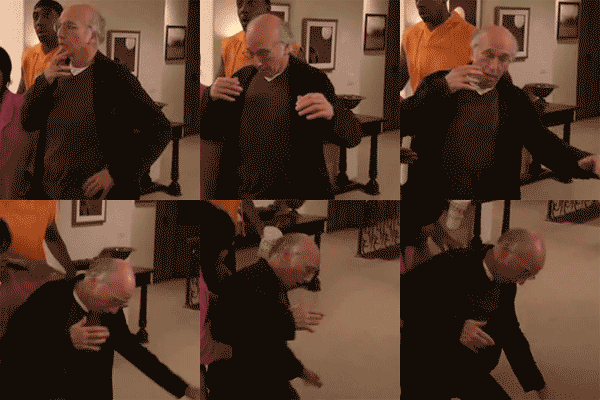
-
Rockies (Sugano) v Twins (Bradley), 6/26 @ 7:10pm CT
ashbury replied to Squirrel's topic in Archived Game Threads
"Cole Carrigg walks." -
Rockies (Sugano) v Twins (Bradley), 6/26 @ 7:10pm CT
ashbury replied to Squirrel's topic in Archived Game Threads
... Lizard Spock -
Rockies (Sugano) v Twins (Bradley), 6/26 @ 7:10pm CT
ashbury replied to Squirrel's topic in Archived Game Threads
"Dang it! I never get the chamber with the bullet!"