



ashbury
-
Posts
42,574 -
Joined
-
Last visited
-
Days Won
473
Content Type
Profiles
Minnesota Twins News, Rumors & Analysis
Minnesota Twins Videos
2026 Minnesota Twins Top Prospect Rankings
2022 Minnesota Twins Draft Picks & Signing Bonuses
Minnesota Twins Trade & Free Agent Rumors
Minnesota Twins Fan Guides & Resources
2023 Minnesota Twins Draft Picks & Signing Bonuses
The Minnesota Twins Players Project
2024 Minnesota Twins Draft Picks & Signing Bonuses
2025 Minnesota Twins Draft Picks & Signing Bonuses
2026 Minnesota Twins Draft Picks & Signing Bonuses
Forums
Blogs
Events
Store
Downloads
Gallery
Everything posted by ashbury
-
Norman, coordinate.
-
Seeing Into The Future (And Not Liking It Much)
ashbury replied to Steven Buhr's topic in Twins Daily Front Page News
Thought provoking analysis, SD. There are a lot of moving parts, so it's tough to forecast what the outcomes will be, but I would think this covers a lot of the possibilities. -
Q&A With Twins Outfield Prospect Adam Brett Walker
ashbury replied to Seth Stohs's topic in Twins Daily Front Page News
What is a number like that based upon? Joe had 22 GIDP in 666 plate appearances this past season. Trevor led the league with 28, in 632. Obviously that's not close to 25%, so we must be talking about fewer PA. Focusing for simplicity on the greater DP threat, Trevor, I see on his b-r.com splits page that he had 48 PA all season where it was one out and only a man on first. 13 GIDP came from that, which is a 27% rate. Inning over, a very bad outcome, for those times. A strikeout (he also did those sometimes ) is bad too, but not as bad. There were also (if I added in my head correctly) 78 other PA with any combination of a man on first (and/or other bases) with fewer than 2 outs, from which came the other 15 DP. That's under 20%. A strikeout is bad too, but not as bad. And then there are the other 506 times Trevor came to bat, when a DP was a very remote possibility if at all. (Indeed none of his DP that season came when no one was on first.) That's 0%. A strikeout is worse in all those situations, by not even putting the ball in play for a chance involving your BABIP, nor adding a baserunner via a walk. If choosing a pinch hitter, sure, one would factor these chances in with the particular situation. For the starting lineup, hopefully what we're mostly talking about here, one is kind of stuck with the situational luck of the draw through the course of the game. The DP rips your heart out that inning. Strikeouts are death by a thousand (OK, one or two hundred) cuts, representing missed opportunity. Over the long season, I don't see the DP as markedly more deadly. -
If I'm GM, I'm still in talent acquisition mode. I'm willing to cull the herd as needed, but I'm not looking to trade away young contributors. Later, when the youth has started to age and become expensive, decisions have to be made. We're not there yet, and definitely not with Gibson. The only way I trade Gibson is if my talent advisors have a consensus that he will never become consistent and the good starts will always be interspersed with bad ones. Then if some other GM over-values him, I package him to obtain something I feel is better. Two-for-one. Not another darn one-for-two; that's part of how we got into 40-man glut problems a year or two ago.
-
He was definitely portrayed as callow. And his Force skillz not being 'leet, inasmuch as a newb like Finn fought him to a near standstill, I was thinking that that fight was a great setup for Rey, just beginning to tap into the Force herself, to show what a force (heh) to be reckoned with she will become, by slicing him in half with one blow. Given that that didn't happen, I look forward instead to Ren growing into a more worthy adversary in the second installment, and to operate as an epic villain in the third. In other news, Daisy Ridley looks to be a brilliant casting choice.
-
Gibson Duffey Hughes Santana Milone This was approximately the rotation used in September when they were trying for a playoff slot. Nothing has changed since September.
-
Q&A With Twins Outfield Prospect Adam Brett Walker
ashbury replied to Seth Stohs's topic in Twins Daily Front Page News
His SO have been climbing so fast as the competition quality increased. High-A was 28% of PA, AA was 35%, AzFL was 40%. And you're right. If we take 35% as his current baseline and if he could take back out 20% of that, and apply a 30% BABIP because he's now putting those balls in play (and/or walking), that's about .020 of OBP. That is enough to make an important difference in a career. Or of course you can just go by rules of thumb and say that he shouldn't strike out at historic rates like that. -
Saw it last night. Missed the 4.4 earthquake in Reno around the halfway mark, probably when some storm trooper was being blown up and we couldn't feel it. The theater was about two-thirds filled, so they'll probably bring in another movie for next week. With all the loose ends in the story, though, I smell a sequel one of these days.
-
Let's Stop Discounting Tommy Milone
ashbury replied to Nick Nelson's topic in Twins Daily Front Page News
One doesn't have to go with memory. He was a starter for the big club only two years, 2008 and 2009. The "splits" feature on baseball-reference.com tells the ERAs for these two years. Your memory is correct for 2008, with him showing good results until inning 6 when the clock seemingly struck midnight and he became instantly a pumpkin. But in 2009, after which point the braintrust apparently pulled the plug, he was the opposite way: 1st inning - 11.34 2nd inning - 7.80 3rd inning - 5.40 4th inning - 2.40 5th inning - 5.40 6th inning - 4.35 2010 he had only 1 start but still was no overnight success, with a season ERA as a reliever of 5.29 in short duty in the majors. -
I'm sure you're right. Somewhere in the recesses of my memory I have tucked away that Ryan once said "I don't like the word rebuild", but when I tried googling that today, I found the exact wording from Brewers GM Doug Melvin instead. But whatever reasons (season ticket sales, etc) our FO might have for not embracing the word, I don't think I was the only one to believe that a full-on rebuild was underway the day they traded Denard Span for a high-ceiling prospect in the low minors. The ensuing trade of Revere wasn't confirmation, but continuation. You don't have to call something by its name, for it to be that thing.
-
Q&A With Twins Outfield Prospect Adam Brett Walker
ashbury replied to Seth Stohs's topic in Twins Daily Front Page News
Yes, this is why teams pay no attention to the K/9 rates for their pitchers. -
Kerby Camacho Suspended 60 Games For PEDs
ashbury replied to Seth Stohs's topic in Twins Minor League Talk
His .093 batting average in the GCL means the PED snark just writes itself. Too bad for him. Seems like players ought to be catching on that enforcement is a real thing. -
Not sure I've ever seen a more stinging rebuke of Terry Ryan. AA has a track record to look at and from it you're not convinced he's even good, but you would welcome supplanting our incumbent with him.
-
I noticed this is your first post here. Welcome! If you haven't already, please look at this thread http://twinsdaily.com/topic/8545-lurkers-and-rookies-please-post-here/ and consider posting something about yourself there.
-
FTFY.
-
Meanwhile the Yankees ran two guys out there game after game (60 and 74 respectively) with SO/9 above 14, not to mention while maintaining ERA/FIP a lot better than May showed in relief. May's good, no question, and I don't believe for a second that 2015 will turn out to have been his finest year. But the bar, the state of the art, is considerably higher than it once was.
-
Three-Bagger: Minor Lefties, Carew & Aggie Agony
ashbury replied to Nick Nelson's topic in Twins Daily Front Page News
I am not intrigued by any of these lefty "names in the mix." -
You only sorta miss Granny and Mom? Or just the cookies?
-
That's my view. Trading the guy who has the most trade value, among several candidates currently on hand, means losing talent you want for your own pennant run, unless you are convinced your own scouting and talent evaluation is greatly superior to the other team's. And even if your talent evaluation is that good, just pick the guy you think is worst and then take whatever is the best you can negotiate in return for him - maybe a dumber GM will value him more. Of course trading involves more than just talent, for instance clearing budget room and so forth. But "we could get the most if we trade this guy" is IMO coming at things backwards. It's how we traded away Matt Garza, who at the time I thought was the last of the group of pitchers we should be sending away, and that's not even second guessing the result of the trade for the actual talent gotten in return. Just trade away either Slowey or Blackburn - who would have brought back little in return, and justly so.
-
Q&A With Twins Catching Prospect Mitch Garver
ashbury replied to Seth Stohs's topic in Twins Daily Front Page News
I found this online without having to search very hard, so I don't see a problem if I post it. Congrats to the happy couple!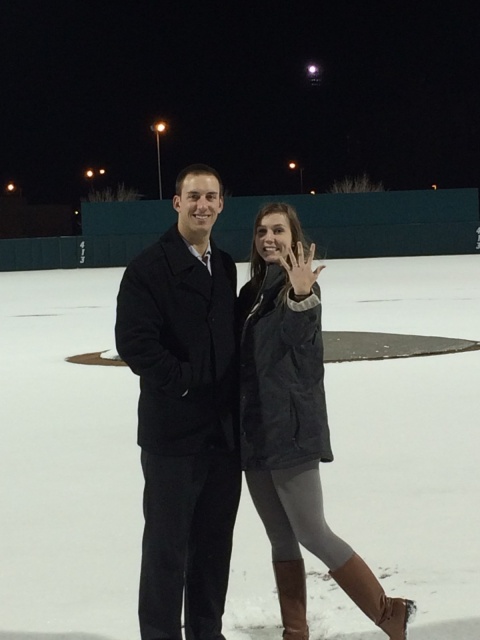
-
Sporting News Ranks Managers By Their Playing Career
ashbury replied to Seth Stohs's topic in Other Baseball
You saying you wouldn't watch the news if Gardy was doing the weather? Because I know I would. -
Sporting News Ranks Managers By Their Playing Career
ashbury replied to Seth Stohs's topic in Other Baseball
While his record declined after the first year, it's nevertheless true that by far the best record, indeed the only winning season, ever compiled by the "new" Washington Senators, in their short history before this sorry franchise moved to Texas, was compiled in 1969 under Teddy Ballgame, an improvement of an astounding 21 wins over his predecessor. "Failed" doesn't quite give fair credit or a balanced enough view. -
If nothing else, he's providing great material for some future biographer working on their Hall of Fame plaques.
-
You mean compared to big market teams? Do you think the prices are the same? You can't just look at top and bottom prices because they all try to offer a range for all fans, mainly for PR purposes, but the number of high priced seats are a lot greater in, say, Boston, or at least that's been my impression when trying to go to a game.
-
I don't think anybody is calling May "lucky" solely because they won. Despite ho-hum statistics for getting on base and hitting with power, they were scoring runs at about a league-high pace. To a lesser extent, despite so-so numbers on the other side of the ball, the team was preventing other runners from scoring. On top of that, with the actual runs for and against that they racked up, they were winning more frequently than their pythag computation would suggest. Going from memory on all this, but it was a perfect storm of timely hitting and stranding of runners and then winning close ones (remember how perfect Perk was?), and you can't take it away from them (it was FUN!), but for forecasting purposes it was easy to guess the winning would not continue unless the underlying numbers got better, and people were saying so. I don't remember looking too deeply at the bad streak July-August, but my recollection is they earned it the old fashioned way, by not hitting and not getting the other guys out. Season-long, they finished 12th in the league for slugging average and dead last for on-base percentage, a combination that should be deadly, yet they scored the 8th most runs. Similarly, the pitching staff was 9th best in on-base pct, 11th in slugging, and yet held up for 9th in preventing runs. Even with all this, they scored fewer runs than they gave up, which won't usually lead to a winning record, yet it did. The May numbers contributed greatly to this overall disparity. And that's why I'm worried about a 78 win season. The underlying hitting numbers could improve and likewise for pitching/defense and yet not show up in the standings, and there's room even for the wins to decline a little. Unsustainable would have been a better word than lucky.

