


Twins Video
Sonny Gray put together one of the best seasons of his career by routinely disentangling himself from the exact type of jam that he found himself in right out of the gates on Tuesday.
Unlike his co-rotation leader Pablo Lopez, Gray is not a pitcher who thrived this year because of missing bats and piling up strikeouts. His 9.0 K/9 rate was fine, don't get me wrong, but 24 qualified MLB starters had a better mark.
Significantly fewer had a better ERA (third in MLB) or fWAR (fourth). At the end of the day, Gray got the job done to an elite degree all season long, even while showing a relative propensity for drawing contact. How'd he do it? A combination of skill and luck.
Gray certainly did a few things to help his cause. He was pretty good at inducing weak contact, with a 67th percentile barrel rate and middling exit velocity. He was very good at inducing ground balls (77th percentile). He generally avoided issuing walks, with a 2.7 BB/9 rate that was his lowest since 2015.

Still, Gray's 1.15 WHIP on the season was nothing too special. He allowed a fair number of base runners, which is why the start to Tuesday's first inning didn't feel all that abnormal or worrisome at the time.
The right-hander's remarkable success in the regular season owed primarily to what he was able to do once runners got on base against him. With nobody on, hitters slashed .237/.280/.358 against Gray – bad but not truly horrible. With men on base that line dropped to .211/.299/.262, and with runners in scoring position, to .194/.313/.206. Gray's strand rate (percentage of runners left on base) was 12th-highest in the league.
Within this, the true biggest key to Sonny Gray's stellar season in 2023 was his historic ability to limit home runs. He surrendered only eight long balls in 32 starts, leading all of baseball with a 0.4 HR/9 rate that ranks as the lowest in Twins franchise history. Gray kept the ball in the yard at an otherworldly level. And in line with the above, only two of those eight homers came with runners on base.
To some extent, both of these strengths – limiting damage with runners on, and avoiding home runs – owe to a specific skill for executing in key spots. Gray did that, all year long. By no means can anyone argue that his phenomenal results were mostly the result of luck.
But ... there was some luck involved. And that's reflected in expected numbers like xERA (3.69) and xFIP (3.65). In many ways, a lapse toward normalization felt mathematically inevitable for Gray.
Who could've known it would happen at the worst time possible, against a very unlikely foe.
Things got off to a troubling start for Gray on Tuesday, right as the action got underway in Game 3. First Jose Altuve stroked a solid single to center, putting the leadoff man aboard. But the Twins starter bounced back with a strikeout of Alex Bregman. Up came the dreaded Yordan Alvarez.
Here, Gray did his thing: in an extraordinarily tough match-up, he made a good pitch and induced a weak grounder down the first base line. But a charging Alex Kirilloff whiffed the ball and allowed it to role into right field for a two-base error. What could've been an inning-ending double play instead led to two runners in scoring position with one out.
A horrible break for Gray and the Twins, but still, the type of tricky situation he's almost always been able to overcome, all year long.
Not this time.
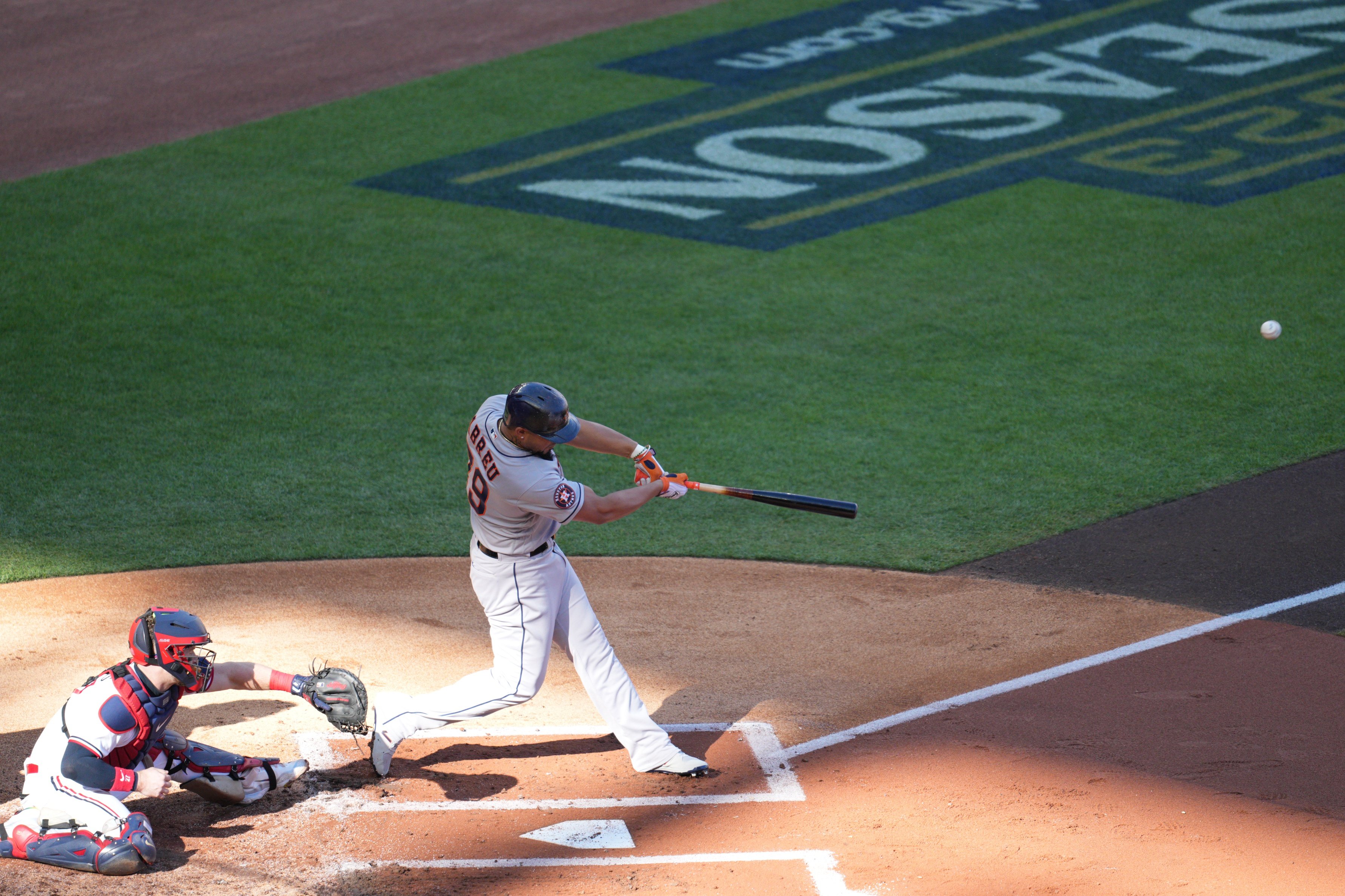
Kyle Tucker laced an RBI single past a drawn-in infield. This brought up Jose Abreu, who would deliver an early death blow as an unlikely hero for Houston.
Newly signed to a $60 million contract by the Astros, Abreu had a horrible first year with his new team. The revered slugger didn't hit a home run until late May and finished with his worst career numbers across the board, with underlying metrics suggesting he might be cooked.
Abreu did come on a bit at the tail end of the season, closing out with a power surge in the final weeks. And maybe that helped set the stage for a series-defining at-bat in Game 3.
Gray missed up and in with a sinker. He came with another one on the next pitch, this time finding the lower part of the zone for a strike. The next pitch, up and in again.
Hoping to have changed Abreu's eye level with the high heat, Gray looked to go do down and away with a sweeper. But this sweeper didn't sweep. It hung right in the middle of the zone and got blasted to Canada. For one of the first times all year, the 33-year-old Gray simply failed to execute in an absolutely critical spot.
The location of this pitch was just astonishingly bad. Gray did the one thing he could absolutely least afford to do in that particular moment, and it split the game right open. The righty has seen the team lose games on his bump days with an odd frequency all year, but rarely could be he named a prime culprit. This time, in perhaps his final start as a Minnesota Twin, he most definitely could.

Gray pushed through to the midpoint of the game but never looked very good, allowing leadoff runners in each of the next four innings, including the fifth where he went HR-2B-BB and was removed with no outs. The veteran was seemingly unable to take advantage of the same shadows that flummoxed Twins hitters all afternoon.
It's not the Sonny Gray we've grown accustomed to seeing, but it's probably the one we should've expected to reveal himself at some point along the way. Even the craftiest and most expert pitcher is bound to experience the cold realities of regression to the mean in baseball.
For Gray and the Twins, this regression felt especially mean, and leaves them on the brink of elimination.







Recommended Comments
Create an account or sign in to comment
You need to be a member in order to leave a comment
Create an account
Sign up for a new account in our community. It's easy!
Register a new accountSign in
Already have an account? Sign in here.
Sign In Now